
In this episode of SpaceTime, we delve into groundbreaking research that sheds light on Earth's ancient history, the formation of hot Jupiters, and the enigmatic climate of Mars.
Earth's Oldest Rocks Confirmed in Northern Canada
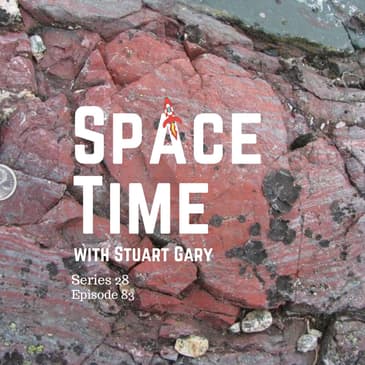
A recent study published in the journal Science confirms that the oldest rocks on Earth are located in northern Quebec, Canada, dating back 4.16 billion years. Lead author Jonathan Nally. from the University of Ottawa explains how this discovery provides a unique window into the Hadean Eon, offering insights into the early Earth's environment and the formation of its first continents. While the Jack Hills Range in Australia holds the oldest material of terrestrial origin, these Canadian rocks are pivotal in understanding Earth's formative years.
New Insights into Hot Jupiter Formation
We explore the intriguing case of CI Tau B, a hot Jupiter that orbits a young star just 450 light-years away. Researchers from Rice University and Lowell Observatory have utilized advanced spectroscopic techniques to analyze the planet's mass and brightness, revealing that it formed through a hot start mechanism rather than traditional models. This study provides a critical benchmark for understanding how giant planets can form rapidly in close proximity to their stars, challenging long-held assumptions in planetary science.
Was Mars Always Doomed to be a Desert?
A new hypothesis from the University of Chicago suggests that Mars was never meant to remain a warm, habitable planet. The study indicates that the planet's past liquid water periods were likely short-lived, driven by the Sun's gradual brightening. Unlike Earth, which has maintained its habitability, Mars appears to self-regulate towards desert conditions, raising questions about the mechanisms that have led to its current frozen state. The findings, published in Nature, build on previous discoveries by NASA's Curiosity rover and could reshape our understanding of Martian climate history.
www.spacetimewithstuartgary.com
✍️ Episode References
Science Journal
https://www.sciencemag.org/
Astrophysical Journal Letters
https://iopscience.iop.org/journal/1538-4357
Nature Journal
https://www.nature.com/nature
Become a supporter of this podcast: https://www.spreaker.com/podcast/spacetime-space-astronomy--2458531/support.
[00:00:00] This is SpaceTime, Series 28, Episode 83, for broadcast on the 11th of July 2025. Coming up on SpaceTime, a new study confirms that the Earth's oldest rocks are in Northern Canada, new clues to the creation of hot Jupiters, and a new study looks at whether Mars was always doomed to be a freeze-dried desert. All that and more coming up on SpaceTime. Welcome to SpaceTime with Stuart Gary.
[00:00:45] A new study has confirmed that planet Earth's oldest rocks are in Canada. A report in the journal Science has identified the Hadean Eon rocks found in Quebec, north of the 55th parallel, to be some 4.16 billion years old. The study's lead author, Jonathan O'Neill from the University of Ottawa, says for more than 15 years the scientific community has been debating the age of the volcanic rocks from northern Quebec.
[00:01:11] He says previous research suggested that they could date back some 4.3 billion years, but this lacked consensus. A new research shows that the intrusive rocks crossing these volcanic formations are 4.16 billion years old, which confirms the volcanic rocks themselves must be older, and thus that this region of the Canadian North is indeed home to the oldest known rocks on planet Earth.
[00:01:35] He says the confirmation positions this area as the only place on Earth where scientists find rocks that formed during the Hadean Eon, that is the first 500 million years of the planet's history. Now, to establish the age of these rocks, the authors combined petrology and geochemistry, and they applied two radiometric dating methods using different isotopes of the elements samarium and neodymium as two separate chronometers which indicated the same age, 4.16 billion years.
[00:02:02] The discovery opens up a unique window into the early Earth's history. Anil says that understanding these rocks goes back to the very origins of the planet. It allows science to better understand how the first continents were formed, and to reconstruct the environment from which life could have emerged. Now, for our Australian listeners, it's worth pointing out that the Jack Hills Range in outback Western Australia still holds the record as the source for the oldest material of terrestrial origin ever found on Earth.
[00:02:31] The Hadean Eon zircons found there have been dated to 4.404 billion years. The zircons in various aspects of their geochemistry also provide evidence for the existence of continental-style crust on the surface of the Earth during the Hadean Eon. Even more intriguing, potentially biogenic carbon isotope ratios have been identified for graphite embedded within 4.1 billion year old zircon crystals from the same site.
[00:02:58] Now, as well as that, oxygen isotopic ratios in the zircons are providing clear evidence for the presence of liquid water on the surface, if not a complete water ocean, contrasting earlier ideas on Earth's history. And that means before the late heavy bombardment 3.9 billion years ago. This is space-time. Still to come, new clues about the creation of hot Jupiters, and a new study looks at whether Mars was always doomed to become a freeze-dried desert.
[00:03:26] All that and more still to come, on Space Time. Ci Tau b is a paradoxical planet. But new research about its mass, brightness, and the carbon monoxide in its atmosphere
[00:03:53] is starting to answer questions about how a planet so large could have formed around a star that's only 2 million years old. A recent report in the Astrophysical Journal Letters detailed the four-year study by astronomers Christopher Johns Krull from Rice University and Lisa Pratt from the Lowell Observatory looking at the near-infrared spectroscopic data of light from Ci Tau b, a close-orbiting giant exoplanet or hot Jupiter in a nine-Earth day orbit around its parent star, located some 450 light-years away in the constellation Taurus.
[00:04:23] The authors studied light directly coming from the planet, the first time that's been done for a close-in planet orbiting such a young star. Johns Krull says the most valuable way to learn how planets form is to study planets like Ci Tau b that are either still forming or have just formed. For decades, most astronomers believe that giant planets like Jupiter and Saturn formed far from their host stars over periods of say tens of millions of years or more.
[00:04:50] But the discovery of dozens of hot Jupiters has led to new theoretical models that describe how such planets might form. Johns Krull says Ci Tau b's age made it the perfect candidate for observation with the immersion-grading infrared spectrograph IGRANS, a unique high-resolution instrument that was used for the observation of Ci Tau b from both the Macdonald Observatory's 2.7-metre and the Lowell Observatory's 4.3-metre telescopes. IGRANS uses silicon-based diffraction grating,
[00:05:18] which improves both the resolution and the number of near-infrared spectral bands that can be observed from distant objects like Ci Tau b and its parent star. Because each atomic element and molecule in the star emits light from a unique set of wavelengths, astronomers look for specific signatures, or spectral lines, to see if an element's present in a distant star or planet. Spectral lines can also reveal details about the temperature and density of a star and how fast it's moving.
[00:05:45] Prato says the research used the spectral lines from carbon monoxide to distinguish the light emitted by the planet from the light emitted by the nearby star. Now, many of the spectral lines that are in the planet are also in the star. And if both the planet and the star were stationary, the spectral lines would all blend together. You simply wouldn't be able to tell which came from the star and which was from the planet. But because the planet's orbiting rapidly around the host star, its spectral lines are Doppler shifted back and forth.
[00:06:13] And that allows scientists to subtract out the star's lines, seeing only the spectra coming from the planet. And from those, the astronomers could determine how bright the planet is relative to the star, which tells them something about how it formed. That's because the brightness of a star or planet depends both on its size and its temperature. Direct observational evidence of the mass and brightness of C-I Tau B is especially useful because the authors also know that it's orbiting a very young star. See, most hot Jupiters are orbiting middle age stars.
[00:06:43] But C-I Talus age gives a tight constraint for putting models to test. Can they produce a planet this bright and this massive in so little time? The analysis of the spectral lines from the carbon monoxide show that C-I Tau B has roughly 11.6 Jupiter masses, and it's about 134 times fainter than its parent star. And Prato says that provides strong evidence that it formed through a hot start mechanism, a theoretical model that describes how gravitational instabilities
[00:07:10] could form giant planets more rapidly than traditional accretion models. The new study provides a unique imperial yardstick by which to measure competing hypotheses. Prato says astronomers now have a mass and brightness for C-I Tau B, the only directly measured mass and brightness for any young hot Jupiter. And that provides some very strong tests for planet formation models. My name is Lisa Prato. I'm an astronomer at Lowell Observatory,
[00:07:37] and I work on very young binary stars and planet formation in very young stellar systems. There's no way you could possibly make up the things that we see with telescopes. They're incredible. It's better than any kind of fiction.
[00:08:06] Our sun is sort of unusual in that it's all by itself. Most stars, if you go out at night, clear night, you look at the sky, you see all those little points of light. About half of those points you see are actually systems of more than one star. Two, three, four, five stars all gravitationally bound. Dr. Lisa Prato's research is aimed at solving a big question. How do planets form?
[00:08:35] The answer lies somewhere inside a star system. Dr. Prato doesn't look for any old stars. She looks for only the youngest ones. These are things that, compared to a human, would be minutes old. And for stars, they're a million years old or two million years old. So there are these newborn stars. These young, wild, misbehaving stars are very unstable, very variable.
[00:09:03] So it's excruciatingly difficult to look for planets in these systems. But very young stars are the only chance for Dr. Prato to catch a glimpse of a disk of dust and gas, that's left over from the star's birth. Inside this disk is where planets form. The search for young stars with planets becomes especially interesting with binaries. You have two stars, and both of them are born together.
[00:09:32] They're exposed to the same conditions, the same environment. And the two stars have the same temperature and the same mass. Why, in some cases, does only one star still have a disk and the other star doesn't? Does that mean the other star has already formed planets? Or does that mean the other star didn't form with a disk? Or there's these great questions. And when you have two or more stars together, you actually have sort of a built-in control. Who knows what answers Dr. Prato might find now that Eigerens,
[00:10:01] the most powerful infrared spectrograph in the world, has come to DCT through collaboration with the University of Texas and Kasi in Korea. Dr. Prato realizes that all future breakthroughs rely on collaboration, most importantly by passing the scientific method on to the next generation of astronomers. I think the most important thing that I do is actually mentoring students and interns and post-docs.
[00:10:29] That's really key to passing along knowledge and ideas, not just the science itself, but also how to do the sciences, the ethics and the things that should drive the work in astronomy, which are curiosity and determination and dedication and honesty. That's Lisa Prato from the Lowell Observatory. And this is Space Time.
[00:10:57] Still to come, a new study looks at whether the red planet Mars was always doomed to be a freeze-dried desert, and later in the science report, discovery of a new molecule that can store 100 times more digital data than current technologies on something no bigger than a postage stamp. All that and more still to come on Space Time. This episode of Space Time is brought to you by NordVPN, Space Time's official VPN service.
[00:11:26] Let's face it, these days your online privacy is more important than ever. Whether you're streaming science documentaries, reading the latest research, or exploring deep space images, you don't want your data to be tracked or your location exposed. With NordVPN, one click is all it takes to secure your internet connection. It encrypts your data, hides your IP address and keeps your activity safe from prying eyes. Whether you're at home, work or connected to a public Wi-Fi. And here's where it gets really good.
[00:11:56] As a Space Time listener, we have an exclusive offer for you. 74% off a NordVPN plan plus 4 extra months for free. That's right, a huge 74% discount plus 4 bonus months just for being a Space Time listener. All you need to do is head over to NordVPN.com slash Stuart Gary. That's NordVPN.com slash Stuart Gary. Not only does NordVPN protect your data, but it gives you access to content from right around the world.
[00:12:23] If you want to watch a science series that's only available in another country, no problem. Just switch your virtual location and unlock it instantly. And of course, the whole thing is risk-free with a 30-day money-back guarantee. So you've got nothing to lose and your online freedom to gain. So, protect your digital life, support Space Time and grab our exclusive offer now at NordVPN.com slash Stuart Gary. That's NordVPN.com slash Stuart Gary.
[00:12:51] And now, it's back to our show. A new study may help explain if the red planet Mars was always destined to become a harsh freeze-dried desert. One of the great unsolved mysteries of modern planetary science is written on the surface of Mars. See, the red planet has canyons carved by rivers.
[00:13:17] And so it was once warm enough with a thick enough atmosphere for liquid water to exist on its surface. So, how and why did it become the barren desert we see today? A study, led by the University of Chicago planetary scientist Edwin Kite, puts forth a new hypothesis as to why Mars never seems to stay barmy for long. The findings, reported in the journal Nature, suggest that the periods of liquid water seen in the past on the red planet were initiated by the sun's brightening.
[00:13:45] And that conditions on Mars means trends towards deserts over time, in contrast to the Earth which has stayed habitable over time. The study builds on findings in April by NASA's Mars Curiosity rover, which found rocks rich in carbonate materials that could provide a new explanation for where the Martian atmosphere went. Kite says that for years, science has had this huge unanswered question of why the Earth has managed to keep its habitability while Mars lost it.
[00:14:12] Models suggest that periods of habitability on Mars have been the exception rather than the rule, and that the red planet generally self-regulates as a desert world. The problem is, Mars is almost the same make-up as the Earth. It's a rocky planet with plenty of carbon and water, near enough to the sun to be warmed but not cooked by it, and yet today, Mars is a frozen desert while the Earth teems with life. For decades, scientists have been searching for an answer.
[00:14:39] The mystery deepened when scientists were able to see river-carved valleys and old lake beds on the surface of Mars, showing the planet at some point did have a climate that was warm enough for liquid water to exist. Kite says, Mars preserves a trace of that environmental catastrophe in the rocks on its surface. When it comes to keeping a planet balmy and mild, it isn't enough to just start out that way. There needs to be a mechanism for stability over time, a mechanism that can respond to changes on and around the planet.
[00:15:09] Scientists think the Earth does this through a finely balanced system that moves carbon from the sky into rock and then back into the sky again. Carbon dioxide in the atmosphere warms the planet. But warmer temperatures also speed up reactions that lock up carbon dioxide into rock, which eventually counteracts the temperature rise. Eventually, the carbon leaks back out into the atmosphere, usually through volcanic eruptions. Over millions of years, this cycle appears to have kept the Earth relatively stable and hospitable for life.
[00:15:39] A similar cycle could also be taking place on Mars, but a self-limiting one. It hinges on the fact that the Sun's brightness rises very slowly over time, by about 8% per billion years. As the Sun's brightening, scientists hypothesize that liquid water begins flowing on Mars. But then this water starts causing carbon dioxide to get locked into rocks, as it does on Earth, which swings the planet back into a cold, barren desert.
[00:16:06] Kite says that in contrast to the Earth where there are always some volcanoes erupting, Mars right now appears to be volcanically dormant. And so the average rate of volcanic outgassing on Mars must be very slow. So in that situation, you simply don't have a balance between the carbon dioxide in and the carbon dioxide out. Because if you had just a little bit of liquid water, you're going to be drawing down the carbon dioxide through carbonate formation. Kite and colleagues developed models showing how these swings and roundabouts could be happening.
[00:16:35] They suggest that Mars experiences short periods of liquid water, followed by 100 million year-long periods of dry desert. The explanation was made possible by Curiosity's discovery earlier this year of carbonate-rich rocks on the Martian surface. See, this had been the missing piece in the puzzle. To have had liquid water, Mars must have had a thicker atmosphere in the past, one made up of greenhouse gases like carbon dioxide. But today, there's very little atmosphere on Mars, just 1.99 that we see on Earth.
[00:17:05] That leaves a puzzle as to where the carbon went. Now the simplest explanation would be that it was drawn down into rocks as it is on Earth. But the first rover tests hadn't turned up any evidence of carbonate-rich rocks. It took Curiosity's journey up the lower reaches of Mount Sharp to finally identify these carbonate rocks. And as the six-wheeled car-sized rover continues its journey up the slopes of Mount Sharp, further tests will show whether the carbonate is as widespread as the authors suspect.
[00:17:34] This is Space Time. And time now to take another brief look at some of the other stories making news in science this week with a science report. Chemists at the University of Manchester and the Australian National University have engineered a new type of molecule,
[00:18:05] which they say could eventually lead to devices storing 100 times more data than current technologies. A report in the journal Nature claims the invention could have major implications for the future of data storage devices. The findings could pave the way for next-generation hardware no larger than the size of a postage stamp, but able to store 100 times more digital data than current technologies and at temperatures as cold as minus 130 degrees Celsius.
[00:18:32] A new study by researchers from the University of New South Wales has revealed the alarming impact heat waves are having on pet dogs. The findings, reported in the Australian Veterinary Journal, examined 20 years of veterinary records. The authors found that public holidays and Sundays carry the greatest risk for dogs, especially during heat wave conditions. See, it appears that's when owners are most likely to take their dogs for walkies. And that's not a good thing considering the heat.
[00:19:01] Cava is a beverage made from the roots of a plant common throughout the South Pacific, and it plays an important role in the culture and economy of many Pacific Island nations. But a warning in the journal Drug and Alcohol Review points out that there's still a lot we don't know about this depressive drug. The authors reviewed existing research into cava to find out what's known about the potential health risks and benefits, as well as the role the drug plays in culture and trade. They say studies on the safety profile of cava are limited,
[00:19:30] and while there's evidence that it may be helpful in reducing anxiety symptoms in the short term, there are potential risks of both liver and brain damage with long-term use. In fact, concerns over liver toxicity have prompted bans on cava in many Western countries, including some Australian states and territories. But as to why anyone would want to drink a beverage that, quite frankly, tastes like mud, remains a mystery. To quote the immortal words of Dr Sheldon Cooper,
[00:19:58] there's absolutely no scientific evidence to support clairvoyance of any kind. Which means that fortune-telling is a fraud, the professions are swindle, and its livelihood is dependent on the gullibility of stupid people. Yet the psychic reading market is experiencing significant growth, especially online fortune-tellers. And Tim Mendham from Australian Skeptics points out that the influx of artificial intelligence chatbots into the field will see this growth accelerate dramatically.
[00:20:25] There's a curious report that came out recently, and you have to preface it by saying the report comes out by a business analysis group, and therefore looking at market opportunities. So you've got market opportunities for psychic, let alone if psychic can actually do it. In fact, this report doesn't sort of go into that area. It just says how much money can you make? The suggestion is that 2024 US psychic's market value was about $340 million US, and that by the time you get to the end of the decade, or thereabouts, it's going to be half a billion. I have heard other figures elsewhere that suggest that the whole psychic industry in the world
[00:20:55] is about worth $2 billion annually. But they're predicting that by 2028, 30% of psychic consultations will involve artificial intelligence-driven tools. And you could say, whoops, that raises a few issues. One, artificial intelligence can gather information quickly and perhaps write a psychic character study of someone rather than saying, I see this sort of thing. But you can even throw in predictions of the future very, very quickly. You can get someone's date of birth using astrological sort of function,
[00:21:23] gender, location, aims and ambitions, whatever, to then very, very quickly develop a reading for someone. So in other words, the psychic needn't do anything. And what's happening is that apparently, according to the study, younger people especially are heading towards online psychic readings as opposed to face-to-face or audio things, et cetera, where someone's talking to you. You just type in your request and you get a feedback back. And that feedback could be coming from an AI. An AI psychic. Well, AI psychic, which probably wouldn't be any worse, quite frankly, than an actual psychic.
[00:21:53] And they just as easily can turn out the same sort of information for everybody. Well, it's almost guaranteed reading, isn't it? It is very much. If you have to give info to start with, you can't just say, hi, what's your reading for me? They've got to ask you questions. And as soon as they start asking you questions, and AI especially can start gathering information based on date of birth, occupation, gender, whatever. You get all those things together and you can start turning things out, which seem very real. And as you know, with the Barnum effect, if you say things to people, they'll tend to believe it.
[00:22:20] Classic stories of giving the same horoscope readings to a whole bunch of students and say, this one is specially written for you. How close is it? They all say, well, it's really close. And then you point out everybody got the same one. If it's AI, you can easily do that. You can expect to do that in about five seconds and there's your money. But if a lot of people are heading towards using AI, it's going to be sort of quite dramatic. They're using some of the means to read the customer. And even AI, if you feed a lot of information into AI, it'll very quickly feedback. One, a lot of information about you.
[00:22:49] And two, can be programmed to feedback what the customer wants, the sort of information the customer wants. That's Tim Mendham from Australian Skeptics. And that's the show for now. Space Time is available every Monday, Wednesday and Friday through
[00:23:18] Apple Podcasts, iTunes, Stitcher, Google Podcasts, Pocket Casts, Spotify, Acast, Amazon Music, Bytes.com, SoundCloud, YouTube, your favorite podcast download provider and from Space Time with Stuart Gary.com. Space Time is also broadcast through the National Science Foundation on Science Zone Radio and on both iHeart Radio and TuneIn Radio. And you can help to support our show by visiting the Space Time store for a range of promotional
[00:23:47] merchandising goodies. Or by becoming a Space Time patron, which gives you access to triple episode commercial-free versions of the show, as well as lots of bonus audio content which doesn't go to air, access to our exclusive Facebook group and other rewards. Just go to spacetimewithstuartgary.com for full details. You've been listening to Space Time with Stuart Gary. This has been another quality podcast production from Bytes.com.