
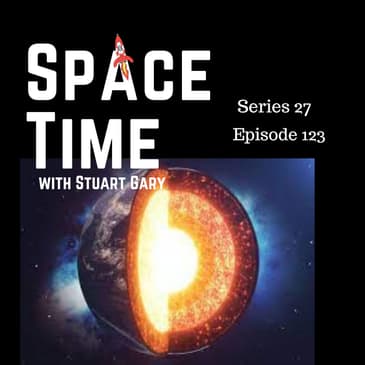
*Discovery of a New Region within the Earth's Core
Scientists have uncovered a doughnut-shaped region within Earth's molten liquid outer core, located at low latitudes parallel to the equator. This torus-like zone was detected due to seismic waves travelling slower through this area compared to the rest of the liquid outer core. The discovery, published in Science Advances, suggests that this region could be several hundred kilometres thick and contains a high concentration of light chemical elements, which may be affecting the seismic wave speeds. The findings provide new insights into the Earth's magnetic field and its potential future changes.
*Fresh Questions about the True Origins of the Earth's Moon
A new hypothesis challenges the widely accepted giant impact theory of the Moon's formation. The study proposes that the Moon was captured during a close encounter between the young Earth and a separate terrestrial binary planetary system. This theory could explain the Moon's current orbital plane, more aligned with the sun's ecliptic than Earth's equator. The study opens the door to further exploration of the Moon's origins, especially considering its chemical similarities to Earth.
*New Study Reveals More Secrets about Pluto's Binary Partner, Charon
NASA's Webb Space Telescope has revealed that Charon, Pluto's binary partner, has significant reserves of carbon dioxide and hydrogen peroxide on its surface. The carbon dioxide ice forms a thin veneer over a water ice-rich subsurface. The study, published in Nature Communications, suggests that the carbon dioxide was likely stored beneath the surface until exposed by impacts, while hydrogen peroxide results from radiation breaking apart water ice. These findings add to the understanding of Charon's chemical composition and its geological history.
00:00:00 - This is spacetime series 27, episode 123 for broadcast on 11 October 2024
00:00:46 - Scientists have detected a new doughnut shaped region within the Earth's molten liquid core
00:12:31 - A new study has come up with a different hypothesis to explain the origin of the moon
00:17:46 - NASA's Webb Space Telescope reveals vast reserves of carbon dioxide on Pluto's surface
00:21:19 - People with type two diabetes who sleep short may develop microvascular disease
00:24:23 - Movie producers claim they've accidentally captured footage of a lake monster
00:27:23 - Spacetime is available every Monday, Wednesday and Friday through various podcasting platforms
www.spacetimewithstuartgary.com
www.bitesz.com
🌏 Get Our Exclusive NordVPN deal here ➼ www.bitesz.com/nordvpn. The discount and bonuses are incredible! And it’s risk-free with Nord’s 30-day money-back guarantee! ✌
Check out our newest sponsor - Old Glory - Iconic Music and Sports Merch. Well worth a look....
Become a supporter of this podcast and access commercial-free episodes plus bonuses: https://www.spreaker.com/podcast/spacetime-with-stuart-gary--2458531/support.
[00:00:00] This is SpaceTime Series 27, Episode 123, for broadcast on the 11th of October 2024.
[00:00:07] Coming up on SpaceTime, discovery of a new region within the Earth's core, fresh questions
[00:00:13] about the true origins of the Earth's moon, and a new study has revealed more secrets
[00:00:19] about Pluto's binary partner, Sharon.
[00:00:22] All that and more coming up on SpaceTime.
[00:00:27] Welcome to SpaceTime with Stuart Gary.
[00:00:46] Scientists have detected a new donut-shaped region within the Earth's molten liquid outer core.
[00:00:52] The strange, torus-like zone was found at low latitudes, parallel to the equator, right on
[00:00:58] the core mantle boundary.
[00:00:59] The Earth has two core layers, the inner core, a solid layer, and the outer core, a liquid
[00:01:05] layer.
[00:01:06] The outer core is predominantly made of liquid iron and nickel, and the vigorous movement
[00:01:11] of the electrically conductive liquid creates Earth's magnetic field.
[00:01:15] That's important because it shields the planet and helps sustain all life, protecting it from
[00:01:20] damaging solar winds and harmful radiation.
[00:01:24] Surrounding the Earth's core is the planet's mantle.
[00:01:27] It makes up some 80% of the total mass of the Earth, and sitting on the top of that is a
[00:01:32] very thin layer called the crust.
[00:01:34] That's where we live.
[00:01:35] A report in the journal Science Advances suggests that this donut region could be several hundred
[00:01:40] kilometres thick.
[00:01:42] One of the study's authors, Huda-Vir Kulzic from the Australian National University, says
[00:01:46] the region was discovered because seismic waves are travelling slower through this area than
[00:01:51] the rest of the liquid outer core.
[00:01:53] The discovery was achieved because rather than using traditional seismic wave observation
[00:01:58] techniques and thereby observing signals generated by earthquakes within the first hour of
[00:02:03] an event, the study's authors instead analysed the similarities between waveforms many hours
[00:02:08] after the earthquake's origin times, leading them to make this unique discovery.
[00:02:13] By understanding the geometry of the paths of these waves and how they traverse the outer
[00:02:17] core's volume, they were able to reconstruct their travel times through the Earth, demonstrating
[00:02:22] that the newly discovered region has low seismic speeds.
[00:02:25] This low velocity within the liquid core implies that there's a high concentration of light
[00:02:31] chemical elements in this region.
[00:02:33] It's that which could be causing the seismic waves to slow down.
[00:02:36] And these light elements, along with temperature differences, are also helping to stir liquid
[00:02:41] within the outer core.
[00:02:42] There are still mysteries about the Earth's outer core that are yet to be solved, and these
[00:02:47] will require multidisciplinary efforts from seismology, mineral physics, geomagnetism and geodynamics.
[00:02:53] Teltic says knowing more about the OZADA core's composition, including the light chemical elements there,
[00:03:00] will be fundamental to understanding the planet's magnetic field and predicting when it could
[00:03:05] weaken or cease completely.
[00:03:07] In this work we developed a new method, or at least we used a recently established method
[00:03:14] in seismology that looks in the late part of the seismic waveforms rather than the early
[00:03:20] parts that are probably well known to your listeners as compressional waves and shear waves.
[00:03:26] So here we are looking at the late part of the waveforms, and what's special about them is that
[00:03:32] they see the Earth in an unprecedented way because they are highly reverberating waves from
[00:03:39] the internal structures and the discontinuities.
[00:03:42] So by using that we were able to peek into some of the secrets of the Earth that we were not
[00:03:48] able to understand before.
[00:03:50] And secondly, we then focused on the Earth's outer core, so the liquid core, and we were able
[00:03:57] to constrain a low latitude or equatorial, if you want, ring, or mathematically speaking,
[00:04:06] torus in the liquid outer core with low seismic velocities, lower than the surrounding outer
[00:04:14] core.
[00:04:15] The outer core is a liquid, right?
[00:04:17] So it's a hot ball of iron and nickel exposed to extremely high temperatures and pressures.
[00:04:24] So it's liquid, and if you think about the way the liquid outer core convects or flows,
[00:04:31] it's much faster than the mantle of the Earth.
[00:04:34] So it is liquid, and the reason why we were able to look into it is that the compressional
[00:04:41] waves spread through liquids, unlike shear waves.
[00:04:45] Are we thinking this is made out of the same substance, the same molten iron, nickel material
[00:04:50] as the outer core, or is this sort of a mixture between the outer core and lots of olivine and
[00:04:56] that from the mantle?
[00:04:57] We are seismologists, right?
[00:04:58] So we use a geophysical inference based on our observations that we have on the Earth's
[00:05:04] surface.
[00:05:05] So we read a lot of waveforms, and based on that, we make some inferences about the deep
[00:05:10] interior of the Earth.
[00:05:11] And what we can conclude based on our study is that the top of the liquid outer core is
[00:05:18] slower than the surrounding core, but not everywhere.
[00:05:22] It's only in the equatorial part of the liquid core.
[00:05:26] And then we can make some interpretations why the seismic waves are slowed down in that
[00:05:32] particular ring or torus in the liquid core.
[00:05:35] And our interpretation is based on some previous studies on the topic from geodynamics and geodynamical
[00:05:43] simulations, is that the origin of this low velocity ring must be thermochemical, meaning that
[00:05:50] it cannot be just due to the different patterns of liquid flow or convection in the outer core,
[00:05:58] and that it has to be due to a likely presence of a light chemical element in the liquid core
[00:06:05] that are, for some reason, concentrated in the equatorial torus.
[00:06:10] So those light elements, together with the different modes of convection, could produce a drop in the
[00:06:17] seismic velocity, yet not exactly what we observed.
[00:06:21] 2% is a quite large drop in seismic velocities.
[00:06:25] And it would require several order of magnitude difference in the density of the liquid core.
[00:06:32] So I would say this interpretation is still quite open to many scientists who study the dynamics of
[00:06:39] the Earth's interior to look into it and to demonstrate how it is possible to get such a dramatic drop in
[00:06:48] seismic velocities in the liquid core.
[00:06:51] Is it due to the presence of light elements or perhaps due to a stratification that occurs at the ceiling of
[00:06:59] the liquid core or a chemical reaction between the chemical elements of the liquid core with the metallic core with the silicate menthol?
[00:07:09] We don't know that yet, to be honest.
[00:07:12] So as the Earth spins, it acts like a giant centrifuge.
[00:07:15] So different elements are separating, I guess.
[00:07:18] And we know that the composition is different.
[00:07:20] Is that because of the centrifugal effect or is that simply because the core is slowly solidifying and this part hasn't solidified yet?
[00:07:28] Well, the answer is probably a combination of all these effects.
[00:07:32] I should clarify that as the inner core solidifies, so as the Earth cools down, the temperature drops to a certain point of pressure.
[00:07:42] The inner core starts solidifying from the center outwards.
[00:07:47] And in the process of the solidification, we have, first of all, some latent heat that is released.
[00:07:54] And secondly, light chemical elements are released also in the liquid outer core.
[00:08:00] And there are some studies suggesting that it is possible to get both cylindrical flow that would be parallel to the rotation axis of the Earth.
[00:08:09] And that's how we think the flow in the outer core organizes itself,
[00:08:13] in these huge vertical vortices that are parallel to the rotation axis of the Earth.
[00:08:18] But on top of that, you also have the radial flow.
[00:08:22] So you can have two sort of regimes of flow that coexist in the liquid core.
[00:08:28] And that would contribute to the separation of light elements or their preferential parts that they take in the liquid core as the solid inner core grows.
[00:08:39] And then, you know, how these light elements are distributed in 3D in the outer core is still an open question.
[00:08:48] And I think this study is a small step forward in this direction to understand what is the current distribution of light elements in the liquid core.
[00:08:58] And, of course, why this is important.
[00:09:00] It's important because these are, you can think of this distribution of light elements in the liquid core as the initial conditions for the geodynamo,
[00:09:09] because the connection in the liquid core that's largely driven by the light elements is generating and maintaining the magnetic field of the Earth.
[00:09:19] You mentioned earlier that the liquid outer core is solidifying from the inner core outwards.
[00:09:24] Does it also solidify from the mantle downwards or not?
[00:09:27] I think that's not the case, because what drives the solidification is the particular temperature pressure condition, right?
[00:09:36] And the melting curve of iron is driven by the temperature pressure conditions.
[00:09:42] So it's the triple point.
[00:09:43] Right.
[00:09:43] How did you make this discovery?
[00:09:44] We were studying the so-called CODA correlation wave field.
[00:09:48] And CODA correlation wave field has two parts to understand.
[00:09:52] So the first one is the CODA.
[00:09:53] CODA, I already talked about it.
[00:09:55] It means the late part of the waveforms.
[00:09:57] So similar to music, we call it CODA.
[00:10:00] And the first part, correlation, is just a fancy term for the similarity between seismic waveforms.
[00:10:06] So you can think of this correlation wave field as an extension of a physical seismic wave field.
[00:10:12] So instead of looking at direct physical seismic wave field, we compare the waveforms on many pairs of seismic stations or seismic receivers around the world.
[00:10:24] And instead of the signals of the earthquakes, we look at the similarity of these signals.
[00:10:30] So the correlation wave field becomes a mathematical extension of the physical seismic wave field.
[00:10:36] And by looking at the similarity of the tiny signals, we actually have a more potent tool than the signals themselves.
[00:10:44] Because two weak signals will probably not reveal themselves about the observational threshold.
[00:10:51] But when you compare them and when you measure their similarity, they will become above this observational threshold.
[00:10:58] And so by looking at the many pairs of these similarities of the waveforms, many hours after large earthquakes, we discovered that the correlation wave field, which is again this mathematical wave field, looks different for the parts from the north to the south than from the east to the west.
[00:11:17] And we were basically then able to demonstrate through the waveform modeling that the only configuration in the liquid outer core that explains our observation is the existence of this low velocity equatorial torus in the top of the outer core.
[00:11:34] Do you know how thick it is? How big the torus is?
[00:11:36] We think that based on our results, it extends down to at least 300 or 400 kilometers below or beneath the core mental boundary towards the center of the Earth.
[00:11:48] And in terms of the width, it's somewhere between minus 35 and plus 35 degrees or latitude.
[00:11:56] That's Professor Hudevia Tolzic from the Australian National University.
[00:12:01] And this is Space Time.
[00:12:03] Still to come, a new hypothesis about the origin of the Earth's moon.
[00:12:08] And Pluto's binary partner, Sharon, reveals some of her secrets.
[00:12:12] All that and more still to come on Space Time.
[00:12:31] A new study has come up with a different hypothesis to explain the origin of the Earth's moon.
[00:12:37] Over six missions to the moon from 1969 to 1972, NASA's Apollo astronauts gathered more than 800 pounds of lunar rock and soils.
[00:12:47] Chemical and isotopic analysis of these materials showed that they were very similar to rocks and soils found on Earth.
[00:12:54] Calcium-rich, basaltic, and dating to about 60 million years after the solar system was formed 4.6 billion years ago.
[00:13:02] And using that data, planetary scientists came up with a consensus that the moon was most likely formed after a Mars-sized planet,
[00:13:10] which has been dubbed Theia, collided with the early proto-Earth, turning both bodies into a massive magma ocean.
[00:13:17] That ocean eventually coalesced to form the Earth as we know it today.
[00:13:22] But some of the debris from the impact was ejected into space,
[00:13:26] eventually going into orbit around the newly created Earth and then accreting to form the moon.
[00:13:31] Now this hypothesis is called the giant impact theory,
[00:13:35] and it answers most, if not all, of the questions scientists have about the moon's origins.
[00:13:40] But is that the true story of where the moon came from?
[00:13:44] A new study published in the Planetary Science Journal offers another possibility.
[00:13:49] That is, that the moon was captured during a close encounter between the young Earth
[00:13:54] and a separate terrestrial binary planetary system, which involved the moon and another rocky object.
[00:14:00] While the so-called giant impact theory set the narrative for the next 40 years,
[00:14:04] questions still remained.
[00:14:06] For example, a moon that forms from a planetary collision,
[00:14:10] taking shape as debris clumps together in a ring, should orbit above the planet's equator.
[00:14:15] But the Earth's moon orbits in a different plane.
[00:14:18] In fact, the moon's actually more in line with the sun on the ecliptic
[00:14:21] than what it is with the Earth's equator.
[00:14:24] Now in this new alternative theory, called binary exchange capture,
[00:14:28] the authors speculate that Earth's gravity separated a binary partner,
[00:14:32] the moon and another terrestrial planet,
[00:14:34] snagging one of those objects, which we now call the moon,
[00:14:37] and flinging its binary partner away to somewhere else.
[00:14:41] They say this new hypothesis would explain the moon's orbit in its current plane.
[00:14:47] And they say there's evidence to support their hypothesis elsewhere in the solar system,
[00:14:51] with Triton, the largest of Neptune's moons, being a good example.
[00:14:55] The rating hypothesis for Triton is that it was pulled into orbit around Neptune from the Kuiper belt,
[00:15:01] a place where one in every ten objects is thought to be a binary.
[00:15:05] Pluto and its binary partner, Charon, being a good example.
[00:15:09] More about that later.
[00:15:10] The thing is, Triton orbits Neptune in a retrograde orbit,
[00:15:14] moving in the opposite direction to the planet's rotation.
[00:15:17] And its orbit is also significantly tilted,
[00:15:20] angled at 67 degrees to Neptune's equator.
[00:15:23] Now according to this new theory,
[00:15:25] the Earth could have captured a satellite even larger than the moon,
[00:15:28] an object the size of the planet Mercury, maybe even Mars.
[00:15:32] But the resulting orbit may not have been stable.
[00:15:35] Now one of the study's authors is Darren Williams from Penn State University.
[00:15:40] He says the problem is that the capture orbit,
[00:15:43] the one that the moon follows,
[00:15:44] began as an elongated ellipse rather than a circle.
[00:15:48] Over time, influenced by extreme tides,
[00:15:51] the shape of this orbit was changed.
[00:15:53] See, today the Earth's tide actually moves ahead of the moon.
[00:15:57] And high tide accelerates the orbit.
[00:16:00] It gives it a sort of pulse, a bit of a boost.
[00:16:03] Now over time, that boost is causing the moon
[00:16:06] to move further and further away from the Earth.
[00:16:10] Every year, the moon moves away from the Earth
[00:16:12] at a rate of 3 centimetres.
[00:16:14] Williams says the effect's reversed if the moon's closer to the Earth
[00:16:17] as it would have been immediately after capture.
[00:16:20] But by calculating tidal changes and the orbit's size and shape,
[00:16:24] Williams and colleagues determined
[00:16:25] that the moon's initial elliptical orbit
[00:16:27] contracted over a timescale of thousands of years.
[00:16:30] And the orbit also became more circular.
[00:16:32] Rounding its path until the lunar spin
[00:16:35] locked it into its orbit around the Earth as it is today.
[00:16:39] Williams says at that point,
[00:16:40] the tidal evolution likely reversed
[00:16:42] and the moon began to gradually drift away.
[00:16:45] And at its current distance from the Earth,
[00:16:47] 384,400 kilometres,
[00:16:50] the moon now feels a significant tug from the sun's gravity.
[00:16:53] Williams says the moon's now so far away
[00:16:56] that both the sun and Earth are competing for its attention,
[00:16:59] both are gravitationally pulling on it.
[00:17:01] Williams claims that his calculations show that,
[00:17:03] mathematically, a binary exchange-captured satellite
[00:17:06] could behave just as the Earth's moon does.
[00:17:09] But he's not certain that's how the moon came to be.
[00:17:13] He says no one knows for sure how the moon was formed.
[00:17:16] The last four decades,
[00:17:17] science has had one possibility for how it got there.
[00:17:20] But now, Williams claims,
[00:17:22] he's opened up a treasure trove of new questions
[00:17:24] and opportunities for further study.
[00:17:26] The first of which, I'm sure,
[00:17:28] will be why the moon's chemical composition
[00:17:30] is so similar to that of the Earth.
[00:17:33] This is Space Time.
[00:17:35] Still to come,
[00:17:36] Pluto's binary partner, Sharon,
[00:17:38] reveals some of its secrets.
[00:17:40] And later in the science report,
[00:17:42] a new study looks at why Mount Everest is so tall.
[00:17:46] All that and more coming up
[00:17:47] on Space Time.
[00:17:49] A new study shows that Pluto's binary partner,
[00:18:06] Sharon,
[00:18:07] has vast reserves of carbon dioxide
[00:18:09] and hydrogen peroxide on its surface.
[00:18:11] The findings, reported in the journal Nature Communications,
[00:18:15] are based on new observations
[00:18:16] by NASA's Webb Space Telescope.
[00:18:19] The carbon dioxide ice,
[00:18:20] also known as dry ice,
[00:18:21] appears to be a thin layer
[00:18:23] covering a subsurface mostly made up of water ice.
[00:18:26] It's thought the carbon dioxide
[00:18:28] was most likely stored beneath the surface
[00:18:30] of the frozen world
[00:18:31] until it was exposed by impact events,
[00:18:34] while the hydrogen peroxide
[00:18:35] could have formed from radiation
[00:18:37] breaking apart water ice.
[00:18:39] These new discoveries add to Sharon's
[00:18:41] already known chemical inventory,
[00:18:43] previously identified by both space-based
[00:18:45] and ground-based observations.
[00:18:47] And it includes water ice,
[00:18:49] ammonia-bearing species,
[00:18:50] and the organic materials
[00:18:52] responsible for Sharon's grey and red colouration.
[00:18:55] The study's lead author,
[00:18:57] Sylvia Protopapa,
[00:18:58] from the Southwest Research Institute
[00:19:00] in San Antonio, Texas,
[00:19:01] says Sharon's the only mid-sized
[00:19:03] Kuiper-built object
[00:19:04] in the 100 to 1600 kilometre diameter range
[00:19:07] that's been geologically mapped.
[00:19:10] That's thanks to NASA's New Horizon mission,
[00:19:12] which flew past the Pluto-Sharon
[00:19:14] binary system in 2015.
[00:19:16] Unlike many of the larger objects
[00:19:18] in the Kuiper-built,
[00:19:19] the surface of Sharon isn't obscured
[00:19:21] by highly volatile ices such as methane,
[00:19:23] and therefore provides valuable insights
[00:19:25] into how processes like sunlight exposure
[00:19:28] affect these distant worlds.
[00:19:30] In 2022 and 2023,
[00:19:33] the authors used NASA's Webb Space Telescope's
[00:19:36] near-infrared spectrometer
[00:19:37] to obtain four observations
[00:19:39] of the Sharon-Pluto system.
[00:19:41] Different viewing geometries
[00:19:43] provided full coverage
[00:19:44] of Sharon's northern hemisphere.
[00:19:46] The advanced observational capabilities
[00:19:49] of Webb allowed scientists
[00:19:50] to explore the scattered light
[00:19:52] from Sharon's surface
[00:19:53] at longer wavelengths
[00:19:54] than would otherwise have been possible.
[00:19:55] And that expanded their understanding
[00:19:58] of the complexity
[00:19:59] of this fascinating world.
[00:20:01] The team compared
[00:20:02] their spectroscopic observations
[00:20:03] with laboratory measurements
[00:20:04] and detailed spectral models
[00:20:06] of the surface,
[00:20:07] concluding that the carbon dioxide
[00:20:08] is actually present there
[00:20:10] primarily as a surface veneer
[00:20:12] on a water-ice-rich subsurface.
[00:20:14] Proto-Puppet says
[00:20:15] their preferred interpretation
[00:20:17] is that the upper level
[00:20:18] of the carbon dioxide
[00:20:19] originates from the interior
[00:20:21] of this world
[00:20:22] and has been exposed to the surface
[00:20:24] through cratering events.
[00:20:26] Carbon dioxide is known
[00:20:27] to have been present
[00:20:27] in regions of the protoplanetary disk
[00:20:29] from which the Pluto system
[00:20:31] was formed.
[00:20:32] And the presence
[00:20:33] of hydrogen peroxide
[00:20:34] on the surface of Sharon
[00:20:35] clearly indicates
[00:20:36] that the water-ice-rich surface
[00:20:38] was altered by
[00:20:38] solar ultraviolet radiation
[00:20:40] and energetic particles
[00:20:42] in the solar wind
[00:20:43] and galactic cosmic rays.
[00:20:45] You see,
[00:20:45] hydrogen peroxide can be formed
[00:20:47] from oxygen and hydrogen atoms
[00:20:49] originating from the breakup
[00:20:50] of water ice
[00:20:51] due to incoming ions,
[00:20:53] electrons and photons.
[00:20:55] This is Space Time.
[00:21:12] And time now
[00:21:13] to take another brief look
[00:21:14] at some of the other stories
[00:21:15] making use in science this week
[00:21:17] with a science report.
[00:21:18] A new study warns
[00:21:20] that people with type 2 diabetes
[00:21:22] who sleep for more than
[00:21:23] nine hours a night
[00:21:24] or less than seven hours a night
[00:21:26] are more likely
[00:21:26] to experience
[00:21:27] microvascular disease
[00:21:29] which involves damage
[00:21:30] to small blood vessels
[00:21:31] and which could ultimately
[00:21:32] lead to more serious complications.
[00:21:35] The findings reported
[00:21:36] at the annual meeting
[00:21:37] of the European Association
[00:21:38] for the Study of Diabetes
[00:21:39] was based on research
[00:21:41] involving 396 people
[00:21:43] with diabetes
[00:21:44] who were categorised
[00:21:45] according to how long
[00:21:46] they slept.
[00:21:47] Among those who slept
[00:21:48] for less than seven hours nightly,
[00:21:50] 38% had vascular damage.
[00:21:53] While among those
[00:21:54] who slept more than nine hours,
[00:21:55] 31% also suffered
[00:21:57] the same damage.
[00:21:58] In the group who slept
[00:22:00] between seven and nine hours,
[00:22:01] the incidence was far lower,
[00:22:03] just 18%.
[00:22:04] The authors found
[00:22:05] the risk linked to short sleep
[00:22:07] was highest in people
[00:22:08] over the age of 62,
[00:22:09] but not for long sleep.
[00:22:11] They say interventions
[00:22:12] to help improve
[00:22:13] the health of diabetics
[00:22:15] could include
[00:22:15] a focus on improving sleep.
[00:22:18] A new study has suggested
[00:22:20] that Mount Everest
[00:22:21] has become taller
[00:22:22] than other Himalayan peaks
[00:22:23] partly because
[00:22:24] of a nearby river system.
[00:22:26] A report in the journal
[00:22:27] Nature Geoscience claims
[00:22:29] researchers modelled
[00:22:30] how drainage piracy,
[00:22:31] that's where one river
[00:22:32] captures another,
[00:22:34] increased water flow
[00:22:35] in the Arun River,
[00:22:37] 75 kilometres from Mount Everest,
[00:22:39] accelerating local erosion.
[00:22:41] Today,
[00:22:42] the Arun River
[00:22:43] runs to the east
[00:22:44] of Mount Everest
[00:22:45] and merges downstream
[00:22:46] with a much larger
[00:22:47] Kose River system.
[00:22:49] Over a millennia,
[00:22:50] the Arun has carved out
[00:22:52] a substantial gorge
[00:22:53] along its banks,
[00:22:54] in the process
[00:22:55] washing away
[00:22:56] billions of tonnes
[00:22:57] of earth and sediment.
[00:22:58] Now,
[00:22:59] in response
[00:23:00] to the loss
[00:23:00] of all that eroded material
[00:23:02] as the river gorge deepened,
[00:23:03] the ground
[00:23:04] underlying the wider area
[00:23:06] would have rebounded upwards,
[00:23:07] possibly by as much
[00:23:08] as 2 millimetres a year
[00:23:10] and in the process
[00:23:11] that could have increased
[00:23:12] Mount Everest's height.
[00:23:14] In fact,
[00:23:15] the model suggests
[00:23:16] that between 15 and 50 metres
[00:23:17] of Mount Everest's height
[00:23:19] might be due
[00:23:20] to this river capture event
[00:23:21] which probably took place
[00:23:23] about 89,000 years ago.
[00:23:25] At 8,849 metres,
[00:23:28] Mount Everest
[00:23:29] is the tallest mountain
[00:23:30] on Earth
[00:23:30] and rises about
[00:23:32] 250 metres above
[00:23:33] the next tallest peak
[00:23:34] in the Himalayas,
[00:23:35] K2.
[00:23:36] Everest is considered
[00:23:38] unusually high
[00:23:39] for this mountain range.
[00:23:40] That's because
[00:23:41] the next three tallest peaks
[00:23:42] only differ
[00:23:43] by about 120 metres
[00:23:45] in height
[00:23:45] from each other.
[00:23:47] A new study warns
[00:23:49] that higher temperatures
[00:23:50] and rainfall
[00:23:50] could increase
[00:23:51] the chances
[00:23:52] of urban lightning strikes.
[00:23:54] The findings,
[00:23:55] reported in the Journal
[00:23:56] of the Royal Society,
[00:23:57] analysed the geographic,
[00:23:58] climatic and urban
[00:23:59] variabilities
[00:24:00] of 349 cities worldwide
[00:24:02] to try and figure out
[00:24:04] why urbanisation
[00:24:05] often leads
[00:24:06] to increased
[00:24:06] local lightning frequencies.
[00:24:08] The authors found
[00:24:09] that cities
[00:24:10] with higher temperatures
[00:24:11] and more rainfall
[00:24:12] than their surrounding areas
[00:24:14] are also more likely
[00:24:15] to show
[00:24:15] lightning strike increases,
[00:24:17] especially in warmer
[00:24:18] and wetter regions
[00:24:19] and in cities
[00:24:20] with larger urban areas
[00:24:22] and nearer the equator.
[00:24:24] A couple of movie producers
[00:24:26] claim they've accidentally
[00:24:27] captured some footage
[00:24:28] of what they describe
[00:24:29] as a real live lake monster
[00:24:31] while they were filming
[00:24:32] a movie about,
[00:24:33] well,
[00:24:34] a lake monster.
[00:24:35] Tim Mendham
[00:24:36] from Australian Skeptic
[00:24:36] says the team
[00:24:37] have now lined up
[00:24:38] some parrot experts
[00:24:40] to evaluate
[00:24:41] what they've filmed.
[00:24:42] Now this is Lake Champlain,
[00:24:43] which is near
[00:24:44] the US-Canadian border
[00:24:45] and it's a supposed
[00:24:46] lake monster
[00:24:47] which people have recognised
[00:24:48] and for the claims
[00:24:49] since about the 1800s
[00:24:50] and for a while
[00:24:51] it was the most famous
[00:24:52] lake monster in the world
[00:24:54] until that other one
[00:24:55] cropped up in Scotland
[00:24:56] and the publicity machine
[00:24:57] for the Loch Ness monster
[00:24:58] was far better
[00:24:59] than the one
[00:25:00] for Lake Champlain's creature
[00:25:01] that, you know,
[00:25:02] it got swamped in a way
[00:25:03] and then everyone's
[00:25:04] quite depressed
[00:25:04] that Champy,
[00:25:05] as it's called,
[00:25:06] wasn't getting
[00:25:06] as much notoriety
[00:25:07] as possible.
[00:25:08] There are still
[00:25:08] the diehards.
[00:25:09] There's a local
[00:25:10] little league baseball team
[00:25:11] called the Champs
[00:25:12] and there is a Champs
[00:25:13] festival
[00:25:13] and that sort of stuff
[00:25:14] but if you ask people
[00:25:15] to name a lake monster
[00:25:16] they'll all say
[00:25:17] Loch Ness straight away.
[00:25:18] Anyway,
[00:25:19] these couple of people
[00:25:19] wrote a book
[00:25:20] called Lucy and the Lake Monster
[00:25:22] about a girl
[00:25:23] trying to prove
[00:25:23] that this monster
[00:25:24] does exist.
[00:25:25] The book was popular
[00:25:25] so they made a film.
[00:25:27] It's really a kid's film
[00:25:28] in a way
[00:25:28] and they were filming
[00:25:29] the girl and the father
[00:25:30] out in a boat,
[00:25:31] fictional girl and father
[00:25:32] out in a boat
[00:25:33] on the lake
[00:25:33] and they were filming it
[00:25:34] from a drone
[00:25:35] so they're looking
[00:25:35] straight down
[00:25:36] onto them in the boat
[00:25:37] and when they got back
[00:25:39] and were looking
[00:25:39] at all the footage
[00:25:40] they'd filmed
[00:25:40] which was quite a lot
[00:25:41] they suddenly noticed
[00:25:42] the shape underneath
[00:25:42] the boat
[00:25:43] moving apparently
[00:25:44] and it's bigger than the boat
[00:25:45] and so it's not
[00:25:46] this tiny little thing
[00:25:47] and as they said
[00:25:48] it was moving
[00:25:48] its arms thin
[00:25:50] in the way
[00:25:50] that a plesiosaur
[00:25:51] would move.
[00:25:52] I don't know
[00:25:52] if they've ever seen
[00:25:53] one move
[00:25:53] but they assumed
[00:25:54] they would move
[00:25:55] in a certain way
[00:25:55] and so they thought
[00:25:56] they have actually
[00:25:57] captured footage
[00:25:58] of Champy
[00:25:59] in the flesh
[00:25:59] in the water
[00:26:00] now it is a shape
[00:26:01] underwater
[00:26:02] so I don't know
[00:26:03] how clear it is
[00:26:03] they haven't revealed
[00:26:04] the information yet
[00:26:05] they haven't released
[00:26:06] the footage yet
[00:26:07] they are having
[00:26:07] a world premiere
[00:26:08] of the film
[00:26:09] they've made
[00:26:10] at a small arts theatre
[00:26:11] in a small town
[00:26:13] in Canada
[00:26:13] near where Lake Champlain
[00:26:15] is at there
[00:26:15] and it's going to be
[00:26:16] shown a few other things
[00:26:16] it's not exactly
[00:26:17] a Hollywood premiere
[00:26:19] they say it's very
[00:26:19] exciting to see
[00:26:20] this thing
[00:26:21] they do have
[00:26:22] a propensity
[00:26:23] to believe
[00:26:24] one of the producers
[00:26:25] of this film
[00:26:26] said that they
[00:26:26] do believe
[00:26:27] in these sort of
[00:26:27] creatures
[00:26:28] they gave this
[00:26:28] footage to
[00:26:29] and I quote here
[00:26:31] we decided to have
[00:26:32] it evaluated
[00:26:32] by trained scientists
[00:26:33] with a minimum
[00:26:34] of one earned
[00:26:35] doctorate degree
[00:26:36] in real science
[00:26:37] having a doctorate
[00:26:38] degree doesn't
[00:26:39] guarantee you're
[00:26:40] going to be
[00:26:40] a good source
[00:26:41] of
[00:26:41] knowing in a doctorate
[00:26:42] and breakdancing
[00:26:43] these days
[00:26:43] we're getting
[00:26:44] these professors
[00:26:45] to look at them
[00:26:45] and to report
[00:26:46] back their findings
[00:26:47] there have been
[00:26:48] photos of this
[00:26:48] thing done in the past
[00:26:49] one famous one
[00:26:50] of it looking like
[00:26:51] it's on its side
[00:26:52] and turning a flipper
[00:26:52] up into the air
[00:26:53] well maybe that's
[00:26:54] a bit hard to tell
[00:26:55] there's some good
[00:26:56] stories about
[00:26:57] Lake Champlain
[00:26:58] and the search
[00:26:58] for evidence
[00:26:59] what these two people
[00:27:00] who made the film
[00:27:01] say is that all
[00:27:01] the evidence
[00:27:02] we've seen so far
[00:27:03] doesn't have context
[00:27:04] it's just this shape
[00:27:04] in the water
[00:27:05] so they're very
[00:27:06] excited about this one
[00:27:07] because you get a
[00:27:07] comparison between
[00:27:08] the size of the boat
[00:27:09] and the size of this
[00:27:10] creature
[00:27:10] certainly helps promote
[00:27:11] the film
[00:27:11] doesn't it
[00:27:12] it does help
[00:27:13] promote the film
[00:27:14] so we're going to
[00:27:14] have to see the film
[00:27:15] before we
[00:27:16] wait for the film
[00:27:17] to be released
[00:27:18] before we can
[00:27:18] say anything further
[00:27:19] we're going to
[00:27:19] have to take their
[00:27:20] word for it
[00:27:20] that it was a
[00:27:21] plesiosaur
[00:27:22] swimming underneath
[00:27:22] the boat
[00:27:23] that's Tim Mendham
[00:27:24] from Australian Skeptics
[00:27:29] and that's the show
[00:27:42] for now
[00:27:43] Space Time
[00:27:44] is available
[00:27:44] every Monday
[00:27:45] Wednesday
[00:27:45] and Friday
[00:27:46] through Apple Podcasts
[00:27:47] iTunes
[00:27:48] Stitcher
[00:27:49] Google Podcast
[00:27:50] Pocket Casts
[00:27:51] Spotify
[00:27:52] Acast
[00:27:53] Amazon Music
[00:27:54] Bytes.com
[00:27:55] SoundCloud
[00:27:56] YouTube
[00:27:57] your favourite
[00:27:58] podcast download
[00:27:58] provider
[00:27:59] and from
[00:28:00] SpaceTime
[00:28:00] with Stuart
[00:28:01] Gary
[00:28:01] dot com
[00:28:02] Space Time
[00:28:03] is also broadcast
[00:28:04] through the
[00:28:04] National Science
[00:28:05] Foundation
[00:28:06] on Science Zone
[00:28:07] Radio
[00:28:07] and on both
[00:28:08] iHeart Radio
[00:28:09] and TuneIn Radio
[00:28:10] and you can help
[00:28:11] to support our show
[00:28:12] by visiting the
[00:28:13] Space Time store
[00:28:14] for a range of
[00:28:15] promotional merchandising
[00:28:16] goodies
[00:28:17] or by becoming
[00:28:18] a Space Time
[00:28:19] patron
[00:28:19] which gives you
[00:28:20] access to
[00:28:21] triple episode
[00:28:21] commercial free
[00:28:22] versions of the show
[00:28:24] lots of
[00:28:24] bonus audio
[00:28:25] content
[00:28:25] which doesn't
[00:28:26] go to air
[00:28:26] access to our
[00:28:27] exclusive Facebook
[00:28:28] group
[00:28:29] and other
[00:28:29] rewards
[00:28:30] just go to
[00:28:31] SpaceTime
[00:28:32] with Stuart
[00:28:32] Gary
[00:28:32] dot com
[00:28:33] for full
[00:28:34] details
[00:28:34] and if you
[00:28:35] want more
[00:28:36] Space Time
[00:28:36] please check out
[00:28:37] our blog
[00:28:37] where you'll find
[00:28:38] all the stuff
[00:28:39] we couldn't fit
[00:28:39] in the show
[00:28:40] as well as
[00:28:40] heaps of images
[00:28:41] news stories
[00:28:42] loads of videos
[00:28:43] and things on the
[00:28:44] web I find
[00:28:45] interesting or
[00:28:46] amusing
[00:28:46] just go to
[00:28:47] SpaceTime
[00:28:48] with Stuart
[00:28:48] Gary
[00:28:48] dot
[00:28:49] tumblr
[00:28:49] dot com
[00:28:50] that's all
[00:28:51] one word
[00:28:52] and that's
[00:28:52] tumblr
[00:28:53] without the
[00:28:53] e
[00:28:54] you can also
[00:28:55] follow us
[00:28:55] through
[00:28:55] at
[00:28:56] Stuart
[00:28:56] Gary
[00:28:56] on
[00:28:57] Twitter
[00:28:57] at
[00:28:58] SpaceTime
[00:28:58] with
[00:28:58] Stuart
[00:28:59] Gary
[00:28:59] on Instagram
[00:29:00] through our
[00:29:01] SpaceTime
[00:29:01] YouTube
[00:29:02] channel
[00:29:02] and on
[00:29:03] Facebook
[00:29:03] just go to
[00:29:04] Facebook
[00:29:04] dot com
[00:29:05] forward slash
[00:29:06] SpaceTime
[00:29:07] with Stuart
[00:29:07] Gary
[00:29:07] you've been
[00:29:09] listening to
[00:29:09] SpaceTime
[00:29:10] with Stuart
[00:29:10] Gary
[00:29:11] this has been
[00:29:12] another quality
[00:29:13] podcast production
[00:29:14] from
[00:29:14] bytes dot com