
This episode is brought to you by Squarespace. When it's time to get online you need Squarespace to make the process straightforward and easy. To check out how they can help you and our special offer to get started, visit www.squarespace.com/spacetime
SpaceTime Series 29 Episode 31 *Planet Earth’s balance is shifting A new study claims planet Earth’s balance is shifting with the Northern Hemisphere absorbing significantly more solar energy than the Southern Hemisphere -- a shift that could reshape global weather patterns. *A unique insight into the Sun’s inner life Astronomers discover that the Sun’s internal structure changes from one solar cycle minimum to the next. *Landsat 9: More than just a picture For over 50 years, the Landsat program has provided the longest continuous satellite record of Earth's land surface from space. *The Science Report New warnings about the bleak future for Victoria’s critically endangered Brush-tailed rock-wallabies. Study shows teens who use cannabis are more likely to develop psychiatric disorders. Research shows bird watchers develop denser attention and perception-related areas in their brains. Skeptics guide to Elon Musk’s opinion on UFOs https://spacetimewithstuartgary.com https://www.bitesz.com/show/spacetime/ This week’s guests include: Professor Michele Trenti from the University of Melbourne Artemis II astronaut Christina Cook Artemis II astronaut Jeremy Hanson Orion and Artemis systems food lab manager Ashua Ook NASA Artemis flight controller Wyatt Mckinley And our regular guests: Alex Zaharov-Reutt from techadvice.life Tim Mendham from Australian Skeptics And senior science writer and Sky and Telescope magazine contributor Jonathan Nally 🌏 Get Our Exclusive NordVPN deal here ➼ www.bitesz.com/nordvpn . The discounts and bonuses are incredible! And it’s risk-free with Nord’s 30-day money-back guarantee! ✌
Become a supporter of this podcast: https://www.spreaker.com/podcast/spacetime-with-stuart-gary--2458531/support.
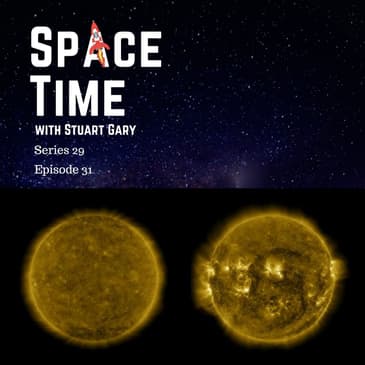
This is Spacetime Series twenty nine, Episode thirty one, for broadcast on the thirteenth of May twenty twenty six. Coming up on Spacetime, Planet Earth's Balance is Shifting, a unique insight into the Sun's inner life and lansat nine more than just a picture. All that and more Coming up on Spacetime. Welcome to space Time with Stuart. Gary and you. Study claims planet Earth's balance is shifting. The findings reported in the Journal of the Proceedings of the National Academy of Sciences p and AS, showed that the northern hemisphere is now absorbing significantly more solar energy than the southern hemisphere, a shift that could reshape global weather patterns. Since two thousand and one, all the hemisphere has been retaining approximately zero point three to four what's more solar energy per square meter every decade compared to the south. This growing energy gap is driven by a combination of environmental changes that have fundamentally altered how our planet reflects sunlight. As snow and ice smelt, they exposed darker land and ocean surfaces with soakarp heat rather than reflecting it back into space. At the same time, a decline in air pollution across the North has cleared the atmosphere of reflective aerosols, while rising water vapor levels further trap heat, creating a feedback loop of warming. Perhaps the most startling discovery is that the Earth's natural cooling mechanisms are failing to keep pace. Scientists previously expected cloud cover to increase and offset the extra heat absorption, but recent data shows clouds aren't stepping in to restore the balance. This discrepancy challenges existing climate models and suggested the planet's ability to self regulate its energy may be far more fragile than previously thought. The thing is, as this hemispheric divide widens, the resulting pressure could trigger significant shifts in rainfall patterns and storm tracks across the world. This is space time still to come, a unique insight into the Sun's inner life and lance at nine proving to be more than just a pretty picture. All that and more still to come on space time, astronomers have analyzed more than forty years of stellar data to uncover new evidence that the Sun's internal structure subtly changes from one solar cycle minimum to the next. The findings reported in the Journal of the Monthly Notices of the Royal Astronomical Society are showing that even small differences in solar magnetic activity produce detectable changes in the Sun. Every eleven years, our Sun goes through a cycle of intensifying magnetic storms, with lots of sunspot activity triggering violent solar flares and coronal mass ejections, which blast billions of tons of plasma charged particles a magnetic field intos space and occasionally towards the Earth. This period, known as solar maximum, reaked havoc over the past gar pummeling the Earth with powerful geomagnetic storms, affecting satellites, navigation systems, communications networks, and terrestrial power grids. But over the past week there have been virtually no sunspots seen on the Earth facing side of the Sun, because that's likely to change as the Sun's fartcye rotates around. Nevertheless, the Sun can be expected to start the quiet and down again as it slowly proceeds to solar minimum, its calmest period when few, if any sunspots are visible and solo magnetic fields are all relatively weak. Solar minimum is when the Sun's magnetic poles flip polarity. The north pole becomes set and the south pole becomes north. The last polarity flip was back in November twenty nineteen, marking the start at the current solar cycle twenty five. The next is expected sometime around twenty thirty. Using observations from six telescopes sighted around the Earth known as the Birmingham Solar Oscillations Network or BISON, astrophysicists looked at what happens inside the Sun during four of its quietest periods between solar cycles twenty one and twenty five. Researchers analyze tiny vibrations in the Sun formed by trapped pressure waves, which make the Sun gently oscillate. This allowed them to infer what's happening deep below the Sun's surface, a process known as helio seismology. This was the first study to compare four successive solar minima by looking inside the Sun. Using these oscillations, astronomers look for a distinctive sound wave or glitch created when helium becomes doubly ionized, changes in sound speed, as well as comparing observations against predictions from solar models with slightly altered internal conditions. They found that the solar minimum, which occurred in two thousand and eight two thousand and nine between cycles twenty three and twenty four, which was known to be one of the quieest and longest on record, showed measurably different internal conditions compared to the other three minima. The helium goods were significantly larger than in the other three minima, indicating a real structural difference. The Sun exhibited a higher sound speed in its outer layers, suggesting higher gas pressures and temperatures, and lower magnetic fields. One of the studies authors, built Chaplain from the University of Birmingham, says it's the first time researchers were able to clearly identify how the Sun's internal structure shifts from one cycle to the next. The Sun's outer layers subtly change across activity cycles, and Chaplain and colleagues found that deep quiet minima can leave a measurable internal fingerprint. The new findings could prove useful for forecasting future activity cycles. Revealing how the Sun behaves beneath its surface during these quiet periods is significant because this behavior has a strong bearing on how activity levels build up in the following cycles. Chaplain says the work demonstrates the power of long term STELLO searsmic observations with upcoming missions such as the European Space Agency's PLATO. The techniques used in this study could be applied to other Sun like stars, helping astronomers better understand how their activity changes and how they influence their local environments, including any planets that might orbit around them. This is space Time. Still to come. Lansat proves that it's more than just a pretty picture, and later in the science report, a new study shows that teens who use cannabis are far more likely to develop psychiatric disorders. All that and more still to come on Space Time. This episode of space Time is brought to you by square Space. If you've ever wanted to make your mark online, whether you're just getting started or ready to take your business to new heights, square space is the all in one website platform specifically designed to help you stand out and succeed. With Squarespace, you can easily claim your domain, build a beautiful website, showcase your skills and products, and even get paid, all in one seamless place. Let's talk about why squarespace is recommended for anyone looking to offer professional services online. First, offering your services couldn't be easier. Squarespace gives you everything you need to impress your clients and streamline your business. You can set up a custom website to showcase consultations, events, or any experience you provide. And here is where it gets really exciting. Squarespace's design tools give everyone the power to create a website that looks like it came from a top tier design studio. The result is a website that is unmistakably yours, no coding or design degree required. And to make sure people actually find your beautiful site, squarespace includes SEO tools that work in the background. Now. If you want to see how easy it is to bring your ideas to life online, visit squaespace dot com slash space time for a free trial, and when you're ready to launch, use the code space time at the checkout. Save ten percent on your first purchase for a website of domain. That's square space dot com slash space time promo code space time and of course we have a link in our show notes. For more than fifty years now, the Lansat program has provided the longest continuous satellite record of earth sland surface from space. Lansat nine launched back in twenty twenty one, is the latest mission in this remarkable legacy. It builds on decades of Earth observation and uses upgraded technology including enhanced radiometric resolution, improved signal to noise performance, and PAULA. Knight thermal imaging, working in tandem with Lansat eight to map the entire planet every eight days. Lancet nine's data is being fused with the European Space Agencies Center two satellites, enabling the daily global observations, in the process delivering shopper more detailed observations which are hoping scientists and communities monitor a changing planet. This report from MESTV. It started over fifty years ago with an idea a satellite orbiting Earth observing our planet's surface, gathering. Data day in, day out. That idea gave birth to the lance At program, a partnership between NASA and the US Geological Survey, the longest continuous record Earth's land surface from space. LANs At one's launch in nineteen seventy two was the first link in a chain of eight satellites, each one building upon the last, and today lance AT nine carries that legacy forward two one conti ship and lift off since its launch in twenty twenty one, and Lansat nine axes many scenes per day. As lansats five and seven combined working in tandem with Lansat eight, the pair now collect nearly fifteen hundred scenes daily, creating a complete map of the planet's land surface every eight days. It's not just about scale, it's about lansat's ability to revisit the same scene multiple times a month. With the pace of acquisitions, lansat nine helps track seasonal shifts and crops, the spread of wildfires, the aftermath of storms, and even rapid changes in the glaciers and coastlines. More images means more data healing research and scientific applications around the world. While Lansat nine's main design is nearly identical to lance at eight's, it's able to collect data in greater detail thanks to an upgraded radiometric resolution fourteen bit instead of lance. At eight's twelve bit. They of it like upgrading from a box of four thousand crans. To one with sixteen thousand. Every shade captured, every subtle detail. Lan Sat nine's quadrupled radiometric sensitivity makes a real difference when capturing data over the planet's brightest surfaces like snow and ice, revealing subtle changes that might otherwise go unnoticed, shifts an ic extead, changes in how surfaces reflect sunlight, and even the growth of glacial lakes forming where ice once stood. Seeing more shades of detail is powerful, but it only matters if the picture itself is clear. Lan Sat nine not only sharpens what we can detect, it also cuts through the static, delivering a stronger signal to noise ratio, which means images that have less interference. It's like trying to hear a whisper in a noisy room. Lan Sat nine quiets the static so we don't miss anything important, and that clarity makes a difference, especially over dark surfaces like water, which can harbor harmful algal blooms. That can spread quickly, threatening. Drinking water supplies local wildlife and even human safety. By spotting these blooms with greater sensitivity, LANSAT nine gives communities and scientists more reliable and actionable information to respond. LANSAT nine doesn't clock out when the sun goes down. Its onboard thermal sensor tears measures our planet's surface heat even in the darkness that means we can monitor urban heat islands, volcanic hotspots, and water temperature at night. Since twenty twenty two, the US Geological Survey's Special Request Data Program has implemented the Lancet Extended Acquisition of the Poles or LEAP for short, taking advantage of LANSAT nine's ability to see in the dark to acquire imagery in polar regions year round, when the sun can set for up to six months at the poles. Together with lance AT eight, the satellites can detect features like meltwater, cracks. And even open water within ice under low light conditions. Enhanced coverage helps scientists better monitor ice dynamics and seasonal changes in polar regions, detecting calving events, surface melt, and changes in sea ice extent even during the dark months. LANSAT nine isn't working alone. It's part of a global. Team of satellites where collaboration across agencies and nations is giving us the clearest, most consistent view of Earth yet. NASA's Harmonized LANSAT Sentinel two project uses data from Lansats eight to nine with that of the European Space Agencies. Sentinel two AB and C satellites to form a seamless, consistent surface reflectance record. In this virtual constellation, Lancet nine contributes its spectral, precision and calibrated data, helping enable global observations every one to two days at thirty meter resolution. Lancet nine's high fidelity Radiometric Stability and Continuity anchor HLS ensuring that the fused product maintains the scientific integrity that Lancet users expect. LANSAT nine is more than just today's mission, It's part of the foundation for the future. Through this Sustainable Land Imaging program, NASA and the US Geological Survey aims to preserve our ability to keep it continuous, reliable record of Earth's land for decades to come. That means not just flying satellites, but building the technology, partnerships and planning needed to keep that record unbroken. Within SLI, NASA's Sustainable Land Imaging Technology Initiative is testing new instruments that can make future emissions smaller, more capable, and more efficient. Lance AT nine is NASA's first SLI mission and plays a key role here setting the benchmark for data quality and coverage, proving what works today and guiding the technologies of tomorrow. Its stability and precision are hallmarks of previous lessons learned, allowing scientists to trust the record across decades, and its success helps guide the innovations that will come next. For more than half a century, Landsat satellites have given us an unbroken record of our changing planet. In just four. Years, lance At nine has brought that vision its even sharper focus, capturing millions of scenes, advancing how we track water, ice, land, and strengthening the world's longest Earth OPS record. It's not just another satellite in orbit. It's a bridge, carrying the lands At legacy forward with enhanced technology while preparing the foundation for the future of sustainable land imaging. Because with lands AT, every image is more than a picture. It's a calibrated digital record, providing knowledge we can use to understand, protect and sustain life Earth. This is space time, and time that to take another break. Look at some of the other stories making news in science this week with the Science Report. A new study is shown that Victoria's already critically endangered brush tailed rock wallaby population is now being further threatened by small population sizes, a lack of genetic diversity in reduce predators, especially foxes, and climate change. Brush tailed rock wallabies are one of Australia's most vulnerable marsupials and have already almost been wiped out in Victoria. The new findings, reported in the journal Proceedings of the Royal Society of Victoria, show that numbers declined dramatically during the late nineteenth and early twentieth centuries following European colonization, leaving just three populations left in the state. The authors say potentious solutions include managing predators more effectively, moving wallabies between populations to boost stagnant gene pools, and studying how these animals will be affected by ongoing climate change. A new study warns that teens are used cannabis are more likely than those who don't to develop psychiatric disorders, especially bipolar disorder and psychosis. The findings, reported in the Journal of the American Medical Association, stated some four hundred and sixty three thousand, three hundred and ninety six American adolescents aged between thirteen and seventeen who were screened for cannabis. They found that using cannabis over the past year was linked to an increased risk of psychosis, bipolar, depressive, and anxiety disorders by the age of twenty six, and teens who started using cannabis earlier in life were at the greatest risk, especially for depression and anxiety disorders. A new study has shown that bird watches are by no means bird brains. The findings, reported in the journal Jane Neurosi are based on a comparison of the brains of twenty nine expert bird watches and twenty nine beginners. Scientists found that dedicated bird watchers had denser attention and perception related areas in their brains, which was linked to more acute bird identification, even among older people. The authors reached their conclusions by looking at how water traveled around the participant's brains, finding it spread further and more easily in the brains of experts. The authors believe birding may benefit the brain because it requires a keen eye, paying careful attention, and a strong memory. Being at twitter, it can provide benefits in other areas of life. The authors also asked participants to remember random faces that were paired with birds, and found even aller experts outperformed the beginners. The authors conclude that being a bird watcher may benefit the brain and help older people stay cognitively healthy. The world's richest man, Elon Musk, says he doesn't believe that alien spacecraft have visited the Earth. Last month, former US President Brack Hussein Obama said on a podcast that extraterrestrial aliens were real, but he had not seen any, and they weren't being kept in Area fifty one. Are aliens real? They're real, but I haven't seen and they're not being kept in fifty one. There's no underground facility unless there's this enormous conspiracy and they hid it from the president of the United States. What was the first question you wanted answered when you became president? Were the ewents? Were the audience of That prompted this response from current President Donald Trump. He made it big for safe. He took it out a class of right information. And that forced Obama a quickly issue a carefully word of clarification on Instagram, claiming, and I quote I saw no evidence during my presidency that extraterrestrial has made contact with US quote skeptics to Minum says, it's all very amusing. Yeah. Elon muss copy a hero of your readership is your audience is so spacey. So Elon Musk has said he does not believe UFOs exists. He says, well, he actually says there's no evidence to suggest that UFOs exists as a sign of alien intelligence or extraterrestrial traveling. The implication is that he's got so much stuff up there in space thanks to SpaceX and his satellite that is always putting up there, that surely they would have come across alien craft. In some states, it needs better evidence, and so far there ain't any, and I think the skeptics would agree with that. We're waiting for the evidence. In this particular case, he's certainly got he should have the evidence because of all the traffic that he's creating in space, but he doesn't. And he's flying on sciences, and the science says that if there are extraterrestrials out there, there are so far away it'd be really hard for them to get here. That's right. I mean, he has said that life in somewhere out there in the universe is probably quite likely, but nothing here, and certainly nothing that would imply crafts that are being flown around the skies. As he says, it might be terrestrial technology of some sort or another. This is the story of mystery planes and that sort of thing. There was sort of military plane, but he said no evidence that there no evidence put forward that he can see which is scientifically based, that there's a UFO UAP alien craft flying in our atmophere. That's the skeptics timendum, and this is space Time reminding you the truth is out there, and that's the show for now. Spacetime is available every Monday, Wednesday and Friday through at bytes dot com, SoundCloud, YouTube, your favorite podcast download provider, and from space Time with Stuart Gary dot com. Space Time's also broadcast through the National Science Foundation, on Science Own Radio and on both iHeartRadio and tune in Radio. And you can help to support our show by visiting the Spacetime Store for a range of promotional merchandising goodies, or by becoming a Spacetime Patron, which gives you access to triple episode commercial free versions of the show, as well as lots of bonnus audio content which doesn't go to wear, access to our exclusive Facebook group, and other rewards. Just go to space Time with Stuart Gary dot com for full details. You've been listening to Space Time with Stuart Gary. This has been another quality podcast production from bytes dot com