
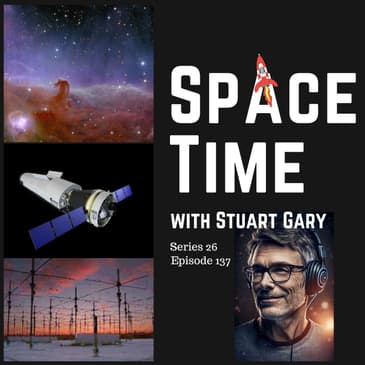
1. **Euclid Mission's Groundbreaking First Images**: The European Space Agency's Euclid spacecraft, dedicated to exploring the mysteries of the dark universe, has unveiled its first set of images. This marks a significant milestone in our understanding of the cosmos. 2. **Europe's Ambitious Space Transport Vision**: The European Space Agency is advancing space exploration by developing a new cargo spacecraft. This innovative vessel is designed to transport supplies and potentially crew members to the International Space Station and further, to the lunar gateway. 3. **HAARP's Artificial Airglow Phenomenon**: Residents of Alaska were alerted about the High-frequency Active Auroral Research Program (HAARP) and its potential to create artificial airglow in the Arctic skies. This unique phenomenon is a part of HAARP's ongoing research activities. 4. **The Science Report Highlights**: - **Alarming Extinction Risks**: A recent study highlights a concerning fact that 19% of European species are now facing the threat of extinction. - **Caffeine and Early Alcohol Exposure in Children**: Research indicates that children who regularly consume caffeinated beverages are more likely to experiment with alcohol at a younger age. - **Genetics and Children's Sleep Patterns**: If your child struggles with sleep, it might be linked to their genetic makeup. 5. **Alex on Tech: Investigating the Optus Crash**: Dive into the technical analysis of the Optus crash with Alex, exploring the intricacies and implications of this significant event in the tech world. Stay tuned to SpaceTime Series 26 Episode 137 for more in-depth discussions and insights on these fascinating topics!
Become a supporter of this podcast: https://www.spreaker.com/podcast/spacetime-with-stuart-gary--2458531/support.
[00:00:00] This is SpaceTime Series 26 Episode 137 for broadcast on the 15th of November 2023. Coming up on SpaceTime, the Euclid mission releases its first science images, Europe announces plans to build its own cargo ship to supply the International Space Station,
[00:00:19] and HAARP issues an artificial airglow warning to the good people of Alaska. All that and more coming up on SpaceTime. Welcome to SpaceTime with Stuart Gary. Astronomers have released the first images from the European Space Agency's Euclid spacecraft, which is on a mission to study the dark universe.
[00:00:57] Euclid will investigate dark matter and dark energy, mapping the universe's evolution over the last 10 billion years to try and understand how dark matter and dark energy have shaped it. Dark matter is a mysterious invisible substance which appears to only interact with normal matter
[00:01:15] through gravity. Scientists know it exists because they can see its interactions with normal, so-called baryonic matter, preventing galaxies from flinging apart as they spin and acting as a sort of gravitational lens, magnifying the light from deep space objects.
[00:01:32] Dark energy, on the other hand, is a mysterious force causing the universe's rate of expansion out from the Big Bang to accelerate. It will determine the ultimate fate of the universe, whether we end up in a big freeze or a big rip.
[00:01:47] Launched from Cape Canaveral back on the 1st of July, Euclid has now travelled some 1.5 million kilometres to a position in space known as the Lagrangian L2 point. It's a sort of gravitational
[00:02:00] well on the night-time side of the Earth directly opposite from the Sun. It's a point in space where spacecraft can remain relatively stable without needing to use lots of fuel in order to maintain position. The L2 point's also being used by the Webb Space Telescope. Following a period
[00:02:17] of commissioning, testing its instruments and other components, mission managers believed all systems were performing nominally and so instructed Euclid to perform first light, taking a series of engineering survey images of star fields to see how well it worked.
[00:02:33] First light images are typically just showcasing the instrument. Of course to show the public it's nice to have it focused so we went through the focusing procedure that takes about a week
[00:02:45] and towards the end we got a very fine crisp deep image. The first light image is just one of these exposures, a 566 second integration image. The physical size of the vis focal plane is about 0.7 degrees, 0.7 degrees. One of the primary science goals for Euclid is weak
[00:03:08] lensing survey and weak lensing relies on the distortion of the galaxy images and so what we want is a very clean crisp image of galaxies so that we have a reliable source of what you know what this weak lensing distortion could look like. For the first light
[00:03:27] we were going to show a detail of the full focal plane and this is for one CCD in particular which happens to contain a stellar cluster, a large galaxy, another large galaxy and a very bright star.
[00:03:45] Nothing has been processed, the cosmic rays are still there, the bias has not been removed. Besides this beautiful vis image we also observe in the infrared and for that we have an infrared instrument it's called NISP, near infrared spectrometer and photometer. We turn on the NISP
[00:04:08] instrument very quickly after the launch of the Euclid satellite. Mostly we turn on the instrument unit to monitor the cooldown of the instrument and once the temperature reaches a threshold so below 130 Kelvin we turn on the data processing unit and the focal plane array of the
[00:04:32] NISP instrument. We undergo first several tests on the NISP instrument to verify operational behavior of the instrument. The image you show is a raw image so no processing, I just add a little color to emphasize the position of star otherwise the image is
[00:04:52] naturally black and white because our detectors are monochromatic detectors and you can see some cosmic ray events in the foreground from the cosmic sky in the background here. So the image quality is evaluated by measuring the size of the star because stars are very far
[00:05:16] away, they are like point source. What we measure from stars on the instrument is what we call the point spread function so the response of the instrument to a point like source and the smallest
[00:05:29] this response the higher the quality of the image. So basically we measure the size of the star here to control the quality of the image. The infrared part we can determine from the spectral energy distribution of these galaxies, the redshift and we call it photometric redshift. So together
[00:05:49] combined with the infrared observations and the optical observation we do the weak lensing experiment. This is the spectroscopy and what this means is that each of these lines is a spectrum
[00:06:04] of the sources that NISP generally detects. So if you saw the NISP image you had all of the little points some of them stars a lot of them galaxies and each of those points is now smeared out into
[00:06:17] its wavelength components to get a spectrum. And what we can do with the spectroscopy for galaxies is we can measure the distances and this is very important for galaxy clustering which is one of
[00:06:31] the main goals of Euclid and this tells you how far each of the galaxies is and with that information you can then build a 3D map of what the galaxies look like around us. Now is what we call
[00:06:45] first light so we are very proud to show that we can really see what we expected. If you look at the images very carefully you still see defects that is cosmic rays and all these things. In the first
[00:06:59] few months of Euclid we are going to check out the instruments but also do the calibrations necessary calibrations and it's not yet looking at the sky which we want to do after we have done
[00:07:14] all these verifications. Once we look at the sky we come with some images we will take during this checkout phase which is taken in a way we will do during the survey and that will tell us
[00:07:34] how good the quality is of the survey. We have already selected a set of images and they must be really stunning. If this is already so nice I mean the images we will show you
[00:07:48] extremely stunning I think. And in that report from ESA TV we heard from Euclid Viz. Instrument Scientist Rico Nakajima, Euclid Project Scientist René Lorids from ESA, Euclid NIPS Instrument Scientist William Gillard and Euclid Collaboration Support Scientist Kerry Patterson. Following some
[00:08:10] fine-tuning a series of five science images were then taken including views of a large cluster of thousands of distant galaxies, close-ups of two nearby galaxies, a gravitationally bound group of stars called a globular cluster and the iconic horsehead nebula. An immense cloud of gas and
[00:08:28] dust in deep space deep inside which newborn stars are forming. There are mysteries in deep space. The nature of dark matter and dark energy has perplexed astronomers for decades but ESA's Euclid Space Telescope is now ready to help. Its first science images are released. I started to
[00:08:49] work for Euclid 2013, 10 years ago. Over that time the spacecraft has been designed, it has been manufactured, it has been assembled, tested and verified. The mission is almost ready to start its six years collection of data. ERO is an acronym for Early Release Observations,
[00:09:11] a programme where we observe a number of very interesting targets which are appealing for the public but also have scientific value. I've seen the first ERO image and had this enormous pleasure. It's absolutely stunning so this is a very exciting moment. Scientists are still working
[00:09:30] on the images. The result is really astonishing. Euclid is designed to map approximately 1.5 to 2 billion galaxies. By analysing the shapes and distribution of those galaxies, astronomers will gain clues to the nature of the dark matter and dark energy. For the first time with Euclid we
[00:09:50] can take a sample of galaxy for which I know the stellar mass, how much stars they form etc and I can go and measure very accurately how much total mass, how much dark matter mass there
[00:10:02] is in them and that's what I want to do with Euclid on my side. During its mission Euclid will generate a vast amount of data, the equivalent of a million DVDs that must be stored and made
[00:10:14] available to the world's astronomers. These images together will give us the total structure of the universe up to a look back time of 10 billion years so we can follow the evolution of the
[00:10:27] structure over 10 billion years and this is really the aim of Euclid, to make this giant 3D distribution map and derive from it the properties of dark matter and dark energy. Now that we have real data
[00:10:43] in place that's really a game changer for us so we now can test everything that we can offer this real data to our interfaces which is really really exciting for us so this is a very emotional
[00:10:57] moment and very challenging also. There are cosmic secrets in these images, invisible to the human eye but waiting to be revealed by computer analysis and our understanding of physics. Euclid's scientific
[00:11:12] mission into the dark side of the universe is about to begin. And in that report from ESA TV we had from Euclid deputy project scientist Roland Vavreck, Euclid project scientist Renee Loridge from ESA, Sarah Nita from ESA's Euclid Science Archive and Euclid science ground segment
[00:11:30] scientist Herve Aussel. At this stage with all systems working Euclid's expected to begin regular science operations in early 2024. During its planned six-year mission Euclid will produce the most extensive three-dimensional maps of the universe ever undertaken. It'll cover a third
[00:11:49] of the sky and contain billions of galaxies up to 10 billion light years away. To do this Euclid needs a wide field of view. In this way the spacecraft differs from targeted observatories
[00:12:02] like Webb which focuses on a small area of the sky at any one time but typically offers far higher resolution images. Wide field survey telescopes like Euclid on the other hand can observe large
[00:12:14] sections of the sky all at once. They can therefore cover the sky much faster than targeted telescopes. Euclid still has higher resolution than previous survey missions which means it'll be able to see more galaxies in each image than previous telescopes. For example Euclid's wide view
[00:12:33] will enable it to capture the entire Perseus galaxy cluster and many galaxies beyond it all in just one image. Located 240 light years from Earth, Perseus is among the most massive structures in the known universe. Euclid's full survey will ultimately cover an area 30 000 times larger.
[00:12:52] The telescope survey approach is necessary if it's going to study dark energy, that mysterious driver behind the universe's accelerating expansion. While gravity should theoretically be pulling everything in the universe together instead everything is moving further apart and
[00:13:08] it's moving apart at a faster and faster rate. And dark energy is the term scientists are using for this unexplained expansion. Now to study this phenomenon scientists will need to map the presence
[00:13:20] of another cosmic mystery, dark matter. Dark matter is important because there's five times more of it than the regular matter that makes up the universe and so if dark energy's expansive influence on
[00:13:32] the universe has changed over time that change should be recorded in how dark matter is distributed on large scales across the universe and Euclid's three-dimensional map should be able to capture it. NASA's Nancy Grace Roman mission will also study dark energy but in ways that are complementary
[00:13:51] to Euclid. Roman will study a smaller section of the sky than Euclid but it will provide higher resolution images of hundreds of millions of galaxies and it will peer deeper into the universe's past providing complementary information. Nancy Grace Roman is slated to launch in May 2027
[00:14:09] and mission planners will use Euclid's images to inform Nancy Grace Roman's dark energy work. This is Space Time. Still to come, Europe to build a new cargo ship to supply the International Space Station and scientists issue a warning that the harp instrument in Alaska is being activated
[00:14:29] and that could result in an artificial airglow. All that and more still to come on Space Time. The European Space Agency has announced plans to develop a spacecraft to carry supplies and eventually possibly people to and from the International Space Station and even beyond
[00:15:00] to the Lunar Gateway Space Station project. The agency is looking at developing a reusable commercial space cargo shuttle servicing the orbital outpost by 2028. The proposal comes at a difficult time for ESA as delays in the development of the new Ariane 6 launcher has
[00:15:18] left Europe without an independent heavy lift means of accessing space. Already delayed by some four years, Europe's replacement for the Ariane 5 launcher is now not slated to fly until much later next year. Europe's last cargo ship, the ATV or Automated Transfer Vehicle, was designed for
[00:15:37] single use only and so wasn't capable of atmospheric re-entry. And that's where this new spacecraft will be different. It'll be capable of returning cargo back to Earth. The new cargo ship will be launched aboard the Ariane 6, thereby providing Europe with its own independent and uninterrupted access to
[00:15:56] space. Right now, with restrictions on Russia because of Moscow's invasion of Ukraine, Europe's totally reliant on the United States for access to space. Still, the viability of the new spacecraft project remains somewhat in doubt. That's because only an initial 75 million euros has been
[00:16:15] allocated for the first phase of the project. That compares with NASA's 790 million dollars in funding which went towards SpaceX's Dragon and Northrop Grumman's Cygnus cargo ships, which are also providing services to the International Space Station. Europe currently supplies service
[00:16:32] modules for NASA's Orion spacecraft, which will eventually take humans back to the Moon and then onto Mars and beyond. And it's planning to use its ATV design as the basis for the new habitat
[00:16:44] modules for the Lunar Gateway Space Station. This is Space Time. Still to come, warnings of artificial airglow in the cold arctic skies as scientists initiate the HAARP experiment. And later in the
[00:16:59] science report, a new study finds that a fifth of all European species are now under threat of extinction. All that and more still to come on Space Time. Alaskans were being warned last week that HAARP, the High Frequency Active Auroral Research Program, might be about to create
[00:17:34] artificial airglow in the cold arctic skies. Scientists from the University of Alaska Fairbanks, Cornell University, the University of Colorado Denver, the University of Florida and the Georgia Institute of Technology were undertaking a variety of experiments with the highly classified
[00:17:52] instrument focusing on the Earth's ionosphere. The ionosphere is the part of the Earth's atmosphere between 80 and 600 kilometers in altitude. It's the region where extreme ultraviolet x-ray solar radiation ionizes the rarefied atoms and molecules there, creating a layer of electrons. The ionosphere
[00:18:12] is important because it reflects and modifies radio waves for use in communications and navigation. The HAARP scientists are investigating ionosphere mechanisms that cause optical emissions. They're also trying to understand whether certain plasma waves, that is gas so hot that the electrons
[00:18:30] are knocked off the atoms, can amplify other very low frequency waves. And they're investigating how satellites can use these plasma waves in the ionosphere for collision detection and avoidance. Prior to the experiments taking place, the scientists issued a warning that artificial
[00:18:47] airglow might take place over a four-day period. If so, that airglow would be visible up to 500 kilometers from the HAARP facility which is located almost halfway between Anchorage and Fairbanks. So how would it all work? Well HAARP creates airglow by exciting electrons in Earth's ionosphere
[00:19:06] with a series of often on pulses of high frequency radio transmissions. In a way it's very similar to how space weather from coronal mass ejections can trigger auroral activity at higher latitudes, generating the northern and southern lights, the aurora borealis and aurora
[00:19:23] australis. And as it turned out, the last week or so we've seen so much continuous solar activity that it's triggered nightly auroral displays anyway. So any additional airglow caused by HAARP would have been drowned out by the sun's activities. HAARP's ionospheric research instrument is a
[00:19:41] phased array of 180 high frequency antennas. They're spread across some 33 acres and can radiate some 3.6 megawatts of energy up into the upper atmosphere and ionosphere. The airglow would appear as a faint red or possibly green patch in the sky, depending on which atoms and molecules
[00:20:01] were being affected. The HAARP transmission frequencies vary, they usually occur between 2.8 and 10 megahertz. HAARP was originally developed by the United States Air Force and Navy to analyze their ionosphere and investigate the potential for developing ionospheric enhancement technology for
[00:20:18] radio communications and surface surveillance. It's all very similar to Australia's groundbreaking Jindalee over the horizon radar, now called JAWN. JAWN monitors air and sea movements across some 37,000 square kilometers north of the Australian mainland. No one knows exactly how powerful it is
[00:20:39] that's classified, but we keep hearing stories about military personnel able to monitor ships sailing in and out of Asian ports. By the way, JAWN also operates at the same frequencies as HAARP, however it's never featured the sort of notoriety that HAARP's experienced.
[00:20:57] HAARP has become the subject of multiple conspiracy theories, with claims that it's a military weapon designed to change weather patterns, triggering floods, hurricanes, droughts and even earthquakes, and there are even suggestions it's capable of setting the skies on fire. Sounds like a potential
[00:21:14] story for Australian skeptics. This is Space Time, and time now to take another brief look at some of the other stories making use in science this week with the Science Report. A new study has determined
[00:21:43] that some 19 percent, that's nearly a fifth of the nearly 15,000 European species on the International Union of Conservation of Nature's Red List of Threatened Species are now under threat of extinction. The Red List is the most comprehensive source of species extinction threat information on the
[00:22:01] planet, with about 10 percent of all animals and plants found in Europe now on the list, based on their conservation status. The new findings reported in the Journal PLOS One are based on a detailed
[00:22:12] analysis of the European species list, finding 27 percent of plant species are in danger of extinction, along with 24 percent of invertebrate animals and 18 percent of vertebrate animals. The authors found that agriculture remains the major factor driving these extinction risks. A new study has found that
[00:22:32] kids aged nine and ten to drink caffeinated beverages on a daily basis tend to try alcohol at a younger age. The findings reported in the Journal Substance Use and Misuse also looked at their brain activity as they performed a series of tasks, finding daily caffeinated beverage drinkers
[00:22:50] developed different brain activity patterns compared to kids who consumed caffeinated beverages less often, including more impulsive behaviors and poorer working memory. The research is based on an international study of more than 2,000 children. The authors found that a year after
[00:23:07] asking kids about their soft drink consumption, those who drank caffeinated beverages daily were more than twice as likely to have tried alcohol. The researchers say the study can show if the caffeinated drinks are causing differences in behavior and brain activity, and it's possible
[00:23:23] that kids who are more impulsive are also more likely to drink caffeinated soft drinks on a regular basis, and they're also more likely to try alcohol at an earlier age. Is your child a poor
[00:23:35] sleeper? Well if so, a new study suggests it might be in their genes. The study reported in the Journal of Child Psychology and Psychiatry looked at 2,458 children of European ancestry and found that kids who were genetically predisposed to insomnia had more insomnia-like sleep problems
[00:23:54] such as frequent awakenings or difficulty falling asleep, as reported by their parents. Those who were genetically predisposed to longer sleep did indeed sleep longer, but were also more awake during the night as teens. The authors say the research provides
[00:24:09] indirect evidence for a lifetime poor sleeper trait, and therefore the need for early recognition and prevention of sleep difficulties. What appears to have been a major software update managed to cripple the entire Optus network across Australia last week. Although the Telco
[00:24:28] won't admit it, it appears the update, imposed on aging 2012-era Optus technology, failed to cope with the dramatically increased traffic demands brought about by today's 5G world. With the details, we're joined by technology editor Alex Zaharov-Wright from TechAdvice.life.
[00:24:47] Optus is Australia's second largest telco behind Telstra and in front of Vodafone, and they're a Singaporean-owned company, and they're known for competing in the smartphone space with their mobile network and with NBN services. And at about 4 or 5 in the morning,
[00:25:01] an update of some sort was applied. That's normally the time you'd put updates, it's the time the network is being least used. And various sources online have claimed that whilst the update could be applied, it was being applied to very old hardware which couldn't take the 5G
[00:25:16] workloads, which all sounds a bit strange to me, but that's what sources are claiming. But clearly, something went wrong with the upgrade and it didn't just take down the mobile network, but it took down just about the whole network. People couldn't make emergency triple zero or 911 calls
[00:25:29] as it would be in the US through their landlines, but they could do it through mobile phones. But then some people on mobile phones found that they couldn't make triple O calls because they weren't
[00:25:38] in range of another network that could be roamed to. But of course, people's mobile phones were completely down, as was mobile data. And some of the people had their broadband connections also unable to be connected to. So people went for more than 12 hours without having the internet
[00:25:53] or phone connection. There were big lines at the competing Vodafone and Telstra stores that people couldn't port out because you couldn't receive the verifying SMS to port out. And the CEO didn't
[00:26:03] run up to the media for several hours. Now they had a big cybersecurity hack last year, Optus had, and you would have thought that they would have learned. They'd be on the front floor to assure
[00:26:12] people they're doing everything they can to not hide from the cameras, but be upfront and say, look, we are owning this. Yes, something really bad has happened. We're working really hard to
[00:26:19] fix it. And we're not afraid to come and talk to you and customers and let you know that we're here and we're very sorry. And originally, Optus wanted to give no compensation at all. They tried to
[00:26:28] claim that it would be a couple of dollars per person and it wouldn't amount to much. But people had been up in arms about that one lady couldn't speak to the hospital to inform her that her
[00:26:36] mother had died. Other people had lost all sorts of business because they couldn't take electronic payments, their payment terminals were down or transportation systems, trams and buses. Melbourne's entire rail network shut down.
[00:26:47] Yeah. Now a lot of these systems did have manual backups of sorts, but it took time to be put into place. There was still hiccups. And whilst a number of services were back online through
[00:26:57] backup systems of various sorts, most people were out for the entire day. And some people claimed to still be having problems 24 hours later, even though it was all meant to be fixed within a half day timeframe. So look, terrible timing. The Singtel board, the company that owns
[00:27:11] Optus in Singapore was in Australia when they had the big cyber attack last time. And then last week they were in Australia for another board meeting and this particular outage happened. Yeah, they must be really impressed.
[00:27:22] Yeah. Well, the word for the Singapore board is don't come to Australia. But this is a big wake up call to show how fragile modern systems are when we rely upon telecommunications networks and technology so intensely. Well, the Royal Australian.
[00:27:36] Solve the problem. They issued a statement by way of X saying very simply, cash is still king. Absolutely. And look, governments wish to turn us all into cashless societies. Well, when you don't have any cash and you can't pay by cash, and there are various companies that
[00:27:50] are saying, oh, no, we only take electronic payments now. Well, you're denying people the ability to have cash available for a rainy day when you don't want to have a central bank digital currency where the currency can be set to expire. It can be outright stolen from you
[00:28:03] electronically without anything happening. You could be cancelled and have all your money just mysteriously disappear from your account. So if this was a cyber attack and it happened to all
[00:28:11] our telcos, well, we would be in big trouble. I mean, this is how you take a modern society down. So a big wake up call for the industry, for the government, for Optus itself. Moving on, and there's been more action on the wireless power revolution.
[00:28:23] Wireless power. That sounds like something Tesla was trying to achieve 100 years ago. Yeah. Yeah. And what that is, is power that is transmitted through the air in much the same way that your smartphone, tablet or computer is receiving data over Wi-Fi. Now, the way that
[00:28:38] most wireless power currently works is you have to physically place your device onto a wireless charging pad and you can't take that device away with you and have it continuously being charged because that's not how current wireless power systems work. But what Energis and another
[00:28:52] company called Ossia and others out there, Motorola, Slush, Lenovo are working on this as well. They've been working on ways to transmit power through the air without cooking you as you're walking through an electrified airspace. And although the future is going to be where all of
[00:29:06] your devices in the home and the office are being charged wirelessly, so they either have to have no batteries or very small batteries, and it's being worked on so it's commercialized so that we will eventually have wireless power everywhere. And this wireless future that Tesla himself
[00:29:23] thought of is finally coming true 100 years later. And there've been some updates for Apple and Google. Tell us about them. Yeah, all of the different Apple devices have had updates for the watch. You've got 10.1.1. It's meant to fix the battery drain for iPhones. There's a problem where
[00:29:37] some people were charging their phones wirelessly in cars equipped with wireless charges, and that was disabling the NFC chip inside. And that issue has now been solved. And also there was an issue
[00:29:48] with a lock screen widget on iOS 17 where it wasn't showing snow properly. Not an issue for us in the Southern Hemisphere, but it will soon be an issue for those in the North. Clearly lots of bug fixes
[00:29:57] and security updates. And Google has also launched its November updates for its Pixel devices. And interestingly, if you've got a Samsung or a Motorola or some other Android device, those November security updates are not there yet. If you want the updates as quickly as you get them on
[00:30:13] Apple devices in the Android world, you need to get the Google Pixel devices. Otherwise, you'll be waiting. And whilst you're waiting, the device is not secure. So interesting that Google is able to do that, but none of its competitors can. But that's, I guess, one of the
[00:30:27] benefits of being a Google Pixel user. And what else is on TechAdvice.life at the moment? Reports about Apple working on a new form of battery that will last much longer and also OpenAI launching
[00:30:37] a new GPT store, a copyright shield that will protect people using its services from copyright infringements. People can create their own tech GPT engines and plenty more. That's Alex Sahara-Vroid from TechAdvice.life. And that's the show for now. Space Time is available every Monday, Wednesday
[00:31:12] and Friday through Apple Podcasts iTunes, Stitcher, Google Podcasts, Pocket Casts, Spotify, Acast, Amazon Music, Bytes.com, SoundCloud, YouTube, your favorite podcast download provider, and from Spacetime with Stuart Garry.com. Space Time is also broadcast through the National Science
[00:31:31] Foundation on Science Zone Radio and on both iHeart Radio and TuneIn Radio. And you can help to support our show by visiting the Spacetime store for a range of promotional merchandising goodies, or by becoming a Spacetime patron, which gives you access to triple episode commercial free
[00:31:48] versions of the show, as well as lots of bonus audio content which doesn't go to air, access to our exclusive Facebook group, and other rewards. Just go to spacetimewithstuartgarry.com for full
[00:32:00] details. And if you want more Space Time, please check out our blog where you'll find all the stuff we couldn't fit in the show, as well as heaps of images, news stories, loads of videos, and things
[00:32:10] on the web I find interesting or amusing. Just go to spacetimewithstuartgarry.tumblr.com. That's all one word and that's Tumblr without the E. You can also follow us through at Stuart Garry on Twitter, at Spacetime with Stuart Garry on Instagram, through our Spacetime YouTube channel,
[00:32:28] and on Facebook. Just go to facebook.com forward slash spacetimewithstuartgarry. You've been listening to Spacetime with Stuart Garry. This has been another quality podcast production from Bytes.com.