
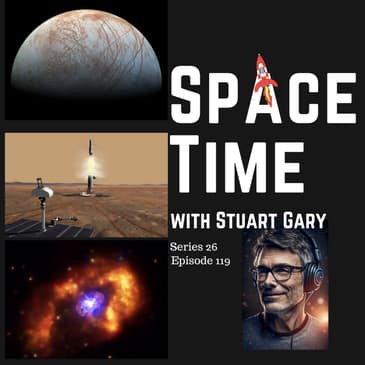
Become a supporter of this podcast: https://www.spreaker.com/podcast/spacetime-with-stuart-gary--2458531/support.
00:00:00
STUART GARY: This is SpaceTime series 26 episode 100 and 19 for
00:00:04
broadcast on the fourth of October 2023. Coming up on space
00:00:08
time, carbon discovered on Europa, NASA's Independent
00:00:13
Review boards report on the MARS Sample Return Mission and a new
00:00:18
twist to the story of the Great Eruption of Eta Carina. All that
00:00:22
and more coming up on space time.
00:00:26
GENERIC: Welcome to space time with Stuart Garry.
00:00:46
STUART GARY: Astronomers have discovered carbon dioxide, one
00:00:49
of the key ingredients essential for life as we know it on the
00:00:52
surface of the Jovian Ice Moon Europa. The discovery in data
00:00:56
from NASA's Web space telescope suggested this carbon likely
00:01:00
originated in the subsurface ocean beneath Europa's icy crust
00:01:05
and was not delivered by meteorites or other external
00:01:08
sources.
00:01:09
The discovery is vitally important because Jupiter's ice
00:01:13
moon Europa is one of just a handful of worlds in our solar
00:01:16
system that could potentially harbor conditions suitable for
00:01:20
life. Previous research has shown that beneath its water ice
00:01:23
crust lies a salty liquid water ocean with a rocky sea floor.
00:01:28
However, until now, scientists have not been able to confirm
00:01:31
that this global subsurface ocean contains all the chemical
00:01:34
ingredients needed for life, especially carbon. But
00:01:38
astronomers using data from NASA's Web Space telescope have
00:01:41
now identified carbon dioxide in a specific region on Europa's
00:01:45
icy surface.
00:01:47
And importantly, it was deposited there on a
00:01:49
geologically recent timescale. The discovery reported in two
00:01:54
papers in the journal science has important implications for
00:01:57
the potential habitability of Europa's oceans.
00:02:00
The lead author of one of those two papers, Jomo Viala from
00:02:04
NASA's Goddard Space Flight Center in Greenbelt Maryland
00:02:07
says that on Earth, life likes chemical diversity, the more
00:02:11
diversity, the better earthlings are carbon based life forms and
00:02:15
understanding the chemistry of Europa oceans will help
00:02:18
scientists determine whether it's hostile to life as we know
00:02:21
it or whether it might be a good place for life to evolve.
00:02:25
The lead author of the second paper analyzing these data,
00:02:28
Samantha Trumbo from Cornell University says the team
00:02:31
believes it's observed evidence that the carbon seen on Europa
00:02:34
surface comes from the moon's subsurface ocean. She says
00:02:39
that's not a trivial thing because carbon is a biologically
00:02:42
essential element.
00:02:44
The new findings are all very timely as NASA plans to launch
00:02:47
its Europa clipper spacecraft which will perform dozens of
00:02:50
close flybys of Europa to investigate whether it could
00:02:53
have conditions suitable for life in October 2024.
00:02:57
The web data shows that the carbon dioxide is mostly
00:03:00
abundant in one region, an area known as Terra Rego, a
00:03:04
geologically young region of generally resurfaced chaos
00:03:07
terrain, an area containing large cracks, bowlers and chunks
00:03:12
of ice looking like something's burst through from underneath
00:03:15
the crustal ice here has been disrupted and there's likely
00:03:18
been an exchange of material between the subsurface ocean and
00:03:22
the icy surface.
00:03:23
Previous observations using the Hubble Space telescope have
00:03:27
already shown evidence of ocean derived salt in Terra Rego. Now
00:03:32
the detection of carbon dioxide heavily concentrated in the same
00:03:35
area implies that the carbon probably has its origin. Also in
00:03:39
the internal ocean.
00:03:40
Scientists are now debating just how much eus oceans connect to
00:03:44
its surface. Are there just a few fractures or are there
00:03:48
plumes all over the place? The important thing is these
00:03:51
findings suggest that they may well be able to learn some very
00:03:54
basic things about Europa's ocean's composition. Even before
00:03:58
they need to attempt to drill down through kilometers of ice
00:04:01
to get the full picture.
00:04:03
The carbon dioxide was identified using data from the
00:04:06
integral field unit on Webb's near infrared spectrograph and
00:04:10
we know it's fresh because carbon dioxide isn't stable on
00:04:14
Europa's surface. Therefore, the scientists agree it must have
00:04:17
been supplied on a geologically recent timescale.
00:04:20
A conclusion bolstered by its concentration in a region of
00:04:24
young terrain. Scientists are now trying to identify a plume
00:04:28
of water vapor erupting from Europa surface which could be
00:04:31
the source of the carbon Hubble reported tentative detections of
00:04:35
plumes in 2013, 2016 and 2017.
00:04:38
However, finding definitive proof has been difficult and the
00:04:42
new web data shows no evidence of plume activity. This is space
00:04:47
time still to come. NASA's Independent Review Board reports
00:04:51
on what's now needed for a MARS Sample Return Mission and a new
00:04:55
twist in the story of the Great Eruption of EDTA Karina. All
00:04:59
that and more still to come on space time.
00:05:19
NASA has released its Independent Review Board's MARS
00:05:22
Sample Return report. The space agency established the board
00:05:26
back in May to evaluate the technical cost and schedule
00:05:29
plans of the mission.
00:05:30
Prior to any final design, the board looked at current plans
00:05:34
and goals noting the scientific importance of the mission but
00:05:37
also expressing concerns over the mission's budget evaluation
00:05:41
came up with 20 findings and 59 recommendations. Nicola Fox
00:05:46
NASA's associate administrator for science says the agency has
00:05:50
plans for a robust moon to MARS exploration approach. MARS is a
00:05:55
rich destination for science discovery and understanding.
00:05:59
The Red Planet supports the agency's aardema program to
00:06:03
ultimately send humans to the Martian surface. In response to
00:06:07
the new report, NASA has set up a review team. The team will
00:06:11
make its recommendations by the second quarter of financial year
00:06:14
2024.
00:06:15
Regarding a path forward needed to keep the project within a
00:06:18
balanced science program currently slated for around
00:06:22
2030. The joint NASA European Space Agency mission will be
00:06:25
highly complicated. It'll involve the launch of at least
00:06:29
two rockets bound for the Red Planet. There's also the launch
00:06:32
of a rocket from the surface of MARS.
00:06:35
The first time a rocket has been launched from the surface of
00:06:37
another planet and there'll be an orbital rendezvous around
00:06:40
MARS again the first time there's been an orbital
00:06:43
rendezvous around another planet. The current plans call
00:06:47
for one of the Earth launched rockets to carry a lander
00:06:50
equipped with several MARS helicopters and rovers as well
00:06:53
as a smaller scent rocket.
00:06:55
The rovers and helicopters will be used to retrieve samples now
00:06:58
being collected by NASA's MARS Perseverance rover as part of
00:07:02
its ongoing exploration of Jezero crater and an ancient
00:07:05
river delta which once flowed down into the crater carrying
00:07:08
sediments from further upstream.
00:07:10
The six world car sized Perseverance rover landed in Jez
00:07:14
back in February 2021 carrying the small experimental ingenuity
00:07:18
rotocop Chiro Crater is a 45 kilometer wide impact crater
00:07:23
located on the western edge of a flat plain called clones which
00:07:28
lies just north of the Martian equator.
00:07:30
The landing site is about 3700 kilometers from its sister rover
00:07:35
curiosities landing site gale crater. The samples being
00:07:39
collected by Perseverance will be loaded into a special
00:07:42
container in the ascent rocket which is mounted on the lander.
00:07:45
The ascent rocket will then be launched back into MARS orbit
00:07:49
where it will rendezvous and dock with the second rocket
00:07:51
launched from Earth which contains a return to Earth
00:07:54
cruise stage. The sale container will then be transferred in
00:07:58
orbit from the ascent rocket to the cruise stage which will then
00:08:01
fly back to Earth during its journey to Earth.
00:08:04
The sale container will be transferred to a re-entry
00:08:07
capsule which will be jettisoned from the cruise stage upon
00:08:10
approach to Earth, the re-entry stage will then reenter the
00:08:13
Earth's atmosphere and parachute down to the surface for
00:08:16
collection by scientists. So this is a very complex mission
00:08:22
so far.
00:08:22
Perseverance has collected samples in 22 out of its 43
00:08:26
sample tubes. These include 16 Martian rock and two Martian
00:08:31
regular samples and Martian atmospheric sample as well as
00:08:35
three witness tubes before launch, five of the 43 tubes
00:08:39
were designated as witness tubes and they were filled with
00:08:42
materials which would capture particulates in the ambient
00:08:44
Martian environment.
00:08:46
10 of the sample tubes have been left on MARS as a backup at a
00:08:49
location known as three forks sample depot. Three of the five
00:08:54
witness tubes will also be left on the Red Planet. So current
00:08:58
plans call for just 30 of the tubes to return to Earth for
00:09:01
study.
00:09:02
The search for science of past microbial life on MARS is the
00:09:06
primary mission of the Perseverance rover and the
00:09:09
samples collected so far include a wide variety of different
00:09:12
geological materials including some which here on Earth do
00:09:16
provide habitable environments suitable for life. This report
00:09:21
from NASA TV.
00:09:26
NASA TV: Sample one is called rub.
00:09:28
It's an atmospheric sample that we picked up from a place called
00:09:31
Polygon Valley in the crater floor is our one and only
00:09:35
atmospheric sample. So in this case, the rock itself was old
00:09:39
and altered and it kind of crumbled as we were picking up
00:09:41
the sample. And so when things don't go according to plan, we
00:09:45
improvise and we try to still get good signs out of it.
00:09:47
So in this case, now we have a capture of just the air that was
00:09:51
around there and that's also a valuable sample that we didn't
00:09:53
have before learning about the atmosphere is important because
00:09:56
that tells us what the elements and chemicals are that are in
00:09:59
the air on MARS, which is really different than Earth and it's
00:10:02
different than MARS was in the past.
00:10:03
And so we can do the same sorts of analysis that you could do on
00:10:06
rocks to understand what makes up the air, what makes these two
00:10:09
planets so similar but so different. The rocks are one
00:10:12
part of the story, the air around the rocks is another part
00:10:14
of the story. We decided to drop rub on in our backup sample.
00:10:18
Default at three forks, there are not many ways to capture air
00:10:23
from another planet. And we've got that sample.
00:10:28
Number two is named Monnier. Sample. Number three is called
00:10:31
mon, this was our first pair of rock core samples collected from
00:10:36
the R two B ridge region. We didn't anticipate finding
00:10:39
igneous rocks on the crater floor. We thought we might be
00:10:41
seeing things like lake sediments and sedimentary rocks
00:10:43
for the most part.
00:10:44
But instead what we found were a lot of igneous rocks of a couple
00:10:47
of different types. We found that in this rock were sort of
00:10:50
pits and cavities and mineral that led us to believe that this
00:10:54
rock had encountered quite a large amount of aqueous
00:10:57
alteration.
00:10:58
So, interaction with groundwater sometime after it was deposited,
00:11:01
we're really excited about igneous rocks because once we
00:11:04
have those rocks in laboratories here on Earth, we can use all
00:11:07
sorts of laboratory techniques to understand the
00:11:09
crystallization age.
00:11:10
So it helps us get a very exact age for when these rocks were
00:11:13
forming, which is a really useful thing that we've never
00:11:15
been able to do before on MARS was drilled and sealed in the
00:11:19
same saw and the sample is slightly larger. So that is the
00:11:22
sample that we kept on board the rover.
00:11:23
Whereas we placed the Monnier sample in our Three Fork sample
00:11:26
depot to celebrate the collection of our first sample
00:11:32
pair on the surface of MARS. We used the camera on the end of
00:11:35
our robotic arm called Watson and we took a celebration
00:11:38
selfie.
00:11:41
Sample four is called sale and sample five is et we picked
00:11:45
these both up in a region called South Ceta in the crater floor.
00:11:49
These samples were interesting because they captured some of
00:11:51
the diversity in terms of minerals that are in the rocks
00:11:54
in the crater floor. So we saw signs that we think are from
00:11:57
sulfates.
00:11:58
We saw these little white crystals and we think those are
00:12:00
captured in the rocks that we collected and those are evidence
00:12:03
of alteration with water of the rocks that are on. MARS. We also
00:12:07
saw really strong signals of carbonates and carbonates are
00:12:10
exciting because they are also a record of water interaction with
00:12:14
rocks and indications of ph neutral environments, which
00:12:17
means that the environment was likely habitable.
00:12:19
A long time ago, we also saw signs of hydration, which means
00:12:23
there's actually water trapped in these rocks. Out of these two
00:12:26
samples, we decided to drop Klete in our sample depot at
00:12:30
three forks, sulfates and carbonates and phosphates tell
00:12:34
us more about the aqueous history of MARS. And so we were
00:12:36
able to pick up that evidence in these samples.
00:12:41
Sample six is called rabin and sample seven is Malay and we got
00:12:44
them from a rock called is in South Ceta in the crater floor.
00:12:48
In order to learn more about a rock to decide if we actually
00:12:51
want to pick up a sample there, we do what's called an abrasion
00:12:53
patch. So we take a bit on our rover and we scrape off the
00:12:57
surface of a rock. And so you can see some of the interior
00:13:00
that's less altered by the exterior environment in the
00:13:03
abrasion patch associated with these cores.
00:13:05
We saw this beautiful big sulfate crystal that looks
00:13:08
exactly like a polar bear. And I remember it so strongly because
00:13:11
we saw signals that look like sulfate. We saw signals that
00:13:14
look like hydration. And it had another chemical that we think
00:13:17
is either perchlorate or phosphate. These samples are
00:13:20
interesting because they capture some of the diversity of
00:13:22
minerals that we saw on the crater floor.
00:13:24
And we saw things like white sulfate crystals. Those are
00:13:27
exciting because on Earth they can preserve signs of life for a
00:13:29
really, really long time. For me as an astrobiologist. The other
00:13:32
really exciting thing about this rock is that we saw multiple
00:13:36
types of signals that are consistent with organics and
00:13:39
organics are the building blocks of life.
00:13:42
And there are also signs of potential habitability in this
00:13:45
environment. So maybe there are organics in the sulfate crystal
00:13:48
that's in that polar bear in this rock. Out of this pair, we
00:13:51
dropped Malay in the sample depot at three forks that mix
00:13:55
all together in just 1, 100 micron spot, which is a really,
00:13:59
really small area that was really unique and exciting about
00:14:02
this rock sample.
00:14:05
Number eight is called ha honey sample. Number nine is at this
00:14:09
was a sample pair collected near our Octavia E Butler landing
00:14:12
site.
00:14:14
This particular out crop was interesting because we think it
00:14:17
was slightly less altered and represents likely the most
00:14:20
pristine of the igneous rocks that we've collected. Pristine
00:14:24
refers to how fresh of a surface it is essentially.
00:14:28
And so some of the other rocks that we collected have evidence
00:14:30
for interaction with groundwater. There's minerals in
00:14:34
the rocks that form in the presence of water like
00:14:36
carbonates and sulfates and things like that. We didn't see
00:14:38
that same type of evidence at this particular outcrop near our
00:14:41
landing site.
00:14:41
And so we think this pair of samples encountered less
00:14:44
interaction with liquid water. Some of the other samples that
00:14:46
we collected, there were a couple of cells in between
00:14:49
drilling and sealing for at. So we dropped the AA sample in our
00:14:53
Three Fork sample depot.
00:14:56
This sample pair is from the maz formation. So we collected a
00:14:59
couple of pairs from the Ceta formation. We collected one from
00:15:03
the mas formation. And then as we were finishing up our crater
00:15:06
floor campaign, we wanted to collect one more sample pair to
00:15:09
represent the mas formation.
00:15:11
So we have roughly the same number of samples from each of
00:15:13
the igneous formations that we've encountered. And so this
00:15:15
was a very valuable sample pair to collect sample.
00:15:21
10 is called Swift Run and sample 11 is Skyland and we got
00:15:24
them from a rock called Skinner Ridge in the Delta Front.
00:15:28
These samples are really interesting because they're the
00:15:30
first ones from the Delta Front. So we're out of the crater
00:15:32
floor, we're into the Delta Front. And what made this rock
00:15:35
particularly interesting is carbonate was everywhere. This
00:15:39
was like a carbonate rock. And so in a lot of the other rocks,
00:15:42
we looked at previously, there was variation across even a
00:15:45
small area.
00:15:45
There were all of these different minerals sort of
00:15:47
clustered together in this rock. You could see that there was
00:15:51
textural variation so you could see different grains. But this
00:15:54
carbonate signal was really, really strong and carbonate is
00:15:57
that mineral that shows evidence of water alteration of rocks,
00:16:01
especially in a possibly habitable environment.
00:16:04
Out of this pair, we dropped Skyland at our 34 sample depot.
00:16:09
Deltas on Earth are really good places for habitability and
00:16:13
astrobiology studies because they can preserve signs of life
00:16:16
for a really long time and they're usually hotbeds of life
00:16:18
activity and carbonate minerals, which is something that we saw
00:16:21
really strongly in these samples. They can preserve
00:16:24
organics and signs of life for a very long time.
00:16:29
Sample. Number 12 is called Hazel top sample. Number 13 is
00:16:32
called Bear Wallow. This was a pair of samples collected from
00:16:35
the wildcat ridge outcrop at the Delta Front.
00:16:40
This sample pair represents a fine grain muds stone. It's a
00:16:44
really fine grain sedimentary rock that was deposited in an
00:16:47
ancient lake because of the fine grain size of this rock. We
00:16:50
think it has a higher potential to preserve signs of ancient
00:16:53
life.
00:16:55
Hazel top was my favorite because if you look at the
00:16:58
images looking inside the sample tube from the core sample, you
00:17:01
can actually see a little mineral vein in the rock, the
00:17:04
rocks will fracture and then water will pass through them and
00:17:08
leave behind mineral veins in the rocks.
00:17:10
And so you can actually see evidence of a small little
00:17:12
mineral vein, which is really neat. We also think that we cod
00:17:15
into a concretion which is direct evidence of ancient
00:17:19
interaction with water on MARS Hazel is actually a little bit
00:17:24
smaller than Bear Wallow.
00:17:25
But because of the potential for the concretions and the vein in
00:17:29
the Hazel top sample, we decided to keep that one on board. And
00:17:32
instead we dropped the Bear Wallow sample in the Three Fork
00:17:34
sample depot. It's got a lot of good stuff in there. And I'm
00:17:37
really excited about that sample.
00:17:39
Sample. 14 is called and sample 15 is Mac Geek and we got them
00:17:44
from a rock called Ali in the Delta Front. So Ali was a really
00:17:48
interesting rock because it looked like a relatively fine
00:17:51
grained rock that had clay and on Earth, fine grain and clay
00:17:55
are sort of thought of as the holy grail for where you would
00:17:59
find biosignatures because there's a lot of good evidence
00:18:02
that it preserves signs of for a really long time.
00:18:04
These sedimentary rock samples that were collected from the
00:18:06
Delta Front. These are the rocks that we came to Jero Crater to
00:18:09
collect because they represent lake environments where we have
00:18:13
fine grained mud and stone deposits where we're hoping to
00:18:17
find signs of organic molecules and potential biosignatures.
00:18:20
We're looking for signs of ancient life on MARS. And these
00:18:23
are the rocks that we think have the best potential to preserve
00:18:26
those signs.
00:18:27
Out of this pair. We dropped Mac Geek at our Three Fork sample
00:18:30
depot.
00:18:33
We're really excited about this sample pair because these
00:18:35
represent more samples of fine grained silt, stone and muds,
00:18:39
stone deposits on Earth.
00:18:40
If you go to a fine grain clay growing rock, you'd be like,
00:18:42
wow, amazing, perfect, great. This is where I'm going to find
00:18:45
signs of life. And if that isn't true on MARS, this rock will be
00:18:48
a really good test sample. 16 is called K click and we collected
00:18:52
it from a rock called Hidden Harbor in the Delta Front.
00:18:55
This sample is interesting because we started to see
00:18:57
diversity in the textures associated with sulfate
00:19:00
minerals. So there was a lot of sulfate in these samples, but
00:19:03
they didn't look the same in every case, meaning that these
00:19:06
samples capture the diversity in this type of mineral on MARS
00:19:09
seeing different textures and colors associated with similar
00:19:13
minerals in one rock can indicate a variety of different
00:19:16
things.
00:19:17
One possibility is there were different fluid events. So we
00:19:20
know that sulfate is associated with water and we saw hydration
00:19:23
signals in this rock as well, but we saw multiple different
00:19:26
kinds. So does that mean water interacted with this rock
00:19:28
multiple times? And what happened in each of those times?
00:19:33
This sample is part of the collection carried by the rover
00:19:36
that will hopefully come to Earth sample.
00:19:38
Number 17 is called Atmo mountain sample. Number 18 is
00:19:41
called Crosswind Lake. This pair of samples was collected from
00:19:44
the observation mountain location near the Delta Front.
00:19:47
This was our first pair of regolith samples which is very
00:19:52
different from the rock core samples that we were collecting
00:19:55
up until this point.
00:19:56
Regolith essentially just means loose material and represent a
00:20:00
range of grain sizes. The scientists on the team refer to
00:20:03
it as a jewelry box because you have all of this different
00:20:05
material. All in one sample, we have sand pebbles dust so we can
00:20:10
get a really good sense for what this material is made out of
00:20:14
where it came from.
00:20:15
And what's exciting about these is that they can represent a
00:20:17
much broader region. So most of the rocks that we observe have
00:20:22
been in that place for at least some amount of time, dust can
00:20:25
have been transported way more frequently. So we might be
00:20:28
getting sort of a window out beyond just observation mountain
00:20:31
or even just the Delta Front.
00:20:33
And it also helps us understand some context for eventual human
00:20:36
exploration of MARS because we want to know how the really fine
00:20:41
grained materials like dust interact with spacecraft and
00:20:44
material and also with astronauts that are exploring
00:20:47
the surface.
00:20:48
We decided to drop the Crosswind Lake sample in the Three Fork
00:20:52
sample depot. This was our last paired sample before and
00:20:55
Perseverance dropped 10 tubes in the sample depot at three forks.
00:20:59
So from here on out, we're going to be collecting single samples
00:21:02
at each of our sampling locations.
00:21:04
There's value in observing something where it's been for a
00:21:06
long time. But there's also value in observing something
00:21:09
that's transported a lot because basically, we can't get
00:21:12
everywhere on this traverse. So if we can pick samples that have
00:21:15
been a lot more places, we can get like a bigger diversity
00:21:18
easier.
00:21:19
Sample 19 is called melon. It was collected from the Berea
00:21:22
outcrop from the Upper Fan Campaign. This particular sample
00:21:26
melon is unique because it is the first sample of the Upper
00:21:31
Fan Campaign. It's unique also because it represents deposition
00:21:35
in an ancient river versus an ancient lake deposits like we
00:21:38
were seeing lower down at the Delta Front campaign.
00:21:41
This sample is interesting because it has a lot of
00:21:43
carbonate, which is exciting because we're seeing that story
00:21:46
continued across the different regions in Jero Crater.
00:21:49
So we saw some variations in the crater floor then in the Delta
00:21:52
Front and now in the Upper Fan, this can start to tell us about
00:21:56
a flow that may have happened or how widespread the water was or
00:22:01
if the crater was filled multiple times with water, like
00:22:04
it was filled and then dried and filled and then dried. How would
00:22:06
that show up in terms of diversity and region within the
00:22:09
crater?
00:22:10
This rock was deposited from flowing rivers that carried
00:22:12
material from outside the crater into the crater and deposited
00:22:15
them along the Upper Fan here. And so we're interested in
00:22:19
learning more about where these rocks came from and because
00:22:22
these were carried in from river channels from outside Jero, this
00:22:25
is the perfect sample to answer those questions.
00:22:28
This sample is part of the collection on the rover that
00:22:30
will hopefully be brought back to Earth.
00:22:36
STUART GARY: And in that report from NASA TV, we heard from JP L
00:22:39
MARS Perseverance Rover astrobiologists and Dana Sharma
00:22:43
and Rachel Krona from JPL MARS Perseverance Rover Science
00:22:47
Operations. This is space time still to come a new twist to the
00:22:53
story of the giant eruption of EDTA Karina.
00:22:56
And later in the science report, it's now confirmed that 2023 was
00:23:01
Earth's hottest northern hemisphere summer since global
00:23:04
records began all that and more still to come on space time.
00:23:22
Ok.
00:23:24
Astronomers are combined 20 years worth of data on one of
00:23:27
the brightest binary star systems in the sky at a Carina
00:23:31
to uncover important new details about a massive eruption
00:23:35
witnessed on Earth in the mid 19th century. The new findings
00:23:40
reported in the Astrophysical Journal are based on
00:23:42
observations taken by NASA's Earth orbiting Chandra X ray
00:23:46
telescope.
00:23:47
Astronomers use the Chandra observations along with data
00:23:51
from Esa's XMM Newton X ray space telescope to glee New
00:23:54
never before seen details about a massive stellar eruption 180
00:23:59
years ago, which is continuing to expand into a space today at
00:24:03
speeds of over 7 million kilometers an hour located some
00:24:07
7500 light years away between the constellations, Canopus and
00:24:12
the Southern cross in Karina in the trumpet 16 open star
00:24:16
cluster, Etta Karina is a ticking time bomb.
00:24:20
The two massive stars are undergoing a violent final phase
00:24:24
of their existence for exploding a spectacular core collapse
00:24:29
supernovae. The primary star is estimated to be somewhere
00:24:33
between 100 and 5200 times the mass of our sun. It's 5 million
00:24:38
times as luminous as the sun.
00:24:40
It has 800 times the sun's radius and a surface temperature
00:24:44
of some 32 Kelvin, the companion star, although smaller
00:24:50
than the primary of just 80 solar masses, 20 times the sun's
00:24:54
radius is even hotter with a surface temperature of around
00:24:57
37 Kelvin.
00:25:00
These two massive spectral type o blue stars orbit each other
00:25:04
every 5.54 Earth years cocoon deep inside a gigantic twin lobe
00:25:10
cloud of thick gas and dust known as the homunculus nebula.
00:25:14
A bipolar emission reflection nebulae. The nebula was created
00:25:19
when Rina underwent a spectacular eruption starting in
00:25:22
18 37 known as the Great Eruption.
00:25:26
It eventually reached its peak in 18 43 when it was one of the
00:25:29
brightest objects in the night sky before gradually fading away
00:25:33
again. By 18 56 both ticer and its surrounding shroud of dust
00:25:39
generate huge amounts of infrared radiation, making it
00:25:42
the brightest infrared source in the sky.
00:25:45
Rina underwent another slightly smaller eruption in 18 92. And
00:25:50
it's been steadily brightening again since about 1940. During
00:25:54
the Great Eruption in 18 43 Edrea ejected between 10 and 45
00:25:59
times the mass of the sun with both stars. Now reaching the
00:26:03
ends of their lives in the main sequence and expected to go
00:26:06
supernova virtually any day.
00:26:07
Now, in astronomical terms, scientists are keeping a close
00:26:11
watch but they won't have to look very hard because when it
00:26:14
does go supernova, a Rena will be clearly visible even in
00:26:18
daylight and may even become brighter than the moon for
00:26:21
several months on end.
00:26:23
What the new research has been doing is studying a bright ring
00:26:27
of x- rays around the homunculus nebula which were first
00:26:30
discovered about 50 years ago and studied in previous Chandra
00:26:33
work.
00:26:34
This new data uncovered by Chandra is revealing important
00:26:37
new hints about EDTA Karina's violent history, including the
00:26:41
rapid expansion of the ring and a previously unknown faint shell
00:26:44
of x rays just outside it. The study's lead author Michael
00:26:48
Koran from NASA's Goddard Space Flight Center in Greenbelt
00:26:51
Maryland says this faint x-ray shell could be a blast wave from
00:26:55
the Great Eruption of the 18 forties.
00:26:57
And if so, it tells an important part of Rina's back story that
00:27:01
would otherwise not have been known now because this newly
00:27:04
discovered outer x-ray shell has a similar shape and orientation
00:27:08
of the homunculus nebula. Korra and colleagues think both
00:27:11
structures probably have a common origin.
00:27:13
The idea that material was blasted away from Rina Wool
00:27:17
before the 18 43 Great Eruption sometime between 1218 100 is
00:27:22
based on the motion of clumps of gass previously seen in data
00:27:25
from NASA's Hubble Space telescope.
00:27:28
Later, the fast blast wave from the Great Eruption tore through
00:27:31
space colliding and heating the earlier clumps to millions of
00:27:34
degrees creating the bright x-ray ring. Now that blast wave
00:27:39
has now traveled well beyond the bright ring. The shape of the
00:27:42
faint x- ray shell shows that the faint shell, the homunculus
00:27:46
nebula itself and the bright inner ring likely all came from
00:27:49
eruptions from the star system with Xmm Newton.
00:27:53
Researchers saw that the x-ray brightness of ed had faded with
00:27:57
time and that agrees with previous observations of the
00:28:00
system obtained with NASA's Neutron star interior
00:28:03
composition explorer telescope mounted on the International
00:28:06
Space Station.
00:28:08
The authors applied a sample model in order to estimate how
00:28:11
bright Rina would have been in x-rays at the time of that Great
00:28:15
Eruption. And they combined this with the speed of the material
00:28:18
they determined from these new observations.
00:28:20
This allowed them to estimate how quickly the high speed gas
00:28:24
was being ejected. The authors then combined this information
00:28:27
with estimates of how much gas was ejected to determine that
00:28:30
the Great Eruption likely consisted of two explosions.
00:28:34
There was a first quick ejection of a smaller amount of fast low
00:28:37
density gas which produced the x-ray blast wave.
00:28:40
This was then followed by the slower ejection of dense gas
00:28:44
that would eventually form the homunculus nebula. A team led by
00:28:48
Nathan Smith from the University Of Arizona.
00:28:50
One of the co authors of the new x-ray study had previously
00:28:53
suggested that the Great Eruption was caused by the
00:28:56
merger of two starss in what was originally a triple star system.
00:29:01
Now, this would also explain the ring like structure seen in x-
00:29:04
rays because it would have caused material to be ejected in
00:29:07
a flat plane. Smith says the story of EDTA just keeps getting
00:29:11
more interesting.
00:29:13
All the evidence is suggesting that Edo has survived a very
00:29:16
powerful explosion that would normally obliterate a star, but
00:29:21
the ticking time bomb of EDTA keeps ticking away for the next
00:29:25
big and possibly final eruption will keep you informed this
00:29:30
space time and time.
00:29:48
Now to take another brief look at some of the other stories
00:29:49
making news in science this week with the science report, the
00:29:53
northern hemisphere's summer of 2023 has now officially been
00:29:58
confirmed as Earth's hottest since global records began in 18
00:30:01
80.
00:30:02
Scientists with NASA's Goddard Institute For Space studies
00:30:06
found that the months of June, July and August combined were
00:30:09
0.23 °C warmer than any other northern hemisphere summer in
00:30:14
NASA's records and 1.2 °C warmer than the average summer between
00:30:19
1951 and 1980. In fact, August alone was 1.2 °C warmer than
00:30:25
average.
00:30:26
The new records came as exceptional heat swept across
00:30:29
much of the world exasperating deadly wildfires in Canada and
00:30:33
Hawaii and triggering searing heat waves in South America,
00:30:37
Japan, Europe and the US while also likely contributing to
00:30:41
severe rainfall in Italy, Greece and central Europe.
00:30:44
NASA assembles its temperature records from surface air
00:30:47
temperature data acquired by tens of thousands of
00:30:50
meteorological stations as well as sea surface temperature data
00:30:54
from ship and buoy based instruments. The raw data is
00:30:57
then analyzed to account for varied spacing and temperature
00:31:00
stations around the globe and for urban heating effects that
00:31:04
could skew calculations.
00:31:06
The record setting summer continues a long-term trend of
00:31:09
warming scientific observations and analysis made over decades
00:31:13
by NASA, the National Oceanographic And Atmospheric
00:31:16
Administration, NOAA and other international institutions have
00:31:19
shown that the warming has been driven primarily by human caused
00:31:23
greenhouse gas emissions.
00:31:25
At the same time, natural El Nino events in the Pacific are
00:31:28
pumping extra warmth into the global atmosphere. And this
00:31:32
often correlates with the warmest years on record.
00:31:36
A new study has found that jellyfish can be trained to spot
00:31:40
and dodge obstacles despite their lack of a central brain,
00:31:44
it was previously thought that advanced learning might not be
00:31:47
possible without a centralized brain. So the researchers tested
00:31:51
this theory by putting Caribbean box jellyfish into a tank
00:31:54
decorated.
00:31:55
So as to make one of the walls look further away than it was a
00:31:59
report in the journal. Current biology shows that over just 7.5
00:32:02
minutes, the jellyfish were able to reduce the amount of times
00:32:06
they bumped into the wall by 50 per cent.
00:32:10
Australia has announced that it will purchase 1/4 MQ Four C
00:32:14
Triton high altitude surveillance drone from Northrop
00:32:17
Grumman. The news came as Northrop Grummer also awarded
00:32:20
the maintenance contract to keep the sophisticated multi role
00:32:24
intelligence gathering unmanned aircraft operational.
00:32:27
The squadron will be operated by pilots at a ground station at
00:32:30
the Amber Air Force Base in Adelaide's north with the
00:32:33
aircraft themselves flying out of the Tinel Air Base near
00:32:36
Katherine in the northern territory. The Triton is
00:32:39
intended to provide real time intelligence, surveillance and
00:32:42
reconnaissance missions over oceans and coastal regions and
00:32:46
to complement the Air Force's Boeing P Eight.
00:32:48
Beside maritime patrol aircraft, the Triton will help Australia
00:32:52
meet its security needs by providing maritime monitoring
00:32:55
and sovereign surveillance of the sea lanes of the Indo
00:32:58
Pacific. The Australian Titans are progressing as plan through
00:33:02
the construction schedules with the first test flights later for
00:33:05
later this year at Northrop Grumman's Palmdale Aircraft
00:33:07
Integration Center in California.
00:33:10
The first of the jet powered aircraft should arrive in
00:33:12
Australia next year. Once operational Australian and US
00:33:17
Titans will share their data providing a critical ability in
00:33:20
one of the world's most strategically important regions.
00:33:24
The titans are based on the earlier Arq Four Global Hawk,
00:33:28
but they feature reinforcements to the airframe and wing, the
00:33:31
icing systems and lightning protection. This allows the
00:33:34
aircraft that are sent through cloud layers in order to gain a
00:33:37
closer view of ships and other targets at sea. The censor
00:33:41
suites will help gather details on ships including their speed,
00:33:45
location and classification.
00:33:48
It's been another big week for artificial intelligence
00:33:51
advancers and now with the latest happenings, we're joined
00:33:54
by technology editor Alex Zaharov-Reutt from tech advice
00:33:58
dot com
00:33:58
ALEX ZAHAROV-REUTT: Live Open AI.
00:33:59
The company behind Chat GPT has announced that Chat GPT plus in
00:34:03
a couple of weeks will have an update where it can speak to you
00:34:06
and listen to what you're saying, it can see so you can
00:34:09
take photographs and for example, show it to maths
00:34:12
equations that you might need help with or you might want to
00:34:14
help your children's education with or you might have some code
00:34:17
that you've been writing about on a whiteboard with your fellow
00:34:19
developers and then Chat GPT can write the code for you so it can
00:34:22
see it can hear it and it can speak and this will come to
00:34:25
regular Chat GPT users in a few weeks as well.
00:34:28
But two weeks time for those who are paying us $20 per month open
00:34:32
AI has been receiving a lot of competition. There's a company
00:34:35
called Anthropic, which has received a $4 billion investment
00:34:39
from Amazon. And Anthropic does the Clawed Two GPT, which is
00:34:43
seen as quite a competitor to Chat GPT four.
00:34:46
So there's lots and lots of things happening out there. Of
00:34:48
course, we also have Microsoft who launched their Windows 11
00:34:51
with the co pilot built in. Now, Microsoft has invested $10
00:34:56
billion into open AI so it's like they own half of it or a
00:34:59
part of it anyway. And they've been using Tad GBT technology
00:35:03
inside of Windows.
00:35:04
And so that is now the first operating system to have a built
00:35:07
in AI even though you can get plug ins from Macos and all
00:35:11
sorts of plug ins, this is the first time it's native and I'm
00:35:13
sure Microsoft will at some point allow you to let its being
00:35:16
A I to see, to hear and to speak back to you as well because it's
00:35:20
only natural and some actually did the same demonstrations that
00:35:24
open AI did with its seeing, hearing and speaking and bad AI
00:35:28
on Google can do the same things too.
00:35:29
So if we're really entering an era of AI that is just going at
00:35:33
a super fast pace. And in fact, just to finish off on this
00:35:37
topic, we have Anthropic CEO And Co founder Dario Adele saying at
00:35:40
the recent techcrunch disrupt conference that the last 10
00:35:43
years, he said this has been a remarkable increase in the scale
00:35:46
that we've used to train neural nets and we keep scaling them up
00:35:49
and they keep working better and better.
00:35:51
Basically says that what we see in the next two or three or four
00:35:53
years is going to make what we've seen so far pale into
00:35:56
insignificance, a brave new world.
00:35:57
The only one that is not making a big song and dance about it in
00:36:00
terms of saying AI AI AI is Apple, but a lot of the things
00:36:03
we're doing in the background are all AI driven as well. So
00:36:06
this is the beginning stages will one day reminisce about a
00:36:09
world where we didn't have A I just like we wonder how our
00:36:12
parents and grandparents existed without the modern smartphones
00:36:15
that we live by today.
00:36:17
STUART GARY: Speaking of Apple, Mac's got new software out.
00:36:20
Yeah.
00:36:20
ALEX ZAHAROV-REUTT: So Mac 14 Sonoma has finally launched. So
00:36:23
this is on the same day that Windows 11 with its AI co pilot
00:36:26
launch, we had Mac Os launching. There's a number of interesting
00:36:29
features, five of them to really stand out this new game mode.
00:36:31
It prioritizes CPU and GP to really give the Mac Os the
00:36:35
ability to compete on a level playing field with the pcs and
00:36:39
the consoles that have always been known for gaming. Now,
00:36:42
Apple has got a really big gaming head start on its
00:36:44
smartphones and tablets. So it's time for the Mac Tosh and this
00:36:47
is its era. We also have desktop widgets. Now we've seen widgets
00:36:50
on Androids and on iphones for a while.
00:36:52
But the widgets now on the desktop can also be interacted
00:36:55
with. So that's an interesting little extra bit of information
00:36:57
that allows you to just at a glance, see upcoming emails,
00:37:01
appointments and other weather and other things that you are
00:37:03
used to on your phone.
00:37:04
If you're using airpods, it will now switch even more seamlessly
00:37:07
and more quickly between iphone, ipad and Mac. Big upgrades to
00:37:13
the notes program, you can start something in notes which is like
00:37:15
text edit on steroids and you can then finish it in pages,
00:37:18
which is Apple's version of word and also the video conferencing.
00:37:23
If you're talking in zoom or face time, if you have a
00:37:25
presentation, you can actually have that appearing behind you
00:37:29
and you can be in front of it as though there was a big green
00:37:32
screen in front of you. And so that's just going to make
00:37:34
presentations look a bit more professional.
00:37:36
STUART GARY: That's Alex Sahara Roy from tech advice, start
00:37:39
Life.
00:37:55
And that's the show for now. SpaceTime is available every
00:37:58
Monday, Wednesday and Friday through Apple Podcasts, itunes,
00:38:02
Stitcher, Google Podcast, pocket casts, Spotify, a cast Amazon
00:38:07
music bites dot com, Soundcloud, YouTube, your favorite podcast
00:38:12
download provider and from Space time with Stewart Gary dot com.
00:38:16
SpaceTime is also broadcast through the National Science
00:38:19
Foundation on Science Zone Radio and on both iheart Radio And
00:38:23
Tune in radio and you can help to support our show by visiting
00:38:27
the SpaceTime store for a range of promotional merchandizing
00:38:30
goodies or by becoming a SpaceTime patron, which gives
00:38:34
you access to triple episode commercial free versions of the
00:38:36
show as well as lots of bonus audio content, which doesn't go
00:38:40
to air access to our exclusive Facebook group and other
00:38:43
rewards.
00:38:44
Just go to space time with Stewart Gary dot com for full
00:38:47
details. And if you want more space time, please check out our
00:38:51
blog where you'll find all the stuff we couldn't fit in the
00:38:53
show as well as heaps of images, news stories, loads of videos
00:38:57
and things on the web. I find interesting or amusing. Just go
00:39:01
to space time with Stewart Gary dot tumbler dot com.
00:39:04
That's all one word and that's Tumbler without the e you can
00:39:08
also follow us through at Stuart Garry on Twitter at space time
00:39:12
with Stuart Garry on Instagram through our space time YouTube
00:39:15
channel and on Facebook, just go to Facebook dot com forward
00:39:19
slash space time with Stewart Gary. And SpaceTime is brought
00:39:23
to you in collaboration with Australian Sky and Telescope
00:39:26
Magazine. Your Window on the Universe.
00:39:29
GENERIC: You've been listening to Space Time with Stuart Garry.
00:39:32
This has been another quality podcast production from bitesz
00:39:35
dot com.