
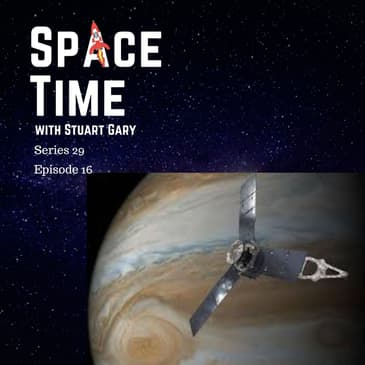
In this episode of SpaceTime, we dive into groundbreaking revelations about Europa's ice shell, explore new evidence for the existence of a potential Planet Nine, and discuss a significant advancement in quantum physics that challenges the Heisenberg Uncertainty Principle.
Europa's Ice Shell Thickness Revealed
Data from NASA's Juno mission has provided the first insights into the thickness of Europa's icy crust, estimating it to be around 29 kilometers. This measurement comes from Juno's 2022 flyby, where the spacecraft utilized its microwave radiometer to analyze the moon's surface temperature and characteristics. The findings suggest that beneath this thick ice lies a global ocean of liquid water, potentially harboring the ingredients necessary for life. Understanding the ice shell's structure is crucial for future missions, including NASA's Europa Clipper, set to arrive in 2030.
The Case for Planet Nine
A new study published in Nature Astronomy presents fresh simulations suggesting that wide-orbit planets, like the hypothesized Planet Nine, could be a natural outcome of chaotic early planetary systems. Researchers found that during turbulent phases of stellar formation, planets can be flung into distant orbits rather than being ejected entirely. This work offers a 40% chance that a Planet Nine-like object exists, providing a promising avenue for future exploration as telescopes become more capable of surveying the distant solar system.
Advancements in Quantum Physics
In a remarkable breakthrough, physicists have demonstrated a method to sidestep the Heisenberg Uncertainty Principle, allowing for simultaneous precise measurements of a particle's position and momentum. This innovative approach, detailed in Science Advances, could pave the way for ultra-precise sensor technologies across various fields, including navigation and astronomy. The study redefines the boundaries of quantum measurement, offering new possibilities for scientific exploration.
www.spacetimewithstuartgary.com
✍️ Episode References
Nature Astronomy
Science Advances
Become a supporter of this podcast: https://www.spreaker.com/podcast/spacetime-your-guide-to-space-astronomy--2458531/support.
This is Spacetime Series twenty nine, Episode sixteen, for broadcast on the sixth of February twenty twenty six. Coming up on Spacetime, scientists finally determine the thickness of Europa's ieshell, a new case for a possible planet nine, and sidestepping the Heisenberg uncertainty principle. All that and more coming up on Spacetime. Welcome to space Time with Stuart Gary. Astronomers have finally received their first clues into the thickness of the frozen ey sheets that cover the Jovian Moon Europa. Data from NASA's Juno mission suggest that the ice shells around twenty nine kilometers thick, at least it is on the part of the Moon with the spacecraft flew over in case steep. Beneath this ice sheet is a global liquid water ocean, containing more water than all the Earth's oceans combined. The new findings reported in the journal Nature Astronomy, obtained using Juno's microwave radiometer during the probe's twenty twenty two fly by of Europa. The junomeasurements the first to discriminate between thin and thick iyceeshore models that have suggested the ice shell is anywhere from less than half a mile tens of miles thick, slightly smaller than Earth's moon. Europa is one of. The Solar System's highest priority science targets for investigating habitability. Evidence suggests that the ingredients of life may well exist in the saltwater ocean that lies beneath its thick icy crust. Uncovering a variety of characteristics of this ice shell, including its thickness, provides crucial pieces in the puzzle of understanding the Moon's internal workings and therefore its potential for the existence of a habitable environment. On September twenty ninth, twenty twenty two, JUNO came within threndred sixty lsomes of europus frozen surface. During this flyby, a spacecraft collected data about half the Moon's surface peering beneath the ice to measure its temperature at various depths. JUNO project scientist Steve Levin from NASA's Jet Propulsion Laboratory in Passing into California, says the twenty nine kilometer estimate relates to the cold, rigid, conductive outer layer of a pure water ice shell. If an inner slightly warmer convective layer also exists. It's possible the total ice thickness would be even greater if, as suggested by some models, the ice shell also contains a modest amount of dissolved salt. Then the estimate of the shell thickness would be reduced by about six kilometers. The thick shell implies a longer route that oxygen and nutrients would have to travel in order to connect Europa's surface to its subsurface ocean, and understanding this process would be highly relevant for future studies of Europa's habitability. The observations also provide new insights into the makeup of the ice just below europe surface, revealing the presence of so called scatterers, irregularities in the near surface ice, such as cracks, paws, and voids, which scatter the instrument's microwaves reflecting off the ice, similar to how visible lights scattered by ice cubes. These scatterers are estimated to be no bigger than a few centimeters in diameter, and they appear to extend to depths of hundreds of meters below Europa's surface. The small size and shallow depths of these features, as modeled in the study suggests they're unlikely to be a significant pathway for oxygen and nutrients to travel from Europa's surface down to its salty ocean. Gino's principal investigator, Scott Bolton, from the Southwest Research Institute in San Antonio, Texas, says how thick the ice shell is and the existence of cracks or pores within it are all part of a complex puzzle needed for understanding Europa's potential habitability. He says they'll provide crucial context for NASA's Europa clippermission and the European Space Agencies duced jupiter Ic Immunes Explorer spacecraft, both of which and now on their way to the Jovian System Europe. The Clipper will arrive there in twenty thirty. Well, Jeez will arrive here later. As for GINO, well, it will carry out its eighty first flyby of Jupiter on February the twenty fifth. Needless to say, we'll keep you informed this report from nasty V. Welcome to Jupiter, the largest planet in our Solar system, three hundred times more massive than Earth. Juno's main mission is to learn more about how Jupiter formed and how the planet works from the outside inn. All we can see now are the tops of the clouds, but Juno's sensitive instruments can look deeper beneath the clouds and churning storms. Juno's orbit takes it over the poles and just three thousand miles above Jupiter's clouds, closer than any other spacecraft has come before. These close encounters allowed Juno to map Jupiter's gravity, magnetic field, and water. Jupiter is so far from the Sun that sunlight here is twenty five times weaker than at Earth. And while there are no astronauts on board, Juno carries three Lego minifigures made of aluminum, the Roman god Jupiter, the goddess Juno, and the famous astronomer Galileo, who in sixteen ten became the first explorer to turn a telescope toward Jupiter. What Galileo saw through a telescope we will explore up close with Juno. This is space time still to come and u K this for a possible planet nine and physicists have reshaped quantum uncertainty to sidestep the restrictions imposed by the famous Heisenberg uncertainty principle. Oh that and more still to come on spacetime. There's new hope today in the ongoing search for a ninth planet out there in the dark outer reaches of our Solar system, somewhere far beyond Neptune. New computer simulations are reported in the journal Nature Astronomy suggests that planets in very wide orbits around their host stars are not anomalies, but rather a natural byproduct of a chaotic early phase in the development of planetary systems. The authors use complex modeling to show that this phase occurs when stars are still tightly packed in their stellar nurseries and planets are still jostling for space in turbulent, crowded systems. One of the studies authors, Nathan Kabe, from the Planetary Science Institute, says the team simulated the capture of planets on distant orbits among a variety of hypothetical planetary systems, and they found that Solar system architectures like the suns have the highest probability of capturing these types of distant outer planets. He says, essentially, it's like watching pinballs in the cosmic arcade. When giant planets scatter each other through gravitational perturbations and directions. Some are flung far away from their heart star. Now, if the timing and surrounding environments are just right, those planets don't get ejected from their systems, but rather they get trapped in extremely wide orbits. For the study, the authors ran thousands of simulations involving different planetary systems embedded in realistic star cluster environments. They modeled a variety of conditions, from systems like our own Solar system with a matrix of gas and ice giants the more exotic systems, including those with two stars. What they discovered was a reoccurring pattern. Planets were frequently pushed into wide eccentric orbits by internal instabilities, but then stabilized thanks to the gravitational influence of nearby stars and the cluster. Cabe says that when these gravitational kicks happen at just the right moment, a planet's orbit becomes des coupled from the inner planetary system, and this creates a wide orbit planet, one that's essentially frozen in place after the cluster disappears. The authors define wide orbit planets as those having semi major axis between one hundred and ten thousand astronomical units, distances that place them far beyond the reach of most traditional planet forming disks. By the way, an astronomical unit, well, that's the average distance between the Earth and the Sun, about one hundred and fifty million kilometers or eight point three light minutes. The findings could explain the long standing mystery of Planet nine, a hypothetical world belief to orbit the Sun at a distance of somewhere between two hundred and fifty and one thousand astronomical units. Though it's never been directly observed, the odd orbits of several trans Neptunian objects tent at its existence. The new simulations showed that this is up to a forty percent chance that a Planet nine like object could have been trapped in such an orbit. The study also ties wide orbit planets to a growing population of roague planets, worlds which were completely ejected from their host star systems. Cape says not every scattered planet is lucky enough to get trapped. In fact, most end up being flung into interstellar space, but the rate at which they do get trapped gives a connection between the planets we see on wide orbits and those we find wandering alone in the galaxy. This concept of trapping efficiency, which is the likelihood that a scattered planet remains bound to its star system is central to the study. The authors found that planetary systems similar to the Sun Solar System are especially efficient, with trapping probabilities of five to ten percent. Other systems, like those composed of only ice giants or circumbinary planets, had much lower efficiencies. Moreover, this study also identifies promising new targets for exoplanet hunters. It suggests that wide orbit planets are most likely to be found around high metallicity stars that already host gas giants, making these systems prime candidates for future deep space imaging campaigns. The authors also noted that if Planet nine really does exist, it could be discovered fairly soon after the VERIICEA Reuben observatory becomes operational. With its unparalleled ability. To survey the sky in depth and detail, the new observatories expected to significantly advance the search for distant Solar System objects, thereby increasing the likelihood of either detecting Planet nine or alternatively providing the evidence needed to totally rule out its existence. This is space time still to come side stepping the Heisenberg uncertainty principle and later in the Science report. A new study warns that people who consume alcohol for longer periods of time are far more likely to develop bowel cancer. All that and more still to come on space time businessests have reshaped quantum uncertainty to sidestep the restrictions imposed by the famous Heisenberg uncertainty principle. The findings, reported in the journal Science Advances, could underpin future ultra precise sensor technology, which is used for navigation, medicine, and astronomy. The Heisenberg uncertainty principle, introduced in nineteen twenty seven, says that you can't know certain pairs of properties, such as the particle's position and momentum, with unlimited precision at the same time. In other words, there's always a trade off and uncertainty, and more closely a properties pinned down the less certain you are about other factors. For example, you can precisely know either where an object is or how fast it's moving, but not both. But now researchers have shown how to engineer a different trade off to precisely measure position and momentum at the same time. Now, according to the authors, the key involves moving the unavoidable quantum uncertainty, the places one doesn't care about. In other words, big course jumps in position and momentum, so the find details one's interested in can be measured more precisely. But of course, even then, aren't you still lacking the accuracy this space? Time and time out of Tech? Another brief look at some of the other stories making US and science this week with a science report. A new study has shown that people who consume alcohol for longer are far more likely to develop bowel cancer. The findings were reported in the journal Cancer. Looked at data on eighty eight thousand and ninety two adults, none of them had cancer when the data was first collected to investigate links between lifetime alcohol consumption and the development of chlorectal cancers. In more than twenty years of follow up, there were one six hundred and seventy nine colorectal cancer cases. With heavy drinkers that's more than fourteen drinks per week, twenty five percent more likely to get colorectal cancer and ninety five percent more likely to get rectal cancer compared to people who drank less than one drink per week. They also found that heavy drinking throughout adulthood was linked to a ninety one percent higher risk of colorectal cancer compared to constant light drinking. In contrast, they found no evidence of increased colorectal cancer risk among former drinkers, who had a lower chance of developing non cancerous tumors which could then go on to become cancerous, then current drinkers averaging less than one drink per week, suggesting that quitting alcohol may well lower your risks. Scientists in the Pacific have sliced open nearly nine hundred dead fish caught by local fishes around the islands of Fiji, Tongua, Tuvalu and Vanawatu, finding that a third of all the fish they examined contained microplastic particles of their bowels. The findings were reported in the Journal Plus one show severity varied between nations, with seventy five percent of Fijian fish contaminated with microplastics compared to just five a fish caught in Vanawatu, while the amount of microplastics within each individual fish was generally lower than that in industrialized nations. The authors are concerned because specific communities rely far more heavily on seafood as their primary protein sauce. A new study has shown that ancient people transported a wild relative of the common potato across the southwestern United States, likely expanding the range of the species. The findings, reported in the journal plus one, showed that granules of the humble spud is found on tills from nine sites going back almost eleven thousand years in areas between Colorado, Utah, Arizona, and New Mexico. The author say previous studies had already found genetic evidence that this particular species of potato was established from a population which was native to much further south. A new study has shown that people hunting for the legendary sasquatch or bigfoot are now using far more sophisticated techniques their ongoing atttempts to find evidence for the hormone its existence. The three year study of bigfoot hunters by scientistic Cardiff University has concluded that those who are searching for squatches are drawing on increasingly sophisticated scientific methods to try and prove its existence. The authors found bigfoot is using a suite of modern technologies such as drones, therm or imaging systems, parabolic dishes in their investigations, but as the skeptics timendum points out, they still haven't found a single shred of scientifically verifiable evidence. If an article came out recently, they was pointing out that bigfoot investigators actually like to use sophisticated techniques for collecting and validating evidence. In other words, they're trying to approach things in a scientific way rather than just in a conspiratorial way or a fantasy way. So that's fair enough, that's good the fact of the technologies they're using, and not particularly cutting edg. Drones and things like that. But I mean it's common, This is not a particularly new idea. There's probably common that bigfoot hunters are actually quite hopeful of finding scientific proof rather than being anti science. And the same would be or it has been similar amongst Uphaud proponents. So though it's changing, and what you're finding is that therefore the Bigfoot want to see verifiable evidence. The travel is what they're finding so far is not very good evidence. And the old story is that a lot of bad evidence doesn't add up to a piece of good evidence. It's just a lot of bad evidence. And in fact, the more bad evidence you have, the less likely something is to be real. You know, if these people are looking at big food from a scientific perspective, there's obviously some problems with it. That bigfoot subtly is everywhere in the US, not just in the northwest Washington's that of Oregon areas. It is all over the place in desert areas as well. So you start wondering, if this animal is so prolific, there should be more evidence found than have been put forward. There's also people now verging because of that, the people verging into very unscientific areas, including sort of parallel universes and supernatural explanations for why they can't catch big food or whatever, even to taking photographs that yeah, they're always fuzzy photographs, And is this because they come from a parallel universe or have supernatural powers? Someone suggests they see that pig would have just buzz the animals and have the way they look. But it's an interesting phenomenon. The UFO people have gone further down to supernatural unscientific areas because they're having trouble. They've probably had a lot more sightings in quotes of the Ufius than the Bigfoot people have, and it's a lot wider spread belief because there's so much bad evidence around, they have to find an alternative, an explanation for the bad evidence. The Bigfoot series, they were looking for scientific evidence. They never actually found any, but they were looking for it. But then in the follow up, the Expedition Bigfoot series, this is where they started speculating whether or not Bigfoot could be an alien or a supernatural being able to disappear and reappear wearing some sort of cloaking device or that sort of thing. It all became very Harry Potter if you. Ask me, yes, trying to explain the way the bad evidence, it's the sad thing. It's an admirable, admirabook that they are trying to use scientific metters and trying to take a scientific approach to evidence. The trouble is when the evidence is not there or when it's very poor, but they are tending to move towards a supernatural explanation or a pseudo scientific explanation, and the UFO people are well advanced down that area, and the big Footers are following in whether it's an alien, whether it's a parallel universe or whatever. So they need to keep thirteen and the triples, the more. They keep thirteen like UFOs, and they don't come up with the goods, and they're very wide searchers these days. You start to one that is the phenomenon not real rather than the explanation being wanting. That's the skeptics timendum, and this is space Time. And that's the show for now. The space Time is available every Monday, Wednesday and Friday through fites dot com, SoundCloud, YouTube, your favorite podcast download provider, and from space Time with Stuart Gary dot com. Space Time's also broadcast through the National Science Foundation, on Science Zone Radio and on both iHeartRadio and tune In Radio. And you can help to support our show by visiting the Spacetime Store for a range of promotional merchandising goodies, or by becoming a Spacetime Patron, which gives you access to triple episode commercial free versions of the show, as well as lots of bonus audio content which doesn't go to air, access to our exclusive Facebook group, and other rewards. Just go to space Time with Steward Gary dot com for full details. You've been listening to space Time with Steward Gary. This has been another quality podcast production from bytes dot com.