
Become a supporter of this podcast: https://www.spreaker.com/podcast/spacetime-with-stuart-gary--2458531/support.
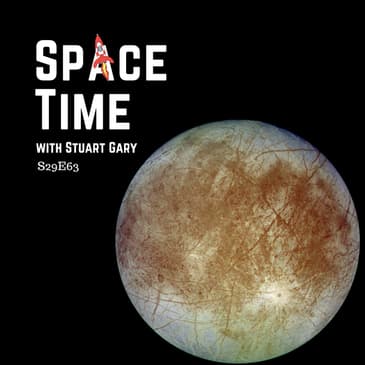
Versus Spacetime Series twenty nine, episode sixty three, for broadcast on the twenty seventh of May twenty twenty six. Coming up on Space Time, Questioning the existence of the ice moon Europa's vapor plumes, A new study raises the questions of whether Earth's co orbitals are stray asteroids or trunks of the Moon, and Europe's Smiles spacecraft is launched on the mission to study Earth's shield against the solar wind. All that and more coming up on Spacetime. Welcome to space Time with Stuart Gary. A new study of Jupiter's ice moon Europa is casting down on previous evidence showing possible vapor plumes ejecting into space. The findings, reported in the journal Astronomy and Astrophysics could have serious implications for the American and European missions now on their way to the Jovian System. Looking back at some fourteen years of Hubble telescope data for Jupiter's moon Europa as given scientists a better understanding of its tenuous atmosphere, but it's also casting down on the idea the ice Moon's intimntly discharging faint water plumes into space from its global subsurface ocean. One of the studies authors, Kurt Ritherford from the Southwest Research Institute in San Antonio, Texas, says the evidence for water vapor plumes on Europa isn't as strong as first thought. Rutherford was one of the authors on the original twenty fourteen paper which proposed the presence of the ice plumes, and he's now reanalyzed the data. His new paper has looked at some fourteen years of data from the Hubble Space Telescope's imaging spectrograph, focusing on Europa's alignment alpha emissions lyman alps, a specific wavelength of ultra violet light emitted and scattered by hydrogen atoms. Rutherford says, between twenty twelve and twenty four the team we're pushing the limits on the Hubble telescope capabilities. One of the difficulties in interpreting the data back then was determining exactly where to place Europe within its context. See The way Hubble works left some uncertainty in terms of placement relative to the center of the image, and if europe His placement was off, even by just a pixel or two, it would have an effect on how the data gets interpreted means that what they originally thought could be evidence of water vapor plumes could also be static noise instead. The re analysis has taken the original ninety nine point nine percent confidence in the plume's existence and reduced it doubt to less than ninety percent confidence. Now that's still pretty good, but it's simply not good enough evidence to support the certainy of the claims being made at the time. Rutherford says the current data set doesn't rule out the possibility of the water plumes first described in the twenty fourteen paper, but it no longer provides concrete evidence for them. The new analysis also provides improved information about the neutral highgen atom component of Europe's escaping atmosphere, originating from its water ice surface. Scientists still hope to find water vapor plumes escaping from Europa. You see. Similar water vapor plumes have been confirmed on Satin's ice moon Enceladus, which also has a global subsurface ocean, and Europa's neighbour Io, another moon of Jupiter, as plumes of sopha dioxide expanding out into space through volcanic eruptions. Cracks in Europa's icy shell could provide potential pathways for liquid water to rise to the surface and then shoot off out into space. And that's important because it would provide an opportunity for NASA's Europa Clipper mission to study the plumes when it arrives in the Jovian System in twenty thirty and when the European Space agencies Jupiter Icy Moons Explorer or Juice mission arrives in the Jovian System the following year. This is space time still to come our Earth's co orbital stray asteroids or chunks of the Moon, and the small mission launches on its mission study Earth's protective shield against the soul or wind. All that and more still to come on space time as well as our moon plated Earth also has a group of asteroids orbiting around the Sun with it, known as co orbitals. These small bodies, sometimes caught extra moons, are caught up in resonance with the Earth and end up staying around for hours, months, or even years before moving off again. Astronomers have long believed that these co orbitals wander in from the main asteroid built between Mars and Jupiter. However, a new report in the journal Icarus claims spectral analysis shows that one of these objects, the twenty four by one hundred and seven meters white asteroid forty six ninety two nineteen Camoalia, as a similar compositional profile space where the ludas silicates that make up the Moon's surface regulith, and that's led some astronomers to suggest a caboaloa may in fact be lunar ejector to be created during an asteroid impact on the Moon, possibly the same event that created the twenty two kilometer wide Geodana Bruno crater. To test the hypothesis, the author's used supercomputer models to simulate twelve thousand possible impact events to see what would happen to this material over millions of years. They found that seventy of these twelve thousand simulations could produce stabilized coorbital objects larger than ten meters in size. Now, that suggests that most of Earth's coorbitals were more likely to have originated from the main asteroid belt, but it also means around four point three percent could have originated from the Moon. China's T two spacecraft is currently on its Guare to study the asteroids on what. Will be a sample or return mission. It'll arrive there next year and collect around a kilogram of regularth from the asteroid surface for return to Earth for more detailed examination and testing. What that sample analysis finds will have a significant impact on science's understanding of orbital mechanics. Now, if the sample is from the main asteroid belt, scientists will need to explain its strange spectral signature. But if the sample turns out to be from the Moon, scientists will be forced to rethink their understanding of the physics of lunar impact mechanics, creter scaling laws, and a range of other characteristics of the Moon. So whatever happens, it'll make for interesting times this space time. Still to come. European Space Agency Smile mission launches on the mission to study the Earth's magnetic shield protecting our planet from the solar wind, and later in the science report, geologists say a new tectonic plate boundary could be forming in Zambia. All that and more still to come on space time. The European Space Agency has successfully launched its Smile spacecraft on an ambitious mission to better understand the interaction between Earth's protective magnetosphere and the constant stream of charged particles flowing out from the Sun in the solar wind and space weather events such as solar and geomagnetic storms. The solar wind can damage anything in its path, especially when it builds up into solar storms. It can erode away a planet's atmosphere and a radiate its surface, destroying life. Our new neighbor, the red planet Mars, is a great example. The Solar Wind Magnetosphere Ionosphere Link Explorer or SMILE spacecraft was launched aboard a Vegas Sea rocket from the European Space Agency's CAREU spaceport in French Guiana. Following launch and separation from the rocket, the first signals from SMILE were received by AES's new Nausea ground station in Australia. The spacecraft's solar panels then deployed, powering its systems and science instruments. SMILE is a collaboration between the European Space Agency and the Chinese Academy of Sciences. It builds on previous spacecraft, including the Cluster Mission and the x MEM mutant Earth Orbiting X ray Telescope. Its three year primary mission will study how Earth responds to the streams of particles and bursts of radiation from the Sun, using an X ray camera to make the first X ray observations of Earth's magnetic shield, and an ultraviolet camera to watch the resulting northern lights non stop for forty five hours at a time. This will allow Astronovus to push the boundaries of science in an effort to answer some of the big questions which have remained a mystery for more than seventy years since scientists first discovered that planet Earth sits within the gigantic bubble of the magnetosphere, and this interaction triggers disturbances ranging from minor substorms to major geomagnetic events, which can ripple through the magnetosphere towards the North and South poles. There, the magnetic storms set off the spectacular northern and southern lights, the Aurora borealis and Aurora astrallus. By comparing the X ray and ultra violet images, astronomers will read in real time the story of how Earth responds to the solar wind onslaught. During the next month, Smile will slowly lift its orbital altitude through a series of e live and engine burns, ultimately ending up in an extremely elliptical orbit that takes it from one hundred and twenty one thousand kilomets above the North Pole, where it collects data before descending down a just five thousand kilomet it's above the South Pole where it delivers that data back to scientists on the Earth. The data collection will begin in earnest in July, after mission managers unfold the spacecraft spooms and open its camera covers and confirm that everything's working. It's expected this report on Smile from Easter TV. Every day Earth faces a relentless attack from the Sun. A usually steady rain of tiny but fierce particles known as the solar wind, can sometimes be interrupted by much bigger b lasts. Luckily, we have a defense, Earth's magnetic field. This shield that Earth holds up against the solar wind is all that prevents our thriving planet from turning into a barren wasteland. And finally, we've reached a moment in history where our scientific tools and technologies are advanced enough to get to the bottom of how exactly this magnetic shield works. Our latest investigator, Smile Smiles, equipped with the unique took it to give us our first complete look that the interaction between the solar wind and Earth. It will be the first ever mission to look at the edge of Earth's magnetic field with X ray vision to uncover where and how our shield is hit. At the same time, it will use ultra violet vision to record the northern lights for more than forty hours at a time, helping us understand how exactly Earth responds to solar storms. SMILE will send the data it collects back down to Earth, mainly to a ground station in O'Higgins, Antarctica. Scientists would dig deep into this data to find out more. They will tackle big questions like what happens where the solar wind meets Earth's magnetic shield, what causes magnetic glitches on the dark side of Earth, and how can we predict the most dangerous threats in advance. This space time and time. That'll take another brief look at some of the other stories making using science this week with the Science Report. A new study is shown that high blood pressure now a fixed two in every five Australians aged eighteen and over, the findings by the Australian Institute of Health and Welfare, and that some thirty nine percent, or seven point two million Australian adults now suffer from hypertension. The study also found that almost two in three Australian adults at sixty three percent with hypertension did not self report the condition, and that indicates they may be unaware that they have a problem. Geologists say a new tectonic plate boundary could be forming in Zambia. The findings, reported in the journal Frontiers in Earth Science, provides more evidence supporting the idea that the African continent is beginning to break up. The authors have found hot thermal springs running through the Cowful Rift in Central Africa, which is part of a two thousand and five kilometa stretcher riffed through the continent. The authors investigated the makeup of gases in these hot springs, finding the levels of helium were comparable to the more established East African rift system, which we already know is in the process of splitting Africa into two separate continents and in that process creating a new ocean. The authors say the gas levels indicate that this newly discovered rift has broken through Earth's crust and into the mantle. While this rift is expected to lead to the breakup of sub Saharan Africa from the rest of the continent. The authors say in the meantime, it could provide economic benefits for the region as it provides access to gethrmal energy, helium, and hydrogen. A new study has found that teenagers spent almost an hour on their phones between ten pm and six am on school nights, a time when they should be sleeping. The findings were reported in the Journal of the American Medical Association. Looked at smartphone usage over this eight hour window because a bedtime of ten pm would allow the maximum amount of recommended sleep before needing to wake up at six am to start the new school day. The authors found that teens spent an average of fifty minutes on their phone during this time, with more than sixty five percent of that time spent on social media apps. More big news in the tech world this week with Google's IO twenty twenty six developers conference in California, announcing a series of updates for a Gemini app with new features including a daily brief, a redesigned interface, access to a new AI video model called Gemini Omney, and a new personal AI agent called Jim and i Spark. The changes signal Google's push to turn into Gemini app into an all purpose AI hub rather than just a standalone chat part, making it more competitive with chat GPT. In Claude with the details were joined by technology editor Alex Sahara Royd from Tech Advice Start Life. Well that had the big Google iOS conference when they had a bunch of major AI announcements. As you can imagine, search has been changed or no more do you have the going that quite well, the Gemini AI overviews to be able to more easily ask questions of Google via this AI mode that sort of expanding that, but also this new mode that allows me to actually have this little actions reated to help you. You might have some sort of guide actually get able to explain stuff to you. There's also information agents and search. There's a personalized of AI agents, but you can start up to work in the background to find what you need when it happens and that information is brought to you. So instead of you searching for things, you are now looking through things that have brought to your attention, that you've curated to have brought to you. So no more are you for the searching that you're actually now looking through things that the system has done for you. On this surgentic sarch the search has been totally redesigned. I mean, I've got this new If you need Gemini for example, there have this new information from the Gemini AI agent. But you can also now ask YouTube. There's a lot of great videos on YouTube, but you don't necessarily in aber to start to the search. But ask YouTube entirely reimagines the experience and you'll see videos the best natural interest and it jumps right to part of the video that's most relevant to you. And look, I've really done that sort of thing. You search FORARD just takes you straight to the part of the video you want to see. But it's all been refreshed. It's all the Gemini start as this personal AI agent in the Gemini app to take actions on your behalf and under your direction. And even if your phone is turned off and you in the phone, this thing keeps working in the background, so you'll get an add to do things for us. Gemini onmen is just can generate samples in any type of output from any type of infant. You might have a resplit of a video that was made, and it can extend loard, it can add things in, it can turns for backgrounds, it can be text of voice and video sort of this next level of AI that we've been talking about for months and years now. That's alex O, Harral Royd Frome, take advice, Start life, and this is space Time. And that's the show for now now. Spacetime is available every Monday, Wednesday and Friday through at bytes dot com, SoundCloud, YouTube, your favorite podcast download provider, and from space Time with Stuart Gary dot com. Space Time's also broadcast through the National Science Foundation, on Science Own Radio and on both iHeartRadio and tune In Radio. And you can help to support our show by visiting the Spacetime Store for a range of promotional merchandising goodies, or by becoming a Spacetime Patron, which gives you access to triple episode commercial free versions of the show, as well as lots of bonnus audio content which doesn't go to weir, access to our exclusive Facebook group, and other rewards. Just go to space Time with Stewart Gary dot com for full details. You've been listening to Spacetime with Stuart Gary. This has been another quality podcast production from bytes dot com.