
Become a supporter of this podcast: https://www.spreaker.com/podcast/spacetime-with-stuart-gary--2458531/support.
00:00:00
This is SpaceTime series 26 episode 124 for broadcast on the
00:00:05
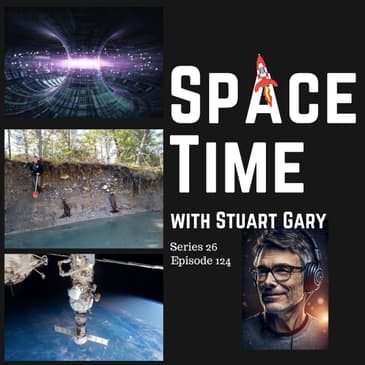
16th of October 2023. Coming up on space time, Australia's first
00:00:11
nuclear fusion reactor, Earth's largest ever solar storm. And
00:00:17
another Russian segment of the International Space Station
00:00:20
springs a leak. All that and more. Coming up on space time.
00:00:25
Welcome to space time with Stuart Gary.
00:00:45
The University Of New South Wales in Sydney has announced
00:00:48
plans to develop Australia's first nuclear fusion Tomac TACS
00:00:53
are one of the technologies being tried around the world to
00:00:56
achieve reliable, safe thermonuclear fusion for power
00:01:00
generation.
00:01:01
Scientists see nuclear fusion as a limitless and clean method of
00:01:05
energy production using nothing but sea water that will
00:01:09
ultimately help end things like global warming and climate
00:01:12
change. Now, nuclear fusion is very different from nuclear
00:01:16
fission used in current nuclear power stations.
00:01:20
Nuclear fission is the process in which uranium atoms are split
00:01:23
apart, releasing a tremendous amount of energy to heat water,
00:01:27
make steam and spin turbines to generate electricity. And
00:01:32
unfortunately, as a by product, it also produces high levels of
00:01:36
radioactive waste. More than 10 per cent of the world's
00:01:39
electricity currently comes from nuclear power plants.
00:01:43
But unlike nuclear fission, nuclear fusion is clean and
00:01:47
limitless. Recently, the Lawrence Livermore National
00:01:50
Laboratories National Ignition Facility in California used
00:01:53
ultra short bursts of 192 high powered lasers to achieve
00:01:58
nuclear fusion in a hydrogen pellet. The laser produced over
00:02:02
2 million joules of energy in a sudden burst lasting just a
00:02:06
nanosecond.
00:02:07
That's 1000 millionth of a second. This generated the
00:02:11
extreme temperatures and pressures needed to trigger a
00:02:13
fusion reaction by heating and compressing the hydrogen
00:02:17
isotopes to just a fraction of their normal size, forcing the
00:02:20
fuse together to make helium and releasing high energy neutrons
00:02:25
in the sun.
00:02:26
This process happens naturally where core temperatures exceed
00:02:29
15 million degrees Celsius and pressures reach £3.84 trillion
00:02:34
per square inch. That's 26.5 pap pascals. But duplicating these
00:02:40
extreme conditions on Earth has proven to be far more difficult.
00:02:43
And the process has become the holy grail of fusion research
00:02:46
ever since the 19 fifties. Laser fusion ignition is one of two
00:02:51
paths that physicists are following in their quest to
00:02:54
achieve nuclear fusion. The other involves magnetic
00:02:58
confinement fusion in which a super heap plasma is contained
00:03:02
in a Taurus or donut shaped vacuum chamber ring called a
00:03:05
Tomac using powerful magnets.
00:03:08
The plasma is made up of heavy and super heavy isotopes of
00:03:11
hydrogen known as deuterium and tritium normal hydrogen, also
00:03:15
known as protium consists of just a single proton in its
00:03:19
nucleus orbited by an electron geum.
00:03:22
Differs in that the nucleus also contains a neutron and tritium
00:03:26
has a proton and two neutrons in its nucleus. These isotopes are
00:03:30
heated to between 153 100 million degrees Celsius by
00:03:34
powerful electric currents within the Tomac ring. At these
00:03:38
extreme temperatures, electrons are ripped off their atoms
00:03:41
forming a charged plasma of hydrogen ions.
00:03:45
This is where the magnets come in. They can find this highly
00:03:49
charged high temperature plasma to an extremely small area
00:03:52
within the ring, thereby maximizing the chance of the
00:03:55
super heated ions fusing together and giving off energy.
00:03:59
It also keeps this hot plasma away from the sides of the
00:04:02
Taurus. Now, the heat generated through this process can be used
00:04:05
to turn water into steam which spins turbines producing
00:04:09
electricity. So far more than 200 experimental Toco Macs have
00:04:13
been built worldwide, but today they've all consumed more energy
00:04:17
than what they produce the massive international to ma
00:04:21
project it.
00:04:22
A the international thermonuclear experimental
00:04:24
reactor is currently under construction in Southern France
00:04:28
with the aim of starting operations in 2027. Meanwhile,
00:04:32
physicists in Germany are using a complicated variation of the
00:04:36
Token Ma known as a Stoler.
00:04:39
It uses a twisting ring design with changes in geometry and
00:04:43
differing magnetic fields. These control the plasma for longer
00:04:47
periods of time compared to the short burst Token Macs usually
00:04:50
achieve the University Of New South Wales nuclear fusion
00:04:54
device will be wholly designed developed built and operated by
00:04:57
students.
00:04:59
The project's headed by nuclear engineering expert Patrick Burr
00:05:02
and aims to have a working device operating within 2 to 3
00:05:05
years. The university's Token Ma will be small just a meter by a
00:05:10
meter and this early Token Ma design will potentially be
00:05:14
followed by other devices also aiming to achieve nuclear fusion
00:05:18
possibly using different methods such as high powered lasers.
00:05:22
The program is being supported by engineering partners, Tomac
00:05:25
energy and HB 11 Energy Burr says the project will be the
00:05:29
first in the world where students will design, build and
00:05:33
manage a fusion reactor.
00:05:35
A tac is a doughnut shaped machine that contains
00:05:41
effectively a vacuum but with a little bit of gas. So it's not
00:05:44
complete vacuum, it's nearly a vacuum but that we put inside
00:05:47
the hydrogen isotopes and then it's got three very large sets
00:05:51
of magnets magnets going around the circumference magnets going
00:05:57
around sort of in the other direction of the you can imagine
00:06:00
and a big magnet in the middle.
00:06:01
And what all those magnets do is that they spin around the atoms
00:06:05
that are inside the vacuum and they spin them very, very, very
00:06:09
fast until well they are ionized atoms, they've been stripped of
00:06:13
the electrons and they get spun very, very quickly until the
00:06:17
force that they have when they collide on one another is enough
00:06:21
to overcome the natural repulsion that when two atoms
00:06:24
bump against one another, they will naturally and just move on,
00:06:27
they repel.
00:06:28
But if you can get them to collide really, really fast,
00:06:31
they will get beyond the natural repulsion and actually fuse
00:06:36
together. And when that happens, you get fusion. So a is one of
00:06:39
the ways in which can achieve fusion by accelerating a plasma
00:06:44
or a gas of charged particles inside a vacuum chamber.
00:06:49
One of those in France right now, aren't they?
00:06:51
Absolutely? The iter is definitely the biggest Tucker
00:06:55
that has ever been so far though. It's actually dwarfed by
00:06:58
the one that will succeed, that 's called demo. So yes, there is
00:07:00
an international consortium. It 's been built in France, but it
00:07:03
actually involves many countries including Australia. In fact,
00:07:07
everyone has been contributing to the development of that ma
00:07:11
machine.
00:07:12
It takes a lot of energy to run these things. But if you fuse
00:07:15
enough hydrogen into helium, there's enough residual energy
00:07:19
produced that there's a little bit more energy than what it
00:07:21
takes to make that thing in the first place. And that's the aim
00:07:24
of the Absolutely.
00:07:26
And in fact, the point of it is to demonstrate that we already
00:07:30
know we can get more energy out than we put in. So fusion is
00:07:34
really an energy amplifier, right?
00:07:35
You need a huge amount of energy to make it go, but then you get
00:07:39
a bit more energy out and it is really about demonstrating the
00:07:43
technologies about the magnets, about the materials, about the
00:07:46
controls, the diagnostics that will allow us to control this
00:07:49
for useful skills, right?
00:07:51
How is the turke different from what the are doing with their
00:07:55
stellar design?
00:07:56
Well, a stellar is not that similar in the sense that it's
00:08:00
also toroid. So it's effectively another doughnut shaped machine.
00:08:04
But the difference there is that it's a very, very complicated
00:08:08
twisted shape of a doughnut and the reason for that and things
00:08:12
like this.
00:08:13
Well, the reason is the simplest way to explain it is this that
00:08:17
so it's very simple to build in principle because you've got
00:08:20
early pre sets of magnets, but it's actually very difficult to
00:08:23
operate because the plasma.
00:08:25
So this current of fast moving atoms that they don't want to
00:08:29
stay around in a nice circular shape, they will tend to try and
00:08:32
escape and you're constantly controlling the currents in all
00:08:35
the magnets to try to keep the plasma do what you want to do.
00:08:39
Well, accelerator. On the other hand, is excruciatingly
00:08:42
difficult to design because the magnets have these really
00:08:45
complicated twisted shapes. But the idea is that once you've
00:08:49
managed to do that, the control of the plasma is really, really
00:08:52
because it naturally wants to remain where it is.
00:08:56
And so you've basically moved the problem of a difficult
00:08:59
control of the plasma to a problem of difficult
00:09:02
construction of really tight tolerances in your magnet
00:09:06
design. The concept is very similar.
00:09:08
Otherwise they've recently in the United States achieved
00:09:12
fusion twice now, but they're using a different system, aren't
00:09:15
they? They're using one involving lasers?
00:09:16
Yes, that's correct. Well, I should clarify. Actually, fusion
00:09:19
has been achieved many times hundreds of times. It's really
00:09:22
been achieved in the United States that you were referencing
00:09:25
to the National Ignition facility. Is that twice they
00:09:28
managed to get more energy out than they put in. And that's a
00:09:31
big, big step forward for the fusion community.
00:09:34
But you're right, they haven't done that with a to or with
00:09:36
Accelerator. They've done that using lasers. Talk about getting
00:09:39
more energy out. But there is a very important point there. But
00:09:42
at the moment, they've only got a little bit out like a tiny,
00:09:45
little bit more. The idea is that you need to get five times
00:09:48
or even 10 times more energy out before it commercially viable.
00:09:52
And they've got to be able to do it consistently too, don't they?
00:09:54
Not just one burst? Absolutely.
00:09:56
And that is the exact point that we're working on here. It's
00:10:00
about working away from. Let's see, what are the conditions we
00:10:03
can achieve and how good is our fusion to? How consistently can
00:10:07
we do it? Can we move from milliseconds to seconds to hours
00:10:10
to days? Because in order to provide electricity to the grid,
00:10:13
it's no good to have energy, but only for a few seconds, you need
00:10:16
to have energy for hours or days at a time.
00:10:19
And there are really many, many different which you can do
00:10:21
fusion. And in fact, there are some 50 plus companies in the
00:10:25
world, all sort of racing to be the first one to build a
00:10:28
commercial fusion reactor. And they're all pursuing very
00:10:30
different technologies.
00:10:31
But broadly speaking, you either use magnets or you use lasers.
00:10:34
And in both cases, what you're trying to do is accelerate atoms
00:10:37
fast enough that they can light together, infuse together with
00:10:40
lasers. All you're doing is imparting a lot of energy to the
00:10:43
atoms from all directions at the same time. And so you're
00:10:46
compressing atoms together.
00:10:47
And that's what the sun does naturally in its core.
00:10:50
Absolutely. Except for the sun does say using gravity actually
00:10:53
because it can, it's enormous.
00:10:55
You guys are planning to build a Token Ma tell me about it.
00:10:58
Yes. So this will be the very first to that is entirely
00:11:01
designed to build and operate by students. So that's what is
00:11:05
innovative about our to it will be very small scale, at least
00:11:08
the first it and I say the first it situation because a key part
00:11:13
of this project is that we're not going to build one and then
00:11:17
that's it, we're going to use it for.
00:11:19
And that's basically the history of all talks that have been
00:11:22
built in history and there's been several, tens of them. But
00:11:25
our goal is to build one. And as soon as we built it and show
00:11:28
what it can do is start building the next one and make it better,
00:11:32
faster, stronger and everything. And this iterative process of
00:11:35
making our reactors keeping them quite small.
00:11:38
So we can meet the rate at a rate of about one new device
00:11:41
every two years. Roughly means that we can really learn very
00:11:44
fast and we can really push the boundary of what is possible at
00:11:48
a much faster pace. It really speeds up the learning curve.
00:11:52
And by doing that, we hope to help our industry partners,
00:11:55
they're aiming to build commercial fusion reactors.
00:11:57
But the challenge that they have is that they have a lot of
00:12:00
engineering challenges, which is a good, that's the good news,
00:12:03
right? Engineering challenges is better than physics challenges.
00:12:06
You know, we don't have to discover new physics. We
00:12:08
understand the physics.
00:12:09
We now need to just deal just in inverted commas, deal with the
00:12:12
engineering challenges to make it feasible. But they've got
00:12:15
lots of challenges and they have to solve all of them in order to
00:12:18
have a commercial reactor. What we're going to do is in each
00:12:21
iteration of the device, we're going to focus on one challenge
00:12:24
and just that one single challenge and we're going to
00:12:27
spend two years trying to solve that one.
00:12:29
And for instance, that might be, can we push the limit of what
00:12:32
the strength of the magnets that we can have on the Dr Ma? So
00:12:36
that we can control a plasma with a higher density, but the
00:12:39
machine doesn't want to rip itself apart because there are
00:12:41
huge forces in part by the magnets.
00:12:43
Or can we design materials that we stand higher temperatures
00:12:46
because these reactors operate at about 100 million degrees C.
00:12:49
So can we design materials that can resend those temperatures
00:12:52
for long enough before we need to replace them? Those are the
00:12:54
sorts of challenges that we hope to help accelerate the
00:12:57
development of for our industry partners.
00:12:59
And that's part of the concept of using magnets around the
00:13:03
Token act to keep the plasma in the center of the doughnut
00:13:07
device so that it doesn't touch the edges. Right. Absolutely
00:13:11
correct.
00:13:11
So in the real world, your very, very hot plasma never touches
00:13:14
the edges, right? And so doesn't destroy your material and the
00:13:17
plasma doesn't cool down either. So that's great.
00:13:19
But in reality, it's actually very difficult to control the
00:13:22
plasma and there will be occasionally and sometimes not
00:13:25
so occasionally deviations from that optimal point, right. So
00:13:28
you have to make engineering materials that can withstand
00:13:31
those transient, those deviation from the idea of setting.
00:13:34
And one great thing about our device is that once we built it,
00:13:37
we're straight on moving on to the next one, which means that
00:13:40
we have a device that we can use for those more destructive type
00:13:43
of testing, then normally you would on a machine that has
00:13:46
taken you 10 years to build and several million dollars to
00:13:49
build, which is doing those tests, to understand what
00:13:52
happens to the machine and to the components of the machine.
00:13:55
When you have a transient in your plasma, for.
00:13:57
The mantra, I keep hearing is always, it's about 10 years
00:14:00
away. It's been about 10 years away for quite some time now.
00:14:03
What's the horizon look like?
00:14:05
Well, you see that's, you know, the joke that's been the future
00:14:09
community for. But there's actually a joke about the joke.
00:14:12
You know, I first heard that when I started my phd and that
00:14:16
was about 15 years ago.
00:14:18
And they used to say when I first heard that joke, they
00:14:21
said, oh fusion is 30 years away and has always been 30 years
00:14:24
away that it's kind of changed its tone and then it became 20
00:14:27
years and most recently 15 and you just said 10 and guess what?
00:14:30
In 15 years, the goal has moved from 30 years to 10 years. I
00:14:34
think that's a successful, right?
00:14:36
So, no, but jokes aside, the truth is this, the goal does not
00:14:40
change if the milestone that when you will achieve future
00:14:43
does not change unless you put, invest into it, right? So if you
00:14:47
need 30 years of development in order to make it happen and you
00:14:50
don't put money into it, it's no one's going to make that
00:14:53
development and it's almost going to be 30 years away.
00:14:55
What's really happened in the last 10 years and especially in
00:14:57
the last five years, it's an unprecedented level of
00:15:00
investment, not just from governments and national labs as
00:15:05
is historic, always been the case like it is the example we
00:15:08
were talking about before.
00:15:09
But now there are a very large number of start up and companies
00:15:13
that have found private investment to do research in
00:15:17
fusion, to develop fusion machines. And I don't know much
00:15:21
about private investors, but I do know that people don't put
00:15:24
money into something unless they get a return in it.
00:15:26
So to me, this is a strong sign that the private investment
00:15:30
sector sees that this is getting close to reality and they've got
00:15:33
to get a return on their money in a reasonable timescale. And
00:15:36
that's really what's kick starting all this accelerated
00:15:38
development of fusion.
00:15:39
And we hope to be a part of that. Where are you going to
00:15:41
build it, going to build UNSW Sydney in the Kensington campus?
00:15:45
And once it's built, it will be open at some days of the year
00:15:49
for the public to see. And we hope to also will it out some of
00:15:52
the events to show the world.
00:15:55
We don't have firm designs and that goes part to the core of
00:15:58
what we're doing. It's going to be entirely designed and built
00:16:00
for students, but we have a parameter space in which to work
00:16:03
in. So we know already that it will be roughly 1 m in diameter.
00:16:07
So that gives you a sense of skill, it's not going to be very
00:16:09
big and that's part of the design criteria. However, that's
00:16:12
the device itself, you very quickly realize that everything
00:16:16
that needs to go around it from the power sources is really
00:16:19
quite big.
00:16:20
The power source itself might be about 10 times the size of the
00:16:22
device. So that gives us a sense of scale of what we're trying to
00:16:25
build a Token. That's a very good question. Thank you. Well,
00:16:29
Toke is the most mature technology in terms of fusion
00:16:32
energy, but by all means, we're not set to only build Tomas.
00:16:36
In fact, whilst the first design will be a to ma we hope that we
00:16:40
will be able to for other technologies in particular laser
00:16:43
technology and laser Ballroom Proton Infusion, which is
00:16:47
pioneered was actually in fact, pioneered here at UNSW and we
00:16:50
are working with a Sydney based company called HP 11 and we hope
00:16:54
to do some devices of that type as well.
00:16:56
We are very technology agnostics and we just hope to be able to
00:16:59
help the entire fusion industry, whatever flavor of reactor
00:17:03
design they're planning to build.
00:17:05
That's Patrick Burr, a senior lecturer at the University Of
00:17:08
New South Wales in Sydney. And this is space time still to
00:17:13
come. Earth's largest ever solar storm and another leak in the
00:17:17
Russian segment of the International Space Station. All
00:17:21
that and more still to come on. Space time.
00:17:40
Scientists have discovered evidence of what may well be the
00:17:43
largest ever solar storm to hit planet Earth. The massive
00:17:47
geomagnetic storm was identified by a huge spike in radiocarbon
00:17:51
levels 14 years ago, discovered during an analysis of
00:17:56
ancient tree rings found in the French Alps, a similar solar
00:18:00
storm today would be absolutely catastrophic for our
00:18:03
technological society.
00:18:05
It would potentially cost billions wiping out
00:18:08
telecommunications and navigation systems, destroying
00:18:11
satellites causing massive electricity grid blackouts and
00:18:15
hitting astronauts with high doses of radiation. The findings
00:18:19
reported in the royal society's philosophical transactions
00:18:22
reveal new insights into the sun 's extreme weather and the risks
00:18:26
that poses for the planet.
00:18:28
The authors measured radio carbon levels in ancient trees
00:18:32
preserved within the eroded banks of the Dots river near gap
00:18:35
in the southern French Alps, the tree trunks which were sub
00:18:39
fossils, meaning his fossilization process has not
00:18:42
been complete, were sliced into tiny tree rings and analysis of
00:18:46
these individual tree rings identified an unprecedented
00:18:50
spike in radiocarbon levels occurring precisely 14 years
00:18:55
ago by comparing the radiocarbon spike with measurements of
00:18:59
beryllium chemical element found in Greenland ice cores.
00:19:02
The authors proposed that the spike was caused by a massive
00:19:05
salt storm which would have ejected huge volumes of
00:19:09
energetic particles into Earth's atmosphere. The study's lead
00:19:13
author Edward Bard from the College Of France says
00:19:16
radiocarbon is constantly being produced in the upper atmosphere
00:19:19
through a chain reaction initiated by cosmic rays.
00:19:23
Recently, scientists found that extreme solar events including
00:19:27
solar flares and coronal mass ejections can also create short
00:19:31
term bursts of energetic particles which are then
00:19:34
preserved to see spikes in radio carbon production occurring over
00:19:38
the course of just a single year. The researchers say that
00:19:42
this occurrence of similar massive solar storms today would
00:19:46
be catastrophic for a modern technological society.
00:19:50
They warn that it's critical to understand the future risks of
00:19:53
events like this in order to enable better protection, build
00:19:56
resilience into communications and energy systems and shield
00:20:00
them from the potential damage. You see extreme solar storms can
00:20:04
have huge impacts on Earth.
00:20:06
A sudden flood of charged particles reaching power lines
00:20:10
will overload transformers causing them to blow. Now, sure
00:20:15
you can replace one or two transformers but having to
00:20:17
replace hundreds even thousands at one time would take years.
00:20:22
The result would mean huge widespread power blackouts
00:20:26
lasting for ages. And of course, these same solar storms will
00:20:30
also damage spacecraft affecting global communication and
00:20:33
navigation systems.
00:20:35
And that can happen in one of two ways. Either the spacecraft
00:20:38
itself can have its circuits fried or the spacecraft's life
00:20:42
could be shortened by expanding the Earth's atmosphere which
00:20:45
would cause greater atmospheric drag for an orbiting spacecraft
00:20:49
that would cause them to lose altitude, meaning more fuel
00:20:52
would have to be used in order to regain a higher orbit as far
00:20:56
as we know, nine such extreme solar storms.
00:20:59
Known as Maik events have now been identified as having
00:21:02
occurred over the past 1500 years. The most recent confirmed
00:21:07
Mallika event occurred in the year 993 with another one in the
00:21:11
year 774.
00:21:14
But this newly identified 14 year old storm is however, the
00:21:18
largest that has ever been found roughly twice the size of the
00:21:22
other two. The exact nature of these mae events remain poorly
00:21:26
understood. That's because they've never been directly
00:21:29
observed or monitored with instruments. But they highlight
00:21:33
that we still have much to learn about the behavior of the sun
00:21:36
and the dangers it poses to society on Earth.
00:21:40
We simply don't know what causes such extreme solar storms to
00:21:44
occur, how frequently they really occur. And if there's
00:21:47
anything we can do to predict them baird points out that
00:21:51
direct instrumental measurements of solar activity really only
00:21:54
began in the 17th century with the start of people cutting
00:21:58
sunspots.
00:21:59
Nowadays, of course, very detailed records are kept using
00:22:02
ground and space based observatories. However, these
00:22:06
relatively short term instrumental records are
00:22:09
insufficient for a complete understanding of the sun
00:22:12
radiocarbon measured in tree rings used alongside bum in the
00:22:16
polar ice cores, provides the best way to understand the sun's
00:22:19
behavior further back into the past.
00:22:22
Right now, the largest directly observed solar storm which
00:22:26
occurred back in 18 59 is known as the Carrington event. It
00:22:31
caused massive disruption on Earth, destroying telegraph
00:22:34
machines and creating night time aurore so bright you could read
00:22:38
a paper without turning on a light. However, the Maaki events
00:22:42
including this newly discovered 14 year old storm would have
00:22:46
been a staggering entire order of magnitude greater in size.
00:22:51
This is space time still to come. Another leak from the
00:22:56
Russian segment of the International Space Station. And
00:22:59
later in the science report, the World Meteorological
00:23:02
Organization says planet Earth's just experienced its hottest
00:23:05
September on record all that and more still to come on space
00:23:10
time.
00:23:26
The NCA multi purpose logistics laboratory module on the Russian
00:23:29
segment of the International Space Station has sprung a
00:23:32
coolant leak. It's the third leak involving a cooling system
00:23:36
aboard a Russian made spacecraft in less than a year and that's
00:23:40
raising new concerns about the reliability of Moscow's space
00:23:44
program.
00:23:45
Similar coolant leaks hit both the Soyuz MS 22 capsule in
00:23:49
December last year and the progress MS 21 cargo ship in
00:23:53
February this year. Both while they're attached to the
00:23:56
International Space Station.
00:23:59
The latest leak was discovered when flecks of frozen coolant
00:24:02
were seen spraying into space from the module's external back
00:24:06
up radiator circuit during a live feed of the Russian
00:24:09
orbital. Now collab and later confirmed in radio chatter
00:24:13
between us mission control and astronauts took more than 10
00:24:17
years longer to build than expected.
00:24:19
And after it finally reached orbit in 2021 it suffered more
00:24:23
problems. In fact, just hours after being attached to the
00:24:26
space station, its main thrusters suddenly began firing
00:24:30
all by themselves, sending the entire space station spinning
00:24:33
out of control.
00:24:35
Crews were forced to fire other opposing thrusters in order to
00:24:38
try and counter the effect of the NCA thrusters which couldn't
00:24:42
be turned off until they had exhausted their entire fuel
00:24:45
supply. As for this latest problem.
00:24:47
Well, the Russian Space Agency, Ros Kosmos says temperatures
00:24:51
aboard the space station remain normal despite the latest
00:24:54
incident, that's because the module's primary radiator
00:24:58
remained working nominally providing full cooling to the
00:25:01
module when these leaks first began occurring.
00:25:04
Ros cosmos put them down to micro meteoroid impacts but with
00:25:09
three leaks involving the same equipment that's raising real
00:25:12
concerns about the reliability of Russian manufacturing.
00:25:16
You see the coolant leaks aren't isolated incidents, air leaks,
00:25:21
venting atmosphere into space have regularly affected other
00:25:24
Russian equipment on the space station, including a leaky Soyuz
00:25:27
capsule which was docked to the orbiting outpost and several air
00:25:31
leaks in other Russian modules, some of which have been patched
00:25:34
but others are in such inaccessible areas, they can't
00:25:37
be fixed.
00:25:39
And so thanks to these Russian modules, the space station will
00:25:42
always be leaking oxygen and it 's not just leaks.
00:25:47
Back in 2018, there was a near fatal ascent board just two
00:25:51
minutes into the flight of a man Soyuz bound for the space
00:25:54
station that was eventually blamed on a strap on booster
00:25:57
being wrongly attached and consequently slamming into the
00:26:01
core stage of the Soyuz rocket.
00:26:03
Instead of flipping away, the International Space Station
00:26:07
remains one of the few areas of co-operation still going on
00:26:10
between Moscow and the West. In the wake of Russia's invasion of
00:26:13
Ukraine and the international sanctions which have been
00:26:16
imposed as a result. This is space time and time now to take
00:26:37
a brief look at some of the other stories making news in
00:26:39
science.
00:26:39
This week with the science report, the World Meteorological
00:26:44
Organization says planet Earth has just experienced its hottest
00:26:47
September on record and by a record breaking margin,
00:26:51
September had an average surface temperature of 16.38 °C.
00:26:57
That's a full half degree above the temperature for the previous
00:27:00
warmest September back in 2020 about 1.75 °C warmer for the
00:27:05
month of September compared to pre industrial references from
00:27:09
the 18 fifties to the 19 hundreds.
00:27:12
According to the World Meteorological Organization, the
00:27:15
current extended streak of high land and sea surface
00:27:18
temperatures is an ominous signal about the speed with
00:27:21
which greenhouse gasses are changing our climate. They say
00:27:25
2023 is now on track to be the warmest year on record.
00:27:30
A new study claims eating grapes could be good for eye health.
00:27:35
The findings reported in the journal food and function,
00:27:38
examine the impact of regular grape consumption on macular
00:27:41
pigment accumulation and other biomarkers of eye health
00:27:45
statistics shows us that an aging population has a higher
00:27:49
risk of eye disease and vision problems.
00:27:52
Key risk factors for eye disease include oxidative stress and
00:27:56
high levels of ocular advanced gly and products. The 16 week
00:28:01
study involved 34 people consuming either 1.5 cups of
00:28:05
grapes per day or a placebo. And the grape eaters showed a
00:28:09
significant increase in macular pigment, optical density plasma
00:28:13
antioxidant capacity and total phenolic content.
00:28:17
Compared to those in the placebo. Those who didn't
00:28:20
consume grapes also saw a significant increase in harmful
00:28:23
advanced end products as measured in the skin. The study
00:28:27
is the first to show that grape consumption beneficially impacts
00:28:31
our health in humans.
00:28:34
A new study has found that cats purr differently to what was
00:28:37
previously thought cats are vocal creatures. They meow, they
00:28:42
squeak, they screech and they purr from a voice production
00:28:46
point of view, the meows squeaks and Screeches aren't
00:28:50
particularly special.
00:28:51
Their sounds generated by the cat's lyrics of voice box, just
00:28:55
like the vocalization in humans and many other mammals. In
00:28:58
contrast, a cat's purr was long believed to be exceptional.
00:29:03
Research.
00:29:04
Dating back half a century suggested that the ps were being
00:29:07
produced by a special mechanism through the cyclic contraction
00:29:10
and relaxation of muscles in the vocal folds within the larynx,
00:29:14
thereby requiring constant neural input and control from
00:29:17
the brain.
00:29:19
However, a new study by the University Of Vienna now
00:29:22
demonstrates that these cyclic muscle contractions are not
00:29:25
needed to generate cat purrs data from a controlled
00:29:29
laboratory experiment shows that the domestic cats lyrics can
00:29:32
produce impressively low pitched sounds, purring frequencies
00:29:36
without any cyclic neural input or repetitive muscle
00:29:39
contractions being needed.
00:29:41
They say the observed sound production mechanism is actually
00:29:44
strikingly similar to human creaky voice.
00:29:48
Back in May last year, we ran a scientifically accurate story in
00:29:52
our Australian Skeptics report exposing a pseudoscientific scam
00:29:56
by anti vaxxers falsely claiming that they can remove vaccines
00:30:00
from the bodies of people who were vaccinated, but later
00:30:03
change their minds. In other words, they claim they could de
00:30:07
vaccinate people. Well, we cried bull dust on that.
00:30:11
However, last month, fact checkers from YouTube decided to
00:30:14
remove the story wrongly claiming that it was spreading
00:30:17
medical misinformation and was in breach of their community
00:30:20
guidelines because our story is medically and scientifically
00:30:25
accurate. We stand by it and we regard this as a case of putting
00:30:29
truth to power. We say YouTube's so called fact checkers are
00:30:34
wrong in fact and so should be permanently removed from their
00:30:37
jobs.
00:30:38
We asked YouTube to appear on our show to explain their
00:30:41
decision so we can better understand their reasoning and
00:30:44
exactly what they're claiming with medical misinformation.
00:30:48
See, we found no misinformation and none of the medical experts
00:30:51
we consulted, found any misinformation either but
00:30:55
surprise, surprise YouTube have declined. Luckily, Tim Mendham
00:30:59
from Australian Skeptics who was part of that original story
00:31:03
wasn't so reticent.
00:31:04
You wonder if they were objecting to it because it
00:31:07
contained medical misinformation regardless of that. We were
00:31:10
actually criticizing it. So, because it was in there, they
00:31:12
then decided to ban it.
00:31:13
It's like if you're giving a speech and you quote a out and
00:31:17
out neo nazi or racist or something as a five words, the
00:31:20
start of your speech, the whole speech gets scrubbed. But I know
00:31:22
if that was the case, you don't get a chance to argue back.
00:31:25
Do you? Firstly, what they said wasn't a fact because there was
00:31:28
nothing wrong in our story. Our story was stating a scientific
00:31:32
fact that you cannot de vaccinate someone who has been
00:31:34
vaccinated because that's not how vaccines work. They don't
00:31:37
stay in the bloodstream for 1000 years.
00:31:39
They do what they're supposed to do, then they die and disappear.
00:31:42
That was what we were saying in the story. And yet these fact
00:31:45
checkers or in this case, fact fiction were at odds with that
00:31:49
and they seemed most upset when we challenged them. How dare we
00:31:52
challenge them.
00:31:52
We originally got this story from the conversation, which is
00:31:56
a series of articles regularly published from academics around
00:31:59
the world. It's a good source of short articles about 900 words.
00:32:04
I know exactly because I copied some of the Frown magazine which
00:32:06
we're allowed to do and they publish a lot of these things.
00:32:08
If you just go to the conversation and look it up,
00:32:11
then you'll find a lot of articles on a whole range of
00:32:13
different topics, some of which I disagree with. A lot of them
00:32:15
are fine.
00:32:15
This was a story called No, you cannot de vaccinate yourself.
00:32:19
And it specifically referred to some treatments that were being
00:32:22
suggested including snake venom kits and cupping bleach as well.
00:32:27
Having a bath in bleach. The snake venom kits are notoriously
00:32:31
poor at withdrawing snake venom and that's when you use them
00:32:34
straight away.
00:32:34
Someone suggested that their effectiveness of removing venom,
00:32:37
they get about 0.04 per cent of the venom out. And at the same
00:32:41
time, they probably cause more damage to the soft tissue around
00:32:43
where you're applying it than just leaving it there.
00:32:46
And then there's the cupping, which is the little glass bowls,
00:32:48
you heat up the air inside it with a match or a paper or
00:32:51
something and then you and you suck the poison out and often
00:32:54
the sucking just goes straight onto the skin.
00:32:55
In this case, they're talking about putting a little cut in
00:32:57
the skin and then putting the ball on top of it to draw out
00:33:00
the nastiness through the cut. This is probably dangerous
00:33:03
because you're going to damage the tissue around where the cut
00:33:06
is.
00:33:06
And in any case that would only affect things on the resurface
00:33:08
or just below the surface of the skin, it's not going to go deep
00:33:11
into your body and remove a vaccine, which as you say has
00:33:15
probably by that stage, sort of passed through, pass through
00:33:17
everything and then it's sort of dissipating as for recommending
00:33:19
bathing in bleach or baking soda or bathing in bleach doesn't
00:33:23
sound like a good idea to me.
00:33:25
And I don't know how they're supposed to get the vaccine out.
00:33:27
So, anti vaccine movements think up any excuse they can to help
00:33:32
their clientele and these things just didn't work for various
00:33:35
reasons.
00:33:35
One that's not how you get rid of vaccines. You can't get rid
00:33:38
of once it's in. And these technologies don't work in any
00:33:41
case whether it's the vaccines or not. So it's surprising that
00:33:44
YouTube would ban that story.
00:33:46
I occasionally get banned on Tumblr because they say my
00:33:50
images are pornographic. They're actually images of planets and
00:33:53
things like this. The computer sees a certain color and it
00:33:58
thinks, oh, this must be a naked.
00:33:59
Lady and here's the word Venus or uranus even worse.
00:34:05
So it's a sad situation where someone can complain and
00:34:08
presumably this was someone who 's supporting the vaccine
00:34:11
removal, complains about a story and it just gets taken down.
00:34:14
That's a bit sort of severe. And then we.
00:34:16
Challenged it and the YouTube Fact Checkers and I use that
00:34:20
term very loosely because they're not checking facts.
00:34:22
They're obviously using their own opinions, either they didn't
00:34:25
understand the article because they're not very bright or
00:34:28
alternatively, they did understand the article and
00:34:30
they're actually in support of the idea of these de vaccination
00:34:35
things, which is scientifically unsound and medically
00:34:38
ridiculous.
00:34:39
But nevertheless, that's what they did. And I thought it was
00:34:42
important that you a chance to rebuff their claims and we'll
00:34:47
get this on air before they decide to fact check this and
00:34:49
ban this as well. Which is probably what they'll do if they
00:34:51
follow a course.
00:34:52
It could be a third reason, of course is that there's so much
00:34:54
garbage on YouTube that they're sort of like the clerk in the
00:34:57
office, stamp, stamp, stamp, stamp, stamp on and let God sort
00:35:01
them out in heaven. Yeah, in a way. Yeah. And just because they
00:35:04
just don't have time someone complains about something.
00:35:06
Oh yeah, I approve that bang bang bang. Then I fact check,
00:35:08
they're not even checking perhaps. And of course, as soon
00:35:10
as they hear that they'll be wiped again. But, you know, I
00:35:14
mean, they either don't know something or they're sympathetic
00:35:17
or they just don't have time to.
00:35:19
Know something, then they shouldn't be making a judgment.
00:35:21
If they're sympathetic, then they shouldn't be making a
00:35:23
judgment. And if they don't have time to check, guess what, they
00:35:26
shouldn't be making a judgment.
00:35:29
So YouTube the ball's in your court to all the social media,
00:35:33
social media is so rife with phony fact checkers, phony,
00:35:37
phony stuff and then phony fact checking.
00:35:39
It was Mehta who admitted that fact checking is simply an
00:35:44
opinion. Well, they admitted, they admitted that in court that
00:35:48
fact checking is simply opinion.
00:35:50
And as we always say, do your own research.
00:35:52
Exactly. Best thing to do. It's what we do. That's Tim Menem
00:35:56
from Australian Skeptics.
00:36:13
And that's the show for now. SpaceTime is available every
00:36:17
Monday, Wednesday and Friday through Apple Podcasts, itunes,
00:36:21
Stitcher, Google Podcast podcasts, Spotify, Acast, Amazon
00:36:26
music bits dot com, Soundcloud, YouTube, your favorite podcast
00:36:30
download provider.
00:36:32
And from space time with Stuart Gary dot com. SpaceTime is also
00:36:36
broadcast through the National Science Foundation on Science
00:36:39
Zone Radio and on both iheartradio and Tune In Radio.
00:36:43
And you can help to support our show by visiting the SpaceTime
00:36:46
Store for a range of promotional merchandizing goodies or by
00:36:50
becoming a SpaceTime patron, which gives you access to triple
00:36:53
episode commercial free versions of the show as well as lots of
00:36:56
bonus audio content which doesn't go to air access to our
00:37:00
exclusive Facebook group and other rewards.
00:37:03
Just go to space time with Stuart Garry dot com for full
00:37:06
details. And if you want more space time, please check out our
00:37:09
blog where you'll find all the stuff we couldn't fit in the
00:37:12
show as well as heaps of images, news stories, loads of videos
00:37:16
and things on the web.
00:37:17
I find interesting or amusing. Just go to space time with
00:37:20
Stuart Gary dot Tumblr dot com. That's all one word and that's
00:37:25
Tumblr without the E, you can also follow us through at Stuart
00:37:28
Gary on Twitter at SpaceTime with Stuart Gary on Instagram
00:37:32
through our space time YouTube channel and on Facebook, just go
00:37:36
to Facebook dot com forward slash space time with Stuart
00:37:39
Gary.
00:37:40
And SpaceTime is brought to you in collaboration with Australian
00:37:43
Sky and Telescope Magazine, your Window on the Universe.
00:37:47
You've been listening to Space Time with Stuart Garry. This has
00:37:51
been another quality podcast production from bytes dot com.