
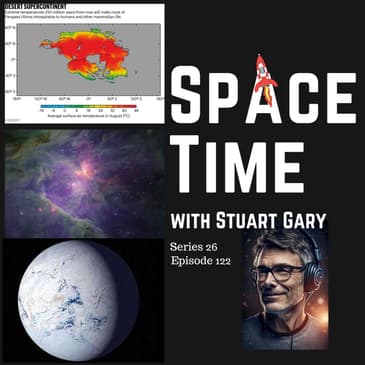
For more space and science updates, subscribe to SpaceTime with Stuart Gary on your favorite podcast platform. Visit our website ( spacetimewithstuartgary.com ) for additional show links and support the podcast through our premium versions on Spotify, Apple Podcasts. Patreon and Supercast.
Become a supporter of this podcast: https://www.spreaker.com/podcast/spacetime-with-stuart-gary--2458531/support.
00:00:00
STUART GARY: This is Space Time series 26 episode 100 and 22 for
00:00:04
broadcast on the 11th of October 2023. Coming up on Space Time,
00:00:09
humans and other mammals are likely to be extinct within 250
00:00:13
million years, strange mysterious planet like objects
00:00:17
discovered in the Orion Nebula and the link between snowball
00:00:22
Earth and complex life. All that and more coming up on Space
00:00:27
Time.
00:00:28
GENERIC: Welcome to Space Time with Stuart Gary.
00:00:48
STUART GARY: A new study looking at how continental drift will
00:00:51
change the face of Earth into the future shows that the
00:00:54
creation of the next Supercontinent Pangaea ultima
00:00:57
will probably have a side effect of causing humans and other
00:01:01
mammals to become extinct.
00:01:03
That's assuming people haven't already done so before then, the
00:01:06
findings reported in the Journal Nature Geoscience shows that
00:01:10
Pangaea ultimate forms around 250 million years from now as a
00:01:14
land mass comprising Australia, Europe, Asia and Africa merges
00:01:18
with the Americas.
00:01:20
This new super continent will trigger massive climate,
00:01:23
extremes causing intense dry heat and making it difficult for
00:01:27
almost any mammal to survive. The climate models suggest that
00:01:31
the planet will undergo its greatest mass extinction event
00:01:34
since the Kei boundary Chiel asteroid salad to the Gulf Of
00:01:38
Mexico's Yucatan Peninsula, 66 million years ago, wiping out 75
00:01:44
per cent of all life on Earth including all the non avian
00:01:47
dinosaurs.
00:01:49
This new research by the University Of Bristol is based
00:01:52
on new supercomputer simulations.
00:01:55
It shows how as the world's continents merge, they form a
00:01:58
giant hot dry and largely uninhabitable Supercontinent
00:02:02
studded with lots of frequently erupting volcanoes where the
00:02:06
different tectonic plates meet and subduct under each other and
00:02:09
where former mid ocean ridges are buried. The increased
00:02:13
volcanic activity produces vast amounts of carbon dioxide which
00:02:17
is then spewed out into the atmosphere further warming the
00:02:20
planet.
00:02:22
In fact, the authors think co two concentrations could rise
00:02:25
from around 420 parts per million today to somewhere over
00:02:29
600 parts per million.
00:02:31
Simulations also predict that the sun will become increasingly
00:02:35
brighter, emitting 2.5 per cent more energy further heading the
00:02:39
Earth's crust, only around 8 to 16 per cent of land will be
00:02:43
hable for mammals. See, the problem is while they've evolved
00:02:47
to lower their body temperature, survivability limits mammals,
00:02:51
upper temperature tolerances have remained pretty well
00:02:54
constant.
00:02:56
This makes exposure to prolonged excessive heat much harder to
00:02:59
overcome and the climate simulations if realized would
00:03:03
ultimately prove unsurvivable.
00:03:05
The study's lead author Alexander Farnsworth says the
00:03:08
newly emerged Supercontinent would effectively create a
00:03:12
triple whammy iris in the continental effect of moving
00:03:16
tectonic plates, a hotter sun and more carbon dioxide in the
00:03:20
atmosphere. The result is a mostly hostile environment
00:03:24
devoid of food and water resources for mammals.
00:03:28
Meanwhile, Curtin University led supercomputer research has found
00:03:32
that the next Supercontinent will form in what is now the
00:03:35
Tropical Pacific Ocean. Apparently that's because the
00:03:38
thickness and strength of tectonic plates under the oceans
00:03:41
tend to reduce with time.
00:03:44
This makes it difficult for the next Supercontinent to assemble
00:03:47
by closing young oceans with thicker plates like the Atlantic
00:03:50
and Indian. The study's lead author, Chu and Hung says that
00:03:54
over the past 2 billion years or so, Earth's continents have
00:03:57
collided together to form a Supercontinent roughly every 600
00:04:01
million years or so through a process known as the super
00:04:04
continental cycle.
00:04:06
Huang says the new Supercontinent will form in the
00:04:09
Tropical Pacific Ocean as America collides with Asia
00:04:13
Australia is also expected to play a role in this event after
00:04:17
first colliding with Asia and then connecting America to Asia
00:04:20
once the Pacific Ocean closes by simulating how the Earth's
00:04:25
tectonic plates are expected to evolve.
00:04:27
And colleagues were able to show that in less than 300 million
00:04:30
years time, it's likely that the Pacific Ocean will be closed,
00:04:34
debunking previous hypotheses.
00:04:37
The Pacific Ocean's what's now left of the Panth ASIS Super
00:04:41
Ocean. It started to form some 700 million years ago when the
00:04:45
previous Supercontinent, Pangea started to break apart. It's the
00:04:50
oldest ocean we have on Earth and began shrinking from its
00:04:53
maximum size during the age of dinosaurs.
00:04:56
It's currently shrinking in size by just a few centimeters per
00:05:00
year. And so it should take two or 300 million years before
00:05:03
closing up entirely with most of the land all piled up in one
00:05:08
place, creating new tall young mountain ranges. The sea levels
00:05:12
are expected to be lower.
00:05:13
The Curtin University results match those of Bristol
00:05:17
University finding that the vast interior of the Supercontinent
00:05:21
will be very arid with high daily temperatures. Huang says
00:05:25
having the whole world dominated by a single continental mass
00:05:28
will dramatically alter Earth's ecosystems and environment.
00:05:32
CHUAN HUANG: Scientists discovered over the last 30
00:05:36
years, the all the world continent every now and then
00:05:39
come together and then break up again, then come together again.
00:05:42
And it turned out it happened at least three times in history.
00:05:45
It's kind of like every 600 million years. So they research
00:05:49
is we try to figure out how does the super come together?
00:05:52
And there are two or three ways of doing that when one is super
00:05:57
break up, then inward closing the new ocean. The other way is
00:06:01
to break up people moving away from the original place, then
00:06:05
collect together on the other side of the globe act closing
00:06:09
the ocean.
00:06:10
So this is the research we try to figure out why the form in
00:06:14
different ways and what's control it. Yeah. So after
00:06:18
playing with a few different parameters and we realize it's
00:06:21
really the strength of the Earth, the shall we call it the
00:06:24
shallow? So under the super ocean near the supercon that
00:06:28
control the power of super four, it's not.
00:06:30
STUART GARY: Just the convection of material coming up from the
00:06:33
mantle along the mid ocean ridges that's causing spread.
00:06:36
It's it's also the thickness of the lithosphere itself.
00:06:39
CHUAN HUANG: Yeah, it's a both the and also the you know, you
00:06:44
know, the new, yeah, yeah. New ocean cross and form at the
00:06:48
middle. But at the other end, they go down and really how easy
00:06:51
this is they can go down and go deep that was controlling our
00:06:56
Supercontinent form.
00:06:56
STUART GARY: You guys found that it's the thickness of the
00:06:59
lithosphere that's changing as well.
00:07:00
CHUAN HUANG: This is a surprise funding actually, when we
00:07:02
started this modeling, we didn't know exactly what controlling
00:07:06
it. Then we realized it's really how strong the oceanic lire
00:07:09
controlling our form. And then we realized the ocean craft
00:07:13
actually getting thinner with time because as the as the Earth
00:07:17
cruise is produce less me, the less me causing the oceanic
00:07:21
craft to thin with time.
00:07:23
So kind of when we traffic they cross getting thinner, thinner.
00:07:26
So turn out we only able to handle form by ward trapping in
00:07:30
some 5, 600 million years ago, but not, not after that. So
00:07:33
that's the let us to make a producing for future
00:07:36
Supercontinent, they can only form by colluding the super
00:07:39
ocean surrounding the Supercontinent.
00:07:41
STUART GARY: We often talk about super continents and have a form
00:07:45
and then break apart and new ones form. That's right.
00:07:48
CHUAN HUANG: That's nearly 30 years ago. The only real
00:07:52
Supercontinent called Pangaea that's from before dinosaur from
00:07:55
this Pangaea from like 320 million years ago. And they
00:07:58
break up, broke up for the 107 170 180 years ago before tea. We
00:08:02
know that was Goana but Goa was only half of the continent is
00:08:07
not really a full Supercontinent.
00:08:08
Yeah, you're right. Gowan formed at about the country boundary
00:08:11
540 million a year. And then before then we knew almost
00:08:14
nothing 30 years ago, we only learned over the last 30 years,
00:08:18
there was a two pan like super form even before Goa.
00:08:22
Yeah. One called Roia, one called Lunar. Yeah, Roia form
00:08:26
around 900 million years ago. No, like 100 and 15 years ago.
00:08:29
STUART GARY: Now we're heading towards the next super continent
00:08:32
which you guys have dubbed. I think it's a name. You guys have
00:08:35
come up with a Asia.
00:08:37
CHUAN HUANG: A is a name, it's a name coined by a well known Paul
00:08:42
Homan from Canada. He believe the next continent subcontinent
00:08:46
form by having the American, the American continent. Gliding
00:08:50
Asia. I treat everything including Pacific Ocean. So
00:08:52
America and Asia.
00:08:54
STUART GARY: Asia and there's no need for people to rush to Bondi
00:08:57
Beach just yet. This will take 600 million years or something.
00:09:01
CHUAN HUANG: Yeah. Now we are in the middle of super credit. So
00:09:04
the previous the pan was 300 million years before now. And
00:09:08
now you reach to East and America in the west. And so we
00:09:13
are right in the middle of the Super cycle. Yeah, I mean you
00:09:16
are living on the coast.
00:09:17
STUART GARY: That's Chuan Heang from Curtin University and this
00:09:22
is Space Time still to come, strange mysterious planet like
00:09:27
objects discovered in the Orion Nebula and the link between
00:09:31
snowball Earth and complex life. All that and more still to come
00:09:36
on Space Time.
00:09:52
New images from the James Webb Space Telescope have revealed
00:09:56
strange planet like structures in the Orion Nebula. The images
00:10:01
taken with Webb's near infrared camera show both planet forming
00:10:05
disks around young stars as well as what appear to be free
00:10:08
floating planetary mass objects.
00:10:11
The free floating planetary mass objects seem to always be in
00:10:14
pairs have consequently been named Jupiter mass binary
00:10:18
objects or Jumbos. For short, these Jumbos are gas giants far
00:10:23
too small to be stars. But the thing is they're not orbiting
00:10:27
around apparent star as normal planets do the discovery
00:10:31
challenges. Existing hypotheses on star and part formation.
00:10:36
See the current doctrine indicates that stars are only
00:10:40
formed by the gravitational collapse of cold molecular gas
00:10:44
and dust clouds. While planets are only formed from the
00:10:48
accretion of material in the protoplanetary discs surrounding
00:10:51
a newly formed star. However, the discovery of so called
00:10:55
failed stars known as brown dwarves.
00:10:57
In the 19 nineties began to blur this distinction. Now, the
00:11:02
detection of what appear to be Jovian sized proto planets free
00:11:05
floating beyond any parent star is providing further fuel for
00:11:09
discussion among astronomers. The observations suggest that
00:11:13
these objects are only about a million years old, relatively
00:11:16
newborn.
00:11:17
In astronomical terms, they have surface temperatures of roughly
00:11:21
1000 °C, but that doesn't last very long, then they rapidly
00:11:25
cool down before freezing even more. Baffling is the fact that
00:11:29
these objects appear to only ever form as pairs, never
00:11:33
individually.
00:11:34
Now, the best hypotheses to try and explain them suggest that
00:11:38
either they're formed in areas of the nebula, too sparse to
00:11:41
create proper stars or they were formed as planets meant to orbit
00:11:45
stars. But for one reason or another were rejected out of
00:11:49
their orbits by some sort of gravitational perturbation with
00:11:52
another object.
00:11:54
The ejection hypothesis is favored by many astronomers
00:11:57
because it's known that planets can be ejected from their
00:12:00
original star systems and left to roam the galaxy as rogue
00:12:04
planets. The problem is that doesn't explain why they're
00:12:08
ejected its binaries. There's simply no scientific model that
00:12:12
can explain that event located some 1344 light years away.
00:12:18
The great nebula in Orion or Messier 42 is the nearest large
00:12:23
star forming ridge into Earth containing quite literally
00:12:27
hundreds of newly forming stars. And protos stars. The Orion
00:12:32
Nebula is located inside the constellation Orion, the Hunter,
00:12:36
it's easily visible to the unaided eye as the middle star
00:12:40
in Orion's sword.
00:12:42
But a careful look shows that it's not a single point light
00:12:45
source like other stars. Instead, it looks a bit fuzzy.
00:12:50
That fuzziness is because it's not a star but an entire nebula
00:12:54
over 24 light years wide, containing as much mass as 2000
00:12:59
suns. The Orion Nebula is one of the most scrutinized and
00:13:03
photographed objects in the night sky and it's amongst the
00:13:06
most intensely studied celestial features.
00:13:09
It's revealed much about the process of how stars and
00:13:13
planetary systems are formed out of collapsing molecular gas and
00:13:16
dust clouds. By studying m 42 astronomers have directly
00:13:21
observed protoplanetary discs, brown dwarves the intense and
00:13:25
turbulent motions of gasses and the photo ionizing effects of
00:13:30
massive nearby stars within the nebula.
00:13:33
This is Space Time still to come the link between snowball Earth
00:13:39
and complex life. And later in the science report, Earth's knee
00:13:43
surface permafrost could be gone by the turn of the century. All
00:13:48
that and more still to come on Space Time.
00:14:06
A new study suggests that massive volcanic activity during
00:14:10
the interglacial period between two of the planet's snowball
00:14:13
Earth phases may have helped with the evolution of early and
00:14:17
complex life.
00:14:18
The findings reported in the journal science advances are
00:14:21
based on new search into the top Pango formation in Southern
00:14:25
China teams from the Chinese Academy Of Sciences took dual
00:14:30
core samples of the region's interglacial stat gray spanning
00:14:33
hundreds of meters for geological Strat gra and
00:14:37
geochemical analysis. The systematic study included high
00:14:41
precision sulfur and mercury isotope analysis.
00:14:45
This provided a new perspective suggesting that the melting of
00:14:49
the snowball Earth induced large scale volcanic activities. The
00:14:53
authors investigated the changes in the Earth's surface
00:14:56
environment and climate following the thawing of the
00:14:59
snowball Earth.
00:15:01
The aang po formation represents a significant source of large
00:15:04
scale sedimentary manganese deposits providing a nearly
00:15:08
complete record of the climate and environmental changes
00:15:11
between two successive snowball Earth events.
00:15:15
The findings based on mole field surveys provided evidence that
00:15:19
the gradual oxidation of interglacial oceans created
00:15:22
favorable environmental conditions which are crucial for
00:15:25
the evolution of early and complex life. The study results
00:15:29
indicate that during the initial stages of the snowball Earth
00:15:33
thawing, the chemical composition of seawater was
00:15:36
primarily influenced by hydrothermal vetting on the
00:15:39
ocean floor.
00:15:40
It shows fundamental differences between the ocean during
00:15:44
snowball Earth and normal ocean conditions. It seems snowball
00:15:48
Earth events severely limited the exchange and circulation of
00:15:52
substances among the ocean atmosphere and land.
00:15:56
The variations in non mass dependent mercury isotopes
00:15:59
provided evidence for the intensification of volcanic
00:16:02
activity during snowball Earth deglaciation. Now, the authors
00:16:07
believe that what's happening is the rapid thawing of snowball
00:16:10
Earth led to a sudden reduction in the amount of pressure on the
00:16:14
surface of the planet thereby triggering magnetic activity
00:16:17
deep within the Earth as that pressure was relieved.
00:16:20
Subsequent volcanic eruptions. They also identified anomalies
00:16:24
in the sulfur isotope composition of pyrite in
00:16:27
interglacial sediments.
00:16:29
This included slight non mass dependent sulfur isotope
00:16:33
fractionation. However, the sedimentary sequence clearly
00:16:37
indicates that this minor non mass dependent sulfur isotope
00:16:40
fractionation isn't related to volcanic activity. Instead, the
00:16:45
fractionation was caused by snowball Earth, altering the
00:16:48
sulfur isotope composition of seawater sulfates.
00:16:52
Time variations of sulfur isotopes demonstrates a gradual
00:16:56
increase in sulfate concentrations of interglacial
00:16:59
seawater and that indicates a progressive oxidation of the
00:17:03
atmospheric and ocean systems during this period.
00:17:07
The authors conclude that changes in atmospheric
00:17:09
chemistry, a gradual decrease in surface temperatures and the
00:17:13
progressive oxygenation of the oceans during the interglacial
00:17:16
period resulted in environmental and climatic changes in the
00:17:20
Earth's surface that promoted the evolution of early complex
00:17:24
life forms.
00:17:25
The snowball Earth hypothesis proposes that planet Earth has
00:17:29
undergone several periods of almost if not total global
00:17:32
glaciations. Now, snowball Earth events are extreme glaciations
00:17:37
far more extensive than ice ages.
00:17:40
These periods of ice house climates resulted in the
00:17:43
planet's surface being entirely or almost entirely frozen over
00:17:47
with ice sheets, often up to two kilometers thick and average
00:17:51
surface temperatures are minus 50 degrees. Celsius.
00:17:54
Proponents of the hypothesis argue that snowball Earth events
00:17:58
best explain sedimentary deposits, generally regarded as
00:18:01
of glacial origins but found in tropical paleo latitudes as well
00:18:05
as other enigmatic features in the geological record. It's
00:18:09
thought the first snowball Earth episode lasted from around 2400
00:18:13
to 2100 million years ago.
00:18:16
And may have been triggered by the first appearance of oxygen
00:18:19
in the atmosphere known as the great oxygenation event. See,
00:18:23
cyanobacteria involved oxygen photosynthesis and began
00:18:27
reproducing at exponential rates, exploiting the abundant
00:18:31
energy of the sunlight.
00:18:33
However, over time, the oxygen they produced as a waste product
00:18:37
saturated the planet polluting Earth's mostly methane
00:18:41
atmosphere, thereby poisoning the dominant anaerobic life
00:18:44
forms for whom oxygen is toxic.
00:18:47
Methane turned from being the dominant atmosphere constituent
00:18:50
to simply a trace gas as it was oxidized into carbon dioxide and
00:18:54
water, a different thinner atmosphere emerged as a result,
00:18:58
one with weaker greenhouse gasses. Now, at this time, solar
00:19:03
luminosity would have been much lower and it was this
00:19:05
combination which triggered the first snowball Earth event.
00:19:09
And there could have been other possible triggering mechanisms
00:19:12
as well. Things that changed ocean currents and weather
00:19:15
patterns such as the formation or break up of super continents.
00:19:19
Due to global plate tectonic movements.
00:19:22
It could also have been changes in solar energy output from the
00:19:25
sun, changes in Earth's orbit around the sun and changes in
00:19:29
the degree of Earth's axial tilt.
00:19:32
Another snowball Earth event some 750 million years ago may
00:19:36
have been caused by the breakup of the ancient Supercontinent
00:19:39
renia that triggered extensive underwater volcanism which
00:19:43
released gasses from the eruptions which then saturated
00:19:46
the oceans, removing carbon dioxide from the atmosphere.
00:19:50
This allowed more heat to escape into space which in turn
00:19:53
increased globalized coverage that caused a positive feedback
00:19:57
loop, reflecting more sunlight away from the Earth and further
00:20:01
cooling the planet through a tipping point to create a
00:20:03
snowball Earth event. The third and most recent snowball Earth
00:20:08
episode appears to have occurred between 656 135 million years
00:20:13
ago.
00:20:13
And that was just before the sudden rapid expansion of
00:20:16
multicellular life forms known as the Cambrian explosion. This
00:20:22
Space Time and time now to take another brief look at some of
00:20:40
the other stories making use in science this week.
00:20:43
With the science report, a new study looking back at some 3
00:20:47
million years of Earth's climate has concluded that most of
00:20:50
Earth's near surface permafrost could be gone by the turn of the
00:20:54
century. The findings were reported in the journal.
00:20:57
The proceedings of the National Academy Of Sciences shows that
00:21:00
the amount of near surface permafrost could drop by 93 per
00:21:04
cent compared to the pre industrial period of 18 50 to
00:21:07
1900. That's some of the most extreme climate warming
00:21:11
scenario. In the latest report of the Intergovernmental panel
00:21:14
on climate change.
00:21:16
By the year 2100 Earth's near surface permafrost within the
00:21:20
upper 3 to 4 m of the soil layer may exist only in the Eastern
00:21:24
Siberian uplands. The Canadian High Arctic archipelago and
00:21:29
northernmost Greenland just as it did during the mid play in
00:21:33
warm period.
00:21:34
The study's authors warn that the loss of this much near
00:21:37
surface permafrost over the next 77 years will have widespread
00:21:41
implications both for human livelihood and for
00:21:44
infrastructure as well as the global carbon cycle and for
00:21:47
surface and subsurface hydrology.
00:21:50
The paper's authors chose to compare Earth's projected future
00:21:53
to the mid player seeing warm period which occurred
00:21:56
approximately 3 million years ago because it's the most recent
00:21:59
period of sustained global warmth in the planet's
00:22:02
geological history.
00:22:05
A new report by the World Health Organization has found that high
00:22:08
blood pressure or hypertension now affects one in three adults
00:22:12
around the world. The findings also show that approximately
00:22:16
four out of every five people with hypertension are not
00:22:19
adequately treated in Australia. Around 20 to 25 per cent of
00:22:23
hypertension is uncontrolled.
00:22:26
But if treatment and control were improved, it could prevent
00:22:29
up to 58 deaths by 2040 archaeologists digging in Africa
00:22:35
have found a 476 year old wooden structure in the Colombo
00:22:40
Falls region of Zambia which may represent the earliest use of
00:22:44
wood for construction ever uncovered.
00:22:47
The discovery which has been reported in the journal nature
00:22:50
are centered on two preserved logs which were interlocked by
00:22:54
an intentionally cut notch and an associated collection of
00:22:58
wooden tools. The authors say it suggest that these logs could
00:23:02
have been used to create a raised platform, walkway or
00:23:05
foundations for a home in an area subjected to periodic
00:23:09
flooding.
00:23:11
Another big week in tech with Google pixel eight and pixel
00:23:14
eight pro. Now out with the details, we're joined by
00:23:18
technology editor Alex Zaharov-Reut from tech advice.
00:23:21
Do live.
00:23:22
ALEX ZAHAROV-REUTT: Well, they've finally been officially
00:23:24
released. Now, they'll go on sale on October the 12th and
00:23:27
there's a whole bunch of A I features as you'd expect from
00:23:31
Google. Things like the call screen where the phone can be
00:23:33
answered for you with a very natural sounding voice.
00:23:36
Somebody asking you the person that's calling, you know, why
00:23:39
are you calling? And then it's going to pass the message on. It
00:23:41
sounds like a real assistant. There's even a section with the
00:23:43
camera where you could take a succession of photos, a series
00:23:46
of photos.
00:23:47
And you know, normally if someone is blinking or looking
00:23:49
down or not looking directly at the camera, and then you can
00:23:52
intelligently the camera app show you the other headshots and
00:23:55
you can choose the headshots where everyone is looking at the
00:23:57
camera and smiling or, you know, not pulling a funny face. It's
00:24:00
something you have to see to truly understand other camera
00:24:03
improvements.
00:24:04
Are there? The computational photography means that with the
00:24:07
50 megapixel lens and with the telephoto, you can get this
00:24:10
optical quality 10 times zoom even though it's only got a five
00:24:12
time zoom.
00:24:13
And at least that's what Google is claiming you've also got this
00:24:16
audio magic eraser where if you're recording a baby making
00:24:21
little noises, cute noises and there's a dog barking in the
00:24:23
background, you can isolate the baby and get rid of the dog
00:24:26
noise.
00:24:26
For example, or if you're recording a street performer and
00:24:29
there's all these car noises in the background, you can just
00:24:31
isolate the sound of the street performer playing the musical
00:24:34
instrument, the photograph editor, they're showing you
00:24:36
somebody in a park and part of the image has somebody in a tent
00:24:39
and the tent's half cut off. You can actually drag that tent to
00:24:42
the right hand side.
00:24:42
It'll fill the rest of the tent in the song there and then you
00:24:44
can make it bigger so you can actually edit images and create
00:24:47
whole new images. There was another image where you could
00:24:50
see part of the Golden Gate Bridge, but part of it was
00:24:52
obscured by fog that you could zoom in and it would fill in the
00:24:55
rest of the bridge.
00:24:56
I mean, you know, really magical stuff helping you to use
00:25:00
generative A I in ways that is a lot more interesting than just
00:25:04
asking chat G BT a few questions.
00:25:06
So there's tons of really cool features inside there that show
00:25:08
that Google is really trying to one up not just Apple in the
00:25:12
petrol, fight against Apple, but every other Android smartphone
00:25:15
maker, you know, Motorola Oppo Xiaomi Samsung, I mean one of
00:25:19
the other features is seven years of not just security
00:25:22
updates but OS updates. So if you buy a pixel eight or eight
00:25:25
pro this year, it'll keep working until 2030.
00:25:28
I mean, it obviously worked for longer than that in theory, but,
00:25:31
you know, you won't get security updates anymore. And no, I was
00:25:35
getting the September update on my, one of my pixel phones, you
00:25:39
know, last month and I had this Motorola phone and it's even
00:25:43
though it had Android 13, its most recent update was in April.
00:25:47
And it's like, well, you know, aren't there a whole bunch of
00:25:49
updates for security that just aren't there? So Google really
00:25:52
wants you to think about who are you going to buy your phone
00:25:54
from? And they're obviously hoping very much that you'll buy
00:25:57
theirs as opposed to Samsung's or anybody else's.
00:25:59
So we've also got the Pixel Watch two with a bunch of
00:26:01
improvements and a new Fitbit charge six and also the Google
00:26:05
Pixel Buds Pro, which will make the sound of your voice clearer
00:26:09
by using a high bandwidth Bluetooth connection and also
00:26:12
down some of the noises that are around the person you're
00:26:15
listening to.
00:26:15
STUART GARY: And I can't let you go without asking you about the
00:26:18
latest controversy regarding the iphone 15. It's becoming a hot
00:26:22
item quite literally.
00:26:23
ALEX ZAHAROV-REUTT: Yes. But the funny thing is whenever I read
00:26:25
an article about that, there's talk that the iphone 14 with the
00:26:29
ios 17 update is recording similar temperatures. So I
00:26:33
suspect it's not actually the iphone 15 as such, but it's ios
00:26:35
17. And in fact, as we're recording, Apple has today
00:26:39
launched ios 17.0 0.3.
00:26:41
So when you're listening to this, it will definitely be
00:26:43
available for your iphone. I would recommend that you
00:26:46
download it straight away for all of your devices, not just
00:26:49
iphone 15, but another bug that's been happening is with
00:26:52
the iphone 15 charging wirelessly in certain cars that
00:26:55
have a wireless charging pad.
00:26:57
And apparently for some reason that's burning out the NFC chip
00:27:00
and people have taken their phones back to be replaced, they
00:27:03
get another one and the same thing happens. So whether that's
00:27:05
fixed in the latest update, I don't know, but I wouldn't be
00:27:07
wirelessly charging my iphone in a car until you get the all
00:27:11
clear that this is safe. Otherwise you might find your
00:27:13
NFC chip is fried.
00:27:15
STUART GARY: And what else is on the website this week, Alex?
00:27:17
ALEX ZAHAROV-REUTT: Well, besides being able to watch the
00:27:19
pixel videos, there's Samsung's new fan edition phones, Spotify,
00:27:22
giving audio books to its premium subscribers. The 20th
00:27:25
annual Cyber Security Awareness Month, Mcafee's new A I internet
00:27:29
powered security and many quest three headsets and ray ban
00:27:32
glasses and more. Please check out Tech dot life.
00:27:35
STUART GARY: That's Alex Zar of Reut from Tech advice dot live
00:27:55
and that's the show for now. SpaceTime is available every
00:27:58
Monday, Wednesday and Friday through Apple Podcasts, itunes,
00:28:02
Stitcher Google Podcast Podcasts, Spotify, Acast Amazon
00:28:07
music bits dot com, soundcloud, YouTube, your favorite podcast
00:28:12
download provider. And from Space Time with Stuart Gary dot
00:28:15
com.
00:28:16
SpaceTime is also broadcast through the National Science
00:28:19
Foundation on Science Zone Radio and on both iheartradio and Tune
00:28:23
in radio.
00:28:24
And you can help to support our show by visiting the SpaceTime
00:28:27
Store for a range of promotional merchandizing goodies or by
00:28:31
becoming a SpaceTime patron, which gives you access to triple
00:28:35
episode commercial free versions of the show as well as lots of
00:28:38
bonus audio content, which doesn't go to air access to our
00:28:41
exclusive Facebook group and other rewards. Just go to Space
00:28:45
Time with Stuart Gary dot com for full details.
00:28:48
And if you want more Space Time, please check out our blog where
00:28:51
you'll find all the stuff we couldn't fit in the show as well
00:28:54
as heaps of images, news stories, loads of videos and
00:28:58
things on the web. I find interesting or amusing. Just go
00:29:01
to Space Time with Stuart Garry dot Tumblr dot com. That's all
00:29:05
one word and that's Tumblr without the E.
00:29:08
You can also follow us through at Stuart Gary on Twitter, at
00:29:11
SpaceTime with Stuart Gary on Instagram through our SpaceTime
00:29:15
YouTube channel and on Facebook, just go to Facebook dot com
00:29:19
forward slash Space Time with Stuart Gary and SpaceTime is
00:29:23
brought to you in collaboration with Australian Sky and
00:29:25
Telescope Magazine, your window on the Universe you've been
00:29:29
listening to Space Time with Stuart Garry.
00:29:32
GENERIC: This has been another quality podcast production from
00:29:35
bitesz dot com.