
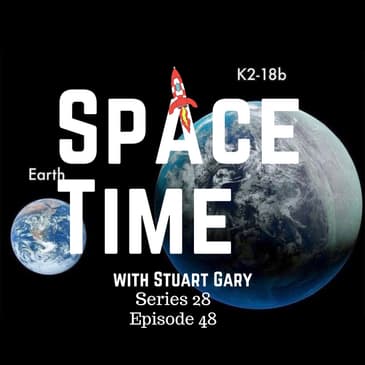
In this episode of SpaceTime, we explore groundbreaking revelations suggesting the potential for alien life beyond Earth. Using NASA's Webb Space Telescope, astronomers have detected chemical signatures of dimethyl sulfide and dimethyl disulfide in the atmosphere of the exoplanet K2 18 b, a sub-Neptune world located 124 light years away in the habitable zone of its host star. While these findings are incredibly promising, researchers urge caution as they work to confirm these biosignatures through further observations.
A Surprising Spiral Galaxy from the Early Universe
Next, we dive into the discovery of a surprisingly large spiral galaxy dating back 11.4 billion years, which challenges current models of galaxy formation. This massive galaxy, dubbed the "Big Wheel," is three times larger than expected for its time, prompting astronomers to rethink how galaxies can grow and evolve in the early universe. The implications of this finding could reshape our understanding of cosmic structure and formation processes.
NASA's Juno Spacecraft in Safe Mode
Additionally, we discuss a recent anomaly that forced NASA's Juno spacecraft to enter safe mode during a close flyby of Jupiter. The spacecraft's precautionary measures allowed it to protect its systems and continue diagnostics, ensuring the mission's ongoing success as it gathers vital data about the gas giant and its moons.
00:00 Space Time Series 28 Episode 48 for broadcast on 21 April 2025
00:49 Potential biosignatures detected on K2 18 b
06:30 Implications for the search for extraterrestrial life
12:15 Discovery of an ancient spiral galaxy in the early universe
18:00 Challenges to current galaxy formation models
22:45 Juno spacecraft enters safe mode after anomaly
27:00 Summary of recent astronomical discoveries
30:15 Science report: Health benefits of sauerkraut and lunar dust solar panels
www.spacetimewithstuartgary.com
www.bitesz.com
🌏 Get Our Exclusive NordVPN deal here ➼ www.bitesz.com/nordvpn. Enjoy incredible discounts and bonuses! Plus, it’s risk-free with Nord’s 30-day money-back guarantee! ✌
Check out our newest sponsor - Old Glory - Iconic Music and Sports Merch and now with official NASA merchandise. Well worth checking out...
Become a supporter of this Podcast for as little as $3 per month and access commercial-free episodes plus bonuses: https://www.spacetimewithstuartgary.com/about
✍️ Episode References
Astrophysical Journal Letters
https://iopscience.iop.org/journal/0004-637X
Nature Astronomy
https://www.nature.com/nature-astronomy/
Applied and Environmental Microbiology
https://aem.asm.org/
Become a supporter of this podcast: https://www.spreaker.com/podcast/spacetime-space-astronomy--2458531/support.
[00:00:00] This is Space Time Series 28 Episode 48, full broadcast on the 21st of April 2025. Coming up on Space Time, have astronomers finally discovered hints of alien life in space? A galactic mystery from the early universe? And NASA's Juno spacecraft forced to enter safe mode after it suffers a sudden anomaly? All that and more coming up on Space Time. Welcome to Space Time with Stuart Gary
[00:00:45] Astronomers have detected the most promising signs yet of possible biosignatures beyond planet Earth. If this proves to be correct, it will be the most important scientific discovery in history – the existence of alien life. However, the authors of the study, which is reported in the astrophysical journal Letters, remain cautious about interpreting the data.
[00:01:07] Using observations from NASA's Webb Space Telescope, the astronomers detected chemical fingerprints for dimethyl sulfide and or dimethyl disulfide in the atmosphere of the exoplanet K2-18b, which is a sub-Neptune world with some 8.6 times the mass and 2.6 times the diameter of the Earth.
[00:01:26] The planet has a 33 Earth day orbit circling in the habitable zone of its host star K2-18, a special type M red dwarf some 124 light years away in the constellation Leo. This means it receives a similar amount of starlight to what the Earth receives from the Sun. The habitable zone is the Goldilocks area around the star, where it's not too hot and not too cold but just right for liquid water to exist on a planet's surface.
[00:01:54] On Earth, dimethyl sulfide and dimethyl disulfide are only produced by life, primarily microbial creatures such as marine phytoplankton. While an unknown chemical process or geological activity could be the source of these molecules in K2-18b's atmosphere, the results are the strongest evidence yet that life could exist on a planet outside our solar system.
[00:02:18] The observations have reached a three-sigma level of statistical significance, meaning there's just a 0.3% probability that they occurred purely by chance. Now, to reach the accepted classification for a scientific discovery, the observations would need to cross the five-sigma threshold, meaning there would have to be less than a 0.00006% probability that these results are simply a chance occurrence.
[00:02:42] The authors say they need between 16 and 24 hours of follow-up observations with Webb in order to help them reach that all-important five-sigma significance. Earlier observations of K2-18b identified methane and carbon dioxide in its atmosphere, and this was the first time that carbon-based molecules were discovered in the atmosphere of an exoplanet in a habitable zone. The results are consistent with predictions for a high-sean planet, a habitable ocean-covered world, underneath a hydrogen-rich atmosphere.
[00:03:11] However, another weaker signal hinted at the possibility that something else was happening on K2-18b. The study's lead author, Nikumat Housadan from Cambridge University, says his team didn't know for sure whether the signal they originally saw was due to methyl disulfide, but just the hint of it was exciting enough to have another look with Webb using a different set of the observatory's instruments. This moment in history of science will be viewed as a paradigm shift in our search for life.
[00:03:38] To determine the chemical composition of the atmospheres of faraway planets, astronomers analyze the light from the host star of those planets during a transit. That's when the planet passes in front of its host star as seen from Earth. As K2-18b transits in front of K2-18, Webb detects a slight drop in stellar brightness coming from the star. At the same time, some of the star's light passes through the planet's atmosphere on its way to Webb's instruments.
[00:04:04] And it's the absorption of some of that starlight in the planet's atmosphere that leaves telltale chemical signature fingerprints known as a spectrum. And astronomers can use that to determine the composition of the constituent gases in the exoplanet's atmosphere. The earlier tentative inference of dimethyl sulfide was made using Webb's near-infrared imager and slitless spectrograph, as well as its near-infrared spectrograph instrument. And together, these cover the entire near-infrared range of the electromagnetic spectrum.
[00:04:32] The new independent observations use Webb's mid-infrared instrument, which covered larger mid-infrared wavelengths. But Housadhan says this provides a separate independent line of evidence, using a different instrument with a different set of wavelength ranges, whereby no overlap with the earlier observations could be implied. And the new signal observations still came in strong and clear.
[00:04:54] We have found signs of biosignature molecules, either DMS or DMDS or both, both of which are produced uniquely by life here on Earth. Dimethyl sulfide and dimethyl disulfide are molecules from the same chemical family, and both are predicted to be biosignatures. Both molecules have overlapping spectral features in the observed wavelength range, although further observations have helped differentiate between the two molecules.
[00:05:20] However, the concentrations of dimethyl sulfide and dimethyl disulfide in K2 18b's atmosphere is very different from what's seen on Earth, where they're generally below one part per billion by volume. On K2 18b, they're estimated to be about a thousand times stronger, over 10 parts per million. And Housadhan says earlier theoretical work had predicted that high levels of sulfur-based gases, like dimethyl sulfide and dimethyl disulfide would be possible on Housadhan worlds.
[00:05:50] Now, given everything scientists know about this planet, a Housadhan world with an ocean that's teeming with life is the scenario which best fits the data. As for the host star, K2 18b, it's smaller and cooler than our Sun, having a surface temperature of about 3,184 degrees Celsius. That compares to the Sun's 6,000 degrees. It's also much younger than the Sun, 2.4 billion years old, rather than the 4.6 billion years of the Sun.
[00:06:17] But interestingly, it displays only moderate stellar activity. And that's important because red dwarves are known to regularly erupt in violent stellar flares, which would irradiate any life on the surface of an orbiting planet. Red dwarves are the most common types of star in the galaxy, making up some 75% of all stars in the Milky Way. And it's estimated that up to 80% of all red dwarves have planets in their habitable zones.
[00:06:42] This star also has a second planet orbiting at K2 18c, which is even closer to the star than b. And that may be interacting with K2 18b through gravitational tides. Also, the flares produced by red dwarves can produce erroneous spectral signals when investigating an orbiting planet. And Hustedan says while these results are exciting, it's vital to obtain more data before claiming that life has been found on another world.
[00:07:09] We also want to do more theoretical and observational studies to make sure that there is absolutely no other way we can make this molecule without life. He says while he's cautiously optimistic, there could be previously unknown chemical processes that work on K2 18b that may account for the observations. We are basically establishing here that we can detect that kind of signature, those kinds of planets and biosignatures in them.
[00:07:33] The inference of these biosignature molecules poses profound questions concerning the processes that might have produced them. But the observations are really now just being seen as a starting point for further investigations that are now needed to confirm and understand the implications. This is a monumental discovery. It is very important, but we also have to be extremely cautious. Needless to say, we'll keep you informed. This is Space Time.
[00:08:02] Still to come, a galactic mystery from the early universe, and NASA's Juno spacecraft forced to enter safe mode following a sudden anomaly. All that and more still to come on Space Time.
[00:08:29] Astronomers have discovered a surprisingly large spiral galaxy in the early universe, dating back some 11.4 billion years to a time when such large galaxies are quite difficult to explain based on current cosmic modelling. In fact, this galaxy is some three times larger than similar galaxies from the same epoch. The findings reported in the journal Nature Astronomy are based on new observations using NASA's Webb Space Telescope.
[00:08:55] Spiral galaxies are flat rotating disk structures filled with stars, gas and dust that orbit around a central core. Our solar system orbits within one such spiral galaxy, and is the Milky Way. One of the study's authors, Tamiya Yanyakara from Swinburne University, says when and how galaxy disks grow and form has been one of the outstanding puzzles of astronomy. And seeing a massive well-ordered disk galaxy at a time when the universe was only 2.4 billion years old
[00:09:23] forces astronomers to rethink just how rapidly and efficiently nature can build cosmic structures. See, this galaxy not only challenges existing models and early galactic formation, but also hints that dense, gas-rich environments may well be the cradle for the universe's earliest giants. The discovery was made as observations were being targeted towards a specific region of the sky which hosts a bright quasar, a superluminal jet shooting out of an active supermassive black hole.
[00:09:51] Using the web data, Naniyakara and colleagues identified galaxies within this over-dense structure. They analyzed their distance or redshifts, their morphology and their kinematics, that is, how they moved across the sky. And it was these observations which led to the serendipitous discovery of the surprisingly large disk galaxy in the field. The galaxy has been dubbed the Big Wheel. It has an optical radius of about 10 kiloparsecs, which is at least three times larger than what would be expected,
[00:10:21] judging by current cosmological models. And further kinematic analysis confirms that this galaxy contains a disk rotating at around 300 kilometers per second. And that's larger than any other kinematically confirmed disks found at similar early epochs. In fact, it's comparable to the size of today's most massive disks. Yana Yaccaro says the disk lives in a highly over-dense environment, hitting that such an environment may well have favorable physical conditions for early disk formation.
[00:10:49] Drivers of this kind are known to host frequent galaxy encounters, mergers and gas flows. Therefore, in order to have a disk grow early and grow quickly, galaxy mergers in this environment need to be non-destructive and oriented in specific directions. Now, alternatively, galaxy inflows must have carried angular momentum that largely co-rotated with the galaxy's disk. Previous studies revealed that the quasar at the center of this group of galaxies is embedded in a large scale structure called a protogalaxy cluster.
[00:11:19] And this contains a high concentration of galaxies' gas and black holes, indicating an exceptionally over-dense environment. Nani Yaccaro says the discovery paves the way to studying this over-dense environment, which remains a relatively unexplored territory. When we were planning the observations, when we got the first images, we didn't really think that it would be that far away. So it was purely surrendered because we kind of put a slit on to do some science with it.
[00:11:45] But then for our amazement, the galaxy was found to be quite far away than we initially thought, kind of changed our kind of view of how these things form and evolve, I think. Tell me about what galaxy formation was like 11.4 billion years ago. This is the distance we are looking back into the universe. So it's about 1.5 billion years after the Big Bang, give or take. So what this says is that in the Earth Universe, at least there is one galaxy,
[00:12:12] which has formed very rapidly and had a lot of star formation and things kind of merging into the galaxy in an unprecedented way. But the surprise in nature itself is not the discovery of the galaxy itself, but it's kind of morphology, how it looks like as a big spiral. Because in our normal models, when we look at these disky spiral galaxies, maybe like our Milky Way or Andromeda, for example,
[00:12:38] we expect them to grow slowly because when galaxies grow, it either happens through smaller galaxies coming in and merging with it or gas coming into the galaxy from the universe from the certain galaxy medium. So for the spiral structure and this disk to be intact, it has to happen very slowly because if you have very big galaxies coming and merging very fast, this disk structure will get broken down and that's how you kind of will make like a difficult galaxy or this kind of very non-spiral-like structure.
[00:13:08] So what has happened here is that while it has grown very fast, it has grown in a way that did not disturb these beautiful spiral arms that we see in the images. So it is not very surprising in some ways because it is in a dense field, because there's a lot of other galaxies around it and it's about 10 times more denser than the nominal cosmic average at this epoch of the universe. But what it also means is that in the same time, while there are a lot of these small galaxies
[00:13:37] that might have merged or some gas coming in, it has happened in a beautiful way in some ways that it kind of kept this structure intact while preserving its nature, while growing in size and also in mass in the same time. Because this galaxy is about 100 billion solar masses, which is only about, give or take, about 10 times smaller than our Milky Way. But it is like 11 billion years ago, right? And it is so massive that it is one of the most massive galaxies we have seen in this epoch, regardless of its size.
[00:14:07] So all of these kind of neat things came in together for this galaxy and that became an interesting result, I think. What does that tell you about the influence of dark matter back then? And I guess also the lack of influence, well, it's there, but to a lesser degree, of dark energy. Yeah. So from what I understand, if you have a lot of dark energy, of course, then the galaxies get split out. So it's harder for to form like bigger sources, of course, because everything will be moving away very fast.
[00:14:37] So the overall bigger picture is that then the dark matter halos, as we call them, will grow much slowly because things are further away. For the dark matter itself, it is hard to compute the dark matter distribution very accurately, because you do have to make some assumptions of how the dark matter might be distributed around the galaxy, which we haven't really looked into in detail. But I think with more deep observations, we should be able to look into them.
[00:15:04] But in these early galaxies, of course, the dark matter is quite concentrated and we expect the stars to have quite a bit of dominance on the distribution. But because dark matter itself is more like we normally model it more in a more like in a Gaussian or some sort of distributed way. So for the spiral arms itself, it has not a strong influence from what I understand. From the spectroscopic readings, were you able to just determine the fact that it's rotating? So there's that Doppler effect there. Or were you able to determine what the galaxy is made of,
[00:15:34] like the concentrations of different chemical elements? Both in the same time, because we put three slips in the images. So what we, because this is the instrument we use, the NERSPEC, we used it in a multi-object mode, which means that you have to select where you want to place these slips in the instrument. So we selected like three locations in this galaxy, one going through the center and two in the spiral arms basically. And because the slips are long, you see whether which direction the galaxy is rotating.
[00:16:03] And in this case, you can see how the source is rotating based on the Doppler shift of the emission line of this galaxy. But apart from that, of course, the fact that you see like hydrogen emission coming off from this galaxy, you can use that to compute the metallicity of the sources to understand how much oxygen and hydrogen, etc. there is. And the hydrogen alpha emission is also almost a direct proxy for how much star formation there is.
[00:16:30] And this is why we are kind of surprisingly see that this galaxy, while it's very big, is still actively forming stars quite rapidly in a similar speed to smaller mass galaxies. So it's kind of quite high in the same time. So at some point it has to stop because the galaxies at some point stops growing because it becomes too big. So, but at least in this case, which is growing very fast, we haven't reached that yet.
[00:16:55] So this is in the inside a large cluster of galaxies. It's sort of supporting our existing cosmic models, isn't it? Yeah. So it is also some sort of a selection effect, because if you go back to why this program was kind of developed initially, was to look into a bright quiesa in that field. So the quiesa is roughly at the same redshift or at the same location in cosmic epoch as this source. You see that in the paper's image as well, where you have like this bright star, which is not a star, it's like a strong A.D.N.,
[00:17:24] like about 1.5 billion years after the Big Bang. The whole science case behind this was once you have these massive quiesa, there is a lot of gas that is acqueating into it. And from the ground-based observations from the Mu spectrograph on the VLT, the Very Large Telescope in Chile, we, in around 2015 or so, we managed to get like a beautiful map of this hydrogen emission, which is in Lyman Alpha, which is kind of the Lyman series of hydrogen, extending like very, very far away from the galaxy.
[00:17:53] So the program was developed to get the hydrogen, the Balmer series hydrogen emission, because the Lyman series hydrogen emission has a lot of resonance scattering, which makes it really hard for us to compute how much gas is there in this field that is coming into the quiesa to build a large-scale structure around it. And the consequence of like having this such a quiesa is that there's a lot of gas coming in, and within these gas flows, there is gas collapsing and forming stars and galaxies.
[00:18:21] So technically speaking, when you have these massive filaments kind of feeding into a thing, you do expect to have a little bit more higher density of galaxies around in the vicinity. So I think this is one of the consequences of this field being a high-dense region because it was selected to be around the quiesa to do a completely different science, and this was completely like an unexpected discovery. The chance to use the James Webb Space Telescope, what was that like? That must have been exciting as an astronomer. Oh yeah, it was super exciting.
[00:18:50] So this was one of the first programs that got time, I think it's about four years ago now. But it took a long time to get this paper out because it was kind of unexpected discovery, and then we had to make sure that it was kind of how to frame the stardomative as well because while it's interesting, we had to kind of show why it is unique as well in the same time. The WST has been quite like transformative, I think. It's probably one of the most sought after observatories at the present time.
[00:19:20] Yeah, it's totally changed our view of the universe, hasn't it? It's changed completely. Yeah, because we were quite limited back in the day because if you really want to understand like the early universe, for example, or look into the dusty regions around our own Milky Way, we had to go to the infrared. But the problem was, of course, because of the atmosphere. We don't really get a good coverage in that wavelength space.
[00:19:43] So we did have to go to space, and I think having like a big mirror with extremely sensitive instruments made quite a big transformation of what we could see. So now we can see galaxies which were formed like just a few hundred million years, like 200 to 300 million years after the Big Bang. So we are kind of pushing the limit already within the first few years of the WST. Well, you're heading towards the cosmic dark ages now, aren't you? Yeah, yeah. So these are like the first galaxies that are being formed.
[00:20:09] So technically speaking, expectation is we might be able to even see the first stars. But it is much because the universe is so big. Well, that's the ultimate goal, isn't it? Population three stars. Yeah, yeah. So there's two ways one could do it. I guess there's like two ways of looking directly into this thing. I just, some people can be lucky because you can have these pockets of pristine gas even a bit closer than the very, very, very early universe, which kind of starts to form stars. So one could be lucky and find something a bit more closer.
[00:20:37] But realistically speaking, the higher the chances at the very early stages when the universe was more and more metal poor. So that would be like, there are a few candidates that have come up in the last few months, but nothing has been confirmed yet because it is kind of really hard even with WST to get spectra of these very, very early systems.
[00:20:56] And then also to convincingly say there is no other metals in these galaxies or like even stellar clusters in this epoch. So does that mean we're pushing the epoch of reanization closer to the cosmic microwave background, 380,000 years? Yes. So the reanization roughly starts around ratio 10 or so, 12 maybe, and then ends up around ratio 6.
[00:21:23] So we know everything about reanization should have finished in the first billion years of the universe or so. But the question, of course, remains is what type of galaxies or what type of stars kind of led the reanization? And also, when did the first stars and galaxies form? So mapping that window from the CMB to end of reanization is kind of active research that the WST would be able to do because it will be able to probe the...
[00:21:47] Actually, it is probing these early galaxies and especially going into much more fainter systems. Because the fainter systems, we do expect to be also to be younger because these are the young things that are kind of developing fast. So by doing so, we are kind of looking into the more lower metallicity system. But the problem, of course, is also that these massive stars, which is called population 3 stars, would also only live for a very, very short time period, like maybe like 1 to 2 million years.
[00:22:15] So if you want to find something within that very short time scale, you have to be extremely lucky. Because what will happen after it explodes, after a few million years when it explodes, is that it will kind of pollute the medium around these star clusters with metals. So then you kind of lose the ability to quickly track these first generation of stars. And you've won population 2 stars, you can find those in the outer reaches of our own galaxy. Yes, we have quite a few of that. And there are like very, very low metallic stars.
[00:22:44] So there are programs even in Australia, which is trying to map our Milky Way to find the remnants of population 3 stars. Because if you are lucky, like you would have like very small mass population 3 stars in our galaxy. But because they have formed like in the very early universe, but because they're small, they've lived for a long time. So there's a possibility that there might be very, very, very low metallic stars in our own Milky Way. I think we found like quite about 10 to the minus 5.
[00:23:12] So it's kind of very low metallic city, but it's not still an inflation 3 definition. But of course, that is a quite different regime of population 3 stars we are looking in the early universe. That's the Mia Naniya Kara from Swinburne University. And this is space time. Still to come, NASA's Juno spacecraft forced to enter a safe mode following a sudden onboard anomaly. And later in the science report, a new study has shown that the German delicacy sauerkraut is good for your gut health.
[00:23:40] All that and more still to come on Space Time. NASA's Juno spacecraft has been forced to enter its safe mode after suffering an unexpected anomaly.
[00:24:04] The solar powered probe went into safe mode twice on April the 4th, while doing one of its close flybys of Jupiter. Safe mode is a precautionary default status the spacecraft enters when it detects an internal systems problem. Not essential functions are then suspended and the spacecraft focuses on key operational tasks, like communicating with the Earth and power management. Upon entering safe mode, Juno's science instruments were all powered down as designed for the remainder of the flyby.
[00:24:32] The mission operations team re-established high-rate data transmission with the spacecraft, and Juno's currently conducting flyby software diagnostics. Mission managers are still working to transmit the engineering and science data that was collected both before and after the safe mode events. Juno first entered safe mode about an hour before its 71st close approach to the gas giant, known as Perijove. It then went into safe mode again 45 minutes following Perijove.
[00:25:00] During both safe mode events, the spacecraft performed exactly as designed, rebooting its computer, turning off non-essential functions, and pointing its antenna towards the Earth for communications. Of all the planets in our solar system, Jupiter is home to the most hostile environment, with the radiation belts closest to the planet being the most intense. Juno's long, highly elongated orbit around Jupiter is designed to try and squeeze through the radiation belts with the least amount of interference.
[00:25:27] Early indications suggest the two Perijove 71 safe mode events occurred as the spacecraft flew through these belts. To block high-energy particles from impacting sensitive electronics, to mitigate the harmful effects of the radiation, Juno is equipped with a titanium radiation vault where its most delicate electronics are kept. Now, including the Perijove 71 events, Juno has unexpectedly entered safe mode on four occasions since arriving at Jupiter.
[00:25:54] The first in July 2016, during its second orbit, and then again in 2022, during its 39th orbit. In all four cases, the spacecraft performed as expected and recovered full capabilities. Juno's next Perijove will be on May 7, and it will include another flyby of the Jovian volcanic moon Io at a distance of about 89,000 kilometres. This is Space Time.
[00:26:34] And time now to take a brief look at some of the other stories making news in science this week with a science report. A new study has shown that the German delicacy sauerkraut is good for gut health. A report in the journal Applied in Environmental Microbiology shows that fermented German cabbage protects gut function, which is an essential part of overall health, supporting digestion and protecting against illness. Researchers were testing whether sauerkraut's nutrients could help protect intestinal cells from inflammation-related damage.
[00:27:03] The study compared raw cabbage, sauerkraut and the liquid brine left behind from the fermentation process. The sauerkraut samples included both store-bought products and fermented cabbage made in the lab. They found that sauerkraut helped maintain the integrity of intestinal cells, while raw cabbage and brine did not. Chemical analysis shows that fermentation changes cabbage's nutritional profile, increasing beneficial metabolites, such as lactic acid, amino acids and plant-based chemicals linked to gut health.
[00:27:33] These changes may explain why fermented foods are often associated with digestive benefits. The authors also found there was no real noticeable difference between grocery store-bought sauerkraut and the lab-made version. A new study has shown that lunar dust could one day be used to make solar panels on the Moon. The findings reported in the journal Device could allow astronauts to access power on the Moon without needing to transport heavy equipment from Earth.
[00:28:00] Scientists created a substance designed to simulate moon dust, and they then melted it into glass, using it to build a solar cell. The authors say the lunar solar cell could be more efficient in space than ones made from Earth materials. Now, they admit there's still a lot of hurdles to jump in order to see whether moon glass production processes would work in the lower lunar gravity environment, and they hope to get their project onto the moon one day in order to test to see if it's viable.
[00:28:27] For those of you who have spent some time in Darwin, or really anywhere on Australia's top end, the term mango madness is nothing new. It refers to higher rates of anxiety, stress and hostility combined with fewer hours of sleep, reduced appetite and lower energy levels during the heat and humidity of the northern Australian monsoonal buildup. Now, a new study reported in the journal Nature Climate Change claims that rising temperatures across Australia
[00:28:52] could increase the burden of mental and behavioural disorders by almost 50% by the year 2050. Research from the University of Adelaide claims to highlight the urgent need to act now to protect mental health as the planet's climate warms. In what most scientists would regard as proof that the law is an ass, the Indian Supreme Court has ruled that the pseudoscience of astrology is a real science.
[00:29:17] And that's despite there being hundreds, maybe even thousands of irrefutable scientifically proven studies showing beyond doubt that this is simply not the case. Tim Mendham from Australian Skeptic says, The United States went through the same trauma in its now infamous monkey trial, which looked at teaching creationism as a science in American schools. Astrology has a very strong following in India. If you go to the position of vacant parts of Indian newspapers, you'll find this list of people who are available from arranged marriages.
[00:29:46] There's often women being promoted by their families as a lawyer, 25, attractive, Aquarius. And they almost inevitably say what the star sign is, and they try and match people up with a prospective husband or wife or whatever the case is with their star sign. So astrology has a big influence, like a lot of other pseudosciences in India, quite frankly. And the trouble is we're there, is they're getting the imprimatur of the universities and the government, the BJP government, the BJP party is particularly fond of traditional Indian science, which we would call pseudoscience.
[00:30:16] Therefore this thing about astrology came up and they went through a court case and the Supreme Court of India decided to rule that yes, astrology is a science. Now the interesting thing is what they used to define science and to define astrology was that they used the Encyclopedia Britannica and they used Webster's Dictionary. The problem was that the Encyclopedia Britannica was dated 1783, I think it was the second edition or something, and the Webster's was pretty much as old as that as well. So they are using pre-scientific, if you like, definitions of what astrology was.
[00:30:45] What does that say about the Indian court system? It says a lot about the Indian court system. It also says a lot about their library. They have a copy of the 1700s Encyclopedia Britannica to pull down. Surely someone would have noticed it's a bit dusty and said maybe we should find a more recent one. In fact, the earlier edition of Encyclopedia Britannica, that was the second edition, the first one says that astrology is rubbish. So they managed to get the one that actually was a bit softer. They also use the rather strange logic that because astrology relies on astronomy,
[00:31:15] which it does, then ignore anyone who tells you that astrology came first. It did not. You can't do astrology without astronomy, right? Astronomers find out where the planets are. Astrology decides what they mean. So because astrology came out of astronomy, and astronomy is science, therefore astrology must be science as well. Now that false logic has a name in sceptical circles, doesn't it? Yeah, I think it's called stupidity. Okay. The logical fault here is that it's the resort to authority, right? Okay. And the trouble is you have to make sure what your authority is. If your authority is dated from 250 years ago,
[00:31:45] you should probably rethink your authority. You can't just say it's true because that person way back then said it was true. That's Tim Mendham from Australian Skeptics.
[00:32:33] And that's the show for now. You can find out on both iHeartRadio and TuneIn Radio. And you can help to support our show by visiting the Space Time store for a range of promotional merchandising goodies. Or by becoming a Space Time patron, which gives you access to triple episode commercial-free versions of the show, as well as lots of bonus audio content which doesn't go to air, access to our exclusive Facebook group, and other rewards. Just go to spacetimewithstuartgary.com for full details.
[00:33:02] You've been listening to Space Time with Stuart Gary. This has been another quality podcast production from Bytes.com.