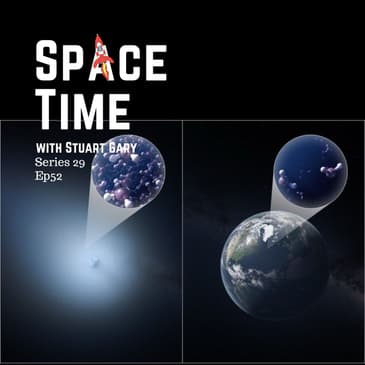
This is Spacetime Series twenty nine, episode fifty two, for broadcast on the first of May twenty twenty six. Coming up on Spacetime, interstellar Comet three I Atlas far more alien than previously thought, NASA now looking at September to launch its new Roman Space telescope, and the European Space Agency's new Australian Dish finally commissioned. All that and more coming up on Spacetime. Welcome to space Time with Stewart Gary. A new study has found that interstellar Comet three I outlass must have originated in a much colder star system, one with lower levels of radiation than our own Solar system. The new findings were reported in the journal Nature Astronomy, based on the observer that three I Atlas is remarkably rich in a specific type of water called heavy water, which contains deuterium and isotope of hydrogen that contains a neutron in its nucleus. Water is made up of two hydrogen atoms and an oxygen atom, hence its H two a formula. In a typical water molecule, those hydrogen atoms have just one proton in their nucleus, orbited by an electron heavy water also exists on Earth, but in much lower quantities than what was observed in three I Outlas. The Steadies, lead author that we sell as Amanzana from the University of Michigan, says less than a year ago astronomers discovered a strange comet sawing through our skies that was not from our Solar system. Although we still don't know where this object three I Outlass came from, the new work will reveals some fresh insights about its birthplace. It's only the third interstellar object ever identified in our Solar system, and Xanas says the new observations showed that the conditions which led to the formation of our Solar system are very different from how planetary systems evolved in other parts of our galaxy. The amount of deterium in three Eye Outlas were some thirty times higher than that found in any comet in our Solar system, and forty times the value of what have found in assertions. These ratios tell astronomers about the conditions that were present when the celestial objects formed, and it allows them to compare the birthplace of three our Atlas with our own Solar system. When planets and comets were forming. It's proof that the conditions that led to the creation of our Solar System are not ubiquitous throughout space. Manzano and colleagues use the DMD Observatory in Arizona and Alma the Attakama Large Millimeta submillimeter array radio telescope in Chile to study some of the earliest gases emitted by the comet, and this marked the first time astronomers have been able to perform this type of analysis on an interstellar object. Apart from three Eyealys, the only confirmed interstellar objects ever detected passing through our Solar System were one I mail Maur and two IBORISEV and Birth have now left. This is space time still to come. NASA now looking at September to launch its new Roman space telescope, and the European Space agencies new Australian Dish finally commissioned. All that and more still to come on space time. NASA are now targeting September as the likely launch date for the new Nancy Grace Roman Space Telescope. That's much earlier than the May twenty twenty seven launch date originally slated. Roman is similar to NASA's famous Hubble Space Telescope, but it's designed to survey far greater fields of the sky at once. Instead of focusing on detailed images of individual galaxies like Hubble, Roman will look at wide swathes of the cosmos, trying to answer questions about how dark energy in dark matter, two of the most Mista series subjects in science today have affected the universe and its evolution. The Roman Space Telescope is very similar to Hubble. Hubble is based on the design of a CIA Keyhole KH nine or more likely KH eleven spy satellite, but modified to look out into the universe rather than down under the Earth's surface. Both Hubble and the Keyhole KH eleven spy satellites were built by Luckheed, and that's where the Roman Space Telescope comes in. Back in twenty eleven, the CIA found they had two spare KH eleven Keyhole spy satellites which were now surplus to the requirements, having been superseded by more advanced versions. They were stored at a special facility at Rochester in upstate New York and were costing the National Reconnaissance Office money to keep them in their special clean room environment, and so they were offered to NASA for free. NASA sent a bunch of astronomers to check them out, and the scientists were amazed at their capabilities, which fire exceeded anything at Baarburn science budget could afford. The two Keyhole satellites share the same two point four meter primary mirrors Hubble, but the mirrors are lighter and more high tech than Hubbles, with a broader field of view one hundred times that of Hubble. They have a shorter focal length than Hubble, making them about a meter and a half shorter than the famous Space telescope, A sort of stubby Hubble, I guess. But it's that short of focal length, which means the KH elevens can image at higher resolution an area one hundred times bigger than Hubble's wide filled camera three, a visible infrared instrument that's become Hubble's most advanced and heavily used sensor, and by imaging areas one hundred times larger in a single shot, more galaxies and objects can be studded with a single image, Unlike Hubble. The secondary mirror on the KH eleven telescopes can be moved either by ground control or automatically using on board instruments. These can be used to bring an image into extremely fine focus. The secondary mirror is supported by six struts with servo motors on each. These servos can maneuver the struts to fine tune the secondarym in order to achieve the finest focus possible. Originally to be named Wide Filled Infrared Survey Telescope or w FIRST, ROMAN will also survey exoplanets. By the end of its five ye emission telescopes expected to amass more than twenty thousand terabytes of data. Scientists will be able to draw in it to identify and study one hundred thousand exoplanets, hundreds of millions of galaxies, billions of stars, and rare objects and phenomena, including some that astronomers have never witnessed before. The Roman Space Telescope will launch a board a SpaceX Falcon heavy rocket Space Launch Complex thirty nine A at the Kennedy Space Center in Florida. This report on the technology of this converted spy satellite from MASSERTV. NASA's Nancy Grace. Roman Space Telescope is designed to answer big questions about the universe. What is dark energy, which seems to be speeding up the expansion of the universe, how many planets exist among the stars, and what are they like. The Roman Space Telescope is similar to Hubble, but benefits from thirty years of technological development. It will view the sky on a scale never before accomplished from space. This is where Roman is closest to Hubble. It has the same size and type of main mirror, a two point four meterre precisely shaped piece of silver coated glass. The size of this mirror is partly how Roman matches Hubbles resolution. Roman's main camera is the Wide Field Instrument, which will take infrared pictures of the sky to study dark energy, observe galaxies and stars, and find exoplanets. Instead of Hubble's single first generation image sensor, the WFI incorporates eighteen third generation chips that allow it to take pictures capturing one hundred times greater sky area than Hubbles. Each three hundred megapixel image will enable scientists to study a large portion of the sky. At Roman's back is its primary means of communication with Earth, the high Gain antenna. This antenna will be responsible for sending nearly one point four terabytes of data to go round stations every day. That's the equivalent of four hundred and sixty hours of streaming video. Roman's critical systems, such as power and data handling, are located in six modules at the spacecraft's rear. These include six rotating reaction wheels that control where the spacecraft points, nearly one ton of propellant for larger movements, and a ten terabyte data recorder. Roman's other instrument is its coronagraph technology demonstration. A coronagraph blocks the star's light to capture the faint light from orbiting planets. It will be the first time a space telescope has used deformable mirrors to precisely control the incoming light and special masks to block only the starlight. This method will enable Roman to capture direct images of distant planets and even analyze the light that is reflected off their surfaces, allowing scientists to learn about their composition and atmospheres. The spacecraft's solar panels provide its power by converting sunlight into electricity. They also shade the spacecraft, helping to keep its instruments at their design temperatures. The solar panels will be able to provide four one hundred watts of power, enough to run two commercial microwave ovens. With all these systems working together and in partnership with powerful future telescopes, the Nancy Grace Roman Space Telescope will be able to usher in a new era of studying our universe. This is space time still to come. The European Space Agency is new Australian dish and later in the science report how climate change is affecting the health of people across Europe. Oh, that and more still to come on space time. European Space Agency has commissioned its second Australian Deep space communications dish at its new Nausea complex near Perth. The thirty five meter DSA four antenna will provide essential telemetry, tracking and command services to keep ease of spacecraft safely connected with mission managers back on Earth. The new dish features x K and KA banned download capabilities, as well as X band uplink with provision for K band plan for the near future. The antenna uses cryogenically cooled receivers operating at minus two hundred and sixty three degrees kelvin. By cooling the link between the physical antenna and the receiver to near absolute zero, background interference noise can be drastically reduced, thereby improving the antenna's ability that detects signals weaker than a whisper from billions of kilometers away. DSA four is also equipped with a twenty kilowatte radio transmitter. You see, radio waves weaken the further they travel, much like ripples spreading out on a pond, so signals sent to distant spacecraft often become extremely faint. Thanks to its powerful transmitter, DSA four can send commands that remain strong and easy for spacecraft to detect, even across the vast distances of the Solar System. DSA four is the newest member of ESA's s Track Network, a global system of ground stations that link satellites in orbit and beyond with the European Space Agency's Operations Center. They receive telemetry, a continuous stream of health, status and scientific data sent down by spacecraft. Performed tracking by precisely measuring a spacecraft's distance, velocity, and position using radio signals and transmit commands that control spacecrafts on board systems, adjusting trajectories and updating mission configurations. With DSA four now commissioned, the network includes four to thirty five meter deep space antennas and three near Earth stations as part of its core infrastructure. DSA four complements s tracks existing thirty five meter dishes, DSA one, which is also at New Nausea, DSA two, which is in Spain, and DSA three in Argentina. The other three ground stations in s TRAC's core network are used for tracking satellites or launches near Earth and use either four and a half or fifteen meter dishes in Caeru, French Guiana, Santa Maria, Portugal, and in Karuna, Sweden. After its inauguration back in October twenty twenty five, DSA four embarked on an intensive commissioning phase. This met months of fine tuning everything from the dish's surface to its ultra precise timing systems, combined to end to end testing was the first step to confirm the signals could pass through every component of the station. During this phase, engineers checked the performance of the antenna's mechanics, radio frequency stages, frequency and timing equipment, power systems, and back end modems. Once the technical checks were complete, engineering teams prepared the station for real life operations. They refined the control software and configured the ground system to work with the new antenna and integrated DSA four into ESA's schedule in network control workflows. In the final phase, teams track modible ISSA spacecraft to ensure they could all communicate with the new antenna, and Euclid was the first ESA spacecraft to be tracked once DSA four entered normal operations, marking the moment the antenna came alive as a working part of ESA's deep space network. Bringing a second deep space antenna online at the Australian site boosts issa's global coverage, providing greater availability and flexibility, as well as built in a redundancy. DSA four also brings the next generation xpand transmission features, which will expand the link configurations possible from new NAUSEA, providing capabilities and operational flexibility that are unique within the s TRACK network. This is Space time and time that to take another brief look at some of the other stories making news and science this week. With the Science Report, A new study has looked at how climate change is affecting the health of the people of Europe. The findings, reported in the lands At Medical Journal, found key issues have seen increases since the nineteen nineties including an increased length in the pollen season by between one and two weeks, a rise in heat related deaths, an increase in infectious diseases such as dengy fever, which is now spreading more easily thanks to the hotter weather, and increasing food insecurity linked to heat waves, especially among poorer Europeans. They also found deaths from breathing in polluted air from woodsmirk at home rose by four percent between the year twoenty and twenty twenty two. The finding show climate change is already harming people self in Europe, and the authors warned that these impacts will only get worse. A new study warns that agricultural soils exposed to glyphis sate might become breeding grounds for hospital grades superbugs. A report in the General Frontiers in Microbiology examined ninety eight bacterial strains from nature reserving buenas areas located near agricultural areas where glyphiscate is often used. They then tested these bugs against sixteen common antibiotics, finding significant resistance build up. The authors warned that antibiotic resistant bacteria could be entering the soil through untreated wastewater from hospitals, but may also find their way back to hospitals from soil through other environmental pathways. They think glyphisset could be driving the evolution of antimicrobial resistance in bacteria as a side effect of developing resistance to the weed killer itself. The Pedagon has announced plans for a new battleship for the US Navy, the first since the nineteen forties. The new thirty five thousand Trump class is included in next year's Department of All Budget submissions. The new DDGX or BBGX class, depending on the document side. It would provide the Pedagon with a vessel that foids the tradeoffs needed for smaller cruiser, destroyer and frigate sized warships. The new two hundred and seventy met along guided missile battleship would be armed with nuclear cruise missiles. It would follow one from the current nine eight hundred ton Taikonderoga class guided missile cruiser and the similar displacement Ali Burk class guarded missile destroyer. The US Navy has not had a battleshiping commission since the retirement of the last nineteen forties era Io class battleship, the US Missouri in nineteen ninety two. The six forty eight thousand, five hundred ton iiO class warships were equipped with nine massive sixteen inch guns and were updated in the nineteen eighties detect Tomahawk and harpoon missiles. I. Meanwhile, the Australian Navies just signed a new contract for the first three of an eventual fleet of eleven Japanese designed upgraded Magumi class guarded missile frigates. The four eight hundred ton new FFM class warships will be equipped with thirty two vertical launch cells. The first three will be built in with the remaining eight to be built in Perth or replace the current Anzet class frigates. There are reports in the Daily Mail that the number of military and intelligence personnel prepared to give public testimony about the existence of exeterrestrial spacecraft has now reached a threshold where maintaining any degree of secrecy may no longer be possible. In fact, the story claims there'll be a big announcement about your first later this year, but as the skeptics timendum points out, your verbuffs have been predicting the same big announcements for years now, yet nothing ever happens. I UFO books which talk about the same thing being claimed in the seventies and eighties and the nineties, and more recently because in the age of TikTok and social media it's gained momentum again some credence by certain members of US Congress who believe in UFOs and want more information. So people giving congressional hearings giving evidence which is not evidence evidence of someone told me that someone knew that their brother Marge to work that kord of thing, and that UFOs are real, and that there's going to be a disclosure very soon. This has been said about twenty twenty four, twenty twenty five, now twenty twenty six. Some are putting it off till twenty twenty seven. Whatever it's been said every year, it's considered every year in the same way as people saying at the end of the world is going to happen any day now. This UFO disclosure is going to be announced very soon. All these things are any day now, and if you get a bit jauntice about it quite frankly, but the big headlines is Donald Trump is going to reveal this information. Other people have said actually that President's not necessarily informed the need to know basis does not necessarily include presidents, apparently as in Independence Day, Why did I know about this? Well, you know you didn't need to know, or plausible deniability if you're like, if we don't tell you, you can say I don't know, it's an excuse for you to work. Some people wanted the West Wing. I know how this thing works. I know, I know, But honestly, this is a big disclosure supposedly going to happen, and we'll wait and see is basically the only reaction you can have to it. It's been said before, been there, done that, Let's see what happens. That's the skeptics timendum, and this space Time, and that's the show for now. Spacetime is available every Monday, Wednesday and Friday through at bytes dot com, SoundCloud, YouTube, your favorite podcast download provider, and from space Time with Stuart Gary dot com. Space Time's also broadcast through the National Science Foundation, on Science Own Radio and on both iHeartRadio and tune In Radio. And you can help to support our show by visiting the Spacetime Store for a range of promotional merchandising goodies, or by becoming a Spacetime patron which gives you access to triple episode commercial free versions of the show, as well as lots of burnus audio content which doesn't go to weir, access to our exclusive Facebook group, and other rewards. Just go to space Time with Stuart Gary dot com for full details. You've been listening to space Time with Stuart Gary. This has been another quality podcast production from bytes dot com.