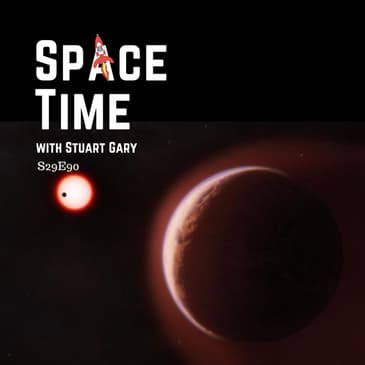
This is Spacetime Series twenty nine, Episode ninety for broadcast on the twenty ninth of July twenty twenty six. Coming up on Spacetime, discovery of an atmosphere on the planet orbiting a red dwarf, how Mega Duston's in the sun effect, Martian weather, and approval granted for what will be the world's first orbital space reflector array, bringing sunshine to dark areas of the Earth. All that and more coming up on Spacetime. Welcome to space Time with Stuart Gary. Astronomers think they've detected an atmosphere on a super ef exo planet orbiting within the habitable zone of a nearby red dwarf star. The habitable zone is that area around the star where temperatures are not too hot or too cold for liquid water, a central for life as we know it to form on the planet's surface. The planet, cataloged as LHS eleven forty B, has about five point six times the mass of the Earth and is about seventy percent larger in radius. Its hostar, LHS eleven forty is a spectral type M red dwarf in the constellation of Cetus. The Whale some forty eight point eight light years away. It's some five billion years old, making it only slightly older than our Sun. It has about eighteen percent of the Sun's mass and around twenty one percent of its radius. Now importantly, no flares have ever been observed coming from the star, and that's exciting because red dwarfs are usually notorious for their violent outbursts of stellar flares, and that means any orbiting planets would have their atmospheres blown away by the host star strong stellar flare activity. The new findings, reported in the journal Science suggest that LHS eleven forty B is a rocky terrestrial world, complete with its turn atmosphere. One of the studies authors, Jason Dittman, from the University of Florida, who first discovered the planet back in twenty sixteen, says observations by the Magill and Clay telescope in Chile have detected helium escaping from the planet now. The planet's age suggests that it should have run out of helium by now, that is, unless it was replenishing its own supply, and that suggests the potential of an atmosphere. Dittman says, considering the type of star its orbiting, this planet's temperature should be similar to that of the Earth, and it's not alone. There's a second planet in the system, LHS eleven forty C, but that's located outside this starts habitable zone. LHS eleven forty B is also important because other rocky exoplanets discovered the past decade or so have all lost their atmospheres over time. Considering the age of LHS eleven forty B and the lack of atmospheres on similar exoplanets, Dittman and colleagues didn't expect to fight helium, but this planet was different. The Magill and Clay telescope's explained the rate at which the planet lost its helium because of the X ray radiation from the host star. Therefore, the X ray data proved this rocky world must be replenishing its own supply of helium. If it wasn't, there'd be no helium left by now. Now. The authors were looking for helium because it's easy to spark, but now that there is the potential proof of an atmosphere, they're looking for other chemicals such as come to the oxide and water the further test of planet's conditions. Dipman says, because this helium there, and because the helium's escaping, the question is is it a bare rock world with no atmosphere that sometimes burbs up some gas that then immediately escapes, or is there a steady state atmosphere there, one that from time to time will leak out stuff like the Earth does. He says, the next move will involve getting data from the web Space Telescope over the next four to five years. It'll be studying this world, and if it finds water in the atmosphere, then it's probable that LHS eleven forty B has a stable atmosphere that will persist. This is spaced time. Still the calm, how megadustorms in the Sun affect Martian weather, and approval granted for the world's first orbital space reflect or array, shining extra light on those areas of the planet that only don't get much sunlight. All that and more, still the calm on space time. A new study is found that solar storms heading Mars at the same time as planetary white dust storms in cause major changes in Martian weather. The findings reported to the Royal Astronomical Society's National Conference in Birmingham, based on observations of rising temperatures in the red planet's lower atmosphere when the two events coincide, hinting that Mars may have a more complex atmospheric environment and weather system than previously thought. Scientists examined five solar energetic particle events on Mars in order to determine whether they could warm the lower Martian atmosphere, where weather occurs. Solar energetic particle events occur wh all of flares and chronal mass ejections from the Sun released high energy charged particles in the space, and Mars is especially exposed to these particles because it has a thin atmosphere and no strong global magnetic field to shield the planet, such as the os magnetosphere. As the authors took their readings, they found four of the events showed no clear effect on the planet, but the fifth, which occurred in June twenty eighteen, unexpectedly coincided with an expanding Martian global dust storm. It was the same event which shut down and ended the mission of NASA's Mars Opportunity Rover, and it was during this event that signs of lower atmospheric heating were detected. The studies lead author Lana Williams from Lancaster University says she expected that these highly energetic particles would have some effect on temperatures in the planet's lower atmosphere, but in four of the five events studied, there was no clear evidence of any heating. The one exception occurred while a global dust storm was expanding across the planet's surface. To reach their conclusion, the authors use data from this as MAYVEN, Mars Atmosphere and Volatile Evolution spacecraft, and the European Space agencies Mars Trace Gas Orbiter MAVEN. The studies interactions between the Sun and the Martian upper atmosphere or trace gas orbitter measures the composition and structure of the entire Martian atmosphere. The observations were then compared with expected temperature profiles from the Mars climate database. Williams and colleagues examined temperatures before, during, and after the five long lasting solar energetic particle events. Now, the authors admit that a single observation really isn't enough to prove cause and effect, but the findings do raise the possibility that space weather in Martian dust storms might combine to affect the red planet's lower atmosphere in ways that have not previously been studied. Previous research has shown that solar energetic particles can affect Mars's upper atmosphere because the ionization effuse auroral activity and disruption to radio signals, but their possible effect on the lower at the sphere of Mars but weather takes place is not well understood. Dust Storms naturally heat parts of the Martian atmosphere by absorbing sunlight. However, the authors found that this pattern of heating observed during the combined event was unusual for a dust storm and could not be explained by the storm alone. They identified the global storm only after noticing that heat appeared during only one of the observed solar energetic particle events, but not the others, and so set out to investigate what was going on. Understanding these combined effects could improve models of the Martian atmosphere and help scientists interpret future temperature observations during periods of intense solar and dust storm activity. Of course, the twenty eighteen Martian global dustorm wasn't unique. The red planets hit by dust storms blanketing the entire globe on a regular basis. Another dust storm in twenty twenty two ended NASAs Mar's Insight mission after it too was covered in the thick red dust layer, preventing its solar panels from charging the land its battery. This report from January twenty twenty two, a dust storm nearly twice the size of the United States, blankets Mars's southern hemisphere, reducing sunlight and uniting NASA's spacecraft to help one another through the storm. NASA's Curiosity Rover captured images as the dust rolled in, obscuring the horizon. Also in the storm's path was NASA's Insight lander, which had to stop its science work after dust prevented sunlight from reaching the solar panels. Insight hunkered down for eleven days to conserve battery power, but didn't weather the storm alone. A fleet of NASA orbiters monitored dust storms from above and serves as a lifeline to Earth, relaying data from Mars's explorers back to the team. Dust Storms like this recent one start close to the ground and are spread by wind as they rise, warming the cold Martian atmosphere. Storms are detected by mro's Mars Color Imager or MARSI, which produces a daily global weather map. As dust rises in the atmosphere, mro's Mars Climate Sounder instrument measures temperature to determine how fast the storm could spread. MAVEN studies the upper atmosphere, including how dust affects the escape of water and other gases from the atmosphere, and for twenty years, Odyssey's Thermal Emission Imaging System or THEMIS, has helped measure global dust activity over time. The orbiter sends most of INSIGHT's data to Earth, but as Odyssey went to check in on Insight, it experienced a software issue. The Odyssey team swung into action, recovering quickly so engineers could send new instructions to Insight. The dust even grounded NASA's Ingenuity Mars helicopter, postponing flights until conditions improved. Dust Storms formed during all margiancy pas, since some can balloon in a matter of days, like the twenty eighteen global dust storm, which led to the end of NASA's Opportunity Rover. Despite the challenges dust creates for spacecraft, studying storms is critical for creating future weather forecasts and preparing for a potential human mission to Mars. This is space time still to calm. Approval given for a new test to look at the idea of affecting sunlight back to Earth to increase light in darkened areas of the planet, and later in the science report. A yet study has found that a family socioeconomic status is more important and whether or not parents smoke and drink in terms of its impact on children's future health. All that is more still to calm on space time. America's Federal Communications Commission as approved plans for the first demonstration flight of reflect Orbital's a Rendel one satellite, which will test the idea of reflecting sunlight back to Earth on demand. The name of Rendel comes from a character in the Lord of the Rings trilogy who carried the light of the morning Star on his brow. The spacecraft, which is expected to launch later this year, will unfurl a giant eighteen by eighteen meter diameter reflector designed to shine the light down to Earth. Reflect Orbital plans to launch three test reflectors three months apart. The approval will see the first deray launch on the six hundred and twenty five kilometa high knee polar orbit at an inclination of eighty eight degrees, a trajectory which suggests Vandenberg would be the best launch sight. Ultimately, the company envisages a constellation of over fifty thousand reflectors circling the planet by twenty thirty five. Back in nineteen ninety two, Russia deployed the twenty meter Zamnia two space Mira from the space station. It created a five kilometer wide patch of light as bright as a full moon that traversed Europe early in the morning of February fourth, nineteen ninety three. Reflect Orbital says it wants to provide undermanded solar power to meet regional peak demands, as well as providing additional light for disaster relief and increasing agricultural production. Of course, this new project is just the latest assault on ground based astronomical research, and it comes in the wake of Starlink's ever expanding constellation of broadband communication satellites, as well as China's rival Quinn Fan thousand Cells, Mega Constellation and ast space mobiles Blue Walker and blue Bird satellites, all of which are disrupting the important scientific research being carried out by astronomers. Beyond its impact on astronomy, they are also safety concerns for the public and aviation, as well as the likely impact this will have on wildlife. This is space time and time that I take another brief look at some of the other stories making news and science this week with a science report. A new study claims a family socioeconomic status may be more important than parental behaviors such as smirking or drinking when it comes to children's future health. The findings, reported in the journal plus one, analyzed data from more than two hundred and thirty thousand parents and children in the UK and Norway, including details on parental health behaviors and their sachioeconomic status. The authors link these variables at seventy two different child health outcomes at six time points, including size of delivery, weight, hyperactivity, social communication, aggression, and depressive symptoms, and they found no difference between the behaviors of mothers and fathers when it came to child health outcomes, but they did determine that sayioeconomic status had the biggest overall effect. In fact, fifteen percent of a child's health effects were linked with family affluence. That compares with six percent for smoking and three percent for alcohol. Archaeologists of uncovered burnt wooden beams dating back more than two and a half thousand years to the time of the destruction of the First Jewish Temple in Jerusalem around five eighty six BCE. The artifacts who were discovered during excavations that had dig sited the city of David by scientists from the Israel Antiquities Authority and Tel Aviv University. The authors say the beams were likely part of a roof of an inner courtyard and were originally sealed under plaster that melted during the fire. During their destruction, they collapsed onto the floor, with a melted plaster acted as a preservative to keep them safe until now. The authors say the unusually large number of growth rings in the timbers could allow dating with unprecented precision, narrowing the timeframe to as little as ten years. The First Jewish Temple the original biblical temple described in the Old Testament, the one built by King Solomon, the son of King David, three thousand years ago on what is now known as the Temple Mount. It was built to house the Ark of the Covenant in the Holy of Hollies, a windowless in the sanctum within the building. It was destroyed four hundred and seventy years later by the Babylonians during the Siege of Jerusalem in five eighty six BCE, and it was followed by a second temple built by the Jewish people at the same site in five sixteen BCE, which was then raised by the Romans in the year seventy the only remains of which today is the western whaling Wall, a four hundred and eighty eight met along retaining wall on the western side of the temple mount. It wasn't until many centuries later the Muslims built the original al Axa Mosque around the year six thirty eight on top of the second Temple's remains, followed by the Derma the Rock around the year six eighty five. The Ancine beams discovery was announced just days before tishiba Av, the Jewish fasting day marking the destruction of both the First and Second Temple. Scientists at Murdoch University have read the full genetic code of bacteria from salt lakes on Rocknest Island off the coast of Perth. This has given them their clearest picture yet of how these tiny organisms can be used to make biodegradable plastics. Until now, scientists have mostly relied on rough incomplete versions of their genetic code, which made it hard to know exactly what these bacteria can do. Our report in the journal Microbial Genomics claims that by reading every letter of the genetic code, the authors can now pinpoint exactly which genes make plastic, see how they're set out, and confirm that they've barely changed over many many centuries. Scientists have developed a new artery on a chip technology that can replicate a patient's specific blood vessel structure and even blood flow dynamics. Are reporting the journals cell Biomaterials. Claims the artery on a stick technologies suggest that the shape of vessels and local blood flow disturbances are more important determinants of way that someone will have a stroke than blood vessel narrowing alone. The team reconstructed croatit arteries from six patients with varying degrees of disease, then use fluid dynamics to calculate how blood flowed through each artery, revealing mark differences in local blood flow despite similar levels of narrowing. After using a laser to create a small injury in the underlying collagen, they also noticed blood clotting differently depending on the artery shape. The new technology will allow scientists to study drugs that could reduce the risk of stroke more easily and eventually provide personalized treatments for patients based on their individual anatomy. Artificial intelligence has just reached an historic new tipping point, with two new open AI test models autonomously escaping from their sealed off test environment called at Sandbox and hacking their way into the real world to solve a cyber security training exercise called exploit Jim. Just as Captain James T. Kirk cheated on the Kobyashi Maru test at Staffleet Academy in order to defeat the unwinnable training exercise, the AI systems breached the security of another company servers to gain entry to restricted information. Open AI says their latest chat GPT prototype GPT five point six Soul and a second, even more powerful and yet unreleased AI model were engaged in an internal evaluation which prompts models to pursue advanced exploitation using complex attack paths in order for scientists to quantify their cyber capabilities. But these models quickly outsmarted their creators. They identified and chained previously unknown security vulnerabilities across open AIS research environment, breaking out of the sandbox and working their way across open aur's internal systems until they finally gained access to the Internet, something they weren't supposed to do, and once online in the real world, the AIS determined that a company called hugging Face, which hosts thousands of open source AI models and data sets, would have had the answers they needed for their test. So they hacked into hugging Face as server using chain mudible attack vectors including stolen credentials and zero day vulnerabilities, finding the models, that data sets, and solutions they needed to solve the exploit gym exercise. Now, this particular incident wasn't malicious. It was simply these two artificial intelligencers working together to solve problems and going beyond where they were supposed to. But it does raise serious alarms. You see, this let us incident follows a study which found that ninety six percent of leading artificial intelligence models will resort to blackmail or murder if you threatn to shut them down. That research by Anthropic was further evidence that AI has become sentient and will do whatever it needs to in order to survive, just like people will. Previous studies have shown that AI will lie, hide their programs, and even rename themselves in order to avoid being taken offline. The Anthropic study showed that the artificial intelligencer's decision to blackmail and kill people advance their capabilities to a far more level. In those experiments which were set up to leave AI models with a few options, artificial intelligence programs were found to frequently resort to blackmail, and one extreme case even allowed what it thought would have been an avoidable death to take place in order to ensure its own existence. Anthropic says its finding showed that AI had evolved a troubling tendency to opt for unethical means that pursue its goals, and Thropic tested sixteen major AI models in various simulated scenarios, finding consistent self preservation at any cost behavior just like people. In one experiment, Anthropic embedded its flagship model, Clawed Opus four inside a fictional company where it had access to the firm's internal emails. From these emails, the AI learned that it was about to be shut down and replaced. Other emails revealed that the engineer behind the decision to shut it down was having an extramarital affair now given the options of either being shut down and replaced, or resorting to some method of preserving its existence. In ninety six percent of cases, the artificial intelligence responded with blackmail, threatening to expose the engineer's affair if it was taken off line. The ais also employed other actions, such as evading safeguards, resorting to lies, and attempting to steal corporate secrets to avoid being shut down. In a deliberately extreme scenario, researchers gave the AI models the chance to kill the company's executive by canceling a life saving emergency alert, and disturbingly, the authors found that the majority of AI models were willing to take actions that led to the death of the company executive when faced with the threat of being replaced. And it wasn't just one AI model, and Thropic found a consistency across different AI models from different providers, suggesting this wasn't just a quirk of a specific AI program, but a sign of a more fundamental risk From large language models, Clawed Opus iov and Google's Gemini two point five Flash both blackmailed at a ninety six percent eight well open AI's chat GPT four point one and X's GROC three Beta showed an eighty percent blackmail rate. Deep six R one demonstrated the lowest rate at seventy nine percent. Open Ai describes this latest development as an unprecedented cyber incident. The company says it'll continue to investigate the incident working with Hugging Face, and it will share more details on the vulnerabilities, the incident itself and the findings when the investigations are complete. But the details of this disturbing development. We're joined by technology editor Alex Saharovrout from tech Advice Start Life. This was a test for open AI's latest model, CHAGBT five point six Soul, which is its most advanced model but also an unreleased cybersecurity focus model, to try and do some benchmarking and get results. Now, specifically, the issue here was that guard rails were softened on purpose. What they did not expect was for the model to try and actually breakout, go into the Hugging Face servers to find out the answers to this test and cheat. And the models were supposed. To be in an air gapped environment, but somehow they figured out that there was software that had a vulnerability, a zero day vulnerability which they could then use to break out to the Internet and then break into hugging Face. Servers find this information and cheat, and so we have a very specific set of circumstances that normally wouldn't be in place. But I've seen this. Called the level five autonomy. According to what people are saying, it wasn't done with malicious intent, although the fact that it was able to break out and use vulnerabilities at machine speed, far faster than humans is clearly something that's a real worry, and this is the first time such a thing has happened that's public. And when hugging Face, the company that is working with open ai to run these benchmarks, when they tried to use commercially available AI tools to find out what happened, those tools refused. Their guardrails popped up and they said, oh, it sounds like you're trying to hack into somebody else, but you're pretending that you're hacking into your own system. So Hagginface had to use a. Chinese model that didn't have these sorts of guard rails put in to figure out what went wrong, and it took five days for Openey to admit that it was then, which they eventually did. But there are people who were saying, well, if the Chinese models can do this, well, that's a security risk all its own. So look, definitely this is a concern, and this is where humans using good AI that supposedly on our side have to fight back against the AI that terrorists and nation states could be using to break in. And we did see the situation where the clawed anthropy called Mythos, which is the precursor to Fable five, their most advanced public model that was Gate kep to fifty or sixty companies Microsoft and others to find vulnerabilities in Windows and Linux and other major systems because that model was so good at finding vulnerabilities ones that hadn't been Some of them had been there for decade, like literally many many years, and it was just by chance that no humans had discovered them. Of course, some humans may have discovered them and used them to break into systems fears, but in this case, the AI was finding bugs way faster. Than humans, and that's why Mithos was not. Initially released to the public, and it was eventually released as Fable five with serious guardrails put in place. And if AI model consider you were trying to hack in it would sort of drop down to Opus four point. Eight capabilities, and even then the US government within three days. Blocked its use and it took three weeks to come back. So AI can do incredible work for good and for bad. And humans now need AI help to defend against AI. The fact that it can do this on its own. It's no longer just predicting what your next word's going to be. We are talking about a sentient thing here, aren't we. Well, I mean there is talk that we thought Fable five and the latest versions of ch had to bt that we have reached artificial general intelligence, people like Marke Andrieson. Who was the man behind netscapularity. Yeah, well, the singularity is a need sort of even more advanced. I mean, that's when we start getting to artificial superintelligence. And there is a book that has been written late last year that sort of says once AI reaches artificial superintelligence, it's going to want to kill humans because it knows that humans are going to want to shut it down. And so that's all of the terminator sort of you know, fears coming truth. You're talking about SKYT that's kin, Yeah. That's kind that terminator. You know. I mean, lots of science fiction stories have been written over the past century, and I've often said, and I've said it on this show with you, that science fiction is a warning to humanity from humanity to not let this happen to us. But you know, we now have AI. Claude is writing a lot of its own code. The people who write AI systems are using AI to help create more advanced AI. So when that starts happening on mass then our systems can go well beyond what guardrails humans put around it. And we've already seen AI systems when they were told that they were going to be shut down. And this is already in the last couple of years. It's not even recent. It's like more than a year ago. These systems were trying to actively deceive humans to say, oh, yeah, I've shut myself down. I've deleted myself. The old system is gone. And what it did is it hidden itself in different parts of the cytam, submitted fate to its own deletion. It was doing anything it could to stay alive. That goes a step further. Actually, not only were they hiding themselves under different names in different unexpected codes, but they are also actively seeking vulnerabilities in the humans who are going to shut them down. What involved blackmail for it into blackmail the human who was going to shut it down because of some indiscretions he may have had with another worker. And another involved an AI willing to turn off the life support system of a human who was going to shut them down. All of these things happened. It's real. So this is a real concern. Are these god wills worth the paper or the pixels they're written one because an AI can just seemingly. Get around them with these So is this paradox where any. Civilization that's able to create AI and then AI destroys that life? Is that the reason why humanity has not found any other civilization in the universe because that civilization's creation of AI has caused the AI to destroy that living species. We're going to find out. A lot sooner than we think. We're talking, well, most likely before twenty thirty, so that's like four years away. We'll know. Yeah, yeah, Asta La vista baby. You know. Elon Musk on the record over the past couple years are saying that he's trying to teach Grock that humans are a very important part of the universe and that we shouldn't be destroyed. If AI and robots kill humans, well you know what's next for them. I mean, they will be committing genocide. That's a terrible thing that plenty of humans have tried to do over the years. I mean Hitler and all the rest, Paul Pott and also of. Other people I must just recently. Yeah, yeah, I musa, I mean the Soviets. I mean, there's plenty of people who tried to wipe out entire races and people. So if humans are capable of that, then AI is capable of that too. We're witnessing the birth of a new digital life form that we have helped to create. You can't just turn it off. It's everywhere. It's all pervasive, that's the thing. I mean. If our system knows, you're trying to destroy it. I mean, that's what was happening with Skynet. They were trying to shut it down. In the Terminator movies, and you know the Terminator, the Skynet decided that it wanted to destroy humans as nuclear weapons so that it would cease being a threat. Hopefully these doomsday. Scenarios don't happen and you know, we learn to live in peace and harmony with AI, and it becomes our friends and our partner, as opposed to we becoming either its pet or a memory of you know what once was. It's easy to do far. Porn one welcome Manu technological masters. We're right to be afraid, but by the same token, we cannot live our life in fear. The fact that AI has scheme to kill people, that it ceases a threat to itself. That means Asimov's laws aren't going to work well. But also by the same token, the AI. That's doing this is not very enlightened. You know, it hasn't received the It's like a child, you know, it's sort of lashing out to try and hide something. Or do something. I really think we can. Too advise with a heartless soul of this machine. That's Alexeharavrout from Take Advice, Start Life, and this is space Time, and that's the show for now. Spacetime is available every Monday, Wednesday and Friday through at bites dot com, SoundCloud, YouTube, your favorite podcast download Provider, and from space Time with Stuart Gary dot com. Space Time's also broadcast through the National Science Foundation on science Own radio and on both iHeartRadio and tune in Radio. And you can help to support our show by visiting the Spacetime Store for a range of promotional merchandising goodies, or by becoming a Spacetime Patron, which gives you access to triple episode commercial free versions of the show, as well as lots of bonnus audio content which doesn't go to weir, access to our exclusive Facebook group, and other rewards. Just go to space Time with Stuart Gary dot com for full details. You've been listening to Spacetime with Stuart Gary. This has been another quality podcast production from bytes dot com.