
Become a supporter of this podcast: https://www.spreaker.com/podcast/spacetime-with-stuart-gary--2458531/support.
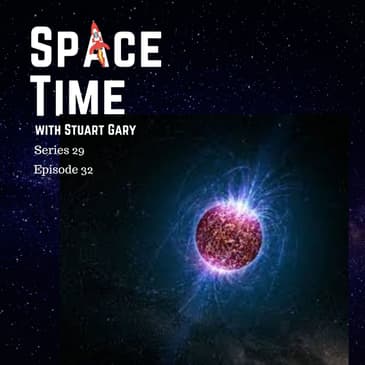
This is Spacetime Series twenty nine, episode thirty two, for broadcast on the sixteenth of March twenty twenty six. Coming up on Spacetime, the birth of a magnetar seen for the first time, rewriting the textbooks on the history of the Earth's moon, and a spectacular fireball lights up the night skies across Europe. All that and more coming up on space Time. Welcome to space Time with Stuart Gary. Astronomers that for the first time seeing the birth of a magnetar, a highly magnetized, spinning neutron star. The discovery, reported in the journal Nature, confirms that they are the power source behind some of the brightest exploding stars in the universe. The findings have established a new phenomenon in exploding stars, that is, supernovae with a chirp in their light curves course by general relativity. Superluminous supernovae, which can be up to ten times brighter than your average exploding star, have puzzled astronomers ever since their discovery in the early two thousands. They were originally thought to simply be the explosion of stars more than twenty five times as massive as our sun. The problem is they also remain bright for much longer than what will be expected when a star's iroincore collapses and its outer layers are subsequently blown off. Now in twenty ten, astrophysicists proposed that a magneta was powering the long lasting glow. According to the hypothesis, when a massive star collapses at the end of its life, it crashes much of its mass down into a super dense compact object called a neutron star. Neutron stars are the densest objects in the universe other than black holes. Just a tea spoonful of neutrons material would literally weigh billions of tons. Now, if the star originally had a very strong magnetic field, it would have been amplified during magnetar formation, reducing a field one hundred to one thousand times stronger than that of a normal spinning neutron star. What we call a pulsar pulsars, and they're highly magnetized big brothers. Magnetars are only about twelve kilometers or so in diameter, but in their youth they can spin up to one thousand times per second. These are millisecond pulsars. As the magnetar spins, the spinning magnetic field can accelerate charged particles, which then slam into the debris from the expanding supernova, increasing its brightness. Magnetars are also thought to be the source of some fast radio bursts. Joseph Farrer from the University of California, Santa Barbara confirm the connection between magnetars and type one superlimited supernovae. After analyzing data from a supernova located a billion light years away and cataloged as SN twenty twenty four AFAV, Pharing colleagues proposed a general relativistic explanation for the unusual bumps in the like of the supernova, which they call chirps. The explanation conclusively connects it to a magnetar. That original twenty ten model proposed that a significant fraction of the energy of the magnetar will get absorbed, generating the superluminosity. Farr's work finding the chirp in SN twenty twenty four AFAV demonstrates that a magnetar did in fact form in the middle of the supernova. After SN twenty twenty four afav's discovery in December twenty twenty four, the Los Cumbrias Observatory, a network of twenty seven telescopes stationed around the world tracked it measured its brightness for more than two hundred days. Pharing colleagues noticed that after the brightness peaked around fifty days after the explosion, it didn't gradually fade like typical supernova do. Instead, its brightness slowly oscillated downwards, with the period of the oscillations gradually shortening, producing a series of forb umps. Previous superlimited Supernerva, we're known to have a couple of these bumps in their decaying light curves, which some astronomers have interpreted as the Supernerva's shock colliding with layers of gas clumped around the star, briefly causing it to brighton, but until now no one had observed four of these bumps. Now, according to Farrer's model, some material from SN twenty twenty four afav's explosion fell back towards the magnetar, forming an accretion disc. Since material around the magnetars are unlikely to be symmetric, the accretion disc would not necessarily be symmetric around the spinning neutron star either, and that would lead to a misalignment of the magnetar spin axis and the spin axis of the accretion disc, and this is where Einstein's general relativity comes in. It states that the spinning mass drag space time with it. It's called frame dragging, and the spinning magnetar would produce an effect known as lens thein procession. That is, it would make the misaligned disk wobble. A wobbling disc would periodically block and reflect the light from the magnetar, turning the whole system into a strobing cosmic lighthouse. The time for this to repeat decreases with the radius of the disc, so as the disc slides inwards towards the magnetar, it wobbles faster, causing the light to oscillate more rapidly as it fades, creating the chirp observed in telescopes. The authors tested several ideas, including pure Newtonian effects and precession driven by the magnetar's magnetic fields, but it was only lends theiring procession, which matched the timing perfectly. Farris says it's the first time general relativity is being needed to describe the mechanics of super and ova. The astronomers also used observational data to estimate the neutron star's spin rate, finding it to be four point two milliseconds and the magnetic field around three hundred trillion times that of the Earth, both hallmarks of a magnetar. Now, this discovery doesn't mean that all superluminous supernovae are powered by magnetars. An alternative hypothesis involves the shockwave from the exploding star hitting materials surrounding it, bumping up its brightness. Now, if the collapse of the star results in a black hole, that could also power a brighter supernova, and if it also has a misaligne accreation disc produced bumps in the light curve. Magnetars are an exciting food of astronomy in stellar astrophysics, with many more mysteries yet to be solved. This report from messertv. A high energy outburst seen in April twenty twenty, confirmed the surprising range of super magnetized objects called magnetars. This blast of X rays and gamma rays triggered instruments on several spacecraft. The eruption was over in the blink of an eye and originated from a galaxy about eleven million light years away. Magnetars are part of the family of compact objects known as neutron stars the crushed leftover cores of exploded stars. What makes magnetars special are their incredibly strong magnetic fields, up to one thousand times stronger than a typical neutron stars. Sudden changes to this ultra strong field are thought to drive brief, enormously powerful outbursts called giant flares. One giant flare in our own galaxy affected Earth supper atmosphere from twenty eight thousand light years away. Detectors on NASA's Fermi Swift Mars Odyssey and Wind missions, as well as on the European Space Agency's Integral satellite, picked up a rapid surge of X rays and gamma rays. Using the arrival times of the signal at different spacecraft, astronomers pinned the burst to n GC two fifty three, a bright nearby galaxy. From start to finish, the event lasted just one hundred and forty milliseconds, as fast as a finger snap. Astronomers see gamma ray bursts, or GRBs, almost every day. We know that at least some of the shortest GRBs come from merging neutron stars more than one hundred million light years away, but a GRB located in our own galactic neighborhood should have appeared much brighter. As astronomers explored this new burst in detail, they found it looked less like a short GRB and more like a magnetar giant flare. Astronomers have recorded two such flares inside our own galaxy and a third in a satellite galaxy. All of these bursts displayed a spiky tail as they faded out, the spike's form as the flare's hotspot spins in and out of view like a lighthouse beam. Current instruments can't detect this feature in flares located at great distances, but other characteristics, such as their extremely fast rise in brightness, are unmatched by short GRBs. This fueled astronomer's growing suspicions that short GRBs associated with galaxies in our neighborhood might really be magnetar giant flares. Now, the precise localization of the twenty twenty event to the disc of the Sculpture galaxy has unmasked them at last. Astronomers suspect that a few percent of observed short GRBs may in fact be giant flares. High powered eruptions in our galactic backyard produced by the strongest magnets in the cosmos. This is space time still to come, rewriting the textbooks on the history of the Moon, and a spectacular fireball lights up the night skies across northern Europe. All that and more still to come on space time. A new study claims the lunar near and pharcides experienced similar levels of asteroid and meteor bombardment, despite the very different appearances, and the new findings contradict earlier suggestions that the far side of the Moon experienced intensified levels of bombombardment compared to the hemisphere facing the Earth. The dichotomy of the two sides of the Moon have long intrigued astronomers, with an near side dominated by vast basaltic volcanic planes called mare, while the far side as a much tacker crust with a rugged, heavily cratered, and mountainous terrain. The new study supports the unified global lunar crater in chronology technique, which links creter density to absolute radiometric ages. Scientists use crater density to provide a rough determination of the average age of a celestial body surface. In simple terms, the more craters, the older the surface is likely to be. These new findings, reported in the journal's Science Advances and the Proceedings of the National Academy of Sciences, are based on lunar regularth collected by China's Changi six sample return mission, which was the first to visit the far side of the Moon. Those samples were then compared with similar samples from missions to the lunar airside. The new findings address how impact structures have recorded the cumulative effects of asteroid and medial bombardment since the Moon first formed some four point five billion years ago. It allows scientists to estimate ages for large areas of the Moon that lack returned samples, and also provides the foundation for aging estimates for other bodies across the Inner Solar System. But some previous studies have suggested that differences in crustal structure or shielding by the Moon's host planet, the Earth, might mean that impact fluxes differed between the near and far sides, raising questions about the universality of the existing model. Previously, all samples used to calibrate this chronology came from the lunar near side, leaving open the possibility that it may not accurately describe the global impact history of the Moon. Another problem involved the possibility that many of the Apollo mission's impact related samples, which were all collected from the lunar nearside, showed ages clustering around three point nine billion years, and that led to the late heavy bombardment hypothesis just a period of extra intense impact events, possibly caused by the outward migration of the gas giants Jupiter and Saturn as they move to their current orbital positions. But it's also possible that the same clustering at three point nine billion years could simply be a sampling bias rather than a true system wide bombardment spike, the idea being that much of these impact samples could simply be caused by a single massive event, say ejected debris from the formation of the Embriyuan basin. Changy six touched down in the Apollo Basin region of the South Pole Achin basin, the largest and oldest recognized impact basin on the Moon. Analysis shows that its samples are dominated by local basaltic material with a radiometric age of about two point eight zero seven billion years that provides a crucial farcide calibration point for comparing impact fluxes between hemispheres. Changey six's collection also includes neurotic rock fragments dated to four point two four cis seven billion years. These crystallized impact melts produced during the formation of the South Pole Ecan basin provide a direct constraint on the timing of this impact event. But these gnridic samples are also inconsistent with the classical late heavy bombardment model, instead favoring the idea of a gradual decline in impact activity following the main phase of planetary accretion in the Inner Solar System. This is space time still to come. A spectacular fireball streaks across the skies of northern Europe, and later in the science report the weird crocodile that walked on two legs. All that and more still to come on space time. The European Space Agencies analyzing a spectacular fireball which lit the night skies over Europe last week, dropping debris all along its trajectory. The meteor streaked across the early evening skies out of the southwest, traveling in the northeasterly direction. It was observed by thousands across Belgium, France, Germany, Luxembourg and the Netherlands. Witnesses say it glowed for around six seconds, leaving a visible trail in the sky as it fractured into pieces. The event was recorded by dozens of dedicated meteor cameras, including the European all Sky seven Fireball network, as well as hundreds of cell phones, security cameras and dash cams. Some observers also reported the event was audible from the ground. At least one house in Germany was reported and being struck by small pieces of the resulting meteorites. There have been no reports of any physical injury. The European Space Agency's Punetary Defense Team says it's now working to determine the object's original size, which is thought to have been up to several meters in diameter. The agency claims that objects in the science range strike the Earth between once every few weeks and once every few years. The timing and direction of the impact indicates the object was likely not visible on any large scale telescope. Sky surveys would scan the night skies for such objects. Now that's not unusual. Remember, so far, only eleven space rocks destined to hit the Earth have actually been detected prior to their atmospheric entry. Small objects approaching the Earth from brighter daytime regions the sky, even around dusk as in this case, are often missed because of the glare of the sun. This space time and time that to take a brief look at some of the other stories making us in science this week With a science report, A new study warns there's little scientific evidence to show that canabis really can help people who are suffering from mental health conditions. The findings, reported in the Journal of the American Medical Association, looked at the available evidence to assess the use of cannabis for a variety of mental health conditions, including post traumatic stress disorder, anxiety depression, bipolar disorder ADHD, and psychosis. The research showed that, along with the lack of evidence of the effectiveness of cannabis to treat these conditions, using dope also comes with its own risks, including worsening mania symptoms, a lack of ability to cope with life among bipolar patients, and an increase in psychotic symptoms. The authors also report that around a third of people use cannabis develop a cannabis use disorder which starts to interfere with their everyday lives, and that means more than just ordering pizzas at three in the morning. The authors say this currently simply not enough evidence to support the use of cannabis for the treatment of mental health conditions, and use should be discouraged among you young people and those with conditions such as bipolar or psychosis. Well. The latest move by Australia's socialist labor government to force its citizens to adopt a digital ID scheme has now come to fruition, with people being forced to verify their ages through digital documentation in order to access R rated video games and websites. It follows last December's legislative changes preventing kids under sixteen from accessing social media platforms except for left wing sites like Blue Sky. Australians have repeatedly rejected the idea of federally mandated ID schemes like the so called Australia Card. The fear is digital ID will eventually place all your data, including employment and medical records, the driver's license, your finances, your internet history and online activities into a single file, which could then be easily accessed by politicians and bureaucrats. It means digital IDs could be used as a clandestine way for governments to introduce a version of China's infamous social credit scheme, in which authorities can monitor what you say and access online and punish you for inappropriate thoughts and actions, restricting where you can live, your ability to travel, your access to medical treatment, and even in which schools your children can go to. And if you think that's far fetched, remember Australians already had their first taste of this big brother approach when police in Victoria and Western Australia began using COVID nineteen digital passes to tract people's movements. A weird ancient relative of crocodiles, which lived during the Age of the Dinosaurs some two hundred and twenty five to two hundred million years ago, may have started life on four legs before learning how to walk on just two as an adult. A report in the Journal of Vertebrate Paleontology found the fossils had unusual proportions, which led them to believe that this pertle sized reptile, son Solusucus cedris, had learned how to walk on two feet. They think that Sonsucus had more proportional four limbs and hind limbs when they were young, but the hind limbs grew longer and more robust as they moved to adulthood. Well, it looks like a psychic from Pakistan who predicted the end of the world a peace still have gotten it wrong, skeptics. Ten Mendum says that says teachings combined sufism with eschatology. People are so keen to predict doomsday. I don't know what benefit it gives them, because Rovioui's not going to get any money once it happens, not what he createds a fellow name a spiritual leader name who he has Akhmad Shahi, who predicted back in the book he wrote in two thousand or that came out in two thousand, that the Earth would be destroyed colliding with a comment resulting in the annihilation of all life forms before the end of last year twenty twenty five. He said this theme would happen in the next twenty to twenty five years in his book that came out in two thousand, so it should have happened by now. It hasn't happened by now. Obviously he kind is going to happen because of its retribution for humanity straying too far from spiritual truths. He's got a very wide ranging sort of predictions. You know about discovering break through medicines which can prolong the aging process. You'd hope to reverse it anyway, for a medicine that can defeat death. It happens occasually. Most predictors don't like doing complete disasters that all life will be wiped out, and don't con't see the point. I don't know what you can do about it to avoid it, for a start, and I don't know what benefit is going to get out of it, apart from saying, oh, he's the predictor who predicted this thing twenty years in the future. He must be real. We've done predictions. Australian skeptics have analyzed predictions, thousands of them, several hundred Australian psychics and predictors them and they found out they were appalling in their accuracy. Eleven percent of these thousands of predictions were accurate. But they are also fairly general that they could apply to a lot of different things. For that was the bleeding obvious, even though that was a category as well, but in most cases they were wrong. They're actually wrong. And you think that this sort of spiritual leader, if they're making predictions that are generally largely almost entirely wrong, you think there's something wrong with that industry. And funny enough, there is. That's the skeptics timendum, and this is space Time, and that's the show for now. Spacetime is available every Monday, Wednesday and Friday through at bytes dot com, SoundCloud, YouTube, your favorite podcast download provider, and from space Time with Stuart Gary dot com. Space Time's also broadcast through the National Science Foundation, on Science Own Radio and on both iHeartRadio and tune In Radio. And you can help to support our show by visiting the Spacetime Store for a range of promotional merchandising goodies, or by becoming a Spacetime Patron, which gives you access to triple episode commercial free versions of the show, as well as lots of bonnus audio content which doesn't go to air, access to our exclusive Facebook group, and other rewards. Just go to space Time with Stewart Gary dot com for full details. You've been listening to space Time with Stuart Gary. This has been another quality podcast production from bytes dot com,