
Our Guests This Week: Professor Kliti Grice from Curtin University Jan Cami from Western University And our regular guests: Alex Zaharov-Reutt from techadvice.life Tim Mendham from Australian Skeptics 🌏 Get Our Exclusive NordVPN deal here ➼ www.bitesz.com/nordvpn . The discounts and bonuses are incredible! And it’s risk-free with Nord’s 30-day money-back guarantee! ✌ If you’d like to support the podcast and gain access to bonus content by becoming a SpaceTime crew member, you can do just that through premium versions on Patreon, Spotify and Apple Podcasts. Details on the Support page on our website https://www.bitesz.com/show/spacetime/support/
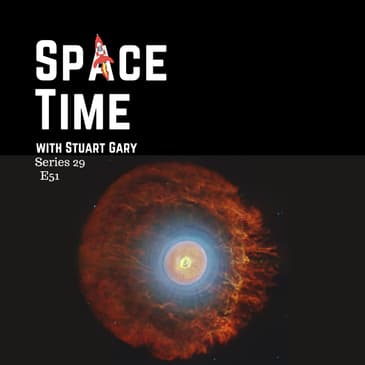
This is Spacetime Series twenty nine, episode fifty one, for broadcasts on the twenty ninth of April twenty twenty six. Coming up on Spacetime, discovery of organic molecules never before seen on Mars, a spectacular new understanding of cosmic buckyballs, and NASA forced to shut down another instrument on the Voyager one spacecraft in order to keep it operating. All that and more coming up on space Time. Welcome to space Time with Stuart Gary. New data is confirmed that NASA is Mars Curiosity rover has identified seven organic molecules on the red planet that have never been detected there before. The newly found molecules were among twenty one carbon tanny molecules identified in a sample collected by the six world car sized mobile Laboratory back in twenty twenty. Scientists have no way of knowing whether these organic molecules were created biologically or through geologic processes. The problem is both paths are possible, but their discovery has renewed confirmation that ancient Mars did have the right chemistry to support life. The newly found molecules joined a growing list of compounds then to be preserved in rocks even after billions of years of exposure on Mars to radiation which break down these molecules over time. The findings were reported in the journal Nature Communications suggests the rock sample, which has been nicknamed Mary Anning three after a British fossil collector and paleontologist, were collected on Mount Sharp, the five and a half kilometatore central peak of Gale Crater. It's an area that was covered by lakes and streams billions of years ago when Mars was a warmer, wetter world compared to the freeze dried desert it is today. It's an area which scientists believe surged and dried up model times through the planet's past, eventually enriching the area with clay minerals that were especially good at preserving organic compounds. By the way organic compounds means carbon containing molecules, it could be the building blocks of life and which are found throughout our solar system. Among the newly identified molecules is a nitrogen heterocycle, a ring of carbon atoms that includes nitrogen, and this kind of molecular structure is considered a precursor to RNA and DNA. The two nucleic acids key for genetic formation. The Steadies. Lead author Amy Williams from the University of Florida in Gainesville, says that discovery is profound because these structures can be chemical precursors to more complex nitrogen bearing molecules. Nitrogen heater cycles had never been seen on the Martian surface before, nor have they ever been confirmed in Martian meteorites found here on Earth. Another exciting discovery was spenzothiopine, a carbon and sulfur bearing molecule that has been found in many meteorites. These metia rites, along with the organic molecules within them, are thought by some scientists who have seeded prebartic chemistry across the early Solar System. A new discovery follows last year's finding of the largest organic molecules ever discovered on Mars, long chain hydrocarbons, including decayne, undercane, and dodocane. This collection of organic molecules increases the prospect that Mars could have provided a habitable environment for past life. Both sets of findings were made using a sophisticated mini lab on curiosity called the Sample Analysis at Mars Instrument or SAM for short, A drill on the end of the rover's robotic arm. First pulverise as a carefully selected rock sample, turning it into powder, and then pouring it into SAM, where a high temperature oven heats the material, releasing gases which can then be analyzed by spectrographs to reveal the rock's composition. And it doesn't end there. SAM also performed wet chemistry on the rock, dropping a Marianni three sample into a small contenter of solvent. The resulting chemical reactions can break apart larger molecules, which would be difficult to detect and identify otherwise. These results were then verified by similar tests on Earth using a piece of the famous Murchison meteorite, one of the most studied meteorites of all time. More than four billion years old, the Murchison meteorite was discovered near the town of Murchison in Victoria. It contains organic molecules that were seeded throughout the early Solar system. The Murchison sample tested broke much larger molecules as some of the same ones seen in mary Anning three, including benzothypine, and that verifies that the Martian molecules found in mary Anning three could have been generated from the breakdown of even more complex compounds relevant for life. This is space time still to come, a spectacular new understanding of cosmic buckyballs, and NASA forced to shut down another instrument, the Voyager Want Spacecraft. All that and more still to come on space time. Fifteen years after astronomers first discovered bucky balls in space, new observations have shown how they're distributed in a shell around the corpse of a dying star. Buckey balls, or Buckminster fullerines, to use their full name, are sucker ball shaped molecules that resemble Hollow's spheres. These molecules, which contain sixty perfectly arranged carbon atoms, were first synthesized back in nineteen eighty five at the University of Sussex by Harry Croto and colleagues in a breakthrough which earned him the nineteen ninety six Nobel Prize in Chemistry. Proto named the molecule after the famed architect Buckminster Fuller, who designed and developed geodesic rms, which share the same structural principles. Proto immediately predicted that bucky balls would be widespread and abundant throughout the Cosmos, and twenty five years later in twenty ten, yarn Kami from Western University detected them in space for the first time using NASAs Spitzer Space Telescope. Stunning new observations by the WEB Space Telescope have now provided fresh details about the bucky balls and the planetary nebula TC one, formed by dying sunlike star more than ten thousand light years away in the constellation Ara. The TC one planetary nebula is what remains of a sun like star after it exhausts its core nuclear fuel supply and sheds its outer layers in expanding shells of gas and dust. What's left behind is the white hot stellar core, called a white dwarf. This floods its surroundings with ultraviolet radiation, causing the expelled gas to glow. This process, unfolding over tens of thousands of years, sculpts the intricate structures now visible by WEB. The carbon rich chemistry of tc IE, including its bucky balls, reflects the composition of the star that made it a window interstellar revolution written in molecules. Cami and colleagues use web's mid infrared instrument to capture the first ever detailed view of this planetary nebula, revealing delicate rays, wispy filaments, and shimmering shells of hot blue gas and colder red material. At the heart of the nebula, they saw an ethereal feature resembling an upside down question mark, hinting at a degree of complexity still waiting to be understood. Cami says he knew TC one was special, but the web data goes far beyond what he anticipated. It's providing new insights into the nature of buckyballs and why they shine so exceptionally bright in this specific planetary nebula, questions which have been puzzling Cammi for more than fifteen years. The new web observations allow scientists to map not just what TC one looks like, but what it's made of, its temperature, its density, its chemical composition, and the motions of the gas throughout the nebula. The result is an extraordinarily powerful windown to the physics and chemistry of a dying star. Among the new data sets early revelations is three dimensional distribution of the bucky balls, showing that they're not scattered randomly throughout the nebula, but instead are concentrated in a thin spherical shell surrounding the central star. Scattering bucky balls in space is important hope scientists track carbon chemistry, explain mysterious signals, and understand how organic materials change in extreme environments. Kemi says that discavery of bucky balls has also changed traditional views about how space chemistry can offer clues about how life may have begun. We discovered bucky balls in space, and bucky balls are these microscopic particles made of carbon that are arranged in a very specific pattern of pentagons and hexagons, which gives them the shape of a soccer ball. Actually looks pretty much like a soccer ball. Bucket balls are now the largest known molecules in space, and we have discovered them using the Spitzer Space telescope. We have used the telescope because these bucky balls they vibrate in all sorts of different ways, and each time they do so, they actually emit specific infrared light and we can discover that signature of that infrared light. It's very precise fingerprint for each of those species. They actually have been hypothesized to exist in space since they were discovered in nineteen eighty five, and so basically I presumed that if they would exist in space, they would not be very abundant and might not be detected that easily, so that I was completely taken aback when I saw that spectrum where these signature are so clear, where they're not contaminated by any other spectral component. Now that we have discovered that bucket balls actually exist in space, there's lots of opportunities for follow up research. If we would find these bucket balls only in one object, then it would just be an odd case. The question is, now, how many objects do we see where we find these bucket balls? Are those bucket balls really abundant in space? Are they just in a niche environment and very under very peculiar conditions. Are not? And that's what we're working on now. That's one of our follow up avenues. That's John Cammy from Western University. And this is space Time still to calm. NASA forced to shut down another instrument on the Voyager one spacecraft to keep it operational, and later in the science report, palaeontologists have just identified a new species of seripod dinosaur. All that and more still to come on Space Time, NASA has been forced to shut down another instrument about the Voyager one spacecraft. In order to conserve power and keep humanities first Interstellar Explorer, operational engineers at NASA's Jet Proportional Laboratory in passing into California sinks to shut down the low energy Charged Particle experiment, which has been operational almost without any interruption since Voyager first launched way back in nineteen seventy seven, almost forty nine years ago. The instrument measures low energy charged particles, including ions, electrons, and cosmic rays, originating both from within our Solar System and from interstellar space beyond. It's provided critical data about the structure of the interstellar medium, detecting pressure fronts and regions of varying particle density in the space beyond our heliosphere, the bubble around our Solar System created by the Sun's atmosphere. The twin Voyager spacecraft are the only man made objects that are far enough from Earth to provide this information. Like its sister spacecraft, Voyager two, Voyager one relies on a radio isotope thermoelectric generator, a device that converts heat from the cane plutonium into electricity. Both probes lose around four watts of power every year, and after almost half a century in space power, mude have now grown raiser thin, requiring mission managers to conserve energy by shutting off heaters and instruments, or making sure that spacecraft don't get so called that their fuel lines freeze. During a routine planned roll maneuver back in February, Voyager one's power levels fell unexpectedly. Mission managers knew that any additional drop in power could trigger the spacecraft's under voltage full protection system. That would cause the spacecraft to start shutting down components on its own in order to safeguard the probe, requiring recovery by flight teams back on Earth. And that's a lengthy process which carries its own risks. So the Voyager management team decided to act first. Voyager one still has two remaining operating science instruments, one that listens for plasma waves, one that measures magnetic fields. They're still working great sending back data from a region of space no other man made object has ever explored. The choice of which instruments to shut down wasn't made in the head of the moment. Years ago, Voyager science engineering teams sat down together and agreed on the order in which they had shut off parts of the spacecraft while ensuring the mission can continue to conduct unique science. Of the ten identical sets of instruments that each spacecraft carried, seven have now been shut off so far. For Voyager one, the low energy charge Particle experiment was next on the list. The team had already shut off the same experiment on Voyager two back in March twenty twenty five. Because Voyager one is now more than twenty five billion kilometers from Earth, the sequence of command sent to shut down the instrument takes twenty three hours to reach the spacecraft, and the shutdown process itself will take about three hours and fifteen minutes to complete, then another twenty three hours to confirm that everything went according to plan. One part of the Low energy Charge Particle experiment, a small motor that spends the censor in the circle to scan in all directions, will remain on. That's because it uses little power, just half of what and keeping it running gives the team their best chance of being able to turn the instrument back on someday if they ever find extra power. Mission managers think that shutting down the Low Energy Charge Particle Experiment will give Voyager one about an extra year of breathing room, and they'll be using that time to finalize a more ambitious energy saving fixed for both Voyager spacecraft, one they're calling the Big Bang, and one, which is designed to extend Voyager operations. The idea is to swap out a group of powered devices all at once, hence the nickname Big Bang, turning some things off and replacing them with low power all turn. It is to keep the spacecraft woman enough to continue gathering science. Mission managers will implement the Big Bang on Voyager two first, which is a little more power to spare and is a little closer to Earth, making it a safer test subject. Those tests are planned for later this month and early June. If things go well, the team will attempt the same fix on Voyager one no sooner than July, and if it all works, there's even a chance that the Voyager one's low energy charge particles experiment would eventually be switched back on. Fingers crossed. The two Voyager spacecraft are the most distant man made objects ever sent into space, and the only ones to have left our Solar System. Their mission was a grand two of the outer Solar System. Both visited the gas giants Jupiter and Saturn. Voyager one then went on to study this tourney Moon Titan before turning north and heading out of the Solar System. Meanwhile, Voyager two went on to visit the ice giant planets Uranus and Neptune for turning south out of the Solar System, so both in our traveling through interstellar space in different directions. Voyager one left our Solar system back in August twenty twelve, and it's traveling in about sixty one thousand kilmetis p hour in the direction the constellation are Fayusius. In November, it'll become the first spacecraft to have reached a full one light day away from Earth I. Meanwhile, Voyager two is about twenty one billion kilometers from home, having crossed into interstellar space. November twenty eighteen. It should pass the brightest star in our night sky, Sirius, which is eight point six light years away, in about two hundred and ninety six thousand years. This is space time and time that attack. Another brief look at some of the other stories making us in science this week with the Science Report. Scienters say an implant that stimulates specific nerves in the tongue could be an effective treatment for obstructive sleep atnear in people who can't use a breathing mask. The findings are reported in the Annals of Internal Medicine, based on a small, randomized control trial using one hundred and four adults in the United States. The authors evaluated the safety and effectiveness of a specialized implant which stimulates the tongue in airway muscles to help people with obstructive sleep out in their breathe when they fall asleep. All participants were given the implant, but only sixty seven of the one hundred and four had the device turned on. After seven months, fifty eight point two percent of patients with the implant turned on saw a fifty percent or more improvement in their sleep APNA, compared with thirteen and a half percent of those who didn't have the implant turned on. Paleontologists have identified a new species of serapod Dinosaur. Serapods are herbivore dinosaurs with elephant like bodies and legs, a long neck and small head at one end and a long tail of the other, and they include the largest of all animals ever to live on land. The discovery reported in the General PeerJ was found in southern Argentina and it has been named Bircherichosaurus deyond Die. The fossils have been dated to one hundred and fifty five million years ago. Scientists discovered parts of its spine, including over thirty neck, back and tel vertebrae, several ribs, and a fragment of the pelvic bone. You aughs to say. The structure of the bones indicates that the remains belonged to an adult about twenty meters long. A new study shows that artificial intelligent chatbots can successfully judge a person's mood simply by looking at the expression on their faces, using famous painted and photograph portraits combined with binary choice questions about the subject's mood or feelings. Israeli researchers found that some AI chatbots, such as chat GPT four, Rock and Gemini, can interpret emersions almost indistinguishable from humans or Claude and Minstrel were less capable. The authors compared the five chatbots with five humans across five scenarios and forty three thy two hundred simulations, judging facial pictures based on variations in perceived competence, benevolence, integrity, and demographics in terms of judging mood. The findings were reported in the journal The Proceedings of the Raw Society. Found the chatbots were more consistent than people and more discerning see that's because people tend to collapse individual features together in order to look for a global good person impression, while the chatbots assess the different dimensions separately. The authors hope the finding could lead to eventual development of emotionally sensitive AI chatbots sometime in the future. It's been a big week in the world of technology, with Microsoft announcing plans for a twenty five billion dollar AI data center in Australia in order to expand in country computing and AI capabilities by the end of twenty twenty nine, and Apple boss Tim Cook has announced he plans to retire later this year, which will mean big changes for the fort trillion dollar company. With the details on both, we're joined by technology editor Alex Harov Royce from Tech Advice Start Life. Yes. Look, it was rumored for quite some months now that Kim Cook was going to be resigning a CEO and doing something else, might starting with an Apple, and that John Turners, who's the engineering hardware chief at Apple, would be taking over, and so it has come to pass. Now Kim Cook was an operations genius and he was trusted by Steve Jobs to be a solid pair of hands, and so he's been there when the launch division pros the AirPods, Apple Watch, I mean some of those things Steve Jobs did have a hand him. But of course once he sadly passed in twenty eleven, his genius wasn't able to be further extracted. And of course, you know there's no Steve Jobs AI as such that he would have had a chance to program that could have given more insights. And even then, the age of AI insights from digital phones of yourself isn't really there yet, although it's getting pretty good. Tim Cook is now going to be the executive chairman of Apple from the first of September twenty twenty six, which is the date that John Turners will take over. And being a hardware man, he has the experience across different parts of Apple. I mean he was there for every iteration of AirPods. He's been there for part of the team that made the iPad. He's been there for a long time since two thousand and one, so he've got a quarter a century of experience, and it's good to see somebody who's on the hardware side and understands how software and hard will work together be at the helm and Tim Cook as the executive chairman is not going anywhere. I mean, he still has all of those incredible relationships with world leaders and so he'll still be a very integral part. And what does this mean for AI? Because Apple's been really behind there. Apple has done more of a deal with Gemini to deeply integrate it. I mean it's a brain transplant sery has needed. And I'm sure Apple still has ambitions to create its own AI systems and it will. I'm sure it just takes time. But to catch up they need to work with somebody very strong and open AI, Gemini, Anthropic, Perplexity, these are all strong contenders. There was rumors that Apple was going about perplexity some years ago, and we launch a Perplexity computer, an app for the Mac that can build research, you know, create design. I mean it's a bit like clawed coworking that it gives you an environment where you can have twenty different agents doing things for you on your behalf, chewing up tokens at whatever cost. That is Apple needs to have that sort of agentic AI interface for macOS to let you be the leader that can orchestrate a bunch of agents to do things on your behalf, not for you to sit there and click. And that is the next computing interface, as well as of course natural languages and interface talking to the computer asking me to do things. And speaking of AI. Big announcement from Microsoft there about the spend twenty five billion that's with a B dollars on a new center in Sydney. Yeah, we're going to do that over the next three years. They've got a memoran of understanding the industry and government about this data center, AI infrastructure and the work in cybersecurity. The big problem is that Australia right now does have a major energy shortage. We've gone to renewables to such an extent that regular power prices are skyrocking through the roof. We used to have the cheapest energy in the world, Now we have some of the most expensive. That can't go well for the idea of setting up an AI harb in Australia. No, I mean our governments have done an absolutely terrible job of maintaining affordable energy. I mean it's been an unmitigated disaster. Prices will meant to come down, according to the government turner of fifth dollars. Yes, they put through some payments to help people, but that's artificial. It's an artificial handout which is costing the country millions and billions. They're talking about building data centers to which power needs to be sent. Yeah, it's an indictment on our political leaders that we find ourselves in this position. You know, it's interesting that Cook has resigned, and you know, I'm probably the only journalist in the Strator calling for Sachi Nadella to resign. I mean, he's been there for a long time. I mean, yes, he's grown Microsoft a lot as well, and he famously said he wanted Google to dance when he launched co Pilot. But co Pilot's a bomb. I mean, a Copilot just hasn't done as well as Microsoft would have wanted. The fact that Microsoft helped open Ai with its thirteen billion dollar investment to become the biggest AI provider around, I suppose the board would think that Satne and Nadella has done a great job. But you know, after spending all this money on AI and not being a true leader in the space. Look, it was here for an AI tour. Well, I can I get my officer Outlook to work? So maybe he should be concentrating on customer service rather than touring the world. Well, I certainly think so. I mean, look, Windows is better than it's ever been. It's fantastic. People use it every day. But you know you can still get weird and wacky viruses. You know, Microsoft issues and update and it's start menu disappears or something goes wrong. I mean, I don't know how you can issue an update and not thoroughly tested. I use Windows for one reason only, and that's to help people fix their problems with Windows. That's about it. The only seem I pay Microsoft for is Office thirty six five because it's just so used to work. It's just easier to do something. I'm glad yours work, so I wish mind it. Well. Look, I have given up on Outlook twenty years ago. I mean a long time ago in the galaxy far far away was I using Outlook. And I've got plenty of people, including you, who are still using Outlook, and there's always problems. They're trying to change the interface. I mean, it's a disaster. That's Alex oharov Roy from Take Advice Live and this space Time, and that's the show for now. Space Time is available every Monday, Wednesday and Friday through fites dot com, SoundCloud, YouTube, your favorite podcast download provider, and from space Time with Stuart Gary dot com. Space Time is also broadcast through the National Science Foundation on Science Own Radio and on both iHeartRadio and tune In Radio. And you can help to support our show by visiting the Spacetime Store for a range of promotional merchandising goodies, or by becoming a Spacetime Patron, which gives you access to triple episode commercial free versions of the show, as well as lots of burnus audio content which doesn't go to weir, access to our exclusive Facebook group, and other rewards. Just go to space Time with Steward Gary dot com for full details. You've been listening to space Time with Stuart Gary. This has been another quality podcast production from bytes dot com.