
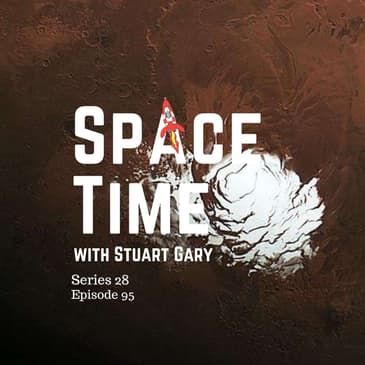
Martian Glaciers: Pure Water Ice
Recent research reveals that Martian glaciers are composed of over 80% pure water ice, challenging previous assumptions that they were primarily rocky. This groundbreaking study, led by Yuval Steinberg from the Weizmann Institute, utilized standardized measurements to analyze the dielectric properties of these glaciers, providing a clearer understanding of their composition. The findings not only enhance our knowledge of Martian geology but also have significant implications for future manned missions, as these glaciers could serve as vital water sources for astronauts.
Discovery of an Intermediate Mass Black Hole
NASA's Hubble Space Telescope and Chandra X-Ray Observatory have identified a rare intermediate mass black hole, known as NGC6099HLX1, actively consuming a star. This black hole, located approximately 450 million light-years away, resides in a compact star cluster and exhibits extreme luminosity during its tidal disruption event. The discovery sheds light on the formation of black holes and their role in galactic evolution, providing crucial insights into the elusive intermediate mass category that bridges stellar and supermassive black holes.
United States Space Force's X37B Mission
The United States Space Force is gearing up for the eighth mission of its Boeing X37B space shuttle, set to launch from Cape Canaveral Space Force Base. This mission will test advanced technologies, including a high-bandwidth inter-satellite laser communications system and a cutting-edge quantum inertial sensor. The X37B's unique capabilities allow it to conduct classified operations while remaining difficult to track, highlighting its significance in modern space operations.
www.spacetimewithstuartgary.com
✍️ Episode References
Icarus Journal
https://www.journals.elsevier.com/icarus
Astrophysical Journal
https://iopscience.iop.org/journal/1538-4357
NASA Hubble Space Telescope
https://hubblesite.org/
Become a supporter of this podcast: https://www.spreaker.com/podcast/spacetime-space-astronomy--2458531/support.
Missus Spacetime Series twenty eight, episode ninety five, for broadcast on the eighth of August twenty twenty five. Coming up on Space Time, Martian glaciers found to be more than eighty percent pure water ice, a rare intermediate mass black hole discovered devouring a star, and the United States Space Forces Boeing X thirty seven B space Shuttle prepares for its eighth mission. All that and more coming up on space Time. Welcome to space Time with Stewart Gary. A new study has found that Martian glaciers are actually more than eighty percent pure water ice. On the slopes of Martian mountains and craters clings what appears to be flowing honey, coated in dust and frozen in time. In reality, these features are incredibly slow moving glaciers, and their contents were once thought to be mostly rock enveloped in some ice. The work over the last twenty years has demonstrated that at least some of these glaciers are mostly pure water ice with only a thin covering off rock and dust. Then you. Findings are reported in the journal Icarus suggest that all glaciers on the Red planet actually contain more than eighty percent water ice. The studies, lead author of Steinberg from the Weiseman Institute of Science in Israel, says in the past, different techniques were being applied by researchers to various sites, with the results not easily compared. In the new study, Steinberg and colleagues first focused on a site that hadn't been examined before, and of the other four sights they studied, only two had been partially examined previously. The authors decided the best thing to do was to standardize how these debris have with glaciers are being analyzed, so they specifically measured their dielectric property that's a measure of how quickly radar waves move through the material. They also examined their lost tangent, which is a measure of how quickly energy dissipates from radar waves focused on the material. From these Steinberg and colleagues were able to infer the ratio of rock to ice within a glacier. Now this can't be done from visual observations of glaciers that have dust and rock covered surfaces. They also identified other areas on the Red planet whennas is Mars reconnaissance or but it could carry out similar analyzes which enabled a global comparison, and they were surprised to find that all the glaciers they stated, even on opposite hemispheres, still all have nearly the same properties. And that's important is to tell scientists that the formation and preservation mechanisms are probably the same everywhere on the red planet. From that, they could conclude that Mars experienced either one widespread glaciation or modible glaciations that all had similar properties. And by bringing together all these sites and techniques for the first time, they were able to unify science as understanding of these types of glaciers. Knowing the minimum purity of these glaciers benefit scientific understanding of the processes that foreman preserve them. Additionally, it helps when planning future man missions to Mars, allowing astronauts to use local resources such as water that can be refined into rocket fuel used for drinking or making oxygen. Next, the team will see out the additional glaciers to add to the global comparison and help solidify their understanding of these dust covered mysteries. This is space time still to come. A rare intermediate mass black hole discovered devouring a star and the United States Space forces. Boeing X thirty seven B space Shuttle prepares for its eighth mission. All that and more still to come on space time. NASA's Hubble space Telescope and Chandra X ray observatory have teamed up to identify a possible new example of a rare intermediate mass black hole in the process of devouring a star called NGC sixty ninety nine HLX one. The sprid X ray source seems to reside in a compact star cluster in a distant elliptical galaxy. A report in the Astrophysical Journal says the galaxy is located some four hundred and fifty million light years away in the constellation Hercules. The newest probable intermediate black hole was located in the galaxy NGC sixty ninety nine Outskirts at approximately forty thousand light years from the galactic center. Just a few years after its launched. Back in nineteen ninety, the Hubble Space Telescope discovered that most, if not all, galaxies throughout the universe contained super massive black holes at their centers, weighing millions to billions of times the mass of our Sun. Galaxies can also contain millions of smaller stellar mass black holes. These way less than one hundred times the mass of the Sun, and their form massive stars with more than eight solar masses, and their lives that explode its core, collapse supernervae blast sop powerful they can briefly outshine an entire galaxy. However, far more elusive a circled intermediate mass black holes. These fill the gap between super massive and stellar mass black holes, and they have masses between the few hundred and a few hundred thousand times that of our Sun. This not too big and not too small category of black holes are often invisible to us because they don't gobble up as much gas and stars as super massive black holes do, which emit powerful radiation when they're active. When an intermediate mass black hole does occasionally devour a hapless passing star in what astronomers call a title disruption event, they too pour out a gusher of radiation, allowing them to be identified. Astronomers first detected it through an unusual X ray source in images taken by the Chandra X ray telescope back in two thousand and nine. They then followed its evolution using the European Space Agency's XMM Newton Space Observatory. The studies lead author Ichichang from the National Sumhwa University in Taiwan says X ray saw with such extreme luminosity a rare outside galactic nuclei, and so they can serve as a key probe for identifying elusive intermediate mass black holes. The X ray emissions coming from NGC sixty ninety nine hlx one as a temperature of around three million degrees celsius, which is consistent with the tidal disruption event. Observations by the Hubble Space telescope found evidence for a small cluster of stars around the black hole, and this cluster would give the black hole lots to feed on because the stars are so incredibly closely crammed together that just a few light months apart about eight hundred billion kilometers, The suspected intermediate mass black hole released its maximum brightness in twenty twelve, before continuing the slow decline through to twenty twenty three. Now, optical on extra observations over this period do not overlap, and this complicates the interpretation. The black hole may have ripped apart a captured star, creating a plasma disc that displays variability or it may have formed a disc that flickers as gas plummets towards the black hole itself. Still, that all raises an interesting question, how long does it take an intermediate black hole to swallow a star? Or back in two thousand and nine, h x one was fairly bright and then by twenty twelve it was around one hundred times brighter before dropping in brightness again. So astronomers will now need to wait to see if it's flaring multiple times or if there was a beginning a peak and now it's just going to fade away until it disappears from view entirely. The authors say this presumably a super massive black hole in the galaxy's core, which is currently quiescent. Doing a survey of intermediate mass black holes could provide information on how larger super massive black holes are formed. You see right now. There are two alternative theories. One is that they're the seeds for building up even larger black holes by coalescing together, since big galaxies grow by consuming smaller galaxies, and so the black hole in the middle of a galaxy also grows through these mergers. Previously, Hubble observations have observed a proportional relationship the more massive the galaxy, the bigger its central black hole. So the emerging picture with its new discovery is that galaxies could have satellite intermediate massive black holes orbiting them, but depending on what's going on, they don't always fall into the center. But there's another idea that's their gas clouds in the middle of dark matter halos in the early universe don't make stars first, but simply collapse directly to form a super massive black hole, And that idea is supported by observations from NASA's James Webb Space Telescope. It discovered that very distant black holes are disproportionately more massive relative to their galaxy. Of course, they could be an observational biases towards detecting extremely massive black holes in the distant universe. That's because those of smaller size are simply too faint to see. In reality, there could be far more variety out there in just how dynamic our universe is at constructing black holes. Super Massive black holes collapsing inside dark matter haloes might simply grow in different ways from those living in dwarf galaxies where black hole are cre may well be the favored growth mechanism. The authors say, if they're lucky, they're going to find more free flirting black holes suddenly becoming x ray bright because of title disruption events. The problem is Chandra and XIMM Mutant each only look at a small fraction of the sky at a time. That means they don't often see new title disruption events in which black holes are consuming stars, and that's where the new Varis or Sky Telescope survey comes in. It should be able to detect these events in optical light as far as hundreds of millions of light years away, and then file observations using Hubble and web could reveal the star cluster around the black hole. This report from nass A TV. Just a few years after its launch in nineteen ninety, NASA has Hubble Space Telescope made a groundbreaking discovery. Nearly every galaxy in the universe appears to have a super massive black hole at its center. Some are millions or even billions of times more massive than our Sun. Along with these cars heavyweights, galaxies also contain countless smaller black holes. These form when massive stars reach the end of their lives and usually have a mass of less than one hundred times that of the Sun, but in between these extremes is something much harder to find, intermediate mass black holes. They range from a few hundred to a few hundred thousand times the mass of our sun. These black holes are tricky to detect because they don't constantly feed on gas and stars. They don't shine unless they're caught in the act of eating a nearby star. That's what makes tidal disruption events so important. When a star strays too close to a black hole, it gets torn apart and the black hole and leashes a burst of energy. Hubble and mass as Chondra X Ray Observatory teamed up to study one of these rare events in a galaxy called NGC six zero nine nine, where a source known as HL lit up the sky. Chandra detected powerful X rays with temperatures around three million degrees, exactly what you'd expect from a star being devoured. Hubble examined the same location an ultraviolet and optical light, revealing a dense cluster of stars surrounding the black hole. These stars are packed so tightly that they are only a few light months apart about five hundred billion miles, providing a convenient potential food source for the black hole. This discovery shows the importance of different telescopes looking at the universe in different types of light. Unique telescopes working together can paint the full picture of what's happening in our universe. This is space time still to come. The United States Space Force preparing one of its to X thirty seven B space shuttles for another classified orbital emission, and later in the science report and you study has shown that heat exposure over time is linked to worsening school performance by kids. All that and more still to come on space time. The United States Space Forces preparing one of its to X thirty seven B space shuttles for another classified orbital mission. The Boeing built X thirty seven B orbital test vehicle will launch on its eighth mission later this month from the Cape Canaveral Space Force space in Florida. The flight comes less than six months after the last flight. OTV seven returned from a record breaking highly elliptical orbital mission where it flew higher than any other wing spaceplane. During that flight, it also demonstrated error braking maneuvers, allowing it to change orbital altitude and inclinations without expending huge amounts of fuel. As well as testing highly classified payloads, these reusable space planes are also suspected of undertakeing satellite inspection operations. During these missions, they intercept and study enemy satellites and possibly attach monitoring devices to them, allowing the Pentagon to spy on what's going on. Because of their ability to rapidly change orbits, the X thirty seven bees are difficult for enemy combatants to track, allowing them to operate in a clandestine environment. Bowing Space Mission Systems Vice President Michelle Parker says the program continues to evolve with each successive flight. The X thirty seven BE demonstrates its adaptability and flexibility by hosting a diverse range of experiments and trying out pioneering new orbil regimes. She says this latest mission, OTV eight, will fly aboard a Falcon nine rocket and will include an integrated service module, thereby expanding its paload capacity. The key experiments aboard the flight, at least the ones they're willing to tell us about, include a high bandwidth inter satellite lesser communication system and the most advanced quantum inertial sensor system yet flown in space. These will support next year generation navigation and communications technologies. The laser communications demonstration will strengthen the resilience, reliability, and adaptability of satellite communication architecture, and the quantum inertial sensor will provide precise navigation in GPS denied environments such as in deep space and on CIS lunar missions. The X thirty seven was originally developed by Nassau in the US Air Force as a scaled down version of the Space Shuttle one, which was able to be launched from inside the shuttle's payload bay. The original plan was for the X thirty seven to rendezvous with satellites and perform in orbit repairs. Development of the project began in nineteen ninety nine. However, the project was later transferred to the US military in two thousand and four and then became classified. Since its maiden flight in April twenty ten, the X thirty seven B has logged over four thousand, two hundred days in orbit on seven missions. This Space time and Time out to take another brief look at some of the other stories making us in science this week with the Science Report. A new study has shown that heat exposure over time is linked to worsening school performance by kids. The findings reported in the journal plus Climate reviewed seven previous studies covering sixty one countries and nearly fourteen point five million students. The authors looked at the individual learning outcomes of students compared to years of data on temperature and climate as they were going to school. They found that six of the seven studies clearly identified a link between heat exposure and poorer learning outcomes, and with the children from lower socio economic groups being far more strongly impacted. I guess that's because their schools don't have air conditioning. A survey of American teens who drive cars found that they spent about a fifth of each trip looking at their ferns rather than the straight ahead of them. The study, reported in the General Traffic Injury Prevention, looked at more than ony teen drivers across the United States, finding that twenty six and a half percent of these glances were for two seconds or longer, a duration which dramatically increases the risk of a crash. Now, the most common reason kids gave for the distraction was entertainment sixty five percent of the time, followed by texting forty percent and navigation thirty percent. A new study is found that the average range of the native Australian dog, theor dingo, depends on how dominant they are and how many offspring they father. The findings reported in the journal the Raw Society Opened Science, based on data from GPS colors and camera traps that tracked five dingo packs. The authors found that subdominant males were detected further outside from their pack during breeding season, while the roaming of subdominant female dingos didn't change. However, dominant male dingos spent more time within their home territory, especially when they had more pups from a previous year, possibly because they needed to defend resources and mates. Few of us is the time or capacity verify every claim made by a so called expert, So how can you distinguish who really is a credible expert? Well. Tim Mendum from Australian Skeptics says there are some easier to spot telltale signs. A lot of dodgy experts around who are sort of portraying themselves as knowing everything, and especially influencers on social media who claim that they do know all about a particular medical treatment or way to pick up your life. Whether it's a skeptical area or not whether it's a scientific area, whether it's a business studies area. There everywhere dodgy experts all over the place. So and some of them we're very convincing as the best con men are. Not all experts are dodgy, thank heaven, but there are some out there that's certainly, and there's a few tips to look out for, especially in the health areas, but probably in other areas as well. One of them is dodgy experts don't acknowledge uncertainty. Science understands that nothing is one hundred percentaranteed. You could say that sun is going to rise tomorrow pretty certain, but you never know it might not right. So anyone who tells you this is one hundred percent accurate is wrong, okay, in any. Huge problem that people of science have with journalists, for example, because journalists want one hundred percent guarantees and science doesn't give that. That's right, exactly right, And in fact, that's part of the fun of science is always seems to develop and new things to find out, minds to be changed, and that's the way science works, and it's sort of constantly developing and fine tuning and finding new areas and new issues that rise up as I was in. The university, standing on the shoulders of great that's right. Dodgy experts don't acknowledge uncertainty. That's part of their appellal courses. That is, it's a lot more attractive if someone says, I know what I'm talking about and I'm definitely bad. And we have that with psychic and water devigners, who we have coming from our challenge, where red flag goes up straight away. Okay. The second one is they don't strive to be objective but either or this could be, that could be. They have to be definitive and yet probably vague at the same time. They rely on emotional language. They throw in a few political genders and a few conspiracies. They probably go for a personal tax as well. They don't have that academic withdrawal a distance from a subject. They get very involved in it, and not because makes them more emotional and more impressive as well. The other one is cherry picking evidence that's obvious. They pick out the evidence that suits their particular claim or philosophy wherever they ignore everything else. And that's not what scientists do. Scientists have to take in as much evidence as possible. They should Basically, it's hard to spot the difference between somebody has no understanding of what it is, or they have full evidence because they talk with confidence that they cherry pick the best evidence to support their view. The last one is god. The experts don't change their mind when the evidence changes. In other words, they know what's accurate. They've developed their thought. They're one hundred percent incorrect, and it doesn't matter what anyone else says to me, regardless of how good it is. I'm not budging. And that's not the way science works. If you've said, science thrives on uncertainty and developing new knowledge and breakthroughs and re breakthroughs and criticism of previous breakthroughs and all sorts of stuff like that. That's the way science works, LiLine. Science, you put your best poss then you let all your friends rip it to pieces. Yeah, you have to be brave to do that, but that's that's the webs done. But I mean, for anyone who says they absolutely know they are to say an accurate that, they're not going to change their minds. They have the evidence that they can pick and choose from, and those are the things that's sure signs that you've got someone who's should be careful with. That's timendum from Austria and Skeptics, and that's the show for now. Space Time is available every Monday, Wednesday and Friday through Apple Podcasts, iTunes, Stitcher, Google Podcast poker Casts, Spotify, a Cast, Amazon Music, Bytes dot com, SoundCloud, YouTube, your favorite podcast download provider, and from space Time with Stuart Gary dot com. Space Time's also broadcast through the Nexttional Science Foundation, on Science Own Radio and on both iHeartRadio and tune in Radio. And you can help to support our show by visiting the Spacetime Store for a range of promotional merchandising goodies, or by becoming a Spacetime Patron, which gives you access to triple episode commercial free versions of the show, as well as lots of bonnus audio content which doesn't go to air, access to our exclusive Facebook group, and other rewards. Just go to space Time with Stewart Gary dot com for full details. You've been listening to space Time with Stuart Gary. This has been another quality podcast production from bytes dot com