
This episode of SpaceTime is brought to you with the support of Squarespace - your one stop when you're ready to build an online presence with ease. To take up our special offer and help support the show, visit www.squarespace.com/spacetime
SpaceTime Series 29 Episode 30 *Solar superstorm hits the red planet Over the past few years planet Earth has been slammed by a series of violent solar storms erupting from the Sun as it transitioned through solar max the climax of its eleven year solar cycle. But what happens when these same storms hit Mars? *Recent tectonic activity discovered on the Moon Scientists have produced the first global map and analysis of small mare ridges seen on the surface of the Moon. *Repair work underway on NASA’s Artemis II manned Moon rocket Work is continuing to repair NASA’s Artemis II rocket as mission managers prepare to return humans to lunar orbit for the first time in over 50 years. *The Science Report Kids who consume more ultra-processed foods more likely to have issues with behaviour and emotions. New clues about how primates – including humans – evolved. New hope for banana lovers as the threat of Panama disease continues to challenge the Cavendish variety. Alex on Tech new MacBook Neo.
🌏 Get Our Exclusive NordVPN deal here ➼ www.bitesz.com/nordvpn . The discounts and bonuses are incredible! And it’s risk-free with Nord’s 30-day money-back guarantee! ✌ If you’d like to support the podcast and gain access to bonus content by becoming a SpaceTime crew member, you can do just that through premium versions on Patreon, Spotify and Apple Podcasts. Details on the Support page on our website https://www.bitesz.com/show/spacetime/support/
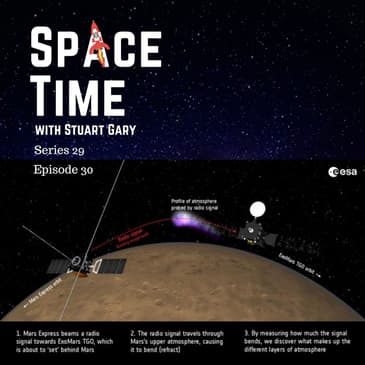
Versus Spacetime Series twenty nine, Episode thirty, for broadcast on the eleventh of March twenty twenty six. Coming up on space Time, a solar superstorm hits the Red Planet, Recent tectonic activity discovered on the Moon, and repair work underway NASA's Artemis two man moon rocket. All that and more coming up on Spacetime. Welcome to space Time with Stuart Gary. Over the last few years, Planet Earth's been slammed by a series of violent solar storms erupting from the Sun as a local start transitions through Solar max, the climax of its eleven year solar cycle. When the solar flares and chronal mass ejections hit the Earth, they affect damage and occasionally destroy spacecraft. They interfere with navigation systems, disrupt communications networks, and blackout terrestrial power grids. But what happens when these same geomagnetic storms reach Mars. Now, thanks to the European Space Agency's Mars orbiters, we know glitching spacecraft and supercharging the Upper Mustian atmosphere. Back in May twenty twenty four, the Earth was hit by one of the biggest solar storms in over twenty years. It sent out planet's atmosphere to. Overdrive, triggering shimmering auroras that were in as far north as Sydney. But this storm also hit the red planet now. Fortunately, Is says two Mars orbiters, Mars Express and Exo Mars Trace Gas Orbiter, were in the right place at the right time, with a radiation monitor aboard the Trace gas orbiter, picking up a dose equivalent to some two hundred normal days in just sixty four hours. Now a new study reported in the journal Nature Communications shows the impact was remarkable. The studies lead author, Jacob Parrot from the European Space Agency says the upper Martian atmosphere was flooded by electrons in the event. Parrot described it as the biggest response in the solar storm ever seen at Mars. The superstorm caused a dramatic increase in electrons in two distinct layers of the red planet's atmosphere. These occurred at altitudes of around one hundred and ten and one hundred and thirty kilometers, with numbers rising by forty five percent and a wapping two hundred and seventy eight percent, respectively, the most electrons ever seen in this layer of the Martian atmosphere. The storm also caused computer errors on board birth spacecraft. That's a typical peril of space weather as the particles involved so energetic and hard to predict. To investigate the superstorm's impact on Mars, Rotten colleagues used a technique known as radio occultation. First, Mars Express beamed a radio signal to Trece gas orbiter at the very moment it was disappearing over the Martian horizon. As trace gas orbit are vanished. The radio signal was spent, that is, refracted by various layers in the Martian atmosphere before being picked up by the orbitter, thereby allowing scientists to glean more about each layer. The researchers also use the observations from NASA's Maven mission to confirm the electron densities. Now, these technique's actually being used for decades to explore the Solar System, but they always use signals being from a spacecraft to Earth rather than between two spacecraft orbiting and other world The superstorm was experienced very differently at Earth and Mars, highlighting the differences between the two worlds. At Earth, the response of the upper atmosphere was more muted, thanks to the shielding provided by a magnetic field. As well as deflecting a lot of solar storm particles away from the Earth, the planet's magnetic field also diverted some towards the Earth's poles, where they follow the planet's magnetic field lines, lighting up the skies with spectacular auroral activity now, while their differences can make it tricky to compare the two planets directly understanding how solar activity impacts the residents of our solar system, in other words, space where the forecasting is hugely important. At Earth, solar storms can be dangerous in damaging for astronauts and equipment in space. As we mentioned earlier, they can disrupt both satellites and systems such as power, communications and navigation. However, studying space where the remains difficult as the Sun throws out radiation material erradically, making targeted measurements largely opportunistic. Fortunately, astronomers were able to use their occultation technique with Mars Express and Trace Gas Orbiter just ten minutes after a large solar flare hit Mars now. At the time, they were only performing two observations per week at Mars, so the timing was extremely lucky. The authors captured the aftermath of three solar events, all part of the same solar storm, but different in terms of what they throw out into space and how they do it. One flair of radiation, one burst of energy particles, and an eruption of material. Known as a chronal mass ejection. Together, these events sent fast moving, energetic magnetized plasma and X rays flooding towards Mars. When the Beraja materials hit the red planet's upper atmosphere, it collided with neutral atoms, stripping away their electrons, causing the region to fill up the sharched particles. The results improve sciences understanding of Mars by revealing how storms deposit energy and particles into the Martian atmosphere. Important, as we already know, the planet's lost huge amounts of water and most of its atmosphere space, most likely driven by the continual stream of particles flowing out from the Sun and the soil or wind, eroding the Martian atmosphere in the process. But there's another side to it. The structure and contents of the planet's atmosphere influence how radio signals travel through space. If the Martian upper atmosphere is packed full of electrons that could block signals used to explore the planet's surface by radar, making this the key consideration for mission planning and impacting science's ability to investigate other worlds. This is space. Time still to come, the detection of recent tectonic activity on the Moon, and works continuing to repair NASA's Artemis to Man mission to the Moon in preparation for what hopefully will be a launch next month. All that and more still to come on space time, scientists have produced the first global map and analysis of small mara ridges seen on the surface of the Moon. The findings, reported in the Planetary Science Journal, suggests that tectonic activity is continuing across the Luna's surface right up to this day. They show for the first time that small maurrow ridges are geologically young and widespread across the lunar mare, the vast dark planes on the Moon's surface. The author's des discovery of how small murray ridges form introduces a new set of potential milkwake sources. It could affect future site selections for lunar landings. Both the Moon and the Earth are tectonically active. However, the tectonic forces affecting each body are very different. Earth's crust is divided into tectonic plates that have converged, separated, and slid past one another to produce expansive mountain ridges, deep ocean trenches, and rings of volcanoes around places like the Pacific Ocean. Now, the Moon's crust isn't divided into tectonic plates, yet stresses within the lunar crust give rise to several distinctive landforms. One of the most common of these are lowbate scarps. These form when the crust compresses and the resulting forces push material up and over adjacent crust along a fault, creating a ridge. These scarps, found in the Lunar Highlands are formed only within the last billion years or so, in other words, the last twenty percent of the Moon's history. Back in twenty scientists confirm that as it continues to cool, the Moon is slowly shrinking, and it's this contraction which caused the lobate scarps and the Lunar Highlands to form in the first place. Yet, the formation of lobate scarps doesn't account for all the recent contractual landforms seen on the Moon. Another recently identified class of tectonic landforms are small murray ridges. Small murray ridges are caused by the same forces that form lowbate scarps, but while lowbate scarps are found in the highlands, small murra ridges are found only in the Maria. The authors sought to map out small maurra ridges in the lunar Maria and analyze their connection to recent tectonic activity. The studies lead author, Coulna Pava from the Center for Earth and Planetary Studies, says that since the Apollo era, scientists have learn about the prevalence of lobate scarps throughout the lunar highlands, but this is the first time scientists have documented the widespread prevalence of similar features throughout the lunar mare. Hops gain a global perspective of recent lunar tectonic activity on the Moon and that lead to a greater understanding of its interior and its thermal and seismic history, as well as the potential for future moonquakes. The authors compiled an extensive small murray ridges catalog, discovering some one thy one hundred and fourteen new small murray ridges segments across the lunar near side Maria that increases the total number of known small marrow ridges across the Moon to two thousand, six hundred and thirty four. They also determined that the average small maurra ridge was around one hundred and twenty four million years old, consistent with the average age of lobate scarps at one hundred and five million years. These ages suggest that, like lobate scarps, small murray ridges are among the youngest geological features on the Moon. Finally, the analysis shows that small murray ridges form through the same type of false as lowbate scarps, and that lobate scarps in the highlands often transition to small murraw ridges in the murray further suggesting a similar origin for both these kinds of structures. This is space time still to come. Work continues to repair NASA's Artemis two rocket in preparation for a possible April mann mission around the Moon, and later in the Science report, a new study warns that kids who consume ultra processed foods are also more likely to have issues with behavior and emotions. All that and more still to come on space time. Works continuing on repairs to NASA's Artemis two man moon mission rocket in the Vehicle assembly building at the Kennedy Space Center in Florida. Technicians have now access the launch vehicle stage adapter to inspect the components that had prevented helium from flowing to the upper stage in the wake of last month's second wet dress rehearsal. Engineers have now determined a seal in the quick disconnect through which helium flows from the ground support systems into the rocket, was obstructing the pathway. The team removed the quick disconnect, reassembled the system, and began validating the repairs to the upper stage by running a reduced flow ratar helium through the mechanism in order to ensure the issue was resolved. Engineers are now trying to determine exactly what allowed the seal to become dislodged in the first place, in order to make sure it doesn't happen again. While the upper stage repair has been underway, technicians have also been working to refresh other systems on the ninety eight meter tall rocket. They're activating a new set of flight termination system batteries, a head of end to end retesting of the system, and are also replacing the flight batteries on the upper stage, the core stage, and the solid rocket boosters, and they're recharging Orion's launcher board system batteries as well. Works also been carried out to replace a seal on a course stage liquid oxygen line feed system. Once complete, engineers will reassemble the oxygen tail service massed umbilical plate and perform a number of integrity tests to ensure the seal interfaces tied. Work on the rocket and the spacecraft will continue over the next few weeks for a second vehicle. Rollout takes place towards the end of the month and launch attempt possibly in April. The Atomis two mission will carry a crew of four on a ten day journey around the Moon and back to Earth. It will be the first time humans have traveled to the Moon in more than fifty years now. From the cruise point of view, Other than flying the ship and doing the science, food will be an important part of the mission. The food flying aboard Atomis two has been specifically designed to support crew health and performance. Unlike the International Space Station, there's no resupply, no refrigeration, and no late load capacity, so all meals need to be carefully selected to remain safe, shelf stable and easy to prepare. And consume inside the Orion spacecraft. Food selections that developed in coordination with space food experts and the crew to ensure balanced calorie needs, hydration, nutrient intake, and accommodating individual group preferences. Food selection for Atomis two also needs to consider its ability to be prepared using Orion's onboard systems, available space, and the power requirements, so food must be easy to prepare and consume in microgravity. Now on a typical mission day excluding launching re entry, astronauts have scheduled time for breakfast, lunch, and dinner. Each Astronauts also a lotted two flavored beverages a day that may include coffee. However, beverage options are limited due to art mass constraints, which restrict how much food and drink can be carried on board. Fresh foods will not be flying on Atemis two because Orion doesn't have refrigeration nor the late load capacity required for fresh foods, so shelf stable foods will be used. They'll help manage food safety and quality throughout the intended shelf life of the mission. They will be compact, self contained, and designed to reduce the risk of crumbs or particulates flowing around in microgravity during the mission. After all, you don't want to end up inhaling breadcrumbs. NASA says Automis two menus will reflect decades of advancement in space food systems. Back during the Apollo days, missions relied on early food technologies with limited variety, mostly paste in tubes or space Shuttle missions expanded the menu options and also the opportunity for onboard preparation, and the International Space Station benefits from regular resupply missions and occasional fresh foods that In contrast, Ittemis two uses a fixed pre selection menu designed for a self contained space vehicle with no resupply. Now, while that sounds pretty boring, the good news is the Atomis two crew have a direct input into the menu selection. In order to do that, they've been sampling, evaluating, and rating all the foods on a standard menu during pre flight testing, and their preferences are balanced with nutritional requirements and what a rank can accommodate. The final crew specific menus are all set well before launch two. The three days worth of food for each crew member is packed together in a single container, providing flexibility for meals selection during the flight. Menus are tailored based on the spacecraft's food preparation capabilities. During each phase of the mission, Certain foods, such as freeze dried meals, require hydration using Orion's portable water dispenser, which is not available during some phases, including the launch and landing. As a result, food selected for these phases need to be ready to eat and compatible with the spacecraft's operational constraints, while a broader range of food options are available. Once full food preparation systems are up and running, bottom line food bord Orian will be ready to eat, rehydratable, thermo stabilized, and irradiated. The crew uses Orion's portable water dispenser to rehydrate foods and beverages, and a compact briefcase sized food warmer to heat meals as needed. This report from MASSERTV Round the Moon. Meal, Round the Moon Meal? What would you eat? Cheese? Oh my gosh, it's clever. Cribe. My name is Christina Cook and I'm Jeremy Hanson were crew members on the Artemis two missions flying around the Moon. And when we fly around the Moon, of course we're going to be taking some food with us. That's right. This is how to eat in space. Here. We are in what we call our food Lab at NASA Johnson Space Center. We come in here quite often to sample space food. The neat thing about the food selection is it is so diverse. Different entrees that you wouldn't imagine can be rehydrated and actually good in space are completely fair game and it's pretty awesome. We came in for Artamus to do this. We got about halfway through the first session and we're like, we're not really sure we're gonna have time on board to warm this stuff up. We talked a lot about day one. It's a long ef it's hours before we even leave the launch pad on our way to space, and then we'll get to space. We have a lot of important hands that day. We just did a sim yesterday. Lunch is scheduled. It's am and day meal for all four of us, and so those would be great moments, I think, and our and our mission to have prep some food and sit down or float as a as a crew and just have a joint that'd be fun. My name is A Chill. I'm the FUS system manager for ISIS and Artemis the full lab at Johnson Space Center. That's where we make and the package most of the space food and also where will be making all the food for the artemist missions. Food is a big part for our crew members. They provide the nutrition, the calorie, micronutrient balk crew members, but also boosting crew moroutes very important. There is always a lot of steps, very strict steps for us to follow to making sure the food will provide, are consistent and a meet all the fue safety nutritional requirements and most important also need to taste good. The other strategy is always promoted a variety because everybody this food preference can be very different. Therefore, the more variety we can have, the better to meet the needs of the astromault group. They can bring out these little tiny technique food and you're like, oh my gosh, I thought we were having lunch, and then by the end there's so many space foods. Yes, every time you leave, you. Like I am so fun, I'm so full, I'm in pain, and you just. Rate them like I love this, I don't want to eat it. I'd eat it if you tell me I need it, Because what the food lab does. They take all your preferences, but they're also like good parents and they're like you need a well balanced die exactly. They were like, no, you can't have mac and cheese every day, Christina. Sorry. I'm Wyath McKinley. I'm a flight controller and a crew instructor for Artemis two. We're here at the Space Vehicle Mockup facility at Johnson Space Center. We're inside the Orion mockup where we perform crew training for the Artemists two mission on the Orion vehicle. Crew is able to heat up their food using our briefcase style food warmer. The food is held in contact the central heater plate by these springs so they can warm up and they can have a delicio. Much of the food and drink it's on O'Ryan is we hydrate and so crewe and our potable water dispenser will fill up their food and drink and then at that point you go ahead and pop it into your food order. I'm kind of envisiiting there's maybe one person putting the stuff in and out, kind of tossing it out to everyone as a stunt. Or maybe if we're not scheduled together, you're just on your own over there popping some things in or maybe just in your two minutes of free time between things are kind of getting it ready so it has time to warm up. We'll see eating together really resonates with me. It's I think it's just a human thing to break bread together and to enjoy that necessary thing you have to do, the thing you should be grateful for. And so doing that as a group, as a family has always been meaningful for me eqal lately. It represents togetherness and something a little out of the ordinary. You don't necessarily get to have those meals with everybody or the life, but if you are sharing a meal especial, if you're sharing breakfast, lunch, and dinner with a group of people, that means something. It's like a camping. And in that report from Massa TV, we heard from Artemis to astronauts Christina Cook, Jeremy Hansen, Ryan and Artemis Food Lab manager A Shea, UK and NASA Artemis flight controller. Why McKinley, this is space time and time out to take another brief look at some of the other stories making news and science this week with a science report. A new study warns that kids who eat more ultra processed foods at age three were also more likely to have issues with their behavior and emotions by the age of five. The findings were reported in the Journal of the American Medical Association. Looked into the diets of more than two thousand kids and compared the amount of ultra process foods they ate with a rating system for child behavior. They found that kids who consumed more ultrap process foods scored worse for behavioral and emotional symptoms compared to kids who wait less, and kids who substituted in minimally processed foods had better outcomes with their behavior and emotions. The earliest known relative of all primates, including humans, aren't monkeys, but a small mouse sized mammal called Percaturus, and now scientists have found one of its tiny tooth fossils in a place that offers fresh clues on how primates evolved. A report in the journal Vertebrate Paleontology says the tiny tooth, which could easily be mistaken for a fleck of dust, was found further south in North America than previous fossils, suggesting these ancient primates originated in the north and then spread southwards, diversifying soon after the mass extinction that wiped out the dinosaurs. Sixty six million years ago. The authors say the discovery helps fill the gap in understanding the geography and evolution of our earliest primate relatives. There's new hope today for banana lovers who'll be living under the sort of danicles. With Panama disease continuing to threaten the globally popular Cavendish variety, a report in the General Horticultural Research by Queensland University scientists has pinpointed crucial genetic resistance to a pathogen in a wild subspecies of the fruit. Panama disease is a distractive, soil borne fungus which impacts farmed cavendish bananas worldwide through its virulent race for strains. The authors located the source of resistance on chromosome five in calcut of four, which is a highly fertile wild diploid banana, by crossing it with susceptible bananas from a different subspecies of the diploid banana group. It's been a big week for Apple, with its new budget priced iPhone seventeen E and its MacBook Neo hitting the market. With the details, we joined by Technology editor Alex arol Royd and tech advice Start Life. There's the iPhone seventeen e. I think we spoke about that last week, and it's nine hundred and nine nine dollars. It's the latest Day nineteen ship obviously with one less core because it's the cheapest in the line. Last year's model of sixteen and ekme with one twenty eight gig of storage started capacity this year two fifty six. So same price, better chip and double the storage. Can't go wrong. Now there's a new iPad Air with the M four chip. There's new studio displays and the studio display Xity out. There is a professional displays. There's a new M five Pro and M five Max chips which are inside the MacBook Pro with the Pro and the Max M five chips, so super duper amazing chip. There's a new MacBook Air with M five as well. I mean that people have been waiting for these new models to drop, but the big one that most people are going to talk about is the MacBook Neo. Neo also is a way of say new. This comes in black color, a pink color, a yellow color, and the like a silvery original MacBook color and so thirteen inch screen that doesn't appear to be a notch at all, and the a gig of RAM, and yeah, the storage it's two fifty six gig to start with for eight nine nines. In the US it's five nine nine. So if you wanted the touch ID button on the keyboard and you want to double the storage to five hundred and twelve gig, well, incredibly, it's one thousand and ninety nine. Now, the MacBook Air does come with sixteen GIGABRAM as opposed to eight, and you can actually upgrade the Air in the pros to even higher levels. But you know, if people are just doing web browsing, social media, work processing, email canva a bit of word processing where you've got the Apple intelligence to rewrite what you've said into a more professional tone or a friendly tone, or a formal tone or whatever it is. Look, which is obviously more expensive at eight hundred ninety nine dollars than your sub five hundred dollars Chrome books, which are okay because chromebooks are not very heavy on top of the you know, they don't use much of the operating system's power, so we have a less powerful one in one hunder five hundred bucks. It's okay, but try running a Windows device at that price and you're talking about awful processes, you know, the seller on or the pent here or just nonsense processes that are not the Core I three, I five and I seven, And of course there's nothing with the I three to write, but the I five and the I seven and the new Core Ultra fives and sevens and nine and all that sort of stuff. Those are much more powerful. Now, this Apple MacBook near does have the A eighteen pro chips, so it's not one of the M series chips and it's only in the newest CHIPPA nineteen. It's the A eighteen. But this has been shown by apples Benchmuster have more enough power to do all these desktop things, to run the desktop apps and also can run various iPad and iPhone apps that the developers share. So this should see a resurgence in people buying Max for their kids for themselves. That's alex Oharavroyd from Take Advice, Start Life, and this is space Time. And that's the show for now. Space Time is available every Monday, Wednesday and Friday through fights dot com, SoundCloud, YouTube, your favorite podcast download provider, and from space Time with Stuart Gary dot com. Space Time's also broadcast through the National Science Foundation, on Science Own Radio and on both iHeartRadio and tune in Radio. And you can help to support our show by visiting the Spacetime Store for a range of promotional merchandising goodies, or by becoming a Spacetime Patron, which gives you access to triple episode commercial free versions of the show, as well as lots of burnus audio content which doesn't go to wear, access to our exclusive Facebook group, and other rewards. Just go to space Time with Stewart Gary dot com for full details. You've been listening to space Time with Stuart Gary. This has been another quality podcast production from bytes dot com.