
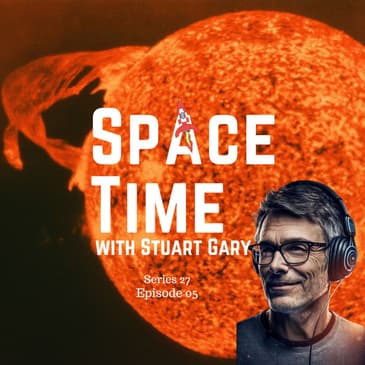
SpaceTime Series 27 Episode 5
*Monstrous X5 solar flare launched on New Year's Eve
The Sun celebrated the completion of Earth’s latest orbit by blasting out a spectacular X-5 class solar flare dwarfing even Sydney’s new year’s eve fireworks display.
*X-37B space shuttle launches aboard Falcon Heavy
SpaceX has successfully launched the US Space Force-52 mission carrying an X-37B space shuttle Orbital Test Vehicle on its seventh mission.
*Beijing launches its tallest ever rocket
China has set a new national space record launching its tallest ever rocket.
*The Science Report
The oldest photosynthetic structures ever discovered found in the Northern Territory.
The link between sedentary leisure time and a woman’s risk of uterine fibroids.
The importance of city parks for species diversity.
Alex on Tech turning cell phones into sat phones
Listen to SpaceTime on your favorite podcast app with our universal listen link: https://spacetimewithstuartgary.com/listen and access show links via https://linktr.ee/biteszHQ
For more podcasts visit our HQ at https://bitesz.com
**Support SpaceTime with Stuart Gary: Be Part of Our Cosmic Journey!**
SpaceTime is fueled by passion, not big corporations or grants. We're on a mission to become 100% listener-supported, allowing us to focus solely on bringing you riveting space stories without the interruption of ads. 🌌
**Here's where you shine:**
Help us soar to our goal of 1,000 subscribers! Whether it's just $1 or more, every contribution propels us closer to a universe of ad-free content.
**Elevate Your Experience:**
By joining our cosmic family at the $5 tier, you'll unlock: - Over 400 commercial-free, triple episode editions. - Exclusive extended interviews. - Early access to new episodes every Monday.
Dive in with a month's free trial on Supercast and discover the universe of rewards waiting for you! 🌠 🚀
[Join the Journey with SpaceTime](https://bitesznetwork.supercast.tech/) 🌟 [Learn More About Us](https://spacetimewithstuartgary.com)
Together, let's explore the cosmos without limits!
#astronomy #space #science #news #spacetime #podcast
Become a supporter of this podcast: https://www.spreaker.com/podcast/spacetime-with-stuart-gary--2458531/support.
[00:00:00] This is Space Time Series 27 Episode 5 for broadcast on the 10th of January 2024. Coming up on Space Time… A monstrous X5 class solar flare launched towards the Earth on New Year's Eve. The X-37 space shuttle launches aboard a Falcon Heavy on another top secret mission.
[00:00:20] And Beijing launches its biggest ever rocket. All that and more coming up on Space Time. Welcome to Space Time with Stuart Gary. The Sun has celebrated the completion of Earth's latest orbit around it by blasting a spectacular
[00:00:52] X5 class solar flare dwarfing even Sydney's New Year's Eve fireworks display. The gargantuan flare was the most powerful solar eruption in six years, with radiation from the blast reaching Earth two days later. Solar flares are powerful bursts of plasma and energy erupting from the Sun's surface.
[00:01:12] They're triggered by the snapping of twisting magnetic field lines reaching out into space in gigantic loops from below the solar surface through sunspots, regions which appear darker than the surrounding area because of their lower temperature caused by the magnetic field lines.
[00:01:28] The Sun isn't solid but rather a gigantic ball of plasma with different latitudes rotating at different rates. And that can cause its magnetic field lines to twist and snap, triggering solar flares and coronal mass ejections.
[00:01:42] The magnetic field lines snap just like rubber bands, in the process flinging powerful waves of radiation and plasma that stream across space at high speeds. Solar flares are classified by their strength, ranging from the weakest B class events through
[00:01:58] C, M and finally the strongest group which are known as X class. Each step up in a letter classification involves a tenfold increase in energy. The classification scale is further divided into numbers from 1 to 9, 1 being the weakest in the class and 9 the strongest.
[00:02:15] Observations by NOAA, the United States National Oceanographic and Atmospheric Administration, show the X5 class flare released on New Year's Eve was accompanied by a coronal mass ejection or CME as billions of tons of charged particles or plasma and magnetic field material was
[00:02:32] flung into space and towards the Earth. The flare hit the planet two days later, triggering a geomagnetic storm and polar cap absorption event which lasted several days as protons accelerated by the flare slammed into the Earth's ionosphere and were then funnelled along the planet's magnetic field lines towards
[00:02:50] the poles where their ionising effect caused spectacular auroral displays, the northern and southern lights, the Aurora Borealis and Aurora Australis. But these ones were powerful enough to also cause disruptions to communications networks. These space weather events or geomagnetic storms often impact radio communications and navigation systems.
[00:03:12] They can also affect spacecraft by damaging or even destroying delicate electronics or causing the Earth's atmosphere to expand and wobble like a jelly blubber. That increases atmospheric drag on spacecraft, resulting in faster orbital decay and forcing
[00:03:26] spacecraft to use more fuel in order to boost themselves back up into the correct orbits, in the process shortening their overall lifespans. But increased radiation is also harmful to astronauts in space and even people on high altitude aircraft.
[00:03:41] And if the charged particles reach the Earth's surface, they can overload power lines, blowing transformers and blacking out power grids. The New Year's Eve X5 class flare was triggered by active sunspot AR3536 which produced another strong flare just four days later.
[00:03:59] The later M4 class flare also hurdled a streamer of plasma into space. Astronauts are now awaiting fresh images from chronographs aboard NASA's Soho spacecraft in order to determine if the escaping streamer formed the core of another coronal mass ejection.
[00:04:14] We do know extreme ultraviolet radiation from this new flare ionized the top of Earth's atmosphere causing another radio blackout, this time over Australia and the surrounding Pacific Ocean. Mariners and pilots would have noticed a loss of signal on some frequencies for about 30 minutes during the flare's peak.
[00:04:33] This latest activity follows last month's powerful X2.8 class solar flare which erupted out of the unstable sunspot AR3514. In fact, 2023 witnessed the most powerful geomagnetic storms in 20 years as well as a 20-year high in the number of sunspots observed in a single month.
[00:04:52] The sun goes through a regular 11-year solar cycle during which it gradually increases in activity and violence, culminating in solar maximum or solar max when the sun's magnetic poles flip polarity with the sun's north pole becoming south and its south pole turning north.
[00:05:10] The current solar cycle, number 25, is predicted to reach solar max either later this year or early next. This report from NASA TV. Enveloping our planet and protecting us from the fury of the sun is a giant bubble of magnetism called the magnetosphere.
[00:05:28] It deflects most of the solar material sweeping towards us from our star at 1 million mph or more. Without the magnetosphere, the relentless action of these solar particles could strip the Earth of its protective layers which shield us from the sun's ultraviolet radiation.
[00:05:45] It's clear that this magnetic bubble was key to helping Earth develop into a habitable planet. Compare Earth to Mars, a planet that lost its magnetosphere about 4.2 billion years ago. The solar wind is thought to have stripped away most of Mars' atmosphere, possibly
[00:06:01] after the red planet's magnetic field dissipated. This has left Mars as the stark, barren world we see today. By contrast, Earth's magnetosphere seems to have kept our atmosphere protected. Eftahia Zesta of the Geospace Physics Laboratory at NASA's Goddard Space Flight Center notes,
[00:06:19] If there were no magnetic field, we might have a very different atmosphere left, without life as we know it. Understanding our magnetosphere is a key element to helping scientists someday forecast space weather that can affect Earth's technology.
[00:06:33] Extreme space weather events can disrupt communications networks, GPS navigation, and electrical power grids. The magnetosphere is a permeable shield. The solar wind will periodically connect to the magnetosphere, forcing it to reconfigure. This can create a rift, allowing energy to pour into our safe haven.
[00:06:54] These rifts open and close many times daily, or even many times hourly. Most of them are small and short-lived. Others are vast and sustained. With the sun's magnetic field connecting to Earth's in this way, the fireworks start.
[00:07:11] Zesta says, the Earth's magnetosphere absorbs the incoming energy from the solar wind and explosively releases that energy in the form of geomagnetic storms and substorms. How does this happen? Magnetic lines of force converge and reconfigure, resulting in magnetic energy and charged particles flying off at intense speeds.
[00:07:33] Scientists have been trying to learn why this criss-crossing of magnetic field lines, called magnetic reconnection, triggers such a violent explosion, opening the rifts into the magnetosphere. NASA's Magnetospheric Multiscale Mission, or MMS, was launched in March 2015 to observe the electron physics of magnetic reconnection for the first time.
[00:07:55] Bristling with energetic particle detectors and magnetic sensors, the four MMS spacecraft flew in close formation to areas on the front side of the Earth's magnetosphere where magnetic reconnection occurs. MMS has since been conducting a similar hunt in the magnetosphere's tail.
[00:08:12] MMS complements missions from NASA and partner agencies such as Themis, Cluster, and Geotail, contributing critical new details to the ongoing study of Earth's magnetosphere. Together, data from these investigations not only help unravel the fundamental physics of space, but also help improve space weather forecasting. This is Space Time.
[00:08:33] Still to come, America's X-37B space shuttle launches on another clandestine mission, and Beijing launches its biggest rocket ever. All that and more still to come on Space Time. SpaceX has successfully launched the United States Space Force 52 mission, carrying an
[00:09:06] X-37B space shuttle orbital test vehicle on its seventh mission. The launch from Pad 39A at the Kennedy Space Center at Cape Canaveral Space Force Base in Florida was flown aboard a Falcon Heavy rocket, which uses three Falcon 9 core stages mounted side by side.
[00:09:23] The launch had originally been slated for December 7th, but had been delayed by a combination of bad weather and ground support issues. It's the third time the Falcon Heavy configuration has been utilized for a national security payload.
[00:09:37] But it's also the first time the X-37B had been launched aboard a Falcon Heavy, which has a payload capacity of 26,700 kilograms. Following the launch, the twin side boosters successfully returned to Earth, landing at SpaceX's Landing Zones 1 and 2 at Cape Canaveral. The core stage was expendable.
[00:09:56] Falcon Heavy is in startup. Great news there's that call out that Falcon Heavy is in startup. Now just waiting for the final call from the launch director. This is the mission director. Go for launch. And great news with that call out.
[00:10:08] All systems are go for launch of Falcon Heavy with USSF 52. T-10, 9, 8, 7, 6, 5, 4, 3, 2, 1. Engine full power and liftoff. Falcon Heavy. T-10, 9, 8, 7, 6, 5, 4, 3, 2, 1. At T plus 50 seconds into Falcon Heavy's flight. Under the power of five million pounds of thrust, Falcon Heavy is carrying OTB-7 out to space.
[00:10:49] And we are coming up on max Q here in a few seconds. That is the point of peak mechanical stress on the vehicle. And we've now passed through that. So we do have a few events coming up here.
[00:10:59] That will be booster engine cutoff or BECO, separation of the side boosters, followed by a side booster boost back burn startup. That'll be the separation from the center core. The center core will continue to carry stage two with the payload until it shuts down its
[00:11:13] engines with MECO and performs a standard stage separation like you see on a Falcon 9. Standard cutoff. Side booster separation confirmed. And back to. Booster boost back start up. The side boosters have separated from the center core and we have the startup of the
[00:11:33] boost back burn on both of those side boosters. Now the side boosters are returning to Florida under the power of three engines. Coming up are a few events in rapid succession. That will be the conclusion of the side boosters boost back burn.
[00:11:46] MECO, stage separation of the center core and the second stage, as well as SES-1 or the NVAC engine igniting on the second stage. SES-1 stands for second stage engine startup. Per the request of our customer, we will not be showing second stage views after SES-1.
[00:12:03] Additionally, our center core or stage one is expendable today, so we will not be attempting to recover it, but we will be following the side boosters back to land. So you can continue to stay tuned for that. We're coming up on the conclusion of the side boosters burn.
[00:12:17] Booster boost back shutdown. Stage separation confirmed. And back ignition and OPAC. Call outs for the side boosters boost back burns concluding. We had MECO, our main engine cut off of the center core, as well as stage separation and also heard confirmation that the NVAC engine has ignited.
[00:12:37] As we mentioned before, separation confirmed. Confirmation that the fairing has separated from the second stage. Again, we will be attempting to recover those fairing halves when they fall back to earth using our recovery vessel, Doug. Trajectory is nominal.
[00:12:51] Now again, as I mentioned earlier, the center core was not built to land or be reused. It is expendable. Having given us all for the mission for the two side boosters, the boost back burns have
[00:13:03] completed and so far the vehicles are on a good trajectory coming back to land. And again, with successful second engine start one, that will wrap up our coverage pertaining to the second stage. So we'll focus our attention on the side boosters.
[00:13:17] Now those side boosters are currently on their way back to land. In order to land back on land, we typically have three burns. Center core FTS has saved. We typically have three burns. They've already concluded a boost back burn, which helps them turn back around and head
[00:13:33] back towards land. The next burn coming up is the entry burn. That's what will reignite three of the engines on each of those boosters. And that helps slow them down as they enter back into the earth's atmosphere.
[00:13:45] Now if we do have successful landings today, we'll mark the 257th and 258th landing of an orbital class rocket. And again, as I mentioned earlier, the center core will be expended and we are not attempting to recover it today.
[00:13:57] Again, the entry burn is coming up here for the side boosters. Booster entry burn startup. And there's that call out that the entry burns have begun on the side boosters. Stage two FTS has saved. The engines have reignited. Booster entry burn shutdown. PY FTS has saved.
[00:14:15] And a short burn. NY FTS has saved. Short burn for both of those boosters. Just under 20 seconds. All vehicles are on nominal trajectories. Great call outs there. All vehicles on nominal trajectories.
[00:14:26] Now again, we do have one more burn for each of these side boosters coming up in just about 30 seconds. That is the landing burn. It's a single engine burn for each booster. And just one engine is powerful enough to slow the vehicles down and safely land back
[00:14:42] on land. Again, we are targeting landing zone one and landing zone two for today's landings. Booster landing burn. After that call out, the engines have reignited. Landing leg deploy. These side boosters touchdown for landing. Stage two is in thermal guidance. You hear the crowd here very excited.
[00:15:03] We have successfully landed both Falcon Heavy side boosters on landing zone one and landing zone two. With these two side boosters, this marks the 257th and 258th overall successful landing of an orbital class rocket.
[00:15:17] The flight was the fifth mission for the Falcon Heavy's current set of side boosters. The Pentagon has released little information about the Delta Wing space plane's latest flight, saying only that it would involve multiple cutting-edge experiments.
[00:15:30] The U.S. Department of the Air Force Rapid Capabilities Office says the tests included operating the reusable autonomously controlled space plane in new orbital regimes, experimenting with future space domain awareness technologies and investigating the effects of radiation on materials supplied by NASA.
[00:15:48] The X-37 was originally designed as a NASA project. The space plane was designed to be launched into orbit inside the payload bays of NASA's Space Shuttle fleet and will then be released to undertake their own missions, including
[00:16:02] the deployment of satellites from their own payload bays, the rendezvous and repair or modification of satellites already in orbit and the capturing of orbital satellites for return to Earth. However, following the 2003 Columbia disaster, the X-37 was modified for launch on Delta II rockets instead.
[00:16:21] The project was transferred from NASA to the U.S. Air Force in 2004 and the project then became classified. We know the X-37 carried out a series of glide tests using Scaled Composites' winged White Knight mothership and in 2006 the Air Force announced that it would proceed with a variant
[00:16:38] of the original NASA X-37 to be known as the X-37B. Because of concerns over the unshrouded spacecraft's aerodynamic properties during launch, the new X-37B variant was specifically designed to fit inside the payload fairings of the Atlas V rocket.
[00:16:55] Boeing built two of the spacecraft, designated as the X-37B Orbital Test Vehicles 1 and 2. One of the X-37B's most annoying features, at least from an enemy's point of view, is its ability to radically change in orbit.
[00:17:09] It can fly in a highly elongated orbit that dips down into the upper atmosphere, using its wings and atmospheric drag as well as its maneuvering thrusters to dramatically change its orbit so it doesn't fly on a predictive schedule.
[00:17:23] This annoying ability to seem to disappear means the Russian and Chinese can't track the spacecraft or guide their own satellites to get a closer look at what's going on up there. If they try, US mission managers simply change its orbit so nothing shows up where the enemy
[00:17:38] is expecting it to. This is Space Time. Still to come, Beijing launches its biggest rocket ever, and later in the Science Report, paleontologists have discovered what appears to be the oldest known photosynthetic organisms ever found deep in the outback of the Northern Territory.
[00:17:56] All that and more still to come on Space Time. China has set a new national space record, launching its biggest rocket ever. The 63.2-meter-tall Long March 5 had been fitted with an extended 18.5-meter payload fairing. The flight from the Wengchang Satellite Launch Center in Hunan Province carried another Chinese
[00:18:33] Yougang spy satellite. Beijing says the new extended fairing replaces the old 12.3-meter fairing usually fitted, enhancing the rocket's capabilities. Fairings are an essential component for any launch vehicle as they house the satellites and other payloads, protecting them from the aerodynamic forces which hit a spacecraft
[00:18:53] during its launch into orbit. This is Space Time, and time now to take another look at some of the other stories making news in science this week with the Science Report. Paleontologists in the Northern Territory have just uncovered the oldest known photosynthetic organisms ever discovered.
[00:19:27] The 1.75 billion-year-old microscopic fossils reported in the journal Nature were found in the Northern Territory's McDermott Formation in the southern MacArthur Basin. The discovery is shedding new light on the origins of photosynthesis, a process used
[00:19:43] by plants and some bacteria known as cyanobacteria to convert water and carbon dioxide into glucose and oxygen using nothing but sunlight. The researchers found structures known as thylakoids, which are also found inside plant cells and modern cyanobacteria, inside tiny fossils called Mavifusa magensis.
[00:20:03] The discovery of thylakoids in a specimen of this age suggests that photosynthesis must have evolved some time before 1.75 billion years ago. A new study warns that clocking up six or more hours of sedentary leisure time daily
[00:20:18] could double a woman's risk of uteroid fibroids before she's gone through menopause. The study, reported in the British Medical Journal, was based on examinations involving some 6,623 women in China aged between 30 and 55. Uterine fibroids are growths in the uterus which can be benign but could also potentially
[00:20:39] become large, painful and affect fertility. Participants were asked to specify how much time they spent on sedentary activities such as board games, screen time or knitting, and the authors found that the more sedentary time spent, the greater the risk of fibroids.
[00:20:55] While this kind of study can't prove cause and effect, the authors say there might be other associated explanations, such as the fact that an inactive lifestyle is related to obesity which is also a risk factor for high estrogen levels and fibroids.
[00:21:10] Other risk factors include metabolic disorders, chronic inflammation and vitamin D deficiency. Experts have traditionally thought that one big city park, like Central Park in New York for example, would support more biodiversity than several smaller parks adding up to the same area.
[00:21:28] However, a new study reported in the journal The Proceedings of the Royal Society B is challenging that idea, at least for birds. Scientists looked at the seasonal diversity of birds in 475 parks in 21 American cities, finding that groups of lots of small parks consistently had higher species richness
[00:21:47] and were inhabited with more rare species than areas that had fewer but larger parks of equivalent area. However, the authors found that larger parks did support other measures of bird biodiversity and so the authors say both sizes seem to play an important role.
[00:22:04] They suggest urban planners consider the implications of park size on regional conservation goals. Now Starlink will turn your cell phone into a sat phone, Microsoft's new AI key and new Samsung Galaxy cell phones on their way later this month.
[00:22:21] With the details on all those stories and more, we're joined by technology editor Alex Zaharov-Royd from TechAdvise Start Life. This month there were 21 Starlink satellites launched and six of those have the capability to have direct to cell phone calls and this is being done in conjunction with T-Mobile,
[00:22:38] one of the big providers in the US. Elon Musk is calling this a cell phone tower in space and this will work with an ordinary unmodified phone. They've got to be 4G LTE compatible and that's obviously the vast majority of smartphones
[00:22:52] already on the network and so there'll be a rollout of more of these over the next months and years and there'll also be a text messaging service later this year as well as access
[00:23:01] to data which is also an important thing in the modern era and of course connections to all those IoT, Internet of Things devices, little sensors and the various things people use on farms and all over the place to be able to connect those remote devices back
[00:23:15] to the network. So this means that eventually, I mean unless you're deep in a cave somewhere, you will pretty much have connectivity everywhere and a lot of the black spots as you're driving around Australia or in different parts of the world where there is no connectivity,
[00:23:29] as long as you have line of sight to the sky, you will have the ability to make and receive phone calls, data and text messages and it's an augmentation of the capability that we saw with the iPhone 14 and 15 that could make emergency SOS calls.
[00:23:43] So this is just yet another evolution of the ubiquitous communications that we already enjoy. So this means that in the future, in the not too distant future, things like Iridium which provides satellite phone services, they'll become, I hate to say it, redundant because
[00:23:58] you'll be able to use your own cell phone to achieve the same result. Well look, eventually. I mean clearly it will take time for more of these satellite cell phone versions to be launched into space.
[00:24:09] The existing ones can't do that and you've also got Amazon launching a lot of satellites so we're going to have competing networks that will offer this. Elon Musk says that this will eventually allow for mobile phone connectivity everywhere on Earth.
[00:24:21] Another advance in artificial intelligence with Windows about to introduce a special button. Yeah, it's called the new co-pilot key for Windows 11 PC. So it's to the right of the space bar where you have an ALT key already and to the right
[00:24:34] of that will be this key that has the Windows co-pilot logo, sort of almost like an infinity symbol but not quite. This is in addition to the Windows key that's on the left hand side of your keyboard if you
[00:24:43] have a Windows PC that brings up the start menu and Microsoft launched that key nearly three decades ago. But a lot of the new Windows 11 PCs that will come with both AMD and Intel chips that have
[00:24:54] a built-in AI neural engine much like your smartphone and tablet does, well this key will bring up the co-pilot which is Microsoft's version of chat GPT powered by GPT-4 and it will enable you to quickly and easily get access to your digital smart assistant to
[00:25:09] do all the things that we currently do with AI and hopefully over the next couple of years a whole lot more as people really take advantage of the fact that PCs will now have this built-in AI engine and you'll have a very easy way to access it.
[00:25:21] Press one key on the keyboard and off you go. And Microsoft isn't just doing co-pilot on PCs. Yes, well they've announced the co-pilot app was available for Android smartphones earlier this month and now they're launching it for iOS as well.
[00:25:35] So this is a free app you can download from the App Store or Google Play and unlike the chat GPT app which needs you to pay US $20 a month to access chat GPT-4, the GPT-4 engine, the 3.5 engine is free but the GPT-4 engine costs money.
[00:25:49] Well with these co-pilot apps you can get GPT-4 free of charge. You can talk to it. It can talk back to you. It's like having a Google search engine that just feeds you the correct information rather than you having to crawl through a list of results.
[00:26:01] And of course Microsoft has competitors with Google, who has BARD. There's plenty of other competitors out there and chat GPT itself will presumably at some point launch chat GPT-5 which will take its time to get over to Microsoft.
[00:26:13] And GTP-5 I take it will be Skynet at its full. No? Okay. Samsung are releasing new phones. Yes, they've just announced that on January 16th in the US in San Jose they'll be launching the Galaxy S24 range.
[00:26:24] So there'll be S24, S24 Plus and of course the S24 Ultra. They will have a titanium version which is similar to iPhone 15's titanium but the big thing is AI. I mean AI is inescapable.
[00:26:35] It's got the Snapdragon Gen 3 chip from Qualcomm inside which has got a built-in supercharged AI engine and Samsung is promising major advances for using AI on your phone. So we'll see what they announce but it's expected to be massive.
[00:26:48] And speaking of massive, your new show is starting on TNT. Tell me. Yeah, TNT Radio.Live on Saturday the 20th of July Australian time frame. My new show will start between 6 and 7 p.m.
[00:27:00] There'll be a technology program called Talking Tech with Alex and this is in addition to the weekly segment that I do with Chris Smith on Wednesdays between 4.30 and 5 p.m. And that'll be in addition to the shows that I do with you and all the other different
[00:27:12] radio programs that I do but if you want to see me on television, you'll be able to watch by YouTube on your TV, via Rumble, on your phone, on your tablet, on your computer. It's a global network and I'm really excited to be starting this new show.
[00:27:25] And speaking of excitement, you're about to head off to CES. So CES is the Consumer Electronics Show. It's over 50 years old. There'll be 140,000 attendees from around the world, over 4,000 exhibitors. It takes over Las Vegas. It is huge. And this year, the theme will be AI.
[00:27:41] I mean look, there'll be home automation, there'll be robots, there'll be cars that can change their paint color, there'll be cooking automation that there was some sort of wok that can cook everything for you by itself and chop it all up. There'll be all sorts of amazing stuff.
[00:27:53] I'll have videos every single day of the best stuff that I've found at CES but it'll be on all the different news programs, all the... I'm very excited to be going to CES and looking forward to just seeing all the cool things
[00:28:03] that are in store for us in 2024. That's Alex Zaharov-Royd from TechAdvice.life. And that's the show for now. Space Time is available every Monday, Wednesday and Friday through Apple Podcasts iTunes, Stitcher, Google Podcasts, Pocket Casts, Spotify, Acast, Amazon Music, Bytes.com, SoundCloud,
[00:28:40] YouTube, your favorite podcast download provider and from Spacetimewithstuartgarry.com. Space Time is also broadcast through the National Science Foundation on Science Zone Radio and on both iHeart Radio and TuneIn Radio.
[00:28:54] And you can help to support our show by visiting the Space Time store for a range of promotional merchandising goodies. Or by becoming a Space Time Patron, which gives you access to triple episode commercial
[00:29:05] free versions of the show, as well as lots of bonus audio content which doesn't go to air, access to our exclusive Facebook group and other rewards. Just go to spacetimewithstuartgarry.com for full details.
[00:29:18] And if you want more Space Time, please check out our blog where you'll find all the stuff we couldn't fit in the show, as well as heaps of images, news stories, loads of videos and things on the web I find interesting or amusing.
[00:29:30] Just go to spacetimewithstuartgarry.tumblr.com. That's all one word and that's Tumblr without the E. You can also follow us through at Stuart Garry on Twitter, at Spacetime with Stuart Garry on Instagram, through our Space Time
[00:29:45] YouTube channel and on Facebook just go to facebook.com forward slash Spacetime with Stuart Garry. You've been listening to Space Time with Stuart Garry. This has been another quality podcast production from bytes.com.