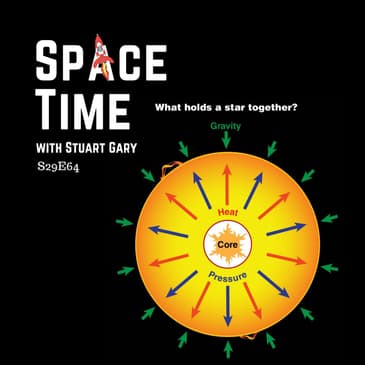
This is Spacetime Series twenty nine, episode sixty four, for broadcast on the twenty ninth of May twenty twenty six. Coming up on Space Time, a new explanation for how stars explode, Neptune's mysterious moon to Red and a safer return to Earth in out back South Australia for a hypersonic test vehicle. All that and more coming up on space Time. Welcome to space Time with Stuart Gary. A new study suggest that the new trina, which are some of the least massive objects in the universe, may trigger some of the biggest explosions in the universe supernovae, the explosive death of massive stars, which is so bright it can outshine an entire galaxy. Neutrinos are the most common form of matter in the universe, but they're so small they're ritually billions of them passing through you right now without you even noticing it. They're produced by some of the most extreme events in the universe, including the cause of stars, supernova explosions, and nuclear reactors. Neutrinos come in three types known as flavors, electron, muon, and tao, and what makes them really weird is that they oscillate between these flavors as they move through space, so an electron neutrainer produced in say a better decay reaction, may interact in a distant detector as a mule or town neutrino. The cause of this oscillation between flavors remains poorly understood. Now are reporting the journal Physical Review Letters has found evidence that a particular rapid form of this oscillation, known as fast flavor conversion, may play a key role in whether or not a collapsing star explodes as a supernova. Stars shine by fusing hydrogen into healium in their cause. When the hydrogen runs out and it's all converted into helium, the star will then start to fuse helium into heavier elements, starting with carbon and oxygen. Now, for most stars, like our Sun, that's where the process will end. The star will die and become a white dwarf. But for stars at least eight times more massive than our Sun, they're big enough to continue this process, producing ever heavier and heavier elements, so they eventually produce iron in their core. But no matter how massive a star is, it can't fuse iron into anything heavier, and so the hydrostatic equilibrium balancing act between gravity crashing a star downwards towards its center and nuclear energy pushing outwards ends and gravity winds causing the start to collapse under its own mass, triggering a shock wave which then BLUs the star apart in a core collapse supernova. While the neutrino is produced during this collapsing core the main drivers of this blast, only certain flavors will interact strongly enough with surrounding matter to heat it up, and as a result, neutrino otsoles and plays a key role. If neutrinos which flavors at the wrong time, the explosion will fail. So to work out exactly what's happening, the authors develop new computer models of collapsing stars across a range of masses and incorporated fast flavor conversions in order to simulate how neutrinas interact during these events. They discovered that the outcome was closely tied to how quickly collapsing material was falling inwards onto the core, a quantity called the mass secretion rate. When the acceleration rates. Low, fast flavor conversion boosts the energy deposited by the neutrinos and helps drive the explosion now. In contrast, when it's high. The conversion reduces the overall neutrino output enough to suppress the supernova blast. But the importance of the neutrinos doesn't end there. Pound for pound, out of all the particles with mass, neutrinos the fastest. In fact, at one point they were thought to be traveling at the speed of light, but because they do have mass, we know that's not possible and that's not being confirmed. But exactly how fast are they? Utrino physicist Kirsty Duffy and Durham University neutrino theorist Jessica Turner discussed exactly how fast neutrinis can travel in this report from Fermilab. Neutrinos are really speedy. These little particles can travel straight through the entire Earth in a fraction of the time it takes you to blink. Pound for pound. Of all the particles with mass, they are the fastest, almost traveling at the fastest possible speed in the universe, the speed of light, but not quite so. Exactly how fast are they? That's tougher to say. You may have heard that light from the Sun takes eight minutes to reach Earth when you look up at the Sun, you're actually seeing it as it was eight minutes ago before all those photons traveled one hundred and forty nine point six billion meters to reach the Earth. But some weird things happen when you travel at the speed of light, and if you're a photon, it seems like the journey tape no time at all. I've invited Jessica Turner to help explain it. Jessica is a neutrino theorist at Durham University. Hi Jessica, Hi Kirsty. You're correct. To photon traveling at the speed of light, the journey happens instantaneously. We move really slowly compared to photons, so our experience of time is immensely different from Einstein's theory of special relativity. We know that the faster something travels, the more time slows down, to the point that for a photon traveling at the speed of light, time stops, so photon experiences the entire universe's timeline all at once. I mean, what think about that for a second. But why are we talking about photons when we're supposed to be discussing the speed of neutrinos. The short answer is, on a practical level, neutrino's travel so close to the speed of light you can basically just round up. That's right. We've tried to measure the speed neutrina's travel by measuring how long it takes for them to travel long distance. For example, the Minos experiment timed how long it took neutrinos to travel seven hundred and thirty five kilometers from Fermilab to northern Minnesota. But we don't have the resolution even in our most precise experiments, to measure the speed of neutrino's being noticeably different from the speed of light. I mean, you know to the extent that we measure neutrinos at all. Now let's get a bit more specific. We can calculate the speed of a neutrino from its energy using Einstein's special relativity equations. If we know its mass, let's run the numbers for a neutrino we'd make at Fermilab's particle accelerators and give it an energy of one GV. The other part of the equation is harder because we don't actually know the mass of the neutrino. We've never been able to measure it, though are some experiments that have helped narrow it down, including Catrin. Catrin recently showed that the mass of the neutrino has to be less than zero point eight evy o a c squared. So let's say Katrin is just shy of finding the neutrino mass. We'll plug in zero point seven ev overseas grid into our equation. That tells us that our neutrinos would travel at nort point nine nine nine nine nine nine nine nine nine nine nine nine nine nine nine nine nine nine five times the speed of light. To put that in context, the Andromeda Galaxy is two point five million light years away, meaning it takes a photon two and a half million years to travel here. At least according to US, if a photon and a one gv neutrino set off at the same time from the Andromeda Galaxy, the neutrino would arrive just zero point not four seconds after the photon. That is how close to the speed of light they travel. So you can see why we have trouble measuring the difference. But then, why are we so certain that neutrinos are traveling slower. One of the special things we know about neutrinos is that they change flavor as they travel. The fact that they can change tells us that, unlike photons, neutrinos experience time, and that tells us that they aren't quite traveling at the speed of light. But if you thought it was that easy to calculate the speed of neutrinos, just wait, there's more. Let's get into some of the weirdness of quantum mechanics. Neutrinos aren't separate. They actually travel as a mix of three different mass states mass one, mass two, and mass three, and each one has a probability of interacting as a different flavor of neutrino, electron, mun or tao. This is an example of quantum superposition and it is pretty wild stuff. Here's Jessica to explain it. So an important thing to remember in this discussion is that particles are also waves, and the length of the wave is not infinite, so you can think of particles as little sections of waves, or as a weave packet. When a neutrino was born at an accelerator, it starts out as a superposition of all three mass states. This means that the wave packets for all three mass states are overlapping, and as long as the wave packets are overlapping, you have a coherent neutrino. Any one of these mass states could be the one to interact in your detector and you wouldn't be able to tell the difference. This leads to the phenomenon of neutrinl oscillation. But things with different masses should travel at different speeds, So what does that mean for the new trainer. We do think that the different mass states of neutrino should travel at different speeds. If the neutrino traveled for long enough, the three wave packets for the three different mass states would slowly spread out over time until they no longer overlap. This would cause what we call decoherence, and in that case we wouldn't see neutrinol oscillation. We'd always have the same proportion of electron, muon and town neutrinos showing up each time. But to get these decoherent neutrinos, they'd have to have traveled an incredible distance, way further than any experiment we could ever build on Earth. The only neutrinos we know of that might experience this phenomenon are the ones that have been traveling since the Big Bang. Unfortunately, there's so low energy at this point that we don't have detectors sensitive enough to see them. As you can see, examining the speed of neutrinos is anything but simple, and there's still more to uncover. Big Bang neutrinos, also known as relic neutrinos or the cosmic neutrino background, are one of my favorite neutrino physics topics. Fun fact. When a neutrino is created, it's immediately going full speed. There's no acceleration period like your car, and whileli can slow down while traveling through material like water or air, neutrinos are basically always traveling at the same speed. This is because they aren't interacting with anything the way that light does through electromagnetism, so it takes the very expansion of spacetime itself to stretch their wavelengths and slow them down. Bonus fun fact. In twenty eleven, neutrinos made headlines when the Opera Experiment reported a measurement that seemed to show neutrinos moving faster than the speed of light. Investigations showed that it was actually an equipment error in the experiment, and neutrinos do a base special relativity after all. Interestingly, one of the experiments that cross checked the Opera result was Icarus, which measured the same neutrinos as Opera with a different timing system. Everything's coming full circle because Icarus was moved to Fermi Lab in twenty seventeen and is now taking data in Fermi Labs. Booster and neutrino beam. LEDs neutrino physicist doctor Kirsty Duffy and Durham University in trino theorist doctor Jessica Turner in that special report from Fermilab, and this space time still the calm. Neptune's mysterious moon to Reed and a safe return to Earth in that South Australian outback were a hypersonic test vehicle. All that and more still the calm on space time. A new study suggests that planet Neptune's distant moon, the Reed, may be the last of the Ice Shant's original satellites which somehow managed to survive a cosmic billiard game. Neptune is the eighth and most distant known planet from the Sun, and it has sixteen known moons, The Ludge the Witch is Triton, the only Neptune moon large enough to have become rounded under its own gravity. Triton is a frozen world with a thin, hazy atmosphere, and it's peppered with cryovolcanoes erupting dark ice high under the sky. This ejector is then blown across the Moon's frozen, nitrogen covered surface by strong winds, leaving dark streaks across the ground. As the material falls back to the icy surface, Triton orbits Neptune in retrogres that is, in the opposite direction of its host planet's rotation, and it's the only large moon in the Solar System to do so. And that's because Triton is thought to be a captured kiper built object from the frigid outskirts of the Solar System that was caught up in Neptune's gravitational field billions of years ago. During that encounter, Trenton must have scattered Neptune's original moons, putting them on destructive collision courses. One of the few exceptions to this fate looks like it could be the tiny moon ne Reed, Neptune's third largest New observations suggests that this three hundred and fifty seven kilometre wide world was instead flying into an extreme elyptical orbit around Neptune. The studies lead author, Matthew Blacob from cal Tech is what scientists know about the Reed is very limited. For its size, the Reed is extremely understudied. It was discovered by Dutch astronomer Gerhard Kaiper forty years ago. He named the moon after the sea nymphs in Greek mythology. The Reed's extremely eccentric orbit around Neptune takes a full Earth year to come complete, ranging from one point four to nine point six kilometers like Triton. The Reed was originally thought to be a captured Carperbilt object. However, new observations by the web Space Telescope suggests that ne Reed's composition is inconsistent with the capperbuilt origin. The new findings, reported of the journal Science Advances, claims that the Reed simply has too much ice, and that suggested it could be part of Neptune's original satellite system. The observations show its elongated orbit matches what one would expect from a moon that was originally formed close to Neptune and was later pushed outwards by the capture of Triton value. Cob says Neptune's innimose moons likely to have been all formed from the shattered remains of the planet's original moons. In other words, they're Triton's casualties. This is space time still to come a safe return to Earth for a hypersonic test vehicle, and later in the Science report, a new study claims your eyes could indicate how strong your burns are. All that and more still to come on space time. A lot of Space Industries W six capsules returned safely to Earth, parachuting down into the South Australian outback. W six was a demonstrator vehicle focusing on the autonomous hypersonic flight and next generation thermal protection systems. The capsule landed on Southern Launchers Kudeber Test Range in western South Australia, completing a journey that began with a ride into orbit on a SpaceX Falcon nine transport mission back in March. The W six mission was funded through a partnership between the United States Air Force Research Laboratory and commercial space companies. The vehicle carried a payload from rear space activity to further test the auto nav autonomous navigation system. Auto NAV traces its heritage to the software originally developed for NASA's Deep Impact program, where it autonomously guided a projectile into a comet at thirty six thousand kilometers per hour, generating an explosion equivalent to four point eight tons of TNT. On W six, the algorithm, operated aboard varda's hypersonic re entry capsule, used onboard imagery to identify resident space objects, including stars and lower orbit satellites, in order to determine its precise position. The mission represents a crucial step towards fully autonomous celestial navigation hypersonic and re entry vehicles operating in dynamic environments. W six also carried a nose tile developed by Sandy National Laboratory, embedded with small samples of advanced thermal protection materials. The mission enabled researchers to evaluate material performance under real life hypersonic heating conditions, as well as that. There were two instrmitted showter tiles on the heat shield collecting in flight thermal and performance data FANASA. These tiles were made at NASA's AIMS Research Center in California six Silicon Valley, using an alternative production technique called each r. Together, these three payloads of generated valuable data supporting continued innovation in thermal protection systems for reusable reentry vehicles and hypersonic platforms. This space Time and Time Out of Tech another brief look at some of the other stories making news in science this week with a science report. A new study claims your eyes could indicate how strong your burns are and if you're developing osteoporosis. The findings are reported in the General Plus Digital Health claims. Retinal images taken from the back of the eye are a way for doctors to estimate the person's biological age. The lack of access to burn density scans can lead to people with osteoporosis and only finding out they have the condition after they've fractured a bone. For the study, the authors compared retinal imagery with burn mineral density scans and with fracturist scores for some two thousand older people from Singapore, as well as over forty thousand British participants. They found all. The biological edge calculated using the retinal imagery was linked to lower burn mineral density and higher osteoporosis risk, meaning taking a retinal photograph could be another option for assessing the risk of fractures. For they happen. Well, it's got to be one of the great moments in science. Researchers have discovered that insects feel pain. The findings, reported in the journal The Proceedings of the Royal Society B showed that the humble chirping cricket can feel pain. The authors found that the insects groomed their antennae more in response to what could be considered painful levels of heat. Researchers applied a soldering iron heated to sixty five degrees celsius to one of the crickets and tennas and found there were significantly more like wed to groom the stimulated antenna and did so for longer, key behaviors associated with pain. The realization that insects experienced pain could have direct implications for the welfare of billions of farmed insects. A new study has shown that most Australian wild dogs have mostly dingo ancestry. The findings reported in the journal Conservation Letters, based on new genetic testing of a population of free roaming canines in Australia often labeled as wild dogs, researchers from Adelaide University analyzes more than three hundred free roaming canines across Australia and found that on average, just eleven point seven percent of their DNA comes from domestic dog breeds. The rest is dingo. Well, it wouldn't be Friday without a good Bigfoot story for you or listening and dancing pleasure. But these animals in factor are real. I've seen them, they're here. I'm having a really difficult time finding an explanation for this. There's something on the hill. Who think there's a squad turning these words. A former US Marine has now come forward with a remarkable tell of encountering a suspected sasquatch during a training exercise at a restricted military base quite a co in Virginia. Skeptics timendum says the incident, which occurred in the summer of two thousand and five, was only revealed recently by the big Foot Field Researchers Association bfro O. We all have a good big Foot story and this isn't one of them. It's basically that some soldiers near Quantico in Virginia military camp there. A former marine has come forward with a quote remarkable account of accounting a suspected sasquatch or we've got to call it a restricted military base. He said. They were is that in field training exercises of a mock urban environment. One evening, he and two other marines were ordered to lead the location and travel through the woods to a pickup vehicle approximately five hundred and seven hundred meters away, which is not very full. But what they saw was there some trees being bent. This is what they said, Well is what this one feller said, trees being bent, and looking down they saw a large, hairy creature with its back facing it. Now that they didn't see a face. All they saw was pretty much a heavy thing pulling two trees together. Oh, come on. They were staggering out of a bar and they saw. The batter or it was a bear, or it was a lot of different things. Because they high tailed it out of it. They said it's proportions and movement did not resemble a human. They didn't see what it looked like. It had brown already's hair, British brown hair. But the one thing they did. Notice was that they experienced weird compass readings. Earlier in the evening, they don't say how much early in the evening. But what's that going to do with anything? I do not know unless they suggesting that Bigfoot is magnetic. Thing nowadays is things like sasquatch, and that they're not just undiscovered species in the real world. They're supernatural, often from space. That's why the term that we all know UFO has been changed because of sort of flying people don't like flying a community to unknown aerial phenomenon still in the air, and then they change it again to unknown anomalous phenomena that drags in all the big Foot and weird creatures and psychic powers and all sorts of different things. So it's an all encompassing and therefore meaningless title, but are still unknown. And these people who were sort of years and nears twenty years ago that this thing is supposed to be happened, and he said it stayed with me forever. Yeah, he saw something pushing a tree era. Apparently he didn't see what it was. He saw a hairy back at night. I think it would be I don't know. So therefore this is not one of the best Bigfoot stories, then again, something like one of the worst. In fact, they're all pretty terrible, So this is just another one to throw in that are sort of bigfoot on or close to a secret military camp. That's the skeptics tremendum. And this is space Time, and that's the show for now. Space Time is available every Monday, Wednesday and Friday through fights dot com, SoundCloud, Youtubeube, your favorite podcast download provider, and from space Time with Stuart Gary dot com. Space Time's also broadcast through the National Science Foundation on Science Own Radio and on both iHeartRadio and tune In Radio. And you can help to support our show by visiting the Spacetime Store for a range of promotional merchandising goodies, or by becoming a Spacetime Patron, which gives you access to triple episode commercial free versions of the show, as well as lots of bonnus audio content which doesn't go to air, access to our exclusive Facebook group, and other rewards. Just go to space Time with Stewart Gary dot com for full details. You've been listening to space Time with Stuart Gary. This has been another quality podcast production from bytes dot com.