
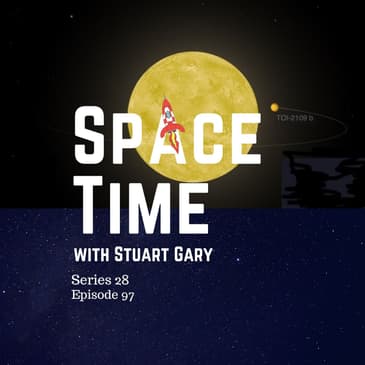
The Death Spiral of TOI 2109b
Astronomers are closely monitoring the death spiral of TOI 2109b, an exoplanet located over 870 light-years away. This gas giant, nearly five times the mass of Jupiter, completes an orbit around its host star in just 16 hours, making it the closest hot Jupiter discovered to date. Researchers from Macquarie University have found that the planet's orbit is decaying, leading to three potential end scenarios: being torn apart by tidal forces, plunging into its host star, or losing its gaseous envelope to intense radiation. These findings provide valuable insights into planetary evolution and the fate of gas giants in close orbits.
New Insights into Mars's Ancient Surface
A recent study has identified a new type of iron sulfate on Mars, suggesting significant geothermal and chemical activity on the planet's surface. Researchers have characterized this uncommon mineral, which may represent a new type due to its unique crystalline structure. The discovery sheds light on how heat, water, and chemical reactions have shaped Mars, and indicates that the planet may have been more geologically active than previously thought. This research enhances our understanding of Mars's potential to have supported life in its past.
New Crew Arrives at the International Space Station
NASA has successfully delivered a new crew to the International Space Station aboard a SpaceX Dragon capsule. The crew, consisting of two Americans, a Russian, and a Japanese astronaut, will replace colleagues who have been aboard since March. As NASA considers extending crew stays from six to eight months to reduce costs, the new team is set to contribute to ongoing research and operations in low Earth orbit.
www.spacetimewithstuartgary.com
✍️ Episode References
Astrophysical Journal
https://iopscience.iop.org/journal/1538-4357
Nature Journal
https://www.nature.com/nature/
NASA's International Space Station
https://www.nasa.gov/mission_pages/station/main/index.html
Become a supporter of this podcast: https://www.spreaker.com/podcast/spacetime-space-astronomy--2458531/support.
00:00 This is space Time Series 28, Episode 97 for broadcast on 13 August 2025
00:42 Astronomers are tracking the death spiral of a doomed planet more than 870 light years away
12:06 ToI 2109 is one of the most interesting systems that we've got
17:06 Scientists have identified a new type of iron sulfate on the Red Planet
23:47 NASA has delivered four new crew members to the International Space Station aboard SpaceX Dragon
25:10 New study claims consuming three fries a week increases risk of developing type 2 diabetes
26:13 Google about to offer AI study tools to college students for free
29:53 You've got to check for updates on all your Apple devices
00:00:00 --> 00:00:02 Stuart Gary: This is space Time Series 28, Episode 97
00:00:03 --> 00:00:06 for broadcast on 13 August 2025.
00:00:06 --> 00:00:09 Coming up on Space Time, astronomers track
00:00:09 --> 00:00:12 a dune planet's death spiral. Fresh clues
00:00:12 --> 00:00:15 about the Red Planet's past and a new
00:00:15 --> 00:00:18 crew arrives aboard the International Space Station.
00:00:18 --> 00:00:21 All that and more coming up on UH Space Time.
00:00:23 --> 00:00:25 Alex Zaharov-Reutt: Welcome to Space Time with Stuart Gary
00:00:25 --> 00:00:26 Gar.
00:00:42 --> 00:00:45 Stuart Gary: Astronomers are tracking the death spiral of a doomed planet
00:00:45 --> 00:00:47 more than 870 light years away.
00:00:48 --> 00:00:50 The exoplanet cataloged as TOI
00:00:50 --> 00:00:53 2109b orbits its host star UH
00:00:53 --> 00:00:55 TOI 2109 in just 16 hours.
00:00:56 --> 00:00:58 And that makes it the closest so called hot Jupiter
00:00:58 --> 00:01:01 ever discovered. The gas giant has nearly
00:01:01 --> 00:01:04 five times the mass and almost twice the diameter of
00:01:04 --> 00:01:07 Jupiter, the largest planet in our solar system.
00:01:07 --> 00:01:10 Ah, by comparison, in our solar system, the closest planet to
00:01:10 --> 00:01:13 the sun is Mercury. It takes 88
00:01:13 --> 00:01:15 Earth days to complete each orbit and it has a mass some
00:01:15 --> 00:01:18 6 times smaller than that of Jupiter. The
00:01:18 --> 00:01:21 host star is a spectral type F orange
00:01:21 --> 00:01:24 dwarf. It's moderately larger, hotter and more
00:01:24 --> 00:01:27 luminous than the sun and is located in the constellation
00:01:27 --> 00:01:29 Hercules. The findings reported in the
00:01:29 --> 00:01:32 Astrophysical Journal show that the planet's extreme close
00:01:32 --> 00:01:35 in orbit will ultimately prove fatal, with the
00:01:35 --> 00:01:38 gas giant's orbital period decaying by at least 10
00:01:38 --> 00:01:41 seconds over the next three Earth years alone. The
00:01:41 --> 00:01:44 study's lead author uh Jamie Alvarado Montes from
00:01:44 --> 00:01:47 Macquarie University says the planet's spiraling
00:01:47 --> 00:01:50 cosmic death dance is likely to end in one of three
00:01:50 --> 00:01:52 possible ways. It could be torn apart by
00:01:52 --> 00:01:55 the host star's gravitational tidal forces. It could
00:01:55 --> 00:01:58 plunge directly into its host star uh, or it could
00:01:58 --> 00:02:01 have its gaseous envelope stripped away by intense
00:02:01 --> 00:02:04 radiation, leaving only a rocky core.
00:02:04 --> 00:02:07 Alvarado Montes and colleagues reached their conclusions by
00:02:07 --> 00:02:10 analyzing transit timing data uh from 2010 through
00:02:10 --> 00:02:13 to 2024 using multiple ground
00:02:13 --> 00:02:16 based telescopes as well as NASA's TESS Space
00:02:16 --> 00:02:18 Telescope and the European Space Agency's CHEOPS
00:02:18 --> 00:02:21 satellite. Alvarado Montes says the
00:02:21 --> 00:02:24 findings suggest that some rocky planets in other star systems
00:02:24 --> 00:02:27 might also be the stripped cause of former gas
00:02:27 --> 00:02:29 giants, a possibility that could res
00:02:29 --> 00:02:32 Astronomy's understanding of planetary evolution.
00:02:32 --> 00:02:35 He says that with continued monitoring over the next three to
00:02:35 --> 00:02:38 five years, astronomers will detect orbital changes
00:02:38 --> 00:02:41 in the system, providing real time observations of a
00:02:41 --> 00:02:43 planetary system in its death throes.
00:02:43 --> 00:02:46 Alex Zaharov-Reutt: The Roche limit is like an orbital position
00:02:47 --> 00:02:49 where the secondary object that orbits the
00:02:49 --> 00:02:52 primary object starts losing its own
00:02:53 --> 00:02:55 stability, right? So the self gravity of the
00:02:55 --> 00:02:58 object is overcome by
00:02:58 --> 00:03:01 the tidal forces of the
00:03:01 --> 00:03:02 primary object.
00:03:02 --> 00:03:04 Stuart Gary: The bit of the planet or the celestial body
00:03:04 --> 00:03:07 nearest the primary body is being gravitationally influenced
00:03:07 --> 00:03:10 to a larger degree than the bit further away. Exactly.
00:03:10 --> 00:03:11 Literally ripped apart.
00:03:12 --> 00:03:14 Alex Zaharov-Reutt: So this, so and this relationship
00:03:14 --> 00:03:17 between the position of the secondary object and the
00:03:17 --> 00:03:20 tidal forces of the primary object is general. It
00:03:20 --> 00:03:23 doesn't only apply for moons or for
00:03:23 --> 00:03:26 planets, but for any pair of bodies where you have
00:03:26 --> 00:03:29 them orbiting or interacting very close to
00:03:29 --> 00:03:31 each other. And it mainly depends on the
00:03:31 --> 00:03:34 relationship of the masses
00:03:35 --> 00:03:37 of the objects, the densities more specifically.
00:03:37 --> 00:03:40 So denser objects have the
00:03:40 --> 00:03:43 roach limit closer to the
00:03:43 --> 00:03:45 primary object and less dense
00:03:45 --> 00:03:48 objects have their Roche limit like
00:03:48 --> 00:03:51 farther away. So for instance, in the case of
00:03:51 --> 00:03:54 Jupiter or Saturn, you have that icy moons
00:03:54 --> 00:03:57 have the roach limit farther away and
00:03:57 --> 00:04:00 rocky moons, like solid moons, will have the
00:04:00 --> 00:04:03 Roche limit super, super close to the planet to Saturn
00:04:03 --> 00:04:06 or Jupiter. And this is a general thing. So it's basically
00:04:06 --> 00:04:08 what happened with the system that, uh, uh, I worked on.
00:04:08 --> 00:04:11 TOI 2109, which is an exoplanet, is
00:04:11 --> 00:04:14 an ultra hot Jupiter. And it's
00:04:14 --> 00:04:17 what people have called a doom because it's
00:04:17 --> 00:04:20 spiraling in towards its star and it's a
00:04:20 --> 00:04:23 very, very big planet, like almost twice the size of Jupiter.
00:04:23 --> 00:04:26 Stuart Gary: And this is in fact the nearest hot Jupiter
00:04:26 --> 00:04:28 to its host star ever seen.
00:04:28 --> 00:04:30 Alex Zaharov-Reutt: Yep, exactly. It's orbiting
00:04:31 --> 00:04:33 the host star in 16, approximately
00:04:33 --> 00:04:36 16.5 hours. Which
00:04:36 --> 00:04:39 is the shortest period exoplanet
00:04:39 --> 00:04:42 discovered today? Well, the shortest period, Hot Jupiter.
00:04:42 --> 00:04:44 Ultra hot Jupiter. Ultra hot Jupiters are
00:04:44 --> 00:04:47 Jupiter like planets that orbit their star in less
00:04:47 --> 00:04:50 than one day. That's the formal definition. But this one
00:04:50 --> 00:04:53 does it in 16 hours. So it's quite impressive and
00:04:53 --> 00:04:56 well, it will have a lot of consequences.
00:04:56 --> 00:04:58 Stuart Gary: What do we know about the host star itself?
00:04:58 --> 00:05:01 Alex Zaharov-Reutt: Yeah, yeah. So it's interesting,
00:05:01 --> 00:05:04 like studying these systems is very interesting
00:05:04 --> 00:05:06 because all the properties of the
00:05:06 --> 00:05:09 objects involved are entwined.
00:05:10 --> 00:05:12 So like you said, if we study this
00:05:12 --> 00:05:15 planet, we study how this planet moves,
00:05:15 --> 00:05:18 how long it's going to take for this planet
00:05:18 --> 00:05:20 to reach the Roche limit. All of these
00:05:21 --> 00:05:23 orbital mechanics, as we call it, really
00:05:23 --> 00:05:26 depends on how the properties of the star
00:05:26 --> 00:05:29 are modeled and how the properties of the planet are modeled.
00:05:29 --> 00:05:32 But also like not just any model,
00:05:32 --> 00:05:35 but models that are based on real data
00:05:35 --> 00:05:38 on observations. And by combining
00:05:39 --> 00:05:42 our theoretical models from tidal
00:05:42 --> 00:05:44 evolution and the observations that we have
00:05:45 --> 00:05:48 for this planet, then we can tell
00:05:48 --> 00:05:51 a lot of things about what's going on inside of the
00:05:51 --> 00:05:53 stock. Because the way the planet moves
00:05:53 --> 00:05:56 depends on how efficiently the star
00:05:57 --> 00:06:00 dissipates energy and also how efficiently the planet
00:06:00 --> 00:06:02 dissipates energy and how this energy
00:06:02 --> 00:06:05 is conserved in the system and how it's
00:06:05 --> 00:06:08 transferred from the orbit of the planet to
00:06:08 --> 00:06:11 the rotation of the star. So it's really
00:06:11 --> 00:06:13 this relationship between the spin, the
00:06:13 --> 00:06:16 stellar spin and the orbital motion of
00:06:16 --> 00:06:19 the planet. Uh, what tells you what's going on
00:06:20 --> 00:06:23 in these tidal interactions? Right, because these tidal interactions
00:06:23 --> 00:06:25 depend on how efficiently
00:06:25 --> 00:06:28 the energy is released from the star or from the
00:06:28 --> 00:06:31 planet. And that's, that's how we can learn more about the
00:06:31 --> 00:06:34 interior properties of the star just by,
00:06:34 --> 00:06:36 by looking at how the planet is moving.
00:06:36 --> 00:06:39 Stuart Gary: And you've come up with three likely scenarios.
00:06:39 --> 00:06:40 Tell us about them.
00:06:40 --> 00:06:43 Alex Zaharov-Reutt: Yeah, those scenarios are very interesting. Is
00:06:43 --> 00:06:46 one of the, like the first one that I could mention
00:06:46 --> 00:06:49 is that the orbital decay
00:06:49 --> 00:06:52 occurs and as uh, the planetary companion
00:06:52 --> 00:06:54 gets close to the Roche limit then,
00:06:55 --> 00:06:58 and if decay happens we
00:06:58 --> 00:07:01 could say at a decent rate, like not too fast,
00:07:01 --> 00:07:04 then when the planet reaches the
00:07:04 --> 00:07:07 Roche limit then the planet will start getting like
00:07:07 --> 00:07:10 obliterated. Right? So the planet moves away from
00:07:10 --> 00:07:13 its geometrical shape and once
00:07:13 --> 00:07:16 the tidal forces are so, so strong,
00:07:16 --> 00:07:19 so intense that they overcome the self
00:07:19 --> 00:07:22 gravitation of the planet, then you have a planet that is
00:07:22 --> 00:07:25 completely disrupted and, and you will
00:07:25 --> 00:07:27 have all the remaining, all the debris
00:07:27 --> 00:07:30 continuing around, orbiting around the star. And
00:07:30 --> 00:07:33 well, you don't have a planet anymore, but you have just
00:07:33 --> 00:07:36 the fingerprints of what once existed.
00:07:36 --> 00:07:39 So you just have debris and you just have material
00:07:39 --> 00:07:42 orbiting around or what we call a ring. Right? So that's
00:07:42 --> 00:07:44 one of the scenarios. It's just the complete
00:07:44 --> 00:07:47 disruption of the planetary companion when
00:07:47 --> 00:07:50 crossing the Roche limit. But something else
00:07:50 --> 00:07:53 that could happen is that the orbital
00:07:53 --> 00:07:56 decay is so fast and it could happen
00:07:56 --> 00:07:59 so fast that could be, I don't know, triggered or
00:07:59 --> 00:08:01 it could be produced by
00:08:01 --> 00:08:04 unaccounted mechanisms of dissipation
00:08:04 --> 00:08:07 inside the star or the planet. It could happen that
00:08:07 --> 00:08:10 when the planet gets closer in its orbit, it will
00:08:10 --> 00:08:13 start actually spiraling in at a faster
00:08:13 --> 00:08:15 rate. So as it goes in it, that
00:08:15 --> 00:08:18 decay happens very fast. Then it could
00:08:18 --> 00:08:21 happen so fast that as it crosses the Roche
00:08:21 --> 00:08:24 limit, it doesn't slow down when it crosses the Roche
00:08:24 --> 00:08:27 limit, but it continues going so fast that it could crash with the
00:08:27 --> 00:08:30 star. So it could, the star could
00:08:30 --> 00:08:33 engulf the planet and basically, well, the
00:08:33 --> 00:08:36 planet will also die, will also disappear, but in a different way. Instead
00:08:36 --> 00:08:39 of being disrupted before reaching the stellar
00:08:39 --> 00:08:41 surface, you have a planet that actually
00:08:42 --> 00:08:45 like goes like head on to the stellar
00:08:45 --> 00:08:47 surface and disappears too, but for a
00:08:47 --> 00:08:50 slightly different reason. Right. So that's the second scenario
00:08:50 --> 00:08:53 and another one that is very interesting, and that is
00:08:53 --> 00:08:56 being like actually quite debated, and we're doing some work
00:08:56 --> 00:08:59 on it too, is that if the orbital
00:08:59 --> 00:09:02 decay, the spiraling of the planet
00:09:02 --> 00:09:04 happens slow, very slowly,
00:09:05 --> 00:09:07 so slow that as, uh, the planet gets
00:09:07 --> 00:09:10 closer in its orbit, then the
00:09:10 --> 00:09:13 planetary atmosphere starts getting
00:09:13 --> 00:09:16 destroyed by the stellar radiation by different
00:09:16 --> 00:09:19 processes, one of them being a photo evaporation.
00:09:19 --> 00:09:22 So that's uh, one of the effects that could destroy
00:09:22 --> 00:09:25 the planetary atmosphere. Photo evaporation, which is
00:09:25 --> 00:09:27 basically just the stellar radiation dissociating
00:09:28 --> 00:09:31 the molecules in the planetary atmosphere.
00:09:31 --> 00:09:33 And it gets spoiled away. Yeah, exactly,
00:09:33 --> 00:09:36 exactly. Just like that. So the planet starts losing
00:09:37 --> 00:09:40 its atmosphere. And with this loss
00:09:40 --> 00:09:42 of material, and taking into account,
00:09:43 --> 00:09:46 uh, a giant planet, a gas giant such as this
00:09:46 --> 00:09:48 one is mainly composed of gas, right.
00:09:49 --> 00:09:51 Then a lot of that material will go
00:09:51 --> 00:09:54 away, reducing the mass of the planet. Right? So
00:09:54 --> 00:09:57 the planet gets less massive. And if that
00:09:57 --> 00:09:59 loss of mass is quite significant,
00:10:00 --> 00:10:03 like very, very significant, and reaching,
00:10:03 --> 00:10:06 say, I don't know, values of 60%
00:10:06 --> 00:10:09 less of the current mass of the planet, then what you
00:10:09 --> 00:10:10 have is that the Roche limit get.
00:10:12 --> 00:10:14 So the Roche limit gets closer to the star. So
00:10:14 --> 00:10:17 what was initially the Roche limit, where the planet could have been
00:10:17 --> 00:10:20 disrupted, is not the Roche limit anymore. Because as I
00:10:20 --> 00:10:23 said before, the Roche limit depends on the mass, on the
00:10:23 --> 00:10:26 mass relationship of the object. But if the secondary object gets
00:10:26 --> 00:10:29 less massive, then the Roche limit moves,
00:10:30 --> 00:10:33 it becomes more interior, like closer to the stellar
00:10:33 --> 00:10:35 surface. So allowing the planet to continue
00:10:36 --> 00:10:39 its migration without getting disrupted. And at some
00:10:39 --> 00:10:42 point what you can have is that if that
00:10:42 --> 00:10:44 material, that atmospheric material is
00:10:44 --> 00:10:47 completely obliterated and blown away, then you
00:10:47 --> 00:10:50 end up with a planet whose composition could
00:10:50 --> 00:10:53 be mostly like a rocky composition. And you
00:10:53 --> 00:10:56 could end up with basically what we could say
00:10:56 --> 00:10:58 like a second generation rocky planet
00:10:58 --> 00:11:01 or a proto rock planet or something
00:11:01 --> 00:11:04 like that. So basically you have the
00:11:04 --> 00:11:07 naked core of what was
00:11:07 --> 00:11:10 before a Jupiter like planet, a gas giant. And
00:11:10 --> 00:11:13 this planet has the potential of,
00:11:13 --> 00:11:16 and that's based off other studies in
00:11:16 --> 00:11:19 the literature in astronomy and astrophysics, is that
00:11:19 --> 00:11:22 the less massive the planet is, the more
00:11:22 --> 00:11:25 stable it is and it will be in its orbit.
00:11:25 --> 00:11:28 And less massive planets are less
00:11:28 --> 00:11:31 prone to undergo orbital decay. So if you
00:11:31 --> 00:11:33 have a planet that is mostly rocky now, then this
00:11:33 --> 00:11:36 planet could stay in that orbit because it's less
00:11:36 --> 00:11:39 massive and the Roche limit has moved farther away.
00:11:39 --> 00:11:42 So it's a very interesting scenario where you could have, you
00:11:42 --> 00:11:45 could end up with a rocky planet from the, basically
00:11:45 --> 00:11:48 the obliteration of the atmosphere of a
00:11:48 --> 00:11:48 gas giant.
00:11:49 --> 00:11:52 Stuart Gary: When NASA's Juno spacecraft began
00:11:52 --> 00:11:54 orbiting at Jupiter. We
00:11:54 --> 00:11:57 discovered we didn't know as much about the
00:11:57 --> 00:12:00 internal structure of gas giants as we had
00:12:00 --> 00:12:02 previously thought we did. Juno changed our
00:12:02 --> 00:12:05 understanding of what's happening deep below the clouds
00:12:05 --> 00:12:06 of Jupiter.
00:12:06 --> 00:12:08 It means that what's going to be happening with
00:12:08 --> 00:12:11 TOI2109B will be
00:12:11 --> 00:12:14 fascinating to see because we're going to be seeing something we've never seen
00:12:14 --> 00:12:14 before.
00:12:14 --> 00:12:17 Alex Zaharov-Reutt: Oh, yeah, definitely, definitely. Right
00:12:17 --> 00:12:20 now, TOI 2109
00:12:20 --> 00:12:23 is one of the most interesting systems that we've
00:12:23 --> 00:12:26 got because there's not many. Like,
00:12:26 --> 00:12:29 there's just a fraction of all of the planets that we've
00:12:29 --> 00:12:31 discovered. Almost 6 now, other
00:12:32 --> 00:12:35 7 awaiting confirmation. This
00:12:35 --> 00:12:37 is a, uh, very particular system where
00:12:37 --> 00:12:40 tidal interactions are so intense that
00:12:40 --> 00:12:43 studying this system further will allow us to
00:12:43 --> 00:12:46 make bigger conclusions of how
00:12:46 --> 00:12:49 the observations that we collect with different
00:12:49 --> 00:12:52 instruments, because we're talking about doing observations
00:12:53 --> 00:12:55 using different techniques, such as planetary transits
00:12:55 --> 00:12:58 or radial velocity. And it's a way to
00:12:58 --> 00:13:01 connect all of these observations with what we know
00:13:01 --> 00:13:04 about how these objects evolve and how they
00:13:04 --> 00:13:06 affect the whole planetary system. Because
00:13:08 --> 00:13:11 such a massive planet orbiting that close to the star,
00:13:11 --> 00:13:14 uh, has consequences not only for the planet, but also
00:13:14 --> 00:13:16 for other bodies in the system. And
00:13:17 --> 00:13:20 at the moment, actually, there is, um, also
00:13:21 --> 00:13:23 other studies undergoing studies
00:13:23 --> 00:13:26 about trying to detect another
00:13:26 --> 00:13:29 planet in the system. So what we will call
00:13:29 --> 00:13:32 TOI 2109C. That
00:13:32 --> 00:13:35 is the possibility of that there is
00:13:35 --> 00:13:37 another planet in the system, another
00:13:37 --> 00:13:40 planet that is affecting also the way that, uh, our
00:13:40 --> 00:13:43 planet to 109B is moving. So,
00:13:43 --> 00:13:46 but to justify these studies, well, we need
00:13:46 --> 00:13:49 to keep targeting this system and
00:13:49 --> 00:13:52 we're going to learn, we're learning a lot about all the
00:13:52 --> 00:13:55 Jupiter, like planet population just
00:13:55 --> 00:13:56 by studying this system.
00:13:56 --> 00:13:59 Stuart Gary: I guess the big question has to be, what's the
00:13:59 --> 00:14:02 timetable? Like, do we know how long it's going to be
00:14:02 --> 00:14:04 before the planet gets so close to the star
00:14:04 --> 00:14:07 that, uh, it starts to break apart or have its atmosphere
00:14:07 --> 00:14:10 drawn off it or plunge into the star. Do we have a
00:14:10 --> 00:14:11 timetable for that?
00:14:12 --> 00:14:14 Alex Zaharov-Reutt: Well, yeah, an astronomical timetable.
00:14:15 --> 00:14:17 We could, we could say, right, because
00:14:17 --> 00:14:20 scales in astronomy are, uh, pretty big.
00:14:20 --> 00:14:23 Sometimes we can't imagine that. Right. But yeah, basically
00:14:23 --> 00:14:26 the orbital decay of this planet, depending on
00:14:26 --> 00:14:29 one of the things that we learned with this planet,
00:14:29 --> 00:14:32 is that the star that the planet orbits,
00:14:32 --> 00:14:35 the host star, might be younger than
00:14:35 --> 00:14:38 when we thought before. And it's because the
00:14:38 --> 00:14:41 observations match this model of a
00:14:41 --> 00:14:43 young host star. So what we learn is that
00:14:43 --> 00:14:46 for a young host star, a star of
00:14:47 --> 00:14:49 roughly 1000 million years, the
00:14:49 --> 00:14:51 planet will take around
00:14:52 --> 00:14:55 0.5 to 1 million years
00:14:55 --> 00:14:57 to get to the Roche limit. Now those scales
00:14:58 --> 00:15:01 are somewhat ridiculous, right in terms
00:15:01 --> 00:15:02 of human time scales, for.
00:15:02 --> 00:15:04 Stuart Gary: Me it's pointing, I wanted to see.
00:15:05 --> 00:15:08 Alex Zaharov-Reutt: Exactly. But there is a way to convert
00:15:08 --> 00:15:11 those astronomical timescales into human
00:15:11 --> 00:15:13 timescales. And the way we do that is by
00:15:13 --> 00:15:16 studying systematically the
00:15:16 --> 00:15:19 transits of this planet. And the estimations that
00:15:19 --> 00:15:22 we gave in, that we gave in, uh, our
00:15:22 --> 00:15:24 study is that it will take us
00:15:24 --> 00:15:27 around three to four years of
00:15:28 --> 00:15:30 consecutive observations of studying
00:15:30 --> 00:15:33 transits of this planet to prove
00:15:33 --> 00:15:36 that orbital decay is indeed happening. And if
00:15:36 --> 00:15:39 we confirm in the next three to four years
00:15:39 --> 00:15:42 that the timing of the transit, something
00:15:42 --> 00:15:44 that we call the mid transit time, that is the time
00:15:45 --> 00:15:47 right in the middle of the transit, right when the planet is
00:15:47 --> 00:15:50 passing by the center of the stock. If we
00:15:50 --> 00:15:53 prove that that timing is changing and
00:15:53 --> 00:15:56 we estimate that over the next three years that change is going
00:15:56 --> 00:15:59 to be 10 seconds, around 10 seconds. So if we
00:15:59 --> 00:16:02 prove that that change, that that shift in
00:16:02 --> 00:16:05 the mid transit time is indeed happening, then
00:16:05 --> 00:16:08 that and discarding other effects in the system,
00:16:08 --> 00:16:11 then that could be a direct evidence that
00:16:11 --> 00:16:13 orbital decay is indeed happening and that uh, the
00:16:13 --> 00:16:16 planet is approaching the Roche limit just as we
00:16:16 --> 00:16:19 predicted. And then well, more studies
00:16:19 --> 00:16:22 of course will be done on it. But basically what we need now
00:16:22 --> 00:16:25 is just to keep observing this planet, getting more data
00:16:25 --> 00:16:28 on it and see if we managed to
00:16:28 --> 00:16:30 detect this shift in the transit.
00:16:31 --> 00:16:33 And well that will be, that would be amazing.
00:16:33 --> 00:16:35 Stuart Gary: That's Dr. Jamie Alvarado Montez from
00:16:35 --> 00:16:38 Macquarie University. And this is
00:16:38 --> 00:16:41 space time still to come. Fresh
00:16:41 --> 00:16:44 clues about the Red Planet's past. And a new
00:16:44 --> 00:16:47 crew arrives aboard the International Space Station. All
00:16:47 --> 00:16:50 that and more still to come on um, space time.
00:17:06 --> 00:17:09 Scientists have identified a new type of iron sulfate
00:17:09 --> 00:17:11 on the red planet Mars, which may represent a ah,
00:17:11 --> 00:17:14 completely brand new type of mineral. The
00:17:14 --> 00:17:17 discovery reported in the journal Nature, adds new
00:17:17 --> 00:17:20 insights into how heat, water and chemical reactions
00:17:20 --> 00:17:22 have shaped the Martian surface.
00:17:23 --> 00:17:25 Sulfur is common on Mars and it combines with other elements
00:17:25 --> 00:17:28 to form minerals, especially sulfates. While
00:17:28 --> 00:17:31 most sulfates are highly soluble and readily dissolve on
00:17:31 --> 00:17:34 Earth during rainfall, on the dry, cold
00:17:34 --> 00:17:37 surface conditions of Mars, these minerals can survive
00:17:37 --> 00:17:39 for billions of years and in the process preserve
00:17:39 --> 00:17:42 important clues about the planet's early history.
00:17:43 --> 00:17:45 And the thing is, each ah, mineral has a unique
00:17:45 --> 00:17:48 crystalline structure and properties, including the
00:17:48 --> 00:17:51 common minerals gypsum and hematite. Scientists
00:17:51 --> 00:17:54 rely on data collected by Mars orbiters to identify
00:17:54 --> 00:17:57 minerals on the surface of the Red Planet. And obtain information
00:17:57 --> 00:18:00 about ancient Martian environments that would have enabled
00:18:00 --> 00:18:02 the formation of those minerals. For
00:18:02 --> 00:18:05 nearly 20 years now, researchers have been puzzled
00:18:05 --> 00:18:08 by unusual layered iron sulfates with a
00:18:08 --> 00:18:11 unique spectral signature. Now scientists
00:18:11 --> 00:18:14 have identified and characterized an uncommon
00:18:14 --> 00:18:17 ferric hydroxy sulfate phase by combining
00:18:17 --> 00:18:19 laboratory experiments here on Earth uh with Martian
00:18:19 --> 00:18:22 orbital observations. The study's lead
00:18:22 --> 00:18:25 author is Janice Bishop from the Search for
00:18:25 --> 00:18:28 Extraterrestrial Intelligence, SETI Institute and NASA's
00:18:28 --> 00:18:31 Ames Research Center. She has investigated
00:18:31 --> 00:18:33 two sulfate bearing sites near the vast
00:18:33 --> 00:18:36 valleys Marineris Canyon system, a
00:18:36 --> 00:18:39 huge rip in the Red Planet's crust, which is the
00:18:39 --> 00:18:42 largest single feature on the Red Planet visible
00:18:42 --> 00:18:44 from space. The observations include a
00:18:44 --> 00:18:47 mysterious spectral band seen from orbital data, as well as
00:18:47 --> 00:18:50 layered sulfates with intriguing geology.
00:18:50 --> 00:18:53 The study included a region called Arum Chaos,
00:18:53 --> 00:18:56 located northeast of Valles Marineris where
00:18:56 --> 00:18:59 ancient waters drained away towards lower regions in the
00:18:59 --> 00:19:01 north, and also a uh plateau above the Juventa
00:19:01 --> 00:19:04 Casma, a 5km deep canyon located
00:19:04 --> 00:19:07 just north of Valles Marineris. The
00:19:07 --> 00:19:10 cliffs in these areas are, uh, signs of ancient water
00:19:10 --> 00:19:13 channels across the landscape. Scientists found
00:19:13 --> 00:19:15 sulfates in just one small low lying spot,
00:19:16 --> 00:19:19 likely left behind when pools of sulfate rich water
00:19:19 --> 00:19:22 slowly dried up, forming hydrated ferrous
00:19:22 --> 00:19:24 sulfates. These minerals, including ferric
00:19:24 --> 00:19:27 hydroxysulfates, appear as thin meter thick
00:19:27 --> 00:19:30 layers occurring both above and beneath basaltic minerals,
00:19:30 --> 00:19:33 suggesting they were heated from lava or ash after
00:19:33 --> 00:19:35 formation. Investigation of the
00:19:35 --> 00:19:38 morphologies and stratigraphies of these four compositional
00:19:38 --> 00:19:41 units allowed the authors to determine the age and formation
00:19:41 --> 00:19:44 relationships among them. Scientists have often
00:19:44 --> 00:19:46 observed sulfate minerals throughout the Valles
00:19:46 --> 00:19:49 Marineris region, including the rugged landscapes known
00:19:49 --> 00:19:52 as chaotic terrains, areas they believe were carved
00:19:52 --> 00:19:54 and shaped by powerful floods in the past.
00:19:55 --> 00:19:58 As water gradually dried up, it left behind
00:19:58 --> 00:20:00 layered deposits of iron and magnesium sulphates,
00:20:01 --> 00:20:03 subtle but powerful clues that Mars was once
00:20:03 --> 00:20:06 a much warmer, wetter world. In one Chaos
00:20:06 --> 00:20:09 terrain, which formed within a former impact crater, the
00:20:09 --> 00:20:12 upper layers contained polyhydrated sulfates,
00:20:12 --> 00:20:15 while monohydrated and ferritic hydroxysulfate
00:20:15 --> 00:20:18 layers form beneath. Each of these three
00:20:18 --> 00:20:21 sulfates contains distinct spectral signatures which can
00:20:21 --> 00:20:23 be identified from orbit. Uh, While the
00:20:23 --> 00:20:26 stratigraphy of these three sulfates was initially puzzling,
00:20:26 --> 00:20:29 lab tests back on Earth AH showed that heating
00:20:29 --> 00:20:32 polyhydrated sulfates to 50 degrees Celsius
00:20:32 --> 00:20:35 winds up producing monohydrated forms, and
00:20:35 --> 00:20:38 heating the same material above 100 degrees Celsius
00:20:38 --> 00:20:40 ends up producing ferric hydroxy sulfates.
00:20:41 --> 00:20:44 All this supports the idea that geothermal
00:20:44 --> 00:20:46 heat must have caused the minerals to transition
00:20:47 --> 00:20:50 monohydrated and polyhydrated sulfates occur across
00:20:50 --> 00:20:53 broad regions of the Red Planet. However, ferric
00:20:53 --> 00:20:56 hydroxy sulfates are, uh, limited to just a few small
00:20:56 --> 00:20:59 areas. So they figure the warmest
00:20:59 --> 00:21:02 geothermal sources most likely set beneath the sites
00:21:02 --> 00:21:04 where ferric hydroxy sulfates appear today. Although
00:21:04 --> 00:21:07 more may lie buried under monohydrated sulfates as
00:21:07 --> 00:21:10 well. The lab tests looked at how these
00:21:10 --> 00:21:13 sulfates all transformed M from zoonite
00:21:13 --> 00:21:15 with four water molecules per unit cell to
00:21:15 --> 00:21:18 zimolmekite with one, and finally to ferric
00:21:18 --> 00:21:21 hydroxysulfates, which contain hydroxyls instead of
00:21:21 --> 00:21:24 water in its structure. It's worth noting that
00:21:24 --> 00:21:26 ferric hydroxy sulfates only form when hydrated
00:21:26 --> 00:21:29 ferrous sulfates are heated in the presence of oxygen.
00:21:30 --> 00:21:32 While the changes in the atomic structure are very small,
00:21:33 --> 00:21:36 this reaction drastically alters the way these minerals
00:21:36 --> 00:21:38 absorb infrared light. And it's that which allowed their
00:21:38 --> 00:21:41 identification from orbit. The reaction
00:21:41 --> 00:21:44 requires oxygen gas and results in the production of
00:21:44 --> 00:21:47 water. Today, Mars has a very thin
00:21:47 --> 00:21:49 atmosphere and it, uh, mostly consists of carbon
00:21:49 --> 00:21:52 dioxide, but it still has enough oxygen for
00:21:52 --> 00:21:55 this reaction to proceed and for oxidation of other
00:21:55 --> 00:21:58 forms of iron as well. Bishop says the
00:21:58 --> 00:22:00 material formed in the lab experiments is likely a new
00:22:00 --> 00:22:03 mineral due to its unique crystalline structure and thermal
00:22:03 --> 00:22:06 stability. Scientists will now need to search and
00:22:06 --> 00:22:09 find it on Earth in order to officially recognise it as a
00:22:09 --> 00:22:12 new mineral. Interestingly, this new ferric
00:22:12 --> 00:22:14 hydroxysulfate appears structurally very similar to
00:22:14 --> 00:22:17 zomaldecite, which is a monohydrated ferrous
00:22:17 --> 00:22:20 sulfate mineral. But ferric hydroxysulfate
00:22:20 --> 00:22:22 form more easily than zoonite, which is a
00:22:22 --> 00:22:25 tetrahydrated mineral. This transformation
00:22:25 --> 00:22:28 from hydrated ferrous sulfates to ferric
00:22:28 --> 00:22:31 hydroxysulfates only happens at temperatures above
00:22:31 --> 00:22:33 100 degrees Celsius. And that's much hotter than what
00:22:33 --> 00:22:36 Mars usually experiences on its surface. It's thought
00:22:36 --> 00:22:39 that the sulfates at Aramchaos and Juvente, including
00:22:39 --> 00:22:42 the ferric hydroxy sulfates, likely formed much more
00:22:42 --> 00:22:45 recently than the terrain in which they occur, uh, possibly during the
00:22:45 --> 00:22:47 Amazonian period, less than 3 billion years ago.
00:22:48 --> 00:22:51 The study reveals that heat from both volcanic activity at
00:22:51 --> 00:22:54 the Gevente Plateau and geothermal energy below
00:22:54 --> 00:22:56 Arum chaos can transform common hydrated
00:22:56 --> 00:22:59 sulfates into ferric hydroxy sulfates.
00:23:00 --> 00:23:02 The findings all suggest that various parts of Mars
00:23:02 --> 00:23:05 may have been chemically and thermally much more active more
00:23:05 --> 00:23:08 recently than scientists previously believed.
00:23:08 --> 00:23:11 And that is offering new insights into the Red
00:23:11 --> 00:23:13 Planet's dynamic surface and its potential
00:23:14 --> 00:23:16 to have once supported life.
00:23:16 --> 00:23:19 This is space time. Still to come,
00:23:19 --> 00:23:22 a new crew arrives aboard the International Space Station.
00:23:22 --> 00:23:25 And later in the Science report, a new study
00:23:25 --> 00:23:28 shows that it's your mother's fault if you end up
00:23:28 --> 00:23:31 fat. All that and more still to come on, uh, space
00:23:31 --> 00:23:31 time.
00:23:47 --> 00:23:49 NASA's just delivered four new crew members to the International
00:23:50 --> 00:23:52 Space station aboard a SpaceX Dragon
00:23:52 --> 00:23:55 capsule. The spacecraft Endeavour docked with the
00:23:55 --> 00:23:58 orbiting outpost's Harmony module Zenith port 15
00:23:58 --> 00:24:01 hours after launching aboard a Falcon 9 rocket from
00:24:01 --> 00:24:04 launch pad 39A at the Kennedy Space center at the Cape
00:24:04 --> 00:24:06 Canaveral Space Force Base in Florida. A launch
00:24:06 --> 00:24:09 attempt the previous day had to be scrubbed due to bad weather.
00:24:10 --> 00:24:13 The new crew, consisting of two Americans as well as a
00:24:13 --> 00:24:16 Russian and a Japanese astronaut, will spend at least six
00:24:16 --> 00:24:19 months aboard the station replacing colleagues who had already
00:24:19 --> 00:24:22 been up there since March. Right now, NASA is
00:24:22 --> 00:24:24 looking at increasing space station stays from six to
00:24:24 --> 00:24:27 eight months in order to cut costs.
00:24:27 --> 00:24:30 That's a move already being adopted by the Russian Federal Space
00:24:30 --> 00:24:33 Agency Roscosmos. The decision comes
00:24:33 --> 00:24:36 as SpaceX is closer to certifying its Dragon captures
00:24:36 --> 00:24:39 for longer flights, which means the newly launched crew could
00:24:39 --> 00:24:42 remain on Station until April 2026.
00:24:42 --> 00:24:45 NASA is also looking at going back to using smaller three
00:24:45 --> 00:24:48 man crews for each transport rather than the current four.
00:24:48 --> 00:24:51 Again, it's a move designed to cut costs
00:24:52 --> 00:24:53 this space time
00:25:09 --> 00:25:10 and time.
00:25:10 --> 00:25:13 Now to take another brief look at some of the other stories making Newton
00:25:13 --> 00:25:15 Science this week with the Science report.
00:25:15 --> 00:25:18 A new study claims consuming three servings of
00:25:18 --> 00:25:21 fries a week is enough to be linked to a 20%
00:25:21 --> 00:25:24 increased risk of developing type 2 diabetes. Diabetes?
00:25:24 --> 00:25:27 But eating the same quantity potatoes, but cooked in other
00:25:27 --> 00:25:30 ways, such as boiled, baked or mashed, does not
00:25:30 --> 00:25:33 substantially increase your risk. The findings
00:25:33 --> 00:25:35 reported in the British Medical Journal also found that
00:25:35 --> 00:25:38 swapping out potatoes for whole grains cut your
00:25:38 --> 00:25:41 diabetes risk, but swapping them out for white
00:25:41 --> 00:25:44 rice actually increased the risk. The findings
00:25:44 --> 00:25:46 are based on data from three previous large US studies,
00:25:46 --> 00:25:49 including a total of more than 205
00:25:49 --> 00:25:52 people. They had been asked to complete detailed food
00:25:52 --> 00:25:55 questionnaires every four years for almost four
00:25:55 --> 00:25:57 decades. During this period,
00:25:57 --> 00:26:00 22 people were diagnosed
00:26:00 --> 00:26:03 with type 2 diabetes. Uh, although this
00:26:03 --> 00:26:06 type of study can't show cause and effect, the authors say
00:26:06 --> 00:26:09 it all adds to existing evidence that whole grains are
00:26:09 --> 00:26:11 effective in helping prevent type 2
00:26:11 --> 00:26:12 diabetes.
00:26:13 --> 00:26:16 Well, if you're getting fat, chances are you can blame
00:26:16 --> 00:26:19 your mother. A new study has shown that your
00:26:19 --> 00:26:22 maternal genetic background plays a greater role in
00:26:22 --> 00:26:25 determining whether you'll become obese. A
00:26:25 --> 00:26:28 report in the journal plos Genetics looked at the body mass
00:26:28 --> 00:26:30 index measurements, diet and genetic data of more
00:26:30 --> 00:26:33 than 2 mother, father and
00:26:33 --> 00:26:36 child trios. The authors found that a
00:26:36 --> 00:26:39 mother's body mass index may be especially important
00:26:39 --> 00:26:42 for determining the child's eventual weight.
00:26:43 --> 00:26:46 A new study claims that including just a few emojis
00:26:46 --> 00:26:49 in your texting could end up making your relationship
00:26:49 --> 00:26:52 stronger. A report of the journal plos One
00:26:52 --> 00:26:54 claims the use of emojis in messaging improves how people
00:26:54 --> 00:26:57 feel others are responding to them and therefore helps you
00:26:57 --> 00:27:00 feel closer and more satisfied in your relationships with them.
00:27:01 --> 00:27:03 The authors worked this out by asking 260
00:27:03 --> 00:27:06 people aged between 23 and 67 to imagine
00:27:06 --> 00:27:09 they were the ones seeing a series of text images that
00:27:09 --> 00:27:12 either included or lacked emojis. They were then
00:27:12 --> 00:27:15 asked to focus on their partner's replies.
00:27:15 --> 00:27:18 The participants ended up rating partners who used
00:27:18 --> 00:27:21 emojis as being more responsive than those who sent
00:27:21 --> 00:27:24 text alone, and this was positively
00:27:24 --> 00:27:27 linked to their closeness and relationship satisfaction.
00:27:27 --> 00:27:30 Interestingly, the authors found no difference between using
00:27:30 --> 00:27:33 face and non face emojis, suggesting that it's the
00:27:33 --> 00:27:36 presence and thoughtfulness of the emojis themselves that matters,
00:27:36 --> 00:27:39 rather than the type Google
00:27:39 --> 00:27:42 are uh, about to offer their advanced AI study tools to
00:27:42 --> 00:27:44 college students in selected countries for free.
00:27:45 --> 00:27:47 With the details, we're joined by technology editor Alex
00:27:47 --> 00:27:50 Zaharov-Reutt Freud from Tech Advice Start Live.
00:27:50 --> 00:27:53 Alex Zaharov-Reutt: Google's going to launch a new phone soon. We don't have all the details
00:27:53 --> 00:27:56 yet because it's not public. Plenty of leaks, but we have to wait for the keynote
00:27:56 --> 00:27:59 to see what's real. But what we've got is
00:27:59 --> 00:28:02 Google bringing, as they say here, the best
00:28:02 --> 00:28:05 of AI to college students for free. Now this is
00:28:05 --> 00:28:07 in the US and Indonesia and Brazil first, but
00:28:08 --> 00:28:11 giving college students access to their
00:28:11 --> 00:28:14 most advanced tools and also their new guided learning mode.
00:28:14 --> 00:28:17 They're giving a billion dollars to support AI education and
00:28:17 --> 00:28:20 training programs and research in the us. It'll roll out
00:28:20 --> 00:28:22 to other countries I guess as well, but they'll get expanded Access
00:28:22 --> 00:28:25 to Gemini 2.5 Pro where you can ask any question.
00:28:25 --> 00:28:28 You can upload images, provides quick homework help. You also get
00:28:28 --> 00:28:31 the deep research capability. This is where you can
00:28:31 --> 00:28:34 get custom research reports just by asking you
00:28:34 --> 00:28:37 say what you want to know about and put sort of some detail and then you get this
00:28:37 --> 00:28:40 multi page report from hundreds of site the Internet and
00:28:40 --> 00:28:43 also there's this thing called NotebookLM. I love this. I
00:28:43 --> 00:28:46 use this myself. You can download it right now it's free, but there's
00:28:46 --> 00:28:49 also a pro version. And what you do is you put in any text
00:28:49 --> 00:28:52 or a PDF or a website, you know, page on a website,
00:28:52 --> 00:28:55 but you can copy and paste like your own thoughts, your
00:28:55 --> 00:28:58 own notes or notes from school or whoever it might
00:28:58 --> 00:29:01 be. And it creates not only like a summary, but it
00:29:01 --> 00:29:03 creates a two person podcast. They do this
00:29:03 --> 00:29:06 incredible job of creating this podcast
00:29:06 --> 00:29:09 podcast with all the important points highlighted
00:29:09 --> 00:29:12 and this banter and chatter between the two of them. There's
00:29:12 --> 00:29:15 also VO3, you can transform a text or a photo into an
00:29:15 --> 00:29:18 8 second video and higher, uh, limits using Jules, which
00:29:18 --> 00:29:21 is a coding agent. You also get 2 terabytes of storage. So
00:29:21 --> 00:29:24 Google is really trying to make themselves indispensable to
00:29:24 --> 00:29:27 students, giving them lots of space. I mean, obviously they hope in the future
00:29:27 --> 00:29:30 they'll pay the money to keep using it. But the AI stuff that
00:29:30 --> 00:29:32 Google is doing is pretty much outstripping
00:29:32 --> 00:29:35 a lot of other players in the industry. Apple's AI is nowhere near
00:29:35 --> 00:29:38 as advanced, although they're going to spend a lot of money to fix that. And of course
00:29:38 --> 00:29:41 ChatGPT and Microsoft are working together against
00:29:41 --> 00:29:44 Google. But uh, yeah, AI, you know, it's just the
00:29:44 --> 00:29:46 beginning and um, we're seeing the big players
00:29:46 --> 00:29:49 really bring out the big guns to uh, help people
00:29:50 --> 00:29:53 and try and capture hearts and minds and future wallets.
00:29:53 --> 00:29:54 Stuart Gary: IOS updates. What's happening?
00:29:54 --> 00:29:57 Alex Zaharov-Reutt: Apple launched the iOS 18.6 updates
00:29:57 --> 00:30:00 and this is the update for its current
00:30:00 --> 00:30:03 released version of the iPhone OS, but they also did the
00:30:03 --> 00:30:06 same for Mac OS 15.6 iPadOS. Basically
00:30:06 --> 00:30:09 these updates are not really introducing any new features
00:30:09 --> 00:30:12 of note. It's fixing bugs, closing security
00:30:12 --> 00:30:15 vulnerabilities. So please check all your Apple
00:30:15 --> 00:30:18 devices and in fact check every device in your house. It's the mantra that I
00:30:18 --> 00:30:20 always talk about. It's the sad reality of living in the 21st
00:30:20 --> 00:30:23 century. You've got to check for updates. Your 50 year old fridge you
00:30:23 --> 00:30:26 never had to worry. But modern devices you do. So Please
00:30:26 --> 00:30:29 check. And iOS26 is coming in September. Been using
00:30:29 --> 00:30:32 the beta version. Loving it. Everyone's going to get a chance to
00:30:32 --> 00:30:34 play with it in just a few weeks.
00:30:34 --> 00:30:36 Stuart Gary: That's Alex Zaharov-Reutt Vroid from TechAdvice
00:30:37 --> 00:30:37 Live.
00:30:53 --> 00:30:56 And that's the show for now. Space Time is
00:30:56 --> 00:30:58 available every Monday, Wednesday and Friday through Apple
00:30:58 --> 00:31:01 Podcasts, iTunes, Stitcher, uh, Google
00:31:01 --> 00:31:03 Podcast, Pocket Casts, Spotify,
00:31:04 --> 00:31:05 acast, Amazon Music,
00:31:06 --> 00:31:09 bytes.com, soundcloud, YouTube Music,
00:31:09 --> 00:31:11 your favorite podcast download provider, uh, and from
00:31:11 --> 00:31:14 spacetimewithstuartgarry, dot com
00:31:14 --> 00:31:17 spacetime's also broadcast through the National Science
00:31:17 --> 00:31:20 foundation on Science Zone Radio and on both
00:31:20 --> 00:31:22 iHeartradio and TuneIn radio. And
00:31:22 --> 00:31:25 you can help to support our show by visiting the Space Time
00:31:25 --> 00:31:28 Store for a range of promotional merchandising goodies,
00:31:29 --> 00:31:32 or by becoming a Space Time Patron, which gives you
00:31:32 --> 00:31:34 access to triple episode commercial free versions of the
00:31:34 --> 00:31:37 show, as well as lots of bonus audio content which
00:31:37 --> 00:31:40 doesn't go to air, access to our exclusive Facebook
00:31:40 --> 00:31:43 group, and other rewards. Just go to
00:31:43 --> 00:31:45 spacetimewithstuartgarry.com for full
00:31:45 --> 00:31:48 details. You've been listening to Space Time
00:31:48 --> 00:31:49 with Stuart Gary Gary.
00:31:50 --> 00:31:53 Alex Zaharov-Reutt: This has been another quality podcast production from
00:31:53 --> 00:31:54 bytes.com.