
This episode of SpaceTime is brought to you with the support of NordVPN...where your online security starts. To check out our special offer for SpaceTime listeners, visit www.nordvpn.com/stuartgary
SpaceTime Series 29 Episode 69 *Evidence of planetary destruction in the early solar system Scientists have confirmed a cosmic collision in the early solar system which saw the complete destruction of a planet possibly as big as Mars. *Are we missing a planet A new study suggests that one of our planets might be missing, and it could explain why the solar system looks the way it does. *SETI investigates interstellar comet 3I Atlas The search for extraterrestrial intelligence SETI institute says it’s found no evidence of any alien technology associated with the interstellar comet 3I Atlas. *The Science Report Global average temperatures likely to continue at or near record levels over the next five years. A new study has discovered two distinct subtypes of autism with different underlying biology. Does reading stuff on paper help you better understand than reading it on a digital device. Alex on Tech Computex 2026.
Become a supporter of this podcast: https://www.spreaker.com/podcast/spacetime-with-stuart-gary--2458531/support.
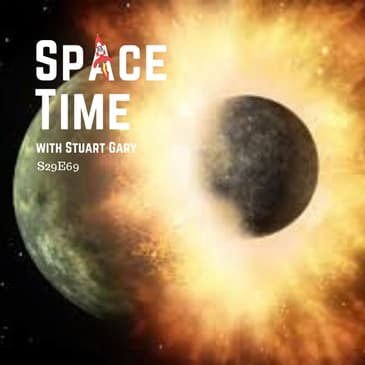
This is Spacetime Series twenty nine, episode sixty nine, for broadcast on the tenth of June twenty twenty six. Coming up on space Time, evidence of planetary destruction in the Early Solar System? Are we Missing a Planet? And SETI The Search for Extraterrestrial Intelligence investigates interstellar comet three eye outlets, All that and more. Coming up on space Time. Welcome to space Time with Stuart Gary. Scientists have confirmed a cosmic collision in the Early Solar System which saw the complete destruction of a planet, possibly as big as Mars. The findings reported in the journal Earth and Planetary Science Letters, based on an angrite meteawrite fragment uncovered in this desert, which was cataloged as Northwest Africa or NWA twelve seven seventy four. One of the studies authors, Aaron Bell from the University of Colorado, Boulder, says it's the first definitive evidence that this last planetary embryo or protoplanet existed, and its unique geological makeup challenges long held assumptions about how planets evolve. Bell says, we know this planet existed because a few shattered fragments from its remains happened to land on Earth, and these meteorites preserved evidence of a completely different pathway through which planets can develop. Angrites are among the oldest known volcanic rocks in the Solar System, forming within the first few million years after the Solar System began some four point five six billion years ago. They're also exceptionally rare. Out of the more than eighty thousand media rites discovered on Earth so far, only sixty eight they're angrites. What makes angrites especially puzzling is their chemistry. Unlike Earth, Mars, and the other terrestrial rocky planets, Agortes contained very little silicon dioxide or silica, which is the meaning ingreding in nearly every known terrestrial planet in the Solar System. For this reason, scientists figured agrites always come from asteroids, something with a radius of less than two hundred kilometers. When Billin colleagues began studying NWA twelve seven seventy four, they found the meteorite contained klinate peroxine, a mineral crystal commonly found in Earth's crust and mantle. But NWA twelve seven seventy fours clinate peroxine was especially rich in aluminum, a telltale sign that this rock must have formed under enormous pressure deep underground. So the authors then replicated the pressure conditions in the lab it determined what would be needed to form it. They found the aluminum rich clianate peroxine needed at least seventeen point five kiler bars of pressure. Now, for comparison, the crushing pressure at the bottom of the Mariana Trench, the deepest point on Earth, is only around one killer bar, so that level of pressure simply couldn't have existed inside a small asteroid. Instead, the calculation suggest that the body where the agarts came from must have been at least two thousand kilomets wide, and other clues in the meteorite point to an even more striking possibility. The crystals still preserved sharp edges and delicate chemical patterns that would normally been erased if they had formed deep underground, and that suggests that these crystals likely formed relatively shallow depths inside the parent body, and that implies that the word they formed on must have been even larger. Now, under that scenario, the angrape parent body must have stretched beyond three thousand, six hundred kilometres in diameter that makes it comparable in size to the Earth's Moon, possibly even approaching Mars size. It's still unclear how the protoplanet met its end. One possibility is a catastrophic event in the early Solar System which chattered it, its fragments later becoming the building blocks for other terrestrial worlds, including the Earth. Bill says the materials that form the angripe parent body are fundamentally different from the ingredients on Earth and Mars. He says it all points to a very distinct and separate evolutionary path implanetary formation during the early history of our Solar System. This space time still to come is our Solar system missing a planet and SETI. The Search for Extraterrestrial Intelligence investigates the interstellar comet three eye outlass. All that and more still to calm on space time. A new study suggests that one of our planets may be missing, and it could explain why our Solar System looks the way it does. A report in the journal Icarus claims that this missing world might have triggered violent gravitational perturbations in the outer Solar System billions of years ago. They could have destroyed some of the moons orbiting around Jupiter and Urinus at the same time creating others. These calculations are all based on the Nie model of planetary migration, which was then refined with the Grand Tack hypothesis. In simple terms, it suggests that Jupiter and then Satin were the first planets to form and the protoplanetary disc evolving around are still nascent Sun some four point six billion years ago, and they formed a lot closer to the Sun than where they are today, possibly around what today is the snow line, which is where the asteroid built is today. The hypothesis suggests that as these gas giants grew, they initially began to migrate inwards, possibly to about twice its current orbital distance from the Sun, before reversing courts and moving out again, eventually ending up in their current orbits now. As Jupiter and Satin migrated inwards, kinetesimals and the protoplanetary disc were captured by Jupiter's resonance, causing the orbits of these tiny rocky bodies to shrink and the eccentricities to grow, resulting in a collisional cascade as their relative velocities became large enough to produce catastrophic impacts. As the density of these objects increased, it ultimately led to the formation of two major rocky planets, the Earth and Venus. The leftover material then formed the two smaller woods bordering them, Mercury and Mars. Meanwhile, as Jupiter and Satin continued their migration outwards towards their current orbits, their gravitational perturbations flung material back towards the Inner Solar System, the evidence for which is clearly seen in the many craters and places like the Moon and Mercury. But the gas giants migration outwards also caused more distant giant icy planets which were forming at the time to be pushed further away, with Neptune being flipped from inside to outside the orbit of Uranus and the process, and speculation has long suggested that there may have been a third ice giant which was either destroyed during the migration or thrown further out beyond Neptune, possibly becoming a road planet destined to float for eternity through the blackness of interstellar space. Now, according to this new study, the Outer Solar System experienced a period of extreme chaos known as the Nie model instability shortly after the planets formed between four billion and four point five billion years ago, and astronomers have long debated how the moons of these giants survived this violent period. To try and resolve that issue, scientists carried out computer simulations to try and model what actually happened. They analyzed one hundred and twenty two computer simulations using thousands of different parameters to track the complex gravitational interactions between the Sun and the various planets, moons, and large asteroids over billions of years, in order to see which models would evolve into the sort of solar system we see today now. The author's tested simulations included not just the four known giant planets Jupiter, Sat, urinosinep Tune, but also scenarios which included an additional one or two planets as speculated in the Nice model, and these simulations showed that the survival rates of moon systems of both Jupiter and Urinus was extremely low, as little as fifteen percent. When the additional planets move close to Uranus, the immense green potational perturbations almost guaranteed the distraction of its moons, but rather than being flung out into space, they collided with each other, creating a massive debris field of ice and rocks. Now, over time these remains had created together, and that could explain how Urinus is oddly jigsaw puzzle like Moon Miranda could have formed. The simulations also show how these collisions could explain how Urinus ended up being tilted on its side. It's a fascinating exercise and it goes a long way to explaining much about how our Solar system looks today. This is space Time. Still to come SETI the Search for Extraterrestrial Intelligence targets the interstellar comet three I Atlas couldn't have been an alien spacecraft, and later in the science report, does reading stuff on paper help you better understand it than reading it on a digital device. All that and more still to come on Space Time. This episode of space Time is brought to you by Nord VP in Space Times Official VPN service. Let's face it, these days, your online privacy is more important than ever. Whether you're streaming science documentaries, reading the latest research, or exploring deep space images. You don't want your data to be tracked or your location exposed. With NordVPN, one click is all it takes to secure your Internet connection. It encrypts your data, hires your IP address, and keeps your activity safe from prying eyes, whether you're at home, work, or connected to a public Wi Fi. And here's where it gets really good. As a spacetime listener, we have an exclusive offer for you seventy four percent off a NordVPN plant plus four extra months for free. That's right, a huge seventy four percent discount plus four bonus months just for being a spacetime listener. All you need do is head over to NordVPN dot com slash Stewart Gary. That's NordVPN dot com slash steward Gary. Not only does NordVPN protect your data, but it gives you access to content from right around the world. If you want to watch science series that's only available in another country, no problem, just switch your virtual location and unlock it instantly. And of course, the whole thing is risk free with a thirty day money back guarantee, so you've got nothing to lose and your online freedom to gain. So protect your digital life, support space time and grab our exclusive offer now at NordVPN dot com slash Stewart Garry. That's NordVPN dot com slash Stewart Gary. The Search for Extraterrestrial Intelligence City Institute says it's found no evidence of any alien technology associated with the interstellar Comet THREEI outlas, first detected back in July twenty twenty five. Comet three I outlass is the third confirmed interstellar object detected passing through our Solar System. Now astronomers know it came from beyond our Solar system because of its hyperbolic trajectory at its high velocity of more than fifty kilomtus per second as it entered the Solar system. Comet three I outlets follows the earlier detections of interstellar objects one IO Mau Maua that was in October twenty seventeen and two I Borissev in August twenty nineteen. Recent observations have shown that Comet three I atleas contains low trace amounts of heavy carbon and its coma, indicating it could be as much as ten to twelve billion years old. Now that's not only older than our Solar System, it's almost as old as our entire Milky Way galaxy. Also, three I outlets is carrying unique chemical signatures indicating its origin in a distant corner of the galaxy in an environment drastically colder than our own Solar system, likely in Earth thirty keelvin that's minus two hundred and forty three degrees celsius. It has a deterium to hydrogen ratio some forty times higher than an Atosians and thirty times higher than native Solar System commets. Astronomers have also detected methane gas readings alongside exceptionally high concentrations of both carbon dioxide and methanols entered our Solar System from the direction of the constellation Sagittarius towards the galactic center. It reached its closest approach of the Sun back in October last year, swooping around our local star between the orbits of Earth and Mars. The commet then made its closest approach to Earth on December the nineteenth at a distance of around two hundred and seventy million kilometers, and has just passed the orbit of Jupiter and is now flying through the constellation Gemini as it heads back out into interstellar space. Following speculation from all the usual suspects that through our atlas could be an alien spacecraft because of its unusual characteristics, all of which can be easily explained by its interstellar origins, the SETI Institute decided to undertake a detailed study of the object. As the Institute's Beth Johnson. Explains, scientists at the SETI Institute searched for technological signals from three I Outlasts, the third interstellar object observed in our solar system, using the Allen Telescope Array ATA at the Hat Creek Radio Observatory in northern California. The team scale and a wide range of radio frequencies for signs of extraterrestrial technology and found none. As expected based on other astronomical observations, showing that the object exhibits natural comet like composition and behavior. Its interstellar origin makes three Eye Atlas a rare opportunity to study material from another stellar system and better understand how planetary systems form and evolve. While observations strongly indicate that three Eye Atlas is a natural object, interstellar visitors are also compelling techno signature targets because an artificial object, however unlikely, could represent detectable extraterrestrial technology and potentially provide the first evidence of life beyond Earth. Eventually, our own voyage or spacecraft will be extraterrestrial artifacts in other stellar systems. Given that, it is important that we understand the natural distribution of interstellar objects so that we will be able to identify any anomalies that could one day be signs of an artificial interstellar object. The team observed three eye atlasts for more than seven hours, with the ATA covering one to nine gigahertz. This broad range allows scientists to search for narrow band radio signals, which are not produced in nature and would be evidence of technology. The team identified nearly seventy four million narrow band signals. After removing human interference and filtering for signals matching three eye Atlice's movement, only about two hundred remained for review. All traced back to technology on the surface of the Earth or our own Earth orbiting satellites. While no technosignatures were found, the study sets new constraints, reinforcing that three I Alice is a natural object. The observations place upper limits on the power of any radio transmitter on or near three atlas, ruling out signals stronger than about ten to one hundred and ten watts. Approximately the power of the household appliance over the detected frequencies. The results from three I atlice show how realistic it is to detect a signal with the technology we have today. That is why it is important to keep searching for techno signatures, even from objects we might not expect to have signals. Besides searching for signs of intelligence, the observation of interstellar objects also helps scientists learn about the natural properties of interstellar objects as they travel through our solar system. That's the SETI Search for Extraterrestrial Intelligence institutes. Betty Johnson and this is Space Time and time out to take another brief look at some of the other stories making news and science this week with a science report. A new study by the World Meteorological Organization warns that global average surface temperatures are likely to continue at or near record levels over the next five years, with nexty twenty twenty seven likely to set new records. The report predicts that the twenty twenty six to twenty thirty period is likely to range from one point three to one point nine degrees celsius in temperature above pre industrial levels, and there's an eighty six percent chance that next year will surpass twenty twenty four as the warmest year ever recorded thanks to the el Nina, which is now upon us. The study also found that there's a ninety one percent chance that global average and E service temperatures will temporarily exceed one point five degrees celsius above eighteen fifty to nineteen hundred levels for at least a year between now and twenty thirty. A new study has discovered two distinct subtypes of autism with different underlying biology. The new findings, reported in the journal Nature Neuroscience, used brain scants to identify distinct patterns of brain connectivity and autism to different underlying molecular mechanisms. The hyperconnectivity subtype involves areas of the brain communicating more than usual, while the hyperconnectivity subtype involves reduced communication between brain areas. The authors claim that together these subtypes account for approximate twenty five percent of individuals with autism. The findings are based on scans analyzing functional connectivity across nine hundred and forty children and young adults with autism and over one thousand neurotypical individuals. The two subtypes exhibit a different functional brand architecture and showed modest differences on standardized autism assessments, with a hyperconnectivity subtype scoring moderately higher on autism severity measures. Meanwhile, a major British study has found that while most middle aged and older adults experienced low levels of anxiety, a small subtype of people those with higher autistic traits, are more likely to report that their anxiety worsens as they age. The findings, reported in the journal Nature, highlight the lack of research in older people on the spectrum, ninety percent of whom have never been formally diagnosed. A new study claims reading stuff on paper might help you better understand the subject than simply reading it on a digital device. The findings, reported in the journal plus one, looked at rain scants of people who were first asked to read an item on paper and were then made to swap over to a digital device to finish the item. The participants will then ask questions on each half after finishing. The authors found participants took longer to think of the answers after reading on the tablet compared to reading on paper. Additionally, areas of the brain known to be related to language that were activated during reading on paper were significantly less active during the digital half of the experiment. The videos new RTX Spark super chip is stolen the show at the computext twenty twenty six trade fair in Taipei. Integrating CPU, GPU and up to one hundred and twenty eight gigabytes of memory on a single chip, it will power many of the world's upcoming flagship laptops. With the details were joined by technology editor Alex Sahara Royd from Tech Advice Start Life. This is Computext in Taipei, in Taiwan. It happens every year. It's to be a trade show for Asia focused on the West and all the major companies are there. All the major PC makers amb Intel, Qualcom will be there as well, but also in video. Now in video is what powers the GPUs and the AI chips that are sitting in all those multi billion dollar data centers. And in video has designed a chip that can sit inside of a Windows laptop which will come from people like HP and over Dell and others. And this is the new PC. This chip is called an RTX Spark and it's a super chip that combines a CPU, the central processing unit. Of course, the GPU the graphics processing unit, and will have incredible neural processing capabilities because it's the inn Video chip that is effectively bowering this AI revolution, and what it's designed to do is give your computer the same kind of AI powers that you get in the big data centers, and that's where AI is heading. AI is going to become local. You won't have to spend hundreds of dollars on tokens or subscriptions to Claude or chat GPT or Gemini, because your computer itself will be able to do offline AI. Now online AI is always going to be more powerful because they have huge clusters of these incredible GPUs strung together. But these sorts of super AI chips that n Video is working on is also going to become the brains of physical AI, which is a fancy way of saying robots. So that is going to be a new class of computer even round Winnows eleven. But it'll have all these ages and you can talk to it. You'll be able to talk to it and converse with it like you can with our today. But your computer will then do things on your behalf, and you know you won't have to click on buttons anymore, you'll just ask for things to be done. So it's a big change. I mean it's sort of the same, sort of like change. Yeah, it's like commanded data or talking to the ship. We did go from the keyboard to the mouse, and you know, we had the VR headset, the augmented reality glasses. So Nvidia is launching this new architecture at computext and it's doing big battles with Intel and AMD who make the traditional chips that you find in computers, and also Qualcom that has their based ships, and of course Apple has their own base ships as well. Now we yet to see what Apple's going to anounced. It's big the Worldwide Developer Conference and how they integrate AI into their platforms. And we also saw Dell launch a competitor to the MacBook near So that's a computer that's five hundred nine nine US dollars eight gigabram two fifty sixty SSD running Mac os using an iPhone aaighteen pro chick, well the one from a couple of years ago, not even the one from last year, and yet it's selling in massive amounts that Apple can't make enough of them. People want to buy it. So Dell has come out with a computer for six hundred nine nine dollars US. Unlike the Apple, it has a back to the keyboard, it has a touch screen, not just a non touch screen, and it comes with eight GIGABRAM as well, but you can upgrade it to larger amounts of RAM and SSD. So there's this push to bring PC prices down to give you a chip that is more than powerful enough to do all the everyday half that people do, but still give you seventeen hours of battery life, which is the sort of life cycle lifespan that Apple is talking about, for only one hundred US dollars more. And we should see more people competing in this space, but this is all happening at a time when the cost of memory and SSD is going through. That's Alex Saharov Rouyd from Take Advice dot Life and this space Time, and that's the show for now. Spacetime is available every Monday, Wednesday and Friday through bytes dot com, SoundCloud, YouTube, your favorite podcast download provider, and from space Time with Stuart Gary dot com. Space Time's also broadcast through the National Science Foundation, on Science Own Radio and on both iHeartRadio and tune in radio, and you can help to support our show by visiting the Spacetime Store for a range of promotional merchandising goodies, or by becoming a Spacetime Patron, which gives you access to triple episode commercial free versions of the show, as well as lots of bonnus audio content which doesn't go to wear, access to our exclusive Facebook group, and other rewards. Just go to space Time with Stewart Gary dot com for full details. You've been listening to space Time with Stuart Gary. This has been another quality podcast production from bytes dot com.