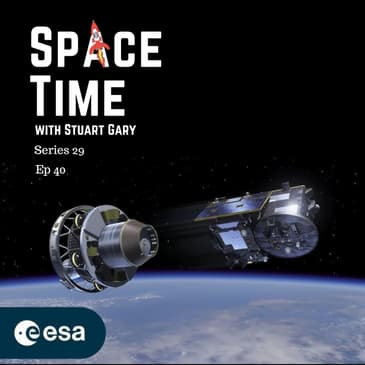
This is Spacetime Series twenty nine, Episode forty, for broadcast on the third of April twenty twenty six. Coming up on Space Time, Using archaeology to study the history of galaxies like the Milky Way, Europe re establishes contact with its lost pe spacecraft, and using blue green algae to grow food on the red planet Mars. All that and more coming up on space Time. Welcome to space Time with Stuart Gary. Astronomers have for the first time used what they call it galactic archaeology to trace the history of a galaxy beyond our own galaxy, the Milky Way. The findings are reported in the journal Nature Astronomy, demonstrate a new way to reconstruct the evolution of galaxies using their detailed chemical fingerprints. The studies lead author LEAs Acurely from the Harvard Smithsonian Center for Astrophysics, says it's the first time that a chemical archaeology method has been used with such fine detail outside our Solar system. She says the work will help astronomers better understand how we got here, how our own Milky Way galaxy formed, and why we ended up breathing oxygen the very same oxygen we're breathing right now. Using data from the Typhoon survey of the last Campanos observatory, authors examined the nearby spiral galaxy called MNGC thirteen sixty five, also known as the Propeller Galaxy or the Great Barred Spiral, located some fifty six million light years away in the constellation Formax. The galaxy's wide disc shape is oriented so we see it face on from Earth. The author's achieved resolution sharp enough to separate and study individual star forming, molecular gas, and dust clouds in the galaxy. When they're young, hot stars shine brightly in ultra violet, and that intense light can excite nearby gases. Each element in that gas, such as oxygen, can then be identified by its spectral signature as a series of bright, narrow lines of light. The centers of galaxies usually have more heavy elements, including oxygen, while they are outer parts of less The oxygen pattern is shaped by several factors, including where the stars formed and exploded a supernovae, how gas flowed in or out of the galaxy, and pass mergers with other galaxies. By measuring how the oxygen patterns changed across the galaxy and then comparing that to state of the art computer galaxy simulations, the authors were able to see how the galaxy grew and merged with other galaxies over its twelve billionere cosmic history. The computer simulations tracked the motion of gas, star formation, black holes, and chemical evolution in galaxy from shortly after the Big Bang right through to the present day. The authors searched through simulations of some twenty thousand galaxies, eventually finding one one they closely matched NGC thirteen sixty fives observed properties, and from this they were able to infert the galaxies likely merger and growth history. The authors found that NGC thirteen sixty five central region formed early in the galaxy's history and developed a large amount of oxygen. Meanwhile, the gas further out built up over twelve billion years through collisions with smaller dwarf galaxies. The gas in the utter spiral arms of the galaxy probably formed relatively late over the last few billion years, and was also fed by gas and stars from merging dwarf galaxies. The findings confirmed that the astronomical processes astronomers model on computers really do represent how galaxies like NGC thirteen sixty five evolve over billions of years. Overall, the sturdy shows that ENNGC thirteen sixty five began as a relatively small galaxy and slowly grew into a giant spiral through modible mergers with other small dwarf galaxies. By studying galaxies like NGC thirteen sixty five, which bears similarities to our own Milky Way galaxy, astronomers will be at to gain an insight into how typical or unusual our Milky Way galaxy is and the different pathways galaxies can take to reach their current states. This is space time still to come. Europe re establishes contact with its lost PROA three spacecraft and using blue green algae to grow food on the red planet Mars. All that and more still to come on space time. The European Space Agency has successfully re established contact with one of the spacecraft and its Proba three mission mission managers lost contact with the prob a month ago when it mysteriously went silent. The twin Proba three spacecraft launched back in twenty twenty four on a two year mission to study the Sun's little understood autter atmosphere, the Corona. The Corona is several million kilometers thick, but it's normally hidden by the bright glare coming from the Sun. It's usually only able to be studied for a few minutes at a time when the Earth experiences a total solar eclipse, during which time the Moon passes directly in front of the Sun, locking out the sunlight and exposing the milky white corona in all its glory. While total eclipses on Earth lasts just a few minutes and only occur a couple of times a year, Probe three was capable of securing ten to twelve hours of observations every week over its two year mission. See. The two probes are designed to fly together in formation, but have to be very precise, allowing them to artificially simulate a solar eclipse. One of the satellites is equipped with a one point four meter sunshade that directly blocks out the Sun from its sister spacecraft, which is fitted with cameras. By flying in precise formation sixty thousand kilometers above the Earth, with one spacecraft hiding the Sun's glare from the other, scientists can study the corona in detail. However, on February fourteenth, the second spacecraft, one which has the crucial chronograph instrument, suddenly lost communications and this triggered a cascade reaction, causing it to lose orientation, resulting in its solar array panel facing away from the sun, training the batteries. The spacecraft then entered a survival mode and it's been silently tumbling through space ever since. The European Space Agency's director, Joseph Aschenbacher says, by some miracle, contact with the way with spacecraft was restored. The other spacecraft, the one with a shield, had been following and observing its lost twin Ashenbacher says, as the faulty spacecraft tumbled, its solar panel must have positioned itself just right for a few moments to grab enough sunlight generate enough power to allow communications to be restored, and that gave ease emission managers the time they needed to send up new instructions. The good news is the spacecraft solar panels are now facing the sun, allowing it to recharge its batter is. Meanwhile, mission managers are now trying to determine what went wrong in the first place, and they're carrying out tests to find out how much damage has been done. This is space time still to come Using blue green algae to grow food on the red planet Mars, and later in the Science report, a new study warns that abstinence could affect sperm quality. All that and more still to come on space time. Scientists have used the cienobacteria based fertilizer to grow food in a simulated Martian environment. When humans eventually undertake that long, arduous journey to the red planet, they'll need to take enough food, water, and air with them for what's likely to be a two year mission a logistical nightmare. Or alternatively, they'll need to be so sufficient and throw their own food along the way and when they arrive on the Martian surface. Now, scientists at the University of Bremen and the German Aerospace Centered DLR have developed a fertilizer which can be produced solely with Martian resources. The fertilizer is based on cyanobacteria, also known as blue green algae. A report in the Chemical Engineering Journal claims blue green algae has several properties that make it especially suitable feace on the red planet. The algae uses carbon dioxide from the Martian atmosphere to produce oxygen and extract important nutrients directly from the Martian soil. The cyanobacteria were cultivated with simulated Martian resources, including an artificially produced regular that mimics Martian dust. The cianobacteria are then converted into a nutrient rich product. This is done by microbes using an anaerobic fermentation process without any oxygen and using only materials which are potentially already available on the Martian surface. The authors were interested in investing getting how to optimize this fermentation process. They found that heating the biomass before processing that the fast decomposition and an operating temperature of thirty five degrees celsius proved to be ideal for the fermentation process. Also, the ratio between the amount of biomass used and the amount of ammonium yield was important as it informs how much cyanobacterial biomass needs to be added to get the right concentration of ammonium in the fertilizer. A mass dust simulant was used as the main source of mineral nutrients, showing that the fermentation can be done using local Martian resources alone. The resulting fertilizer was used to grow duck weed, a fast growing protein rich aquatic plant that's been consumed as a food across Southeast Asia for centuries. From just one gram of dry cyanobacteria, twenty seven grams of fresh edible plant biomass was obtained. One of the studies authors, Thiago Ramelo from the University of Bremen, says the self sufficiency aspects important to make future mass settlements sustainable, but he says cianobacteria also has great potential beyond space missions. It grows quickly, it's nutrient rich, it's easy to cultivate, and it's completely edible. It's already approved as a food in the European Union, and it's considered a contender for a sustainable superfood of the future, both here on Earth and in space. In addition to food production, the system offers another advantage. The process produces methane, which can then be used as an energy source. Jasmine Planta from ZAM, the Center for Applied Space Technology in Microgravity is speaking here with ZAMB research at Thiego Romalo from the University of Bremen. How can we grow food on masks using only local resources? Growing food on masks sounds like science fiction, but you are working on making it reality. Can you tell us what the big challenge is? Yes, So the main challenge is that we cannot ship items from Earth. That means that we have to produce everything on site, including food, fertilizer, and water. And that's where our research comes in. You're using cyanobacteria. Why are so interesting from mass? So, cyanobacteria are incredibly versatile and resilient. In addition, they are capable of fixing carbon dioxide and nitrogen from the atmosphere, as well as extracting mineral nutrients from the regulif which is basically the Martian soil. In addition to that, they are capable of producing oxygen, which is super useful because you can give it to astronauts and create a closed loop ecosystem. And once you've grown the cyanobacteria, how do you turn them into fertilizer. We use a process called anaerobic digestion, which basically means that we use the community of microorganisms that work together to break down the biomass and convert it into a nutrient rich liquid that's called a digest state. This digest it contains ammonium as well as other important nutrients for plants to grow. And it's just made from cyanobacterio biomass and the Martian regulif, which we use a simulant of. As a bonus, which is really cool is that this process produces also methane which can be used as a fuel on Mars. And you tested different conditions to improve the process. Right exactly. So we looked into the preprocessing of the biomass, the operational temperature, and also the biomass concentration in order to make the process as efficient as possible and get as much nutrients as we can possibly for the plants. One important thing that we defined was the concentration of biomass that we needed to add in order to get the amount of ammonium that is suitable for a plant fertilizer. Afterwards with simulated Martian soil, how did that fit into the process. Again, we want to use as much resources on Mars as possible, and for mineral nutrients that means using the regul if that's available there. And so for this study we use the Martian reguli simulant and we tried to understand what's the best way to deliver its nutrients into the anaerobic digestion. So we found that instead of providing it directly into culture, it's best to first extract the nutrients and then giving it to the anerob digestion. When you add just a tiny bit of trace elements, then you get the best nutrient recovery for your fertilizer. Now, the big question does this digest it actually support plant growth? So yes, the great news is that we are actually capable of growing duck weed on the fertilizer that we produced. Duckweed is extremely interesting because it's fast growing and it has a high nutritional value, which makes it a perfect crop for Mars. In addition, it's also already approved for consumption here in the EU. And we are able to produce twenty seven grams of fresh duck weed biomass from just one gram of cyanobacterial dry biomass. And what does this mean for future mass missions? So this basically shows that we can potentially create self sufficient ecosystems on Mars which relies solely on the resources that are found there. Basically, you're building a circular ecosystem. For space exactly. So basically micro organisms and plants work together in order to support human life far away from. Earth and what's next for your research. Yes, so we're looking into scaling the system, testing it under more Mars relevant conditions, as well as looking at other crops that we can test the fertilizer on. Overall, the ming goal is that we make Martian habitats as independent from Earth as possible. That's Jasmine Platinum from ZAM the Center for Applied Space Technology in Microgravity speaking with scientist Thiago Romalo from the University of Bremen, and this is space time and time that to take another brief look at some of the other stories making news and science this week. With a science report, an study wants that abstinence could affect sperm quality. A report in the journal Present Seedings b looked at over one hundred and fifty studies on seamen's storage in both humans and other animal species, finding sperm performance might deteriorate slightly after a period of abstinence. They found storage through sexual abstinence was linked to a small but statistically meaningful decline in sperm performance that's likely due to increase DNA damage and oxidative stress. The authors say their findings could provide information help fertility clinics produce better quality embryos, as well as helping researchers who are breeding animals in captivity. Scientists have recovered ancient pinoa grape pits, suggesting the famous tipple may have been a favorite in France for almost six hundred years. A report in the journal Nature Communications analys the DNA of ancient grape pits found across the country, discovering one that was identical to the modern red grape variety. The study shows that grapes have been deliberately grown in France since the Iron Age around two thy five hundred years ago, and that different varieties were introduced during Roman times due to trading cuttings and seeds between Europe and the Middle Eastern Asia. The authors say this showed the long history of growing grapes in Europe and that some varieties like pinoois, have been continually grown for hundreds of years. A new study shows that many birds are boozing on the human equivalent of a beer a day. The findings, reported in the journal of the Raal Society Open Science, show that many flowers of nectar that contains tiny amounts of alcohol, which when consumed by birds and bees, is equivalent to a human trigging a glass of beer every day. The study measured the exact concentrations of alcohol that result from fermentation by yeasts living within the nectar. The authors found that twenty six of the twenty nine species of flower they tested had alcohol in at least once sample, and for a single species, around half of all samples contained alcohol. When they looked at what the levels of alcohol might mean for the birds and bees pollinating those flowers, they found that hummingbirds and sunbirds consumed a daily dosage equivalent to one point three to one point nine glasses of beer. Cheers. The UFO documentary The Age of Disclosure has been given a special screening on Capitol Hill. UFO fans have held them movie as a game changer in public attitudes towards UFOs, ending the culture of silence around claims once the smiss is the preserve of conspiracy theorists and crackpots. However, critics are pointing out that while the doco has a lot of stories, it contains very few actually verifiable facts. The Skeptics timendum says it's really a case of same old, same old. Ajor Disclosure is the latest super duper revelation documentary on UFOs or UAPs as we called them, these things in which it shows that there is a major cover up government. They have the craft, they have the aliens, interviews a number of people. It's the result of what's becoming a bit of a boom industry, which is the UFO UAP revelation industry. There's a lot of staff has come up at the last few years, especially when they start presenting to Congress, which actually says something about Congressman. There's people who used to work for various government organizations now talking about stuff they can't reveal. It's what it comes down to. We'd like to tell you, but we can't give you the details. I was told by whom can't tell you. There are crafts buried in the ground. Where are they can't tell you? So this follows the same trends. It's a well made documentary. It's the people I've spoken to or heard about who have seen it and who are well informed in the field, say there's nothing new right. In fact, they say, there's other documentaries we treat some of these particular events or claims in more detail than he is in this particular feature. My gosh, next thing you'll be telling me there's no magic tools. It has the usual suspect. A lot of the people, the same people who keep dropping up across all the various programs, a lot of the films and the documentary stuff of the same fuzzy films that have scenes that are opposed to the UFOs most of the time, and not as the classic case of one of the people who was showing up from photos of UFOs and one of them learned out to be a chandelier at nevermind. It's all about the revelation is coming. There's going to be the announcement the president or someone who's going to give you say, yes, here's the good Oil's really happening any day now. And they've been saying this sings about nineteen forty seven, and you can go back through all the. Old good days when there were frisbees and hubcaps that would be. That's exactly right. Yeah, I think a lot a lot of them still are actually quite veryly for balloons. Balloons are the big thing these days. That they've been saying this four years, and we've had things saying just recently twenty four is the year of the big revelation, and then twenty five and then now it's twenty six, twenty seven is being raised and they're going to raise thirty five. But do it. It's it's the problem. Don't just talk about it. All these things just talk about it and they present the same evidence which has been debunked well and truly ninety five percenters cases. The other ones are the unidentified, which don't mean they're alien, They just don't know. And there's nothing new, nothing really new in this age of disclosure documentary, and there's nothing really been new on the various news supports and things that have been said for the last few years. One person, Australian journalist Ross Coulthard walk the award winner, was saying that he has evidence of large spacecraft buried underground, huge spacecraft like enormous football field side things, but buildings put on top of it. And you ask him where and he said, well, I can't tell you. He said, well, come on, that was the theme for me Dependence Day. Yeah, but I mean you tend to stay listen Ross and everybody else who makes these claims, where's your evidence please? Yeah, I'd love to see it. It's not going to shock the world. They're not going to be made your upset. People are interested, very interested in these things of the moment, but they're getting frustrated because it's the same old, same old non evidence being put forward, the same old talking head coming out and making their particular cases. It's suppressing. I'd like to see some email more definite, you know. I mean, the photos are still as rubbish as they have been for the last eighty years. The anecdotes are still sort of wobbly. All the evidence is is very, very more than questionable, I think in the vast, vast majority of cases, and this is just one more example of it. One of the classic things about this is explaining why the evidence is so poor. Why we can't photograph u ver as clearly is because they're in a space time quantum bubble that distorts all the light around them. As soon as you use the word quantum automatic likely when. They use the word contum, I feel, I feel an explanation is not complete, and let's have used the word quantum. And honestly, this is just they're desperate. They're desperate to try and explain why their evidence is such rubbish. So until they actually come up with it with decent evidence, I think, yep, lip wait. That's the Skeptics, Timindum and this is Spacetime, and that's the show for now. Spacetime is available every Monday, Wednesday and Friday through at bytes dot com, SoundCloud, YouTube, your favorite podcast download provider, and from space Time with Stuart Gary dot com. Space Time's also broadcast through the National Science Foundation, on Science Own Radio and on both iHeartRadio and tune In Radio. And you can help to support our show by visiting the space Time Store for a range of promotional merchandising goodies, or by becoming a Spacetime Patron, which gives you access to triple episode commercial free versions of the show, as well as lots of bonnus audio content which doesn't go towear, access to our exclusive Facebook group, and other rewards. Just go to space Time with Stewart Garry dot com for full details. You've been listening to space Time with Stuart Garry. This has been another quality podcast production from bytes dot com.