
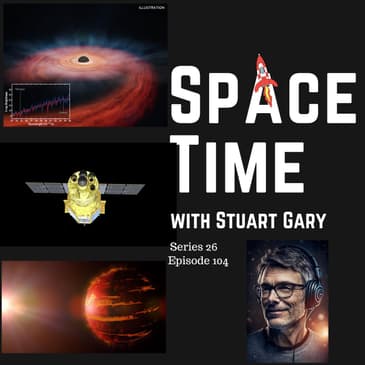
Become a supporter of this podcast: https://www.spreaker.com/podcast/spacetime-with-stuart-gary--2458531/support.
00:00:00
This is space time series 26 episode 100 and four for
00:00:04
broadcast on the 30th of August 2023. Coming up on space time, a
00:00:09
giant black hole destroys a massive star a new window on the
00:00:14
X-ray cosmos. And astronomers find a hot Jupiter or is it a
00:00:19
brown dwarf hotter than the surface of our Sun? All that and
00:00:23
more coming up on space time.
00:00:27
Welcome to space time with Stuart Garry.
00:00:46
Astronomers have been examining the ripped apart remains of a
00:00:49
once giant star that was torn apart and discarded by a super
00:00:54
massive black hole. NASA's Chandra X-ray space telescope,
00:00:59
together with the European Space Agency's Xmm Newton Space
00:01:02
Observatory have been examining the stellar murder scene,
00:01:05
specifically examining the amount of nitrogen and carbon
00:01:09
found near the black hole.
00:01:11
Astronomers think that these were created inside the star
00:01:14
before it was ripped apart as it ventured too close. The study's
00:01:19
lead author John Miller says the observations are showing the
00:01:22
guts of what used to be a star.
00:01:25
The elements left behind are clues astronomers can follow to
00:01:28
help them figure out what sort of star met its demise in this
00:01:31
stellar murder case stars being destroyed by black holes are
00:01:36
referred to as title disruption events.
00:01:39
That's because it's the immense gravitational forces of the
00:01:42
black hole which physically rip the star apart right down to its
00:01:47
subatomic level. And astronomers have found many examples of
00:01:51
total disruption events in recent years. They usually cause
00:01:55
a flare often seen in optical and ultraviolet light as well as
00:01:58
X-rays as the stars remain to heat it up.
00:02:02
But this particular event known as Assassin 14 L I stands up for
00:02:06
several reasons. At the time of its discovery back in November
00:02:10
2014, it was the closest tidal disruption event to earth just
00:02:14
290 million light years away to have been discovered in around a
00:02:18
decade.
00:02:19
Because of this proximity, Assassin 14 L A has provided an
00:02:23
extraordinary level of detail about the destroyed star. Miller
00:02:27
's team applied new theoretical models to make improved
00:02:30
estimates on the amount of nitrogen and carbon around the
00:02:33
black hole.
00:02:34
The relative amount of nitrogen to carbon found points to
00:02:37
material from the interior of the doomed star weighing about
00:02:40
three times the mass of the Sun. The star Assassin 14 L is
00:02:45
therefore one of the most massive, perhaps even the most
00:02:48
massive star that astronomers have ever seen ripped apart by a
00:02:52
black hole.
00:02:53
One of the hardest things with total disruption events is being
00:02:57
able to measure the mass of the unlucky star being destroyed,
00:03:00
observing the destruction of a massive star by a supermassive
00:03:04
black hole is spell binding because high mass stars are
00:03:07
expected to be significantly less common in the cosmos than
00:03:11
lower mass stars.
00:03:12
Now, you may recall that earlier this year, another team of
00:03:16
astronomers reported on Scary Barbie, another tidal disruption
00:03:20
event. Now at the time, they estimated that the star at the
00:03:23
center of that could have been up to 14 times the Sun's mass
00:03:27
before it was destroyed by the black hole.
00:03:29
However, there are a number of problems with this. Firstly, it
00:03:32
still has not yet been confirmed as a tidal disruption. The
00:03:35
estimate of the star's mass mainly based on the brightness
00:03:38
of the flare, not on the detailed analysis of material
00:03:42
around the black hole.
00:03:43
As is the case with assassin 14 Li a report in the Astrophysical
00:03:48
journal letters suggests another exciting aspect of assassin 14
00:03:52
ally's result is what it means for future studies, astronomers
00:03:56
have seen moderately massive stars like assassin 14 ally in
00:03:59
the star cluster which orbits around sater a star, a
00:04:03
supermassive black hole at the center of our own milky way
00:04:06
galaxy, that's just 27 light years away.
00:04:10
Therefore, the ability to estimate stellar masses of
00:04:13
totally disrupted stars potentially gives astronomers a
00:04:16
way to identify the presence of star clusters around
00:04:19
supermassive black holes in far more distant Galaxies as well.
00:04:23
Until this study, there was a strong possibility that the
00:04:26
elements observed in X-rays might have come from gas
00:04:30
released by previous eruptions of the super massive black hole.
00:04:34
However, the pattern of elements analyzed here appears to have
00:04:37
definitely come from a single star and that makes it
00:04:41
intriguing this space time.
00:04:44
Still to come. The launch of a new window on the X-ray cosmos
00:04:49
and astronomers find a hot Jupiter or is it really a brown
00:04:53
dwarf hotter than the surface of the Sun? All that and more still
00:04:57
to come on space time.
00:05:13
Japan's about to launch a new X-ray telescope which will
00:05:16
further enhance science's understanding of the universe.
00:05:20
The upcoming prism X-ray imaging and spectroscopy emissions
00:05:24
spacecraft will study the universe's hottest regions, some
00:05:27
of its largest structures and objects with the strongest
00:05:31
gravity led by the Japan Aerospace Exploration Agency.
00:05:35
Jaxa Prism will peer into these cosmic extremes using
00:05:38
spectroscopy.
00:05:39
The study of how light and matter interact the heart of the
00:05:42
spacecraft is criss micro cater spectrometer named Resolve. It's
00:05:48
a collaboration between Jacka and NASA. It will create spectra
00:05:52
measurements of light's intensity over a range of
00:05:55
energies for X-rays from 400 to 1200 electron volts. Now, by
00:06:00
comparison, visible light energies range from about 2 to 3
00:06:04
electron volts.
00:06:05
Now to do this Resolve measures tiny temperature changes created
00:06:10
when an X-ray photon hits its six by six pixel detector.
00:06:14
Current instruments are only capable of seeing these
00:06:17
fingerprints in a comparatively blurry way but Resolve will be
00:06:21
effectively providing a magnifying glass for scientists
00:06:24
studying X-ray spectrometry to measure that miniscule increase
00:06:29
and determine the X-rays energy.
00:06:30
The detector needs to cool down to around minus 270 °C, just a
00:06:35
fraction of a degree above the minus 273.15 °C, which is
00:06:41
absolute zero. Now, that's 20 times colder than the Boomerang
00:06:45
Nebula, the coldest, no natural environment and about 50 times
00:06:49
colder than the temperature of deep space, which is warmed only
00:06:53
by the oldest light in the universe.
00:06:55
The cosmic microwave background radiation Resolve will reach its
00:06:59
operating temperature following a multistage mechanical cooling
00:07:02
process inside a refrigerator sized container of liquid helium
00:07:07
criss principal investigator Richard Kelly from NASA's
00:07:10
Goddard Space Flight Center in Greenbelt Maryland says the
00:07:13
Resolve instrument will let astronomers peer deep into the
00:07:16
makeup of cosmic X-ray sources venturing inside to a degree
00:07:20
that hasn't been possible before.
00:07:23
Kelly says scientists anticipate many new insights into the
00:07:26
hottest objects in the universe. These include exploding stars,
00:07:30
black holes and the Galaxies powered by them and even entire
00:07:34
clusters of Galaxies.
00:07:36
And that's because Resolve will help astronomers learn more
00:07:39
about the composition and motion of extremely hot gas within
00:07:42
clusters near light speed, particle jets powered by black
00:07:46
holes in active Galaxies and other cosmic mysteries.
00:07:50
See the web space telescope is capturing similar spectra, but
00:07:54
the infrared light and web spectra has revealed the makeup
00:07:58
of gas near active black holes and it's mapped out the movement
00:08:01
of the material towards and away from the viewer. Data from Prism
00:08:05
's Resolve instrument will do the same thing but at higher
00:08:08
energies thereby helping paint a fuller picture of these objects.
00:08:12
Crims other primary instrument is extend which is developed by
00:08:17
Jasa and Japanese Universities as an X-ray imager that will
00:08:20
perform simultaneous observations with Resolve to
00:08:23
provide complimentary information.
00:08:25
Both instruments are relying on two identical X-ray mirror
00:08:28
assemblies which are developed Godard in this report by NASA
00:08:32
TV, Sophia Roberts from NASA's Goddard Space Flight Center in
00:08:36
Greenbelt Maryland explains how understanding spectroscopy
00:08:40
deepened. Science's knowledge of the universe.
00:08:43
Astrophysics is much more than just capturing different
00:08:46
wavelengths of light. Many objects or phenomenon are simply
00:08:50
too far away to directly image a lot of data comes from pixel
00:08:55
sized point sources and those points provide astrophysicists
00:08:59
with a powerful window into what makes up the universe.
00:09:04
Even now, most of what scientists learn about the
00:09:07
cosmos comes from studying light astronomers can work out
00:09:12
distances, speeds, sizes, temperatures and the composition
00:09:18
of elements because matter behaves in predictable and
00:09:23
consistent ways. They do this by literally prying these photons
00:09:28
apart. This is spectroscopy.
00:09:31
Spectroscopy is a study of how matter interacts with light. And
00:09:35
it all began with a prism like entering one side of the prism
00:09:40
bends or refracts as it passes through the triangle shape and
00:09:44
exits out the other side, all of the wavelengths enter together,
00:09:50
but they exit as a rainbow like spread of colors.
00:09:55
What's happening is that the shorter, more energetic
00:09:58
wavelengths like blue and violet bend a little more than the
00:10:02
longer lower energy length like red and orange because they bend
00:10:06
at slightly different angles, the wavelengths separate fanning
00:10:10
out into a band of colors.
00:10:15
NASA has a whole fleet of telescopes that can split and
00:10:18
study a wide range of light on the electromagnetic spectrum,
00:10:22
not just the light that our eyes can detect.
00:10:25
So Hubble can detect through the visible spectrum but also a bit
00:10:30
into the infrared. And the ultraviolet Web is just infrared
00:10:36
and can look at the light that is emitted from billions of
00:10:39
years ago. And of course, the images from Web are really
00:10:42
spectacular. This spectrum shows a light that penetrated the
00:10:46
atmosphere of a planet called wasp 96 B.
00:10:50
The light being measured comes from the planet's host star,
00:10:53
some of which skims through the atmosphere, humans are a long
00:11:00
way from directly imaging exoplanets. So telescopes like
00:11:03
Webb will use spectroscopy to find those chemicals that could
00:11:06
support life in their atmospheres, which is why Webb's
00:11:10
first spectra is so amazing.
00:11:14
You're actually seeing bumps and wiggles that indicate the
00:11:17
presence of water vapor in the atmosphere of this exoplanet.
00:11:21
But it's one thing to identify single elements or simple
00:11:24
molecules but deciphering whole foreign bodies like Dr Oz.
00:11:31
How do you know.
00:11:33
It took us a very long time to figure this out? It really took
00:11:37
us many, many decades and it took us many, many fantastic new
00:11:41
instruments.
00:11:42
If all of our astrophysical objects or anything that we're
00:11:46
looking at were made up of one element, this would just be so
00:11:49
easy, but we don't. So we have to do experiments on earth to
00:11:55
prove what we're looking at looks like what we are thinking
00:11:58
we are looking at. So in here is Argo, it glows as really pretty
00:12:04
purple and then if we look at it with a spectroscope, it shows us
00:12:08
a very specific fingerprint to a gun.
00:12:12
These are called spectral tubes. They contain the gas of one
00:12:16
element. And the box runs a voltage through the tube. When I
00:12:20
turn on the switch, the charged gas turns to plasma and emits a
00:12:25
color that is unique to that one element. It also makes unique
00:12:29
lines when you look through the spectroscope, this same process
00:12:32
happens in a star or a hot region of gas.
00:12:35
So we use tubes like this to verify what we see in space. If
00:12:39
you do a quick search for spectroscopy data, there are
00:12:43
numerous ways that the data can appear. Those variations are
00:12:46
based on the source of the cosmic light. There are three
00:12:49
types of spectra that we can use continuous emission and
00:12:55
absorption light from a hot dense source like the Sun
00:13:00
produces a continuous spectrum.
00:13:05
When that light passes through cooler gasses on its way to us,
00:13:09
the gasses take away or absorb some of the energy dark lines
00:13:14
appear where specific colors are missing.
00:13:19
And when thin gasses glow themselves, we see only their
00:13:23
characteristic colors kind of like a cosmic bar code. These
00:13:28
are the emission spectra like all data. There is an art to
00:13:32
analyzing spectrum. Scientists like Dr Oz use computers to
00:13:37
calculate and tease out clear signals comparing them then to
00:13:41
models that are already known.
00:13:42
Many scientists in the labs on earth, they try to recreate the
00:13:46
same conditions and and measure basically what these kind of, as
00:13:51
you said, fingerprints of those different transitions for
00:13:53
different elements are OK.
00:13:55
So we're always comparing to sort of the fingerprint of what
00:13:58
we have. And then if it has deviated from that, that is the
00:14:02
new information from what we're looking at, correct for Anna
00:14:06
spectra unveiled the structures of black holes, the swirling
00:14:11
winds that surround them and those big jets of particles that
00:14:15
come out of them.
00:14:16
So all of this is mostly a Christian desk at this level. It
00:14:20
's just different parts of it we can zoom in, right?
00:14:23
And we see all of the absorption lines, right? All of these lines
00:14:27
are also shifted a lot. So they come from this wind. So that's
00:14:31
how we know that there is winds blowing around black holes.
00:14:42
The same principles apply no matter the wavelength of light.
00:14:46
But each wavelength of light tells us a little something
00:14:49
different about each character we find in the universe.
00:14:54
It's pretty wild how different the universe looks to our eyes
00:14:58
and how it presents to our telescopes. And that's precisely
00:15:02
why we need to observe in different wavelengths of light.
00:15:06
Modern astronomy is built upon spectroscopy. So with every
00:15:11
stream of light we gather, we further understand what the
00:15:15
universe is made of. All we need to do is pry open its contents.
00:15:21
That's Sophia Roberts from NASA 's Goddard Space Flight Center
00:15:25
in Greenbelt Maryland and this is space time still to come.
00:15:31
Discovery of a hot Jupiter or is it a brown dwarf hotter than the
00:15:35
surface of our Sun? And later in the science report, a new study
00:15:39
warns that Emperor Penguin colonies in Antarctica are
00:15:42
experiencing complete breeding failure due to climate change,
00:15:47
all that and more still to come on space time.
00:16:04
Mr astronomers have discovered a hot Jupiter which has now turned
00:16:09
out to be a brown dwarf hotter than the surface of our Sun. The
00:16:13
search for exoplanets planets which orbit stars located beyond
00:16:17
the borders of our solar system has always been a hot topic in
00:16:21
Astrophysics of the various type of exoplanets.
00:16:24
One is the hot, in the literal sense, hot Jupiter class of
00:16:28
exoplanets that are physically similar to the gas giant Jupiter
00:16:32
in our solar system.
00:16:33
But instead of orbiting the host stars out beyond the snow line,
00:16:36
as Jupiter does around the Sun, hot Jupiters orbit very close to
00:16:41
their host stars often completing a full orbit in just
00:16:44
a few days or even hours. And as their name suggests, they wind
00:16:49
up becoming extremely hot because of their unique
00:16:53
environments. They hold a fascination in the Astrophysics
00:16:57
community.
00:16:58
But the problem is they're really difficult to study
00:17:01
because the glare of the nearby star makes them hard to detect.
00:17:04
Now, a report in the Journal Nature Astronomy looks at the
00:17:07
discovery of a system consisting of what appear to be two
00:17:10
celestial bodies located about 1400 light years away that
00:17:15
together appear to provide an excellent opportunity for
00:17:18
studying a hot Jupiter environment as well as advancing
00:17:21
science's understanding of planetary and stellar evolution.
00:17:25
The discovery of this binary system, the most extreme of its
00:17:29
kind known so far in terms of temperature was made through
00:17:32
analysis of spectroscopic data gathered by the European
00:17:35
Southern observatory's very large telescope in Chile.
00:17:39
The study's lead author, Aal Kun from Israel's Weisman Institute
00:17:43
Of Science says they identified a star orbiting hot Jupiter like
00:17:47
object that based on their readings was the hottest ever
00:17:50
found with a surface temperature around 2000 °C hotter than the
00:17:55
surface of our Sun, which is around 6000 °C.
00:17:59
But she says that unlike the glare obscured hot Jupiter
00:18:02
planets, it was possible to see and study this object because it
00:18:06
's really large compared to its host star, a white dwarf some
00:18:10
10 times fainter than the main sequence star that makes
00:18:14
this the perfect laboratory for future studies of hot Jupiter's
00:18:17
extreme conditions.
00:18:19
Now, let's define some terms here, white dwarfs are the
00:18:24
stellar course of Sun like stars that have used up all their core
00:18:27
hydrogen and helium fuel supplies ceasing core nuclear
00:18:31
fusion. The process which makes stars shine, their outer layers
00:18:35
will eventually blow off, leaving behind and exposing just
00:18:39
their white hot stellar core.
00:18:42
A white dwarf usually around the size of the earth which will
00:18:45
slowly cool over the eons. Now, in this case, the other part of
00:18:50
our binary system, the hot Jupiter turns out to actually be
00:18:54
a brown dwarf. Now, brown dwarfs are failed stars lacking enough
00:18:59
mass to commence the core nuclear fission process in the
00:19:02
first place.
00:19:03
However, unlike gas giant planets, brown dwarfs are
00:19:06
massive enough to survive the pull of their stellar partners.
00:19:10
See, the enormous mass of a star means its gravity can cause
00:19:13
objects to get too close to break apart.
00:19:16
But this brown dwarf is also really dense some 80 times the
00:19:19
mass of Jupiter or squeezed into an object no larger than Jupiter
00:19:24
with that sort of density, it's able to survive intact and form
00:19:28
a stable binary system with its host star, the white dwarf, when
00:19:32
two bodies be they a star and planet or in this case, a white
00:19:36
dwarf and brown dwarf orbit really close to each other.
00:19:39
The differential forces of gravity acting on the near and
00:19:42
far side of the brown dwarf cause its orbital and rotational
00:19:46
periods to become synchronized.
00:19:48
Now, this phenomenon is known as tidal locking and it permanently
00:19:52
locks one side of the planet in a position that always faces the
00:19:56
star. Now we see the same thing here on earth with the moon
00:20:00
always having the same face what we call the near side of the
00:20:03
moon always facing the earth tidal aing leads to extreme
00:20:07
temperature differences between the day side hemisphere which is
00:20:10
bombarded by direct stellar radiation.
00:20:13
And the far or outward facing night side hemisphere which
00:20:17
receives a much smaller amount of the radiation, the intense
00:20:21
radiation from their stars causes hot jupiters and even
00:20:24
brown dwarfs extremely high surface temperatures.
00:20:28
And the author's calculations based on an analysis of the
00:20:31
brightness of the light emitted from the system suggest the
00:20:34
orbiting brown dwarf's day side. Surface temperature is somewhere
00:20:37
around 7000 to 9500 °C.
00:20:41
The temperature on the night side of the brown dwarf is still
00:20:44
hot, somewhere between 3700 °C and all that results in an
00:20:50
extreme temperature difference of around 6000 degrees between
00:20:54
the dwarf's two hemispheres this space time and time. Now to take
00:21:16
another brief look at some of the other stories making news in
00:21:18
science.
00:21:18
This week. With the science report, a new study warns that
00:21:23
emperor Penguin colonies in Antarctica are now experiencing
00:21:26
complete breeding failure as a direct consequence of the
00:21:29
unprecedented loss of Sea ice recorded in the region in recent
00:21:33
years due to climate change.
00:21:35
A report in the journal Communications, Earth and
00:21:38
Environment used satellite images from 2018 to 2022 to
00:21:43
monitor emperor Penguin colonies in the Bellings House and Sea
00:21:46
region of Antarctica. Finding that four out of the five
00:21:49
colonies there saw absolutely no chicks survive to fled
00:21:53
successfully.
00:21:54
During the spring of 2022 emperor Penguin colonies
00:21:58
generally need stable ice attached to the land between
00:22:01
April and January to ensure successful breeding and molting.
00:22:05
That's because the cheeks don't develop waterproof feathers
00:22:08
until fledging.
00:22:09
This is the first major breeding failure of Emperor penguins
00:22:13
observed during 13 years of observations in the region and
00:22:16
it's amongst the first evidence of the direct impact of
00:22:20
Antarctic warming on the viability of Emperor Penguin
00:22:23
populations.
00:22:25
A new study has recommended mask wearing should continue in
00:22:29
healthcare settings. The findings reported in the
00:22:32
journal, the annals of internal medicine argues that the
00:22:35
infection of SARS COV two is still a threat especially to the
00:22:39
most vulnerable patients and that masks if worn correctly are
00:22:43
a proven method of preventing transmission.
00:22:46
The authors of the commentary say both patients and healthcare
00:22:49
professionals should draw up on lessons learned during the
00:22:52
height of the COVID-19 pandemic and continue to mask up as
00:22:56
severe outcomes. Attributable to COVID-19 are still occurring.
00:23:00
The problem is many healthcare workers still come into work
00:23:03
with COVID-19, both symptomatic and asymptomatic and pre
00:23:08
pandemic, sick leave policies and more limited testing options
00:23:11
are making healthcare workers more likely to work even though
00:23:15
they're sick.
00:23:17
Researchers say they've found absolutely no link in the
00:23:20
country's uptake of Facebook and its population having poorer
00:23:24
mental health. The findings reported in the journal, the
00:23:27
Royal Society Open Science used well being data from close to a
00:23:31
million people across 72 countries over 12 years and
00:23:34
compared it with individual usage data from millions of
00:23:37
Facebook users worldwide.
00:23:40
They say their data doesn't support the idea that social
00:23:43
media was bad for mental health. And in fact, if you follow the
00:23:46
right blogs and websites, it could be related to positive.
00:23:50
Well being.
00:23:52
Samsung tops the list of complaints, possible delays in
00:23:56
some next generation iphones and new updates for people running
00:24:00
Windows on their Macs with the details on all these stories and
00:24:03
more. We're joined by technology editor Alex Sahara Roy from Tech
00:24:07
Advice dot life.
00:24:09
Well, this comes from the new South Wales Fair Trading
00:24:11
Commission and they've released the top 10 list of most
00:24:14
complained about businesses. In 2023. Samsung has topped the
00:24:17
list with 416 complaints from January to June 2023. And the
00:24:22
common issues were the quality of goods, the supply of goods
00:24:25
and services, the conduct of the company, the request for a
00:24:28
refund and warranty rights and remedies.
00:24:31
But lest you think that they're the only technology company in
00:24:35
the list Apple comes in at number nine with 103 complaints.
00:24:39
So four times fewer complaints, the issues of the quality of
00:24:42
goods, quality of service and repairs and maintenance. Number
00:24:45
10 on the list is good guys with 75 complaints. And there's also
00:24:49
people like kite and true water to water filtration company and
00:24:52
a bunch of other ones there. And there are.
00:24:53
Delays in the new iphone 15.
00:24:55
Tell me, yeah, an analyst says that the iphone 15 Pro Max,
00:24:58
which is the biggest version with the biggest battery and the
00:25:01
most cameras and the biggest zoom. This is expected to be 3
00:25:05
to 4 weeks delayed compared with the rest of the iphones because
00:25:08
of a sensor issue where Sony just can't make enough of the
00:25:12
camera sensors for Apple in time and look, it's not the first
00:25:15
time I've had delays.
00:25:16
The iphone 10, a couple of months after the iphone eight,
00:25:19
several years ago, there were delays of the iphone 12 mini and
00:25:22
the iphone 12 Pro Max. So this is the first time but it will
00:25:25
push out some of those sales.
00:25:26
Look, it will all happen in the same quarter still, which is
00:25:29
important for yearly sales figures. The December quarter
00:25:32
obviously is the most biggest one that they have every single
00:25:35
year because of all the Christmas and sales and the
00:25:37
holiday shopping season and people are finally upgrading
00:25:40
their iphones.
00:25:40
And of course, if you're upgrading from an iphone eight
00:25:43
or a 10 or even 11 or 12, you're going to see big jumps this year
00:25:46
in terms of the camera quality and especially with the iphone
00:25:49
15 Pro Max, we expect to see a periscope zoom, which will
00:25:53
hopefully be, you know, five or 10 times like we see on the
00:25:56
Samsung phones which have 10 times optical zooms.
00:25:58
And the parallels desktop software sets of changes.
00:26:01
Yes, this is parallels desktop 19. This is a new version. This
00:26:05
is a software that is used to run Windows virtually on your
00:26:08
MAC.
00:26:08
And for many years now, it has been out, it's been getting
00:26:10
improvements every year, able to run more games, more graphical
00:26:13
programs that are letting you run Word Excel, powerpoint to
00:26:16
Windows versions on your MAC desktop, you can either have the
00:26:19
desktop as a separate desktop or you can just run Windows
00:26:21
programs on the MAC desktop as though there were at other MAC
00:26:24
program.
00:26:24
Now, improvements this year are that you can use your touch ID
00:26:27
if your MAC has one to log into Windows in a password less way
00:26:31
and there's improvements to graphics, but you can also run
00:26:33
older versions of Windows, other versions of MAC Os versions of
00:26:36
Linux. And it's just the most efficient way to have multiple
00:26:40
operating systems on the same MAC.
00:26:42
And of course, if you buy a MAC that has 16 or 32 gigs of memory
00:26:46
and plenty of space on the SSD, then you don't have to worry
00:26:49
about the various operating systems slowing down whilst
00:26:52
you're trying to run several of them at the same time. And I can
00:26:55
say that running Windows on a MAC using parallel's desktop
00:26:58
software is actually better than running Windows by itself on a
00:27:01
regular PC. So it's really good stuff.
00:27:02
It's about 99 bucks a year to upgrade and give it a go if you
00:27:05
need to run Windows programs on your MAC. And you can find more
00:27:08
information about all those stories at Tech Advice life. And
00:27:10
I've also got information on Nintendo's Charles Martine, the
00:27:14
Voice Of Mario, retiring.
00:27:16
There's NBN has released uncapped satellite plans for
00:27:19
people in rural and regional Australia. The ai hype has been
00:27:24
analyzed by Gartner who says that generative AI is at the
00:27:27
peak of inflated expectations. We learn more about that there
00:27:30
and look there's tons more. So please check out Tech Advice dot
00:27:33
life when you can and have a great day.
00:27:35
That's Alex Sahara Roy from Tech Advice dot life and that's the
00:27:55
show for now.
00:27:56
SpaceTime is available every Monday, Wednesday and Friday
00:27:59
through Apple Podcasts, itunes, Stitcher, Google Podcast, pocket
00:28:03
casts, Spotify, a Cast Amazon music bites dot com, Soundcloud,
00:28:09
YouTube, your favorite podcast download provider and from space
00:28:13
time with Stuart Gary dot com.
00:28:15
SpaceTime is also broadcast through the National Science
00:28:18
Foundation on Science Zone Radio and on both iheart radio and
00:28:22
Tune in radio and you can help to support our show by visiting
00:28:26
the SpaceTime store for a range of promotional merchandizing
00:28:29
goodies or by becoming a SpaceTime patron, which gives
00:28:33
you access to triple episode commercial free versions of the
00:28:36
show as well as lots of bonus audio content, which doesn't go
00:28:39
to air access to our exclusive Facebook group and other
00:28:42
rewards.
00:28:43
Just go to space time with Stewart Gary dot com for full
00:28:46
details. And if you want more space time, please check out our
00:28:50
blog where you'll find all the stuff we couldn't fit in the
00:28:52
show as well as heaps of images, news stories, loads of videos
00:28:57
and things on the web. I find interesting or amusing. Just go
00:29:00
to space time with Stewart Gary dot tumblr dot com.
00:29:03
That's all one word and that's Tumbler without the e you can
00:29:07
also follow us through at Stuart Garry on Twitter at space time
00:29:11
with Stuart Garry on Instagram through our space time YouTube
00:29:15
channel and on Facebook, just go to Facebook dot com forward
00:29:18
slash space time with Stewart Gary. And SpaceTime is brought
00:29:22
to you in collaboration with Australian Sky and Telescope
00:29:25
Magazine. Your Window on the Universe.
00:29:28
You've been listening to Space Time with Stuart Garry. This has
00:29:31
been another quality podcast production from bites dot com.