
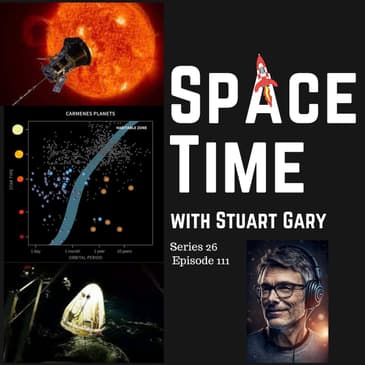
#space #astronomy #science #spacetime #news
Become a supporter of this podcast: https://www.spreaker.com/podcast/spacetime-with-stuart-gary--2458531/support.
00:00:00
STUART GARY: This is Spacetime series 26 episode, 100 and 11 or
00:00:04
broadcast on the 15th of September 2023. Coming up on
00:00:08
Space Time, a Venus fly by sends the Parker Solar Probe on a
00:00:13
record setting fly by around the Sun 50 new neighboring
00:00:17
exoplanets discovered nearby. And NASA's SpaceX cruise six
00:00:22
returns safely to Earth. All that and more coming up on Space
00:00:27
Time.
00:00:29
GENERIC: Welcome to Space Time with Stuart Garry.
00:00:49
STUART GARY: NASA's Parker Solar Probe has just undertaken a new
00:00:52
gravity assist fly by of Venus which is slingshot of the
00:00:56
spacecraft towards a record setting series of flights around
00:01:00
the Sun starting this month traveling at over 24 kilometers.
00:01:04
A second Parker Solar Probe passed just 4003 kilometers
00:01:08
above the Venusian surface as it curved around the shroud covered
00:01:12
planet and headed back in towards the Sun commission
00:01:15
managers at the Johns Hopkins Applied Physics Laboratory in
00:01:18
Maryland kept close contact with the spacecraft during its fly by
00:01:22
using NASA's Deep space communications network.
00:01:26
Any exception was an eight minute loss of signal when the
00:01:29
planet Venus itself was between the Earth and Parker missions.
00:01:34
Operation manager, Nick Pinkens says the spacecraft remains on
00:01:37
track to make its closest fly by of the Sun. Yet Venus's gravity
00:01:42
assists are essential to guiding Parker aggressively closer
00:01:45
towards the Sun.
00:01:47
The spacecraft relies on the planet to reduce its orbital
00:01:50
energy and this in turn allows it to travel closer to the Sun
00:01:54
where since 2018, it's been exploring the origins and
00:01:58
secrets of the solar wind, a continuous stream of charged
00:02:02
particles flowing out from the Sun and bathing the entire solar
00:02:06
system.
00:02:07
Its latest maneuver was Parker's sixth of seven planned gravity
00:02:11
assists using Venus. It served as an orbit maneuver applying
00:02:16
velocity change called delta V on the probe and reducing its
00:02:20
orbital speed by around 9547 kilometers an hour. And the
00:02:25
maneuver also changed the spacecraft's orbit, setting the
00:02:28
Parker Solar Probe up for its next five close passes of the
00:02:31
Sun.
00:02:32
The first of which will take place on September 27th on each
00:02:36
of these close approaches known as per Helis, the Parker Solar
00:02:39
Probe will set or match its own speed and distance records
00:02:43
coming to within just 7.3 million kilometers of the
00:02:47
visible surface of the Sun while traveling at around 635
00:02:51
kilometers per hour.
00:02:53
And that is faster than any other man made object has ever
00:02:57
traveled. Launched aboard a delta four heavy rocket from
00:03:01
space launch complex 37 at the Cape Canaveral Air Force Station
00:03:04
in Florida.
00:03:05
Back in August 2018, the Parker Solar Probe is on a seven year
00:03:09
mission studying the Sun's outer atmosphere corona. The mission's
00:03:13
undertaking 24 high eccentric orbits around the Sun flying
00:03:17
Deep into the corona as far as 6 million kilometers above the
00:03:21
Sun's visible surface.
00:03:23
It'll trace the flow of energy that heats the corona and
00:03:25
accelerates the solar wind, determining the structure and
00:03:29
dynamics of the magnetic fields and source of solar winds and
00:03:32
work out the mechanisms which are accelerating and
00:03:34
transporting energetic particles. The $1.5 billion
00:03:38
spacecraft carries four principal scientific
00:03:41
instruments.
00:03:42
They're designed to study magnetic fields, plasma and
00:03:45
energetic particles and capture images of the solar wind. The
00:03:50
electromagnetic fields investigation or fields will
00:03:53
make direct measurements of electric and magnetic fields as
00:03:56
well as radio waves pointing flux, absolute plasma density
00:04:00
and electron temperature.
00:04:02
It's composed of two flux gate magnetometer, a search core
00:04:06
magnetometer and five plasma voltage sensors. The integrated
00:04:10
science investigation of the Sun or ISIS package will measure
00:04:13
energetic electrons protons and heavy ions. It's composed of two
00:04:18
independent instruments ep I high and ep I low.
00:04:22
The white thought image of the solar probe or whisper is made
00:04:26
up of optical telescopes that can acquire images of the corona
00:04:29
and in a heliosphere, the solar wind electrons alphas and
00:04:33
protons or sweep instrument is an experiment that counts
00:04:37
electrons protons and helium ions in order to measure their
00:04:40
properties such as velocity density and temperature.
00:04:44
Its primary instruments are two electrostatic analyzers and
00:04:47
Farad a cup. This Space Time still to come, the discovery of
00:04:53
50 new exoplanets in our own cosmic neighborhood. And NASA's
00:04:57
SpaceX crew six returns safely to Earth. All that and more
00:05:02
still to come on Space Time.
00:05:20
Astronomers have discovered a treasure trove of dozens of
00:05:23
exoplanets that is planets orbiting stars other than our
00:05:26
Sun and they're all in our own galactic neighborhood.
00:05:29
The catch reported in the journal astronomy and
00:05:32
Astrophysics includes 33 newly discovered planets, 26 planets
00:05:36
confirmed from previous transit surveys and a re analysis of 17
00:05:41
other known planets. Now, four of the planets are potentially
00:05:45
habitable meaning their rocky terrestrial worlds and they
00:05:48
orbit in the habitable zone of their host stars.
00:05:51
That's the area from their star where temperatures would allow
00:05:54
liquid water central for life as we know it to exist on a
00:05:58
planet's surface. All of the planets are orbiting low mass
00:06:01
stars within 60 light years of the Sun.
00:06:05
The new observations were made by the Carmenes Consortium using
00:06:08
a 3.5 m Telescope at the Color Alto Observatory in Spain. This
00:06:13
telescopes equipped with both visible light and infrared
00:06:16
spectrograph, thereby allowing detailed radio velocity
00:06:19
measurements to be made of the stars in order to look for any
00:06:22
tell tale wobble of the star caused by the gravitational tug
00:06:26
of an orbiting planet.
00:06:28
One of the study's authors, Ignacia Rivas from the Institute
00:06:31
Of Space Sciences in Catalona says the new data set allows
00:06:34
scientists to calculate how often stars host planets.
00:06:38
Rivas says the results suggest the current of 1.4 planets per
00:06:42
star. And that's interesting because NASA's Planet Hunting
00:06:46
Kepler space Telescope found a similar rate using the transit
00:06:50
method in which the light from a host star is briefly blocked out
00:06:53
by a passing or transiting planet.
00:06:56
The fact that two different planet hunting techniques have
00:06:59
now both obtained similar results is significant because
00:07:02
it provides good evidence that nearly all low mass stars
00:07:05
probably have at least one orbiting planet.
00:07:08
Interestingly, 12 of the newly discovered planets were large
00:07:11
Jupiter mass gas giants which are not normally found orbiting
00:07:15
low mass stars. The authors think these could have been
00:07:19
formed due to gravitational instabilities which are prone in
00:07:22
massive coal discs of planetary material surrounding young
00:07:25
nascent stars.
00:07:27
Still, their discovery does raise new questions about
00:07:30
planetary formation processes and the establishment of
00:07:33
planetary system architecture. Jonathan Nalley, the editor of
00:07:37
Australian Sky and Telescope Magazine says it's good robust
00:07:41
work on a large sample scale.
00:07:44
JONATHAN NALLY: Yeah. Now these are exoplanets we're talking
00:07:46
about, these are planets that are circling other stars, not
00:07:49
our Sun. So the scientists haven't found 50 new planets in
00:07:52
our solar system. These are other planetary systems. So this
00:07:55
particular group of scientists have been spending the last five
00:07:57
years using a Telescope in space to study several 100 stars all
00:08:02
within 60 light years of Earth and that's really close by in
00:08:05
space terms.
00:08:06
And what they were doing was they were hunting for signs of
00:08:08
planets circling those stars. So they've now announced the
00:08:12
discovery of 33 new planets. They've confirmed the presence
00:08:15
of another 26 that had already been spotted and they've done
00:08:18
some analysis on another 17 planets that also had previously
00:08:22
been candidates.
00:08:23
The suspicion was that they were planets as well. Now, six of
00:08:27
these planets out of this total are considered to be potentially
00:08:31
habitable. And what scientists mean by that these days is that
00:08:34
the likely temperatures that exist on the surface of these
00:08:37
planets mean that liquid water could exist not frozen as ice or
00:08:42
too hot and then it's just a gas.
00:08:44
But what they're looking for is planets could have liquid water
00:08:47
on their surfaces because here on Earth, for instance,
00:08:49
everywhere there is liquid water, there's life, even if
00:08:52
it's just microscopic, it's everywhere. They've looked where
00:08:54
there's water, there's life even, you know, in icy places
00:08:57
where there are little cracks where some water exists in a
00:09:00
tiny amount of liquid water, there's life in it.
00:09:03
So even underground anywhere, look inside nuclear reactors for
00:09:07
goodness sake. So there are extremo files, they call them
00:09:11
things that can live basically anywhere, these little
00:09:13
microscopic things. So that's why they're looking for planets
00:09:17
that might have at least the temperatures that are good for
00:09:20
water.
00:09:20
One other thing, the team worked out was how many planets on
00:09:23
average stars have. And from the data that they were doing, it
00:09:27
turns out that there's 1.4 planets per star is the average,
00:09:31
it's a bit like the, you know, average family's got what, 2.4
00:09:34
kids or something. I used to have 2.4 kids, I think it was.
00:09:37
So it's an average, of course, but this actually matches what
00:09:39
other scientists had come up with before using different sort
00:09:43
of techniques. So it's sort of confirmed that as being a pretty
00:09:46
solid bit of data. And one final thing the team has done also is
00:09:50
it's worked out ways to help tell the difference between
00:09:54
indications of the presence of a planet circling a star.
00:09:58
And things happening on the star itself such as star spots, star
00:10:02
spots are similar to sunspots there, dark areas, cooler areas
00:10:06
on the surface of the star. And this is important because the
00:10:10
technique they're using to detect planets for this team was
00:10:13
looking for tiny dimming of the light coming from all of these
00:10:17
stars transit method where a planet's gone in front.
00:10:23
And so it's blocked out a little bit of the Starlight and the
00:10:25
Starlight dim a little bit. Well, a star spot can do that
00:10:28
too if you've got a big dim, a cooler darker spot on a star and
00:10:32
it rotates into view that can sort of masquerade as a planet
00:10:37
or vice versa.
00:10:38
So they've been able to work out ways to sort of overcome that
00:10:43
and have more confidence than what they are seeing when they
00:10:46
see a star dimming is actually one of these exoplanets and not
00:10:49
a spot or they've been able to say no, that is a star spot. So
00:10:53
that's of interest to astronomers who are looking for
00:10:56
star spots. So there you go, 50 more planets and within 60 light
00:10:59
years of Earth. So there are a lot of planets out there.
00:11:02
STUART GARY: That's Jonathan Nalley, the editor of Australian
00:11:04
Sky and Telescope Magazine and this is Space Time. Still to
00:11:09
come. NASA's SpaceX cruise six returns safely to Earth. And
00:11:14
later in the science report, scientists have discovered a new
00:11:17
type of water ice, all that and more still to come on Space
00:11:22
Time.
00:11:39
Well, after spending 186 days in orbit, NASA's SpaceX crew six S
00:11:43
returned safely to Earth splashing down in the North
00:11:46
Atlantic Ocean off the coast of Jacksonville, Florida.
00:11:49
NARRATOR: We do have de orbit burns start. So a quick recap
00:11:52
within the last 10 minutes, Dragon jettisoned its trunk and
00:11:54
initiated the deorbit burn for those operations. NASA and
00:11:58
SpaceX closely coordinate with the United States Coast Guard to
00:12:01
establish a safety zone to ensure public safety and for the
00:12:05
safety of those involved in the recovery operations as well as
00:12:07
the crew on board returning spacecraft.
00:12:10
NARRATION: We are now within the atmospheric entry phase of the
00:12:13
return for the crew six crew. Once again, the plasma build up
00:12:17
on the exterior of the capsule results in our inability to
00:12:22
command or communicate with the Dragon capsule during this time.
00:12:25
This is heading towards the Atlantic coast of near
00:12:30
Jacksonville, Florida.
00:12:31
NARRATOR: So recovery teams are in position off the coast of
00:12:34
Jacksonville, Florida and we are still targeting our expected
00:12:37
splashdown time of 9:17 p. m. Pacific 12:17 a. m. Eastern. We
00:12:43
only have about a minute and some change of this blackout
00:12:47
period anticipated. And again, there's some variation on when
00:12:50
we can hear from the crew Dragon.
00:12:52
NARRATION: SpaceX com check.
00:12:54
So at this point, we're going to hear SpaceX cops begin to hail
00:12:57
as Gary said, this blackout period is estimated. So we're
00:13:00
now beginning to reach out to the crew to see if we've
00:13:03
regained that communications capability.
00:13:05
What Dragon SpaceX com check.
00:13:10
NARRATOR: We hear crew six from inside the cabin on the back end
00:13:12
of the Black Copy Dragon, we see a healthy flight computer expect
00:13:15
automated chute deployment up next will be the deployment of
00:13:22
the drogue parachutes.
00:13:27
NARRATION: All right. So that call out just letting the crew
00:13:28
know that they can expect to have the initial parachute
00:13:33
deployment. That is the drogue parachutes and that those
00:13:37
typically deploy about 18 ft at that point in time. The
00:13:42
capsule is going around 350 MPH at the time that the main
00:13:47
parachutes are deployed just seconds later, they'll be going
00:13:51
around 120 MPH.
00:13:54
NARRATOR: Drug pirates have fired and we have good
00:13:56
confirmation of drug shoots.
00:13:58
NARRATION: Two drugs, Dragon nominal descent rate and
00:14:02
recovery team reports a visual on two healthy drugs to 10
00:14:07
years.
00:14:09
NARRATOR: He drove shoot jettison here momentarily.
00:14:11
NARRATION: At this point in time, Dragon has saved all of
00:14:13
its propulsion systems and is now has already terminated. That
00:14:17
nitrox suit and cabin purges those were helping to keep the
00:14:20
crew cool during the re entry looks like we have four very
00:14:26
beautiful and healthy Maine parachutes.
00:14:29
Dragon, we see a nominal descent rate on four healthy Maines.
00:14:34
Dr Coffee Space Dragon coming up on one time.
00:14:38
So there's that confirmation copy 1000 m, confirmation of
00:14:44
those four healthy shoot deployments now standing by for
00:14:48
splashdown at the point of splashdown, the capsule will be
00:14:51
going about 15 or 16 MPH continuing to accelerate from a
00:14:57
from a speed of about 120 MPH 800. So we will now begin copy
00:15:03
800 to hear commander Steve Bowen call out the altitude as
00:15:08
they approach the water surface.
00:15:10
That is again in meters landing in water is simpler and provides
00:15:14
more margin against unlikely parachute issues. We had to
00:15:17
learn how to make Dragon waterproof, but once you do
00:15:20
that, it's very much a rinse review reuse type process 600
00:15:25
copy 600 600 m and the descent rate is as predicted. Dragon
00:15:31
Endeavor. With the crew, six team members on board.
00:15:36
Dragon, we see 400.
00:15:38
Now about 400 m above the ocean surface.
00:15:43
This I was dragging 200 for flash down.
00:15:46
Copy braced for splashdown.
00:15:48
NARRATOR: Again, the seats have been rotated in a position to
00:15:51
take the loads of re entry and parachute deployment as well as
00:15:54
splash down. The crew is braced. We are inside 100 meters.
00:15:58
NARRATION: Dragon Endeavor continuing its slow descent
00:16:01
flash down. Those parachutes are then cut and released. Dragon
00:16:05
Endeavor has now returned home. NASA astronaut Steve Bowen Woody
00:16:09
Hoberg, Sultan Al Nati and Andre.
00:16:12
Dragon splash down.
00:16:15
Copy splash down and we see shoots.
00:16:21
A 17 hour return journey from space crew. Six is home.
00:16:26
STUART GARY: Their Dragon capsule Endeavor was quickly
00:16:28
retrieved by the SpaceX recovery vessel.
00:16:31
Megan formally ending their six month mission to the
00:16:33
International Space Station while on station as part of
00:16:37
expedition 69 the four man crew participated in hundreds of
00:16:41
experiments, three spacewalks preparing the station four and
00:16:45
eventually installing two new Arosa or International Space
00:16:49
Station rollout solar arrays which are designed to augment
00:16:52
power generation for the orbiting outpost.
00:16:55
The experiments and technology demonstrations undertaken by the
00:16:58
mission included assisting a student robotic challenge,
00:17:02
studying plant genetic adaptions to space and monitoring human
00:17:06
health in microgravity to prepare for exploration beyond
00:17:09
low Earth orbit.
00:17:11
The astronauts also released Saskatchewan's first satellite
00:17:14
which is designed to test new radiation detection and
00:17:17
protection systems which derive from melanin which is found in
00:17:20
many living organisms including humans. The journey marked the
00:17:24
fourth flight for the Dragon capsule Endeavor which first
00:17:28
flew on SpaceX demonstration mission two in May 2020.
00:17:32
The spacecraft will now be returned to Florida for
00:17:35
inspection and processing at SpaceX's refurbishing facility
00:17:38
at Cape Canaveral where teams will inspect the capsule,
00:17:41
analyze data on its performance and prepare it for its next
00:17:45
mission.
00:17:46
The cruise six mission is part of NASA's commercial crew
00:17:48
program and its return to Earth follows the launch last week of
00:17:52
NASA's SpaceX crew seven mission beginning yet another long
00:17:56
duration science expedition.
00:17:59
This is Space Time and time now to take another brief look at
00:18:18
some of the other stories making news in science this week with
00:18:21
the science report, a new study is focused on one of the most
00:18:25
common features of the autism spectrum disorder that is
00:18:29
reduced levels of eye contact compared with neurotypical
00:18:32
people.
00:18:33
Although eye contact is a crucially important part of
00:18:36
everyday interactions, scientists have been limited in
00:18:39
studying the neurobiological basis for life search
00:18:41
interactions with eye contact in people on the spectrum because
00:18:45
of the inability to image the brains of two people
00:18:47
simultaneously.
00:18:49
However, a report in the journal PLOS one now shows how new
00:18:52
innovation technology has allowed researchers to image two
00:18:56
individuals simultaneously during real life interactions.
00:19:00
Both participants were fitted with caps which had lots of
00:19:03
sensors on them that emitted light into the brain and also
00:19:06
recorded changes in light signals with information about
00:19:09
brain activity during both face gaze and eye to eye contact.
00:19:13
The researchers then analyzed brain activity during brief
00:19:16
social interactions between neurotypical people and those on
00:19:19
the spectrum using functional near infrared spectroscopy. They
00:19:24
found that during eye to eye contact, participants on the
00:19:27
spectrum had significantly reduced activity in the dorsal
00:19:30
parietal cortex compared to neurotypical people.
00:19:33
They found that neural activity in these regions was synchronous
00:19:37
between neurotypical participants during real eye to
00:19:39
eye contact but not during gaze at a video face.
00:19:43
On the other hand, the expected increase in neural coupling was
00:19:46
not observed in people on the spectrum and this is consistent
00:19:50
with the differences in social interactions. The findings
00:19:53
provide a better understanding of the neurobiology of autism
00:19:56
and general underlying neural mechanisms that drive typical
00:20:00
social connections.
00:20:02
An Australian study has revealed that plants can't effectively
00:20:06
remove toxic gasoline fumes including cancer causing
00:20:10
compounds such as benzene from indoor air. The study found that
00:20:14
the ambient small green wall containing a mix of indoor
00:20:17
plants was highly effective at removing harmful cancer causing
00:20:21
pollutants.
00:20:22
With 97 per cent of the most toxic compounds removed from the
00:20:25
surrounding air in just eight hours. The study which has not
00:20:29
yet been peer reviewed was funded by the plant company aus.
00:20:35
Scientists have discovered a new type of water ice. The findings
00:20:39
reported in the journal Physical Review B shows that the
00:20:42
transformation to an ionic state occurs at far lower pressures
00:20:46
than previously thought. Like many other materials, water can
00:20:50
form different solid materials based on variable temperatures
00:20:53
and pressure conditions.
00:20:55
It's just like carbon turning either into diamond or graphite.
00:20:58
However, water's unusual and it comes in at least 20 solid forms
00:21:02
of ice and they've just found another one. Zach Gran and
00:21:06
colleagues from the Department Of Physics And Astronomy at the
00:21:08
University Of Nevada, Las Vegas made the discovery after
00:21:12
developing a new method of measuring the properties of
00:21:14
water under high pressure.
00:21:16
Their work involved first squeezing ice between the tips
00:21:19
of two diamonds freezing into several jumbled ice crystals. It
00:21:23
was then subjected to laser heating which melted it before
00:21:26
it quickly reformed into a powder like collection of tiny
00:21:29
crystals by incrementally raising the pressure and
00:21:32
periodically blasting it with lasers.
00:21:34
Grand and colleagues observed the cubic ice V two transition
00:21:38
into a new structure of tetra Gonal symmetry, which they're
00:21:41
calling ice V three. While new and unusual types of ice are
00:21:45
unlikely to be found naturally on Earth's surface, it could
00:21:48
exist Deep inside the planet's mantle and in the crust and
00:21:51
upper mantle of other worlds therefore, could provide
00:21:54
conditions suitable for life as we know it.
00:21:58
A new study shows that people who tend to see images or hear
00:22:02
voices where there are none are also more likely to believe in
00:22:05
conspiracy theories and paranormal phenomena. One of the
00:22:09
most important tasks of the perception system of our brains
00:22:12
is to identify meaningful patterns in the streams of
00:22:15
sensations received by our sensory organs.
00:22:19
This is the basis of our ability to identify objects in our
00:22:22
environment and interact with them. However, Tim Mendham from
00:22:26
Strand Skeptics says sometimes human brains show a tendency to
00:22:30
seek out and find patterns that don't actually exist.
00:22:34
TIM MENDHAM: Apophenia is a sort of umbrella term for when people
00:22:36
see or hear things that aren't there. You're seeing things like
00:22:39
you're seeing a face in the clouds specifically is
00:22:42
specifically the visual.
00:22:43
But apophenia comes, you're hearing sounds, you're hearing
00:22:46
voices, you know, it sounds like your dead relative calling or
00:22:50
something like that, not quite that you're hearing ghosts and
00:22:53
that sort of thing. You hear a creek, your house settling and
00:22:56
you suddenly think of someone walking through your house,
00:22:58
right?
00:22:59
STUART GARY: Paradols when you're seeing things that do
00:23:02
look like faces and clouds, that's not quite the same thing
00:23:05
as what you're talking about then.
00:23:07
TIM MENDHAM: Well, a is the broader term paradols included
00:23:10
in it. Really? Ok. Ok. So a sort of looking at the whole topic.
00:23:14
So yeah, there's, there's visual and there's all sorts of other
00:23:18
anything in which you're thinking you see a pattern where
00:23:21
there is none and the pattern is often a face or a visual thing
00:23:24
that you are familiar with and that it's not what you're there.
00:23:26
So that's what this covers. It's a normal thing, people do it all
00:23:30
the time. I mean, it's.
00:23:31
STUART GARY: Part of our genetic makeup used to protect us in
00:23:33
ancient times when we lived in caves.
00:23:35
TIM MENDHAM: And yes. So what happens is that people who have
00:23:37
this tendency on a continuing basis, more than just normal
00:23:41
basis of seeing things that say is that amusing? Whether, who
00:23:44
really believe it and take it to the extreme also have a tendency
00:23:47
to believe. Apparently according to this research that was done
00:23:50
on students in Switzerland, they have a tendency to believe
00:23:53
pseudo theories, conspiracy theories and in the paranormal.
00:23:57
So they're seeing realities if you like in things where they
00:24:00
don't exist, whether reality doesn't exist. What they
00:24:02
actually did a survey on, they asked people if they, they see
00:24:05
things through visual patterns, audio auditory signals,
00:24:09
interpreting events or data as sort of like a coincidence or it
00:24:12
goes beyond coincidence.
00:24:13
And then also if they then also believed in certain conspiracy
00:24:16
theories in paranormal beliefs and a whole range of things,
00:24:19
apparently, there is an index or a scale called the proneness to
00:24:21
paranormal scale. People who are prone to paranormal beliefs also
00:24:25
prone to apophenia issues, parador, et cetera and also
00:24:29
prone to, to tend to be to conspiracy theories. Now, this
00:24:32
is one study.
00:24:33
It'd be great to see it replicated to see how it works
00:24:36
out. But it's just basically saying that the psychological
00:24:39
mechanisms behind the perception of non existent patterns might
00:24:43
be the same mechanisms that make one endorse beliefs without
00:24:46
evidence. So you're seeing things that aren't there,
00:24:48
surprise, surprise and you're believing things that also are
00:24:51
probably not there.
00:24:52
STUART GARY: That's Tim Ende from Australian skeptics.
00:25:11
And that's the show for now. Spacetime is available every
00:25:14
Monday, Wednesday and Friday through Apple Podcasts, itunes,
00:25:18
Stitcher, Google Podcast. Pocket casts, Spotify a Cast Amazon
00:25:23
music bites dot com, Soundcloud, YouTube, your favorite podcast
00:25:28
download provider and from Space Time with Stewart Gary dot com.
00:25:32
Spacetime is also broadcast through the National Science
00:25:35
Foundation on Science Zone Radio and on both iheart Radio And
00:25:39
Tune in radio.
00:25:40
And you can help to support our show by visiting the Spacetime
00:25:43
store for a range of promotional merchandizing goodies or by
00:25:47
becoming a Spacetime patron, which gives you access to triple
00:25:50
episode commercial free versions of the show as well as lots of
00:25:54
bonus audio content, which doesn't go to air access to our
00:25:57
exclusive Facebook group and other rewards just go to Space
00:26:01
Time with Stewart Gary dot com for full details.
00:26:04
And if you want more Space Time, please check out our blog where
00:26:07
you'll find all the stuff we couldn't fit in the show as well
00:26:10
as heaps of images, news stories, loads of videos and
00:26:13
things on the web. I find interesting or amusing. Just go
00:26:17
to Space Time with Stuart Garry dot tumblr dot com.
00:26:20
That's all one word and that's Tumbler without the e you can
00:26:24
also follow us through at Stuart Garry on Twitter at Space Time
00:26:28
with Stuart Garry on Instagram through our Space Time YouTube
00:26:31
channel and on Facebook, just go to Facebook dot com forward
00:26:35
slash Spacetime with Stewart Gary And Spacetime is brought to
00:26:39
you in collaboration with Australian Sky and Telescope
00:26:41
Magazine, your Window on the Universe.
00:26:44
GENERIC: You've been listening to Space Time with Stuart Garry.
00:26:47
This has been another quality podcast production from bites
00:26:51
dot com.