
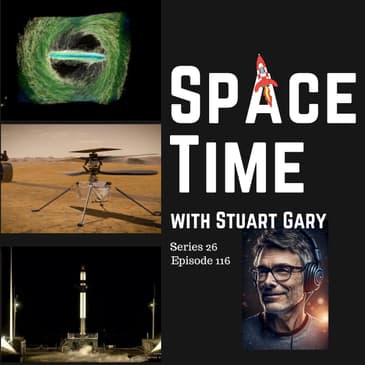
#astronomy #space #science #news #podcast #spacetime
Become a supporter of this podcast: https://www.spreaker.com/podcast/spacetime-with-stuart-gary--2458531/support.
00:00:00
STUART GARY: This is Spacetime series 26 episode, 100 and 16
00:00:04
for broadcast on the 27th of September 2023. Coming up on
00:00:08
space time. A new study warns that black holes are actually
00:00:13
eating faster than previously expected. NASA's ingenuity.
00:00:17
Helicopter sets a new altitude record on MARS and Rocket lab's
00:00:21
electrons suffers a catastrophic failure during launch all that
00:00:26
and more coming up on space time.
00:00:30
GENERIC: Welcome to space time with Stuart Garry.
00:00:50
STUART GARY: A new study is changing the way astrophysicists
00:00:53
understand the eating habits of supermassive black holes. While
00:00:58
previous researchers have hypothesized that black holes
00:01:01
eat slowly. New computer simulations are suggesting that
00:01:04
black holes actually scaff down food faster than conventional
00:01:08
understanding suggests.
00:01:11
A new study reported in the Astrophysical Journal is based
00:01:14
on high resolution three dimensional computer simulations
00:01:18
which are showing that spinning black holes twist up the
00:01:21
surrounding space time process called frame dragging in the
00:01:25
process.
00:01:26
This is ripping apart the violent whirlpool of gas, the
00:01:29
accretion disk that encircles and feeds the black hole. Now
00:01:34
this process is resulting in the accretion disk being literally
00:01:38
torn into two separate discs, inner and outer.
00:01:42
The black holes then devour the inner disk afterwards, debris
00:01:46
from the outer disk spills inwards to refill the gap left
00:01:50
behind by the now wholly consumed inner ring. And the
00:01:53
eating process repeats one cycle of this endlessly repeating eat
00:01:59
refill eat process can take just a few months. And that's a
00:02:02
shockingly fast timescale compared to the hundreds of
00:02:05
years.
00:02:06
Researchers had previously proposed. The new findings could
00:02:10
help explain the dramatic behavior of some of the
00:02:12
brightest objects in the universe quasars which can
00:02:15
abruptly flare up and then vanish without explanation.
00:02:20
The study's lead author Nick Cas from North Western University
00:02:23
says classical accretion disc theory predicts that the disc
00:02:27
evolves slowly but some quasars which result from black holes
00:02:31
eating gas on their accretion discs appear to drastically
00:02:34
change over timescales of just a few months.
00:02:37
Classical accretion disc theory simply can't explain this
00:02:41
drastic variation but the phenomena seen in the
00:02:44
simulations could explain this. That's because the quick
00:02:48
brightening and dimming are consistent with inner regions of
00:02:51
the disc being destroyed.
00:02:53
Accretion disks surrounding black holes are physically
00:02:56
complicated objects making them incredibly difficult to model.
00:03:01
Conventional theory has struggled to explain why these
00:03:04
discs shine so brightly and then abruptly dim sometimes to the
00:03:08
point of disappearing completely.
00:03:10
Previous researchers have mistakenly assumed that
00:03:13
accretion disks are relatively orderly in these models of the
00:03:17
gas and particles swirl around the black hole in the same plane
00:03:20
as the black hole itself and in the same direction as the black
00:03:24
hole spin then over timescales of hundreds to hundreds of
00:03:28
thousands of years, gas particles gradually spill into
00:03:31
the black hole.
00:03:32
The feeder has says that for decades, people made the very
00:03:36
big assumption that accretion disks were aligned to the black
00:03:39
hole's rotation. But he says the gas that feeds these black holes
00:03:44
doesn't necessarily know which way the black hole's spinning.
00:03:47
So why would they automatically be aligned and changing this
00:03:52
alignment drastically changes the entire picture. The new
00:03:56
computer simulation, which is one of the highest resolution
00:03:59
simulations of a Christian disks ever carried out indicates that
00:04:03
the regions surrounding the black hole are much messier and
00:04:06
more turbulent than previously thought using summit.
00:04:10
One of the world's largest supercomputers located at the
00:04:13
Oak Ridge National Laboratory. The authors carried out a three
00:04:16
dimensional general relativistic magneto hydrodynamic simulation
00:04:20
of a thin tilted accretion disk.
00:04:23
While previous simulations weren't powerful enough to
00:04:25
include all the necessary physics needed to construct a
00:04:28
realistic black hole. This new model included gas dynamics
00:04:33
magnetic fields and general relativity to assemble a more
00:04:37
complete picture.
00:04:39
Caz says black holes are extreme general relativistic objects
00:04:43
that affect the space time around them. And so when they
00:04:46
rotate, they physically drag space time with them. And this
00:04:50
creates a really strong effect close to the black hole that
00:04:54
becomes increasingly weaker with distance from the event horizon.
00:04:58
The point of no return beyond which matter falls forever into
00:05:02
the black hole's singularity frame dragging makes the entire
00:05:06
creasing disk wobble in circles similar to how its gyroscope
00:05:10
processes. But the thing is the inner disc wants to wobble much
00:05:14
more rapidly than the outer disk.
00:05:16
This mismatch of focus causes the entire disc to warp, causing
00:05:21
gas from different parts of the disc to collide. The collisions
00:05:25
create bright shocks that violently drive material closer
00:05:29
and closer to the black hole.
00:05:31
As the warping becomes more severe, the innermost region of
00:05:34
the accretion disk continues to wobble faster and faster until
00:05:38
eventually it breaks apart from the rest of the disc.
00:05:41
Now, according to the new simulations, both these sub
00:05:44
disks then start evolving independently of each other
00:05:48
instead of smoothly moving together like a flat plate
00:05:51
surrounding a black hole, the sub disks independently wobble
00:05:55
at different speeds and angles sort of like the wheels of a
00:05:58
gyroscope. And when the inner disk finally tears off, it
00:06:01
processes independently.
00:06:04
Paz says it processes faster because it's closer to the black
00:06:07
hole and because it's smaller, so it's easier to move. Now,
00:06:11
according to the new simulations, the tearing region
00:06:14
where the inner and outer subs disconnect is where the feeding
00:06:18
frenzy truly begins. Well, fr tries to keep the two disc
00:06:23
segments together.
00:06:24
The twisting of space time by the spinning black hole wants to
00:06:28
rip it apart. So there's competition between the rotation
00:06:32
of the black hole and the friction and pressure inside the
00:06:35
disc. It's the tearing region where the black hole wins, the
00:06:40
inner and outer discs collide into each other.
00:06:42
And the outer disk shaves off layers of the inner disc in the
00:06:45
process, pushing it further inwards. Now the two sub disks
00:06:49
intersect at different angles. The outer disk pours material on
00:06:54
top of the inner disc. And this extra mass pushes the inner disc
00:06:57
towards the black hole where it's eventually devoured.
00:07:01
Then the black hole's own gravity pulls gas from the outer
00:07:04
disk towards the now empty inner region in order to refill it.
00:07:08
Caz says these fast cycles of eight refill eight potentially
00:07:12
explain so called changing look. Quasars.
00:07:15
Quasars are the brightest objects in the universe. So
00:07:19
extremely luminous, they can be seen more than 13 billion light
00:07:23
years away literally from the other side of the universe.
00:07:26
They're actually made up of extremely luminous jets of
00:07:29
energy and matter generated by feeding black holes and then
00:07:33
beamed out at close to the speed of light.
00:07:36
They're so powerful. They can emit thousands of times more
00:07:40
energy than the entire milky way's 400 billion stars and
00:07:44
changing look quasars are even more extreme. They appear to
00:07:49
turn on and off over duration periods of just a few months.
00:07:53
Now, that's a tiny amount of time for a typical quasar.
00:07:57
Caz says the inner region of an accretion disc, which is where
00:08:00
most of the brightness comes from can totally disappear. The
00:08:03
system simply stops being bright and then all of a sudden it
00:08:07
brightens up again and the process repeats and that can be
00:08:12
done over just the space of a few months. Conventional physics
00:08:16
doesn't have any way to explain this.
00:08:19
They can't explain why it disappears so quickly in the
00:08:21
first place and they certainly can explain how it refilled so
00:08:25
quickly. So not only do these new computer simulations
00:08:29
potentially explain quasars, they could also answer ongoing
00:08:33
questions about the mysterious nature of black holes. How gas
00:08:37
actually gets into the black hole to feed it is the central
00:08:40
question in a CRE desk physics.
00:08:43
If you know how that happens, they'll tell you how long the
00:08:46
disc lasts, how bright it is and what the light should look like
00:08:50
when we observe it using telescopes. This is space time
00:08:55
still to come. NASA's ingenuity. Helicopter sets a new altitude
00:09:00
flight record and Rocket lab's Electron explodes during launch
00:09:06
all that and more coming up on space time.
00:09:24
NASA's MARS Ingenuity Helicopter has set a new flight altitude
00:09:27
record reaching some 20 m above the red planet's ancient desert
00:09:32
landscape. Now that's 2 m above its previous record. The tiny
00:09:38
tissue box size twin rotor chopper was on its 59th flight.
00:09:43
The 142.59 2nd sortie was simply designed to hover with no
00:09:48
horizontal travel. It's described by NASA as a pop up
00:09:51
flight.
00:09:52
The 1.8 kg Roto craft arrived on the red planet back in February
00:09:56
2021 attached to the underbelly of the car size six wheeled
00:10:01
MARS, perseverance rover ingenuity was built using simple
00:10:05
off the shelf components and it was originally only intended to
00:10:09
undertake five proof of concept test flights on MARS in order to
00:10:13
determine whether or not an aircraft really could
00:10:15
successfully fly on the red planet.
00:10:18
Remember, MARS hasn't got Earth's thick atmosphere density
00:10:22
on MARS is just 1 99th that of Earth. Now, with its 59th flight
00:10:27
successfully completed, the chopper has proven itself to be
00:10:30
a valuable companion for perseverance scouting the trail
00:10:34
ahead of the rover in order to find interesting geology and
00:10:37
warn of hazardous terrain over the course of its 59 flights.
00:10:42
Ingenuity has now traveled some 13 m and it's stayed aloft
00:10:48
for 106 minutes, 30 seconds.
00:10:51
Its single flight distance and duration records are 704 m set
00:10:55
in April 2022 at 169.5 seconds achieved in August 2021. The
00:11:03
primary goal of the perseverance mission is to search for
00:11:06
evidence of past microbial life on MARS.
00:11:10
The landing site was the floor of the 45 kilometer wide Jezero
00:11:14
crater which billions of years ago harbored a large lake back
00:11:18
in the day when MARS was a warm wet world before it transformed
00:11:22
into the inhospitable freeze dried desert.
00:11:25
It's become today next to the perseverance landing site is an
00:11:30
ancient expansive river delta fan of sediments, they contained
00:11:34
material washed down from further upstream and which would
00:11:38
be a likely place for life to thrive had it ever existed on
00:11:41
the red planet? As its mission proceeds, perseverance is
00:11:45
collecting samples that will eventually be sent back to Earth
00:11:49
for more detailed scientific examination.
00:11:52
Meanwhile, as ingenuity continues on its extended
00:11:54
mission of aerial exploration mission managers back on Earth
00:11:58
are looking at the next generation of aircraft to fly on
00:12:01
MARS. This report from NASA TV.
00:12:05
NASA TV REPORT: Two years ago, ingenuity proved that we could
00:12:07
do the impossible we can fly on. MARS. Let's talk about what's
00:12:11
next.
00:12:11
Here at the surface. Robotics. Lab testing is being done on
00:12:14
future MARS helicopters. Teddy Santos is here with us today to
00:12:19
talk about the helicopter that started it all ingenuity. Teddy,
00:12:22
what's the latest.
00:12:24
Ingenuity is doing great. Our baby is still flying on the
00:12:26
surface of MARS. Our rotor system, our little cell phone
00:12:29
processor on board are off the shelf. Lithium ion batteries are
00:12:32
all doing fantastic. One area that we're looking very closely
00:12:35
at is our solar panel.
00:12:36
You can imagine after two years of flying on the surface of
00:12:38
MARS, you'll get some dust on top, but we still have an ample
00:12:41
margin and ample energy to keep up our flight operations and the
00:12:44
extended mission of continuing to scout and push the flat
00:12:47
envelope of what's possible.
00:12:48
The testing being done in this room is part of the next
00:12:50
helicopter mission of MARS called the sample recovery
00:12:52
helicopters. The goal is to be a back up to get these samples
00:12:57
back to Earth but simply perseverance, collects the
00:13:00
sample tubes.
00:13:00
The sample return lander will retrieve those samples directly
00:13:04
for perseverance and then there's a Rocket inside of that
00:13:06
lander that's actually going to send those samples back to Earth
00:13:10
as a backup to getting those sample tubes from MARS back to
00:13:14
the lander. We're designing the next generation of helicopters
00:13:17
to not only be able to pick up and carry a sample tube but also
00:13:21
drive around on the surface.
00:13:22
Are there any other ways ingenuity is influencing future
00:13:26
MARS exploration.
00:13:27
We're looking at a research concept called MARS Science
00:13:30
helicopter. It's a helicopter. So six rotors and a ring around
00:13:34
a central structure.
00:13:36
It's about the size of the rover. And you can imagine in
00:13:38
the future, you will have fleets of these MARS Science
00:13:41
helicopters flying around bringing important payloads to
00:13:44
areas of MARS that we've never been able to access before.
00:13:47
What's next for ingenuity?
00:13:50
We're trying to fly faster, trying to fly higher. We've
00:13:53
added new software capabilities. We can now detect landing sites
00:13:58
airborne. Those sorts of winds are coming from the surface of
00:14:01
MARS directly into the design of the new sample recovery
00:14:05
helicopters. And she's done a fantastic job. We surpassed any
00:14:08
sort of metric of success that anyone on the team could have
00:14:11
ever imagined for this little tiny £4 spacecraft.
00:14:14
STUART GARY: This space time still to come. Rocket lab's
00:14:19
Electron explodes during launch and later in the science report,
00:14:24
scientists begin phase one trials of a new HIV vaccine. All
00:14:29
that and more coming up on space time you come.
00:14:47
Rocket lab have grounded all Electron missions following the
00:14:51
failure of its latest launch from New Zealand. The we will
00:14:54
never desertion mission from launch complex. One on the North
00:14:57
Island's Maa Peninsula was to add a second Acadia Earth
00:15:01
imaging synthetic Ava radar satellite to CAPELLA. Space's
00:15:04
current constellation.
00:15:06
The spacecraft was to be placed into a 635 kilometer high orbit.
00:15:11
The launch had already been placed on hold at T minus eight
00:15:14
minutes due to an anomaly. It was then resumed some 125
00:15:19
minutes later with a countdown clock reset to T minus 14
00:15:23
minutes and 35 seconds. The countdown and launch proceeded
00:15:27
smoothly with a spectacular night time lift offload is
00:15:31
complete.
00:15:31
COMMENTATOR: The system is in recirculation. Anti gay is
00:15:34
disabled.
00:15:34
Stage one and stage two tanks are pressed high flow engine
00:15:37
purge enabled 10 987654321 flipped off the T plus 30
00:15:55
seconds.
00:15:55
And our 41st Electron has lifted off from the pad at Rocket lab's
00:15:59
launch complex one Electron powering its way to orbit for
00:16:03
CAPELLA very soon. We will approach Max Q or maximum
00:16:06
aerodynamic pressure. The moment that the Rocket experiences the
00:16:09
most stress as it climbs.
00:16:11
Electronic personic, approaching Max Q, high voltage battery
00:16:15
discharges nominal Max Q an Electron has cleared Max Q, the
00:16:19
Rocket is performing nominally so far now up to 16 kilometers
00:16:23
in altitude as it reaches speeds of more than 2300 kilometers an
00:16:28
hour. Next up are three events and electrons as sent that will
00:16:32
happen in quick succession.
00:16:33
First up, we have Miko the moment when all nine Rutherford
00:16:36
engines on the first stage throttle down and then shut off
00:16:39
completely very quickly. After that, we'll have the separation
00:16:42
of the 1st and 2nd stages followed by the ignition of the
00:16:46
single Rutherford engine on electrons second stage as the
00:16:49
mission continues to orbit stage.
00:16:50
One propulsion holding nominal stand by for Miko at 15 seconds
00:16:54
to staging, entered burnout detect mode, Miko confirmed
00:16:57
stage separation successful.
00:16:59
STUART GARY: However, just after first stage separation at two
00:17:02
minutes, 38 seconds after liftoff, elementary data
00:17:05
suddenly showed the velocity of the Electron upper stage
00:17:07
decreasing rapidly as its single Rutherford vacuum engine was
00:17:11
supposed to ignite and all stations.
00:17:15
SPK_4: We have experienced an anomaly. Please remain on
00:17:17
station and we will investigate and action. The anomaly plan.
00:17:22
STUART GARY: The failure has broken a string of nine
00:17:24
consecutive successful launches. The last failure was way back in
00:17:28
May 2021. The mission was Rocket lab's 41st Electron launched and
00:17:33
its ninth flight this year, a full investigation to determine
00:17:38
exactly what happened is now underway. This is space time and
00:17:59
time there to take another brief look at some of the other
00:18:01
stories making news in science.
00:18:03
This week with the science report, scientists have begun
00:18:07
phase one trials of a new preventative HIV vaccine
00:18:11
candidate in the United States and South Africa. The research
00:18:15
which is supported by the National Institutes Of Health
00:18:18
will evaluate a novel vaccine known as VR 1003 88. They'll be
00:18:22
looking at its safety and its ability to induce an HIV
00:18:26
specific immune response.
00:18:28
VR 1388 is designed to instruct the body's immune system to
00:18:33
produce more T cells that can recognize HIV and signal an
00:18:37
immune response to prevent the virus from establishing chronic
00:18:41
infection. VR 1388 uses a cyclo mela virus vector to deliver the
00:18:47
vaccine material to the immune system without causing disease
00:18:50
to study participants.
00:18:52
A cytomegalovirus vector remains in the human body for life that
00:18:57
suggests that it has the potential to deliver and then
00:19:00
safely help the body retain HIV vaccine material for a long
00:19:04
period, potentially overcoming the waning immunity observed in
00:19:08
or short lived vaccine vectors. Initial results from the phase
00:19:13
one trials are expected in late 2024.
00:19:17
The human immuno deficiency virus HIV is the infection that
00:19:22
attaches to the body's immune system causing acquired immune
00:19:25
deficiency syndrome or aids. It's thought to have originated
00:19:29
from infected primates in western central Africa. And was
00:19:33
first identified in humans in May 1981 when a large cohort of
00:19:37
otherwise healthy young biological males suddenly began
00:19:40
dying from a range of unusually rare diseases.
00:19:44
Hiv targets the body's white blood cells, things like helper
00:19:48
T cells, specifically CD four plus T cells. It also targets
00:19:53
macrophages and dendritic cells weakening and causing the
00:19:57
progressive failure of the immune system.
00:19:59
Thereby allowing a wide range of opportunistic diseases such as
00:20:03
tuberculosis and several types of cancers to become critical,
00:20:07
eventually killing the patient HIV is spread from patient to
00:20:11
patient through body fluids. Early symptoms include fever,
00:20:16
fatigue and headaches, skin rashes, swollen, lymph nodes,
00:20:20
aching muscles, joint pain, nausea, vomiting, diarrhea,
00:20:24
night sweats, a sore throat and a dry cough.
00:20:28
Right now, the only known treatments for HIV involve
00:20:32
powerful drug cocktails known as anti retroviral therapy or art.
00:20:36
The World Health Organization estimates that up to 52 million
00:20:40
people have been killed by the AIDS virus and another 40
00:20:44
million are currently living with HIV.
00:20:48
In the latest example of the ever increasing power of
00:20:51
artificial intelligence. A report in the journal of the
00:20:54
annals of emergency medicine has found that Chat GPT can suggest
00:20:58
the most likely diagnosis for emergency department patients
00:21:01
every bit as well as a trained doctor. And it could one day
00:21:05
support emergency doctors.
00:21:08
The study involved the team entering details of 30 Dutch
00:21:11
emergency department patients into both Chat GP T 3.4 and chat
00:21:16
GP T 4.0 included were all their medical notes. The authors found
00:21:21
that the emergency department doctors had the correct
00:21:24
diagnosis within the top five most likely diagnoses in 87 per
00:21:28
cent of cases.
00:21:30
By comparison, chat GPT 3.5 had a 97 per cent accuracy rate and
00:21:36
version 4.0 had the same 87 per cent accuracy rate as human
00:21:41
doctors, Facebook has blocked the Royal Melbourne Institute Of
00:21:46
Technology's fact lab fact checking operation from policing
00:21:49
content on its platform. After Sky News, Australia
00:21:52
investigations uncovered a secret foreign funded bid to
00:21:56
influence an upcoming referendum.
00:21:59
The investigation dubbed the fact check files revealed that
00:22:03
the university's fact checking director was campaigning for one
00:22:07
side in the upcoming Australian referendum and rearing slogans
00:22:11
and images created by the side.
00:22:12
He supports the investigation claims his team were responsible
00:22:17
for several misleading fact checks which led to a censorship
00:22:20
of journalism related to the referendum meters says the
00:22:24
allegations contained in the fact check files led to its
00:22:28
decision to suspend RMIT from its global fact checking
00:22:32
operation.
00:22:33
RMIT could also be in breach of section 2.2 of the international
00:22:37
fact checking network's code of principles which doesn't allow
00:22:41
fact checking operations to unduly focus on one side of
00:22:45
political debates. You see an audit of RMIT referendum fact
00:22:49
checks showed 17 referendum checks between May the third and
00:22:53
June the 23rd this year, all of which were targeting opinions or
00:22:57
views opposed. And this case wasn't unique.
00:23:01
Two years ago, the highly respected British medical
00:23:04
journal Slam Metta over another Facebook fact checker lead
00:23:08
stories, they allege that its fact checking was inaccurate,
00:23:12
incompetent and irresponsible after Facebook refused to admit
00:23:17
that its fact checkers were wrong over an investigation into
00:23:20
poor clinical trial research practices at a contract research
00:23:23
facility helping carry out vaccines trials.
00:23:26
Meanwhile, when they were forced to defend themselves from a
00:23:29
lawsuit by an American journalist back in 2021
00:23:32
Facebook's senior management testified under oath that the
00:23:36
fact checks used to police what people could read or watch are
00:23:40
just opinion.
00:23:42
And the judge agreed us district court judge Virginia Demaci
00:23:46
found that Facebook couldn't have to fame the journalist
00:23:50
because its fact checking program reflects a subjective
00:23:53
judgment about the accuracy and reliability of assertions made
00:23:57
in the content of what's being checked.
00:24:00
The judge said that simply because the process by which
00:24:03
content is assessed and a label applied is called a fact check
00:24:06
does not mean that the assessment itself is an
00:24:09
actionable statement of objective fact.
00:24:12
In simple terms, fact checking is just the opinion of the fact
00:24:16
checker. Nothing more new figures suggest there could be
00:24:21
over 58 broadband internet satellites orbiting the Earth by
00:24:26
2030. With the details. We're joined by technology editor Alex
00:24:31
Zaharov-Reutt from Tech Avis start live.
00:24:34
ALEX ZAHAROV-REUTT: Yeah, look, some experts are predicting that
00:24:36
there'll be 58 satellites orbiting the Earth by 2030.
00:24:39
That's nearly 725 per cent more than this year. And Starlink is
00:24:44
doing very well. Their speeds are going up in most countries
00:24:47
and people are preferring it to fixed broadband services, but
00:24:50
they're not the only ones.
00:24:51
Amazon plans to have half of their 3236 Leo satellites up by
00:24:58
2026. And they're going to spend $120 million on a huge facility
00:25:04
to process satellites at NASA's Kennedy Space Center in Florida.
00:25:08
And these first prototype satellites are going to launch
00:25:11
in September. Now, China, they also want to provide internet
00:25:14
connectivity to over 362 million of their people.
00:25:17
That's nearly one in every four people in China because those
00:25:20
people living in rural or remote communities. And of course, you
00:25:23
know, light is a great savior there. You don't have to have
00:25:26
cables running across the country, very expensive to
00:25:29
either put under the ground or to put up on poles.
00:25:32
And they're looking to have their own satellite
00:25:35
constellation with potentially over 12 satellites. So you
00:25:38
can see, I mean, Elon Musk wants to have 30. China wants to
00:25:41
have 12. Amazon wants to have nearly 3.5 1000. So there's
00:25:44
going to be a huge number of satellites orbiting the Earth
00:25:48
giving us effectively ubiquitous connectivity and the phone
00:25:51
companies.
00:25:52
They also have to partner with the satellite providers, not
00:25:55
just for five G but for future six G as well. And already in
00:25:58
Australia, for example, both Telstra and Optus, the two
00:26:01
biggest carriers for mobile and NBN internet services have done
00:26:05
deals with spacex. So there's going to be a lot of activity in
00:26:08
the sky.
00:26:08
STUART GARY: Lots of launches, the French government have put a
00:26:10
ban on iphone 12 S. What's the story?
00:26:13
ALEX ZAHAROV-REUTT: Well, the French are saying that the
00:26:14
iphone 12 is exceeding the eu limits of a specific measure
00:26:19
known as the absorption rate, the specific absorption rate,
00:26:22
that's the amount of radiation that the phone is sending out.
00:26:25
And you know whether it's in your hand or if it's in your
00:26:27
pocket and obviously, if ther is too high, then certain
00:26:30
authorities want to ban it.
00:26:32
France has done that even though other countries are quite
00:26:35
comfortable. Now, Apple is scheduled to go to issue some
00:26:37
sort of a software update to keep the French happy. I mean,
00:26:40
the iphone 12 isn't really being sold in huge numbers although
00:26:43
Apple still does sell it. But it's interesting to note that it
00:26:46
was only the iphone 12. They don't have any concerns with any
00:26:49
of the other phones on the market.
00:26:50
STUART GARY: Logitech's come out with a new webcam. Ok.
00:26:52
ALEX ZAHAROV-REUTT: This is called the Logitech Reach and
00:26:54
we're actually launching it on Kickstarter. So it's going to be
00:26:57
a crowd funding project, but they're going to make it no
00:26:58
matter what? And this is dubbed the most flexible show and tell
00:27:02
camera.
00:27:03
It's a two in one full actually webcam and it's an overhead
00:27:06
camera. And what you can do is you can swivel it, move it
00:27:10
around, grab it by the lens, point it to yourself, point it
00:27:13
to a board game. It's like a.
00:27:14
STUART GARY: Camera on a, isn't it? That's right.
00:27:17
ALEX ZAHAROV-REUTT: It's like a boom mic. But instead of a
00:27:18
microphone, it's a camera. And of course, most of the log tech
00:27:21
cameras do actually have microphones in them, but it's
00:27:23
really flexible and cool. And it's amazing that nobody ever
00:27:26
thought of this before. Even though we've had the idea of
00:27:29
having boom mics for decades. There's no official prices yet.
00:27:32
I did a survey. They were talking about a 399 US price and
00:27:36
a 2 99 discounted price.
00:27:37
If you go to reach camera dot lodge dot com, I'll have the
00:27:41
link on my website, then you'll be able to sign up to be alerted
00:27:44
when the price is officially announced and you'll be able to
00:27:47
get an exclusive discount. But it's definitely something that a
00:27:50
lot of influencers and content creators have gone. That looks
00:27:54
very cool. I'd love to get one of those.
00:27:55
STUART GARY: And what else is on the website?
00:27:56
ALEX ZAHAROV-REUTT: One of the stories concerns iphone
00:27:58
Protective covers for the new iphone 15. There's one from zag
00:28:02
areas that have some sort of a graphene element inside the case
00:28:04
which they say makes it tougher than diamonds, but they have a
00:28:07
new blue light screen protector, anti blue light screen
00:28:10
protector. They say it's the most blue light of any of the
00:28:13
screen protector on the market.
00:28:14
And you've got antibacterial options which of course is now
00:28:17
all the rage. And on the back of the case, you have that ring,
00:28:20
which is the Magsafe ring that allows you to magnetically
00:28:23
attach a charger or a camera mount or rechargeable battery
00:28:27
packs or even fans to keep the device cool when you're doing
00:28:30
gaming.
00:28:31
But this particular ring on the back of the case, you can
00:28:34
actually take it out and it's got a little in there and then
00:28:38
you can use it as a phone. So it's quite clever because
00:28:41
normally that ring cannot be moved at all. This is the first
00:28:44
time I've seen somebody decide, oh, let's make the ring movable
00:28:47
on a hinge and then it's a built in.
00:28:49
So it's quite clever and it's always good to see innovation
00:28:52
because normally the cases are just better protect your phone
00:28:55
and nothing else. But now we're seeing cases that do a lot more
00:28:58
than just keep the phone clean and I'll have all the details on
00:29:00
that and plenty more at tech Advice Dot Life. Please come and
00:29:03
have a look.
00:29:03
STUART GARY: That's Alex Sahara Royd from Advice dot live and
00:29:23
that's the show for now. Spacetime is available every
00:29:26
Monday, Wednesday and Friday through Apple podcasts, itunes,
00:29:30
Stitcher Google Podcast, pocket casts, Spotify a Cast Amazon
00:29:35
music bites dot com, Soundcloud, YouTube, your favorite podcast
00:29:40
download provider.
00:29:41
And from Space Time with Stewart Gary dot com. Spacetime is also
00:29:45
broadcast through the National Science Foundation on Science
00:29:48
Zone Radio and on both iheart Radio And Tune in radio.
00:29:52
And you can help to support our show by visiting the Spacetime
00:29:56
store for a range of promotional merchandizing goodies or by
00:29:59
becoming a Spacetime patron, which gives you access to triple
00:30:03
episode commercial free versions of the show as well as lots of
00:30:06
bonus audio content, which doesn't go to air access to our
00:30:09
exclusive Facebook group and other rewards. Just go to space
00:30:13
time with Stewart Gary dot com for full details.
00:30:16
And if you want more space time, please check out our blog where
00:30:19
you'll find all the stuff we couldn't fit in the show as well
00:30:22
as heaps of images, news stories, loads of videos and
00:30:26
things on the web. I find interesting or amusing. Just go
00:30:29
to space time with Stuart Garry dot tumblr dot com. That's all
00:30:33
one word and that's Tumbler without the E.
00:30:36
You can also follow us through at Stuart Garry on Twitter at
00:30:39
space time with Stuart Garry on Instagram through our Space time
00:30:43
YouTube channel and on Facebook, just go to Facebook dot com
00:30:47
forward slash space time with Stewart Gary and Spacetime is
00:30:51
brought to you in collaboration with Australian Sky and
00:30:53
Telescope Magazine. Your Window on the Universe.
00:30:57
GENERIC: You've been listening to Space Time with Stuart Garry.
00:31:00
This has been another quality podcast production from bitesz
00:31:03
dot com.