
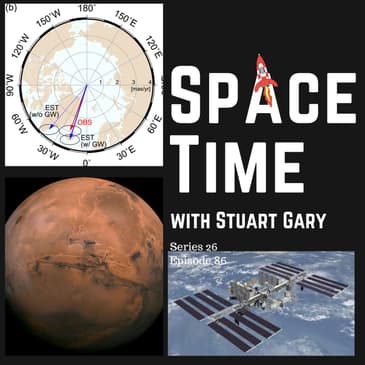
SpaceTime with Stuart Gary - your one-stop Space News Podcast
#astronomy #space #science #news #podcast #spacetime
Become a supporter of this podcast: https://www.spreaker.com/podcast/spacetime-with-stuart-gary--2458531/support.
00:00:00
STUART GARY: This is space time series 26 episode 86 for
00:00:03
broadcast on the 19th of July 2023. Coming up on space time,
00:00:09
it now seems human interference has changed Earth's spin axes. A
00:00:13
new study shows that Martian sand dunes have been eroded by a
00:00:17
shift in prevailing winds following the planet's last ice
00:00:20
age and a water recovery milestone aboard the
00:00:24
International Space Station. All that and more coming up on space
00:00:28
time.
00:00:30
GENERIC: Welcome to space time with Stuart Garry.
00:00:50
STUART GARY: A new study has shown that humans have changed
00:00:52
Earth's rotation by pumping out vast amounts of groundwater and
00:00:56
moving it elsewhere. The findings reported in the journal
00:00:59
Geophysical research letters has shown that the planet has tilted
00:01:03
by nearly 80 centimeters towards the east based on climate
00:01:07
models.
00:01:08
Scientists previously estimated that humans had already pumped
00:01:11
out some 2150 gigatons of groundwater equivalent to more
00:01:15
than six millimeters of sea level rise between 1993 and
00:01:19
2010. But validating that estimate has been difficult. One
00:01:24
approach lies with the Earth's rotational pole, that's the
00:01:28
point around which our entire planet spins.
00:01:31
Now it does move during a process called polar motion,
00:01:35
which is when the position of the Earth's rotational axis
00:01:38
varies relative to the crust. Now, the distribution of water
00:01:42
on the planet affects how mass is distributed and that impacts
00:01:46
where the Earth's axis is.
00:01:48
The study's lead author, Kay We Anser from Seoul National
00:01:51
University says it's like placing a tiny bit of weight on
00:01:54
a spinning tarp and causing it to rotate slightly differently
00:01:57
because of the change in weight distribution. In the same way,
00:02:01
the Earth spins a little bit differently on its axis as water
00:02:05
is moved around the Earth's rotational pole actually changes
00:02:08
a lot.
00:02:09
And the redistribution of groundwater actually has the
00:02:12
largest impact on the drift of the rotational pole. What its
00:02:16
ability to change Earth's rotation was discovered in 2016.
00:02:20
But until now, the specific contribution of groundwater to
00:02:24
these rotational changes was unexplored.
00:02:26
In this new study, researchers model the observational changes
00:02:30
in the drift of the Earth's rotational axis and the movement
00:02:33
of water first with only ice sheets and bleaches considered.
00:02:37
And then by adding in different scenarios of groundwater
00:02:40
redistribution, the model only matched the observed polar drift
00:02:44
once the researchers included 2150 gigatons of groundwater
00:02:49
redistribution. Without it, the model is off by 78.5
00:02:53
centimeters. That's 4.3 centimeters of drift per year.
00:02:58
The location of the groundwater matters for how much it could
00:03:01
change polar drift.
00:03:02
For example, redistributing groundwater from mid latitudes
00:03:05
has a larger impact on the rotational pole. And during the
00:03:09
study period, most of the groundwater was redistributed in
00:03:12
Western North America and North western India. Both of which are
00:03:16
mid latitude locations.
00:03:18
Attempts to slow groundwater depletion rates, especially in
00:03:22
these sensitive regions could theoretically alter the change
00:03:25
in drift. But only if such conservation approaches are
00:03:28
sustained for decades. Now, it's worth noting that the rotational
00:03:32
pole of the planet normally changes by several meters every
00:03:35
year. So changes due to groundwater pumping don't run
00:03:39
the risk of shifting seasons.
00:03:41
But on geological timescales pole and drift can have an
00:03:44
impact on climate. The next step for this research will be
00:03:48
looking into the past observing changes in Earth's rotational
00:03:52
pole is useful for understanding continent scale water storage
00:03:56
variations.
00:03:57
Polar motion data is available from as early as the late 19th
00:04:01
century. So scientists can potentially use this data to
00:04:05
understand continental water storage variations for at least
00:04:08
the last 100 years. Were there any major hydrological regime
00:04:12
changes resulting from a warmer climate? Polar motion could well
00:04:16
hold the answer.
00:04:18
This is space time still to come. A new study says the Red
00:04:23
Planet MARS underwent major climatic changes as its
00:04:27
rotational axis shifted about 400 years ago. And a new
00:04:31
water recovery milestone has been achieved aboard the
00:04:34
International Space Station. All that and more still to come on
00:04:38
space time.
00:04:53
A new study claims the Red Planet MARS underwent a sudden
00:04:56
change in prevailing weather patterns as the Martian
00:04:59
rotational axis shifted about 400 years ago. A detailed
00:05:04
analysis of data obtained by China's Jurong rover of dunes
00:05:08
located in the Southern Utopia Polynesia region of MARS
00:05:11
suggests the entire planet underwent a major shifting
00:05:14
climate that accompanied changes in prevailing winds.
00:05:18
A report in the journal Nature claims this shift coincided with
00:05:21
the end of the last glacial period. On MARS. The authors
00:05:25
assessed the surface structure and chemical composition of
00:05:28
Martian dunes that determined the age of sand structures and
00:05:31
prevailing wind directions at different locations near the
00:05:35
Jeong Rovers landing site.
00:05:37
They found the prevailing wind direction of the southern
00:05:40
utopian Polynesia shifted by nearly 70 degrees from north
00:05:43
east and north west eroding crescent shaped dunes formed
00:05:47
during the last glacial period into dark longitudinal ridges.
00:05:50
After the last Martian ice age.
00:05:53
The study's lead author Lai Chen Lai from the Chinese Academy Of
00:05:56
Sciences says the climate evolution of MARS has been a
00:05:59
principal focus for researchers on the Red Planet for years. He
00:06:03
says MARS is the most similar planet to the Earth in our solar
00:06:06
system and understanding Martian climatic processes promises to
00:06:10
uncover details of the evolution and history of Earth and other
00:06:14
planets in our solar system.
00:06:16
Previous research suggested that the Martian climate had changed
00:06:19
slowly over time drifting from a warm wet world capable of
00:06:23
supporting life into the freeze dried desert we see today, but
00:06:28
the inability to directly measure and sample geological
00:06:31
formations on MARS has always limited scientists' ability to
00:06:35
validate and better characterize the planet's climatic processes.
00:06:39
La's team used high resolution orbital cameras and the Jurong
00:06:43
Rovers terrain in the multi spectral cameras surface
00:06:46
composition analyzers and meteorological measuring
00:06:49
instruments to obtain in situ data directly from the Martian
00:06:52
surface.
00:06:54
The authors estimated that a change in the angle of the
00:06:56
rotational axis of MARS could have caused the planet to exit
00:07:00
its most recent ice age. The effects of these changes were
00:07:03
subsequently captured by the morphology orientation, physical
00:07:07
properties and Strat gray or layering of the dunes on the
00:07:10
southern utopian Polynesia where the Gero rover landed.
00:07:14
The study was designed to integrate rover scale data from
00:07:17
June formations and weather conditions to not only confirm a
00:07:21
change in prevailing wind direction with the close of the
00:07:23
last Martian ice age, but also improve general circulation
00:07:27
models used to predict finer scale changes in seasonal wind
00:07:30
direction.
00:07:32
Importantly, prevailing wind data and June's toray at the
00:07:35
rover's landing site were consistent with the presence of
00:07:38
ice and dust layers found at middle and higher latitudes on
00:07:41
the planet lies says that a great deal of effort is being
00:07:45
invested in characterizing the ancient climate of MARS over the
00:07:49
course of the Amazon in epoch that began about 3.55 to 1.8
00:07:54
billion years ago and continues to this day.
00:07:57
He says, understanding the Amazonian climate of MARS is
00:08:01
essential to explaining the current Martian landscape,
00:08:04
volatile matter reservoirs and atmospheric state.
00:08:07
And to relate these current observations and active
00:08:10
processes to models of the ancient climate of MARS.
00:08:14
Observations of the current climate of MARS can help refine
00:08:17
physical models of the Martian climate and landscape evolution
00:08:21
and even form new paradigms. This is space time still to come
00:08:27
a water recovery milestone aboard the International Space
00:08:30
Station.
00:08:31
And later in the science report, researchers all agree Planet
00:08:35
Earth has entered a new geological time epoch the
00:08:38
Anthropocene. All that and more still to come on space time for
00:08:58
manned missions that venture beyond low Earth orbit. Among
00:09:02
the many challenges crew face will be how to provide basic
00:09:05
needs without resupply missions from the ground.
00:09:09
As part of this problem, NASA are developing life support
00:09:12
systems that can regenerate or recycle consumable such as food,
00:09:16
air and water and they're testing them aboard the
00:09:19
International Space Station. Now, ideally life support
00:09:23
systems would need to recover close to 98 per cent of the
00:09:26
water which crews bring along with them at the start of a
00:09:29
journey.
00:09:30
And the space station's environmental control and life
00:09:32
support system, Elis has now demonstrated that it can achieve
00:09:36
this significant goal. Elis is a combination of hardware that
00:09:40
includes a water recovery system which collects waste water and
00:09:43
sends it to a water processing assembly which then converts it
00:09:47
into drinkable water.
00:09:48
One specialized component uses advanced dehumidifiers that
00:09:52
captures moisture released into the cabin air from people's
00:09:55
breath and sweat. Another subsystem recovers water from
00:09:59
urine using vacuum distillation, achieving around 94 per cent
00:10:02
recovery.
00:10:03
Now, a brine processor assembly has been added to the urine
00:10:07
distillation unit. Increasing reclaimable water levels to the
00:10:11
targeted 98 per cent needed for long duration space missions to
00:10:15
the moon. And MARS the brine processor assembly takes the
00:10:19
brine produced in the urine distillation unit and runs it
00:10:22
through a special membrane technology that blows warm dry
00:10:25
air over the brine to evaporate the water.
00:10:29
That process creates humid air which just like the crew breath
00:10:33
and perspiration is collected by the station's water collection
00:10:36
systems. All the collected water is treated by the water
00:10:39
processor assembly which uses a series of specialized filters
00:10:43
and a catalytic reactor that breaks down any trace
00:10:46
contaminants that remain sensors then check water purity and
00:10:50
unacceptable water is reprocessed.
00:10:53
The system also adds iodine to the acceptable water in order to
00:10:56
prevent microbial growth, it then stores it ready for the
00:11:00
crew to reuse. Turns out each crew member needs about four
00:11:04
liters of water per day for consumption, food preparation
00:11:07
and hygiene such as brushing teeth.
00:11:10
While the idea of drinking recycled sweat and urine might
00:11:13
make most people squeamish. NASA says the end result from the
00:11:16
onboard Elis processor is actually cleaner than what
00:11:20
municipal water systems produce on the ground. This report from
00:11:24
NASA TV.
00:11:26
NASA TV: Humans need water to survive. Each astronaut requires
00:11:30
about a gallon of water per day. But sending supplies of water to
00:11:34
space is difficult and expensive, resupply will become
00:11:38
impossible. As humans travel deeper into space.
00:11:42
The ability to recycle water on long term exploration missions
00:11:46
is critical to NASA's ability to complete those missions.
00:11:50
Thanks to the brine processor, part of the International Space
00:11:53
Station's water recovery system. NASA has the ability to recycle
00:11:57
98% of the water collected from the US SEGMENT on the orbital
00:12:01
outpost meeting the threshold necessary for water recovery on
00:12:05
long duration space exploration missions like something out of
00:12:10
science fiction.
00:12:12
Water from astronauts breath and sweat is collected by special
00:12:15
air conditioners that dehumidify the space station's cabin air.
00:12:20
The system also collects the crew's urine and runs it through
00:12:23
a urine processor which produces brine in 2021.
00:12:27
A special brine processor assembly was added to the
00:12:30
system, extracting more water and helping to demonstrate that
00:12:34
goal of reclaiming 98% of the space station us segments water
00:12:39
by working toward closing the water loop. NASA engineers are
00:12:43
saving millions of dollars and taking us one step closer to
00:12:46
long duration expeditions to the moon MARS and through space.
00:12:56
STUART GARY: This space time and time had to take another brief
00:13:16
look at some of the other stories making news in science
00:13:18
this week with the science report.
00:13:21
Well, there's no more debate about it. Planet Earth has
00:13:24
entered and is well entrenched in the new geological time era.
00:13:27
The Anthropocene, the fourth International conference on
00:13:31
stratigraphy has confirmed what scientists have been seeing
00:13:34
around them that Earth has changed radically due to human
00:13:37
intervention.
00:13:39
And so the international Anthropocene working group is
00:13:42
now trying to determine the best way of defining the Anthropocene
00:13:45
age on the basis of scientific findings and officially
00:13:49
declaring it as soon as possible. The researchers are
00:13:52
gathering evidence on how specific markers, exclusive
00:13:55
characteristics of the Anthropocene can be used to
00:13:58
determine in rostrata exactly when human influence on the
00:14:02
Earth's geology became irreversible.
00:14:04
This will show future scientists the point with human traces
00:14:08
began appearing in the rock strata. Now, various starting
00:14:11
dates for the start of the Anthropocene have been proposed.
00:14:14
These include the beginning of the agricultural revolution
00:14:17
between 12 and 15 years ago.
00:14:20
Although when you think about it, that was actually confined
00:14:22
to just one location. The more favorite date, one that's
00:14:25
detectable in the planet's geology globally is the
00:14:28
detection of radio nucleotide fallout associated with nuclear
00:14:32
bomb testing which began at trinity in 1945 and peaked
00:14:37
during the 19 fifties.
00:14:40
Well, it appears the great weight loss debate might
00:14:42
conclude in a stalemate. As us, researchers suggest both
00:14:46
intermittent fasting and calorie counting end up producing
00:14:49
similar results. Scientists split 90 adults with obesity
00:14:53
into three groups, eight hour time, restricted eating a
00:14:57
reduced calorie diet and no change whatsoever.
00:15:01
A report in the journal Annals of internal medicine found the
00:15:04
first two groups lost around the same amount of weight over the
00:15:07
study period. However, the fasting group had improved
00:15:11
insulin sensitivity compared to the calorie restricted group.
00:15:16
Paleontologists in Chile have identified a new species of
00:15:20
hadrosaur, an herbivorous duck bill dinosaur often referred to
00:15:23
as the cow of the dinosaur era. The discovery reported in the
00:15:28
journal science advances challenges long held beliefs
00:15:31
about the range of hadrosaur in the southern hemisphere.
00:15:34
Goo and Nano measured some 4 m in length, weighed over a ton
00:15:39
living during the cretaceous period 72 million years ago. In
00:15:43
the extreme south of what is now Patagonia, they could easily
00:15:46
adopt either a bipedal or quadrupedal posture in order to
00:15:49
reach vegetation. The name Gouin comes from the language of the
00:15:53
first inhabitants of the region and it means being similar to a
00:15:57
wild duck or swan.
00:16:00
There's more big news on the artificial intelligence front
00:16:03
today with the release of the latest iteration of Google's
00:16:06
bad. AI and Elon Musk confirming development of his own version
00:16:10
of artificial intelligence to be known as X dot A I. With the
00:16:14
details. We're joined by technology editor Alex Zahara
00:16:17
Reutt from Tech Advice dot live, both.
00:16:20
ALEX ZAHAROV-REUTT: Google and Elon Musk have been very busy
00:16:21
with AI this week, Google has just announced A I's biggest
00:16:24
expansion to date. So you can now listen to responses in over
00:16:27
40 languages if you want to hear the pronunciation of a word or
00:16:30
listen to a poem or a script. It's very handy for that. You
00:16:32
can enter a prompt and just tap on the sound icon to hear the
00:16:35
answers.
00:16:35
You can easily adjust the responses. This is something
00:16:37
that Microsoft did with being AI you could have casual, you could
00:16:40
have a conversation or you could have detail, but Bard has five
00:16:44
different options. You can have simple, long, short professional
00:16:47
or casual and they're starting with English only.
00:16:49
You can pin and re end conversations. You can use
00:16:52
images in your prompts, you can share bud responses and you can
00:16:55
even export Python code to repli. So yeah, they've really
00:16:58
expanded Bard clearly. They want to fight back against Chat GPT.
00:17:01
They want to fight back against being AI and they want to fight
00:17:03
back against what Elon Musk is playing with a.
00:17:05
STUART GARY: Musk is one of those people who are warning the
00:17:07
government about the dangers being posed by AI for both
00:17:11
social cohesion and also simply because could AI one day take
00:17:16
over the world? Are we looking at a Skynet scenario here?
00:17:19
And because there were so many companies involved in
00:17:22
researching AI for their own benefit, Musk wanted to counter
00:17:26
that with a different AI one that explores the universe for
00:17:30
humanity's benefit. And this sort of follows on from that
00:17:33
thesis. Yeah, it's.
00:17:34
ALEX ZAHAROV-REUTT: X dot AI. It's obviously his rival to KGB
00:17:38
says the goal of is to understand the true nature of
00:17:41
the universe. And he has said in the past that he wants his A I
00:17:44
to understand that humans are a really important part of the
00:17:47
universe. We shouldn't be destroyed or gotten rid of like
00:17:50
the Terminator and Skynet wanted to do.
00:17:51
And he's got a whole stack of former people from Chat GPT from
00:17:55
Google Research, Microsoft Research Tesla and the
00:17:58
University Of Toronto. So he's pulled together as many people
00:18:01
as he can to really turbocharge his AI efforts.
00:18:04
Now, even though the modern AI that we have today is really a
00:18:07
very advanced auto complete machine. It doesn't actually
00:18:11
have any sentience. It might seem like it does, it might seem
00:18:14
like you're speaking with a human being, but definitely
00:18:16
we're very far from actually having a truly sentient robot.
00:18:21
STUART GARY: That can sing.
00:18:22
ALEX ZAHAROV-REUTT: Yeah, we're very far away from that and I'll
00:18:24
have more information about the formation of X dot AI and the
00:18:27
link to the Twitter Spaces chat on my site, Tech Advice dot
00:18:31
life. You can go there to check it all out.
00:18:33
STUART GARY: That's Alex Sahara Rout from Advice dot live.
00:18:52
And that's the show for now. SpaceTime is available every
00:18:56
Monday, Wednesday and Friday through Apple podcasts, itunes,
00:18:59
Stitcher, Google Podcast, Pocket casts, Spotify, a Cast Amazon
00:19:04
music bites dot com, Soundcloud, YouTube, your favorite podcast
00:19:09
download provider.
00:19:10
And from Space time with Stewart Gary dot com. SpaceTime is also
00:19:15
broadcast through the National Science Foundation on Science
00:19:17
Zone Radio and on both iheart radio and Tune in radio.
00:19:22
And you can help to support our show by visiting the SpaceTime
00:19:25
store for a range of promotional merchandizing goodies or by
00:19:29
becoming a SpaceTime patron, which gives you access to triple
00:19:32
episode commercial free versions of the show as well as lots of
00:19:35
bonus audio content, which doesn't go to air access to our
00:19:38
exclusive Facebook group and other rewards.
00:19:41
Just go to space time with Stewart Gary dot com for full
00:19:44
details. And if you want more space time, please check out our
00:19:48
blog where you'll find all the stuff we couldn't fit in the
00:19:50
show as well as heaps of images, news stories, loads of videos
00:19:55
and things on the web.
00:19:56
I find interesting or amusing. Just go to space time with
00:19:59
Stewart Gary dot tumblr dot com.
00:20:01
That's all one word and that's Tumblr without the e you can
00:20:05
also follow us through at Stuart Garry on Twitter at space time
00:20:09
with Stewart Garry on Instagram through our space time YouTube
00:20:13
channel and on Facebook, just go to Facebook dot com forward
00:20:16
slash SpaceTime with Stewart Gary And SpaceTime is brought to
00:20:20
you in collaboration with Australian Sky and Telescope
00:20:23
Magazine, your Window on the Universe.
00:20:26
GENERIC: You've been listening to Space Time with Stuart Garry.
00:20:29
This has been another quality podcast production from bites
00:20:32
dot com.