
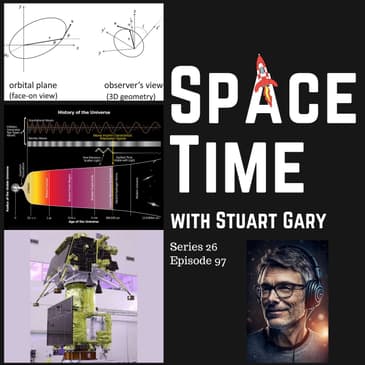
**2. Delving into the Universe's Infancy:** The Australian National University spearheads a groundbreaking research project. Dive deep into the early universe in three dimensions, exploring the formation of its first elements post the big bang, 13.8 billion years in the past.
**3. Chandrayaan-3's Lunar Feat:** India's ambitious lunar mission, Chandrayaan-3, achieves a pivotal milestone by successfully transitioning into a lunar orbit.
**4. The Science Report Highlights:** - A new variant of COVID-19 emerges, rapidly becoming dominant. - The Great Barrier Reef faces potential irreversible damages due to climate change. - Discoveries hint at possibly the largest animal ever to have existed.
**5. Skeptic's Corner:** A light-hearted guide to the concept of marrying a ghost.
**Support SpaceTime with Stuart Gary: Be Part of Our Cosmic Journey!**
SpaceTime is fueled by passion, not big corporations or grants. We're on a mission to become 100% listener-supported, allowing us to focus solely on bringing you riveting space stories without the interruption of ads. 🌌 **Here's where you shine:** Help us soar to our goal of 1,000 subscribers! Whether it's just $1 or more, every contribution propels us closer to a universe of ad-free content. **Elevate Your Experience:** By joining our cosmic family at the $5 tier, you'll unlock: - Over 350 commercial-free, triple episode editions. - Exclusive extended interviews. - Early access to new episodes every Monday. Dive in with a month's free trial on Supercast and discover the universe of rewards waiting for you! 🌠 🚀 [Join the Journey with SpaceTime 🌟 [Learn More About Us]
Together, let's explore the cosmos without limits!
#space #astronomy #science #news #podcast
Become a supporter of this podcast: https://www.spreaker.com/podcast/spacetime-with-stuart-gary--2458531/support.
00:00:00
This is Space Time series 26 episode 97 for broadcast on the
00:00:04
14th of August 2023. Coming up on Space Time, what could be the
00:00:10
biggest revolution in science since general relativity theory
00:00:14
unlocking the early universe in three dimensions and India's
00:00:18
Chandra in three enters lunar orbit. All that and more. Coming
00:00:23
up on Space Time.
00:00:26
Welcome to Space Time with Stuart Garry.
00:00:46
It could be the biggest revolution in science since
00:00:49
general relativity. But it's not there yet. A new study claims to
00:00:53
have confirmed modified Newtonian dynamics or mod which
00:00:57
is a variation of science's current understanding of gravity
00:01:01
under special circumstances. If correct, the immense
00:01:05
implications will be profound for all of astrophysics for
00:01:08
theoretical physics.
00:01:09
And of course for cosmology in its simplest terms, it would
00:01:14
completely change science's understanding of the universe.
00:01:18
It would also be vindication for theoretical physicist mode Hai
00:01:21
Milgram from the Weisman Institute in Israel who 40 years
00:01:25
ago first calculated his revolutionary theoretical
00:01:28
framework, famously known today as modified Newtonian dynamics
00:01:33
or Mond.
00:01:34
The authors of the latest research claim their discovery
00:01:37
which has been reported in the Astrophysical Journal has met
00:01:40
the conventional five sigma criteria needed for a new
00:01:44
scientific discovery, if confirmed, it would resolve the
00:01:47
long standing mystery of dark matter, that invisible substance
00:01:51
that makes up over 80 per cent of the mass of the universe, but
00:01:54
which interacts only gravitationally with
00:01:56
conventional so called bionic matter.
00:01:59
The stuff that makes up everything we see in the
00:02:01
universe from stars and planets down to dogs, cats, cats,
00:02:05
horses, trees, and people scientists know dark matter is
00:02:09
real only because they can see its effect on Galaxies,
00:02:12
providing the extra mass and hence the extra gravity needed
00:02:16
to hold them together as they rotate, preventing them from
00:02:19
flinging apart.
00:02:20
However, if gravity was just a little bit different under
00:02:24
certain conditions, you wouldn't need dark matter, it may not be
00:02:27
real.
00:02:27
After all, this new study is based on data collected by the
00:02:31
European Space Agency's Gaer mission which has been gathering
00:02:34
observations on the exact position and movement of
00:02:37
billions of stars in our galaxy, including their speed and
00:02:40
direction. In other words, their proper motion through space.
00:02:44
The study's lead author, Q Yun Chee from the Sigo University in
00:02:47
Seoul decided to examine not the rotation of entire Galaxies but
00:02:52
the orbital motions of long period, widely separated binary
00:02:56
star systems, which he refers to as white binaries galactic discs
00:03:00
and wide binaries share some similarities in their orbits.
00:03:04
Although wide binaries follow highly elongated orbits, while
00:03:08
hydrogen gas particles in the galactic disc follow nearly
00:03:11
circular orbits by taking their measurements to the limit of
00:03:14
verifiable analysis. Cha and colleagues were able to provide
00:03:17
what they claim is conclusive evidence of the breakdown of
00:03:21
standard gravity in low acceleration situations in
00:03:24
binary star systems.
00:03:26
Put simply they discovered a difference in the way gravity
00:03:29
was acting, which doesn't match the Standard Newtonian model in
00:03:34
order to get as much data as possible.
00:03:35
He repeated the observations on 26 wide binaries within the
00:03:40
650 light years observed by GAA getting the same effect each
00:03:45
time Chee's study focused on calculating the gravitational
00:03:49
accelerations experienced by binary stars as a function of
00:03:52
their separation or equivalently the orbital period by a mighty
00:03:56
Carlo de projection of observed sky projected motions in three
00:03:59
dimensional space.
00:04:01
He found that when two stars orbit around each other with
00:04:04
accelerations lower than about one nanometer per second
00:04:07
squared, they start to deviate from the predictions of Newton's
00:04:10
universal law of gravitation.
00:04:12
And Einstein's General Relativity theory. In fact, for
00:04:16
accelerations lower than about 0.1 nanometers per second
00:04:19
squared, the observed acceleration was about 30 to 40
00:04:22
per cent higher than the Newton Einstein predictions.
00:04:26
In a sample of 20 wide binaries within a distance of
00:04:29
650 light years, two independent acceleration bins respectively
00:04:33
showed deviations of over five sigma significance in the same
00:04:37
direction because the observed acceleration is stronger than
00:04:41
about 10 nanometers per second squared. All agreed with
00:04:43
Newtonian Einsteinian predictions from the same
00:04:46
analysis.
00:04:47
The observed boost in accelerations at lower
00:04:50
accelerations is a mystery. Now what was intriguing about this
00:04:53
breakdown of Newtonian Einstein theory at accelerations weaker
00:04:57
at about one nanometer per second squared is exactly what
00:05:00
mode Milgram first suggested in his own theoretical work on
00:05:04
modified Newtonian dynamics or Mond.
00:05:07
Moreover, the boost factor of about 1.4 is correctly predicted
00:05:11
by a mod type Lagrangian theory of gravity known as aquel, which
00:05:15
was proposed by Milgram. And the late physicist Jacob Beckstein.
00:05:19
What is remarkable is that the correct boost factor requires
00:05:23
the external field effect from the milky way galaxy. That's a
00:05:26
unique prediction of Monn type modified gravity. So what the
00:05:30
wide binary data shows is not just the breakdown of Newtonian
00:05:34
dynamics but also the manifestation of the external
00:05:37
field effect of modified gravity.
00:05:40
Unlike galactic rotation curves in which the observed boosted
00:05:43
accelerations can at at least in principle be attributed to dark
00:05:46
matter. In the Newtonian Einstein standard gravity model
00:05:50
wide binary dynamics can't be affected by it even if it
00:05:53
existed.
00:05:54
Standard gravity simply breaks down in the weak acceleration
00:05:57
limit in accordance with the mon framework. Now, if it's all
00:06:00
verified, the implications of wide binary dynamics will be
00:06:04
profound just as anomalies in mercury's orbit observed in the
00:06:08
19th century, eventually led to Einstein's General Relativity.
00:06:12
Now anomalies in wide binaries will require a new theory
00:06:16
extending general relativity to the low acceleration mind limit.
00:06:20
Despite all the success of Newtonian gravity, Einstein's
00:06:23
General Relativity is still needed for relativistic
00:06:26
gravitational phenomena such as black holes and gravitational
00:06:29
waves.
00:06:30
Likewise, despite all the successes of general relativity,
00:06:34
a new theory beyond this is needed for Mond phenomena in the
00:06:38
weak acceleration limit. Now if confirmed, it would mean that
00:06:41
because gravity follows Mond, a large amount of dark matter in
00:06:45
Galaxies in the universe as a whole are no longer needed.
00:06:48
As for the man who came up with the idea in the first place.
00:06:52
Well Milgram put it simply, he says it would mean a new
00:06:55
revolution in physics was underway, but for such a far
00:06:59
reaching finding and it is indeed very far reaching science
00:07:02
requires confirmation by independent analysis with
00:07:06
preferably even better future data.
00:07:08
Milgram says if the anomaly is confirmed as a breakdown of
00:07:12
Newtonian dynamics and especially if it indeed agrees
00:07:15
with the most straightforward predictions of Mond, it will
00:07:17
have enormous implications for astrophysics for cosmology and
00:07:22
for fundamental physics at large.
00:07:24
And I guess if that's the case, I hope you remember where you
00:07:27
heard it first. This is Space Time still to come unlocking the
00:07:33
early universe in three dimensions. And India's Chan in
00:07:36
three spacecraft enters lunar orbit, all that and more still
00:07:40
to come on Space Time.
00:07:59
The Australian National University is continuing to lead
00:08:02
a key project studying the formation of some of the first
00:08:05
elements to form in the universe. Following its creation
00:08:08
of the Big Bang 13.82 billion years ago.
00:08:11
This decade long project has been looking back in in the
00:08:14
infancy of the universe, especially at a watershed event
00:08:18
that dramatically changed the cosmos as we know it from a
00:08:21
neutral and dark place to one being almost completely ionized
00:08:25
and transparent. Basically giving us the universe we have
00:08:29
today. It's a period known as the epoch of re ionization a
00:08:34
time when the first structures in the universe were formed.
00:08:38
Despite its pivotal role, the epoch of realization is one of
00:08:41
the least understood phases in the history of the universe. The
00:08:45
project under the umbrella of Astro 3D, formerly Castro 3D
00:08:49
seeks to answer significant questions about this time in
00:08:52
cosmic history such as where did the energy to ionize the entire
00:08:56
universe come from?
00:08:57
And was it simply ultraviolet light from the first stars? Or
00:09:01
were there other forces at play exactly? When did the veil of
00:09:05
the cosmic dark ages rise?
00:09:07
And how long did it take tracing the distribution of matter from
00:09:10
the earliest times of the universe through to the present
00:09:13
day will help astronomers build a three dimensional picture of
00:09:16
the formation and evolution of the universe as we see it today.
00:09:21
Astronomers need to know how the structures of the universe, the
00:09:24
cosmic web as we see it now grew out of matter forming the
00:09:27
building blocks of the Galaxies like our own milky way.
00:09:31
And also what forces shape the accumulation and motion of
00:09:34
matter in the universe across space and time to achieve these
00:09:38
goals. Scientists including Professor Lisa Curley are
00:09:41
developing a new generation of instruments to view the sky in
00:09:44
more exquisite three dimensional observations than ever before.
00:09:48
The work is being funded by the Australian Research Council's
00:09:51
Center Of Excellence For All Sky Astrophysics in three
00:09:54
dimensions. It's helping to unlock secrets of the early
00:09:58
universe and study the development of elements that
00:10:01
make up the periodic table.
00:10:03
Kiley says the project's investigating nothing less than
00:10:06
how the universe formed its first matter in the dark moments
00:10:09
after the Big Bang, how the first stars and Galaxies formed
00:10:13
and evolved into the Galaxies we see today Galaxies like our
00:10:16
milky way and how stars created the chemical elements that bat
00:10:20
the universe as we see it.
00:10:22
Now, the research is being conducted by a team of around
00:10:26
200 scientists and engineers from around the world. Part of
00:10:30
the project involves the development of new high tech
00:10:32
instruments.
00:10:33
These are going to be crucial not just for this project but
00:10:36
also for the next generation of giant optical and radio
00:10:39
telescopes such as the giant Magellan telescope and the
00:10:43
square kilometer array. Kelley says by using the newly
00:10:46
developed three dimensional technology on current optic and
00:10:49
radio telescopes, scientists will be able to build a picture
00:10:52
of how Galaxies formed and evolved across cosmic time.
00:10:56
The technology is helping scientists build three
00:10:59
dimensional models which are pinpointing which materials
00:11:01
formed in the early universe and map where those elements and
00:11:05
stars were born and also how they evolved into the universe
00:11:08
that we live in today.
00:11:10
So we're aiming to radio and optical telescopes combined with
00:11:14
supercomputers to understand how the matter and the chemical
00:11:18
elements in the universe formed and evolved across cosmic time.
00:11:21
The way we currently see the is that the Big Bang itself created
00:11:25
when the universe cooled down enough from a quark gluon plasma
00:11:29
created the first elements of hydrogen and helium and maybe a
00:11:33
bit of lithium and brill too. And after that, the sort of took
00:11:37
over that process.
00:11:38
That's right. And so this is a these other elements, in
00:11:41
particular, the carbon and the nitrogen and oxygen.
00:11:46
And we think these are made either stars during their
00:11:49
lifetimes, especially big stars, the population three stars, for
00:11:52
example, would have been huge, they would, they would have made
00:11:55
huge amounts of these elements and the other elements, the
00:11:58
heavier elements were made when these stars went supernova. That
00:12:00
's correct.
00:12:01
So there's multiple stars that we need to look at and we have
00:12:05
detailed simulations of entire stellar populations where so we
00:12:10
have a big series program in the Center Of Excellence where we're
00:12:13
generating whole populations of stars and enjoying them together
00:12:16
to create simulations of Galaxies.
00:12:19
Are we looking at watching them evolve and see how they change
00:12:22
with age through time?
00:12:23
Yeah, that's right. So in the simulations, we can do that. And
00:12:26
then with observations, what we're going to be doing is we're
00:12:28
going to be using the milky way to look at stars that formed at
00:12:32
different times. We're going to be looking for the oldest stars
00:12:35
in the milky way, which could be the first stars that formed in
00:12:38
the universe.
00:12:39
And also we're going to be then looking at the first Galaxies
00:12:42
that formed in the universe, be doing that directly with the
00:12:44
James Webb space telescope. And after that, we'll be looking at
00:12:48
Galaxies at all different distances from us. And with
00:12:52
that, we can actually look back in time many billions of years.
00:12:55
We've used the Hubble space telescope to look at very
00:12:58
distant Galaxies and those Galaxies look very different to
00:13:01
the Galaxies that we see today. So the distant Galaxies in the
00:13:05
very early universe were very clumpy and lumpy and very messy
00:13:09
looking.
00:13:09
They don't anything like our beautiful spiral milky way
00:13:12
galaxy or the elliptical smooth Galaxies that we have around us.
00:13:17
So we're hoping to look back even earlier to look at the
00:13:19
building blocks of those Galaxies, the smaller clumps of
00:13:24
matter and the smaller clumps of star formation in the very early
00:13:28
universe to see Galaxies when they were actually first forming
00:13:31
one of.
00:13:32
The big hopes of James Webb. Also, I guess a dream for many
00:13:36
astronomers is to actually see a population three star.
00:13:40
Yes, that's right. So that's one of the hopes for this center as
00:13:43
well is to see a population three star. And we're aiming to
00:13:47
do it in two ways with the space telescope. But also by looking
00:13:50
at studies of millions of stars in our milky way, these
00:13:53
population.
00:13:54
Three stars are very important. These first stars, they're very
00:13:57
different from the stars we see today, aren't they?
00:13:59
They are, they've got a very strange amount of elements in
00:14:03
them. They're very pristine. They've got hardly any elements
00:14:06
that we have around today in our milky way. So for example, if
00:14:11
we're looking at, they're looking at the oxygen or the
00:14:14
iron in them, they can have very, very little oxygen or iron
00:14:17
when you have.
00:14:18
That sort of lack of metallic, which is what we refer to when
00:14:21
we talk about elements other than hydrogen and helium on the
00:14:24
periodic table. When you have so little metallic that must make
00:14:27
the star look very different. It must be a very different type of
00:14:30
star to what we have today in terms physically of size and
00:14:34
mass.
00:14:34
Haven't found them quite yet. We found stars that are very close
00:14:37
but not quite discovered those first stars, the Galaxies were
00:14:42
very messy, they were clumpy and some of the Galaxies were very,
00:14:46
very blue compared to today. They had much more star
00:14:50
formation. They had much more star formation happening per
00:14:53
given volume than they do in Galaxies today.
00:14:56
30 times more than the milky way does.
00:14:58
Now, back then, we are discovering Galaxies with spiral
00:15:01
arms that have already been cleanly formed around six or 7
00:15:06
billion years ago. So they must have started forming earlier
00:15:09
galaxy clusters.
00:15:10
Some of them are believed to have been formed very early on
00:15:12
too.
00:15:13
Yes, the galaxy clusters seem to have been formed many billions
00:15:16
of years ago, maybe eight or even 10 billion years ago. The
00:15:19
first clusters would have been forming and we've been looking
00:15:22
at some nearby what we call nearby galaxy clusters. They're
00:15:26
actually about 8 billion years ago. We looked back in time and
00:15:30
we're both looking at understanding the star formation
00:15:34
happening within the galaxy clusters.
00:15:36
And also we're using them as gravitational lenses. The big
00:15:39
galaxy clusters bend the light from background Galaxies and
00:15:42
magnify it and allow us to see the light from the background
00:15:46
Galaxies that it would be far too faint for us to see with our
00:15:49
modern day telescopes. So the galaxy clusters are useful for
00:15:53
many different reasons.
00:15:54
Is it fair to think that because the universe was a physically
00:15:58
smaller place back then, hadn't spread out as much, hadn't
00:16:02
expanded as much. That makes perfect sense that there would
00:16:04
have been galaxy clusters so early on.
00:16:06
Yes. So we think that Galaxies were having lots more collisions
00:16:10
and were much closer together in the past. And we think that that
00:16:14
also contributed to the large amount of star formation that
00:16:17
we, that we see in the early universe.
00:16:19
When Galaxies collide together or pass close by each other,
00:16:22
there's a lot of gas collisions happening within the galaxy,
00:16:25
their gravitational potentials are disrupted and there's tidal
00:16:29
forces large, occurring through the galaxy. And then this causes
00:16:33
gas collisions which then causes star formation to happen in the
00:16:37
densest regions of the gas.
00:16:38
Why is ionization important? What does that tell us about?
00:16:42
Well, the universe we live in.
00:16:43
Ionization is incredibly important because this was the
00:16:46
time when the universe changed from being in the dark ages to
00:16:50
the lit universe, when the first stars and the first Galaxies and
00:16:54
the first black holes lit up the universe. And this, it was
00:17:00
basically a watershed event in the history of the universe.
00:17:03
And it was the first time ionizing radiation radiation
00:17:07
that rips electrons off atoms. It's the first time that that
00:17:11
was produced in the universe and our current universe is 99 per
00:17:15
cent ionized and how it got to this state is unknown. And that
00:17:18
's one of the goals of this center to explain how the
00:17:22
universe reached this level of ionization.
00:17:24
That's Professor Lisa Curley from the Australian National
00:17:27
University and this is Space Time still to come. India's
00:17:32
Chandra and three spacecraft enters lunar orbit. And later in
00:17:36
the science report, a new strain of COVID-19 that's fast becoming
00:17:40
one of the most prevalent variants, all that and more
00:17:43
still to come on Space Time.
00:18:01
India's Chandra Three spacecraft has successfully transitioned
00:18:05
from an earth centric to a lunar centric orbit. Marking a major
00:18:10
milestone in India's ambitious lunar project. The Israel or
00:18:14
Indian Space Research Organization spacecraft is
00:18:17
carrying the moon mission three lander which is stated to
00:18:20
descend to the lunar surface on August.
00:18:22
The 23rd mission managers say their 3900 kg spacecraft is
00:18:28
performing nominally the probe successfully undertaken a series
00:18:31
of planned orbital reduction maneuvers designed to tighten
00:18:35
its orbit and these will continue throughout the coming
00:18:37
week.
00:18:38
Then the Vikram lander will be deployed to begin its journey
00:18:41
down to the lunar surface. The target is the moon's little
00:18:45
explored South Pole Region. If successful India will become the
00:18:49
fourth nation to have achieved a soft landing on the moon behind
00:18:53
the Soviet Union, the United States and China.
00:18:56
Once on the ground, Vikram will release the 26 kg program.
00:19:00
Rover, the tiny six wheeled vehicle will explore the moon's
00:19:03
South Pole Region examining the moon's surface composition, its
00:19:07
thin exosphere and its tectonic activity. The presence of water
00:19:12
at the bottom of craters in permanently shadowed areas of
00:19:15
the moon's South Pole will be of special interest for this
00:19:18
mission.
00:19:19
We'll keep you informed. This is Space Time and time now to take
00:19:40
a brief look at some of the other stories making news in
00:19:42
science this week where the science report a new strain of
00:19:46
COVID-19 is fast becoming one of the most prevalent variants of
00:19:50
the disease in the United Kingdom in the United States and
00:19:53
Australia will most likely be next.
00:19:56
America's CDC says the COVID sub variant eeg 5.1 1st showed up in
00:20:02
February and quickly began dominating cases in the process.
00:20:06
Joining the other seven common variants circulating throughout
00:20:09
the community which are now being monitored by the World
00:20:11
Health Organization Immunity researcher, Professor Cassandra
00:20:15
Berry from Murdoch University says the E 5.1 variant is
00:20:19
descended from the lineage of the omicron variant of SARS COV
00:20:23
two that suggests that immunity to mico will provide a level of
00:20:28
protection against the new strain and lower the disease
00:20:31
severity.
00:20:32
But she says it's still important for people to stay up
00:20:34
to date with their vaccination boosters as the threat of
00:20:37
disease from these pandemic viruses is not over right now.
00:20:42
Some 7 million people have been killed by the COVID-19
00:20:45
Coronavirus since it was first detected near China's Wuhan
00:20:49
Institute Of Virology. Back in September 2019, the World Health
00:20:54
Organization estimates the true death toll is likely to be
00:20:57
around 18 million with some 768 million confirmed cases
00:21:01
globally, almost 10 per cent of the planet's population.
00:21:06
A new report warns that the Great Barrier Reef is likely to
00:21:10
face impacts from climate change that could become irreversible
00:21:14
around mid century regardless of whether global emissions
00:21:17
stabilize. That's the latest warning contained in a new study
00:21:21
by the Australian Academy Of Sciences. The report explores
00:21:25
different possible future scenarios for the Great Barrier
00:21:28
Reef under different emission levels.
00:21:31
A total of 84 multidisciplinary experts joined the roundtable
00:21:34
discussions. The first on climate impacts on functions of
00:21:37
the Great Barrier Reef. The second on interventions and the
00:21:41
third on the future of the reef. The report makes it clear that
00:21:45
climate change remains the primary threat to this global
00:21:49
icon and its connected systems.
00:21:52
Scientists have discovered the remains of what might well be
00:21:55
the largest animal that ever lived. The 39 million year old
00:21:59
whale fossils reported in the journal nature were uncovered in
00:22:03
southern Peru and include 13 vertebra, four ribs and a hip
00:22:07
from a bacillus Sauro whale estimated to have been somewhere
00:22:10
between 85 and 340 tons in weight.
00:22:14
Paleontologists say that at the higher end of this estimated
00:22:17
range, the whale named Pertus Colossus would have been both
00:22:21
longer and heavier than a blue whale which at 29.9 m in length
00:22:25
and a mass of up to 219 tons is currently believed to be the
00:22:29
biggest animal that ever lived.
00:22:31
The authors say the buoyancy associated with the increase in
00:22:35
bone mass is consistent with a shallow water lifestyle,
00:22:38
supporting the idea that Bacillus Soros were hyper
00:22:41
specialized for coastal environments.
00:22:45
If you're trying to become a famous mega rock star, but the
00:22:48
talent trains already left the station. What do you do? Well,
00:22:52
you marry a ghost of course, just before you release your
00:22:55
latest album and make sure as many people know about it as
00:22:57
possible. However, as Tim Mendham from Australian Skeptics
00:23:01
reports, it's a marriage that never really had a ghost of a
00:23:04
chance.
00:23:05
There's a singer in the UK named Brock Hard, who supposedly
00:23:09
married a ghost a few years ago to the surprise of her fans, I
00:23:13
presume she had some fans and she married this ghost an
00:23:15
interesting experience and a sad person down the road. And now
00:23:21
she's actually found out that the marriage wasn't as good. It
00:23:23
was going to be.
00:23:26
It never goes to a chance. Right.
00:23:28
And so she's now getting divorced from the ghost. I
00:23:31
really don't know whether the ghost worries about those legal
00:23:35
niceties of having a bit of paper saying you're divorced. So
00:23:37
she turned to an exorcist to end her tumultuous marriage after
00:23:41
five miserable months of being married to the paranormal
00:23:43
character.
00:23:44
Ok. That was a relationship that worked well or didn't last that
00:23:47
long. But you said it was like carrying a huge weight I didn't
00:23:49
think were heavy anyway, but never mind carrying a huge
00:23:52
weight around the responsibility, I suppose of
00:23:54
looking after a ghost.
00:23:55
What responsibility? I mean, ghosts are pretty well self
00:23:58
cleaning.
00:23:59
They don't live in me around the house. Normally they don't have
00:24:02
a lot of clothes to worry about. Exactly. Nothing to wash sheets.
00:24:07
Maybe we had to patch up those holes where the eyes are that
00:24:13
the strange thing is you sort of wonder what this is about?
00:24:16
No, I mean, I just don't think she got the spirit of things.
00:24:19
Yeah. Thank you. You wonder why it was happening? And she, her
00:24:22
ghost was named Eduardo with a w, not an Eduard but Eduardo and
00:24:27
she was looking forward to starting a new life. I don't
00:24:29
think they were going to have a family but never mind. But why
00:24:31
was it happening? She's a musician and, oh, she's got a
00:24:33
new record coming out. Pardon? My cynicism.
00:24:35
But I would suggest she's trying to get publicity and she was
00:24:38
trying to get publicity for the first time when she got married.
00:24:41
Now she's trying to get publicity because of the divorce
00:24:43
and that's me being terribly cynical, but she's a person. If
00:24:45
you go onto the news sites and have a look at the stories about
00:24:48
her, she's a person who loves to pose, she's posing in
00:24:50
cemeteries.
00:24:51
She sort of coy look and the heavy on the eye makeup and all
00:24:53
that sort of, it's all about me. I think it is all about her.
00:24:57
Yeah. And I think she's trying to muster up some publicity for
00:25:00
her new record coming out just now. I don't know what it sounds
00:25:03
like. I haven't heard the record. It might be played
00:25:05
backwards.
00:25:06
It's one of those sort of sad but interesting stories that we
00:25:10
get hit with a lot of.
00:25:11
It's like watching the Sussex, isn't it? You know, we want
00:25:14
privacy, we want privacy.
00:25:17
It's also very much you wonder. I don't think most people take
00:25:21
it that seriously. So, I don't think it's going to be the end
00:25:23
of the world sort of story if she gets divorced and then
00:25:25
remarried again. You know, it's one of those.
00:25:27
Things that's Tim Mendham from Austria in Skeptics and that's
00:25:47
the show for now. SpaceTime is available every Monday,
00:25:50
Wednesday and Friday through Apple podcasts, itunes,
00:25:54
Stitcher, Google podcast, Pockets, Spotify, a cast Amazon
00:25:59
music bites dot com, soundcloud, YouTube, your favorite podcast
00:26:03
download provider and from Space Time with Stewart Gary dot com.
00:26:08
SpaceTime is also broadcast through the National Science
00:26:11
Foundation on Science Zone Radio and on both iheart Radio And
00:26:15
Tune in radio.
00:26:16
And you can help to support our show by visiting the SpaceTime
00:26:19
Store for a range of promotional merchandizing goodies or by
00:26:23
becoming a SpaceTime patron, which gives you access to triple
00:26:26
episode commercial free versions of the show as well as lots of
00:26:29
bonus audio content which doesn't go to air access to our
00:26:33
exclusive Facebook group and other rewards. Just go to Space
00:26:37
Time with Stewart Gary dot com for full details.
00:26:40
And if you want more Space Time, please check out our blog where
00:26:43
you'll find all the stuff we couldn't fit in the show as well
00:26:46
as heaps of images, news stories, loads of videos and
00:26:49
things on the web. I find interesting or amusing. Just go
00:26:52
to Space Time with Stuart Garry dot tumblr dot com.
00:26:56
That's all one word and that's Tumbler without the E you can
00:27:00
also follow us through at Stuart Garry on Twitter at Space Time
00:27:03
with Stuart Garry on Instagram through our Space Time YouTube
00:27:07
channel and on Facebook, just go to Facebook dot com forward
00:27:11
slash Space Time with Stewart Gary and SpaceTime is brought to
00:27:15
you in collaboration with Australian Sky and Telescope
00:27:17
Magazine. Your Window on the Universe.
00:27:20
You've been listening to Space Time with Stuart Garry. This has
00:27:24
been another quality podcast production from bites dot com.