
In this episode:
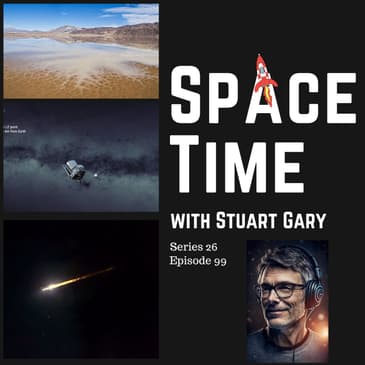
- **Mars Curiosity Rover's Discovery**: Unearth the secrets of the Red Planet with NASA's latest findings. Ancient mud cracks suggest potential life-friendly conditions on Mars. Dive deep into the significance of these hexagonal patterns and what they mean for the history of microbial life. - **Europe's Eucalyptus Spacecraft's Journey**: Join the European Space Agency as their spacecraft reaches its final orbit. Discover its mission alongside the James Webb Space Telescope and the mysteries they aim to unravel. - **Fiery Skies Over Melbourne**: Experience the awe as Melbourne's sky lights up with space junk from a Russian Soyuz rocket. Learn about the mission behind this rocket and where the debris finally settled. - **Euclid's Mission to Uncover Dark Matter**: Embark on a cosmic journey with the European Space Agency's Euclid spacecraft. Delve into its mission to study dark matter, dark energy, and the accelerating expansion of the universe. - **Science Report Highlights**: Explore the latest in science, from the tragic history of Europe's first human inhabitants to the alarming climate changes in Asia. Stay updated with the most recent discoveries and studies shaping our understanding of the world. Stay tuned with "SpaceTime with Stuart Gary" for more exciting space adventures and scientific revelations.
Become a supporter of this podcast: https://www.spreaker.com/podcast/spacetime-with-stuart-gary--2458531/support.
00:00:00
This is space time series 26 episode 99 for broadcast on the
00:00:04
18th of August 2023. Coming up on SpaceTime, the Ancient
00:00:10
Martian mud cracks that could have sparked life on the Red
00:00:13
Planet Europe's Eucalypt spacecraft reaches its final
00:00:16
orbit and a fiery space junk display in the skies high above
00:00:21
Melbourne. All that and more coming up on space time.
00:00:26
Welcome to space time with Stuart Garry.
00:00:46
Scientists say the Discovery of mud cracks on the Red Planet's
00:00:49
surface by NASA's Mars. Curiosity rover suggests that
00:00:52
this area may have been favorable for the emergence of
00:00:55
microscopic life on Mars if it ever existed there.
00:00:59
Scientists of course, aren't entirely sure how life began
00:01:02
here on Earth, but one hypothesis suggests that
00:01:06
persistent cycles of wet and dry conditions on land helped
00:01:09
assemble the complex chemical building blocks necessary for
00:01:12
microbial life to evolve. And that's why a patchwork of well
00:01:16
preserved ancient mud cracks found by curiosity is causing so
00:01:20
much excitement for mission managers.
00:01:23
The Discovery reported in the journal nature details how the
00:01:26
distinctive hexagonal pattern in these mud cracks offers the
00:01:29
first evidence of wet dry cycles occurring on early Mars, the
00:01:34
study's lead author, William Rain from France's Research
00:01:37
Institute Of Astrophysics And Planet Technology says this type
00:01:40
of mud crack forms when wet and dry cycles occur repeatedly
00:01:44
perhaps seasonally.
00:01:45
The robotic mobile laboratory first spotted the mud cracks
00:01:48
back in 2021 after drilling a sample from a rock target named
00:01:52
Puntos, which was found within a transitional zone between a clay
00:01:56
rich layer and one higher up that's enriched with salty
00:01:59
minerals called sulfates. While clay minerals usually form in
00:02:03
water sulfates tend to form as water evaporates.
00:02:07
The minerals prevalent in each area reflect different areas of
00:02:11
Gale Crater's history. The transitional zone between them
00:02:14
offers a record of a period when long dry spells became prevalent
00:02:18
and the lakes and rivers that once filled the crater began to
00:02:21
recede as mud dries out, it shrinks and fractures into t
00:02:26
shaped junctions.
00:02:27
These are what curiosity discovered previously at the old
00:02:30
circus site. A collection of mud cracks lowered down on Mount
00:02:33
Sharp. Those junctions are evidence that old circus mud
00:02:37
formed and dried out once. While the recurring exposures to water
00:02:41
that created the Ponte's mud caused the t shaped junctions to
00:02:44
soften and become y shaped, eventually forming a hexagonal
00:02:48
pattern.
00:02:49
The hexagonal cracks in the transitional zone kept forming
00:02:52
even as new sediment was deposited. Indicating that the
00:02:55
wet dry conditions continued over a long period of time. Ken
00:03:00
Cam Curiosity's Precision Laser instrument and confirmed a hardy
00:03:03
crust of sulfates along the cracks edges, which isn't too
00:03:06
surprising.
00:03:07
Given the proximity to the sulfate region, the salty crust
00:03:11
is what made the mud cracks resistant to erosion, preserving
00:03:14
them for billions of years ripen says it's the first tangible
00:03:18
evidence that the Ancient Martian climate had regular
00:03:22
Earth like wet dry cycles. But even more important, these wet
00:03:26
dry cycles are helpful, maybe even required for the molecular
00:03:30
evolution that could ultimately lead to life.
00:03:33
Although water is essential for life, as we know it, a careful
00:03:36
balance is needed. Not too much water, not too little, the kinds
00:03:40
of conditions that sustain microbial life. Those that allow
00:03:43
a long lasting leg, for example, aren't the same as the
00:03:46
conditions scientists think are required to promote the chemical
00:03:49
reactions that could lead to life.
00:03:51
A key product to those chemical reactions are long chains of
00:03:54
carbon based molecules called polymers, including nucleic
00:03:58
acids, molecules considered to be the chemical building blocks
00:04:01
of proteins which are essential for life as we know it.
00:04:04
And wet dry cycles control the concentration of chemicals that
00:04:08
feed those fundamental reactions leading to the formation of
00:04:11
polymers over its 11 years on the surface of the Red Planet.
00:04:15
Curiosity has found ample evidence that ancient Mars could
00:04:19
have supported microbial life. Now, the mission has found
00:04:23
evidence of the sort of conditions that may well have
00:04:25
promoted the origin of life as well.
00:04:28
The Discovery of the ponto mud cracks may well have provided
00:04:31
scientists with their first opportunity to study the remains
00:04:35
of life's cauldron. Remember Earth's tectonic plate activity
00:04:39
constantly recycles its surface thereby bearing examples of
00:04:42
prebiotic life on this planet. Mars doesn't have tectonic
00:04:47
plates.
00:04:48
So much older period of that planet's history have been
00:04:51
preserved for scientists to study and who knows what they'll
00:04:55
find. This is space time still to come. Esa's Eucalypt mission
00:05:01
reaches its final orbit and Victorians treaded to a fiery
00:05:05
skyy display as space junk plummets towards the surface.
00:05:09
All that and more still to come on space time.
00:05:27
Ok. Let's take a short break from our show for a word from
00:05:30
our sponsor Nord VPN. You know, you really should be worried
00:05:35
about your online privacy and that of your family as well.
00:05:39
After all. Who wants some bad actor prying on your kids while
00:05:43
they're online? If you're worried then, so are we?
00:05:47
And that's why we recommend Nord VPN an easy to use lightning
00:05:52
fast and secure virtual private network that keeps your data
00:05:55
safe and protected from prying eyes. It's the system we use and
00:06:00
we were using it long before they became a sponsor of ours.
00:06:04
So we really can recommend it with nought VPN.
00:06:08
You can browse the internet without fear of someone snooping
00:06:11
on your traffic and they don't keep any logs of user activity
00:06:15
so you can be sure that your identity remains confidential.
00:06:18
Plus, they've got a network of servers in more than 60
00:06:21
countries and that means you'll always have a fast connection
00:06:24
wherever you go.
00:06:26
And just as importantly, they offer great value. You can have
00:06:30
the security of Nord VPN for no more than the cost of a cup of
00:06:34
coffee once a month. So Nord VPN gives you peace of mind as well.
00:06:39
And don't forget if you, you grab our exclusive space time
00:06:43
Nord VPN deal, you'll get a huge discount on your Nord VPN plan
00:06:47
plus a bonus gift. Just go to Nord VPN dot com slash Stuart
00:06:52
Gary. It's completely risk free with Nord VPNS 30 day money back
00:06:56
guarantee. So you've got absolutely nothing to lose and
00:07:00
so much to gain that URL again is no VPN dot com slash Stuart
00:07:06
Gary.
00:07:07
So why not get the best protection available today? It's
00:07:11
just a few clicks away and it's a really great deal. And of
00:07:15
course, as always, you'll find the URL details in the show
00:07:18
notes and on our website. And now it's back to our show.
00:07:23
You're listening to space time with Stuart Garry.
00:07:29
The European Space Agency's Euclid spacecraft has finally
00:07:33
reached its final orbital perch a gravitational well, some 1.6
00:07:38
million kilometers away on the dark side of the Earth known as
00:07:41
the Lagrangian L two position. There, it joins the James Webb
00:07:45
Space Telescope in a halo orbit searching the distant universe
00:07:49
with infrared eyes.
00:07:51
Euclid's mission was launched aboard a Falcon Nine rocket from
00:07:54
the Kennedy Space Center in Florida over a month ago, unlike
00:07:58
Webb, which is hunting for the earliest stars and Galaxies,
00:08:01
Euclid is undertaking a deep sky survey searching for the effects
00:08:05
of dark matter and dark energy by accurately measuring the
00:08:08
accelerating expansion of the universe itself.
00:08:12
To achieve this, the telescope will measure the shapes of
00:08:15
Galaxies at varying distances from Earth and it will
00:08:18
investigate the relationship between distance and red shift.
00:08:22
That is how much the universe has been stretched by the
00:08:25
physical expansion of space time.
00:08:27
Dark matter is a mysterious invisible substance that makes
00:08:31
up over 80% of the total mass of the universe. Scientists are
00:08:35
pretty sure it exists because they can see its gravitational
00:08:37
interaction with normal matter preventing Galaxies from flying
00:08:41
apart as they rotate.
00:08:42
On the other hand, dark energy is causing the expansion of the
00:08:46
universe to accelerate. So studying it will help
00:08:49
astronomers determine the ultimate fate of the universe.
00:08:52
And consequently, us named after the ancient Greek mathematician
00:08:56
Euclid. The mission advances and complements Eso's Plank
00:08:59
telescope which operated between 2009 and 2013.
00:09:04
Its wide angle telescope is equipped with a 600 megapixel
00:09:07
camera to record visible light, a near infrared spectrometer and
00:09:11
a photometer to determine the red shift of detected Galaxies.
00:09:15
Euclid will develop a three dimensional map of the universe
00:09:18
containing a vast amount of data.
00:09:20
In fact, it will cover more than a third of the sky and its third
00:09:24
dimension will represent time spanning some 10 billion years
00:09:28
of cosmic history. But dealing with that huge and detailed set
00:09:32
of novel data that Euclid's observations will produce won't
00:09:36
be an easy task to prepare for it.
00:09:38
Scientists with the Euclid Consortium have developed one of
00:09:41
the most accurate and comprehensive computer
00:09:43
simulations of the large scale structure of the universe ever
00:09:46
produced. They've named this the Eucalypt flagship simulation
00:09:51
running on large banks of advanced processes.
00:09:54
Computer simulations provide a unique laboratory to model the
00:09:57
formation and evolution of large scale structures in the
00:10:00
universe. Things like Galaxies, galaxy clusters and the filament
00:10:04
cosmic webs. They form. These state of the art.
00:10:08
Computational techniques allow astronomers and astrophysicists
00:10:11
to trace the motion and behavior of an extremely large number of
00:10:15
dark matter particles over cosmological volumes under the
00:10:18
influence of their own gravitational pull. They
00:10:21
replicate how and where Galaxies form and grow and can be used to
00:10:25
predict their distribution across the celestial sphere.
00:10:29
This report from ESA TV.
00:10:39
In the past 20 years, cosmology has undergone a transition
00:10:43
towards precision science. The standard Cosmological model has
00:10:48
been established and its parameters are being measured
00:10:51
with accuracy.
00:10:53
Euclid will improve this model's precision and help us unveil the
00:10:56
dark universe by studying the large scale distribution of
00:11:00
Galaxies and cosmic structures at 1.5 million kilometers from
00:11:06
Earth. We witnessed the stars in the milky way our galaxy
00:11:10
observed by Euclid will impose highly stringent constraints on
00:11:18
the Cosmological model that governs our universe.
00:11:25
Euclid will generate images in the visible and infrared
00:11:28
covering one third of the sky.
00:11:32
We have created the largest and most comprehensive virtual
00:11:35
galaxy catalog to date our simulated universe simulated
00:11:40
dark matter distribution is not randomly distributed but rather
00:11:44
forms clusters, filaments and voids in between Galaxies are
00:11:51
traces of the dark matter distribution.
00:11:54
There are different types of Galaxies. Euclid's flagship
00:11:57
simulation allows us to visualize the universe from
00:12:00
different points of view, giving us a better understanding of the
00:12:04
evolution of the formation of structure in our universe. Over
00:12:08
time, Euclid will explore even further than our simulated
00:12:14
universe.
00:12:16
We have observed the universe from Earth from space. Euclid's
00:12:21
flagship simulation brings the dark universe to life blending
00:12:25
observations with our best theoretical model of the dark
00:12:28
universe. Join Euclid on this extraordinary journey to unlock
00:12:33
the mysteries of the universe.
00:12:36
This is space time still to come a fiery display of space junk in
00:12:41
the skies above Melbourne. And later in the science report, a
00:12:45
new study suggests that Europe's first human inhabitants were all
00:12:49
wiped out by a mass glaciation event. All that and more still
00:12:54
to come on space time.
00:13:12
Melbourne residents looked skywards in amazement last week
00:13:15
when a series of bright orange fireballs came streaking out of
00:13:18
the northern sky. There were thousands of reports across
00:13:22
Victoria and Tasmania of a bright light streaking across
00:13:26
the evening sky leaving a fiery trail in its wake as the
00:13:30
Australian Space Agency says the spectacular night time display
00:13:34
was space junk.
00:13:35
The break up of a Russian Soyuz two rocket that had been
00:13:38
launched earlier in the evening from the Processes Cosmodrome
00:13:40
800 kilometers north of Moscow. The mission was carrying a new
00:13:44
generation of Glows K two global navigation satellites into orbit
00:13:49
for the Russian military.
00:13:50
The spin upper stage which was traveling at some seven
00:13:53
kilometers per second was seen to break apart as it fell with
00:13:57
huge segments being torn off the main fuselage. As it plummeted
00:14:00
through the atmosphere, the remains eventually hit the
00:14:03
planet's surface in the great Southern Ocean, south east of
00:14:06
Tasmania.
00:14:08
A noam or notice to airman warning of the event had been
00:14:11
issued the previous day this space time and time. Now to take
00:14:31
another brief look at some of the other stories making use in
00:14:34
science this week with the science report long before Homo
00:14:38
Sapiens ventured out of Africa and arrived in Eurasia.
00:14:41
An earlier hominid species, Homo Erectus had already paved the
00:14:45
way Homo Erectus spread out of Africa over a million years
00:14:49
before Homo Sapiens, fossils of Homo Erectus show they spread
00:14:54
east through Eurasia into China as Peking Man and then south
00:14:58
into Indonesia as Java Man.
00:15:00
But they also traveled north and west into Europe where bands of
00:15:04
early Homo Erectus hunter gatherers colonized the land
00:15:07
making innovations in stone tills as they spread thrived and
00:15:12
eventually died. But new evidence suggests the hominid
00:15:16
occupation of Europe wasn't continuous.
00:15:18
A report in the journal science claims a massive North Atlantic
00:15:22
cooling event during the Pleistocene epoch about 1.1
00:15:25
million years ago and lasting some 4000 years, appears to have
00:15:29
been so frigid, it wiped out Europe's entire Homo Erectus
00:15:33
population. An examination of the hominid fossil record and
00:15:37
stone tool evidence in Europe suggests a gap in human
00:15:40
occupation of about 200 years Starting some 1.1 billion
00:15:45
years ago.
00:15:46
The authors reconstructed the ancient climate using organic
00:15:50
sediments left by algae and pollen in deep sea core samples
00:15:53
which showed temperature and vegetation changes over the
00:15:56
years. As average temperatures plummeted by 4.5 °C.
00:16:01
This extreme glaciation deprived Homo Erectus of food resources,
00:16:05
resulting in a complete interruption of early hod
00:16:08
occupation of Europe. In fact, it wasn't until some 900
00:16:12
years ago that more resilient hominids in the form of
00:16:15
Neanderthals arrived.
00:16:17
As for modern day humans, Homo Sapiens, they began showing up
00:16:21
in the fossil record in Africa around 300 years ago and may
00:16:25
even have briefly appeared in Europe more than 200 years
00:16:28
ago. However, Homo Sapiens main push out of Africa didn't happen
00:16:32
until 65 years ago, eventually replacing
00:16:36
Neanderthals in Europe around 40 years ago.
00:16:40
A new study warns that weather and climate change impacts are
00:16:44
increasing in Asia which is now ricocheting between droughts and
00:16:47
floods ruining lives and destroying livelihoods. There
00:16:51
were 81 weather, climate and water related disasters in Asia
00:16:55
in 2022 of which over 83 per cent were flood and storm
00:16:59
events.
00:17:00
And a new report by the World Meteorological Organization
00:17:04
warns that melting ice and glaciers together with rising
00:17:07
sea levels threatens more socio economic disruption in the
00:17:10
future.
00:17:11
The report found that more than 5000 people lost their lives and
00:17:15
more than 50 million people were directly affected by the weather
00:17:18
related events of 2022. It also found more than $36 billion in
00:17:24
economic damages due to climate change events in Asia.
00:17:29
A new study shows that adults over 60 who live unhealthy
00:17:32
lifestyles are more than twice as likely to be admitted to a
00:17:36
nursing home. Early, the findings presented at the
00:17:39
International Congress On Obesity in Melbourne was based
00:17:42
on a study of over 100 people over the age of 60 in New
00:17:45
South Wales.
00:17:46
Over a period of 10 years, they found that 18 per cent were
00:17:50
admitted to a nursing home. During that time, the authors
00:17:54
then looked at the lifestyles of the participants and categorized
00:17:57
them as high, medium or low risk lifestyle based on factors like
00:18:00
smoking, exercise and diet.
00:18:03
They say compared to those in the low risk group, the risk of
00:18:06
the nursing home admission was 43 per cent higher in the high
00:18:09
risk group and 12 per cent higher in the medium risk group.
00:18:13
And smokers had a 55 per cent higher risk than non smokers.
00:18:18
In the immortal words of Dr Sheldon Cooper.
00:18:21
I don't mean to be rude or discourteous. But before we
00:18:25
begin, I'd just like to say that there is absolutely no
00:18:28
scientific evidence to support clairvoyance of any kind which
00:18:33
means and again, no insult intended that you're a fraud.
00:18:39
Your profession is a swindle and your livelihood is dependent on
00:18:43
the gullibility of stupid.
00:18:44
People never get tired of hearing that. Although I'm sure
00:18:49
psychics do well, it now seems psychics are trying to broaden
00:18:53
their scope by moving into new areas of the paranormal world
00:18:57
and delving into the ancient Chinese practice of Feng Shui.
00:19:01
Tim Mendham from Australian Skeptics says at least by
00:19:04
focusing on Fen Xu, they're keeping in the spirit of things.
00:19:07
There's a story.
00:19:08
Recently that came out with a psychic who was advising on Feng
00:19:11
Feng is the Chinese practice of making sure your house is laid
00:19:15
out and aligned properly to maximize your luck, et your good
00:19:18
fortune. And you're trying to avoid something, isn't it? Yeah,
00:19:21
you shouldn't have a back door opposite of front door because
00:19:24
the good luck comes in and goes straight out again. Various
00:19:26
things are how you your garden furniture.
00:19:30
The idea of having a little closet just to keep the bad
00:19:33
spirits in.
00:19:33
Yes, a little closet to keep the bad spirits in. So you put them
00:19:36
away with the old clothes and the mothballs. This story
00:19:39
suggests that the unluckiest items to have in your home. The
00:19:42
number one is Lilacs. Apparently, Lilacs is an old
00:19:44
tradition.
00:19:45
They say that forbids Lilacs in the house, they link Lilacs with
00:19:48
fairies and bad spirits and inviting the spirits and fairies
00:19:52
into your home is not such a good idea outside the house is
00:19:54
finding as much lilac as you like. There was also suggesting
00:19:57
that lilac blossom was used to cover up the spell of illness
00:20:00
and death. That might be the case. I don't know. But anyway,
00:20:02
so don't have lilac in your house.
00:20:04
You're going to have cacti in your house, put them by the
00:20:05
front window because that will scare off bad. You shouldn't
00:20:08
have cacti in the house because the thorns represent bad luck
00:20:11
and represent sort of something negative. You have them outside
00:20:14
again, that's fine. But if you're going to have them
00:20:15
inside, put them near a window. Another thing that, that's bad
00:20:18
for you.
00:20:18
The broken clocks, anything broken is apparently not good,
00:20:21
including a once they talk about broken or old brooms should get
00:20:24
rid of those because they retain the bad energy in the brushes of
00:20:27
the broom. Broken clocks represents bad luck, time being
00:20:31
frozen, et cetera. You're not moving on. So don't have broken
00:20:34
clocks in your house.
00:20:35
You don't have dead plants because that weakens your energy
00:20:37
in your home. It doesn't look nice to have your dead roses in
00:20:40
the bath. But these are plants that are growing or tissue
00:20:44
Adams. Well, then they're very good. There's a whole range of
00:20:46
stuff. Anyway, of this advice, I'm a psychic.
00:20:49
Now, this is the sort of mixture of a psychic trying to tap into,
00:20:54
into another area of fringe belief, which is the fun shui
00:21:00
and you try and get more bang for your buck by crossing over
00:21:02
between different modalities and you're trying to get as much
00:21:07
following as you can. And basically you say enough silly
00:21:10
things and you'll get in the press and that whole publicity
00:21:12
as good.
00:21:13
That's Tim Mende from Australian Skeptics and that's the show for
00:21:32
now. SpaceTime is available every Monday, Wednesday and
00:21:36
Friday through Apple podcasts, itunes, Stitcher Google Podcast,
00:21:40
pocket casts, Spotify, a Cast Amazon music bites dot com,
00:21:45
Soundcloud, YouTube, your favorite podcast download
00:21:49
provider and from space time with Stewart Gary dot com.
00:21:53
SpaceTime is also broadcast through the National Science
00:21:55
Foundation on Science Zone Radio and on both iheart Radio And
00:21:59
Tune in radio.
00:22:01
And you can help to support our show by visiting the SpaceTime
00:22:04
Store for a range of promotional merchandizing goodies or by
00:22:08
becoming a SpaceTime patron, which gives you access to triple
00:22:11
episode commercial, free versions of the show as well as
00:22:14
lots of bonus audio content which doesn't go to air access
00:22:17
to our exclusive Facebook group and other rewards. Just go to
00:22:21
space time with Stewart Gary dot com for full details.
00:22:25
And if you want more space time, please check out our blog where
00:22:28
you'll find all the stuff we couldn't fit in the show as well
00:22:30
as heaps of images, news stories, loads of videos and
00:22:34
things on the web. I find interesting or amusing. Just go
00:22:37
to Space time with Stewart Gary dot tumblr dot com.
00:22:41
That's all one word and that's Tumblr without the E you can
00:22:45
also follow us through at Stuart Garry on Twitter at space time
00:22:48
with Stewart Gary on Instagram through our space time YouTube
00:22:52
channel and on Facebook, just go to Facebook dot com forward
00:22:56
slash SpaceTime with Stewart Gary And SpaceTime is brought to
00:22:59
you in collaboration with Australian Sky and Telescope
00:23:02
Magazine, your Window on the Universe.
00:23:05
You've been listening to Space Time with Stuart Garry. This has
00:23:09
been another quality podcast production from bites dot com.