
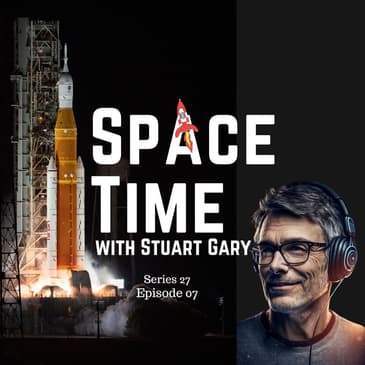
The Space News Podcast.
SpaceTime Series 27 Episode 7
*NASA delays manned return to the Moon until 2026 NASA has scrubbed this year’s planned manned Artemis 2 mission around the Moon.
*A successful maiden flight for United Launch's new Vulcan Centaur rocket The United Launch Alliance's new Vulcan Centaur rocket has undertaken a successful maiden flight.
*NASA's Parker Solar Probe completes its closest encounter with the Sun NASA's Parker Solar Probe has just undertaken its 18th close approach to the Sun skimming just 7.26 million kilometres above the visible solar surface.
*The Science Report
Scientists have now confirmed that 2023 was the hottest year ever recorded on planet Earth.
The new cancer testing regime that picks up 18 different early stage cancers
Solving the mystery disappearance of the largest of the great apes from Asia.
Skeptics guide to consciousness
https://spacetimewithstuartgary.com https://bitesz.com
This week’s guests:
Dr. Keith Bannister from the CSIRO
Aaron Roodman Stanford Linear Accelerator Center
Brian Nord Fermilab
Ann Elliott Ohio State University
And our regular guests:
Alex Zaharov-Reutt from techadvice.life
Tim Mendham from Australian Skeptics
Listen to SpaceTime on your favorite podcast app with our universal listen link: https://spacetimewithstuartgary.com/listen and access show links via https://linktr.ee/biteszHQ
For more space news podcasts visit our HQ at https://bitesz.com
Your support is needed...
**Support SpaceTime with Stuart Gary: Be Part of Our Cosmic Journey!**
SpaceTime is fueled by passion, not big corporations or grants. We're on a mission to become 100% listener-supported, allowing us to focus solely on bringing you riveting space stories without the interruption of ads. 🌌
**Here's where you shine:**
Help us soar to our goal of 1,000 subscribers! Whether it's just $1 or more, every contribution propels us closer to a universe of ad-free content.
**Elevate Your Experience:**
By joining our cosmic family at the $5 tier, you'll unlock: - Over 400 commercial-free, triple episode editions. - Exclusive extended interviews. - Early access to new episodes every Monday.
Dive in with a month's free trial on Supercast and discover the universe of rewards waiting for you! 🌠 🚀 [Join the Journey with SpaceTime](https://bitesznetwork.supercast.tech/) 🌟 [Learn More About Us](https://spacetimewithstuartgary.com)
Together, let's explore the cosmos without limits!
#spacetime #astronomy #space #science #news #Podcast
Become a supporter of this podcast: https://www.spreaker.com/podcast/spacetime-with-stuart-gary--2458531/support.
This is Spacetime Series twenty seven, Episode seven, for broadcast on the fifteenth of January twenty twenty four. Coming up on Spacetime, NASA delays a man returned to the lunar's surface until twenty twenty six. A successful maiden flight for United launches new Vulcan Center rocket, and NASA's Parker's Solar Probe completes its eighteenth close encounter with the Sun. All that and more coming up on Spacetime Welcome to Space Time with Stuart Gary. NASA has scrubbed this year's planned Artemis two man mission around the Moon. The agency says the flight, the first to tech humans to the Moon in over fifty years, will be delayed until at least September next year, in the process, pushing the return of people to the lunar surface aboard the Atomis three mission back from December twenty twenty five until at least September twenty twenty six. NASA has put the delays down to a range of safety concerns with the Lockheed Martin built Orion spacecraft, as well as development issues with the new Moon suits and continuing delays with SpaceX's Starship Mega rocket, which will carry crews from the Orion spacecraft orbiting around the Moon, down to the lunar surface and back up again. The twenty five day unmanned Artemis one mission to the Moon back in November twenty twenty two appeed to go smoothly with no serious issues disclosed at the time. However, it's now been revealed that the Artemis one Orion capsule suffered more extensive charring damage to its ablative heat shield during amos free re entry and was initially expected, and tests on another Orion spacecraft have now uncovered a designed fall with a life support systems electronics, as well as a separate issue which is popped up with one of the battery systems. There have also been two fouled launch attempts from its Texas star base by SpaceX's one to twenty one meter Toll Starship, which are posing serious concerns. Both launch failures saw the Starship super Heavy explode in the skies over the Gulf of Mexico. A third test flight is now planned for next month, but the longer it takes to get Starship into Earth orbit, the longer NASA will have to wait before it can launch its Atomus three mission, and there are other complications with Starship as well. SpaceX points out that Starship will need to have its fuel tank refilled once it's in orbit around the Earth before it heads off to the Moon. An estimated ten fuel transfers will be needed to do the job, and so SpaceX are planning to build an orbital fuel depot. And there have also been ongoing issues with the manufacture of the new EVA spaces for you from the Lunar's surface, which developed by Houston's Axiom Space. The Apollo eraist space suits, which we used during the late sixties and seventies and are still the basis for the EVA spacesuits used by NASA today, aren't really suitable for use on the lunar's surface. That's because they become damaged by the ultra fine but extremely sharp lunar dust or regulars, which is the Apollo astronauts found out became a real problem. Not only did the dust get everywhere on the suit, clogging equipment and causing radiators to overheat, but it was so sharp that it quite literally wore a hole in the knee on the outer spacesuit garment. During one geological EVA NASA Administrator Bill Nilsen says the delays will give the atemist teams more time to work through the challenges. The ten day Artemis two mission, which includes three Americans and one Canadian astronaut, will be a full scale, dressed rehearsal for Atomis three. It'll but the Earth twice in order to get enough speed for translunar injection, taking humans further from the Earth than ever before into an extended lunar orbit that will result in a free return trajectory back to Earth if successful. That'll be followed by the Artemis three mission, which will land astronauts on the Moon's south Pole, which Nilsen describes as a different moon from the Sea of Tranquility, where Apollo eleven astronauts nearl Armstrong and buzz Aldron landed in nineteen sixty nine. The Sea of Tranquility was relatively flat terrain. The lunar south pole, on the other hand, is pot marked with dick craters, and because of the angle of the sunlight, most of those craters are in total darkness. NASA says that delays shouldn't effect the following Artemis four mission, which will be the first to use the new Lunar Gateway Orbital space station. It currently remains on track for launch. In twenty twenty eight, during NASA as Apollo era, twelve Americans walked on the lunar surface, in the process, winning the space race and demonstrating to Moscow that Washington held the ultimate Cold War. Today, the competition isn't the Soviet Union, but rather China were expecting to have taker knots walking on the Moon by twenty thirty this space time still to come. The United Launch Alliances new Vulcan Centaur rocket undertakes a successful maiden flight, and NASA's Parker Solar Probe completes its closest encounters so far with the Sun. All that and more still to come on space time. The United Launch Alliances new Vulcan Centaur rocket has undertaken a highly successful maiden flight. The new sixty two meter tall, two stage Vulcan Centaur was initially designed to meet the design to phase out the current Russian Idea eight engines used on the Atlas five, which are no longer being supported by Moscow following the Western boycott of Russia in response to the Kremlins invasion of Ukraine. It also provided the United Launch Alliance with an opportunity to replace the heritage Delta four rocket with a new single launch system. The Vulcan's twin Blue Origin sourced B four liquid methane and liquid oxygen powered core stage replaces the Keerrot scene in liquid oxygen fueled I one eighties used on the Atlas five, as well as the liquid hydrogen on liquid oxygen core stage engines used on the Delta four, and the Vulcan core stage is designed to be fitted with up to six strap on solid rocket boosters, depending on payload and target orbit. On top of that, there's a new Centaur five upper stage. It replaces the earlier design common Centaur and Centaur three variants which we used on the Atlas five. The mission called CIRT one blasted off from Space Launch Complex forty one at the Cape Canaverals Space for Space in Florida. Status JECK Go Vulcan Go Centaur GO parents ten nine eight seven six five four three. We have ignition and lift off of the first United Launch Alliance Vulcan rocket, launching a new era in space flight to the Moon and beyond. Just laborating two good SRBs hitting peak pressure on the SRBs. Everything looking good. You got pitching our programs in coming into normal rates for that event. We have good hydraulic pressure on both engines, good chamber pressure on both engines. Everything looking good. Coming up on sixty seconds into the flight. Everything looking good, two good engines, two good SRBs. Body rates look good, nice and smooth, and we've hit our first throttle point on the B fours. Everything looking good and we have passed through MAK one. We are now supersonic, coming up on max Q at max dynamic pressure. Everything looking good. We're rolling off on the SRBs and we have cut off on the SRBs, coming up on jettison and approximately thirty seconds fifteen seconds that's their p jet. P fours continue operate nominally, seeing expected PU activity and the boost remains and we have separation of both SRBs. Everything looking good. The E fours continue to operate normally. We up on two minutes into the mission. We are now seventeen miles in altitude. We just heard confirmation of solid rocket booster jettison. We have about three minutes until we reach our next mission event. Booster engine cut off and we see booster PU correcting towards the nomenal IMR. Everything looking good. Both engines continue to pre normally, and we now weigh probably half of our lift off weight. Everything looking good, and we fired the power valve, activating the reaction control system on the upper stage. Pressures are rising as expected. P four continues to operate normally. Vehicles continue to apply down the center of the range track. Everything looking good. Thirty three miles in altitude, fifty two miles down range, traveling at four thousand miles per hour. Then you see excellent performance out of the b E four's chamber pressure, Nice and smooth. Vehicles settle accelerating a little over two g's at this time, good body rates, nice and smooth operation of the booster. Forty seven miles in altitude, ninety five miles down range at fifty five hundred miles per hour. Engines continue to burn normally. Everything looking good, and the vehicle now weighs one quarter of us slipped off weight as they passed through the carbon line. Next mark Wet. We're looking for a boot space chill down on the centaur. Main engines. Boost remains continue to operate normally, and we've been on boot space chill. Housing tents are dropping as expected. Coming up to the end of the boost phase. Prost me ten seconds to BICO throttle down. In preparation for BICO. We've completed boot space chill down and we have cut off. Coming up on Fulcan Center separation. We have Vulcan Center separation. Everything looking good coming up on the Centaur phase and experiencing a good data loss here. We've recovered the data center. Our engines are up and running normally steady state pressure, and we've just jettisoned the payload pairing two good break wires, good steady state operating levels on the Centaur mainze, two good engines on the open loop control on Center PU. This is Vulcan Mission Control at T plus five minutes fifty seven seconds. We just heard flight commentator Rob Gannon confirm the successful completion of the early phase of today's flight and all systems continue to operate nominally. Our next event, main engine cut off will occur in about ten minutes while we wait. I'm joined by Amanda Piquetti e LA, Director of Vehicle Upgrades. Amanda, thank you so much for joining us, and I know it's still early, but congratulations. Thank you you as well. This is amazing. How did it feel to watch the Vulcan rocket lift off for the first time? Oh, just absolutely amazing. I didn't expect it to be the way it was. It's just my heart is still pounding. It was excellent and just I'm so proud of all the work that the team did to get where we are today. Absolutely, and developing a new rocket is an enormous endeavor of what you were a huge part again, and we're still early, but how do you imagine the whole Vulcan team is feeling right now? I feel like they have to be the same way, you know, smile ear to ear. I know the team is at all our sites, friends and family. They've been supporting us for many years to get to where we are, so I'm sure they are jumping up and down just like me. It's been amazing. How is the Vulcan rocket going to change the industry? Yeah, that's a great question. So Vulcan is very much based on our heritage rockets, the Delta four and Atlas five vehicles, but we've brought in a lot of new innovation and capabilities that are going to allow us to even better support our war fighters, exploration as well as connecting the world. The great thing about Vulcan is it's highly versatile, meaning we can use that vehicle to do anything we want. Allows for affordability for anybody who needs access to space. This is the first certification flight. What are the next steps for Vulcan after this? Yeah, so with the first flight we are well under the way from a certification perspective. We do have a second fight that we'll need to do here later this year. Once that complete get completed, we'll have about two months or so of post flight data testing, and then at that point we will be certified by the US Base Force and we will be ready to fly all their important payloads for them. Coming up on five hundred seconds into the mission, everything's looking good. Tinuing to burn Centaur, body rates right as expected, steady acceleration just under half a g, and we are now two hundred and thirty five miles in altitude, eight hundred and thirty six miles down range, traveling at eleven thousand, one hundred and fifty miles per hour, continuous nominal performance from Centaur, and approaching the halfway point of this first burn of Centaur. Everything looks good, you know. On thousand miles down range, traveling at eleven thousand, tive hundred miles per hour. This is Vulcan mission control at T plus ten minutes seven seconds. Our next event, main engine cutoff, will occur in about five minutes. While we wait, I'm joined by Eric Manda, part of ULA's mission design team. Eric, thanks for joining Usmana, thanks for having me, of course. So we're still pretty early in this fight today, but can you tell us how the data is looking so far? Yeah? Absolutely so. I just want to say that it was so I ran outside so I can watch this thing lift off, and that was so cool after so many years of development to watch this thing fly, that was fantastic. Absolutely, I bet. Yeah. So what is the data showing us so far? Yeah? Absolutely so. I've had a very quick look. Obviously we're very early in the flight still, but I've taken a look at the S and B performance as well as the boost performance so far, and everything looks just spot on, just perfect. Unfortunately, we've had a lot of these systems on at List and Delta for a long time, and so we've had a lot of flight data to anchor our models, and everything is lining up just like we would expect can you talk a little bit about why we need three burns and how we use those three burns to complete our mission today. So the first burn performs our injection into lower thorbit. Unfortunately, if we just continue that burn from that point in time, we wouldn't necessarily be aligned with where we need to be in order to get to the Moon. So what we do after we get to lower thorbit is we shut those engines down, we coast around until we get to the right spot to do that, and then we light those engines up again. When we do that and complete the burn, that will allow us to send the Astrobotic Paragrin Lander onto the Moon. So we shut those engines down again and we are ready to do that and then start them one more time in order to do the third burn, and that's just going to take Celestici's Enterprise mission out to deep space. So let's talk a little bit about where these things happen. We're going to go ahead and shut down the main engines on the Centaur when we get about halfway across the Atlantic Ocean, and then we're going to coast the rest of the way across the Atlantic Ocean across Africa, and go ahead and start the engines up again, and we get to Madagascar and that's where we'll do the second burn, and then we coast again until we get about to pop in New Guiney, and when we get about to over pop in New Guiney, that's where we'll go ahead and do that third and final burn. The second burn will be about four minutes long, and then we'll have another coast for thirty minutes before we have a pretty short twenty second burn for the final burn. Once we've done that, then we've got some engineering demos we're going to do before we finally safe the state and shut everything off. And then at about four days later is when the center will leave the Earth Moon system and beyond find its way to the deep space. Depending on its configuration, the new Vulcans Center a launcher can carry a paillot of up to twenty seven point two tons into Loweth orbit, fifteen point three tons in a geostationary orbit, and twelve point one tons in the Luna transfer orbit, making it comparable with SpaceX's Falcon nine aboard. The Vulcan's maiden flight was astrobotics Pereguine Lunar Lander Its mission, however, wasn't nearly as successful as the vulcans. The robotic lander is separated from the center upper stage without incident, and its avionics systems powered up and perform nominally sending telemetry back to Astrobotics mission managers through NASA's Deep Space Network. However, just hours later, Astrobotics began reporting technical problems, starting with what appeared to be an inability to orient Pereguin's top mounted solar panels towards the Sun that's needed to keep the lunar landers on board batteries charged up. Pereguine then began to drift off course and communications were temporarily lost. Eventually, engineers were able to re establish contact with a one thousand, two hundred and eighty three kilogram Lander and were able to send instructions to keep it tilted in the right direction to keep its solar array pointing towards the Sun. As mission managers try to work out what was going wrong, they eventually traced the problem to a faulty valve in part of the spacecraft's propulsion system. An image taken by one of the onboard cameras showed the multi layer insulation badly displaced and damaged. That explained some of the telemetry which was showing a critical loss of propellant on board the spacecraft. In fact, judging by the loss rate, Peregune was destined to run out of fuel within forty hours. That loss of propellant meant the mission was doomed to fail, with a soft landing on the Moon now out of the question. Good news was that experiments on board the lander were performing well and they were sending back good data. Astrobiotics were now simply committed to getting the Pereguine as close to the Moon as possible before it loses its ability to maintain its sunpointing position and subsequently loses all power and enters an uncontrollable tumble. Peregon was supposed to enter Luna orbit and remain there for several weeks before committing to a landing in the mid latitude region of the Moon at a place called Sirius Visco Sitatis on February the twenty third. This space time still to come NASAs Parkersloprobe completes its closest encounter with the Sun and later in the science report, meteorologists have now confirmed that twenty twenty three was the hottest year ever recorded on planet Earth. All that and more still to come on space time messis Parker Solar Probe has just undertaking its eighteenth close approach to the Sun, skimming just seven point twenty six million kilometers above the visible solar surface. The close encounter, known as perihelion, began on Christmas Eve and continued until January the teid, with the spacecraft swooping down at some six hundred and thirty five thousand, two hundred and sixty six kilometers per hour. The close approach distance matched the record set by a park It during its previous close encounter back in September last year. It also matched the speed record set during that encounter. Mission managers at the JOHNS. Hopkins Applied Physics Laboratory in Laurel Maryland's report that the spacecraft entered its close encarnter with the Sun in good health, with all systems operating nominally. Following close approach, the Parker Solar Probe checked back in with mission managers sending it state of speak in turn on January the fifth. The spacecraft is now transmitting science data from the encounter, including the properties, structure, and behavior of the solar wind will give you more details when they come to hand. This space time and time. That'll take a brief look at some of the other stories making us in science this week with a Science report. Scientists have now confirmed that twenty twenty three was indeed the hottest gear ever recorded on planet Earth. The findings by the European Unions Copernicus Climate Change Service, which are based on both ground and satellite readings, show that the planet's average temperature in twenty twenty three was one point four to eight degree solsius warmer than the average for the eighties fifty to nineteen hundred pre industrial period, as well as being the planet's hottest recorded year by a substantial margin. The new readings also suggest that last year would have been the planet's warmest year in at least the last one hundred thousand years. The findings are based on global temperature records going back to eighteen fifty, and they're then checked against paleoclimatic data records from sources such as tree rings and ice core air bubbles. Twenty twenty three was also the first year in which every day was more than a degree celsius hotter than pre industrial levels. With two days both in November, being two degrees celsius warmer than pre industrial levels. Last year was also zero point one seven degrees hotter than twenty sixteen, which was the previous hottest year on record. Meteorologists say that while the arrival of an El Nina weather pattern has worse than the situation, global warming caused by the use of fossil fuels and other greenhouse gases, remains the primary cause behind the temperature increase and emissions of carbon dioxide, the most significant greenhouse gas remain stubbornly high. For example, last year, the concentration of carbon diox on the atmosphere rose to its highest ever recorded level of four hundred and nineteen parts per million. The Word Meetingological Organization says China remains the world's biggest carbon dioxide polluta, producing almost a third of the total global output, amounting to more than ten point one million tons annually. A team of researchers working for a company that's designed a new cancer testing regime claimed that a six specific panel of just ten proteins can pick up eighteen different early stage cancers, representing all the major organs of the human body. A report in the British Medical Journal claims the team whittled down a list of some three thousand blood plasma proteins down to the finalists of ten, which they see are expressed differently among the plasma of cancer patients in healthy people. The authors say they were able to identify ninety three percent of stage one cancers among men in the sample group of four hundred and forty and eighty four percent of women. An attached to editorial to the study says that while there are still several problems in the tests that need to be addressed before it can be deployed to the general population, this new method may be a good means of improving current issues related to sex specific detection tests. A new study may have finally solved the mystery disappearance of the largest of the great apes from Asia. A report in the journal Nature focused on the extinction of the largest ever primate, Gacantipithecus Blackie, which went extinct at a time when other Asian great apes were thriving. The new evidence, uncovered by a team of Australian, American, and Chinese scientists, found that the largest primate to ever walk on the Earth went extinct between two hundred and ninety five thousand and two hundred and fifteen thousand years ago, simply because they were unable to adapt their food preferences and behaviors, and because they were vulnerable to the changing climates which eventually sealed their fate. Measurements of the fossilized teeth have allowed paleontologists to estimate Joacandipithecus's height at around three meters it's nine point eight feet with a mass of around two hundred to three hundred kilograms. Back in the nineteen fifties, bigfoot enthusiasts began to hypothesize that stories of Yeti, Yowie's and Sasquatch were actually descriptions of encarnters with relic populations of Dagandipithecus that had somehow survived in isolation from the changing world around them. But the most obvious problem with the Gigantipithecus Bigfoot connection theory is the simple fact that no scientific evidence supporting Bigfoot has ever been found. A recent letter signed by more than one hundred distinguished scientists has sought to discredit integrated information theory, labeling the leading hypothesis of consciousness as nothing more than sew the science. However, it's two men them from a strange Skeptics points out, no hypothesis of consciousness is currently empirically testable, so strictly speaking, no such idea is scientific. It is a great debate and actually has the sounds with esoteric, but it actually has broader implications. Now I have the prefaces we're saying, I'm not a neurologist, I'm not practicing philosopher, fuly amateur, and I'm not necessarily an expert on consciousness. But looking at this, there is a debate right now about different ways of measuring and explaining what consciousness is. Generally speaking to the view is that consciousness is how you are aware of the world around you, of your role in it, and what's happening to you, et cetera. Now, consciousness, this idea has bigger implications beyond just the esoteric one of how the brain works. It has implications for legal issues and all sorts of things you imagine, like fatal consciousness of the fetus of the data before born. Does that have consciousness? That has an implication for abortions in medical treatments of various sorts. Do animals have consciousness? And that has the implication for everything from laboratory testing to actually eating and using animals to plants out consciousness. That's been suggested too, that yeah, should you be coming down plants? Do they screen when you sort of pull them out of the ground, letters screams when you cut it up? That's right? Do they? Oh? Yes, they do? Yes, But whether that's consciousness or just the chemical reaction and automatic chemical reaction, okay, even as far as suggesting that the universe have consciousness, So I'm not quite sure how we going to I'm through that. But basically consciousness comes down to two different aspects, as a physical one, which can be measured by neurological measurements et cetera, sticking things to your head and measuring electrical impulses that sort of stuff, which is pretty straightforward. And then there's a subjective measurements of consciousness, which is how people suggest what they have seen, you know, for the witnessing of activities, et cetera. Now it's a very broad area, isn't. Are we talking about simple chemical reactions or are we talking about I guess sentience because the line is very blurred between them. That's right, and that's a bit of a contentious issue. It is as much a philosophical issue as it is a scientific one. But anyway, the argument right now is about one particular theory of assessing and explaining consciousness, and it's called integrated information theory, which is pretty dull and broad. It which is suggesting that these subjective and objective measurements are measuring the same thing, that they are the same and they're just different ways of looking at it. I mean, the skeptics would know that there is a difference between reality and how people perceive it. That we know that witness testimony can be very dodgy, especially over a period of time. We know that things like neurological testing through things like polygraph machines, which is the live detectors, are almost useless and are certainly not recognized in most courts because they're only measuring stress rather than truth, and they're not necessarily stress but not necessarily great indicator of truth. So anyway, there's this debate about integrated information theory with a letter that was written by one hundred and twenty odd scientists recently presumably practicing neurologists or philosophers, who were saying it's sudo science, and the response from at least one person who has studied it says, you can't say, you can't highlight that one as being suito science because all the theories is their science, which is that's not on the people who are promoting consciousness theory wanted to hear. But there's a range of different theories. There's the one called global neuronal workspace theory, and there's another one called the higher order thought theory, which is higher order thought, which is hot the hot theory. And there's basically what you called subse fusion agreements, which is the way that people identify problems and that inferences about consciousness as the experiment or does the experiment to play a role, and all sorts of different things. Anyway, it is a complex area, but it does have implications in the in the real world. As we've said, is AI a form of consciousness? Well, that's exactly right. That's where it comes to. That's where you get into this big areas and suddenly we get back to the three laws of robotic which is obviously an AI issues. As I guess, the one of three laws that robots have to obey, you robots have to protect you, and robots can't do anything that will hurt you. I usually power down when they come up, and so you know, very seriously progected. I mean imagine coma pace. How conscious are they and what do you do? Stem cell research? Is that a consciousness issue? Organoid testing as they call it, which is often just fits to the brain put in the patridish you use that it or something and that Yes, yes, I mean frog legs, et cetera. Are they consciousness? They get an experiment with pig brains recently whether they were able to get reactions which rendered the test questionable, and in fact it's been now banned because there was an issue of that whether or not those brains had become conscious and had achieved sentience. Again, yes it is. I mean you could take it down to the extreme and say everything is conscious and therefore can you do anything to anything without impinging on it consciousness rights. That's when you get into very interesting philosophical areas and where sort of stuff will help you. It doesn't go anywhere, is it applicable? Is it useful? And Pera's not And anyway, these people are arguing that the methods that are being suggested the series of consciousness, what it is, how it can be assessed, et cetera. Pseudoscience quite possibly will never understand consciousness. We can might get a duplicate it with AI, et cetera. The consciousness will also involve sort of ethical decision making, all sorts of appreciations of other people's right, civil rights, all that sort of aspects should be coming into consciousness your own right primary amongst that. Can an AI do that? I don't know? Can you program in ethics, free laws of robotics, et cetera. And therefore this argument, which is sounds bit esoteric and certainly complex, that's timendum from Australian skeptics, And that's the show for now. Space Time is available every Monday, Wednesday and Friday through Apple Podcasts, iTunes, Stitcher, Google podcast, pocket Casts, Spotify a cast, Amazon Music, bytes dot com, SoundCloud YouTube, your favorite podcast provider, and from space Time with Stuart Gary dot com. Space Time's also broadcast through the National Science Foundation, on Science Own Radio and on both iHeartRadio and tune in Radio. And you can help to support our show by visiting the Spacetime Store for a range of promotional merchandising goodies. Or by becoming a Spacetime Patron, which gives you access to triple episode commercial free versions of the show, as well as lots of Bonnus audio content which doesn't go to weir, access to our exclusive Facebook group, and other rewards. Just go to space Time with Steward Gary dot com for full details, and if you want more space Time, please check out our blog, where you'll find all the stuff we couldn't fit in the show, as well as heaps of images, news stories, loads of videos and things on the whereby find interesting or amusing. Just go to space Time with Steward Gary dot tumbler dot com. That's all one word, and that's Tumbler without the E. You can also follow us through at Stuart Gary on Twitter, at space Time with Stewart Gary, on Instagram, through a Spacetime YouTube channel, and on Facebook just go to Facebook dot com forward slash space Time with Stewart Gary. You've been listening to space Time with Steward Gary. This has been another quality podcast production from bytes dot com.