
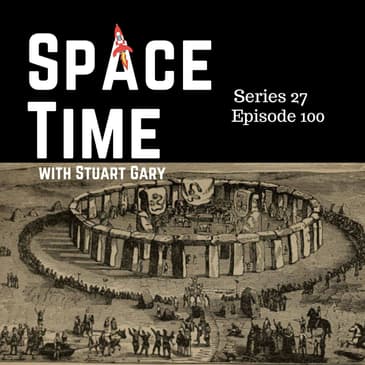
00:00:00 - This is spacetime series 27, episode 100, for broadcast on 19 August 2024
00:00:46 - New research has revealed Stonehenge's monumental altar stone comes from Scotland
00:08:49 - Have you drawn an opinion yet as to what Stonehenge was used for
00:11:39 - Tomorrow night's super moon will also be a blue moon
00:12:15 - NASA's Mars Perseverance rover begins climb up western rim of crater
00:17:08 - The moon will reach its fullest early tomorrow morning in Australia
00:19:45 - One consequence of perigee full moons is an increase in ocean tides
00:22:20 - A new study finds Australians are more likely to live longer than other nations
00:25:18 - Increasing coastal erosion is reducing Arctic Ocean's ability to absorb carbon dioxide
For more SpaceTime, visit our website at www.spacetimewithstuartgary.com
www.bitesz.com
Become a supporter of this podcast: https://www.spreaker.com/podcast/spacetime-with-stuart-gary--2458531/support
Sponsor Link:
You really need a Password manager in your life. Really, they just work. Check out the deal we have for you with NordPass....you'll be glad you did. And you'll be helping support SpaceTime (at no extra cost to you): www.bitesz.com/nordpass
[00:00:00] [SPEAKER_00]: This is SpaceTime Series 27 Episode 100 for broadcast on the 19th of August 2024.
[00:00:06] [SPEAKER_00]: Coming up on SpaceTime… The origins of Stonehenge's altar stone revealed.
[00:00:12] [SPEAKER_00]: NASA's Mars Perseverance rover begins the long climb up Jezero crater's rim.
[00:00:18] [SPEAKER_00]: And tomorrow's full moon, it'll be a blue supermoon.
[00:00:22] [SPEAKER_00]: All that and more coming up on SpaceTime.
[00:00:26] [SPEAKER_02]: Welcome to SpaceTime with Stuart Gary.
[00:00:46] [SPEAKER_00]: It's long been considered an ancient astronomical calendar,
[00:00:50] [SPEAKER_00]: and now new research has revealed Stonehenge's monumental six-ton altar stone,
[00:00:55] [SPEAKER_00]: long believed to have originated in Wales, actually comes from Scotland.
[00:01:00] [SPEAKER_00]: The findings reported in the journal Nature
[00:01:02] [SPEAKER_00]: show just how connected and advanced Neolithic Britain was 5,000 years ago.
[00:01:07] [SPEAKER_00]: The distance between Stonehenge and the far north of Scotland is around 750 kilometres.
[00:01:14] [SPEAKER_00]: The discovery of the altar stone's rural origins was made by scientist at Curtin University,
[00:01:19] [SPEAKER_00]: who has sent fragments of the mostly buried 5 by 1 metre wide, 50 centimetre thick boulder,
[00:01:25] [SPEAKER_00]: which lies at the centre of Stonehenge's iconic stone circle on Salisbury Plain in southwestern
[00:01:31] [SPEAKER_00]: England. The analysis shows that the altar stone matched sandstone from north-eastern Scotland,
[00:01:37] [SPEAKER_00]: and was very clearly different from the Welsh Brecon Beacons or Black Mountains regions where
[00:01:42] [SPEAKER_00]: it was originally assumed to have come from. Stonehenge, specifically the Great Trialathon,
[00:01:48] [SPEAKER_00]: the encompassing horseshoe arrangement of the five central trialathons, the hill stone,
[00:01:53] [SPEAKER_00]: and the embanked avenue are all aligned to the sunset of the winter solstice,
[00:01:58] [SPEAKER_00]: and oppose the sunrise of the summer solstice. A natural landform of the monument's location
[00:02:04] [SPEAKER_00]: followed this line and may have inspired its construction. The excavated remains of culled
[00:02:09] [SPEAKER_00]: animal bones suggest that people probably gathered at the site for the winter solstice
[00:02:14] [SPEAKER_00]: rather than the summer solstice in order to participate in religious ceremonies and festivals.
[00:02:19] [SPEAKER_00]: In the 1960s, Gerald Hawkins described in detail how the site was apparently set out to observe
[00:02:25] [SPEAKER_00]: the sun and moon over a recurring 56-year cycle, further submitting the hypothesis that the monument
[00:02:31] [SPEAKER_00]: functioned as an astronomical calendar. The ancient monument consists of an outer ring of
[00:02:37] [SPEAKER_00]: vertical sarsen standing stones, each around 4 metres high, 2.1 metres wide, and weighing around
[00:02:44] [SPEAKER_00]: 25 tonnes, and topped by connecting horizontal lintel stones. Inside is a ring of smaller blue
[00:02:51] [SPEAKER_00]: stones, and inside these are free-standing trialathons, as well as two bulky vertical
[00:02:57] [SPEAKER_00]: sarsens joined by a lintel. The stones are set within earthworks in the middle of the densest
[00:03:02] [SPEAKER_00]: complex of Neolithic and Bronze monuments in England, including several hundred burial mounds.
[00:03:08] [SPEAKER_00]: Archaeologists believe Stonehenge was constructed in several phases, from around 3100 BCE to 1600
[00:03:15] [SPEAKER_00]: BCE, with a circle of large sarsen stones placed between 2600 BCE and 2400 BCE. The surrounding
[00:03:23] [SPEAKER_00]: circular earthbank and ditch, which constitute the earliest phases of the monument, have been
[00:03:28] [SPEAKER_00]: dated to around 3100 BCE. Radiocarbon dating suggested the blue stones were given their
[00:03:34] [SPEAKER_00]: current positions between 2400 and 2200 BCE, although they may have been at the site much
[00:03:40] [SPEAKER_00]: earlier, possibly as early as 3000 BCE. Previous studies have shown that Stonehenge's large sarsen
[00:03:47] [SPEAKER_00]: stones, which form all 15 of the Henge's central horseshoe, came from the nearby West Woods on the
[00:03:52] [SPEAKER_00]: Wiltshire's Marlborough Downs. These include the uprights and lintels of the outer circle,
[00:03:58] [SPEAKER_00]: as well as the outlying stones such as the heel stone, the slaughter stone, and the station stones.
[00:04:04] [SPEAKER_00]: Stonehenge's blue stones, on the other hand, originated from Pembrokeshire in Wales.
[00:04:09] [SPEAKER_00]: They were originally erected at Stonehenge in an arc of double stone holes known as the Q&R
[00:04:14] [SPEAKER_00]: holes, before being rearranged into their current arrangement of outer circle and inner horseshoe.
[00:04:19] [SPEAKER_00]: One of the study's authors, Professor Chris Kirkland from Curtin University,
[00:04:24] [SPEAKER_00]: says the findings of the true origins of the altar stone have significant implications
[00:04:28] [SPEAKER_00]: for understanding ancient communities, their connections and their transportation methods.
[00:04:34] [SPEAKER_00]: He says the discovery highlights a significant level of societal coordination during the
[00:04:38] [SPEAKER_00]: Neolithic period and helps paint a fascinating picture of prehistoric Britain. Kirkland believes
[00:04:44] [SPEAKER_00]: transporting such massive cargo over land from Scotland to southern England would have been
[00:04:49] [SPEAKER_00]: extremely challenging, suggesting instead a likely maritime shipping route along the coast
[00:04:55] [SPEAKER_01]: of Britain. So the central stone within Stonehenge is the altar stone and it's a flat lying six-armed
[00:05:01] [SPEAKER_01]: monolith and we've been lucky enough to get historical samples from that and using some
[00:05:05] [SPEAKER_01]: technology we've developed at Curtin for the mining industry, using geochronology to looking
[00:05:10] [SPEAKER_01]: at the age of the crystals, we've been able to give a very distinct fingerprint for that
[00:05:14] [SPEAKER_01]: altar stone and by comparing that to sandstones around Britain and Ireland we've got a very good
[00:05:19] [SPEAKER_01]: match with material from northeast Scotland and that greater than 95% confidence we can say that
[00:05:24] [SPEAKER_01]: the altar stone has come from 750 kilometres away in the Arcadian Basin. There must be a lot of
[00:05:29] [SPEAKER_00]: sandstones in the British Isles, would have been a tedious trial and error job. Yeah but that's the
[00:05:35] [SPEAKER_01]: thing with sandstones right, a sandstone collects lots of grains from the surrounding geology so it
[00:05:40] [SPEAKER_01]: gets actually a very distinct fingerprint. So the sandstones will basically collect grains from the
[00:05:48] [SPEAKER_01]: Basin and it departs this almost unique fingerprint into the Basin where the sediment is. Luckily within the UK there's actually been quite a lot of work already done
[00:05:56] [SPEAKER_01]: looking at sandstones so by collecting new samples but also using this huge database of published
[00:06:03] [SPEAKER_01]: results from sandstone samples we were able to make some very good correlations. The other important
[00:06:08] [SPEAKER_01]: point as well is that the British Isles has got a very distinct geological history north of
[00:06:14] [SPEAKER_01]: sure a join between Scotland and England the geology is very different so by looking at the
[00:06:18] [SPEAKER_01]: ages within our grains we can already narrow down very quickly where the material has come from.
[00:06:24] [SPEAKER_00]: Were you surprised to see that it was Scottish not Welsh? Yeah I mean to be honest I was shocked
[00:06:30] [SPEAKER_01]: you know it's already a massive task importing material from Wales to Stonehenge because we know
[00:06:36] [SPEAKER_01]: some of the other bluestones, so bluestones are the more exotic far travel rocks came from
[00:06:41] [SPEAKER_01]: hills within Wales about 200 kilometres away I mean that's already a huge task but just
[00:06:47] [SPEAKER_01]: spare a thought for these guys in the Neolithic now carting material six tonne rocks over 750
[00:06:52] [SPEAKER_01]: kilometres and that really helps us understand prehistoric society, Neolithic society in the
[00:06:58] [SPEAKER_01]: British Isles how connected they were and also helps us understand some of their technology.
[00:07:02] [SPEAKER_00]: Well that's the thing isn't it it shows that what we now call the UK was really well connected long
[00:07:08] [SPEAKER_01]: ago. Yeah that is absolutely correct that's really strongly what it points to you know it's a really
[00:07:14] [SPEAKER_01]: fascinating story but it's not without precedent we have some other evidence for example with cattle
[00:07:19] [SPEAKER_01]: and other materials being transported over sea voyages to northeast northern UK in the Neolithic
[00:07:26] [SPEAKER_01]: period but this just shows how advanced that technology was that it was able to transport
[00:07:31] [SPEAKER_01]: material as large as six and a half tonnes I guess one thing I like to say is like just even today
[00:07:36] [SPEAKER_01]: transporting a six and a half tonne rock from Scotland all the way to England would be a massive
[00:07:39] [SPEAKER_00]: I can imagine that what we now call the British Isles would have been a heavily forested area
[00:07:44] [SPEAKER_00]: back then and to have this piece of rock transported such a great distance you couldn't do it over
[00:07:50] [SPEAKER_01]: land it had to be by sea surely. Yeah I absolutely agree with you you think about you're right the
[00:07:55] [SPEAKER_01]: vegetation was very different back then much more heavily forested but also there's huge mountain
[00:08:00] [SPEAKER_01]: ranges, valleys, there's bogs, there's estuaries that would all have to be navigated if it came
[00:08:06] [SPEAKER_01]: in over land routes so our preference at the minute based on the evidence we have is that it's come
[00:08:11] [SPEAKER_01]: by some marine shipping route we should also say that we also considered glacial transport but that
[00:08:17] [SPEAKER_01]: really doesn't work either while the UK has been heavily glaciated in the past if we look at the
[00:08:21] [SPEAKER_01]: glacial flow direction they're all in a very different direction or actually northwards and
[00:08:26] [SPEAKER_01]: taking things further away from the Akkadian basin that's like basin in northeast Scotland
[00:08:30] [SPEAKER_01]: where the material has come from and Stonehenge in the south of England also none of the rocks
[00:08:34] [SPEAKER_01]: really within Stonehenge have glacial striation and if we look at more collectively all the
[00:08:40] [SPEAKER_01]: rocks in Stonehenge their periods have been chosen from very specific regions so it's not this
[00:08:44] [SPEAKER_01]: random collection of material that you might expect if material had been glacially transported.
[00:08:49] [SPEAKER_00]: Have you drawn an opinion yet as to what you think Stonehenge was used for? The function of
[00:08:54] [SPEAKER_01]: Stonehenge I think we can say some things quite safely. We can say that hasn't been used just for
[00:08:59] [SPEAKER_01]: one thing it has solar alignment there's elements that might have lunar alignment so there is some
[00:09:04] [SPEAKER_01]: aspect of it being a calendar that's one important thing but we also know there's burial grounds
[00:09:09] [SPEAKER_01]: there as well so there's some there's probably multiple purposes here we know there's also
[00:09:13] [SPEAKER_01]: feasting at Stonehenge so really they may have been used for different things at different periods
[00:09:18] [SPEAKER_01]: of time. One thing is for sure that the society really invested a huge amount of effort in
[00:09:23] [SPEAKER_01]: constructing it so it was obviously somewhere very important and sacred to them. And it was
[00:09:28] [SPEAKER_00]: constructed over many many many hundreds of years with different rocks coming from different locations
[00:09:33] [SPEAKER_01]: Yeah that's absolutely right you know we know that in some of the later construction phases
[00:09:39] [SPEAKER_01]: there's the large starstone stones which are from the local environment about 20 kilometers away
[00:09:44] [SPEAKER_01]: we've mentioned already the blue stones which are smaller stones erected in circles which have
[00:09:49] [SPEAKER_01]: come from Wales. We now know the central six-ton flat lying slab the altar stone sandstone is from
[00:09:56] [SPEAKER_01]: northeast Scotland but there is historical evidence of wooden circular pillars as well so
[00:10:02] [SPEAKER_01]: it had a huge history of construction and indeed probably reconstruction in places as well so
[00:10:08] [SPEAKER_01]: there's evidence of some of the monoliths of the standing stones actually being moved from elsewhere
[00:10:14] [SPEAKER_01]: from potentially other stone circles so it's a fascinating history within the structure itself.
[00:10:20] [SPEAKER_01]: Where does this go now what's next? I think there's multiple ways the research could go we're kind of
[00:10:25] [SPEAKER_01]: keen to look at northeast Scotland and really pin down exactly where within the Acadian Basin
[00:10:31] [SPEAKER_01]: the actual quarry itself is and there's ways we can do that because the kind of fingerprint within
[00:10:36] [SPEAKER_01]: the basin is quite distinctive but we can look at a range of other mineral grains to try and
[00:10:41] [SPEAKER_01]: really fine-tune our understanding of the geology of the source region which would be really
[00:10:46] [SPEAKER_01]: interesting but I guess more broadly it's really fun for us as geologists and geochronologists
[00:10:52] [SPEAKER_01]: who work at the Age of Rock to apply this tool that we normally apply to the mining industry
[00:10:56] [SPEAKER_01]: to apply it to other archaeological questions and there's a range of other sample material
[00:11:01] [SPEAKER_00]: that we could actually apply the same technique to. What you've actually done here is change history
[00:11:05] [SPEAKER_00]: you've exposed a new page in the history of Stonehenge how does that make you feel?
[00:11:10] [SPEAKER_01]: It's incredibly exciting but also quite privileged to have the tools also I should mention my PhD
[00:11:17] [SPEAKER_01]: student Anthony Clark as well his inspiration to actually go and collect this material so it's just
[00:11:23] [SPEAKER_01]: he's Welsh isn't he? Yeah he's Welsh so if people make a joke about you know yeah that's what everyone has
[00:11:31] [SPEAKER_01]: so I think his response is usually around the rugby where he points out that well it's okay
[00:11:36] [SPEAKER_00]: as long as Wales win the rugby it'll be all right. That's Professor Chris Kirkland from Curtin University
[00:11:43] [SPEAKER_00]: and this is Space Time. Still to come, Perseverance begins its long climb up to the rim of Jezero
[00:11:50] [SPEAKER_00]: crater and we're in for not just a super moon tomorrow night it'll also be a blue moon we'll
[00:11:55] [SPEAKER_00]: tell you all about it all that and more still to come on Space Time. After spending some two and a
[00:12:18] [SPEAKER_00]: half hours on Jezero crater's floor and river delta, NASA's Mars Perseverance rover has now commenced its journey to an area where it will search for what hopefully will be more discoveries that could rewrite Martian history.
[00:12:30] [SPEAKER_00]: The six-wheeled car-sized mobile laboratory has just begun a multi-month long ascent up the western
[00:12:36] [SPEAKER_00]: rim of Jezero crater and that'll see it tackle some of the steepest and most challenging terrain
[00:12:41] [SPEAKER_00]: it's ever encountered. The climb will mark the kickoff of the mission's new science campaign
[00:12:47] [SPEAKER_00]: its fifth since landing on the red planet way back on February the 18th 2021. Perseverance has now
[00:12:54] [SPEAKER_00]: collected some 22 rock cores and traveled over 129 kilometers since arriving at Mars. Perseverance
[00:13:01] [SPEAKER_00]: project manager Art Thompson from NASA's Jet Propulsion Laboratory in Pasadena California
[00:13:06] [SPEAKER_00]: says the rover's in excellent condition to undertake the rim climb challenge. He says mission managers
[00:13:12] [SPEAKER_00]: are raring to see what's up there. Two of the priority regions the science team want to study
[00:13:18] [SPEAKER_00]: at the top of the crater are nicknamed Pico Tuquino and Witch Hazel Hill. Imagery from NASA's orbiters
[00:13:24] [SPEAKER_00]: around Mars indicate that Pico Tuquino contains ancient fractures that may have been caused by
[00:13:30] [SPEAKER_00]: hydrothermal activity in the distant past. Meanwhile orbital views of Witch Hazel Hill
[00:13:35] [SPEAKER_00]: show layered materials that likely date from the time when Mars had a very different climate than
[00:13:40] [SPEAKER_00]: what it has today. Those views have revealed light tone bedrock very similar to what was found at
[00:13:46] [SPEAKER_00]: Bright Angel the area where Perseverance recently discovered and sampled the Chiava Falls rock which
[00:13:51] [SPEAKER_00]: exhibits chemical signatures and structures that could possibly be informed by life billions of
[00:13:57] [SPEAKER_00]: years ago when the region contained running water. Back during the river delta phase of the mission
[00:14:03] [SPEAKER_00]: the rover collected the only sedimentary rock samples ever taken from a planet other than Earth.
[00:14:08] [SPEAKER_00]: Sedimentary rocks are important because they form when particles of various sizes are transported
[00:14:13] [SPEAKER_00]: by water and then deposited into a standing body of water. On Earth liquid water is one of the most
[00:14:19] [SPEAKER_00]: important requirements for life as we know it. A study published in the Journal of the American
[00:14:25] [SPEAKER_00]: Geophysical Union Advances chronicles the 10 rock core samples gathered from sedimentary rocks in
[00:14:30] [SPEAKER_00]: the ancient Martian river delta, a fan-shaped collection of rocks and sediment that formed
[00:14:35] [SPEAKER_00]: billions of years ago at the convergence of a river and the crater lake. The core samples collected
[00:14:41] [SPEAKER_00]: at the fan front are the oldest whereas rocks caught at the fan top are likely the youngest
[00:14:46] [SPEAKER_00]: produced when flowing water deposits sediment into the western fan. Among these rock cores are
[00:14:52] [SPEAKER_00]: likely the oldest materials sampled from any known environment that was likely potentially habitable.
[00:14:58] [SPEAKER_00]: Now if they're eventually brought back to Earth by the long proposed joint NASA-ESA Mars sample
[00:15:03] [SPEAKER_00]: return mission they'll tell scientists about when, why and for how long Mars contained liquid water
[00:15:09] [SPEAKER_00]: and whether some organic prebiotic or even potentially biological evolution may have taken
[00:15:15] [SPEAKER_00]: place on the red planet. As for the crater rim mission well it promises to provide samples that
[00:15:21] [SPEAKER_00]: will have significant implications for understanding Martian geological history.
[00:15:26] [SPEAKER_00]: That's because these are expected to be samples of the red planet's most ancient crust.
[00:15:31] [SPEAKER_00]: The rocks form from a wealth of different processes and some represent potentially
[00:15:36] [SPEAKER_00]: habitable environments that have never been examined up close before. But reaching the top
[00:15:41] [SPEAKER_00]: of the crater's rim won't be easy. To get there, Perseverance will have to rely on its
[00:15:47] [SPEAKER_00]: auto-navigation capabilities as it follows a route that the rove's plan is back on Earth
[00:15:52] [SPEAKER_00]: designed to minimize hazards while still giving the science team plenty of stuff to investigate.
[00:15:58] [SPEAKER_00]: Encountering slopes of up to 23 degrees on the journey, the rover will have gained about 300
[00:16:03] [SPEAKER_00]: meters in elevation by the time it summits the crater's rim at a location which the science team
[00:16:08] [SPEAKER_00]: have now dubbed Aurora Park. Then perched hundreds of meters above the 45 kilometer wide crater floor
[00:16:16] [SPEAKER_00]: Perseverance can begin the next leg of its adventure. The rover will characterize the
[00:16:22] [SPEAKER_00]: planet's geology and its past climate to help pave the way for future human exploration of
[00:16:27] [SPEAKER_00]: the red planet sometime during the next decade. This is Space Time. Still to come, we have a full
[00:16:35] [SPEAKER_00]: moon tomorrow night and not only will it be a super moon, it'll also be a blue moon. We'll have
[00:16:40] [SPEAKER_00]: all the details next. And later in the science report, there are new warnings today that the
[00:16:45] [SPEAKER_00]: MPAX virus is now starting to spread beyond Africa to the rest of the world. All that and more still
[00:16:51] [SPEAKER_00]: to come on Space Time. If you look into the sky tonight, you'll see a full moon. A full moon usually
[00:17:13] [SPEAKER_00]: lasts for about three days before the shadow of the Earth starts to bite into it again. The moon
[00:17:18] [SPEAKER_00]: will actually reach its fullest early tomorrow morning and not only will it be a perigee or so-called
[00:17:24] [SPEAKER_00]: super moon, it's also a blue moon. And it doesn't end there. It's sometimes called a sturgeon moon,
[00:17:30] [SPEAKER_00]: the red moon, the corn moon, the green corn moon, the barley moon, the herb moon, the grain moon,
[00:17:36] [SPEAKER_00]: and the dog moon, depending on your preferences and cultural beliefs. Be precise. The full moon will
[00:17:42] [SPEAKER_00]: occur at 4 25 a.m tomorrow August the 20th Australian Eastern Standard Time. The term
[00:17:49] [SPEAKER_00]: super moon is a trendy name beloved by old school media looking for clickbait to describe a perigee
[00:17:55] [SPEAKER_00]: full moon. That's when the moon's at its closest orbital position to the Earth during a full moon.
[00:18:00] [SPEAKER_00]: Now on average the moon orbits about 384 400 kilometers from the Earth. But the moon's orbit
[00:18:07] [SPEAKER_00]: around Earth isn't a perfect circle. It's slightly elliptical. That means one part of the orbit will
[00:18:12] [SPEAKER_00]: be an itsy-bitsy bit closer to the Earth, about 357 000 kilometers away. That's known as perigee.
[00:18:18] [SPEAKER_00]: While the other part of the orbit will be a bit further away, around 406 000 kilometers. That's
[00:18:24] [SPEAKER_00]: apogee. The difference in orbit is about five percent closer or further away than the average.
[00:18:31] [SPEAKER_00]: Now the exact distances at both perigee and apogee also vary due to other factors,
[00:18:35] [SPEAKER_00]: such as whether the lunar orbit's long axis is pointed towards the sun. Also the moon's orbital
[00:18:41] [SPEAKER_00]: extremes are at their greatest between November and February. That's when Earth's orbit places
[00:18:46] [SPEAKER_00]: our planet and therefore the moon closer to the sun. You see Earth's orbit itself is also elliptical
[00:18:52] [SPEAKER_00]: by almost two percent and therefore the sun's gravitational influence is greatest during those
[00:18:57] [SPEAKER_00]: months. Now while people tend to make a big deal about super moons, they're actually not all that
[00:19:01] [SPEAKER_00]: uncommon. Generally occurring in groups of about three roughly every 13 months and eight days.
[00:19:07] [SPEAKER_00]: Now that means every 14th full moon will be a super moon. Now while technically a super moon
[00:19:13] [SPEAKER_00]: can look about 14 percent larger and 30 percent brighter than a normal full moon, you really
[00:19:18] [SPEAKER_00]: wouldn't notice the difference unless someone told you. And even then any size difference
[00:19:22] [SPEAKER_00]: perceptions you do have would more likely be due to your imagination. Even skilled sky gazers are
[00:19:28] [SPEAKER_00]: challenged to see any real difference in size or brightness. In reality you'd really need proper
[00:19:34] [SPEAKER_00]: astronomical equipment to measure the difference. Also remember that the full moon always looks
[00:19:39] [SPEAKER_00]: unusually large and bright when it's near the horizon. That's in effect known as moon illusion.
[00:19:45] [SPEAKER_00]: One consequence of perigee full moons and new moons for that matter might be a noticeable
[00:19:50] [SPEAKER_00]: increase in ocean tides. There are many factors influencing tidal heights at given locations,
[00:19:56] [SPEAKER_00]: though they're usually highest known as spring tides at the full or new moon when the sun,
[00:20:01] [SPEAKER_00]: earth and moon are all aligned. So a perigee moon being a bit closer than the average will result
[00:20:07] [SPEAKER_00]: in slightly higher tides. The term super moon isn't that old. In fact it was first invented
[00:20:13] [SPEAKER_00]: just in 1979, not by an astronomer but by an astrologer. Now for those unfamiliar with the
[00:20:19] [SPEAKER_00]: difference between the two, and I'm quite sure no one listening to this show fits in that category,
[00:20:24] [SPEAKER_00]: nevertheless, an astronomer is a person who studies space and the cosmos using the scientific
[00:20:29] [SPEAKER_00]: method to learn more about the universe. On the other hand an astrologer is a pseudoscientific
[00:20:34] [SPEAKER_00]: person who uses inaccurate positions for constellations planets and other celestial
[00:20:39] [SPEAKER_00]: bodies at different times to tell others about their character or to predict their future.
[00:20:44] [SPEAKER_00]: There has never been any scientific evidence supporting any of the claims made by astrology,
[00:20:50] [SPEAKER_00]: and its continued success in society depends exclusively on people's gullibility.
[00:20:57] [SPEAKER_00]: These days trendoids use the term super moon, and I saw it in an article just earlier today,
[00:21:02] [SPEAKER_00]: to describe any full moon within 90% of perigee. And for the record this will be the first of four
[00:21:08] [SPEAKER_00]: consecutive super moons this year, with the full moons in September and October being the closest.
[00:21:14] [SPEAKER_00]: Although it won't look blue, as the third full moon in a season with four full moons,
[00:21:18] [SPEAKER_00]: this is also classified as a blue moon. The first recorded use of the term blue moon in English
[00:21:24] [SPEAKER_00]: dates back to 1528. Speculation as to the origin behind the term include an old English phrase
[00:21:31] [SPEAKER_00]: that means betrayer moon because it led to mistakes in setting the dates for Lent and Easter.
[00:21:37] [SPEAKER_00]: But since the 1940s, the term blue moon has been used to describe a second full moon in a calendar
[00:21:43] [SPEAKER_00]: month that has two full moons. And the names don't end there. The Maine Farmers Almanac began
[00:21:49] [SPEAKER_00]: publishing Indian names for full moons back in the 1930s, and these have now become widely known
[00:21:55] [SPEAKER_00]: and used. Now according to this almanac, for a full moon in August, the Algonquin tribes in what
[00:22:00] [SPEAKER_00]: is now the northeastern United States called this the sturgeon moon, after the large fish they were
[00:22:06] [SPEAKER_00]: easily caught at this time of the year in the Great Lakes and other major bodies of water.
[00:22:10] [SPEAKER_00]: But other names reported for the moon is the red moon, the corn or green corn moon,
[00:22:15] [SPEAKER_00]: the barley moon, the herb moon, the grain moon, and even the dog moon. This is Space Time.
[00:22:37] [SPEAKER_00]: And time now to take a brief look at some of the other stories making use in science this week
[00:22:41] [SPEAKER_00]: with the Science Report. The World Health Organization has declared an upsurge of
[00:22:46] [SPEAKER_00]: mpox cases across multiple African countries, a public health emergency of international concern
[00:22:52] [SPEAKER_00]: as the virus begins spreading to the rest of the world. The disease, formerly known as monkeypox,
[00:22:58] [SPEAKER_00]: spread rapidly across the world in 2022, including Australia, and it's now surging
[00:23:03] [SPEAKER_00]: again with a new variant. Mpox is a viral disease caused by the orthopoxvirus. It was first
[00:23:10] [SPEAKER_00]: identified in humans in the Democratic Republic of Congo in 1970 and is endemic to Central and
[00:23:17] [SPEAKER_00]: Western Africa. Mpox can be transmitted from animals to humans and between humans through
[00:23:22] [SPEAKER_00]: direct contact with skin lesions, body fluids, or the respiratory droplets of an infected person.
[00:23:28] [SPEAKER_00]: It can also be transmitted by prolonged face-to-face contact with an infected person
[00:23:32] [SPEAKER_00]: and touching contaminated objects. Historically, mpox was neglected in Africa, but it gained global
[00:23:38] [SPEAKER_00]: attention during a 2022 outbreak that spread to regions like Europe, Australia and the United States.
[00:23:45] [SPEAKER_00]: The current outbreak is concerning due to a new strain known as clade 1b, which is spreading
[00:23:50] [SPEAKER_00]: rapidly in the Congo and at least 12 neighboring countries. Importantly, this strain is potentially
[00:23:56] [SPEAKER_00]: more deadly and it appears to affect children at a higher rate than other strains. A new study
[00:24:03] [SPEAKER_00]: has found that Australians are more likely to live longer than people living in New Zealand,
[00:24:07] [SPEAKER_00]: the United States, the United Kingdom, Canada or Ireland. The findings reported in the British
[00:24:13] [SPEAKER_00]: Medical Journal, based on data from the five English-speaking countries, see how life expectancy
[00:24:18] [SPEAKER_00]: differs among culturally similar nations. They found Australia was a clear best performer in
[00:24:25] [SPEAKER_00]: terms of life expectancy, leading the rest by 1.26 to 3.95 years for women and 0.97 to 4.88 years for
[00:24:34] [SPEAKER_00]: men. Now the study can't explain why other countries with very similar lifestyles to Australia differ
[00:24:40] [SPEAKER_00]: in life expectancy by so much. However, researchers are speculating that Australia's high number of
[00:24:46] [SPEAKER_00]: migrants and where they come from may be playing a role. Australia has lower life expectancy
[00:24:52] [SPEAKER_00]: inequality, however this may in part be due to its very small Indigenous population, as the life
[00:24:58] [SPEAKER_00]: expectancy gap between non-Indigenous Australians and Aboriginal and Torres Strait Islander people
[00:25:03] [SPEAKER_00]: remains high. Differences in lifestyle also play a significant role, and the researchers say the
[00:25:09] [SPEAKER_00]: death rates from drug and alcohol misuse, screenable and treatable cancers and cardiovascular
[00:25:15] [SPEAKER_00]: and respiratory diseases are all lower in the true blue land of Oz. A new study has shown that
[00:25:22] [SPEAKER_00]: increasing coastal erosion is reducing the Arctic Ocean's ability to absorb carbon dioxide.
[00:25:28] [SPEAKER_00]: The findings reported in the journal Nature Climate Change are based on new computer modelling.
[00:25:34] [SPEAKER_00]: The projections found that the annual increase in atmospheric carbon dioxide due to permafrost
[00:25:39] [SPEAKER_00]: erosion by 2100 may be the equivalent of about 10% of European car emissions in 2021.
[00:25:45] [SPEAKER_00]: The authors warn that the Arctic is now warming four times faster than the rest of the planet.
[00:25:50] [SPEAKER_00]: The thawing Arctic permafrost is allowing for faster coastal erosion in the region,
[00:25:55] [SPEAKER_00]: which is projected to increase by a factor of two to three by the year 2100, and that will
[00:26:01] [SPEAKER_00]: increase the supply of organic matter from land into the ocean. According to the modelling, previous
[00:26:06] [SPEAKER_00]: climate studies may have misinterpreted the Arctic Ocean's uptake of carbon dioxide from the
[00:26:11] [SPEAKER_00]: atmosphere by not including the areas worst affected by coastal erosion, which release more
[00:26:16] [SPEAKER_00]: carbon than they absorb. The Chiropractic Board of Australia has been forced to reinstate a ban on
[00:26:23] [SPEAKER_00]: the dangerous practice of spinal manipulation of infants, more commonly known as baby backcracking.
[00:26:30] [SPEAKER_00]: The reinstatement follows an outcry by doctors and a request from health ministers who have
[00:26:34] [SPEAKER_00]: been asked to formally outlaw the practice. Chiropractors claim spinal manipulation of
[00:26:40] [SPEAKER_00]: babies helps with colic reflux constipation and different problems with sleep. But Tim Mendham
[00:26:45] [SPEAKER_00]: from Australian Skeptics points out that the Royal Australian College of General Practitioners
[00:26:50] [SPEAKER_00]: has found little evidence supporting these so-called benefits and believe the treatment
[00:26:54] [SPEAKER_00]: is simply unsuitable for young children. Chiropractors have been sort of cracking
[00:26:58] [SPEAKER_02]: people's backs for a fair time, it's probably over 100 years now, and one of the issues that
[00:27:03] [SPEAKER_02]: cropped up was cracking the backs of infants, I mean infants like week old or weeks old babies.
[00:27:10] [SPEAKER_02]: Their skeleton is still forming in a way, they're very vulnerable to things that might happen and
[00:27:14] [SPEAKER_02]: I've seen quite horrifying videos of a chiropractor either raising a baby by the feet or putting it
[00:27:21] [SPEAKER_02]: over their lap and cracking the spine and it really is a crack sound. And it's one of the
[00:27:26] [SPEAKER_02]: most horrifying things you can see, we can do major damage, they can do damage to adults especially
[00:27:30] [SPEAKER_02]: when they're twisting the neck and twisting the head. The babies that tend to just be cracking
[00:27:34] [SPEAKER_02]: the spine rather than twisting head, you wouldn't want to do that to a baby. And when various videos
[00:27:38] [SPEAKER_02]: came out of this a number of years ago, about four years ago, there was an outrage, understandably.
[00:27:42] [SPEAKER_02]: One of the main chiropractors who was doing this was called in front of the chiropractic board,
[00:27:46] [SPEAKER_02]: they waved their finger at him and said don't do that again and you can no longer treat anyone
[00:27:50] [SPEAKER_02]: under 12. So they banned the practice for a while and then shortly, well recently,
[00:27:55] [SPEAKER_02]: they unbanned the practice and said it's okay now, you can go back to cracking babies. And
[00:28:00] [SPEAKER_02]: then there was an outrage by the medical fraternity etc saying what the hell are you doing,
[00:28:05] [SPEAKER_02]: these are babies, do not do this. So they banned it again. This is the Chiropractic Association
[00:28:09] [SPEAKER_02]: doing this, sorry the Chiropractic Board of Australia, it's a different thing. Chiropractic
[00:28:13] [SPEAKER_02]: Board banned this process so they banned it, unbanned it, banned it again and now the
[00:28:18] [SPEAKER_02]: Chiropractic Association which is almost like a trade union of chiropractors is demanding it be
[00:28:23] [SPEAKER_02]: opened again. So the whole issue is that the chiropractors are claiming it's a very specific
[00:28:28] [SPEAKER_02]: adjustment tailored to the force appropriate to the size of the person who's receiving it.
[00:28:33] [SPEAKER_02]: You're talking about babies, little tiny forces, you can hear a baby's back crack. It's dangerous
[00:28:37] [SPEAKER_02]: and you could do something very serious to a child that they'll suffer from the rest of their life.
[00:28:42] [SPEAKER_02]: Apart from the fact there's a lot of stuff within chiropractic which is totally unsupported by
[00:28:46] [SPEAKER_02]: science including some of the technology and terminology that they use themselves as in a
[00:28:49] [SPEAKER_02]: subluxation which is no one really knows what it is but it's a thing which is quoted a lot
[00:28:54] [SPEAKER_02]: in a chiropractic fraternity as the cause of the spine being out of order and all these sort
[00:28:59] [SPEAKER_02]: of issues and illnesses being generated forthwith. Chiropractic is lower back massage,
[00:29:05] [SPEAKER_02]: she'll be stuck with sick with that. Get out of the thing where it causes every illness known to
[00:29:09] [SPEAKER_00]: mankind. That's Tim Mindom from Australian Skeptics and that's the show for now.
[00:29:30] [SPEAKER_00]: Space Time is available every Monday, Wednesday and Friday through Apple Podcasts iTunes,
[00:29:35] [SPEAKER_00]: Stitcher, Google Podcasts, Pocket Casts, Spotify, Acast, Amazon Music, Bytes.com, SoundCloud,
[00:29:43] [SPEAKER_00]: YouTube, your favourite podcast download provider and from Spacetimewithstuartgarry.com.
[00:29:49] [SPEAKER_00]: Spacetime is also broadcast through the National Science Foundation on Science Zone Radio
[00:29:54] [SPEAKER_00]: and on both iHeart Radio and TuneIn Radio. And you can help to support our show by visiting
[00:29:59] [SPEAKER_00]: the Spacetime store for a range of promotional merchandising goodies or by becoming a Spacetime
[00:30:05] [SPEAKER_00]: Patron which gives you access to triple episode commercial free versions of the show as well as
[00:30:10] [SPEAKER_00]: lots of bonus audio content which doesn't go to air, access to our exclusive Facebook group and
[00:30:15] [SPEAKER_00]: other rewards. Just go to spacetimewithstuartgarry.com for full details. You've been listening to
[00:30:22] [SPEAKER_02]: Spacetime with Stuart Garry. This has been another quality podcast production from Bytes.com