
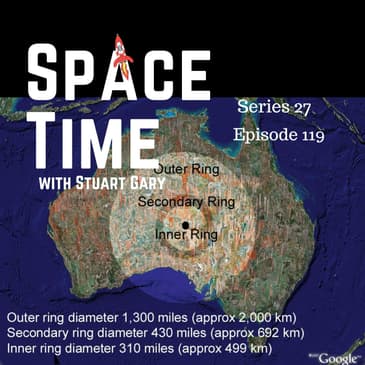
*Australian Crater Offers Fresh Insights into Earth's History
Scientists have uncovered a potential 600-kilometre-wide crater in Australia's outback, which could revolutionise our understanding of Earth's geological past. This discovery, presented at the 37th International Geological Congress in South Korea, suggests the existence of Mapix, a massive Cambrian-Precambrian impact structure. The crater's unique characteristics could provide new insights into the geological and biological evolution of our planet. The study's authors have found significant geological evidence, including pseudotachylite breccia and shock minerals like lonsdaleite, supporting the age, size, and location of this impact structure.
*Perseverance Rover Discovers Striped Rock on Mars
NASA's Mars Perseverance rover has spotted an unusual black and white striped rock on the Red Planet. The discovery was made during the rover's exploration of the outer rim of Jezero Crater. The rock, named Freya Castle, has a striking pattern and is unlike anything previously observed on Mars. Early interpretations suggest that igneous and metamorphic processes could have created its distinctive stripes. This finding adds to the variety of intriguing rocks discovered by the rover, which could be among the oldest or youngest ever investigated on Mars.
*Blue Origin's New Glenn Completes Second Stage Hot Fire Test
Blue Origin's new heavy-lift rocket, the New Glenn, has successfully completed a hot fire test of its second stage booster. This critical test at Cape Canaveral's Space Launch Complex 36 marks a key step towards the rocket's inaugural test flight, scheduled for next month. The NG-1 mission will carry the prototype Blue Ring spacecraft, designed for refuelling, transporting, and hosting satellites. The 15-second hot fire test demonstrated the integrated operation of the vehicle's BE-3U engines and various subsystems, setting the stage for future missions.
www.spacetimewithstuartgary.com
www.bitesz.com
🌏 Get Our Exclusive NordVPN deal here ➼ www.bitesz.com/nordvpn. The discount and bonuses are incredible! And it’s risk-free with Nord’s 30-day money-back guarantee! ✌
Check out our newest sponsor - Old Glory - Iconic Music and Sports Merch. Well worth a look....
Become a supporter of this podcast and access commercial-free episodes plus bonuses: https://www.spreaker.com/podcast/spacetime-with-stuart-gary--2458531/support.
00:00 - This is spacetime series 27 episode 119 for broadcast on 2 October 2024
00:49 - Scientists have discovered a possible crater stretching more than 600 kilometres across Australia's outback
02:54 - NASA's Mars Perseverance rover has discovered an unusual striped rock
05:46 - The Mars Perseverance rover is exploring ancient Martian rocks
10:59 - Researchers have found nanostructures around deep ocean hydrothermal vents
12:57 - 61% of Americans admit to self censoring, according to study
15:09 - Meta showing off their new Orion augmented reality glasses; Huawei releasing threefold phones
19:16 - Spacetime is available every Monday, Wednesday and Friday through various podcasting services
[00:00:00] [SPEAKER_03]: This is SpaceTime Series 27 Episode 119 for broadcast on the 2nd of October 2024.
[00:00:06] [SPEAKER_03]: Coming up on SpaceTime, the Australian crater that could offer fresh insights into planet Earth's history,
[00:00:13] [SPEAKER_03]: NASA's Mars Perseverance rover spots an unusually striped rock on the red planet
[00:00:18] [SPEAKER_03]: and Blue Origin's New Glenn spacecraft completes a successful second stage hot fire test.
[00:00:25] [SPEAKER_03]: All that and more coming up on SpaceTime.
[00:00:28] [SPEAKER_01]: Welcome to SpaceTime with Stuart Gary.
[00:00:48] [SPEAKER_03]: Scientists have discovered a possible crater stretching more than 600 kilometers across the
[00:00:54] [SPEAKER_03]: red center of Australia's outback and this crater could reshape science's understanding
[00:01:00] [SPEAKER_03]: of planet Earth's geological history. The amazing discovery has been presented at the 37th
[00:01:05] [SPEAKER_03]: International Geological Congress in South Korea. It suggests the existence of MAPIX,
[00:01:10] [SPEAKER_03]: the massive Australian Cambrian pre-Cambrian impact structure. This non-concentric complex
[00:01:16] [SPEAKER_03]: crater is so important, it could provide new insights into the geological and biological
[00:01:21] [SPEAKER_03]: evolution of planet Earth. One of the study's authors, Daniel Cannelly from the Virginia
[00:01:26] [SPEAKER_03]: Commonwealth University says the discovery not only highlights the significance of this
[00:01:30] [SPEAKER_03]: impact structure but also opens new avenues for understanding Earth's geological past.
[00:01:36] [SPEAKER_03]: He says the data gathered offering a unique glimpse into the forces that have shaped
[00:01:40] [SPEAKER_03]: the planet. A detailed study of the area around ground zero suggests the impact event
[00:01:45] [SPEAKER_03]: probably occurred at the end of the Ediacaran period within the Neoprotizoic era which spans
[00:01:50] [SPEAKER_03]: from a billion to 538.8 million years ago. Among the geological evidence uncovered to
[00:01:56] [SPEAKER_03]: support the age, size and location of the impact structure are massive deposits of pseudo
[00:02:01] [SPEAKER_03]: tachylite breccia or melt rock near the crater center. The authors also found
[00:02:06] [SPEAKER_03]: shark minerals including Lon's Delight or Shark Diamond in the deposits along with impact level
[00:02:11] [SPEAKER_03]: amounts of iridium. Now that's significant because iridium is a very rare element here on Earth but
[00:02:17] [SPEAKER_03]: it's very common in asteroids. This is space time. Still to come, NASA's Mars Perseverance
[00:02:24] [SPEAKER_03]: rover spots some unusually striped rocks on the red planet and Blue Origin's new
[00:02:29] [SPEAKER_03]: heavy lift rocket the new Glenn has successfully completed a hot fire test of its second stage
[00:02:34] [SPEAKER_03]: booster. All that and more still to come on space time. NASA's Mars Perseverance rover is
[00:02:56] [SPEAKER_03]: discovered in unusual black and white striped rock unlike anything ever seen on Mars before.
[00:03:02] [SPEAKER_03]: The six-willed car-sized mobile laboratory made the discovery as it was continuing's
[00:03:06] [SPEAKER_03]: exploration of the outer rim of Jessro crater. It's now been nearly a month since the rover
[00:03:12] [SPEAKER_03]: began its climb up the steep slopes leading to the crater rim as it continues its hunt for
[00:03:17] [SPEAKER_03]: ancient rocks that could teach scientists about early Martian history. While these tricky slopes
[00:03:22] [SPEAKER_03]: made for an initially slower scent, drive progress has improved greatly in recent days
[00:03:27] [SPEAKER_03]: with Perseverance cruising along much flatter terrain. From its current perch the rover can
[00:03:33] [SPEAKER_03]: now spot landmarks from earlier in the mission like the iconic Kodiak Butte now
[00:03:37] [SPEAKER_03]: distant on the hazy Martian horizon which is now thick with dust from nearby dust storms.
[00:03:43] [SPEAKER_03]: While driving across some apparently fairly unremarkable pebbly terrain,
[00:03:47] [SPEAKER_03]: mission managers noticed a cobblestone in the distance with hints of an unusual texture
[00:03:51] [SPEAKER_03]: in the low-resolution NAVCAM images. They gave it the name Freya Castle. The team then undertook
[00:03:58] [SPEAKER_03]: a multi-spectral observation using the Mascam Z camera in order to get a closer look before
[00:04:02] [SPEAKER_03]: driving on. When this data was downloaded a couple of days later after Perseverance had already
[00:04:08] [SPEAKER_03]: left the area it became clear just how unusual and significant this rock really was.
[00:04:14] [SPEAKER_03]: Freya Castle is around 20 centimetres across and it has a striking pattern with alternating
[00:04:19] [SPEAKER_03]: black and white stripes. The internet immediately lit up with speculation about what this zebra
[00:04:24] [SPEAKER_03]: rock might be made of. The Perseverance science team thinks the rock has a unique texture unlike
[00:04:30] [SPEAKER_03]: anything seen in Jezero creator before, in fact unlike anything ever seen on Mars before.
[00:04:35] [SPEAKER_03]: The problem is science's knowledge of the chemical composition of this rock is limited,
[00:04:39] [SPEAKER_03]: but early interpretations suggest that igneous and or metamorphic processes could have created
[00:04:44] [SPEAKER_03]: its stripes. Now since Freya Castle is a loose stone that's clearly different from the underlying
[00:04:49] [SPEAKER_03]: bedrock it's likely arrived at its current location from somewhere else, perhaps having
[00:04:54] [SPEAKER_03]: rolled downhill from a source higher up. This possibility as research is excited and
[00:04:59] [SPEAKER_03]: they're hoping that as they continue driving further uphill Perseverance might encounter
[00:05:03] [SPEAKER_03]: an outcrop of this new type of rock so that more detailed measurements can be acquired.
[00:05:08] [SPEAKER_03]: Of course Freya Castle is merely the latest in this series of intriguing rocks found there recently.
[00:05:14] [SPEAKER_03]: Ever since arriving in the vicinity of the crater rim the Perseverance team have noticed an
[00:05:19] [SPEAKER_03]: increased variety of rocks such as the diverse collection of boulders found at Mount Washbourne.
[00:05:24] [SPEAKER_03]: Now these could be our first glimpses of the ancient rocks uplifted from depth by Jezero's
[00:05:29] [SPEAKER_03]: impact event now lying exposed on the surface of the crater rim. NASA Deputy Project Scientist
[00:05:35] [SPEAKER_03]: Katie Stack Morgan says these unusual new rock discoveries could be among the oldest that
[00:05:40] [SPEAKER_03]: Perseverance has ever investigated. On the other hand she says they could also be the youngest,
[00:05:45] [SPEAKER_00]: any time will tell. The Mars Perseverance rover is climbing out of the crater it landed on
[00:05:50] [SPEAKER_00]: and it's exploring rocks that are amongst the oldest we've seen on Mars or the youngest.
[00:05:58] [SPEAKER_00]: We're here in the Mars Yard at NASA's Jet Propulsion Laboratory. This is where we test robotic
[00:06:03] [SPEAKER_00]: prototypes as we explore Mars. Right now the real Perseverance rover is in the main channel
[00:06:08] [SPEAKER_00]: that once fed Jezero crater. Picture rushing water carrying big boulders and sediment as
[00:06:14] [SPEAKER_00]: it filled the crater but getting there was a slog. It was slow going through an area called the
[00:06:20] [SPEAKER_00]: margin unit which is really rocky and hilly but once we got out of the rocks we passed
[00:06:24] [SPEAKER_00]: through a dune field and it has been smooth sailing ever since. Now that we're in the channel
[00:06:29] [SPEAKER_00]: we're seeing things we've never seen before. Many of the boulders we see at the Martian surface
[00:06:35] [SPEAKER_00]: represent ancient lava flows that have broken up and eroded over time but a rock like this one
[00:06:40] [SPEAKER_00]: might have come from deeper in the crust and could be amongst the oldest rocks we've seen
[00:06:45] [SPEAKER_00]: or studied on Mars. It could also have come from the ancient rocks exposed nearby in the
[00:06:54] [SPEAKER_00]: rim though. We're making a stop at a site called Bright Angel. The rocks there could contain sediments
[00:06:59] [SPEAKER_00]: deposited by one of the last bursts of water into the crater and could be amongst the youngest rocks
[00:07:05] [SPEAKER_00]: we've looked at yet. Perseverance is equipped with cameras, geochemistry instruments and an
[00:07:10] [SPEAKER_00]: underground radar. We're going to use observations from these instruments to determine how and when
[00:07:15] [SPEAKER_00]: these rocks formed and depending on what we find we may decide to sample these rocks.
[00:07:20] [SPEAKER_00]: Whether Bright Angel is older or younger than what we've seen before in the crater
[00:07:23] [SPEAKER_00]: these rocks could be an important bookend to our Jezero sample collection. With Jezero in the
[00:07:29] [SPEAKER_00]: rear view mirror I'm most looking forward to this next phase of exploration on the crater rim.
[00:07:36] [SPEAKER_03]: And in that report from NASA TV we heard from NASA Deputy Project Scientist with the
[00:07:41] [SPEAKER_03]: Perseverance Project team Katie Stack Morgan. This is space time. Still to come!
[00:07:47] [SPEAKER_03]: Blue Origin's New Heavy Lift Rocket the New Glenn successfully completes its hot fire test of
[00:07:53] [SPEAKER_03]: its second stage booster and later in the science report have scientists finally discovered the
[00:07:58] [SPEAKER_03]: cradle of life. All that and more still to come on space time. Blue Origin's New Heavy Lift
[00:08:20] [SPEAKER_03]: Rocket the New Glenn has successfully completed a hot fire engine test of its second stage
[00:08:25] [SPEAKER_03]: booster. The critical test at Cape Canaveral Space Launch Complex 36 is a key step towards the
[00:08:32] [SPEAKER_03]: rocket's inaugural test flight slated for next month. The NG1 mission will carry the prototype
[00:08:37] [SPEAKER_03]: blue ring spacecraft as its first payload. The blue ring platforms are sort of space tug.
[00:08:43] [SPEAKER_03]: It's designed to be capable of refuelling transporting and hosting satellites. The New
[00:08:49] [SPEAKER_03]: Glenn launch will also serve as a national security space launch demonstration mission.
[00:08:54] [SPEAKER_03]: The 15 second hot fire test was the first time the vehicle operated as a fully integrated system
[00:08:59] [SPEAKER_03]: with both its BE3U rocket engines burning and both the launch vehicle subsystems and the ground
[00:09:05] [SPEAKER_03]: control systems operating simultaneously. These include not just the new BE3U engines but
[00:09:11] [SPEAKER_03]: also the helium system which keeps the liquid hydrogen and liquid oxygen tanks pressurized,
[00:09:16] [SPEAKER_03]: the thrust vector control system which steers the rocket using engine gimbling
[00:09:20] [SPEAKER_03]: and the engine startup and shutdown sequences which allow the BE3U rocket motors to be restarted
[00:09:26] [SPEAKER_03]: multiple times during the mission. The 98 meter tall New Glenn two-stage rocket is named after
[00:09:32] [SPEAKER_03]: John Glenn, the first American to orbit the earth. The upper or second stage features two BE3U
[00:09:39] [SPEAKER_03]: engines with an expanded bleed design that optimizes thrust performance. That means each engine
[00:09:44] [SPEAKER_03]: is initially rated for 160,000 pounds of thrust but it will operate at 173,000 pounds during the
[00:09:51] [SPEAKER_03]: NG1 mission. That makes these among the highest thrust to weight hydrogen engines ever used.
[00:09:57] [SPEAKER_03]: The giant reusable first stage is powered by seven BE4 engines, the most powerful liquefied
[00:10:03] [SPEAKER_03]: natural gas field oxygen-rich stage combustion engines ever flown. After each flight the
[00:10:08] [SPEAKER_03]: New Glenn first stage will return to earth landing on a badge called landing platform
[00:10:12] [SPEAKER_03]: vessel 1 and works now on the way to make the second stage reusable as well. Alongside the BE4
[00:10:20] [SPEAKER_03]: and BE3U engines, little origin also produces the BE7 engines for its blue moon lunar landers
[00:10:26] [SPEAKER_03]: and the BE3PM engines fitted to its new Shepard vehicle which is used for space tourism activities.
[00:10:32] [SPEAKER_03]: As with New Glenn, the new Shepard launch vehicle is reusable and named after an American
[00:10:37] [SPEAKER_03]: astronaut, in this case Alan Shepard who was the first American to reach space. This is space time.
[00:10:59] [SPEAKER_03]: Time that'll take another brief look at some of the other stories making news in science this
[00:11:03] [SPEAKER_03]: week with a science report. Researchers have discovered inorganic nanostructures surrounding
[00:11:09] [SPEAKER_03]: deep ocean hydrothermal vents that are strikingly similar to molecules that would make life as
[00:11:14] [SPEAKER_03]: we know it possible. A report in the journal Nature Communications claims these nanostructures
[00:11:19] [SPEAKER_03]: are self-organized and they act as selective ion channels which create energy that can then
[00:11:25] [SPEAKER_03]: be harnessed in the form of electricity. It works like this, when sea water seeps down into the
[00:11:30] [SPEAKER_03]: earth through cracks on the ocean floor it gets heated up by magma, it then rises back to
[00:11:35] [SPEAKER_03]: the surface and is released back into the ocean through fishes called hydrothermal vents.
[00:11:40] [SPEAKER_03]: The rising hot water contains dissolved minerals gained from the time it was deep inside
[00:11:45] [SPEAKER_03]: the earth and when it meets the cool ocean water chemical reactions force the mineral ions out of
[00:11:50] [SPEAKER_03]: the water where they form solid structures around the vents called precipitates. The study's authors
[00:11:55] [SPEAKER_03]: were studying samples collected from the Pacific Ocean's Mariana Trench at a depth of some
[00:12:00] [SPEAKER_03]: 5,743 meters. The Mariana Trench is the deepest part of the Earth's oceans. The key sample
[00:12:08] [SPEAKER_03]: which led to this discovery was an 84 centimeter piece composed mostly of brusite. Optical
[00:12:13] [SPEAKER_03]: microscopes and scans with x-rays revealed that the brusite crystals were arranged in continuous
[00:12:19] [SPEAKER_03]: columns that acted as nano channels for the vent fluid. The researchers noticed that the surface
[00:12:24] [SPEAKER_03]: of the precipitate was electrically charged and that the size and direction of the charge, positive
[00:12:29] [SPEAKER_03]: or negative, varied across the surface. They were able to show that the nanopores acted
[00:12:35] [SPEAKER_03]: as selective ion channels. At locations with carbonated heat to the surface the nanopores
[00:12:41] [SPEAKER_03]: allowed positive sodium ions to flow through. However at nanopores with calcium it hid to the
[00:12:46] [SPEAKER_03]: surface the pores only allowed negative chloride ions to pass through. It's not proof that it's
[00:12:52] [SPEAKER_03]: where life began but it's a tantalizing discovery. A new study has compared what people say in
[00:12:59] [SPEAKER_03]: public to what they really think in private. It turns out that although they don't like
[00:13:04] [SPEAKER_03]: to admit it people tend to self-censor themselves an awful lot to a far greater degree than
[00:13:09] [SPEAKER_03]: what was previously thought. The Massachusetts think tank populace together with you gov found that 61%
[00:13:15] [SPEAKER_03]: of Americans admit to self-censoring in other words keeping their true opinions on sensitive
[00:13:20] [SPEAKER_03]: topics to themselves. The study surveyed around 20,000 people. They found that while 36% of
[00:13:27] [SPEAKER_03]: Democrats and 14% of Republicans say they trust the government to tell the truth in reality
[00:13:33] [SPEAKER_03]: only 5% of Democrats and 2% of Republicans really believe that. And trust in the media was almost
[00:13:40] [SPEAKER_03]: as bad. While 42% of Democrats and 16% of Republicans said they trust the media to tell the truth
[00:13:46] [SPEAKER_03]: in reality just 9% of Democrats and 3% of Republicans really believe that the media
[00:13:52] [SPEAKER_03]: tells the truth. Also while 37% of Americans say the United States is a mostly fair country
[00:13:58] [SPEAKER_03]: deep down only 7% of people really believe that.
[00:14:03] [SPEAKER_03]: Scientists have isolated personality traits associated with self-control skills. A report
[00:14:09] [SPEAKER_03]: in the journal PLOS ONE has found that neuroticism, extroversion and conscientiousness are major
[00:14:15] [SPEAKER_03]: traits that impact how good your self-control is. The study's authors investigated the
[00:14:20] [SPEAKER_03]: relationship between five major personality traits and self-control among 480 military
[00:14:25] [SPEAKER_03]: cadets who had undergone personality testing. They looked for two types of self-control inhibitory,
[00:14:31] [SPEAKER_03]: the ability to resist temptation and the ability to initiate tasks to achieve long-term goals.
[00:14:38] [SPEAKER_03]: The authors say that participants who scored highly for neuroticism were likely to have lower
[00:14:42] [SPEAKER_03]: self-control in general and a lower ability to initiate tasks. They also found that higher
[00:14:48] [SPEAKER_03]: extroversion and conscientiousness scores were associated with higher self-control across
[00:14:53] [SPEAKER_03]: categories but less so when higher extroversion or conscientiousness also came together with
[00:14:58] [SPEAKER_03]: high neuroticism. The authors say personality traits impacted the two different types of
[00:15:03] [SPEAKER_03]: self-control in different ways showing the importance of distinguishing between them.
[00:15:09] [SPEAKER_03]: Well it's been a huge week in technology with meta showing off the new Orion augmented
[00:15:13] [SPEAKER_03]: reality glasses although at this stage it's only developer form and Huawei releasing their
[00:15:18] [SPEAKER_03]: new three fold cell phones. With the details we're joined by technology editor Alex Saharov-Royd
[00:15:24] [SPEAKER_02]: from TechAdvice.Live. Well at the MetaConnect conference they announced a whole series of
[00:15:28] [SPEAKER_02]: things one is the MetaQuest 3S which they're calling their most affordable mixed reality
[00:15:34] [SPEAKER_02]: headset so that's the latest version of their virtual reality headset that you can actually
[00:15:39] [SPEAKER_02]: see through but it's not designed really to be a pair of augmented reality glasses as such we
[00:15:44] [SPEAKER_02]: also have new meta AI with some celebrity voices people like Awkwafina, Dane Judy Dench, John Cena,
[00:15:52] [SPEAKER_02]: Keegan Michael Key and Kristen Bell so if you want your AI to sound like a celebrity you can do that
[00:15:58] [SPEAKER_02]: some new features for the Ray-Ban Meta glasses that pair of sunglasses that have AI inside that
[00:16:04] [SPEAKER_02]: they've got new features in there so you can remember things like where you parked or
[00:16:08] [SPEAKER_02]: translate speech in real time or answer questions about what you're saying but the big thing
[00:16:12] [SPEAKER_02]: that they announced was then you Orion smart glasses so this is their first true augmented
[00:16:18] [SPEAKER_02]: reality glasses a bit like what Apple has done with the Apple Vision Pro but instead of looking
[00:16:22] [SPEAKER_02]: like a giant pair of ski goggles these look like a normal pair of glasses obviously slightly
[00:16:28] [SPEAKER_02]: chunkier than what you'd expect from a pair of sunnies but instead of glasses got silicon
[00:16:32] [SPEAKER_02]: carbide the frames are magnesium can have multiple windows up in front of you like the Apple
[00:16:37] [SPEAKER_02]: Vision Pro you can have 3D holographic video calls and they're saying that's their most advanced
[00:16:43] [SPEAKER_02]: pair of glasses that they've had to make things very very small this is just a developer version
[00:16:49] [SPEAKER_02]: so it's not the commercial consumer version at scale yet they talk about having this in the
[00:16:54] [SPEAKER_02]: next few years but they talked about these AI glasses about a decade ago and here they are
[00:16:58] [SPEAKER_03]: this is really where we're going isn't it this is the future yeah you don't have to look in
[00:17:03] [SPEAKER_02]: your hand at a glowing glass rectangle but when you look out at something you can see
[00:17:07] [SPEAKER_02]: digital information just appearing overlaid on top of reality and because the glasses are looking
[00:17:15] [SPEAKER_02]: like a pair of regular glasses people can see your eyes so they're not seeing a digital representation
[00:17:19] [SPEAKER_02]: also it's not super heavy I mean you still have the battery you've got to put into your pocket
[00:17:23] [SPEAKER_02]: that haven't quite gotten the the batteries to go into the frames that can power this sort of
[00:17:27] [SPEAKER_02]: experience just yet that by 2030 these sorts of glasses should effectively be commonplace and
[00:17:33] [SPEAKER_02]: instead of having a smartphone you'll have your smart glasses on what was once science fiction
[00:17:37] [SPEAKER_02]: with a terminator and other movies it's not going to be reality this is a challenge laid down to
[00:17:42] [SPEAKER_02]: Apple when Apple obviously also will get their Vision Pro headset down but Apple didn't launch a
[00:17:47] [SPEAKER_02]: developer kit they launched something for the public and I've tried the Vision Pro it is
[00:17:51] [SPEAKER_02]: stunning I mean it's incredible but after 20 30 minutes you can feel the weight you
[00:17:55] [SPEAKER_02]: definitely won't feel the weight with these particular glasses from Meta the graphics don't
[00:17:59] [SPEAKER_02]: look as good as what I see on the Vision Pro but still looks pretty amazing the question is though
[00:18:04] [SPEAKER_02]: do you trust Apple more than you trust face and the other big news I thought was Huawei's new
[00:18:09] [SPEAKER_02]: three-fold yeah now I'm speaking to you on an iPhone but I'm looking at my Google Pixel Pro fold
[00:18:15] [SPEAKER_02]: nine which is the second generation which is very thin that's got two screens the Huawei
[00:18:21] [SPEAKER_02]: equivalent has three screens so it unfolds into a 10.2 inch tablet each folding piece is quite thin
[00:18:27] [SPEAKER_02]: so when you fold it up it is thicker than a regular phone but it does look quite stunning
[00:18:32] [SPEAKER_02]: when you see the videos of this online now you do have two sets of creatures because you've got
[00:18:37] [SPEAKER_02]: three paints that have to fold out and they will figure out how to make that completely
[00:18:40] [SPEAKER_02]: flat one day of course with the Huawei version I mean it's $2,800 US that's you know over
[00:18:46] [SPEAKER_02]: $4,000 Australian they did have four million pre-orders in China but definitely this is the
[00:18:51] [SPEAKER_02]: future of this small and unfolded. This will take us to 2030 when the glasses become commonplace.
[00:18:56] [SPEAKER_02]: Well it's going to be a mixture of the two I mean you're still going to want to have devices you
[00:19:01] [SPEAKER_02]: can hold that will fold down into something small and unfold okay but you'll also want to have
[00:19:04] [SPEAKER_02]: the glasses I mean I can imagine that there'll be things I will want to see on the screen the
[00:19:08] [SPEAKER_02]: things I want to see in my field of view there's going to be use cases for all of those
[00:19:12] [SPEAKER_02]: devices one's not going to replace the other immediately certainly not in the short term
[00:19:16] [SPEAKER_03]: that's Alex Harrow Roy from techadvice.life that's the show for now. Spacetime is available every
[00:19:39] [SPEAKER_03]: Monday Wednesday and Friday through Apple Podcasts iTunes, Stitcher, Google Podcast,
[00:19:45] [SPEAKER_03]: Hockercasts, Spotify, Acast, Amazon Music, Bytes.com, SoundCloud, YouTube, your favorite
[00:19:52] [SPEAKER_03]: podcast download provider and from spacetimewithstewettgarry.com. Spacetime's also broadcasts through
[00:19:59] [SPEAKER_03]: the National Science Foundation on Science Zone Radio and on both iHeart Radio and TuneIn Radio
[00:20:04] [SPEAKER_03]: and you can help to support our show by visiting the spacetime store for a range of
[00:20:09] [SPEAKER_03]: promotional merchandising goodies or by becoming a spacetime patron which gives you access to
[00:20:15] [SPEAKER_03]: triple episode commercial free versions of the show as well as lots of bonus audio content
[00:20:19] [SPEAKER_03]: which doesn't go to air access to our exclusive Facebook group and other rewards just go to
[00:20:26] [SPEAKER_03]: spacetimewithstewettgarry.com for full details and if you want more spacetime please check out our
[00:20:31] [SPEAKER_03]: blog where you'll find all the stuff we couldn't fit in the show as well as heaps of images
[00:20:35] [SPEAKER_03]: news stories loads of videos and things on the web I find interesting or amusing just go to
[00:20:42] [SPEAKER_03]: spacetimewithstewettgarry.tumblr.com that's all one word and that's tumblr without the
[00:20:48] [SPEAKER_03]: you can also follow us through at steward garry on twitter at spacetimewithstewettgarry on instagram
[00:20:54] [SPEAKER_03]: through our spacetime youtube channel and on facebook just go to facebook.com forward slash
[00:21:01] [SPEAKER_03]: spacetimewithstewettgarry you've been listening to spacetimewithstewettgarry this has been another
[00:21:06] [SPEAKER_01]: quality podcast production from bites.com