
*Discovery of the Outer Solar System's Magnetic Field
Scientists have discovered evidence of an ancient magnetic field at the far reaches of our solar system. Research published in AGU Advances, based on 4.6 billion-year-old grain samples from the asteroid Richie, suggests the presence of a weak magnetic field during the formation of the outer solar system. This field, although weak, could have been instrumental in the formation of the outer planets, including Jupiter, Saturn, Uranus, and Neptune. The findings provide new insights into the magnetic influences shaping our solar system.
*Southern Launch Gets Green Light for Orbital Missions
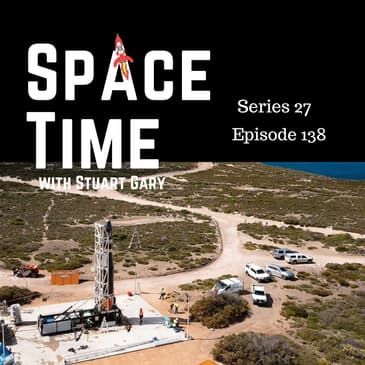
Southern Launch has received federal and state government approval for its Whalers Way orbital launch complex in South Australia. The site is poised to support up to 42 orbital rocket launches annually, with plans for multiple launch pads and comprehensive tracking facilities. This development marks a significant step forward for Australia's growing Space industry.
*Axiom Unveils New Lunar Spacesuits for NASA
Axiom Space has revealed the new spacesuits for NASA's Artemis 3 mission, set for a lunar landing in 2026. Designed to withstand the harsh lunar environment, these suits feature improved mobility and dust resistance. The new design includes interchangeable segments to accommodate various body types, reflecting advancements in spacesuit technology since the Apollo era.
The Science Robert
A study has identified a decline in low-pressure weather systems, crucial for rainfall in southern Australia, since the mid-20th century. Meanwhile, the largest study of brain volume to date has found genetic links between ADHD and Parkinson's disease. In wildlife news, taming wild elephant calves has been shown to increase stress levels, potentially affecting their health. Finally, the paranormal world is abuzz with sightings of Robin Hood's ghost in Sherwood Forest, though sceptics remain unconvinced.
www.spacetimewithstuartgary.com
www.bitesz.com
🌏 Get Our Exclusive NordVPN deal here ➼ www.bitesz.com/nordvpn. Enjoy incredible discounts and bonuses! Plus, it’s risk-free with Nord’s 30-day money-back guarantee! ✌
Check out our newest sponsor - Old Glory - Iconic Music and Sports Merch and now with official NASA merch. Well worth a look....
Become a supporter of this Podcast and access commercial-free episodes plus bonuses: https://www.spreaker.com/podcast/spacetime-with-stuart-gary--2458531/support
00:00 Scientists uncover an ancient magnetic field at the outer edge of the solar system
08:09 Axiom Space has unveiled the new lunar spacesuits NASA plans to use
13:50 Low pressure weather systems driving southern Australia's rainfall have declined over decades
16:19 Reports in England that Robin Hood has been seen haunting Sherwood Forest
[00:00:00] This is SpaceTime Series 27 Episode 138 for broadcast on the 15th of November 2024.
[00:00:06] Coming up on SpaceTime, discovery of the outer solar system's magnetic field,
[00:00:12] Southern launch gets the green light for orbital missions from South Australia,
[00:00:17] and Axiom unveils its new lunar spacesuits for NASA.
[00:00:21] All that and more coming up on SpaceTime.
[00:00:25] Welcome to SpaceTime with Stuart Gary.
[00:00:45] Scientists have uncovered an ancient magnetic field at the outer edge of the solar system.
[00:00:50] The findings, reported in the journal AGU Advances, are based on research into tiny 4.6 billion-year-old grain samples taken from the asteroid Ryugu.
[00:01:00] The grains were among those collected by the JAXA, Japanese Aerospace Exploration Agency's Hayabusa-2 sample return mission,
[00:01:07] which parachuted down onto the Wilma rocket range in outback South Australia in 2020.
[00:01:13] Scientists believe Rayugu initially formed on the outskirts of the early solar system,
[00:01:18] before migrating in towards the main asteroid belt between Mars and Jupiter,
[00:01:22] and then eventually settling into orbit between Mars and Earth.
[00:01:25] The authors analysed Rayugu's particles for signs of an ancient magnetic field that might have been present when the asteroid first formed.
[00:01:32] Their results suggest that if there was a magnetic field, it would have been very weak.
[00:01:37] At most, such a field would have been about 15 microtesla.
[00:01:41] Now, Earth's own magnetic field today is around 50 microtesla.
[00:01:45] Even so, scientists estimate that such a low-grade magnetic field intensity would still have been enough
[00:01:51] to pull together primordial gas and dust to form the outer solar system's asteroids,
[00:01:56] and potentially play a role in giant planet formation, including Jupiter, Saturn, Uranus and Neptune.
[00:02:02] One of the study's authors, Benjamin Weiss from MIT, says scientists have known that a magnetic field shaped the inner solar system,
[00:02:09] where the Earth and the other terrestrial planets, Mercury, Venus and Mars were formed.
[00:02:13] But until now, it's been unclear as to whether such a magnetic influence also extended into more remote regions of the solar system.
[00:02:20] Weiss says the new research shows that everywhere we look, there's some sort of magnetic field that was responsible for bringing mass to where the Sun and planets were forming.
[00:02:30] And he says that now also applies to the outer solar system planets as well.
[00:02:35] Around 4.6 billion years ago, the solar system formed from a dense cloud of interstellar gas and dust,
[00:02:42] which collapsed into a swirling disk of matter.
[00:02:44] Most of the material gravitated towards the centre of the disk forming the Sun.
[00:02:49] The remaining bits formed a solar nebula of swirling ionised gas.
[00:02:54] Scientists suspect that interactions between the newly formed Sun and the ionised disk generated a magnetic field that threaded through the nebula,
[00:03:02] helping to drive accretion and pull matter inwards to form the planet's asteroids and moons.
[00:03:07] This nebula field disappeared around 3 to 4 million years after the solar system's formation.
[00:03:13] Scientists had already determined that a magnetic field was present throughout the inner solar system,
[00:03:17] out to about the orbit of Jupiter today.
[00:03:20] The intensity of this inner nebula field was somewhere between 50 and 200 microtesla,
[00:03:25] and it likely influenced the formation of the inner terrestrial planets.
[00:03:30] Now these estimates of the early magnetic field are based on meteorites which have landed on Earth
[00:03:34] and are thought to have originated from the inner nebula.
[00:03:37] But the outer solar system was still a magnetic mystery.
[00:03:41] And that's where Ryugu comes in.
[00:03:43] Ryugu gave scientists the chance to finally analyse samples from the outer solar system.
[00:03:49] Wiese and colleagues acquired several sample grains, each about a millimetre in size.
[00:03:53] They placed the particles on a magnetometer to measure the strength and direction of the sample's magnetisation.
[00:03:59] They then applied an alternating magnetic field to progressively demagnetise each sample.
[00:04:05] Like a tape recorder, this slowly rewinds the sample's magnetic record.
[00:04:10] Eventually they found the samples held no clear sign of a preserved magnetic field.
[00:04:15] And this suggests that either there was no nebula field present in the outer solar system where the asteroid first formed,
[00:04:21] or the field was so weak that it was not recorded in the asteroid's grains.
[00:04:25] Now if the latter is the case, the authors estimate such a weak field would have been no more than 15 micro teslar in intensity.
[00:04:33] The authors also re-examined data from previously studied meteorites.
[00:04:37] They specifically looked at ungrouped carbonaceous chondrites.
[00:04:41] These are meteorites that are properties that are characteristic of having formed in the distal solar system.
[00:04:47] Scientists had already estimated that these samples were not old enough to have formed before the solar nebula disappeared.
[00:04:52] Any magnetic field record the samples contained then would not reflect the nebula field.
[00:04:58] They re-analyzed the ages of their samples and found that they're closer to the start of the solar system than what was previously thought.
[00:05:05] That means that these samples probably formed in this distal outer region.
[00:05:09] And one of the carbonaceous chondrite samples had a positive field detection of around 5 micro teslar.
[00:05:16] Now that's consistent with the upper limit of 15 micro teslar.
[00:05:19] The updated carbonaceous chondrite sample combined with the new Ryugu samples suggested the outer solar system beyond Jupiter hosted a very weak magnetic field that was nevertheless strong enough to pull matter together from the outskirts to eventually form the outer planetary bodies.
[00:05:36] Jupiter, Saturn, Uranus and Neptune.
[00:05:39] This is space time.
[00:05:41] Still to come.
[00:05:43] Southern launch gets the green light for orbital missions from South Australia.
[00:05:47] And Axiom unveils its lunar spacesuits for NASA.
[00:05:51] All that and more still to come on Space Time.
[00:06:09] Southern launch has finally been granted both federal and state government approvals for its Whalers Way orbital launch complex.
[00:06:16] Located on the tip of South Australia's Air Peninsula near Port Lincoln, the facility which right now is little more than a concrete hard stand, could see regular orbital rocket launches from late next year.
[00:06:28] Once operational, Whalers Way will accommodate direct descent trajectories from 55 to 177 degrees, including polar sun-synchronous orbits and 135 degree inclinations.
[00:06:39] Current plans call for at least two launch pads, together with vehicle assembly buildings, clean rooms, integration facilities and long-range tracking and telemetry sites, thereby allowing continuous monitoring right through to payload separation.
[00:06:54] Initial approvals have been granted for up to 42 orbital rocket launches every year.
[00:06:59] The Whalers Way facility will complement the Cunibus suborbital test range along South Australia's west coast and east Ceduna, which is designed to track and recover test articles following their flights.
[00:07:10] Australia is currently home to three other spaceports.
[00:07:14] There's Equatorial Launch Australia's Arnhem Space Centre in the Northern Territory.
[00:07:18] It's already been used for suborbital flights by NASA.
[00:07:21] Gilmore Space Technologies' Bowen Spaceport in North Queensland has just received its own orbit launch approval from the Australian Space Agency.
[00:07:29] And then there's the famous Woomera rocket range in outback South Australia run by the Department of Defence.
[00:07:35] It was home to Australia's first orbital launches and was once the second busiest spaceport in the world after Cape Canaveral.
[00:07:42] A sixth spaceport, Space Centre Australia, is currently planned for the Cape York Peninsula in far north Queensland.
[00:07:49] It's recently appointed former Prime Minister Scott Morrison as its chair.
[00:07:54] This is Space Time.
[00:07:56] Still to come, Axiom Space unveils its new lunar spacesuits for NASA and later in the science report,
[00:08:02] scientists discover genetic links between attention deficit hyperactivity disorder and Parkinson's disease.
[00:08:08] All that and more still to come on Space Time.
[00:08:27] Axiom Space has unveiled the new lunar spacesuits NASA's Artemis 3 crew will be using when they walk on the Moon in September 2026.
[00:08:36] The new suits are designed to be more robust than those worn 50 years ago during the Apollo missions,
[00:08:41] and they're better able to deal with the razor sharp yet talcum powder-like lunar dust.
[00:08:45] The external layer of the new suits will still be white to better reflect the heat, but the new outfits will also include touches of grey and red stripes.
[00:08:54] The new suits are composed of interchangeable segments allowing different people of different shapes and sizes to adapt the suits to meet their specific needs.
[00:09:03] The suits are designed to handle temperatures ranging from 54 degrees Celsius in direct sunlight down to minus 203 degrees Celsius in shattered areas.
[00:09:12] The backpacks carry enough oxygen, water and power for an eight-hour EVA or extra vehicle activity.
[00:09:18] That's NASA speak for Moonwalk.
[00:09:20] These reports from NASA TV and Axiom Space.
[00:09:27] There's been a lot of excitement about spacesuits lately.
[00:09:32] But what about that iconic puffy marshmallow suit that we used to walk on the Moon?
[00:09:37] This is what we call an Extra Vehicular Mobility Unit or EMU.
[00:09:42] And these suits truly are in a class of their own.
[00:09:45] Since Apollo, we've retooled and reimagined what can be accomplished on a spacewalk.
[00:09:50] And the current spacesuit that NASA uses is based on a design that first flew in 1981.
[00:09:56] Through rigorous maintenance, safety testing and upgrades, this suit has allowed us to perform some incredibly monumental achievements.
[00:10:03] And spacewalk our way into the record books.
[00:10:06] We may have all come on different ships, but we're in the same boat now.
[00:10:11] A spacesuit is not something you simply wear.
[00:10:14] It's more like an astronaut's very own personal vehicle.
[00:10:17] A spacesuit is basically a self-contained environment.
[00:10:20] It is a mini spacecraft that is tightly wound around a human body.
[00:10:24] Containing everything they need to survive.
[00:10:27] Because we are going back to the Moon and on to Mars.
[00:10:32] Exploration spacesuits have to solve the challenges from the past and anticipate those in the future.
[00:10:37] Some of the biggest environmental challenges that we're seeing is finding a balance between mobility and lunar dust.
[00:10:45] In other words, exploration is dirty work.
[00:10:49] Looks like you guys have been playing in a coal bin.
[00:10:52] I don't know how we're gonna get it out.
[00:10:55] Like how are we gonna clean these guys off before they're allowed to go back inside?
[00:10:59] There's many ways and do we know if they work?
[00:11:02] We have to find out.
[00:11:03] And when your life depends on a good seal and perfectly performing fabrics, dust is kind of a big deal.
[00:11:10] Lunar regolith, it looks like it's just a fine-grained material when you see the pictures of the Apollo boots in it and stuff.
[00:11:18] But you're gonna see anywhere from broken rock shapes to fractured glass shapes.
[00:11:25] That's what it looks like under the microscope.
[00:11:27] Of such a small particle size range that it gets in everything.
[00:11:30] The Apollo missions only needed their suits to last for a few moonwalks.
[00:11:35] But these missions to the Moon and Mars could be weeks, months, and even years long, demanding the most innovative solutions from NASA and our industry partners.
[00:11:44] The Axiom team was very excited when we learned that we got the XEVAS contract.
[00:11:49] And to know that we're gonna be a part of getting mankind back to the Moon is really exciting.
[00:11:54] The suits that are used today were developed several decades ago.
[00:11:56] Originally they were developed for the space shuttle and they're using the International Space Station today.
[00:12:00] But if we want to go back to the Moon, then we need a new space suit.
[00:12:04] Space suit design has been really evolutionary for decades.
[00:12:07] And we are kind of taking a larger leap.
[00:12:10] We are changing it so it's dust tolerant, so that you can walk far distances,
[00:12:14] that you can help if your fellow crew member gets incapacitated, the ability to bring them back with you.
[00:12:20] So all these updates were more of a revolution than an evolution of the current design.
[00:12:25] I'm excited by some of the really new developments in technology
[00:12:28] that have been added in. And I think it's gonna be a great suit.
[00:12:34] It is an unbelievable amount of effort.
[00:12:39] From seamstresses to requirement specialists to engineers, managers.
[00:12:45] We have a range of skill sets and everyone is so proud to be doing what they're doing.
[00:12:51] It's like a little bit of each of us is going up there with the astronauts
[00:12:55] and a little bit of our mentors, a little bit of our family.
[00:12:58] Like it's more than just ourselves, right?
[00:13:04] It's everyone before us and everyone after us.
[00:13:07] So that's, you can definitely feel it.
[00:13:10] That gives you goosebumps, right?
[00:13:11] Like that is, it hasn't sunk in yet and I don't know if it will ever sink in.
[00:13:16] And even when it's happening and you're looking at the moon and you're like,
[00:13:19] there's someone on the moon in an Axiom suit.
[00:13:22] Like that is the dream.
[00:13:25] Those reports from NASA TV and Axiom Space.
[00:13:29] Included were Axiom Space's Axe Plus Project Manager Tammy Radford,
[00:13:34] EVA Deputy Project Manager Russell Routon,
[00:13:37] Axe Plus Manager Michelle Stein,
[00:13:39] Axe 2 Mission Commander Peggy Whitson,
[00:13:42] Axe Plus Thermal Loop Lead Sarah Lucario,
[00:13:45] Sewing Tech Zach Pugh,
[00:13:46] and Axe Plus Deputy Manager Christopher Jackson.
[00:13:49] This is Space Time.
[00:14:07] And time now to take another brief look at some of the other stories
[00:14:10] making news in science this week with a science report.
[00:14:13] A new study has shown that the weather systems driving much
[00:14:17] of southern Australia's rainfall have declined over recent decades.
[00:14:21] A report in the Journal of Southern Hemisphere Earth Systems Science
[00:14:25] found that low pressure weather systems,
[00:14:27] which are an important source of rainfall in southern Australia,
[00:14:30] have been on the decline since the mid 20th century.
[00:14:33] The study's authors analysed long-term trends in lows between 1959 and 2023.
[00:14:40] They found a steady decline in the number of low pressure systems over that time period,
[00:14:45] and a corresponding decline in rainfall.
[00:14:47] The authors say decreasing lows on the east coast of southern Australia
[00:14:51] can explain more than 70% of rainfall changes experienced since the 1960s.
[00:14:56] They say further research should investigate the influence of human-driven climate change in these trends,
[00:15:02] and whether this decline is related to other forms of global climate change.
[00:15:07] The world's largest study of brain volume has discovered genetic links
[00:15:11] to attention deficit hyperactivity disorder and Parkinson's disease.
[00:15:15] The findings, reported in the journal Nature Genetics,
[00:15:19] found hundreds of genetic variants involved in brain size,
[00:15:22] which are also found in paper with brain conditions such as Parkinson's and ADHD.
[00:15:27] The study is the world's largest investigation of how genetic differences influence structures in the deep brain,
[00:15:33] and it provides a new insight into the intricate relationship between genetic makeup and brain health.
[00:15:40] Well, here's something we should have already known.
[00:15:42] A new study warns that taming wild elephant calves increases their stress levels
[00:15:48] and may have implications for their physical health.
[00:15:50] A quarter of Asian elephants are captive,
[00:15:53] with more than 90% of these tamed and cared for by handlers.
[00:15:57] A report in the Journal of the Royal Society Open Science
[00:16:00] measured indicators of stress while elephant calves underwent taming in Myanmar.
[00:16:05] Although most indicators of acute and elevated stress levels only lasted a few weeks,
[00:16:10] the authors found that some were still high several months later.
[00:16:14] And that could have serious implications for the animal's physical health.
[00:16:19] Time now for the silliest story of the week,
[00:16:21] and there are reports in Merriott, England,
[00:16:23] that the ghost of Robin Hood has been seen haunting the enchanted woods of Sherwood Forest.
[00:16:29] A group of mediums and paranormal investigators
[00:16:32] claim to have made sightings not just of Robin Hood,
[00:16:34] but also of dark-hooded druids roaming the woods late at night.
[00:16:39] Tim Mendham from Australian Skeptics wonders,
[00:16:41] how do they know that it's Robin Hood?
[00:16:43] The story with Sherwood Forest is,
[00:16:45] if you've been there up near Nottingham
[00:16:47] in sort of the midland sort of area of England,
[00:16:49] is that because there's the home of Robin Hood and these Merri men.
[00:16:52] Robin Hood was supposed to be sort of,
[00:16:54] Robin of Oxley,
[00:16:55] who was a nobleman who was deprived of his realm
[00:16:58] by the Sheriff of Nottingham, King John,
[00:17:00] when he came back from the Crusades.
[00:17:02] And he therefore got really upset about that
[00:17:04] and ran into Sherwood Forest and met these Merri men,
[00:17:07] all wearing Lincoln green outfits,
[00:17:09] looking very fetching,
[00:17:10] so they could blend into the Sherwood Forest.
[00:17:12] And then they would start robbing from the rich
[00:17:13] and giving to the poor.
[00:17:15] Most of that's rubbish,
[00:17:16] never mind the fact that Robin of Oxley might have existed.
[00:17:19] He was a nobleman of sorts and disenfranchised,
[00:17:21] but the concept of the Merri men and their bow and arrow
[00:17:24] and robbing from the rich and giving to the poor
[00:17:26] was pretty much made up.
[00:17:27] It's a nice story and it's been around for a long time.
[00:17:29] It's based on the idea of the green man,
[00:17:31] a mysterious person living in the forest
[00:17:33] who's mixed in with nature,
[00:17:35] who's like Tolkien, Tom Bombadil sort of character,
[00:17:37] who therefore is a spirit of nature.
[00:17:39] Robin Hood sort of comes out of that a bit.
[00:17:41] So what's happening is that there's a paranormal expert,
[00:17:44] mediums and investigators who are reporting
[00:17:46] they've been detecting the spirit of Robin Hood in the forest.
[00:17:49] Now, why Robin Hood?
[00:17:50] Why not Prince John or the Sheriff of Nottingham?
[00:17:54] Friar Tuck.
[00:17:55] And Little John, et cetera.
[00:17:56] All these people who are equally sort of tenuous in their existence.
[00:17:59] Why only Robin Hood spirit?
[00:18:00] Why don't all the others?
[00:18:01] And surely they'd be the same in the New Forest
[00:18:03] or Epping Forest
[00:18:04] or the various forests that still exist in England.
[00:18:06] Now they're also seeing Druids in the forest
[00:18:08] wandering through in their white robes.
[00:18:10] Now the trouble is with Druids,
[00:18:11] the image we have of Druids is pretty much a recent fabrication.
[00:18:14] Julius Caesar refers to Druids in his annals of invading England.
[00:18:17] Or they might be a total recent fabrication from the 1700s
[00:18:20] when the whole thing became interesting.
[00:18:22] And there's no suggestion that Druids were associated for a start with Stonehenge.
[00:18:25] Now in fact, Sherwood Forest, I really don't know.
[00:18:27] But suddenly these people are seeing the spirit of Robin Hood
[00:18:29] and figures of Druids wandering through Sherwood Forest.
[00:18:33] And you're going to say, hang on, hang on.
[00:18:34] They weren't real in the first place.
[00:18:36] But certainly not the way that you're thinking of them.
[00:18:38] It's a strange, wonderful thing about the paranormal
[00:18:40] that people will grab onto anything
[00:18:42] no matter how illogical or inconsistent are their theories.
[00:18:45] And so Sherwood Forest is probably as good as any place to find a haunted tree
[00:18:48] or a figure of a legendary thief
[00:18:51] or some mystical priest who never really existed as such as people, you know.
[00:18:55] So all part of the glorious tapestry of folklore, I would suggest.
[00:18:58] That's Tim Mendham from Australian Skeptics.
[00:19:02] And that's the show for now.
[00:19:19] Space Time is available every Monday, Wednesday and Friday
[00:19:22] through Apple Podcasts, iTunes, Stitcher, Google Podcasts, Pocket Casts, Spotify,
[00:19:28] Acast, Amazon Music, Bytes.com, SoundCloud, YouTube,
[00:19:33] your favourite podcast download provider
[00:19:35] and from SpaceTimeWithStewartGary.com.
[00:19:38] Space Time is also broadcast through the National Science Foundation on Science Zone Radio
[00:19:43] and on both iHeart Radio and TuneIn Radio.
[00:19:46] And you can help to support our show by visiting the Space Time store
[00:19:50] for a range of promotional merchandising goodies.
[00:19:53] Or by becoming a Space Time patron,
[00:19:55] which gives you access to triple episode commercial free versions of the show
[00:19:59] as well as lots of bonus audio content which doesn't go to air,
[00:20:03] access to our exclusive Facebook group and other rewards.
[00:20:06] Just go to SpaceTimeWithStewartGary.com for full details.
[00:20:10] And if you want more Space Time, please check out our blog
[00:20:13] where you'll find all the stuff we couldn't fit in the show,
[00:20:16] as well as heaps of images, news stories, loads of videos
[00:20:19] and things on the web I find interesting or amusing.
[00:20:22] Just go to SpaceTimeWithStewartGary.tumblr.com
[00:20:26] That's all one word and that's Tumblr without the E.
[00:20:30] You can also follow us through at Stuart Gary on Twitter,
[00:20:33] at SpaceTimeWithStewartGary on Instagram,
[00:20:36] through our Space Time YouTube channel.
[00:20:38] And on Facebook, just go to Facebook.com
[00:20:41] forward slash SpaceTimeWithStewartGary.
[00:20:44] You've been listening to Space Time With Stuart Gary.
[00:20:47] This has been another quality podcast production from Bytes.com.
[00:20:51] Space Time With Stuart Gary.