
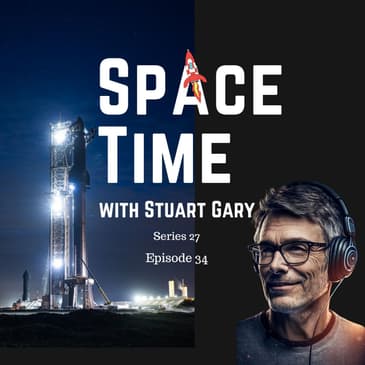
SpaceTime Series 27 Episode 34
*SpaceX's Starship Tests the Limits of Spaceflight
In a breathtaking display of rocketry, SpaceX's Starship edges closer to the stars, nearly perfecting its third flight test. The behemoth of engineering, the Starship Super Heavy, roared through the Texan skies, reaching for orbital velocity. Despite a few hiccups, including the loss of both the Starship and its Super Heavy booster, the test marked significant progress towards SpaceX's ambitious goals for space colonization.
*Voyager 1: The Silent Pioneer's Uncertain Future
Voyager 1, humanity's farthest-flung emissary, is now sending back puzzling signals from interstellar space. After over four decades of travel, the spacecraft's communication has become erratic, leaving scientists at NASA's Jet Propulsion Laboratory scrambling to decode the mystery. Could this be the twilight of the mission that has reshaped our understanding of the solar system?
*A New Window into the High-Energy Cosmos
The EROSITA telescope, despite geopolitical tensions, has beamed back a treasure trove of X-ray data, revealing the energetic intricacies of the universe like never before. Australian scientists leverage this data to unveil the violent dance of a star shredded by a black hole and the haunting remnants of a supernova. These cosmic cataclysms, observed in unprecedented detail, offer clues to the violent processes shaping galaxies and the fate of stars.
*Rocket Lab's Back-to-Back Launch Success
Hot on the heels of a groundbreaking space debris removal satellite launch, Rocket Lab continues its winning streak with the 45th Electron rocket launch. The mission expands an Earth observation constellation, proving the company's rapid launch capabilities. With eyes now set on their first launch from American soil, Rocket Lab is poised to make space access even more routine.
For more SpaceTime and to support the show, visit our website at https://spacetimewithstuartgary.com where you can access our universal listen link, find show notes, and learn how to become a patron.
Listen to SpaceTime on your favorite podcast app with our universal listen link: https://spacetimewithstuartgary.com/listen and access show links via https://linktr.ee/biteszHQ
Support the show: https://www.spreaker.com/podcast/spacetime-with-stuart-gary--2458531/support
For more space and astronomy podcasts, visit our HQ at https://bitesz.com
(00:00) SpaceX's Starship aces most of its third test flight
(07:40) Voyager 1's mission may be nearing its end
(13:58) Astronomers get a clearer picture of the high-energy X-ray sky
(19:49) Rocket Lab successfully launches 45th Electron rocket
(23:04) The science report: The link between outer suburban living and childhood asthma
(26:53) Hydroxychloroquine linked to nearly 17,000 deaths during the pandemic
00:00:00
This is Space Time Series 27 Episode 34, for broadcast on the
00:00:05
18th of March 2024. Coming up on Space Time, SpaceX's Starship
00:00:10
almost aces its third flight test. It was the first
00:00:14
spacecraft to reach interstellar space, but is Voyager 1'S
00:00:18
mission finally coming to an end? And astronomers get their
00:00:22
clearest picture yet of the high-energy universe. All that
00:00:26
and more coming up on Space Time.
00:00:30
Welcome to Space Time with Stuart Gary.
00:00:35
Thank you The world's largest and most powerful rocket, SpaceX
00:00:53
's Starship Super Heavy, has completed a mostly successful
00:00:56
test flight. The 122-metre-tall mega-rocket thundered into blue
00:01:02
Texan skies from SpaceX's Starbase launch complex in Boca
00:01:06
Chica on the Gulf Of Mexico coast.
00:01:10
By director ty huntington telling the team we are go for
00:01:13
the watch so let's listen in Nein. 8, 7, 6, 5, 4, 3, 2, 1.
00:01:26
Boa noite.
00:01:31
Yeah Thank Thank you.
00:01:35
Thank you.
00:01:41
30 seconds into flight we are feeling the rumble we are seeing
00:01:45
33 out of 33 Raptor engines ignited on the Super Heavy
00:01:50
Booster Booster and ship, avionics power and telemetry
00:01:53
nominal. Acquisition of single Corpus Christi. Continuing to
00:01:57
get good call outs, our trajectory looking nominal,
00:02:00
systems looking nominal.
00:02:01
At this point, we've already passed through vacuum, that
00:02:03
maximum dynamic pressure, and it 's passing supersonic. So we're
00:02:07
now moving faster than the speed of sound. The next major
00:02:10
milestone is going to be a hot staging maneuver. We're going to
00:02:14
be doing that in just about 90 seconds. To do that, we're going
00:02:17
to shut down. All but the three center Raptor engines on Super
00:02:21
Heavy.
00:02:22
That'll be our MECO, our most engines cut off. And then the
00:02:25
clamps holding the two stages together are going to release.
00:02:28
Starship's second stage will ignite its engines, the RVACs
00:02:31
first, the sea levels right after that. The sea level
00:02:34
engines will be splayed or just kind of pointed out at about a
00:02:37
15 degree angle.
00:02:38
And so those six engines will push Starship off of the
00:02:42
Booster. All right, counting down now. We're going to be
00:02:44
coming up right around the three minute Mark on that hot staging
00:02:47
maneuver. And that will start carrying the ship into space.
00:02:51
Booster will start to do its flip, and then move in on the
00:02:54
boost back burn, setting it up for a splashdown in the Gulf Of
00:02:58
Mexico.
00:02:58
It was a case, well, almost of third time's a charm as the
00:03:02
gleaming stainless steel rocket successfully reached orbital
00:03:05
velocity, riding on a flaming golden pillar of light. Then
00:03:09
right on time, the Starship Upper Stage successfully
00:03:12
undertook a hot staging separation from the Super Heavy
00:03:15
Booster Stage two minutes and 45 seconds after liftoff,
00:03:19
continuing on its journey into space.
00:03:24
Hot staging confirmed. Booster's now making its way back, seeing
00:03:29
six engines ignited on ship. Okay, we got a Starship on its
00:03:34
way to space and a Booster on the way back to the Gulf. Oh,
00:03:37
man, I need to pick my jaw up from the floor. Just stunning.
00:03:43
First stage is currently performing.
00:03:46
Good there. News informing us that the second stage or the
00:03:49
ship, everything looking good. Nominal there. First stages
00:03:51
currently performing the boost back burn, expecting that to
00:03:54
last about one minute.
00:03:56
That boost back burn propels the Booster back towards the coast,
00:03:59
taking it to a landing in the waters of the Gulf Of Mexico.
00:04:03
We're only using the Super Heavy boosters, 13 center engines from
00:04:07
here on out. Those are the ones that can gimbal. In other words,
00:04:10
they move and change direction in order to change the thrust to
00:04:14
steer the first.
00:04:15
Stage back to Earth everything is looking good for both the
00:04:19
first stage or the Super Heavy Booster as well as on the
00:04:22
Starship or we also refer to that as the ship now the boost
00:04:26
back burn was the first of two burns required to return it to
00:04:29
Earth the next one will be the landing burn where all 13 center
00:04:34
engines will initially ignite and then transition into a three
00:04:37
engine burn to help slow it down Now, just as a reminder of the
00:04:41
stage one test objectives, we're looking for controlled ascent,
00:04:46
which we have so far.
00:04:47
Stage separation, which gorgeous. We cruised right
00:04:50
through it as well as the trajectory. Good news there
00:04:53
telling us that the path that Starship is on is good. Now,
00:04:57
Starship's second stage is still firing its engines. And as you
00:05:01
heard, following planned flight path, the ship objectives, we're
00:05:04
looking for hot staging again, cruised right through that.
00:05:06
We're looking to demonstrate controlled ascent. As well as
00:05:09
overall insertion.
00:05:11
Super Heavy is performing beautifully today. It's on its
00:05:14
return leg of the journey. Chip continuing to burn its six
00:05:18
engines, the Raptor vacuum engines, the Raptor sea level
00:05:22
engines. About 30 seconds away.
00:05:29
So we start with the landing burn on the Booster. Grid fins
00:05:33
are rotating. The grid fins are guiding us through the
00:05:38
atmosphere, up towards our splashdown site. Again, we're
00:05:41
going for a splashdown, soft splashdown.
00:05:45
For the landing burn, we're going to expect to see the 13
00:05:48
center engines light, rapidly bring down the Booster's
00:05:51
velocity. And then just the three... In the center for
00:05:57
Splashdowns. We're getting a few engines. We've had acquisition
00:06:02
of signal. Let's see if we can get some other video of that.
00:06:05
However, neither Starship nor its Super Heavy Booster survived
00:06:09
the journey all the way through to their intended splashdowns.
00:06:13
Now, this is a test objective today. It is still something
00:06:17
that we're attempting to learn. And to make it that far to
00:06:20
demonstrate the controlled re-entry up to that point is
00:06:23
pretty darn good.
00:06:24
The Super Heavy core stage successfully initiated its flip
00:06:27
maneuver and boost back burn in order to change its trajectory
00:06:31
and speed. And that was followed a few minutes later by a landing
00:06:35
burn above the Gulf Of Mexico. However, it seems the Super
00:06:39
Heavy failed to ignite all of its landing burn engines as
00:06:42
planned, leading to the loss of the Booster.
00:06:44
The ship continuing to look nominal with its... Ascent burn.
00:06:49
This burn lasting about six minutes total. And we're
00:06:53
expecting that this burn will end just after T plus eight
00:06:57
minutes, a minute from now. So far, though, I mean, congrats to
00:07:01
the team making it this far is farther than we've gone.
00:07:05
Absolutely.
00:07:06
So far, we've hit controlled ascent. We're in the middle of
00:07:09
that right now. We demonstrated the hot staging cruise through
00:07:12
that. We demonstrated controlled. Entry of the Booster
00:07:17
just stopped a little short of the engine relay, but hey, that
00:07:20
's something we can learn for the next one. Engine. Did you
00:07:22
heard there by the.
00:07:26
And then we found one of us.
00:07:31
Starships, six Raptor engines have successfully shut down.
00:07:37
We're going to come up for nominal orbital insertion, which
00:07:40
is incredible. We're farther than we've ever been before.
00:07:44
We've got a Starship, not just in space. But on its coast phase
00:07:48
into space. Just to recap where we've come, and we left it off
00:07:52
right on time at 8.25 a.m. We didn't have to hold at our gate
00:07:56
at all.
00:07:57
We had 33 out of 33 Raptor engines open up and light and
00:08:01
get us through a nominal ascent on another successful hot stage.
00:08:05
All six engines on the ship propelling us into orbit. We did
00:08:09
see what looked like a nominal boost back burn, and then we
00:08:12
make it all the way to the landing burn this time. Didn't
00:08:15
light all the engines that...
00:08:16
We expected and we did lose the Booster. We'll have to go
00:08:19
through the data to figure out exactly what happened,
00:08:22
obviously. So be on the lookout for information about that. But
00:08:26
a ship in space, we've got a bunch of, as we said, ambitious
00:08:31
objectives ahead of us over the next couple of minutes and
00:08:35
pretty much over the next hour.
00:08:36
We're going to really, we've got the ship in space. We're now
00:08:39
going to take advantage of this and try and learn as much as
00:08:41
possible about some of the other systems, including that. First
00:08:45
ever Raptor relight in space, so it's just going to be
00:08:47
incredible. So what a liftoff, what a hot stage, what an
00:08:51
amazing sight to see Starship there in outer space.
00:08:53
The upper Starship stage continued flying after
00:08:57
separation, eventually entering a planned suborbital coasting
00:09:00
phase above the planet. Now during this maneuver, SpaceX
00:09:04
needed to demonstrate two of the spacecraft's flight systems
00:09:07
needed for vehicle qualification, namely the
00:09:10
transfer of cryogenic fuel between tanks and the
00:09:13
re-ignition of Starship's Raptor engines.
00:09:16
Now following these operations, Starship began re-entering the
00:09:19
upper atmosphere, just as planned. This was about 65
00:09:23
minutes into the mission. They were aiming for a splashdown in
00:09:26
the Indian Ocean, about 1 kilometers off the West
00:09:29
Australian coast. However, during the descent, mission
00:09:33
managers suddenly lost contact with the spacecraft.
00:09:36
Now, despite the loss of both craft, SpaceX insists the
00:09:39
mission did achieve many of the key goals that were set out
00:09:43
during the flight. This was the third test flight of the full
00:09:47
Starship Super Heavy stack, the world's biggest and most
00:09:50
powerful rocket. Two previous attempts to launch the giant
00:09:54
vehicle into orbit both failed.
00:09:56
SpaceX was forced to issue a self-destruct order, blowing up
00:10:00
the vehicle during its first test flight back in April last
00:10:03
year, after the upper Starship stage failed to separate from
00:10:06
the Super Heavy stage as planned. Now, that problem
00:10:09
involved the spacecraft simply not reaching sufficient velocity
00:10:13
or altitude due to multiple engine failures on the Super
00:10:16
Heavy Booster.
00:10:16
That's because of damage to the Raptor engines caused by debris
00:10:20
thrown up by the rocket's initial thrust blasting the
00:10:23
launch pad to bits during lift-off. It meant the rocket
00:10:27
never had enough power to reach its intended altitude and speed.
00:10:31
Instead entering an uncontrolled spin due to loss of thrust
00:10:34
vector control, in the process triggering the activation of the
00:10:38
flight termination system. The second test flight, back in
00:10:41
November, lasted a bit longer than the first, and there was a
00:10:45
successful stage separation.
00:10:47
But as the Super Heavy initiated its flip manoeuvre and boost
00:10:50
back burn, one of the engines suddenly exploded, apparently
00:10:53
due to a filter blockage, which caused inadequate inlet pressure
00:10:57
in the Raptor engine's oxidiser turbo pumps. Meanwhile, the
00:11:01
upper Starship stage continued to ascend normally for about
00:11:04
seven minutes until a leak in its aft section developed during
00:11:07
a planned oxygen venting.
00:11:10
And that triggered a combustion event which interrupted
00:11:12
communications between the spacecraft's flight computers.
00:11:15
That caused full engine shutdown, which then triggered
00:11:18
the autonomous self-destruct system to initiate. The Starship
00:11:22
Super Heavy has twice the power of the world's second most
00:11:25
powerful rocket, NASA's SLS or Space Launch System, which
00:11:29
carries the Artemis Orion Moon spacecraft.
00:11:32
And Starship is playing an important role in NASA's Artemis
00:11:36
man-moon program. The specially modified version of Starship, to
00:11:40
be called the Human Landing System or HLS, will be used as a
00:11:44
sort of lunar shuttle in 2026, transporting the Artemis III
00:11:48
crew and their equipment from the Orion spacecraft in Cislunar
00:11:52
orbit down to the lunar surface and back up again.
00:11:55
So not only will SpaceX need to show that it can launch, fly and
00:11:59
land Starships safely, they need to be able to prove they can do
00:12:02
it multiple times, as several tanker versions of Starship will
00:12:06
also need to be launched to refuel the HLS in Earth orbit so
00:12:09
that it has enough fuel for its mission to the moon, down to the
00:12:12
surface, and then back up into Cislunar orbit.
00:12:16
And let's not forget, SpaceX's boss Elon Musk's vision goes far
00:12:19
beyond the moon. Musk sees Starship as a colonial transport
00:12:24
system, ultimately replacing the Falcon 9 rocket and dragon
00:12:27
capsule to eventually carry humans not just to the moon, but
00:12:31
onto Mars and beyond.
00:12:34
Musk fears that humans have all their eggs in the one basket,
00:12:37
planet Earth. And he wants to establish a second lifeboat
00:12:41
colony on another world, just in case. And considering how
00:12:46
reminiscent the world today is of 1930s Germany, and when you
00:12:50
add to that the added threat of today's nuclear capabilities,
00:12:53
you really can't blame him for feeling that way.
00:12:57
This is Space Time. Still to come. Voyager 1 was the first
00:13:02
man-made spacecraft to leave the solar system and enter
00:13:05
interstellar space. But there are now growing fears its
00:13:09
mission may have come to an end. And a new telescope in Earth
00:13:12
orbit is giving astronomers a clearer picture of the
00:13:15
high-energy universe. All that and more still to come on Space
00:13:20
Time.
00:13:37
NASA's Voyager 1 spacecraft is the most distant man-made object
00:13:41
in space. It's more than 24 billion kilometers away.
00:13:47
However, this first spacecraft to cross into interstellar space
00:13:50
isn't doing well, and its days seem to be numbered as it's been
00:13:55
sending back incoherent messages to mission managers since
00:13:58
November, and scientists don't know why.
00:14:01
But now finally, the team at NASA's Jet Propulsion Laboratory
00:14:04
in Pasadena, California, who have been in charge of the
00:14:07
Voyager mission, may have a clue.
00:14:10
The source of the issue appears to be with one of the three
00:14:13
onboard computers, the Flight Data Subsystem. It's responsible
00:14:17
for packaging the science and engineering data before it's
00:14:21
sent back to Earth by the Telemetry Modulation Unit.
00:14:24
On March 3rd, the Voyager mission team saw activity from
00:14:27
one section of the Flight Data Subsystem that differed from the
00:14:31
rest of the computer's unreadable data stream. The new
00:14:34
signal still wasn't in the format used by Voyager 1 when
00:14:37
the flight data subsystems working properly, so initially
00:14:40
the team still didn't know what to make of it.
00:14:42
But an engineer with the agency 's Deep Space Network, which
00:14:46
operates the radio antennas that communicate with both Voyagers
00:14:49
and other spacecraft travelling to the moon and beyond, was able
00:14:52
to decode the new signal and found that it contains a readout
00:14:56
of the entire Flight Data Subsystem memory.
00:14:59
The Flight Data Subsystem memory includes the spacecraft's code
00:15:03
or instructions for what to do, as well as all variables or
00:15:06
values used in the code that can change based on commandants and
00:15:10
spacecraft status.
00:15:12
And it also contains science or engineering data for downlink.
00:15:16
Mission managers will now compare this readout to the last
00:15:19
one that came down just before the issue arose, and they'll
00:15:22
look for discrepancies in the code and the variables to
00:15:25
potentially find the source of the ongoing issue.
00:15:29
This new signal resulted from a command sent to Voyager 1 on
00:15:32
March 1.
00:15:34
Simply called the Poke, the command is meant to gently
00:15:37
prompt the Flight Data Subsystem to try different sequences in
00:15:40
its software package, just in case the issue could be resolved
00:15:44
by going round a corrupted section.
00:15:46
Now, because Voyager 1 is more than 24 billion kilometres from
00:15:49
the Earth, it takes 22 and a half hours for a radio signal to
00:15:53
reach the spacecraft, and of course then another 22 and a
00:15:56
half hours for the probe's response to the to reach the
00:15:59
antennas of the Deep Space Network here on Earth. So, the
00:16:03
team received the results of the command on March 3rd.
00:16:07
By March 7th, engineers began working to decode the data and
00:16:11
on March 10th they determined that it contained a memory
00:16:14
readout. The team is now analysing that readout. But
00:16:19
using that information to devise a potential solution and then
00:16:22
put it into action will take time.
00:16:24
Still, time's what they've got plenty of. Voyager 1 and its
00:16:28
sibling, Voyager 2, have been on their journey now for more than
00:16:32
40 years, ever since they were launched way back in 1977.
00:16:37
They're both more than 130 times further away from the Earth than
00:16:41
what the Earth is from the Sun.
00:16:43
The two spacecraft were originally on a four-year grand
00:16:46
tour of the outer solar system. That was made possible by a
00:16:50
unique alignment of the planets, which allowed the probes to use
00:16:53
the gravity assist of each planet to literally slingshot
00:16:56
them to the next planet.
00:16:58
Well, Voyager 2 visited all four of the outer planets, the gas
00:17:01
giants Jupiter and Saturn, as well as the ice giants Uranus
00:17:05
and Neptune. Voyager 1 focused on the gas giants alone, before
00:17:08
turning its attention to the edge of the solar system and
00:17:11
interstellar space beyond, a realm it is now exploring.
00:17:17
This is Space Time. Still to come, astronomers get a clearer
00:17:22
picture of the high-energy universe, and New Zealand
00:17:25
launches its 45Th Electron rocket. All that and more still
00:17:29
to come on Space Time.
00:17:42
Thank Astronomers have been given a clearer picture of the
00:17:49
high-energy X-ray sky thanks to the first all-sky data survey
00:17:53
release by the Erisita telescope. The spectacular
00:17:57
observations have allowed scientists to study new details
00:18:00
of a supernova remnant, the dying remains of a massive star
00:18:04
that exploded eons ago.
00:18:06
Erisita is a German X-ray telescope instrument fitted
00:18:10
aboard the Russian Spectre-RG spacecraft. Now, there were
00:18:13
fears that this data might have been lost following the West's
00:18:16
boycott of Russia following the Kremlin's invasion of Ukraine.
00:18:20
That's because all cooperation with Moscow, other than the
00:18:23
International Space Station, but including all other space
00:18:26
sciences, has been suspended in the wake of the brutal Russian
00:18:29
campaign. However, Erezita remained operational and
00:18:34
transmitted data back to scientists, in the process
00:18:37
providing the largest X-ray catalogue ever published.
00:18:41
Now, a whole swathe of scientific papers have already
00:18:43
been released in the wake of the observations. And these include
00:18:47
two, led by Australian researchers Adele Goodwin and
00:18:50
Silvia Mantovannini, both from the International Centre For
00:18:53
Radio Astronomy Research at Curtin University.
00:18:56
Goodwin and Mantovannini combined X-ray data from Eris
00:18:59
Zeta with optical and radio data from Australian telescopes in
00:19:03
order to get deeper insights into high-energy cosmic
00:19:06
phenomena. Goodwin and colleagues watched the
00:19:08
supermassive black hole destroy a star in a tidal disruption
00:19:12
event at the centre of a galaxy some 1.3 billion light-years
00:19:16
away.
00:19:17
The destruction was first observed as a bright X-ray
00:19:19
source by Rosita, before Goodwin and colleagues used the
00:19:22
Australia Telescope Compact Array at Narrabri in northern
00:19:25
New South Wales to track the star's debris field ejected by
00:19:28
the black hole over two years as it moved through the galaxy.
00:19:33
These observations have been informing scientists about how
00:19:36
stars are destroyed and how the black hole spat out the material
00:19:39
as the star was consumed. It also gave the authors some
00:19:43
excellent information about the central region of this distant
00:19:46
galaxy.
00:19:48
Meanwhile, Mata Vaninian colleagues used Iraceta's
00:19:50
observations to study a supernova remnant within our own
00:19:54
Milky Way galaxy. Matt Avenini says her team used several radio
00:19:58
surveys to confirm that the X-ray diffuse structure observed
00:20:02
by Rosita was indeed a supernova remnant.
00:20:05
For my work, I'm trying to combine data at two different
00:20:08
wavelengths to look for supernova remnants along the
00:20:11
galactic plane. This is pretty useful because different
00:20:15
wavelengths can give us different information from the
00:20:17
sources, in particular in radio bands. So using the MWA, the
00:20:22
Martian Wall State Array here in Australia, we are able to...
00:20:25
Better identify these objects on the plane because of their
00:20:29
structure.
00:20:31
Because the electrons lose less energy at low frequencies, so we
00:20:36
are able to detect even the older candidates. Instead, with
00:20:41
X-rays, we are able to have information about the
00:20:44
composition of the object, so we can confirm what kind of sources
00:20:50
we are looking at, and we have information about the mechanism
00:20:55
that is involved in the emission that we detect. So we are able
00:21:00
to say if we have, for example, acceleration of electrons.
00:21:05
And by looking at this, you can find out a lot about the object
00:21:09
itself.
00:21:10
Yes, exactly. Combining observations from two different
00:21:13
surveys, we are able to...
00:21:16
We confirm with certainty the nature of the object. So, for
00:21:19
example, in this particular case, the candidate we have
00:21:22
identified was already discovered in previous surveys.
00:21:26
But because they just had data from a single radio frequency,
00:21:31
they couldn't say much about it. But adding the EROS data
00:21:35
detections, we are able to confirm that this object is
00:21:37
actually a supernova remnant.
00:21:39
And the EROSITA data is absolutely amazing. It's found
00:21:42
so many hot X-ray sources throughout the galaxy and beyond
00:21:46
that scientists, astronomers are going to be looking through this
00:21:49
material for years.
00:21:51
Yes, the EROSITA, the first survey of the EROSITA detected
00:21:55
more or less 900 of... Sources. That is like 25 times
00:22:00
the number of sources that has been detected from previous
00:22:03
X-ray surveys. And this is exciting. We're able to see so
00:22:07
many bright X-ray searches, black holes, supernova remnants.
00:22:12
How fortunate it was that we were able to get this data
00:22:15
because it's on a Russian satellite and we weren't sure
00:22:18
the Russians were going to cooperate because of the
00:22:20
situation in Ukraine.
00:22:22
Yes, actually the telescope is owned by a Russian-German
00:22:26
collaboration. So we are actually using the German part
00:22:31
of the data. So we are able to see alps of the X-ray sky. The
00:22:35
other alp is in the hands of the Russians and unfortunately we
00:22:40
can't study the data. So luckily the remnant in this particular
00:22:44
cave was in the right side of the sky. We have to say that
00:22:47
that was a bit fortunate.
00:22:48
So tell me about the supernova remnant you were studying. How
00:22:51
far away is it? What do we know about the progenitor, if
00:22:55
anything at all? What were you able to determine?
00:22:57
So the remnant I'm studying is G321.3-3.9.
00:23:02
And the name is composed by the galactic coordinates of the
00:23:06
object itself. As you can see, it is located at high latitudes
00:23:11
from the plane, and this means that the absorption of the
00:23:15
X-rays is less strong, and that 's why we're able to see it
00:23:19
pretty clearly. We have an estimate of the distance.
00:23:25
It has a lot of uncertainties. It varies between 600 and 1
00:23:29
parsecs, and this means that it 's located from us at a distance
00:23:33
of 100 million times. The distance that there is between
00:23:37
us and the Sun. We are able to determine this distance by X-ray
00:23:42
analysis. In particular, we have determined the quantity of
00:23:46
electrons that we have between the Earth and us, and so we can
00:23:50
estimate an upper limit of this distance.
00:23:53
Instead, with radio emissions, looking at the brightness of the
00:23:58
Earth, we are able to determine a lower limit. We can't say a
00:24:02
lot about the progenitors. There are two possibilities. So in the
00:24:05
case of the supernova remnant, we can have a massive plaque or
00:24:09
a white dwarf that can generate the explosion. In the case of a
00:24:12
massive star, it is composed of an onion pine structure.
00:24:16
Where the center is composed by iron, so it's a pretty heavy
00:24:21
element, and the star is not able to burn it anymore. So all
00:24:25
the outer layers of this star collapse toward the center,
00:24:28
increasing the density of the star itself and reducing the
00:24:32
explosion. Instead, in the case of a white dwarf, it could
00:24:35
either be in a binary system with another star or with
00:24:39
another white dwarf, and it's a creating matter from the
00:24:42
companion.
00:24:43
Increasing once again the density of the core and then
00:24:46
generating the explosion. So we have these two kind of
00:24:50
phenomenon that can happen. And the first thing to understand
00:24:55
what is the progenitor of the supernorian is to check whether
00:24:59
there is a composite object inside the shell of the source.
00:25:03
And we don't have it in our case.
00:25:05
Is that part of the hope now, to get a spectra of the thing so
00:25:09
you can work out whether it's a type 1a or a type 2?
00:25:12
To try to determine the classification, we usually look
00:25:17
at the X-ray composition. So through this technique that is
00:25:20
called spectroscopy, we look at what are the elements that
00:25:23
compose the remnant. And to be a type 1a, a white dwarf
00:25:29
exploding, we have to detect hydrogen absorption lines. So we
00:25:35
have to have hydrogen in the composition of our remnant.
00:25:38
If we don't see the lines, it's more likely to be a massive
00:25:43
star. So type 2, yes. A type 2 supernova. Also the shape, it
00:25:49
could be a factor. Type 1a are usually more symmetric with a
00:25:53
circular shape. So in our case, we don't have hydrogen and the
00:25:58
shape is pretty elliptical. I don't know if you have seen an
00:26:01
image. So we expect to be a type 2 supernova. So we expect to be
00:26:05
a massive star exploding.
00:26:08
Do we have any idea how old it is yet?
00:26:10
We estimated an age of 4 kilo years. But it's based on
00:26:17
the estimate of the distance that we made, so we can be 100%
00:26:20
sure that this is the actual age of the remnant. We need to have
00:26:24
further observation.
00:26:26
What are you going to do now? Are you going to keep digging
00:26:28
into this or start searching for other ones, or what's the plan?
00:26:32
So now I'm actually combining data from two different radio
00:26:36
surveys. To have a deeper image of that particular area of the
00:26:41
sky. And so hopefully we could be able to determine what is the
00:26:45
mechanism that is driving the emission of the remnant and so
00:26:49
determine the distance and age in a more accurate way. And at
00:26:52
the same time, we will look around the same region to see if
00:26:55
we can detect other supernova remnants.
00:26:57
That's Silvia Metta-Vanini from the International Center For
00:27:00
Radio Astronomy Research at Curtin University. And this is
00:27:05
Space Time.
00:27:06
Still to come, Rocket Lab launches its 45Th Electron
00:27:10
rocket into orbit, and later in the Science Report, a new study
00:27:14
shows that kids in the outer suburbs of Australia's largest
00:27:17
cities are twice as likely to wind up getting asthma as those
00:27:21
in inner city areas. And scientists really aren't sure
00:27:25
why. All that and more still to come on Space Time.
00:27:45
Rocket Lab has successfully launched its 45Th Electron
00:27:48
rocket, placing a new Earth observation satellite into
00:27:50
orbit. The Al Knight Long mission launched from Pad B at
00:27:54
Rocket Lab's Launch Complex 1 in New Zealand's North Island,
00:27:57
carrying the STRI-X3 synthetic aperture radar satellite into a
00:28:02
561km high Sun-synchronous orbit, thereby further expanding
00:28:06
Synspective's existing satellite constellation.
00:28:09
The launch came on the heels of its On Closer Inspection launch
00:28:12
from New Zealand just a week or so earlier. That placed the new
00:28:16
experimental satellite into orbit designed to pioneer new
00:28:19
methods of space junk removal.
00:28:21
The ADRAS-J, or Active Debris Removal by Astroscale Japan
00:28:25
Satellite, will approach and inspect a disused Japanese H-2A
00:28:29
rocket stage which was left behind in low Earth orbit during
00:28:32
the launch of the GOSAT Earth Observation Satellite in 2009.
00:28:37
The spacecraft will use its onboard cameras and sensors to
00:28:40
assess the spent rocket stage's condition and its behaviour and
00:28:44
attitude in space.
00:28:46
The insights gained from this mission will be vital for
00:28:48
exploring potential techniques for safe de-orbiting of similar
00:28:52
objects in the future, as part of efforts to combat the growing
00:28:55
challenge of space junk in orbit. Meanwhile, Rocket Lab are
00:28:58
already preparing for their next mission.
00:29:01
This will be a classified satellite launch for America's
00:29:03
National Reconnaissance Office. And importantly, this will also
00:29:07
be the first launch from Rocket Lab's new Space Launch
00:29:09
Complex-2, located at NASA's Wallops Island Flight Facility
00:29:13
on the Virginian Mid-Atlantic coast. There's been a long
00:29:17
build-up to get Launch Complex-2 operational.
00:29:20
Rocket Lab have been forced to jump through all sorts of hoops
00:29:23
in terms of safety and engineering requirements in
00:29:26
order to get American approval. But it's all systems go now, and
00:29:30
that launch could be taking place in the next couple of
00:29:33
days. We'll keep you informed. This is Space Time.
00:29:50
And time now to take a brief look at some of the other
00:29:52
stories making use in science this week with the Science
00:29:55
Report.
00:29:57
A new study has found that children who live in the outer
00:30:00
suburbs of Australia's four largest cities are twice as
00:30:03
likely to end up with asthma as those who live in inner-city
00:30:06
areas. The findings, reported in the Journal Allergy And Clinical
00:30:10
Immunology, are based on health data captured in the last
00:30:13
Australian census.
00:30:15
The data was gathered after Australians completing the 2021
00:30:18
census were asked for the first time to also share information
00:30:22
about long-term health conditions in order to help
00:30:24
researchers map patterns of chronic disease across the
00:30:27
country.
00:30:28
The authors don't know why kids aged between 5 and 14 who live
00:30:32
in the outer suburbs of Sydney, Melbourne, Brisbane and Perth
00:30:36
were more likely to develop asthma. They expected the inner
00:30:39
city might have the most childhood asthma cases because
00:30:42
of heavy traffic flow and air pollution.
00:30:45
But instead, the clear pattern was one of an increasing asthma
00:30:48
risk towards the outer suburbs, where 12% of kids suffered from
00:30:52
childhood asthma as opposed to just 6% in the inner cities.
00:30:56
However, it is worth pointing out that previous studies have
00:30:59
shown a strong correlation between the risk of developing
00:31:02
asthma and socioeconomic factors.
00:31:06
A new study suggests that small amounts of apple cider vinegar
00:31:10
every day may help overweight or obese people lose weight and
00:31:13
reduce their body mass index. The findings were reported in
00:31:17
the British Medical Journal.
00:31:18
Based on a small study of 120 people aged between 12 and 25,
00:31:22
it was split into either those who drank a placebo or those who
00:31:26
drank either 5, 10 or 15 millilitres of apple cider
00:31:30
vinegar every morning. After 12 weeks, the groups who drank the
00:31:34
cider lost an average of around 5 to 7 kilograms, while those
00:31:38
who drank the placebo lost less than 1 kilo.
00:31:42
A new study has shown that the clever Australian magpie gets
00:31:46
its smarts thanks to nurture rather than nature. The findings
00:31:51
were reported in the Journal of the Royal Society Of Open
00:31:53
Science, a based study designed to test whether the Australian
00:31:57
magpie's talents were mostly inherited or something the bird
00:32:00
brains learnt from their flock.
00:32:02
The authors tested magpies and their fledglings'ability to
00:32:05
learn which coloured lids food was located under and they found
00:32:08
very little evidence that they inherited this ability. Instead,
00:32:12
they found that fledglings raised in larger groups passed
00:32:15
the test in fewer trials, suggesting their cognitive
00:32:18
abilities are impacted by the environment, that is, nurture
00:32:22
more than their genetics or nature.
00:32:26
Hydroxychloroquine, the malaria drug falsely claimed to be a
00:32:29
miracle cure for COVID-19, has now been linked to nearly 17
00:32:34
deaths in six countries during the pandemic. A report in the
00:32:38
Journal Biomedicine And Pharmacotherapy found that
00:32:41
Hydroxychloroquine was actually associated with an 11% increase
00:32:45
in mortality rates.
00:32:47
Tim Mendham from Australian Skeptics says the study found
00:32:50
that an estimated 16 Hydroxychloroquine-related
00:32:55
deaths occurred in Belgium, France, Italy, Spain, Turkey and
00:32:58
the United States. He says the findings clearly illustrate the
00:33:02
hazards of drug repurposing with low-level evidence.
00:33:05
Hydroxychloroquine is a malarial drug and a lot of people were
00:33:09
claiming it was good for treating, curing. Covid during
00:33:12
the pandemic, mainly those who, ironically, people who were
00:33:16
initially doubtful that COVID even existed, and then suddenly
00:33:19
they were offering up these miracle cures.
00:33:21
Apart from all the ivermectin.
00:33:23
Whose effectiveness was completely overblown, this
00:33:26
Hydroxychloroquine was put forward as a potential saviour.
00:33:29
The study that came out recently looked at the effect of people
00:33:33
who had taken Hydroxychloroquine across six countries, Belgium,
00:33:37
France, Italy, Spain, Turkey, and the United States, and they
00:33:40
found... Close to 17 cases with...
00:33:43
It looked like there had been a negative impact of taking
00:33:45
high-gloss proxy chloroquine to the fact that they died. It was
00:33:48
published in a recent issue of a Journal called Biomedicine And
00:33:51
Pharmacotherapy, and it's associated with about 11%
00:33:54
increase in mortality rate, actually 16 deaths related
00:33:59
to people taking it.
00:34:00
They reckon this showed the hazard of the drug that was
00:34:02
portrayed as being a safe alternative to establish COVID
00:34:06
vaccines that they were saying, that the proponents were saying
00:34:09
were curious. In other words, they're safe. Alternative was
00:34:12
actually had the potential to kill people. That's Tim Mendham
00:34:15
from Australian Skeptics.
00:34:33
That's the show for now. Space Time is available every Monday,
00:34:37
Wednesday, and Friday through Apple Podcasts, ITunes,
00:34:40
Stitcher, Google Podcasts, Pocket Casts, Spotify, Acast,
00:34:45
Amazon Music, Bytes.Com, SoundCloud, YouTube, your
00:34:49
favorite podcast download provider, and from
00:34:51
spacetimewithstuartgarry.com.
00:34:54
Space Time is also broadcast through the National Science
00:34:57
Foundation on Science Zone Radio and on both IHeart Radio and
00:35:01
TuneIn Radio. And you can help to support our show by visiting
00:35:05
the Space Time store for a range of promotional merchandising
00:35:08
goodies.
00:35:09
Or by becoming a Space Time patron, which gives you access
00:35:12
to triple episode commercial free versions of the show, as
00:35:15
well as lots of bonus audio content which doesn't go to air,
00:35:18
access to our exclusive Facebook group and other rewards. Just go
00:35:22
to spacetimewithstuartgary.com for full details.
00:35:26
And if you want more Space Time, please check out our blog, where
00:35:29
you'll find all the stuff we couldn't fit in the show, as
00:35:32
well as heaps of images, news stories, loads of videos, and
00:35:35
things on the web I find interesting or amusing. Just go
00:35:38
to spacetimewithstuartgary.Tumblr.-
00:35:41
com. That's all one word, and that's Tumblr without the E.
00:35:46
You can also follow us through at Stuart Gary on Twitter, at
00:35:49
spacetimewithstuartgary on Instagram, through our Space
00:35:52
Time YouTube channel. And on Facebook, just go to
00:35:55
Facebook.com forward slash Space Time with Stuart Gary. You've
00:36:00
been listening to SpaceTime with Stuart Gary. This has been
00:36:03
another quality podcast production from Bytes.Com.