
SpaceTime Series 27 Episode 36
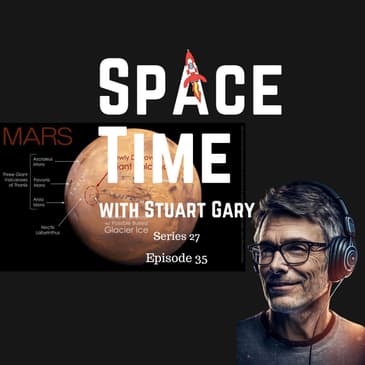
*Mars Unveils a Colossal Volcanic Secret
Astronomers have discovered a massive ancient volcano on Mars, hidden beneath an ice sheet in the planet's Tharsus volcanic province. This behemoth, which has eluded detection by orbiting spacecraft since 1971, could offer new insights into the Red Planet's geologic past and potential for life. The structure, tentatively named Noctus Volcano, stands over 29,600 feet tall and spans about 280 miles across. Its discovery near the labyrinthine Noctus Labyrinthus and the colossal Valles Marineris suggests a long history of volcanic activity and hints at the presence of glacial ice beneath its surface.
*Europe's New Radar Mission to Monitor Climate Change
The European Space Agency is gearing up for ROSAL, a cutting-edge Earth observation mission set to scrutinize the planet's oceans, land, and ice. With the largest deployable planar antenna array ever built, ROSAL will complement existing Copernicus Sentinel missions by using L-band radar to penetrate vegetation and ice, providing invaluable data for climate change research, agriculture, and geohazard monitoring.
*International Space Station's Revolving Door
It's been a bustling period aboard the ISS with multiple crew rotations. Axiom Space's third private mission has concluded, paving the way for their fourth venture and future space station modules. The arrival of NASA's SpaceX Crew-8 promises six months of groundbreaking experiments, including 3D organoid growth to study diseases. Meanwhile, SpaceX Crew-7's departure marks the end of a mission filled with over 250 experiments, ranging from immune cell behavior in microgravity to artificial retina production.
*AI Robot Chemist Could Pave the Way for Martian Oxygen Production
Scientists have developed an AI-powered robot chemist capable of extracting oxygen from Martian meteorites. This breakthrough suggests that future Mars missions might sustain human life and fuel rockets using the Red Planet's own resources. The AI robot's ability to identify and react chemicals to produce oxygen could revolutionize space exploration logistics and support long-term colonization efforts.
For more SpaceTime and to support the show, visit our website at https://spacetimewithstuartgary.com where you can access our universal listen link, find show notes, and learn how to become a patron.
Listen to SpaceTime on your favorite podcast app with our universal listen link: https://spacetimewithstuartgary.com/listen and access show links via https://linktr.ee/biteszHQ
Support the show: https://www.spreaker.com/podcast/spacetime-with-stuart-gary--2458531/support
For more space and astronomy podcasts, visit our HQ at https://bitesz.com
📋 Episode Chapters
(00:00) Could a robotic chemist create oxygen from resources already on Mars
(00:27) Giant ancient volcano and glacial ICE sheet discovered on Mars
(07:13) European Space Agency planning new Earth observation mission to monitor climate change
(16:23) Roselle is an operational mission that acquires data all the time
(18:02) SpaceX launched a Dragon capsule bound for the International Space Station last month
(20:48) Could robotic chemist create oxygen out of resources already available on Mars
(22:55) High temperatures over 33 degrees Celsius increase risk of stroke, study finds
(25:28) American politicians want to ban TikTok over concerns about propaganda on social media
(27:34) Metta have decided they will not pay for news content on Facebook
(28:50) Microsoft are about to make some big announcements with new releases
[00:00:00] This is SpaceTime Series 27 episode 36 for broadcast on the 20th of March 2024.
[00:00:07] Coming up on SpaceTime, discovery of a giant volcano on Mars,
[00:00:13] a new radar mission for the European Space Agency and could a robotic chemist create oxygen
[00:00:19] from resources already on Mars?
[00:00:22] All that and more coming up on SpaceTime!
[00:00:26] Welcome to SpaceTime with Stuart Gary!
[00:00:46] Scientists have discovered what appears to be a giant, ancient volcano and glacial ice
[00:00:51] sheet buried in the eastern part of the Martian fastest volcanic province near the red planet's
[00:00:56] equator.
[00:00:57] Amazingly, the structure has remained undetected, literally hiding in plain sight, despite
[00:01:03] being repeatedly imaged by orbiting spacecraft going all the way back to Mariner 9 in 1971.
[00:01:10] Siders say it was never identified as a volcano simply because it was so deeply eroded
[00:01:15] beyond any easy recognition.
[00:01:17] Still, for decades this giant volcano is being one of Mars's most iconic regions.
[00:01:23] It's right at the boundary of the highly fractured maze-like Noctis-Laborinthus, the
[00:01:28] Labyrinth of the Night and the monumental Valley's Marinerans or Valley's of the Mariner canyons
[00:01:34] which form a massive split in the red planet's crust.
[00:01:38] Previsionally named Noctis volcano, pending an official title, the structure has centered
[00:01:43] some 7 degrees 35 minutes south, 93 degrees 55 minutes west.
[00:01:48] It reaches over 9,022 meters, that's 29,600 feet in height and spans some 450 kilometers
[00:01:57] or 280 miles across.
[00:01:59] Volcanoes' gigantic size and its complex modification history indicate that it must have been
[00:02:05] active for a very long time.
[00:02:07] And its southeast and part lies a thin recent volcanic deposit beneath which glacial ice
[00:02:13] appears to be still present.
[00:02:16] This combined giant volcano on possible glacier discovery is significant as it points to an
[00:02:21] existing new location to study Mars' geologic evolution through time, to search for possible
[00:02:26] signs of Martian life if it ever existed on the red planet and to explore with both robots
[00:02:32] and ultimately humans in the future.
[00:02:34] The studies lead author Pascal Lee from the SETI Institute and NASA's Ames Research Center
[00:02:39] says he needs to be examining the geology of the area where they just found the remains
[00:02:44] of a glacier when they suddenly realized they were actually inside a huge and deeply
[00:02:49] eroded volcano.
[00:02:51] Now there were several clues which went finally put together gave away the volcanic nature
[00:02:56] of the jumble of layered maces and canyons in the eastern part of Noctis Labyrinthus.
[00:03:02] Now firstly there was the central summit area which was marked by several elevated maces
[00:03:07] forming a sort of arc reaching a regional high and then sloping downwards away from the
[00:03:12] summit area.
[00:03:13] Then there were the more general outer slopes, they were extending out some 225 kilometers
[00:03:18] away from the central summit in all directions.
[00:03:21] There was also a caldera remnant, the remains of a collapsed volcanic crater once host to
[00:03:26] a lava lake that was right near the center of the structure.
[00:03:30] Finally there were lava flows, pyroclastic deposits made from volcanic particulate materials
[00:03:36] such as ash, cinders, pymus and tepra and hydrated mineral deposits were detected at several
[00:03:41] locations within the structures perimeter.
[00:03:44] In fact this whole area of Mars is already known to have a wide variety of hydrated minerals
[00:03:49] spanning a long stretch of Martian history and a volcanic setting for these minerals had
[00:03:55] long been suspected.
[00:03:57] So it may not have been too surprising for scientists to finally find the so-called
[00:04:01] Smirking Gun volcano there.
[00:04:04] In addition to the volcano, the scientist also discovered a large 5,000 square kilometer
[00:04:10] area of volcanic deposits within the volcanic perimeter which feature a large number of rounded
[00:04:15] elongated blister like mounds.
[00:04:18] This so-called blister terrain is being interpreted as a field of ruthless cones, mounds produced
[00:04:24] by explosive steam venting or steam swelling when a thin blanket of hot volcanic minerals
[00:04:30] comes to rest on top of a water ice-rich surface.
[00:04:34] The find follows the earlier discovery of the spectacular remnant of a glacier, or relic
[00:04:39] glacier through a sizable erosional opening in the same volcanic blanket in the form of
[00:04:44] a light turned deposit of sulfate salts with a morphologic traits of a glacier.
[00:04:49] The sulfate deposits are made mainly of jarricide, that's a hydra sulfate and they've been
[00:04:53] interpreted to have formed when the blanket of volcanic pyroplastic materials came to
[00:04:58] rest on the glacier and then reacted chemically with the ice.
[00:05:02] The breached ruthless cones identified in this study show similar properties to polyhydrated
[00:05:07] sulfates, further suggesting that the blistered volcanic blanket may be hiding a vast sheet
[00:05:13] of glacial ice beneath it.
[00:05:15] The not-disvolcano presents a long and complex history of modification possibly from a combination
[00:05:21] of fracturing, thermal erosion and glacial erosion.
[00:05:25] The studies authors are interpreting this volcano to be a vast shield made of layered
[00:05:29] accumulations of pyroplastic materials, livers and ices, the latter resulting from repeated
[00:05:34] build-ups of snow and glaciers on its flanks throughout time.
[00:05:39] As fractures and faults eventually developed in particular in connection with the uplift
[00:05:43] of the broader fastest region where the volcano sits, livers began to rise through different
[00:05:48] parts of the volcano, leading to thermal erosion and the removal of vast amounts of buried
[00:05:53] ice as well as the catastrophic collapse of entire sections of the volcano.
[00:05:58] Subsequent glaciers continued their erosion giving many canyons within the structure
[00:06:02] of their current distinctive shapes.
[00:06:06] But much about this newly discovered giant volcano still remains a mystery.
[00:06:11] Although it's clear that it would have been active for a long period of time and probably
[00:06:15] began it's build-up early in Martian history, it's unknown exactly how early that was.
[00:06:20] Similarly, although it shows clear evidence of having also experienced eruptions even
[00:06:25] in modern Martian times, it's unknown if it's still volcanically active and might erupt
[00:06:29] again.
[00:06:31] And if it has been active for a long period of time, there's a tantalizing question.
[00:06:36] Could the combination of sustained warmth and water from ice have allowed the site to
[00:06:40] become habitable?
[00:06:42] Could life have formed there?
[00:06:45] This is space time.
[00:06:47] Still to come and you radar mission for Europe and a busy time with lots of comings and
[00:06:52] goings aboard the International Space Station.
[00:06:55] All that and more still to come on space time.
[00:07:13] The European Space Agency are planning a new Earth observation mission to monitor how
[00:07:18] the planet is changing due to global warming.
[00:07:21] The Copernicus Radar Observation System for Europe in Elband or Rosil spacecraft will
[00:07:27] provide continuous day and night all weather monitoring of the Earth's oceans, land and ice
[00:07:32] together with other frequent observations of the planet's surface at high spatial resolution.
[00:07:38] Built by Thalousolenea Space, Rosil is one of six Copernicus Sentinel expansion missions
[00:07:44] that is developing on behalf of the European Union.
[00:07:48] These missions are designed to expand the current capabilities of the Copernicus Space
[00:07:52] Component which is already the world's largest supplier of Earth observation data.
[00:07:57] The 2016 kilogram Rosil spacecraft will carry an active phase-derase synthetic aperture
[00:08:03] radar.
[00:08:04] The radar antenna will be the largest deployable plane-arantiner ever built measuring an impressive
[00:08:10] 40 square meters in size.
[00:08:12] Rosil will deliver many benefits, including essential information on forests and land cover
[00:08:17] and that will lead to improved monitoring of terrestrial carbon cycles and carbon accounting.
[00:08:23] Now since the longer Elband signal being projected by Rosil will be able to penetrate through
[00:08:27] many natural materials such as vegetation, dry snow and ice, the mission will provide additional
[00:08:33] information that simply can't be gathered by the Copernicus Sentinel-1 C-band radar mission.
[00:08:39] It will be used to support forest management to monitor some sidelines and soil moisture
[00:08:43] and to pick out different crop types for precision farming and food security.
[00:08:48] In addition, the mission will contribute to the monitoring of polar ice sheets and ice caps,
[00:08:53] sea ice extent in the polar regions and seasonal snow.
[00:08:57] The mission will also greatly extend science's ability to monitor minute surface displacements
[00:09:03] thereby helping to at least detect geohazards.
[00:09:06] It will map surface soil moisture conditions over land, helping improve hydrology and weather
[00:09:11] forecasts and support the operational monitoring of sea and land ice across the Arctic.
[00:09:17] This report from ACTI-V
[00:09:19] Rosil is the largest plenary-san antenna ever built with an area of 40 square meters.
[00:09:24] It's the first time we use a longer wavelength and because of this longer wavelength
[00:09:29] we collect new information from space that is not yet accessible or that is not yet collected by other satellites.
[00:09:36] The first European mission to fly a software-defined radar.
[00:09:39] Not many people know that 15 countries are involved in the building of Rosil,
[00:09:43] this is truly a European project.
[00:09:45] We have X-band missions, we have C-band missions like Sentinel-1 and now we have L-band missions.
[00:09:53] Rosil, as the name implies, stands for radar-observing system for Europe at L-band.
[00:10:02] The term L-band here refers to the wavelength that is being used.
[00:10:07] L-band is a longer wavelength much longer than Sentinel-1.
[00:10:10] Both of them provide a different information that can be combined and gives you a better view
[00:10:17] of the Earth together.
[00:10:18] They also complement each other by flying in the same orbit
[00:10:22] and collecting information at regular intervals over the same area.
[00:10:26] So it can be used as a single system just like we use our eyes,
[00:10:30] also as a single system as a single way of looking at the world around us.
[00:10:35] My name is Malcolm Davidson and I work as a Rosil mission scientist in ISA.
[00:10:41] What kind of information does Rosil provide?
[00:10:43] Well, it provides information on the C-Ice, the different C-Ice types that are there.
[00:10:48] It tells us whether ships can navigate safely and being able to detect these ships
[00:10:54] even when there are clouds or there is darkness or indeed some storms.
[00:10:59] This information about ships is useful for security applications.
[00:11:03] It's also useful for safety applications and for ecosystem applications.
[00:11:09] One of the important ecosystem applications is, for instance, oil spills
[00:11:13] where monitoring the oil spill, the extent of the oil spill
[00:11:18] and the severity of the oil spill is extremely important.
[00:11:22] Rosil also has a very good role to play in climate change
[00:11:27] or the monitoring the effects of climate change.
[00:11:29] The fact that the ice sheets are melting, how quickly they are melting,
[00:11:33] how much water is being released as they melt
[00:11:36] are some of the questions that Rosil helps answer.
[00:11:40] Another important area that Rosil supports is agriculture
[00:11:44] and agriculture is linked to food security.
[00:11:47] By providing high-resolution soil moisture information,
[00:11:51] Rosil contributes to better crop management practices.
[00:11:55] Another important role that Rosil plays is in terms of forest carbon stocks.
[00:12:00] When I say forest carbon stocks, I'm talking about monitoring the forests
[00:12:04] across our globe and making an inventory
[00:12:08] of how much carbon lies within these forests.
[00:12:12] Rosil contributes to the safety of European citizens
[00:12:17] by monitoring geohazards.
[00:12:19] Geohazards are typically what we think of when we think of disasters, natural disasters,
[00:12:25] such as landslides, such as subsidence when the buildings and other structures
[00:12:32] are sinking into the ground and earthquakes and volcanoes, of course, are well known.
[00:12:37] Rosil is able to penetrate through the vegetation with its long wavelength
[00:12:41] and sense the movements as they take place
[00:12:45] and even a little before they take place.
[00:12:47] And this type of information is inaccessible
[00:12:50] to the current generation of Copernicus satellites
[00:12:53] and is a unique characteristic of Rosil.
[00:13:00] In order to meet the challenge in quality requirements,
[00:13:03] state-of-the-art technology is required all across the instrument.
[00:13:06] My name is Nico. I'm Nico Gibbert and my job is the Rosil payload manager.
[00:13:11] The mission objectives of Rosil require to image a large area.
[00:13:15] We call it a swath with fine level of detail, so a high resolution.
[00:13:20] More specifically, the satellite can image a script on ground of 260 km with
[00:13:25] and one will be able to distinguish structures down to a size of 5 to 10 meters.
[00:13:30] So Rosil is the first radar mission in Europe
[00:13:32] which will provide so much information.
[00:13:35] In addition, we need to transmit a lot of power
[00:13:37] to see also weak, so small targets on the ground.
[00:13:40] It's a bit like using a strong torch
[00:13:43] to be able to see also in the darkest corners.
[00:13:46] Rosil provides ground-breaking high resolution information
[00:13:49] on ice condition in the Arctic
[00:13:51] even in condition of complete winter darkness supporting syvenavigation.
[00:13:55] Rosil's pierces the darkness with the help of its own illumination.
[00:14:00] It illuminates the surface below
[00:14:03] and collects information in the Arctic even in the height of winter.
[00:14:08] It is a combination of different techniques.
[00:14:10] For example, when receiving the echo from the ground
[00:14:13] the antenna dynamically sweeps the beam across the ground
[00:14:16] to follow the position of the echo.
[00:14:17] At the same time, five different data streams transfer to ground.
[00:14:22] This is what we call digital beam forming.
[00:14:24] We have split the large antenna into many small antennas
[00:14:27] which we can then individually control
[00:14:29] both when transmitting and as well when receiving the echo.
[00:14:36] It's a bit like a car which at the same time should be small,
[00:14:40] provide a lot of space and go fast by the little fuel consumption.
[00:14:44] This means we need it to design an instrument which is quite special.
[00:14:47] We are developing power modules of unprecedented peak power in Europe.
[00:14:51] Such peak power requires a sophisticated design
[00:14:54] which comes with a lot of challenges.
[00:14:56] Overall, we radiate 9 kilowatts of power
[00:14:59] which is actually enough to hit my complete house in the winter.
[00:15:02] My name is Gianruigi Cosimo.
[00:15:03] I am the Rosel Project Manager.
[00:15:05] If I have to make a sample of a key technology
[00:15:09] which has been specifically developed for Rosel
[00:15:11] I should mention the transmittal receiver modules
[00:15:14] which are the heart of the antenna front and the electronics.
[00:15:18] For those elements we had to run some pre-development activities
[00:15:24] testing that the technology was mature enough to be embarked on the Rosel missions.
[00:15:29] We needed to move away from classic design of radar instruments
[00:15:33] which consists of one large antenna.
[00:15:34] In simple words we are having 60 small antennas
[00:15:37] which you can flexible reconfigure by changing the software.
[00:15:41] In addition, we are transferring several data streams to the ground
[00:15:44] which gives a lot of flexibility to process the data in many different ways.
[00:15:48] In this respect Rosel is truly a software-defined radar
[00:15:51] so it was tested over the large range of temperature variation
[00:15:55] that we see in orbit to check how much it deforms.
[00:15:58] And although the dimensions are huge
[00:15:59] it's 2.2 meters by 30 centimeters
[00:16:03] this sample is quite light
[00:16:04] and it doesn't weigh more than a couple of kilograms.
[00:16:07] Well, it has to be light
[00:16:08] because if the antenna gets too heavy
[00:16:10] then the launcher could not carry it up to the orbit
[00:16:13] so actually it's a feature of our instrument
[00:16:16] to keep the antenna very lightweight
[00:16:18] so it's really a novel technology.
[00:16:22] Imaging such a wide area of 260 kilometers
[00:16:26] with a fine level of detail comes with a massive amount of data.
[00:16:30] On average Rosel will produce 6.5 terabyte of information
[00:16:34] every 100 minutes.
[00:16:36] This means almost 100 terabyte of data every day.
[00:16:39] For comparison, this would correspond to almost 4,000 hours
[00:16:43] of Netflix videos in high definition every day.
[00:16:46] Each Rosel spacecraft is designed to remain operational 7.5 years.
[00:16:50] One important characteristic of Rosel
[00:16:52] is that it is an operational mission.
[00:16:55] Operational in the sense that it acquires data all the time.
[00:16:59] It makes the data available quickly
[00:17:01] so that it can be used for the different applications
[00:17:05] and thirdly, it follows an open data policy
[00:17:08] which supports many different new applications
[00:17:12] and enables scientists to investigate
[00:17:15] how best to use the data in new types of applications
[00:17:19] that don't yet exist but will exist in the future.
[00:17:22] According to the current planning,
[00:17:23] Rosel will be ready for launch in 2028.
[00:17:26] And it is based on the most powerful radar electronics ever
[00:17:29] reconfigurable from ground.
[00:17:31] This space time still to come
[00:17:34] busy times about the international space station
[00:17:36] with lots of coming and going
[00:17:38] and could a robot chemist create oxygen
[00:17:41] from resources already available on Mars
[00:17:44] or that and more still to come on space time.
[00:17:49] What's been a busy time aboard the International Space Station
[00:17:56] with several crews arriving and departing over the past few weeks?
[00:18:00] Last month, space excellence to dragging capsule bound
[00:18:03] for the International Space Station
[00:18:05] carrying a four person team from Axiom Space.
[00:18:08] This was Axiom's third private space station
[00:18:11] which was the first time that the crew was in the space station
[00:18:15] from Axiom Space.
[00:18:17] This was Axiom's third private space mission
[00:18:20] to the orbiting outpost and was designed
[00:18:22] to undertake a series of experimental projects
[00:18:24] for the company.
[00:18:26] Axiom is planning to undertake a fourth mission
[00:18:28] to the ISS later this year, possibly in October.
[00:18:31] The company's also developing its own modules
[00:18:33] for the International Space Station.
[00:18:35] They'll be built over the next few years
[00:18:37] with the first expected to be launched and docked
[00:18:40] to the ISS in 2026.
[00:18:43] Automally, when the International Space Station is finally
[00:18:46] de-orbited, Axiom plans to use their modules
[00:18:48] as the basis for their own future orbiting space station.
[00:18:52] The Axiom crew remained on station for almost three weeks
[00:18:55] before returning to Earth and splashing down
[00:18:58] in the North Atlantic Ocean off the coast of Florida.
[00:19:01] As soon as they got on,
[00:19:03] when another four person crew flew up to the orbiting outpost,
[00:19:06] also aboard a dragon capsule launched on a Falcon 9 rocket
[00:19:09] from the Kennedy Space Center.
[00:19:11] Their dragon endeavor capsule docked
[00:19:13] with the space station's Harmony Module Space Facing Port.
[00:19:17] It was a case of second time lucky for this mission,
[00:19:20] the first attempt a few days earlier
[00:19:21] had to be scrubbed jitter high winds.
[00:19:24] The launch also marked the fifth flight
[00:19:26] for the same endeavor capsule.
[00:19:28] The NASA SpaceX crew weight as they're called
[00:19:31] will spend the next six months on station
[00:19:33] undertaking experiments on STEM cells to create organoids.
[00:19:36] These are artificially grown masses
[00:19:38] of cells resembling organs,
[00:19:40] which will be used to study degenerative diseases.
[00:19:43] They'll be taking advantage of the microgravity
[00:19:45] environment of space to enable three dimensional cell growth
[00:19:48] in these organoids, which is not always possible on Earth.
[00:19:51] Then you crew are replacing NASA SpaceX crew 17.
[00:19:55] You'll left a few days later
[00:19:56] aboard their own dragon spacecraft
[00:19:58] signaling the end of Expedition 69 and 70.
[00:20:02] Their six month tour aboard the ISS
[00:20:04] involved taking part in more than 250 experiments
[00:20:07] and space walks, including research into microgravity's impact
[00:20:10] on immune cells and liver regeneration,
[00:20:13] which could potentially often
[00:20:14] you insights into aging and disease.
[00:20:16] Other experiments included protein crystal growth
[00:20:19] in microgravity studies into artificial
[00:20:22] retina manufacturing and space projects
[00:20:24] to reduce the material mass being transported into space,
[00:20:28] research into adding microbial coatings
[00:20:30] for use in space travel that have built
[00:20:32] on a better therapeutics for use in drugs,
[00:20:35] optical fiber production in microgravity
[00:20:37] and a study of heart muscle cell development in space.
[00:20:41] The NASA Dragon crew seven capsule
[00:20:43] spushed down safely in the Gulf of Mexico
[00:20:46] just near the far at a panhandle.
[00:20:48] Meanwhile yet another leak,
[00:20:50] it's either the sixth or seventh I lose count
[00:20:52] has developed aboard the Russian portion of the space station.
[00:20:56] NASA says it's keeping a close sound
[00:20:58] the slightest leak with hatches being kept closed
[00:21:00] to isolate the leak from the rest of the space station
[00:21:03] while the Russians try to find out exactly where it is.
[00:21:07] This is space time.
[00:21:09] Still to come, could a robotic chemist create oxygen
[00:21:12] out of the resources already available on Mars
[00:21:16] and later in the science report
[00:21:17] and you study warns that high temperatures
[00:21:20] above 33 degrees and immediately increase your risk
[00:21:23] of having an ischemic stroke.
[00:21:25] All that and more still to come on space time.
[00:21:29] Music
[00:21:44] Scientists have developed an AI robot chemist
[00:21:47] that can make oxygen from machine meteorites.
[00:21:50] The research reported in the journal Nature
[00:21:52] claimed similar technology could one day
[00:21:54] make human missions to Mars easier and more cost-effective.
[00:21:59] The robot was given five categories of meteorites
[00:22:01] known to exist on Mars in order to analyze them.
[00:22:04] And it was able to identify chemicals
[00:22:06] in the meteorites that could react together
[00:22:08] to produce oxygen.
[00:22:10] It achieved this by painstakingly testing
[00:22:13] the performance of different strategies of oxygen production
[00:22:16] until it found the best one.
[00:22:18] Now that same process would have taken humans
[00:22:21] more than 2,000 years.
[00:22:23] The researchers say technology like this
[00:22:25] could one day allow future Mars missions
[00:22:27] to produce oxygen for rockets
[00:22:29] and life support systems using materials
[00:22:31] already available on the red planet.
[00:22:34] This is space time.
[00:22:37] Music
[00:22:47] And time that to take another brief look
[00:22:50] at some of the other stories making using science this week
[00:22:53] with the Science Report.
[00:22:55] A new study has shown that high temperatures
[00:22:57] over 33 degrees Celsius can immediately increase
[00:23:00] your risk of having an ischemic stroke.
[00:23:03] The findings reported in the Journal
[00:23:05] of the American Medical Association
[00:23:07] show that compared to temperatures of around 12 degrees
[00:23:10] at 33 degrees there was an increased risk of stroke
[00:23:13] in the first hour and the increase lasted for 10 hours
[00:23:16] after exposure to that heat.
[00:23:18] The authors say the new findings
[00:23:20] may help medical practitioners
[00:23:22] devised new public health strategies
[00:23:24] to reduce the risk associated with high ambient temperatures
[00:23:27] under the current effects of global warming.
[00:23:31] Scientists have found increasing evidence
[00:23:33] that wells they get stuck in discarded fishing gear
[00:23:36] wind up having serious lifelong injuries
[00:23:39] that's assuming they survive in the first place.
[00:23:42] The findings reported in the Journal
[00:23:44] of the Presidium's The Raw Society B biological sciences
[00:23:47] are based on studies of North Atlantic right wells.
[00:23:51] The authors found that even if the mammals
[00:23:53] survive the encounter they wind up
[00:23:55] with all kinds of medical issues.
[00:23:57] The researchers used information
[00:23:59] from 199 female wells cited between 1977 and 2018
[00:24:04] combined with known information about entanglements
[00:24:07] clusters minor, moderate or severe.
[00:24:10] They found that as you'd expect,
[00:24:12] severe entanglements had the biggest impact on survival.
[00:24:15] However, even wells who experienced only minor entanglements
[00:24:18] still showed issues, such as these wells
[00:24:20] having the lowest probability of becoming breeders.
[00:24:23] Scientists found that almost all females,
[00:24:25] some 89% have experienced at least one entanglement event
[00:24:29] during their lifetimes and some two-thirds
[00:24:32] have experienced two or more events.
[00:24:34] The authors say that as one of the most endangered
[00:24:37] great wells, management actions are needed
[00:24:39] to address all kinds of entanglements in fishing gear
[00:24:42] even minor ones.
[00:24:44] If the North Atlantic right well population
[00:24:47] is meant to recover.
[00:24:49] A new study shows that spent brewers used,
[00:24:53] that's the basis of Australia's much-loved
[00:24:55] breakfast spread vegomite can also be used
[00:24:57] multiple times to pull metals out of water.
[00:25:00] A report in the journal Frontiers of Bioengineering
[00:25:03] and biotechnology claims this extract was able
[00:25:06] to pull metals such as aluminum, zinc and copper
[00:25:09] out of a solution.
[00:25:11] And when tested on the metal-loaded waste stream,
[00:25:13] they found it was able to pull 50% of copper
[00:25:16] and 90% of zinc that was present in the water.
[00:25:20] And the authors say the yeast can be reused
[00:25:22] and recycled multiple times,
[00:25:24] making the process even more eco-friendly.
[00:25:28] Well it seems both TikTok and Meta
[00:25:30] in the spotlight this week for all the wrong reasons.
[00:25:33] Meta, the parent company of Facebook and Instagram
[00:25:36] are trying to back out of paying for news content
[00:25:38] on their platforms.
[00:25:40] Meanwhile, technology editor Alex Harrow-Royot
[00:25:42] from TechAdvice.life says
[00:25:44] American politicians want to force Chinese owned
[00:25:47] by-dance to divest itself of TikTok.
[00:25:50] It's because of the influence the social media platform has,
[00:25:53] it's used to spy on its users and the propaganda it pushes as news.
[00:25:58] The US wants by-dance the company that owns TikTok
[00:26:02] to de-rest it and sell it to a non-Chinese-based interest
[00:26:06] because that they're saying it's a tool used
[00:26:08] by the Chinese government to spy on people
[00:26:10] to collect all this information on all these different users
[00:26:12] and also to manipulate them with really quite in-ane content.
[00:26:16] People doing crazy challenges or doing silly dance moves
[00:26:19] whereas the version of TikTok that is allowed in China,
[00:26:22] which is owned by the same company,
[00:26:24] but it has a very different mindset in that.
[00:26:27] It's more educational there, isn't it?
[00:26:29] It's much more educational.
[00:26:31] It's about a time you can be on it, if you're a kid.
[00:26:33] Whereas the version we see in the West,
[00:26:35] which the United States gets and us here too, I guess,
[00:26:38] is one which is pushing very strong political viewpoints
[00:26:41] these are two people who firstly are usually young
[00:26:44] and consequently are easily influenced anyway.
[00:26:47] And secondly, it's often the only news source they have.
[00:26:50] Well that is one of the concerns.
[00:26:52] People are going towards social media as their news source
[00:26:56] and just because the mainstream media says something on the news
[00:26:59] doesn't necessarily mean that it's true,
[00:27:01] but definitely your social media platforms,
[00:27:04] which it's right there in your face when you are very intimate with your phone.
[00:27:07] People tend to take that a lot more seriously
[00:27:09] and they tend to take what an influencer says.
[00:27:12] TikTok has been extremely successful in being very addictive
[00:27:16] and the concern about its algorithm pushing various viewpoints
[00:27:20] is real.
[00:27:21] Now, in the States, the House has voted to ban TikTok
[00:27:24] but it still needs approval by the Senate.
[00:27:26] And then of course the President himself could also veto that.
[00:27:29] And this is a sort of way.
[00:27:30] Well, it's not going away.
[00:27:31] It's a Disney so we don't know what's going to happen there.
[00:27:33] Well, we don't yet.
[00:27:34] Now on a related topic,
[00:27:35] a matter of decided they're going to not pay for news content
[00:27:38] on their Australian platform.
[00:27:39] Well, this is something that Facebook has announced.
[00:27:41] Well, meta has announced that it's doing not just in Australia
[00:27:44] but in the US and a number of other countries
[00:27:46] because Facebook was paying out
[00:27:48] tens of millions of dollars to various news organizations around the world,
[00:27:52] in Australia and around the world.
[00:27:53] And a number of those organizations actually use that money
[00:27:56] to employ local reporters in country areas for example.
[00:28:00] And those publications said,
[00:28:01] well, if we're not getting the money from Facebook,
[00:28:03] we're going to have to scale back.
[00:28:05] The problem with Facebook has always been one of trust.
[00:28:08] Mark Zuckerberg has been on a 20 year apology tour
[00:28:11] for this using the data of its users.
[00:28:14] Mark was in Congress only earlier this year
[00:28:18] being forced to apologize to parents
[00:28:20] who's children were on Instagram and who are sexually groomed
[00:28:23] and then fact Ted Cruz, the US senator,
[00:28:25] was questioning Mark Zuckerberg saying
[00:28:27] you know when people were searching for a pedophile cell material,
[00:28:30] instead of outright locking people from that,
[00:28:33] it issued a warning and then one of the buttons said
[00:28:36] worse than the effect of,
[00:28:37] have a look at it anyway.
[00:28:38] And Ted Cruz was completely flabbergasted
[00:28:40] that how this could be the case when any other sort of social media engine
[00:28:44] or search engine would out by blocked from viewing that content.
[00:28:47] So there's a question of trust with Mark Zuckerberg and Facebook.
[00:28:51] And just before we go,
[00:28:52] Microsoft are about to make some big announcements with new releases.
[00:28:55] Yeah, Mark 21 in the US, March 22 in Australia.
[00:28:58] We'll see the surface protein which is their cross between a tablet
[00:29:01] and iPads, the other device and the laptop.
[00:29:03] And also the surface laptop six which is a laptop.
[00:29:06] And there's meant to be OLED screens with HDR capabilities.
[00:29:10] There's meant to be the Intel core ultra processor
[00:29:13] with the built-in NPU neural processing engine or unit for AI stuff
[00:29:18] and also the Snapdragon X Elite,
[00:29:20] which also has a built-in AI component.
[00:29:22] And there's meant to be a new thing called AI Explorer
[00:29:25] where it will look at everything on your computer
[00:29:27] and you can say, hey, show me that thing with dinosaurs
[00:29:29] and it will look up the last time you mentioned dinosaurs
[00:29:31] of search for it, brought up images about it.
[00:29:33] There are concerns that that is going to eliminate your privacy
[00:29:36] but it certainly would help allow you to sort of search through
[00:29:39] your life with ease and with AI's helping doing that.
[00:29:42] There'd be an AI key, there'd be faster ports and sleeker designs.
[00:29:45] So we'll get all the details in about a week's time.
[00:29:47] After it's all launched pretty soon,
[00:29:49] every PC will be an AI PC that can do various AI tasks
[00:29:52] right on the device itself
[00:29:54] and not have to send all that information
[00:29:56] and requests to the cloud.
[00:29:58] That's Alex Harrow Roy from TechAdvice Start Life.
[00:30:01] Music
[00:30:16] And that's the show for now.
[00:30:18] SpaceTime is available every Monday, Wednesday and Friday
[00:30:22] through Apple Podcasts iTunes, Stitcher, Google Podcast,
[00:30:25] PocketCasts, Spotify, Acast, Amazon Music, Bites.com,
[00:30:30] SoundCloud, YouTube, your favorite podcast download provider
[00:30:34] and from SpaceTime with Stuart Gary.com.
[00:30:37] SpaceTime's also broadcast through the National Science Foundation
[00:30:41] on Science Zone Radio and on both I Heart Radio and Tune-in Radio.
[00:30:45] And you can help to support our show by visiting the SpaceTime store
[00:30:49] for a range of promotional merchandising goodies
[00:30:52] or by becoming a SpaceTime patron,
[00:30:55] which gives you access to triple-up-a-side commercial free versions of the show
[00:30:59] as well as lots of bonus audio content which doesn't go to air,
[00:31:02] access to our exclusive Facebook group and other rewards.
[00:31:06] Just go to SpaceTime with Stuart Gary.com for full details.
[00:31:10] And if you want more space time, please check out our blog
[00:31:13] where you'll find all the stuff we couldn't fit in the show
[00:31:15] as well as heaps of images, news stories, loads of videos
[00:31:19] and things on the web I find interesting or amusing.
[00:31:22] Just go to SpaceTime with Stuart Gary.com.
[00:31:26] That's all one word, and that's Tumblr without the e.
[00:31:30] You can also follow us through at Stuart Gary on Twitter
[00:31:33] at SpaceTime with Stuart Gary on Instagram
[00:31:36] through our SpaceTime YouTube channel
[00:31:38] and on Facebook just go to facebook.com forward slash spacetime
[00:31:42] with Stuart Gary.
[00:31:44] You've been listening to SpaceTime with Stuart Gary.
[00:31:47] This has been another quality podcast production from bytes.com.