
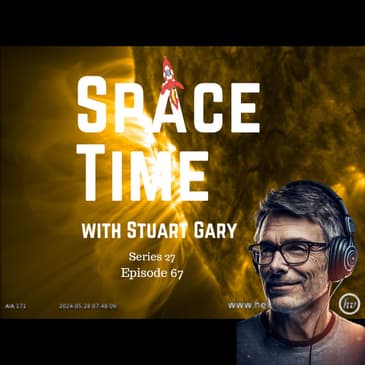
First, we discuss the return of last month's powerful solar storms. The active sunspot region AR 364, now renumbered as AR 3697, has reappeared, bringing with it more geomagnetic storms and spectacular solar flares. We explore the intricate dynamics of solar flares and coronal mass ejections, and their profound impacts on Earth's technology and atmospheric phenomena.
Next, we look forward to the upcoming test flight of the world's largest and most powerful rocket, SpaceX's Starship, scheduled for June 5. This mission is crucial for NASA's Artemis III plans to return humans to the lunar surface by 2026. We delve into the details of the mission and the technological advancements that make Starship a cornerstone for future space exploration.
Finally, we uncover archaeological evidence proving that ancient Britons constructed standing stone monuments with astronomical alignments. The research highlights how these structures were intricately connected with the movements of the sun and moon, offering insights into the sophisticated astronomical knowledge of our ancestors.
00:00 This is spacetime series 27, episode 67, for broadcast on 3 June 2024
00:25 Active region AR 364 has returned after disappearing two weeks ago
05:10 SpaceX says Starship, world's largest and most powerful rocket, likely on June 5
08:07 Scientists say ancient British standing stones were aligned with astronomical movements
18:12 Standing stones in Britain allow you to view sun and moon from very specific perspectives
23:02 New study shows Covid-19 vaccines still effective against hospitalization and death
33:30 Spacetime is available every Monday, Wednesday and Friday through various podcasting platforms
Follow our cosmic conversations on X @stuartgary, Instagram, YouTube, and Facebook. Join us as we unravel the mysteries of the universe, one episode at a time.
Sponsor Offer
This episode is proudly supported by NordPass. Secure your digital journey across the cosmos with a password manager you can trust. Find your stellar security solution at https://www.bitesz.com/nordpass.
Listen to SpaceTime on your favorite podcast app including Apple Podcasts, Spotify, YouTube Music, or wherever you get your podcasts.
Support SpaceTime
Become a supporter of SpaceTime: https://www.bitesz.com/show/spacetime/support/
www.bitesz.com
00:00:00
This is Space Time Series 27 Episode 67 for broadcast on the
00:00:04
3rd of June 2024. Coming up on Space Time, it seems last month
00:00:10
's powerful solar storms have returned, the next test flight
00:00:14
for the world's biggest rocket slated for June the 5th, and
00:00:17
astronomy shown to be set in Standing Stone. All that and
00:00:21
more coming up on Space Time.
00:00:25
Welcome to Space Time with Stuart Gary.
00:00:30
Thank Thank Peace.
00:00:34
Thanks for watching.
00:00:41
Let's do this.
00:00:44
That spectacular sunspot region, which triggered some of the most
00:00:48
violent solar storm activity in decades, has returned. After
00:00:52
disappearing around the southwest limb of the Sun two
00:00:55
weeks ago, active region AR3664, now newly renumbered as AR3697,
00:01:01
is back and it's brought more geomagnetic storms with it.
00:01:05
It announced its return with a spectacular X2.8-class solar
00:01:09
flare, followed by a coronal mass ejection which, luckily,
00:01:13
wasn't facing the Earth.
00:01:15
A comparison of AR3664 as it revolved around the far side of
00:01:20
the Sun and its reappearance into view off the southeast limb
00:01:23
of the Sun shows that it has shrunk in size, but still
00:01:26
retains significant magnetic complexity, with coronal loops
00:01:30
and solar flares erupting almost continuously, producing numerous
00:01:34
C and M class solar flares, as well as at least two X class
00:01:38
events.
00:01:39
The violence exhibited by the Sun during the first four years
00:01:42
of the current solar cycle is already rivaling the level of
00:01:45
solar flare activity experienced throughout the entire eleven
00:01:49
years of the last solar cycle. And remember, we still have
00:01:52
seven years to go in this one.
00:01:54
Solar flares are energetic eruptions of electromagnetic
00:01:57
radiation from the Sun's surface. They're generated by
00:02:01
magnetic field lines deep inside the Sun passing through the Sun
00:02:05
's visible surface.
00:02:06
In the process, producing sunspots, slightly darker
00:02:09
regions of the Sun caused by the magnetic field lines dropping
00:02:13
local temperatures. These field lines then loop out into space
00:02:17
before returning to below the solar surface.
00:02:20
As different latitudes of the Sun rotate at different rates,
00:02:23
these magnetic field lines become twisted, eventually
00:02:26
snapping and reconnecting, in the process releasing huge
00:02:29
amounts of energy. As a solar flare erupts, it can also drag
00:02:34
billions of tonnes of plasma magnetic field from the Sun with
00:02:37
it in the form of a coronal mass ejection or CME.
00:02:41
Solar flares are categorised according to their strength
00:02:44
similar to the Richter scale used for earthquakes. The
00:02:47
smallest ones are B class, followed by C's and then M, with
00:02:51
X being the largest. Each letter represents a ten-fold increase
00:02:55
in energy output.
00:02:57
So, an X-class solar flare is 10 times stronger than an M-class
00:03:01
flare and 100 times stronger than a C-class. Within each
00:03:05
letter class there's also a finer scale from 1 to 9. C-class
00:03:09
flares are usually too weak to noticeably affect the Earth.
00:03:13
But M-class flares do cause radio blackouts and minor
00:03:16
radiation storms that can endanger astronauts. Although X
00:03:20
is the last letter, there are solar flares ten times more
00:03:23
powerful than an X-1 class, so the X-class flares can go higher
00:03:27
than a 9.
00:03:29
X-class flares can fry satellite electronics, they can cut off
00:03:32
communications and navigation systems, trigger power grid
00:03:36
blackouts on the Earth's surface, and cause the planet's
00:03:38
atmosphere to wobble like jello, increasing atmospheric drag on
00:03:42
spacecraft and forcing them to use up more fuel to prevent
00:03:45
orbital decay.
00:03:47
But they also trigger the stunning auroral displays, the
00:03:50
Aurora Borealis and Aurora Australis, the northern and
00:03:53
southern lights.
00:03:55
Last month's geomagnetic storms were the strongest since the
00:03:58
Halloween storms of 2003. Between May 3rd and May 9th,
00:04:03
NASA's Solar Dynamics Observatory recorded no less
00:04:06
than 82 notable solar flare events.
00:04:10
They were spawned by two active regions on the Sun, 3663 and the
00:04:15
far more violent 3664, clusters of sunspots which grew so
00:04:19
complex that they erupted repeatedly for a full week. They
00:04:23
also triggered at least seven coronal mass ejections aimed
00:04:26
directly at the Earth.
00:04:27
And SpaceWeather.com is now reporting that they may have
00:04:30
produced the most powerful auroral display in 500 years.
00:04:35
The vivid auroral curtains of colour were seen as far South as
00:04:38
Mexico and the Bahamas, and as far north as Adelaide and Perth.
00:04:43
In fact, the storms were so intense that the US National
00:04:46
Oceanographic And Atmospheric Administration, NOAA, which
00:04:49
forecasts solar storms and their impacts on our planet, issued a
00:04:52
storm warning for the first time in nearly two decades, and NASA
00:04:56
preemptively shut down science instruments on several
00:04:59
spacecraft and placed at least one into safe mode, just to be
00:05:02
sure.
00:05:03
Whether we're in for the same experience over the next two
00:05:06
weeks, only time will tell, but we'll keep you informed.
00:05:10
This is Space Time. Still to come, the next test flight for
00:05:14
the world's biggest rocket now set down for June 5th, and the
00:05:18
archaeological studies which show astronomy is set in stone.
00:05:22
All that and more still to come on Space Time.
00:05:41
SpaceX says Starship, the world 's largest and most powerful
00:05:44
rocket, is now likely to undertake its next test flight
00:05:48
on June 5.
00:05:49
The flight from the company's starbase in Boca Chica, Texas,
00:05:52
will follow a similar trajectory to the last three missions, with
00:05:56
the Super Heavy Booster stage programmed to undertake a
00:05:58
controlled landing in the water, while the upper stage Starship
00:06:02
section will attempt to achieve orbit and eventually a
00:06:05
controlled re-entry and soft splashdown landing in the Indian
00:06:08
Ocean.
00:06:10
Success of this fourth test mission is vital for NASA's
00:06:13
plans to return humans to the lunar surface in 2026 aboard the
00:06:17
Artemis III mission.
00:06:19
That's because a modified version of Starship called the
00:06:22
HLS will dock with the Orion Artemis III capsule in lunar
00:06:25
orbit and transport two of the Artemis crew members down to the
00:06:28
lunar surface for what's expected to be a week-long stay
00:06:32
near the Moon's South pole before returning them to the
00:06:34
orbiting capsule for the return journey to Earth.
00:06:38
However, all three previous test flights have ended in Starship's
00:06:42
destruction as part of SpaceX's rapid trial and error approach
00:06:45
to development.
00:06:47
The third test flight back in March came close to achieving
00:06:50
its goals, with the Starship reaching orbit and flying
00:06:53
halfway around the world only to be destroyed during atmospheric
00:06:56
re-entry over the Indian Ocean. And Starship's also important to
00:07:01
SpaceX boss Elon Musk.
00:07:03
He developed the 121-metre-tall stainless steel spacecraft as a
00:07:07
colonial transport system designed to eventually replace
00:07:10
the current Falcon 9 and Falcon Heavy launch vehicles, as well
00:07:14
as the Dragon capsules, with a new reusable spacecraft capable
00:07:18
of carrying up to 100 people or 150 tonnes of supplies on
00:07:21
missions to the Moon, Mars and beyond.
00:07:24
You see, Musk wants the human race to become a two-planetary
00:07:28
species by providing a second home on another world. Just in
00:07:32
case.
00:07:34
The Super Heavy Booster is the world's most powerful rocket,
00:07:37
producing some 16.7 million pounds of thrust. That's almost
00:07:41
double that of the world's second most powerful rocket,
00:07:44
NASA's SLS Space Launch System Moon rocket, which are used to
00:07:48
transport the Orion spacecraft used on the Artemis missions.
00:07:52
This is Space Time. Still to come, archaeologists prove
00:07:56
astronomy is set in stone, and later in the Science Report, A
00:08:01
new study has shown that the COVID-19 vaccine currently
00:08:04
available in Australia is still effective. All that and more
00:08:07
still to come on Space Time.
00:08:25
Back in 2017, scientists with the University Of Adelaide were,
00:08:29
for the first time ever, able to statistically prove that the
00:08:32
earliest Standing Stone monuments in Britain, the Great
00:08:35
Circles, were constructed specifically in line with
00:08:38
movements of the Sun and Moon some 5 years ago.
00:08:42
The research, published in the Journal of Archaeological
00:08:45
Science Reports, changed archaeology's understanding of
00:08:48
these great ancient monoliths forever. The study's authors
00:08:51
used innovative two-dimensional and three-dimensional technology
00:08:55
to construct quantitative tests of the patterns of alignments of
00:08:58
the standing stones.
00:09:00
The project's leader Gail Higginbottom said at the time
00:09:03
that nobody before this had ever statistically determined that a
00:09:06
single stone circle structure was constructed with
00:09:09
astronomical phenomena in mind. See up until then it was all
00:09:13
just supposition.
00:09:15
The authors examined the oldest great stone circles in Scotland,
00:09:19
Calanish on the Isle Of Lewis and Stenness on the Isle Of
00:09:23
Orkney, both of which predate Stonehenge's standing stones by
00:09:26
at least 500 years.
00:09:28
Higginbottom and colleagues found a great concentration of
00:09:30
alignments in the standing stones towards the Sun and Moon
00:09:33
at different times of their cycles. And 2 years later in
00:09:37
Scotland, much similar monuments were still being built that had
00:09:40
at least one of the same astronomical alignments found at
00:09:43
the Great Circles.
00:09:45
The stones, however, were not just connected with the Sun and
00:09:48
Moon. The authors found a complex relationship between the
00:09:52
alignment of the stones, the surrounding landscape and
00:09:55
horizon, and the movements of the Sun and Moon across that
00:09:58
landscape.
00:09:59
Higginbottom described the research as finally proving that
00:10:03
the ancient Britons connected the Earth to the sky with their
00:10:06
earlier standing stones, and that this practice continued in
00:10:09
some way for at least 2 years. While examining the sites
00:10:13
in detail, the authors found at least half of them were
00:10:16
surrounded by one landscape pattern and the other half by a
00:10:20
complete reverse landscape pattern.
00:10:22
And these chosen surroundings would have influenced the way
00:10:25
the Sun and the Moon were seen, especially in the timing of
00:10:28
their rising and setting, like when the Moon appears at its
00:10:31
most northerly position on the horizon, which only happens
00:10:34
every 18.6 years.
00:10:36
The authors found that for half the sites, the northern horizon
00:10:39
is relatively higher and closer than the southern horizon, and
00:10:43
the summer solstice Sun tends to rise out of the highest peak in
00:10:46
the north.
00:10:48
At the same time, at the other half of the sites, the southern
00:10:50
horizon is higher and closer than the northern horizon, and
00:10:53
the winter solstice Sun rises out of these highest horizons.
00:10:58
Higginbottom says, it's clear that these people chose to erect
00:11:01
these great stones very precisely within the landscape
00:11:04
and in relation to the astronomy they knew.
00:11:07
She says they invested a tremendous amount of effort and
00:11:10
work to do so. And this tells us about their strong connection
00:11:14
with the environment and how important it must have been to
00:11:16
them for their culture and for their culture's survival.
00:11:19
Certainly as far as individual statistical evidence for
00:11:23
individual circles as opposed to looking at groups of circles,
00:11:26
for example, this is the first time that we've actually been
00:11:29
able to confirm that individual circles have a complex... Array
00:11:33
of orientations regarding different parts of the solar and
00:11:36
lunar cycles.
00:11:39
The reason for that is that when people were looking at the stone
00:11:42
circles previously, they used to look at just the orientations
00:11:45
that they thought hit on the Sun or the Moon and they ignored
00:11:49
those that didn't.
00:11:49
So even if they tried to do some kind of assessment on it, they
00:11:53
weren't approaching it in a very So now we can conclude that
00:11:59
we've done that and we've got excellent results where both the
00:12:03
circle of Calanis which is on the west coast and the Isle Of
00:12:07
Lewis of Scotland and Orkney and the stone circle of Estenes most
00:12:12
certainly say 97.7% sure that they are set up in regards to
00:12:18
astronomical phenomena.
00:12:20
And how did you do the research?
00:12:21
Okay, so we had two approaches. The first one was we had to do a
00:12:25
very specific statistical test that was developed by my
00:12:28
colleague Roger Clay.
00:12:30
Well, we're dealing with something that was 5 years
00:12:32
ago when these things were first set up. So obviously the sky was
00:12:35
different then, you had to account for all that, and also
00:12:39
the landscape, although the hills were there, nevertheless
00:12:41
the landscape may have appeared different in terms of vegetation
00:12:44
and that sort of thing. All these sort of things need to be
00:12:46
considered. Did it as well, so what did you basically do?
00:12:50
First of course we run our programs to ensure that we knew
00:12:53
exactly where the Sun and the Moon were rising and setting at
00:12:57
the time that these stones have been shown to be erected as
00:13:01
scientific dating has shown to be erected.
00:13:04
And then on top of that we looked at or examined the
00:13:07
possibility of the vegetation cover in the areas and basically
00:13:12
certainly for Western Scotland it was shown that there was
00:13:15
either very very open kind of like a scrubland equivalent. And
00:13:20
partial, very, very open basically, particularly on
00:13:24
Western Lewis, very, very open, and Western Scotland generally.
00:13:28
And on Orkney, during that time, it would have been much the
00:13:31
same. So when there were trees, it was very open, or sometimes
00:13:35
just open patches in these two particular areas, and we've
00:13:38
looked at other areas individually.
00:13:40
Is it difficult to put a date on these things? You can't use
00:13:43
carbon dating for stone, I guess, so you're looking at
00:13:45
something which is buried somewhere near it, I guess, that
00:13:48
is carbon, or how did you do it?
00:13:50
By the name of Patrick Ashmore, the excavation of Palanis and
00:13:54
they looked at the different times that specific stones were
00:13:58
erected or not. ...activities around the stone circle. So they
00:14:04
confirmed that different kinds of dating you do are through
00:14:08
burnt material, so for example wood...
00:14:10
Yep.
00:14:11
...or bone. And both have been found at Dennis...
00:14:16
That gave scientists a pretty good idea of when these things
00:14:18
were erected. I guess the fact that we're seeing these sorts of
00:14:22
stone circles throughout what we now call the British Isles, but
00:14:26
also we've seen them in parts of Europe as well.
00:14:29
Are we looking at, and I know this isn't your specific area of
00:14:32
expertise, but are we looking at something which was a fairly,
00:14:34
literally a broad church, I guess, something that was
00:14:36
practiced over a wide area?
00:14:38
All these Standing Stone monuments were placed over a
00:14:41
wide area, right from Ireland until Eastern Europe and beyond
00:14:46
in fact, India, China, other places right through at slightly
00:14:51
different times. Standing Stone circles though are certainly not
00:14:56
as prevalent as perhaps stone rows or single standing stones.
00:15:01
And stone circles are most prevalent in the British Isles,
00:15:04
Western Europe, Spain, Portugal, a few in Scandinavia, no firm
00:15:10
confirmed circles in Germany but lots of standing stones. The
00:15:13
circles tend to be part of a burial monument as opposed to a
00:15:16
separate standing circle.
00:15:18
But there are great patches through the European continent
00:15:21
where people chose to continue building their monuments in wood
00:15:24
and Earth. So there's a very interesting division there
00:15:27
between the groups of people who adopted the megalithic culture
00:15:31
and those who didn't. We're actually starting to look into
00:15:33
that now.
00:15:34
Does it go with trade?
00:15:36
Interesting question. I think that in the very, very early
00:15:40
days of when, for example, agriculture was first coming in
00:15:44
through Europe, I think that that is a possibility. I think
00:15:48
it would have been trade, but also the movement of people.
00:15:50
Because sometimes people brought this different and the new
00:15:55
culture.
00:15:55
The Neolithic, the agriculture and the new stone age coming
00:15:58
through parts of Europe, such as Southeastern Europe and moving
00:16:02
through Central Europe. And other times it was trade. So it
00:16:06
would have been a combination. Nothing simple, I'm afraid.
00:16:08
Sorry, I'd like to say.
00:16:09
But it's not.
00:16:10
Seldom is it.
00:16:11
Yeah, exactly. We like to try and keep it simple, but then
00:16:16
reality overtakes us.
00:16:18
Yeah, there's always caveats in any sort of research.
00:16:21
Absolutely, I agree with you fully there.
00:16:23
What got you interested in this?
00:16:24
What got me most interested in it was when I first saw a very
00:16:27
tiny, tiny article in Scientific American many years ago on the
00:16:31
standing stones of Scotland, one in particular. And my colleague
00:16:35
said to me, why don't you do this for your PhD? Maybe you
00:16:38
could really solve some of the issues.
00:16:40
So it all began there and I have been addicted to it ever since,
00:16:45
moving through from monument to monument and place to place
00:16:48
across Scotland and branching out now through the British Gulf
00:16:51
and... And parts of Europe to see whether or not how much
00:16:54
there is a connection between the peoples and culturally of
00:16:58
those who are using standing stones.
00:16:59
There's been a lot of work in Australia recently looking at
00:17:02
Aboriginal astronomy and the role that the night skies played
00:17:06
in Aboriginal culture. And one thing I've seen by looking at
00:17:09
that is that it simply mirrors what's happening everywhere else
00:17:12
in the world. Is that what you're seeing when you look back
00:17:15
at the 5-year-old culture you're seeing in Stone Age
00:17:18
Britain?
00:17:18
Certainly referring to the idea that people were closely wedded
00:17:22
to the night sky and the day sky as well, I would say absolutely.
00:17:27
That the sky itself, in different ways of course because
00:17:30
the indigenous people of Australia often looked at the
00:17:32
dark spaces in between the bright white lights so to speak
00:17:36
and they had their shapes and their dream time connected to
00:17:40
these identities and they then mirrored what happened to them
00:17:44
in their dream time on Earth as well. And Overseas
00:17:48
ethnographically you have very similar models but...
00:17:51
With constellations and I think that in ancient times that
00:17:54
people were very closely or prehistoric times were very very
00:17:58
closely connected to their landscape they had to be because
00:18:01
it was a life and death situation and it was their
00:18:04
full-time living space you pay attention to what's going on if
00:18:08
you're living in it is it just for agricultural purposes or is
00:18:11
there more to it than that all we really have are the stones
00:18:13
there's no written work associated with this what do you
00:18:16
surmise from what you've done Two very important things going
00:18:21
on and they're both tightly entwined and that is I think
00:18:25
that the standing stones are in places that people already knew
00:18:28
about but these places and I'll explain this because it's
00:18:32
something that we haven't really touched on is that the standing
00:18:34
stones in Britain at least are in very specific places we've
00:18:38
discovered which allow you to view the Sun and the Moon from
00:18:41
very specific perspectives.
00:18:44
So for instance you can have a site see one... Perspective and,
00:18:49
loosely speaking, and the other half of the site, another
00:18:54
perspective. And so the first perspective is that when you're
00:18:57
standing at your zone circle that you will have the northern
00:19:00
horizon very high and quite close to you relatively.
00:19:04
South will be very distant and low compared to the north. The
00:19:08
summer solstice Sun will rise out of the highest peak in the
00:19:11
northeast out of this range or hillock.
00:19:14
Or mountain depending on the landscape and set in the high
00:19:18
mountain in the northwest. If you turn South, the winter
00:19:22
solstice Sun will rise and set out of little hills or there
00:19:26
could be mountains at a great distance from the southeast and
00:19:29
set into a hill in the southwest and often it will travel over
00:19:33
water to do so.
00:19:34
And so you have all these amazing setups that they've done
00:19:38
that can only be viewed at these specific locations and what we
00:19:41
discovered that for scores of sites in Western Scotland which
00:19:46
are Bronze Age, about 50.
00:19:49
So that's about 3 years ago and we now know those two Great
00:19:53
Circles we talked about at the beginning have the same setup.
00:19:57
And so to get back to your question, therefore they know
00:20:00
about these places already so I don't think that they're already
00:20:04
agricultural because as soon as they built Standing Stone, They
00:20:08
already knew about those places before agriculture had come.
00:20:12
Agriculture was coming into that area around the same time. They
00:20:15
were mainly herders but they did do some agriculture but it
00:20:18
wasn't as big as it was down South so to speak. Added to that
00:20:21
then I think that what they've done is actually represent their
00:20:24
cosmological understanding of the universe and through these
00:20:27
standing stones and how they see the Sun rises set out of those
00:20:31
very special setups that they've done.
00:20:32
They are showing themselves and it represents the fact that they
00:20:36
understand that... The universe works as a cycle and that there
00:20:39
is a cycle themselves work as opposition. So you've got day
00:20:43
and night, the Sun rising in the north for example at the summer
00:20:47
solstice, the full Moon that can only rise in the South at the
00:20:51
summer solstice if it's at its most extreme rising and setting
00:20:55
point.
00:20:55
It only occurs every 18.6 years and all these kind of
00:20:59
complicated things go on. Enough information in fact that they
00:21:02
could even if they wanted to predict eclipses if they knew
00:21:05
about that sort of thing. So there's more to it than just the
00:21:09
Neolithic.
00:21:10
It's a very detailed culture, isn't it?
00:21:11
It is very detailed and very complex.
00:21:15
Very complex and it's also linked to the cult of the dead
00:21:19
because you will always find the dead associated with standing
00:21:23
stones.
00:21:24
That was my next question. Are there burial sites nearby? So I
00:21:27
guess you've just answered that.
00:21:28
Yes and in very, very different ways. When they're associated
00:21:32
directly with the standing stones, they're very frequently
00:21:36
cremated dead and you get parts of people's bodies placed.
00:21:41
Cremated stones that is, placed in the socket of the Standing
00:21:44
Stone.
00:21:45
So they put them in before they put the people in or parts of
00:21:48
them before they put the Standing Stone there. And then
00:21:52
they may also put a cremated burial inside a jar and bury
00:21:56
that next to the Standing Stone. Or it may in fact be next to
00:22:01
where they bury the cremation in a stone slab.
00:22:04
Underneath the ground and put a nice stone monument over that,
00:22:09
you know, an array of a can, we call it. Yep. So the dead are
00:22:13
associated in many different ways with these standing stones
00:22:16
and Stonehenge itself is known to have many, many dead
00:22:19
associated with it.
00:22:20
With some standing stones, I believe there's also evidence of
00:22:22
festivals associated with it, animal bones, things like that.
00:22:26
Yes, we've got something very similar also happened at
00:22:29
Stannett. So certainly nearby there may have... Actually been
00:22:34
major festivals occurring. Whether that's in association
00:22:36
with the dead or not as well, I am unsure.
00:22:40
But they've also found bones that are associated with
00:22:43
specific seasons in relation to areas near Stonehenge. And
00:22:48
they've decided they may well have been the special gathering
00:22:51
times that people met together for either trade or other kinds
00:22:55
of connections between groups across a large area.
00:22:58
That's Gail Higginbottom from the University Of Adelaide. And
00:23:02
this is Space Time.
00:23:17
Thank And time now to take a brief look at some of the other
00:23:22
stories making news in science this week with the Science
00:23:24
Report.
00:23:26
A new study has shown that the COVID-19 vaccines currently
00:23:29
available in Australia are still effective, especially against
00:23:33
hospitalisation and death. But the study also points out that
00:23:36
their effectiveness has dropped as new variants appear.
00:23:40
The report in the New England Journal Of Medicine compared
00:23:44
COVID-19 outcomes in about 1.8 million people across the United
00:23:48
States, about 12% of whom had been boosted with one of the
00:23:51
newer vaccines, targeting the sub-variant XBB1.5, which is
00:23:55
also the vaccine currently preferred in Australia.
00:23:59
Comparing with the general population, which includes
00:24:01
unvaccinated people and people vaccinated with earlier versions
00:24:05
of the vaccines, Researchers calculated that XBB1.5 vaccines
00:24:09
were 52.2% effective against symptomatic infection after 4
00:24:14
weeks. But that went down to 32.6% and 20.4% at 10 and 20
00:24:20
weeks respectively. The authors also found effectiveness against
00:24:24
hospitalisation at 4 and 10 weeks respectively was 66.8% and
00:24:28
57.1%.
00:24:31
And effectiveness against death was higher, but less certain
00:24:34
because there were very few deaths. They say that over the
00:24:38
course of the study, effectiveness appeared to reduce
00:24:40
somewhat as newer non-XBB1.5 variants began spreading.
00:24:46
The World Health Organization's official figures suggest that
00:24:49
over 7 million people have now been killed by the COVID-19
00:24:52
Coronavirus since it was first detected among workers at China
00:24:56
's Wuhan Institute Of Virology back in September 2019. But the
00:25:01
World Health Organization estimates that the true death
00:25:03
toll of COVID-19 is likely to be more than 18 million, with some
00:25:07
776 million confirmed cases globally.
00:25:13
After some 128 years of exploration and fossil
00:25:16
excavations, Flinders University paleontologists have finally
00:25:20
uncovered the skull of Australia 's giant goose, Genuonus
00:25:24
Newtoni. The only previously known skull for this megafauna
00:25:28
species, reported back in 1913, was heavily damaged and with
00:25:33
very little of the original bone remaining.
00:25:35
A report in the journal Historical Biology claims the
00:25:38
new fossils excavated from the saline dry beds of Lake Calabona
00:25:43
in a remote region of inland South Australia have helped
00:25:46
scientists reveal what the species really look like. It was
00:25:50
a heavily built bird, over two metres tall, but with tiny wings
00:25:54
and massive hind legs.
00:25:57
An Iranian politician claims the Islamic Republic has now
00:26:01
developed its first nuclear weapons. Lawmaker Ahmed
00:26:05
Bakshayes Adastani has told the Iranian-backed news outlet
00:26:09
Ruyadat24 that the Islamic Revolutionary Guards are keeping
00:26:12
the development of the Iranian nuclear bomb a secret for the
00:26:15
moment.
00:26:16
Adastani, who was re-elected to Iran's quasi-parliament in
00:26:19
March, claimed that Tehran needed atomic bombs in order to
00:26:23
match the United States and Israel. Iran has broken its 2015
00:26:27
non-nuclear proliferation treaty on many occasions, and has
00:26:31
repeatedly prevented UN Atomic Energy Agency weapons inspectors
00:26:35
from accessing suspected atomic weapons sites.
00:26:39
United States President Joe Biden hasn't commented on the
00:26:42
announcement. Back in 2015, the Obama administration handed
00:26:46
Tehran $150 billion, which had been frozen by sanctions imposed
00:26:51
to impede Iran's nuclear program. And then last year,
00:26:54
Biden freed $16 billion for Tehran, including $10 billion
00:26:59
frozen in Iraq and a further $6 billion which had been frozen in
00:27:02
Qatar.
00:27:03
The Heritage Foundation's Center For National Defense says it was
00:27:06
that funding which released money that likely contributed to
00:27:09
Tehran's support for the Hamas and Islamic Jihad terrorists who
00:27:13
invaded Israel on October 7 last year, triggering the current
00:27:18
crisis in Gaza.
00:27:21
During the heart of the Cold War, the CIA ran tests on people
00:27:24
supposedly with paranormal abilities in an effort to try
00:27:28
and gain an advantage over the Soviet Union, who were carrying
00:27:31
out similar tests.
00:27:33
The CIA's so-called Stargate project sounds more like an
00:27:36
episode of Get Smart, testing ideas like remote viewing in
00:27:40
which a spy seeing a secret enemy site would use
00:27:43
extrasensory perception or ESP to try and pass on that
00:27:47
information simply through thought to fellow agents.
00:27:50
Without the need of shoe phones, cameras, radios or other
00:27:53
electronic communication devices. Tim Mendham from
00:27:56
Australian Skeptic says it was one of many crazy ideas the spy
00:28:00
agencies were looking at.
00:28:02
To me, you know, I think it's perfectly justified. If you're
00:28:04
in the CIA, your responsibility would be to use any tool you can
00:28:08
get to try and gain an advantage in the spy world, in the
00:28:12
military world. So naturally you try anything and everything and
00:28:15
you got a lot of money so you can throw the money at these
00:28:17
things to see if they actually work.
00:28:19
So when people say, oh look the CIA invested psychic powers, you
00:28:24
say yes, they also investigated dolphins with minds attack
00:28:27
system and all sorts of different things and they try
00:28:30
anything. So yes. They looked at psychics as they would.
00:28:33
They used FSD.
00:28:35
They tried basically everything to see what would work. And if
00:28:38
it didn't work, they dismissed it and moved on to the next.
00:28:40
They stopped doing it. They did this exactly with the psychics.
00:28:43
So, I mean, it was a Stargate project. It was called, it was
00:28:46
using people from, at some stages anyway, using people from
00:28:49
Stanford Research Institute, SRI, which was separated from
00:28:53
Stanford University. Used to be associated with it until they
00:28:56
were doing things with the military.
00:28:57
And then the Stanford Uni said, no, we don't want you to be part
00:28:59
of us. You go off and be a private thing. And the couple. A
00:29:01
lot of researchers there in particular, who was Harold
00:29:04
Putoff and Russell Targ, that's a famous skeptic, Sam Brandy,
00:29:07
and cruelly referred to as the Laurel and Hardy of
00:29:10
parapsychology.
00:29:11
They were doing things on various, I think they did it on
00:29:14
Uri Geller, tests, especially for remote viewing, which is
00:29:17
seeing things from a distance. Which would be pretty useful in
00:29:19
a military sense if you can see what the other side is doing
00:29:22
over the hill. So they're researching these things for a
00:29:25
long time as part of the field of parapsychology, which is an
00:29:28
investigation of paranormal, especially psychic powers.
00:29:31
They're going on since the development of the British
00:29:34
Psychic Association, Psychic Society in the 1800s to have
00:29:37
this as their aim, to investigate scientifically these
00:29:39
sort of things. And very little has come out of it that's
00:29:42
reliable. Very little might be an oversight that has reliably
00:29:46
come out of these investigations done by...
00:29:48
...different laboratories in different places in the world
00:29:50
and some of them were shown to be their research... Projects
00:29:54
were going to be unsound for the numbers of people used, for the
00:29:57
procedures they used. Some of them definitely involved dodgy
00:30:00
research subjects. Some of them involved dodgy researchers.
00:30:03
But most of the people involved would have been sincere and
00:30:05
really thought they were onto something. This particular
00:30:07
Stargate project was done in California, CIA funding it.
00:30:11
Later on, an organization called the DIA, which is the Defense
00:30:14
Intelligence Agency, so it's like the defense version of CIA,
00:30:18
and they're investigating it.
00:30:19
But after a while, they just gave up. They just dropped it.
00:30:21
They're... Data was investigated by different people, a couple in
00:30:25
particular that's referred to in the article. One was a
00:30:28
psychologist and statistician from University Of California.
00:30:32
Another one was a psychologist and a noted skeptic named Ray
00:30:36
Hyman, who I've interviewed. I've spoken to him about this.
00:30:38
The other person was Jessica Utz, who was in favor of
00:30:40
parapsychology. You found it promising. Ray Hyman was yet to
00:30:44
be convinced. And naturally enough, when they looked at all
00:30:46
the statistical information that came out of the Stargate
00:30:49
project, they had different views. But I've seen reports
00:30:51
about it, I've seen investigations of it, and it was
00:30:54
full of poor practice.
00:30:56
Like the people who were assessing the results, someone
00:30:59
would sit down in a lab and someone else, a researcher would
00:31:02
go out to a location to, say, a big tower or something or a
00:31:05
building or a bit of water or something and think about it.
00:31:07
The person in the lab would try and sort of gauge their thoughts
00:31:10
and be able to draw out the building or whatever that they
00:31:13
were near.
00:31:14
And therefore, they would come back and compare what the
00:31:16
reality was to what the drawings were. And sometimes they were
00:31:19
close, other times they weren't. The person judging it might have
00:31:22
been a bit lenient, saying, well, that looks like that, etc.
00:31:25
A box looks like a bridge because there's a bit of a box
00:31:28
down the bottom of the bridge or something like that, whatever
00:31:30
reason. Some of them did look close. Some of them, you're
00:31:32
bound to get some hits, but not great hits, and some of them
00:31:34
look totally unlike what they were. So then you get practice
00:31:37
of the people only choosing the ones that were close and
00:31:39
ignoring the ones that were obvious misses.
00:31:41
The judges were people who were often the same person judging
00:31:43
all of them, which they shouldn't have. They should have
00:31:45
been independent people judging them, and they weren't always.
00:31:48
People who didn't know which drawing was supposed to be with
00:31:51
which reels. Location.
00:31:53
You could mix them up and say, okay, you tell me which one is
00:31:55
which, which one matches up. An independent person sounded a lot
00:31:58
less accurate than a researcher who was judging it. So
00:32:01
throughout this history of this Stargate project and other
00:32:05
parapsychology investigations of psychics, etc., it's a bit of a
00:32:09
history of poor practice, fraudulent practice. Either on
00:32:12
the part of the researcher or the researchee.
00:32:15
It's sad, actually, because it was most people getting into it
00:32:17
were very sincere about it, and they thought they had gotten on
00:32:19
to something, but obviously the CIA and the DIA, after a while,
00:32:23
thought, no, there's nothing here. Useful, whether there's
00:32:26
nothing there at all, there's certainly nothing useful, and
00:32:28
they just dropped it.
00:32:29
So the history of parapsychology is an interesting history, going
00:32:32
on for now more than 100 years, and we're probably wrong
00:32:35
articles, actually, looking at parapsychology and people taking
00:32:38
it apart and looking at what the cases are, and it hasn't been
00:32:42
very convincing, except to the people who are
00:32:44
parapsychologists.
00:32:45
In many ways, we've really got to thank the CIA for this sort
00:32:48
of stuff, because they showed us how unscientific paranormal
00:32:53
studies are.
00:32:55
They've revealed. They've actually given up. So here it
00:32:57
is. Here's the stuff we got. You find something there. So, yes,
00:33:00
they did the job they should be doing, which is buying money at
00:33:03
anything, which is a bit, yeah. Oh, yeah, you've got that much
00:33:06
money to throw around. Yeah, no wonder you're spending.
00:33:07
Your budget is huge. But they look at various activities and
00:33:10
see if there's anything worthwhile looking at. And in
00:33:12
this particular case, Skygate Project, they didn't. Not to say
00:33:15
that Argon put off both been promoting it ever since, making
00:33:18
a living off it, and Stanford Research Institute is still
00:33:21
going.
00:33:21
What it's doing now in psychic things, I don't know. But, yeah.
00:33:25
It's still out there. And Uri Giller always claims that this
00:33:29
was the laboratory that proved his skills. It wasn't. It didn't
00:33:31
prove his psychic skills anyway. It proved his very convincing
00:33:34
and charming skills. It's not the same thing.
00:33:36
That's Tim Mendham from Australian Skeptics.
00:33:54
And that's the show for now. Space Time is available every
00:33:58
Monday, Wednesday and Friday through Apple Podcasts, ITunes,
00:34:02
Stitcher, Google Podcasts, Hockeycasts, Spotify, Acast,
00:34:07
Amazon Music, Bytes.Com, SoundCloud, YouTube, your
00:34:11
favorite podcast download provider and from
00:34:13
spacetimewithstuartgarry.com.
00:34:16
Space Time is also broadcast through the National Science
00:34:19
Foundation on Science Zone Radio and on both IHeart Radio and
00:34:23
TuneIn Radio. And you can help to support our show by visiting
00:34:27
the Space Time store for a range of promotional merchandising
00:34:30
goodies.
00:34:31
Or by becoming a Space Time patron, which gives you access
00:34:34
to triple episode commercial free versions of the show, as
00:34:37
well as lots of bonus audio content which doesn't go to air,
00:34:40
access to our exclusive Facebook group and other rewards. Just go
00:34:44
to spacetimewithstuartgary.com for full details.
00:34:48
And if you want more Space Time, please check out our blog, where
00:34:51
you'll find all the stuff we couldn't fit in the show, as
00:34:54
well as heaps of images, news stories, loads of videos, and
00:34:57
things on the web I find interesting or amusing. Just go
00:35:00
to spacetimewithstuartgary.Tumblr.-
00:35:03
com.
00:35:04
That's all one word, and that's Tumblr without the E. You can
00:35:08
also follow us through at Stuart Gary on Twitter, at SpaceTime
00:35:12
with Stuart Gary on Instagram, through our SpaceTime YouTube
00:35:15
channel. And on Facebook, just go to Facebook.com forward slash
00:35:19
SpaceTime with Stuart Gary.
00:35:22
You've been listening to SpaceTime with Stuart Gary. This
00:35:25
has been another quality podcast production from Bytes.Com.