
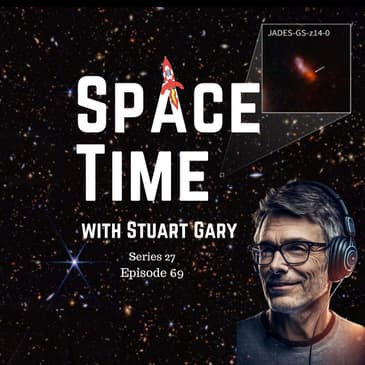
First, we delve into a groundbreaking discovery by the Webb Space Telescope, which has identified the most distant galaxy ever observed. Located a staggering 290 million years after the Big Bang, this galaxy offers unprecedented insights into the universe's infancy and the formation of its earliest stars and galaxies. We explore the methods and implications of this discovery, including the galaxy's surprising brightness and the presence of dust and ionized gas.
Next, we discuss the announcement of a massive new collection of exoplanet discoveries. NASA's Transiting Exoplanet Survey Satellite (TESS) has confirmed 120 new exoplanets and identified six new candidates, bringing the total number of known exoplanets to over 6000. These findings offer a rich database for studying planetary properties and environments, particularly those that may harbor life.
Finally, we highlight new X-ray observations from NASA's Chandra X-ray Telescope, revealing dramatic changes in two famous supernova remnants: the Crab Nebula and Cassiopeia A. These observations provide stunning visualizations and valuable data on the dynamic processes occurring in these remnants.
Follow our cosmic conversations on X @stuartgary, Instagram, YouTube, and Facebook. Join us as we unravel the mysteries of the universe, one episode at a time.
Sponsor Offer
This episode is proudly supported by NordPass. Secure your digital journey across the cosmos with a password manager you can trust. Find your stellar security solution at https://www.bitesz.com/nordpass.
Listen to SpaceTime on your favorite podcast app including Apple Podcasts, Spotify, YouTube Music, or wherever you get your podcasts.
Support SpaceTime
Become a supporter of SpaceTime: https://www.bitesz.com/show/spacetime/support/
www.bitesz.com
[00:00:00] This is SpaceTime Series 27 Episode 69 for broadcast on the 7th of June 2024.
[00:00:07] Coming up on SpaceTime…
[00:00:09] The Webb Space Telescope discovers the most distant galaxy known.
[00:00:13] The unveiling of a massive new collection of exoplanet discoveries.
[00:00:17] And new X-ray observations highlight changes in two of our most famous supernova remnants.
[00:00:24] All that and more coming up on SpaceTime.
[00:00:28] Welcome to SpaceTime with Stuart Gary.
[00:00:48] Astronomers have detected the earliest known galaxy so far discovered,
[00:00:52] located a record-breaking 290 million years after the Big Bang some 13.8 billion years ago.
[00:01:00] Over the past two years, astronomers have been using NASA's Webb Space Telescope to explore what's
[00:01:06] often referred to as the Cosmic Dawn, that period in the first few hundred million years after the
[00:01:12] Big Bang when the very first stars and galaxies were born. These most ancient of all galaxies
[00:01:18] provide astronomers with vital insights into the ways in which the gas, stars and black holes were
[00:01:24] changing when the universe was still very young. Back in October last year and again in January
[00:01:30] this year, astronomers used Webb to observe galaxies as part of the James Webb Advanced
[00:01:35] Deep Extragalactic Survey, or JADES for short. Using Webb's near-infrared spectrograph, they
[00:01:41] obtained a spectrum of a galaxy at a redshift of 14. That's a measure of how much a galaxy's
[00:01:47] light has been stretched by the physical expansion of the universe over space time.
[00:01:52] The authors had already found hundreds of candidate galaxies from the first 650 million
[00:01:57] years after the Big Bang. But in early 2023, they discovered a galaxy which showed strong evidence
[00:02:03] of being above a redshift of 14. Now that's never happened before. There were some artifacts of this
[00:02:10] new source which made them wary. It was surprisingly bright, something astronomers wouldn't expect for
[00:02:15] such a distant galaxy. And it was also very close to another galaxy, such that the two appeared to
[00:02:21] be part of a single larger object. When observed again in October last year as part of the JADES
[00:02:27] Origin Field, new imaging data, this time obtained with Webb's narrow near-infrared camera filters,
[00:02:33] pointed even more towards the high redshift hypothesis. Now by this time, the study's authors
[00:02:38] knew they needed a spectrum to confirm their observations. So in January this year, Webb's
[00:02:44] near-infrared spectrograph observed this galaxy, which by now had been catalogued as JADES GSZ14.0,
[00:02:51] for almost 10 hours. And when the spectrum was first processed, it was unambiguous ever
[00:02:56] that the galaxy was indeed at a redshift of 14.32. Now that blows apart the previous most
[00:03:04] distinct galaxy record, which was at a redshift of 13.2. This discovery was not just a new distance
[00:03:11] record. The most important aspect of JADES GSZ14.0 was that at this distance, astronomers now know
[00:03:18] that this galaxy must be intrinsically very luminous. Now from the images, the source was
[00:03:24] found to be over 1600 light-years across, proving that the light was coming mostly from young stars,
[00:03:30] and not from a mission near a growing supermassive black hole. This much starlight implies the
[00:03:36] galaxy is already several hundreds of millions of times the mass of our sun. And of course it
[00:03:41] raises an important question, how can nature make such a bright massive and large galaxy
[00:03:46] in less than the 300 million years that the universe had at that stage been in existence?
[00:03:52] And the data has also revealed other important aspects of this astonishing galaxy.
[00:03:56] The colour of the galaxy is not as blue as it could be, that indicates that some of the light
[00:04:01] is being reddened by dust even at these very early epochs. JADES researcher Jack Hilton from
[00:04:07] the Stewart Observatory at the University of Arizona also identified that JADES GSZ14.0
[00:04:13] was detected at longer wavelengths with Webb's mid-infrared instrument, which was a remarkable
[00:04:18] achievement considering the distance. The mid-infrared observations cover wavelengths of
[00:04:23] light that were actually emitted in the visible light range, which are redshifted out of reach
[00:04:28] of Webb's near-infrared instruments. Jake's analysis indicates that the brightness of the source
[00:04:33] implied that the mid-infrared observation is above what would be extrapolated from the
[00:04:38] measurements by other Webb instruments, indicating the presence of strong ionized gas emission in the
[00:04:43] galaxy in the form of bright emission lines for hydrogen and oxygen. And that's interesting in
[00:04:48] itself because the presence of oxygen so early in the life of this galaxy came as a real surprise
[00:04:53] because it is suggested there must have already been multiple generations of very massive stars
[00:04:58] that had lived out their lives and died before the galaxy was even observed by Webb. Now all
[00:05:04] these observations together are telling us that JADES GSC14.0 isn't like the types of galaxies
[00:05:10] that had been predicted by theoretical models or for that matter by computer simulations to exist
[00:05:15] in this very early part of the universe. Given the observed brightness of the source, astronomers can
[00:05:21] now forecast just how it might grow over cosmic time and so far they've not found any suitable
[00:05:27] analogs from hundreds of other galaxies they've observed at very high redshift. Of course given
[00:05:32] the relatively small region of the sky searched to find JADES GSC14.0, its discovery has profound
[00:05:39] implications for the predicted number of bright galaxies that are likely to exist in the early
[00:05:44] universe. This is space time. Still to come, discovery of a massive new collection of exoplanets
[00:05:52] and new x-ray observations highlight the changes that have taken place in two of the most famous
[00:05:58] known supernova remnants. All that and more still to come on Space Time. Astronomers have announced
[00:06:20] the discovery of no less than 120 confirmed and six new candidate exoplanets, that is planets
[00:06:26] orbiting stars other than our sun. The findings reported in the Astrophysical Journal was made
[00:06:32] using NASA's Transiting Exoplanet Survey Satellite test as part of the Keck Test Survey Program.
[00:06:39] It brings to more than 6,000 the number of confirmed exoplanets now known to exist.
[00:06:46] The new catalogue provides astronomers with a new database to explore, paving the way to study
[00:06:51] their properties and environments in finer detail, especially those planets thought capable of
[00:06:55] harbouring life as we know it. This latest installment of the survey provides thousands
[00:07:01] of radial velocity observations, that is measurements of the reflex motion of a star
[00:07:07] due to an orbiting planet's gravity, what astronomers call the wobble method.
[00:07:11] The observations are revealing a fascinating mix of planet types beyond our solar system.
[00:07:17] They include rare worlds with extreme environments to ones that could possibly support life as we
[00:07:22] know it. The study's authors analysed 9,204 measurements, more than half of which were
[00:07:28] taken over the course of 301 observing nights using the Keck Observatory's Planet Hunting
[00:07:32] Spectrometer instrument. The results represent the single largest contribution to the understanding
[00:07:39] of the physical nature and system architectures of new planets, TESS has discovered. With all
[00:07:44] of the radial velocities combined, they were able to calculate the masses of 120 confirmed planets,
[00:07:50] as well as 6 candidate planets. The survey has revealed a vast diversity of exotic worlds.
[00:07:57] This time, astronomers honed in on planets orbiting so-called sub-giant stars, their future
[00:08:02] versions of the Sun, undertaking the largest homogeneous study of such planets to date.
[00:08:07] You see, eventually, after it runs out of hydrogen in its core, our Sun will expand to become one of
[00:08:14] these giant stars. Now, astronomers already have some pretty good ideas about what might happen to
[00:08:19] the planets in our solar system when the Sun expands into a red giant. But by directly observing
[00:08:25] these more evolved systems, they can begin to put together the puzzle pieces and tie the observations
[00:08:31] to the theory. The results could help predict the future fate of the Earth when the Sun swirls up
[00:08:36] and most likely engulfs our planet. In particular, the study bridges the gap to other systems that
[00:08:42] have already shown to somehow survive this fate or those that are currently in the process of being
[00:08:47] engulfed. In another example of extreme worlds, the authors discovered the largest rocky planet
[00:08:53] ever found, cataloguing it as TOI 1347b. Their work suggests that terrestrial planets, that is those
[00:09:00] with rocky surfaces like the Earth, likely cannot have masses much more than 10 times that of the
[00:09:06] Earth. See, a larger planet would almost certainly accrete a thick envelope of lighter gases, such as
[00:09:12] hydrogen and helium from its nascent gas disk, and therefore it would produce planets far more similar
[00:09:18] to the ice giants Uranus and Neptune or the gas giants Jupiter and Saturn. This is space time!
[00:09:26] Still to come, new X-ray observations highlighting changes to two famous supernova remnants,
[00:09:31] and later in the Science Report, a new study shows that changes in global ocean circulation
[00:09:37] caused by climate change are increasing the frequency and intensity of extreme cold events.
[00:09:42] All that and more still to come on Space Time. NASA's Chandra X-ray telescope has released two
[00:10:03] new movies spanning two decades which are showing astronomers the dramatic changes that have taken
[00:10:09] place in two of the most famous objects in the sky, the Crab Nebula and Cassiopeia A supernova
[00:10:16] remnants. The new observations show that the Crab Nebula shows a stunning view of the activity in
[00:10:22] the inner region around the nebulous pulsar, a rapidly rotating neutron star. A wisp is moving
[00:10:28] outwards at half the speed of light from the inner ring around the pulsar. It then appears to merge
[00:10:34] with a larger outer ring, visible in both X-rays and optical images. The inner X-ray ring consists
[00:10:39] of about two dozen knots that form, brighten and fade. The new movie also shows a high-speed wind
[00:10:46] of matter and antimatter particles from the pulsar which are ploughing through the surrounding nebula,
[00:10:51] in the process creating a shock wave which forms the inner ring. Meanwhile energetic shock particles
[00:10:57] are also seen moving outwards to brighten the outer ring and produce an extended X-ray glow.
[00:11:02] The observations are also showing enormous electrical voltages which are being generated by
[00:11:07] the rotating highly magnetized neutron star. The star is accelerating particles outwards along its
[00:11:14] equator in order to produce the pulsar wind. Now these pulsar voltages are also producing polar jets
[00:11:20] which are spewing X-ray emitting matter and antimatter particles perpendicular to the rings.
[00:11:26] Meanwhile new observations of Cassiopeia A have revealed the distribution of elements
[00:11:31] essential for life as we know it being ejected by the supernova explosion. This report from NASA TV.
[00:11:38] The Crab Nebula, the result of a bright supernova explosion seen by Chinese and other astronomers
[00:11:44] in the year 1054, is 6,500 light-years from Earth. At its center is a neutron star,
[00:11:51] a super dense star produced by the supernova. As it rotates at about 30 times per second,
[00:11:57] its beam of radiation passes over the Earth every orbit like a cosmic lighthouse.
[00:12:03] As the young pulsar slows down, large amounts of energy are injected into its surroundings.
[00:12:09] In particular, a high-speed wind of matter and antimatter particles ploughs into the surrounding
[00:12:14] nebula creating a shock wave that forms the expanding rings. Jets from the poles of the
[00:12:19] pulsar spew X-ray emitting matter and antimatter particles in a direction perpendicular to the ring.
[00:12:26] Over 22 years, Chandra has taken many observations of the Crab Nebula.
[00:12:31] With this long runtime, astronomers see clear changes in both the ring and the jets.
[00:12:37] Previous Chandra movies showed images taken for much shorter time periods,
[00:12:41] a five-month period between 2000 and 2001, and over seven months between 2010 and 2011 for another.
[00:12:50] The longer time frame highlights mesmerizing fluctuations,
[00:12:54] including whip-like variations in the X-ray jet that are only seen in this much longer movie.
[00:13:01] A new set of Chandra observations will be conducted later this year
[00:13:05] to follow changes in the jet since the last Chandra data was obtained in early 2022.
[00:13:11] The second billing in this doubleheader is just as spectacular. Cassiopeia A, or Cas A for short,
[00:13:19] is the remains of a supernova that is estimated to have exploded about 340 years ago in Earth's sky.
[00:13:27] While other Chandra movies of Cas A have previously been released,
[00:13:31] including one with data extending from 2000 to 2013,
[00:13:35] this new movie is substantially longer, featuring data from 2000 through 2019.
[00:13:42] The outer region of Cas A shows the expanding blast wave of the explosion.
[00:13:47] The blast wave is composed of shock waves, similar to the sonic booms generated by a supersonic
[00:13:53] aircraft. These expanding shock waves are sites where particles are being accelerated to energies
[00:13:59] that are higher than the most powerful accelerator on Earth, the Large Hadron Collider.
[00:14:05] As the blast wave travels outwards, it encounters surrounding material and slows down,
[00:14:10] generating a second shock wave that travels backwards relative to the blast wave,
[00:14:15] analogous to a traffic jam traveling backwards from the scene of an accident on a highway.
[00:14:22] These two movies show Chandra's capabilities of documenting changes in astronomical objects over
[00:14:27] human timeframes. Such movies would not be possible without Chandra's archives that
[00:14:33] serve as public repositories for the data collected over Chandra's nearly 25 years of operations.
[00:14:40] This is Space Time. Time now to take another brief look at some of the other stories making
[00:15:01] news in science this week with a science report. A new study warns that changes in global ocean
[00:15:07] circulation caused by climate change may be increasing the frequency and intensity of
[00:15:12] extreme cold events in our oceans. Scientists already know that climate change shifts ocean
[00:15:18] currents and pressure systems. And the researchers have now found that changes in the East Australian
[00:15:24] current and the Augustus current of the coast of South America have led to an intensification
[00:15:29] of ocean upwelling, a process in which deep, cold water is pushed to the surface. A report in the
[00:15:35] journal Nature Climate Change found that these upwellings can create colder killer events,
[00:15:40] leading to mass deaths of animals living close to their temperature limits. The authors were
[00:15:45] in fact able to link mass animal deaths in 2021 to such an intense cold upwelling, and they've
[00:15:51] given the example of bull sharks as one of the species that may be vulnerable to these cold events.
[00:15:58] A bit of good news now, and a new study has shown that kids conceived by IVF have no overall
[00:16:03] increased risk of childhood cancers than the general population. The new findings reported
[00:16:09] in the Journal of the American Medical Association looked at a cohort of about eight and a half
[00:16:13] million children, 260,000 of whom had been born using medically assisted reproduction.
[00:16:20] However, while the researchers say there was no overall increase in childhood cancer rates in the
[00:16:25] assisted reproduction cohort, there was a slightly higher risk of leukemia among those born by fresh
[00:16:31] or frozen embryo transfer. However, it's important to note this increased risk is not certain,
[00:16:36] and it's likely to have a very marginal impact on overall leukemia cases at the population level.
[00:16:43] The use of recycled concrete and glass aggregates in concrete production has now emerged as a highly
[00:16:48] promising means of increasing the recycling rates of waste materials. However, durability issues
[00:16:54] have plagued some combinations of recycled ingredients. Now, a report in the Journal of
[00:16:59] Structural Concrete claims researchers from Flinders University have developed a high
[00:17:04] performance and sustainable concrete formula which can resist alkalized silica reactions,
[00:17:09] which until now have had a negative impact on the mechanical properties and durability of concrete.
[00:17:14] That was due to the significant silica content of some recycled aggregates.
[00:17:20] We usually think of the idea of UFOs, flying saucers and alien life as a fairly recent
[00:17:26] invention of humankind, most likely sparked by the Cold War fears of the evils of communism,
[00:17:31] as well as secret military tests in the 1940s and 50s which government officials didn't want
[00:17:37] to explain. But actually, when you think about it, there are references to alien life going back
[00:17:42] thousands of years, all the way back to the Old Testament. There are tales like those of Ezekiel
[00:17:47] speaking of an immense dust storm coming from the north with an immense cloud full of lightning
[00:17:52] flashes and a huge ball of fire glowing like bronze. The passage goes on to describe four
[00:17:58] human-like creatures within the fire, each with four faces, four wings and legs like columns with
[00:18:04] feet that sparkled from the fire like burnished bronze. In front, each had a human face. On the
[00:18:11] right side, the face of a lion, on the left the face of an ox and in the back the face of an eagle.
[00:18:18] Ezekiel then speaks of things that look like wheels within wheels on the ground beside each
[00:18:23] of the four-faced creatures, and the wheels were sparkling like diamonds in the sun and with rims
[00:18:29] circled with eyes. Tim Mendham from Australian Skeptics says the idea of alien life is a
[00:18:35] reoccurring theme throughout history. It goes back a long way and certainly before the UFO flap that
[00:18:40] as you say started in the 40s and continues to this day, not so much UFOs and things as much as
[00:18:45] there's a new one on X right now in fact it's like a manta ray flying through the skies above
[00:18:49] Florida that's brand new one yeah. I'll have to look at that one okay. Beliefs before this the
[00:18:53] UFO flap were largely about life elsewhere. If you know your HD world and look at the first men
[00:18:59] in the moon which came out I think before war of the worlds, maybe it was after yeah when people
[00:19:03] travel to the moon and they met up with the Thalamites who were the moon people. There's a
[00:19:08] movie made over in the 60s and they looked a bit more anti than people but never mind. So certainly
[00:19:13] there was this idea of life elsewhere and people back in the several hundred years ago philosophers
[00:19:18] like the bible as you say have always spoken about life elsewhere and the way they saw it then in
[00:19:23] their day in the you're looking at the sort of 1600s and when you're looking at some specific
[00:19:28] philosophers, they called it divine plenitude which was basically the idea that God in all her wisdom
[00:19:34] wouldn't have missed the opportunity of populating the whole universe with living beings. If God could
[00:19:38] create life whether humans or animal or whatever why stop at earth right? Why not put it everywhere?
[00:19:43] That's pretty cool that people back then were thinking that there were places other than earth.
[00:19:48] Oh they knew there were places other than earth, they'd seen planets after all right?
[00:19:51] They'd known about Saturn and Jupiter who were sort of you know they were well known to the
[00:19:54] ancients. They didn't know what they were, they thought they were stars. No, no they thought
[00:19:58] they were hard rock planets. Did they? Yeah that's why you could put an animal on it or a creature
[00:20:02] an alien. They didn't know they were gassy things and it goes straight through. This is actually seen
[00:20:06] as being something of the move towards Copernicus. This is often because of the change of the view
[00:20:13] about astronomy in this time from a geocentric, Ptolemaic view of the solar system that the earth
[00:20:20] is in the middle and everything else revolves around the earth to the Copernican view which
[00:20:24] he wasn't the first etc but others had suggested it but he was perhaps the most famous suggesting
[00:20:28] that no the earth is not in the middle, the sun is and all the planets, all these bodies, planets
[00:20:33] meaning wanderers because they go back and forth in the sky, the night sky, we evolve around the
[00:20:38] sun and they obviously knew about Mercury, Venus, Mars, Jupiter and Saturn. They were known, they
[00:20:44] were known from ancient times and Uranus and Neptune were added not long after and then Pluto
[00:20:50] after that. You know the earth will fit 62 times in Uranus? 63 if you squeeze hard. Right okay
[00:20:57] yeah because earth was a planet and the other bodies that they knew about were also planets
[00:21:02] therefore they had to see them as similar and if ours was populated why aren't they populated
[00:21:06] like you can set up a society which they thought would be like our society. People would have
[00:21:10] social lives, they'd live in houses, they'd make music, contemplate the works of God etc and they probably
[00:21:16] sort of you know did their own everything else as well so the God was the center of their explanation
[00:21:21] of why these other planets, these other bodies would be populated so given the intramarital
[00:21:27] Copernicus you like to say that these are all planets, these are all bodies, these are things
[00:21:30] rotating in space, these are solid and that therefore you use the God bit so God could put life on all
[00:21:36] of them. So they were pretty convinced 400 years ago whatever 500 years ago that there was life
[00:21:40] out there not that they were contacting us but they were out there. The question then came to
[00:21:45] what are these things on other planets? Are they men or are they different sort of works? Had they
[00:21:51] been redeemed by divine intervention by Jesus etc as the people on earth had been? Did they look like
[00:21:57] us? Did they not look like us? It was because you're not quite sure that they had been redeemed through
[00:22:02] the death of Jesus that therefore you think have all of these been fine therefore they say well
[00:22:06] they're not humans. They would say it's easy to reject the alien as being humans because that
[00:22:11] made life easier about how Jesus died for us here on earth but did he do the same thing on every other
[00:22:16] planet? So this is basically where our belief that aliens are not human, humanoid from this idea that
[00:22:22] it's from a religious idea if there is life why not because God would have done it but they couldn't
[00:22:26] be like us because Jesus didn't die for them. It's an interesting situation but yeah there's
[00:22:30] people talking about life elsewhere for ages and ages and ages so that these people in the
[00:22:35] 1600s were torn between their religious beliefs and their scientific beliefs and they tried to
[00:22:39] accommodate both and I think that's where it becomes quite interesting from a historical
[00:22:42] and sociological point of view even if they're not very good on the scientific point of view.
[00:22:46] That's Tim Mindem from Australian Skeptics. That's the show for now. Space Time is available
[00:23:08] every Monday, Wednesday and Friday through Apple Podcasts iTunes, Stitcher, Google Podcasts,
[00:23:14] Pocket Casts, Spotify, Acast, Amazon Music, Bytes.com, SoundCloud, YouTube, your favorite
[00:23:21] podcast download provider and from spacetimewithstuartgarry.com. Space Time is also broadcast
[00:23:28] through the National Science Foundation on Science Zone Radio and on both iHeart Radio and TuneIn Radio
[00:23:34] and you can help to support our show by visiting the Space Time store for a range of promotional
[00:23:39] merchandising goodies or by becoming a Space Time patron which gives you access to triple episode
[00:23:45] commercial free versions of the show as well as lots of bonus audio content which doesn't go to
[00:23:50] air, access to our exclusive Facebook group and other rewards. Just go to spacetimewithstuartgarry.com
[00:23:57] for full details and if you want more Space Time please check out our blog where you'll find all
[00:24:02] the stuff we couldn't fit in the show as well as heaps of images, news stories, loads of videos and
[00:24:08] things on the web I find interesting or amusing. Just go to spacetimewithstuartgarry.tumblr.com
[00:24:14] that's all one word and that's tumblr without the e. You can also follow us through at Stuart
[00:24:20] Garry on Twitter, at spacetimewithstuartgarry on Instagram, through our Space Time YouTube channel
[00:24:26] and on Facebook just go to facebook.com forward slash spacetimewithstuartgarry. You've been
[00:24:32] listening to Space Time with Stuart Garry this has been another quality podcast production from bytes.com