
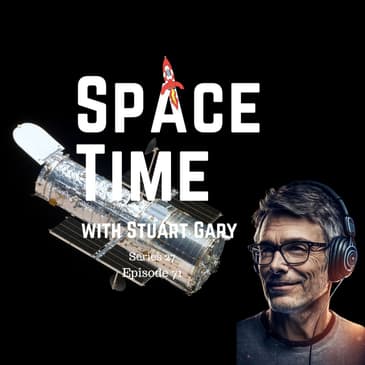
First, we discuss NASA's announcement that the Hubble Space Telescope will begin winding back its science programme due to ongoing issues with its gyroscopes. This decision marks a significant transition for the historic observatory, which has revolutionised astronomical discovery since its launch in 1990.
Next, we cover the long-awaited launch of Boeing's Starliner, which has finally taken a crew to the International Space Station. This milestone paves the way for Starliner to join SpaceX's Dragon in transporting crews to the orbiting outpost under NASA's commercial crew programme.
Finally, we highlight NASA's OSIRIS Apex spacecraft's survival after a close encounter with the sun. This mission is essential for its upcoming rendezvous with the asteroid Apophis in 2029.
Follow our cosmic conversations on X @stuartgary, Instagram, YouTube, and Facebook. Join us as we unravel the mysteries of the universe, one episode at a time.
Sponsor Offer
This episode is proudly supported by NordPass. Secure your digital journey across the cosmos with a password manager you can trust. Find your stellar security solution at https://www.bitesz.com/nordpass.
Listen to SpaceTime on your favourite podcast app including Apple Podcasts, Spotify, YouTube Music, or wherever you get your podcasts.
Support SpaceTime
Become a supporter of SpaceTime:
If you'd like to support SpaceTime and access early release episodes, commercial-free...then look for us on Patreon or Supercast. Links on our website at spacetimewithstuart.com
https://www.bitesz.com/show/spacetime/support/
www.bitesz.com
[00:00:00] This is SpaceTime Series 27 Episode 71 for broadcast on the 12th of June 2024. Coming up on SpaceTime, the Hubble Space Telescope starts to wind back operations, after years of delays, Boeing's Starliner finally launches a crew to the International Space Station,
[00:00:19] and NASA's OSIRIS-APEC spacecraft survives the close encounter with the Sun. All that and more coming up on SpaceTime. Welcome to SpaceTime with Stuart Gary. It's been described as the most valuable scientific instrument ever made, but NASA's now been forced to announce
[00:00:54] that the Hubble Space Telescope will begin winding back its science program. The historic Earth-orbiting observatory, which revolutionized astronomical discovery since its launch in 1990, is being forced to scale back operations because of ongoing problems with one of its three gyroscopes.
[00:01:12] The gyros are used to control the direction in which the telescope points. However, one of them has become repeatedly unstable in recent months, causing the telescope to default into safe mode on several occasions. NASA's Director of the Astrophysics Division, Mark Clampin,
[00:01:28] says that following a series of tests and careful consideration of the options, the decision has now been taken to transition Hubble to operate using only one of its two remaining good gyros, while the other kept powered up in reserve for future use. The transition will reduce Hubble's efficiency
[00:01:45] at carrying out scientific observations by 12%, dropping from 85 orbits a week down to 74. And it will no longer be able to track objects closer than Mars, although those sort of targets are fairly rare anyway. NASA calculates there's still a greater than 70% chance
[00:02:01] that Hubble will remain operational for at least another 11 years, till at least 2035. While Webb's taken over as the primary space telescope thanks to its infrared capabilities, Hubble's primary focus on visible light objects continues to make great astronomical discoveries.
[00:02:19] In fact, just two years ago it detected the furthest individual star ever seen, a Rendall, whose light took 12.9 billion years to reach the Earth. This report from NASA TV. As a cosmic photographer, NASA's Hubble Space Telescope has taken over a million snapshots documenting the universe.
[00:02:39] These images illustrate, explain, and inspire us with their grandeur, but may not match what we'd see with our own eyes. That's because Hubble sees light beyond our sensitivity. Our eyes only sense a small fraction of the universe's light. This tiny band of wavelengths called the visible spectrum
[00:03:00] holds every color in the rainbow. All the light outside that span, with longer or shorter wavelengths, is invisible to our eyes. But those invisible wavelengths can tell us so much more about the universe. Hubble houses six scientific instruments that observe at different wavelengths.
[00:03:19] Together they expand our vision into infrared and ultraviolet light. That doesn't mean Hubble can show us never-before-seen colors. In fact, the telescope can only see the universe in shades of gray. Seeing in black and white allows Hubble to detect subtle differences in the light's intensity.
[00:03:39] If one wavelength is brighter than another, that tells us something about the science of that object. But because color helps humans interpret what we see, NASA specialists work to process and colorize publicly available Hubble data into more accessible images.
[00:03:56] When Hubble snaps a photo, it puts a filter in front of its detector, allowing specific wavelengths to pass through. Broadband filters let in a wide range of light. Narrowband filters are more selective, isolating light from individual elements like hydrogen, oxygen, and sulfur.
[00:04:14] Hubble observes the same object multiple times using different filters. Image processors then assign those images a color based on their filtered wavelength. The longest wavelength becomes red, medium becomes green, and the shortest blue, corresponding to the light sensors in our eyes. Combining them gives us a color image,
[00:04:34] showcasing characteristics we can't make out in black and white. Adding color reveals the underlying science in every image. It's like translating words into another language, making sure no information is lost. Some words have an exact counterpart. The meaning remains the same when you swap them.
[00:04:55] Hubble's true color photos are like that. They are a direct translation, using broad filters in wavelengths we can see. Other words can't be translated directly. When we use narrowband filters or peer outside the visible spectrum, it's like translating words with no one-word replacement.
[00:05:14] Easily done, but requires more work. Narrowband images highlight the concentration of important elements. Infrared images are like heat maps, helping us spot newborn stars in dark, dusty clouds and peer further back in time and space. In ultraviolet, we uncover active aurorae on Jupiter
[00:05:36] and learn how young massive stars develop. Image processors also clean up artifacts, signatures in an image that aren't produced by the observed target. As sensors age, some pixels become imperfect, returning too much electrical charge or not enough. Artifacts can leave behind odd shapes
[00:05:58] or return images without any true black. These effects can be calibrated and removed. Other artifacts come from the dynamic environment of space. Even the best photographers get photobombed. In Hubble's case, the culprits are asteroids, spacecraft or debris trails, and high-energy particles called cosmic rays.
[00:06:20] By combining and aligning multiple observations, image processors can identify them and piece together an artifact-free image. Without processing, many Hubble images would be divided down the middle. Hubble moves slightly with each observation, allowing image processors to fill the gap and replace faulty pixels. This process is called dithering.
[00:06:44] And because there's no natural up or down in space, processors decide how to rotate and frame the image. It's a time-consuming procedure. Simple images take about a week, while large mosaics stitched together from many observations can take a month to process.
[00:07:06] Hubble images may not be what we'd see firsthand. Instead, they are tools for understanding science at a glance, shedding light on otherwise invisible views of our universe. The 11,110-kilogram observatory is based on the design of America's top secret Kehoe spy satellites,
[00:07:28] but modified to look up and out into space rather than down onto the Earth's surface. Named after astronomer Edwin Hubble, it was the first to discover that all galaxies are moving away from each other, at least on the cosmic scale.
[00:07:42] The telescope was launched aboard the Space Shuttle Discovery on STS-31 back in 1990. T minus six, five, four, three, two, one, and liftoff of the Space Shuttle Discovery with the Hubble Space Telescope, our window on the universe. It was placed into a 515-kilometer high orbit.
[00:08:03] Unfortunately, first light showed a problem with its primary mirror. That was eventually fixed in the first of five Hubble service and repair missions which took place using space shuttles between 1993 and 2009. With the demise of the Space Shuttle program in 2011, opportunities to continue servicing Hubble came to an end,
[00:08:24] and the clock's been slowly ticking since then towards the telescope's demise. At the end of the telescope's life, NASA plans to deorbit the spacecraft unless a viable rescue package can be developed. NASA and SpaceX have been studying a possible mission
[00:08:40] to re-boost Hubble's orbit, which is gradually decaying over time due to atmospheric drag. And that mission's also been examining ways of mitigating against the loss of its gyroscopes. However, at this stage, no decision's been made. This is space time. Still to come.
[00:08:57] After years of delays and technical issues, Boeing's Starliner has finally launched a crew to the International Space Station. And NASA's OSIRIS-APEX mission has survived unscathed following its closest ever encounter with the sun. All that and more still to come on Space Time.
[00:09:14] After years of delays and technical issues, Boeing's Starliner has finally launched, taking its first manned flight to the International Space Station. Five, four, three, two, one, ignition. And liftoff of Starliner and Atlas V, carrying two American heroes, drawing a line to the stars for all of us.
[00:09:54] Commander Butch Wilmer there calling down to mission control here in Houston that the spacecraft has begun rolling into the right attitude for its ascent and the guidance navigation and control officer here in the room is seeing good data on that. Starliner passing through max Q,
[00:10:08] or the point of maximum dynamic pressure where the forces of air friction are highest, which in sunny will shortly be passing through Mach 1, where the speed is sound. You got a good throttle up. Starliner and Atlas looking good with speeds and attitude increasing as expected.
[00:10:25] Coming up in less than 20 seconds, the solid rocket boosters will run out of fuel and burn out. Good SRB burnout. Now the fuel in the solid rocket boosters has been depleted. The Atlas main booster stage will be continuing its burn for about the next three minutes. Good handle.
[00:10:41] That call, good handle from Capcom Joshua Kudrick, indicating that the crew now has the ability to initiate an abort manually if needed. All looking good so far. Now two minutes into Starliner's flight and coming up on the solid rocket booster jettison at the 2 minute and 40 second mark.
[00:10:56] Good trajectory. Solid rocket boosters have now been jettisoned after seeing Starliner through its first 90 seconds of flight. Team on the ground here confirming that it was a good jettison and the vehicle's trajectory continues to look good. Now three minutes into today's flight.
[00:11:10] The test flight paves the way for Starliner joining SpaceX's Dragon in transporting crews to the orbiting outpost under NASA's Commercial Crew Program. Flown aboard a United Launch Alliance Atlas V rocket from Space Launch Complex 41 at the Cape Canaveral Space Force Station in Florida,
[00:11:27] Starliner Calypso undertook the two-day flight to autonomously dock with the forward-facing port of the station's Harmony module. The test flight's helping NASA validate the spacecraft's in-orbit operations and capabilities, the launch pad facilities, the launch vehicle, and the return to Earth.
[00:11:44] While SpaceX has been flying crews to the space station aboard their Dragon spacecraft for more than four years now and cargo even longer, Boeing's CST-100 Starliner has been plagued with problems. And even after it finally got off the ground back in December 2019,
[00:12:00] its first unmanned orbital test flight was a complete disaster. Software issues caused the spacecraft to undertake its orbital insertion burn too early and consequently far too low in altitude to reach the space station. And just before its return to Earth, engineers discovered a second critical software error.
[00:12:19] That would have affected the thruster firings needed to safely jettison Starliner's service module. The service module software error incorrectly translated the jettison thruster firing sequence. It would have caused the Starliner spacecraft to crash into the service module,
[00:12:34] destroying both vehicles instead of moving the two away from each other. Later a third software issue was discovered that would have prevented the spacecraft from docking with the space station anyway. Following that disastrous first flight, a NASA review identified some 80 issues
[00:12:49] which needed attention before another test flight would be held. As well as addressing the software issues, Boeing also modified the design of the Starliner docking system, adding a hinged re-entry cover for additional protection during the capsule's fiery descent through the atmosphere.
[00:13:04] They also installed a new propellant heater and new thermal protection tiles as well as new airbags to cushion the capsule's landing. But the problems didn't end there. Once they brought Starliner back to the launch pad in 2021 for a second orbital test flight,
[00:13:19] new problems were detected, this time with 13 propulsion system valves in the spacecraft. Somehow the valves had become corroded by the intrusion of moisture that interacted with the propellant. The source of the moisture was not discovered. Initial attempts to fix the problem at the launch pad failed
[00:13:36] and the entire rocket was then returned to the Vertical Integration Facility for more detailed repairs. But they also failed. Eventually Boeing decided to return the spacecraft to the factory where it could be completely stripped back down to the frame and the valves replaced.
[00:13:52] Finally, a second unmanned orbital test flight held in May 2022 reached the International Space Station successfully. However, it still wasn't smooth sailing. Two orbital maneuvering and attitude control system thrusters fell during the orbital insertion burn. That forced the spacecraft to compensate using the remaining thrusters
[00:14:11] as well as the reaction control system thrusters. Then a couple of reaction control system thrusters used to maneuver Starliner also failed during the docking maneuver. That was due to low chamber pressure.
[00:14:23] And internal monitors inside the capsule also showed some thermal systems used to cool the spacecraft showed extra cold temperatures. That required engineers to manually manage it during the docking. Following the second test flight, further mission evaluations turned up a number of issues
[00:14:40] including problems with the parachute harness and the discovery of flammable tape on wiring. Finally, a manned test flight was tentatively scheduled for early last month. But a problem with an oxygen valve on the Atlas rocket's center upper stage caused the launch to be scrubbed.
[00:14:55] A second launch attempt was also called off following a helium leak in the Starliner service module. Other technical glitches included a voltage surge affecting the astronaut's suit cooling systems. Yet another launch attempt on June 1st was aborted 3 minutes and 50 seconds prior to liftoff
[00:15:12] after one of the three flight computers began responding too slowly to input. Once they finally got off the ground, the crew were asked to put Starliner through its paces with a long list of tests including taking manual control of the spacecraft.
[00:15:26] Its docking with the space station's Harmony port went smoothly. Starliner will now remain docked to the orbiting outpost for at least eight days as crew carry out additional tests including whether the ship can be used as a safe haven in the event of problems on the space station.
[00:15:41] After undocking, Starliner will return to Earth undertaking a parachute and airbag assisted landing on the White Sands Missile Range in New Mexico. And if all that goes smoothly, it'll begin regular operations transporting crew to the space station under NASA's Commercial Crew Program. This is Space Time.
[00:16:00] Still to come, NASA's OSIRIS-APEX spacecraft unscathed after a searing pass by the sun and later in the science report, a new study shows how irrational, inconsistent and prone to making mistakes artificial intelligent chatbots really are. All that and more still to come on Space Time.
[00:16:20] Mission managers say NASA's Origin Spectral Interpretation Resource Identification Apophis Explorer or OSIRIS-APEX spacecraft has survived its closest ever encounter with the sun. The probe flew some 40 million kilometers closer to the head of the sun than it was originally designed to do.
[00:16:52] Mission managers first tested OSIRIS-APEX's instruments in early April once it was far enough away from the sun to return to normal operations. OSIRIS-APEX is on an elliptical orbit around the sun that brings it to a point closest to the sun called perihelion every nine months.
[00:17:09] That's needed to get it on a path that will allow it to meet up with its new target, the asteroid Apophis in 2029. Early data on Apophis indicated that it was likely to impact the Earth. But as astronomers found out more about the asteroid,
[00:17:24] the chances of a direct hit on the Earth became less and less likely. Still, it will pass awfully close to the Earth, closer than many satellites. That'll provide astronomers with a chance of studying this asteroid close up. In order to reach Apophis, the OSIRIS-APEX's trajectory includes several perihelions
[00:17:43] that are closer to the sun than the spacecraft was originally designed to withstand. Besides confirming that the January perihelion worked as predicted, engineers found some surprises while testing the spacecraft's components. In fact, amazingly, some instruments on the spacecraft came out better than expected
[00:18:00] following their exposure to the higher temperatures. These include the camera that helped map Bennu during the OSIRIS-REx mission and which will do the same once OSIRIS-APEX reaches Apophis. That camera has seen a 70% reduction in hot pixels since April 2023, which was the last time it was tested.
[00:18:19] Hot pixels are common in cameras in space. They show up as white spots in images when detectors accumulate exposure to high energy radiation mostly from the sun. It's possible that the heat from the sun reset the pixels through annealing. Before perihelion, the spacecraft's visible and near-infrared spectrometer,
[00:18:37] which mapped the surface composition of Bennu and which will do the same at Apophis, appeared to have a rock from Bennu stuck inside its calibration port. Scientists suspect that sunlight was blocked from filtering through the instrument after the spacecraft, back in its OSIRIS-REx days,
[00:18:52] grabbed a sample of the asteroid Bennu back on October 20th 2020. By picking up the sample and then firing its engines to back away from Bennu, the spacecraft stirred up dust and pebbles, some of which clung to it. But with enough spacecraft manoeuvres and engine burns after sample collection,
[00:19:09] the rock in the calibration port appears to have finally become dislodged. Scientists will check the spectrometer again when OSIRIS-REx swings past the Earth on September 25th next year for a gravitationally assisted boost. Needless to say, the spacecraft's better than expected performance
[00:19:25] during its first close encounter with the sun is welcome news. But engineers are cautioning that doesn't mean it's time to relax. OSIRIS-APEX needs to execute five more exceptionally close passes of the sun, along with three gravity assists of the Earth, in order to reach its final destination.
[00:19:42] It's unclear exactly how the cumulative effect of six perihelions at closer distances than designed will impact the spacecraft and its components. The second OSIRIS-REx perihelion is slated for September 1st this year. At its closest, the spacecraft will be just 76 million kilometres away from the sun.
[00:19:59] That's roughly half the distance between the Earth and the sun, and well inside the orbit of Venus. This is Space Time. And time now to take another brief look at some of the other stories making news in science this week with a science report.
[00:20:28] A new study has found a link between an eczema diagnosis and severity and the amount of salt in your diet. A report in the Journal of the American Medical Association measured the amount of sodium in urine samples from over 220,000 people in the United Kingdom.
[00:20:44] The authors investigated whether a higher sodium level was linked to a higher risk of eczema. They found that simply excreting one more gram of sodium per day was associated with an 11% higher odds of having been diagnosed with eczema, a 16% higher odds of the eczema being active,
[00:21:02] and an 11% higher odds of more severe eczema. The authors say that taking just a single urine sample from their participants meant their results do have some limitations. But there are still a lot of unknowns about what drives the eczema. But the results may contribute to a better understanding
[00:21:20] of how diet influences the skin condition. A new study claims that having a long-term partner or close relationships with friends and family can reduce your risk of heart disease in older age. The findings reported in the Journal of Epidemiology and Community Health
[00:21:37] looked at the social lives of nearly 10,000 Australians aged over 70 and then followed up with them for an average of 6.4 years to see if they had developed cardiovascular disease. The authors found that being married or partnered was associated with a lower heart disease risk
[00:21:53] and for men, having three to eight relatives or friends they felt close to regularly playing games such as cards or chess with them was associated with a lower heart disease risk. They also found that women who had at least three trusted friends
[00:22:06] were less likely to develop heart disease. The researchers conclude that social support may be important for protecting the health of older people who did not have a close-knit support network. A new study has shown how irrational, inconsistent and prone to making mistakes artificial intelligence chatbots really are.
[00:22:26] A report in the Journal of the Royal Society Open Science asked seven different artificial intelligence chatbots to complete a series of tasks designed by psychologists to show that we humans often reason in irrational ways. Amazingly, they found that chatbots are even more irrational than humans
[00:22:44] and often make mistakes that people don't, especially when maths is involved. The chatbots were also inconsistent when asked to repeat the same task providing both human-like and non-human-like responses and getting the task right sometimes but wrong on other attempts.
[00:22:59] The authors say OpenAI's ChatGPT 4.0 gave the most logical human-like responses while Meta's Liama 2 performed the worst only giving human-like responses in 8.3% of cases and refusing to answer at all in 41.7% of cases. Australia's e-Safety Commissioner has been dealt a reality check
[00:23:21] after being forced to back down on her legal efforts in the federal court to force international companies such as the social media giant X formerly known as Twitter, to abide by Australian law even in their overseas operations beyond Australian jurisdiction. Julian McGrant tried to hide vision
[00:23:38] allegedly showing a radical Islamic terrorist repeatedly thrusting a knife into a much-loved Christian bishop during a Western Sydney church service. Inman Grant defended her decision to pursue the case against X claiming her sole goal and focus in issuing the removal notice
[00:23:54] was to prevent extremely violent footage from going viral potentially inciting further violence and inflicting more harm. However, one can easily be forgiven for thinking that Inman Grant's hypocrisy shines bright. That's because she has not bothered to apply the same standards
[00:24:10] to remove online sermons by radical Islamic hate preachers which include passages calling on Muslims to kill Jews. The Almudena Dawah Centre in southwestern Sydney has hosted several of the offending sermons both live and online and the e-Safety Commissioner has not attempted to remove any of them.
[00:24:28] X's global government affairs team welcomed the news of Inman Grant's back down saying the case has raised important questions on how legal powers can be used to threaten global censorship of freedom of speech. With the details, we're joined by technology editor Alex Zaharoff-Wright from TechAdvice Start Life.
[00:24:46] What Julie Inman Grant as the Australian e-Safety Commissar as Elon Musk calls her, or the Commissioner did was to draw mountains of attention to this video on a global basis due to the fact she also tried to ban this globally
[00:24:59] and so many more people were able to see it, many people were drawn to the fact that it was on television news, Facebook pages and other places that you could quite easily see it. There were any number of examples of other acts that you would imagine
[00:25:12] would have been more appropriate to request the banning of and yet we hear nothing about that and Julie Inman Grant's declaration that other social media platforms and search engines complied with their requests and removal notices including Meta, Microsoft, Google, Snap, TikTok, Reddit and Telegram.
[00:25:29] She says this is because the video violated their terms of service and their statements of decency but I think that's just an excuse. It just proves that those particular platforms do not stand up for freedom and free speech and for people to know what the truth was
[00:25:42] based on actual videos but look, she's lost her bid in court. She has decided to pull back because you could see there would be a terrible loss. Well, for a start, it wouldn't work legally. One nation cannot dictate to the world what they can and can't watch online.
[00:25:55] It doesn't work that way. Every country is a sovereign entity. Well, that is absolutely true and yet Julie Inman Grant will tell you that a bunch of other organisations as we named previously were complicit in taking this information down on a global basis.
[00:26:09] That was voluntary. That wasn't by law and she wanted to make it a legal statute and it doesn't work that way. Look, it's true that those organisations took it down in inverted commas but it was voluntary. They also didn't want to have this fight
[00:26:23] with the ESAC commissioner that Elo Musk was very happy to take on. Okay, let's move on and Windows Recall AI has been in the news of late. There are concerns about just how safe it's going to be and we now can confirm it's not safe at all.
[00:26:36] Well, according to reports on X and even from a couple of Microsoft executives at the Build conference a couple of weeks ago when this Windows Recall feature was announced, if you're an administrator and all Windows users are, generally speaking, you can go to your program files folder,
[00:26:51] your app data folder underneath that and open up the SQL database that contains the optically character recognised text from all the images that have been saved every few seconds, every three seconds to your Windows Recall account. Now, Windows Recall works differently to a traditional search engine
[00:27:08] on your computer that is looking for words and information in documents and emails. Here it is able to recognise through AI images of a brown bag that you're wanting to buy for your partner or a blue dress or a blue suit
[00:27:22] and because it can recognise that these are suits and oranges and whatever else, it can convert that into text and then allow you to search in the way that Microsoft calls semantically. So you may not remember the name of the presentation but you may remember
[00:27:34] that it had purple writing pointing to a graph somewhere on one of the pages and this increases the likelihood of you being able to find something where you don't remember the exact details of what the document was called
[00:27:46] or precisely what it was about. But if you can remember something about it, this new system will let you find it. Now, Satya Nadella, the CEO of Microsoft, in an interview with Joanna Stern, the tech writer for the New York Times,
[00:27:56] in answer to her question, well isn't this a bit creepy? Can't this be hacked? Can't people break in and then download this information? He said, well no, it's encrypted, it's protected, we're never going to use it
[00:28:04] to train our AI. But now, of course, given that actually you can find this database quite easily, it may not contain the images but it can contain a lot of information about the text that was on those images through OCR.
[00:28:15] Well, that information could be hacked off your computer, it could be used against you and because it's taking place every three seconds, there is every chance that this is going to be the most comprehensive PC surveillance system used against humans that we've ever seen.
[00:28:27] And Microsoft is not normally known for being forthright with how secure their systems are. They can't protect their own systems from being hacked with Outlook attacks and all the rest. So it's caused great concern and people are asking for Windows Recall to be recalled. When's it coming out?
[00:28:41] The actual PCs themselves with the Qualcomm chip that have Windows Recall are coming out on June 18th globally. Now they will come out later in the year with Intel and AMD chips that also have the AI chip that is more than
[00:28:54] 40 trillion operations per second. But at the moment, the only ones that are capable of this are the Qualcomm ones. So these will be the first computers of Windows Recall. It won't be able to be applied to older computers.
[00:29:05] I'm going to an event during the week at Microsoft's Experience Center in Pitt Street in Sydney where they'll be showcasing a number of these PCs. And that's one of the questions I want to ask one of the Microsoft people I'll be interviewing. Even though Microsoft says 40 trillion operations
[00:29:18] per second or 40 tops is the minimum, we know that the current AMD chip does 38 tops and the current, well 38 as far as I know, 38 or 39 tops and we know that the current Meteor Lake branded Intel chips do about 10 tops. Now theoretically that should be enough
[00:29:31] to process the images from Windows Recall. We do know that AMD will have 50 and 60 tops computers with their Strix Point chips. And we know that Intel's Lunar Lake chips coming later this year as well will have 48 tops, well in excess of the 40 tops minimum
[00:29:46] that Microsoft speaks about. But I just also wonder, can this not be backported? Will it not eventually be backported anyway? Is this not just a marketing thing to get people to buy the Qualcomm PCs now and not wait for the Intel and AMD ones due later this year?
[00:29:59] That's Alex Zaharov-Royd from TechAdvice.Live. And that's the show for now. Space Time is available every Monday, Wednesday and Friday through Apple Podcasts iTunes, Stitcher, Google Podcasts, Pocket Casts, Spotify, Acast, Amazon Music, Bytes.com, SoundCloud, YouTube, your favourite podcast download provider and from Spacetime with Stuart Garry.com.
[00:30:40] Space Time is also broadcast through the National Science Foundation on Science Zone Radio and on both iHeart Radio and TuneIn Radio. And you can help to support our show by visiting the Spacetime store for a range of promotional merchandising goodies.
[00:30:54] Or by becoming a Spacetime Patron, which gives you access to triple episode commercial free versions of the show as well as lots of bonus audio content which doesn't go to air, access to our exclusive Facebook group and other rewards. Just go to spacetimewithstuartgarry.com for full details.
[00:31:12] And if you want more Space Time, please check out our blog where you'll find all the stuff we couldn't fit in the show as well as heaps of images, news stories, loads of videos and things on the web I find interesting or amusing.
[00:31:24] Just go to spacetimewithstuartgarry.tumblr.com. That's all one word and that's Tumblr without the E. You can also follow us through at Stuart Garry on Twitter, at Spacetime with Stuart Garry on Instagram, through our Spacetime YouTube channel and on Facebook, just go to facebook.com forward slash spacetimewithstuartgarry.
[00:31:45] You've been listening to Spacetime with Stuart Garry. This has been another quality podcast production from bytes.com.