
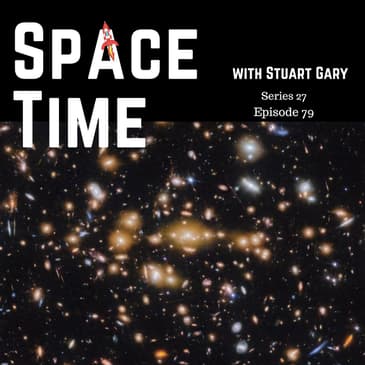
First, astronomers have discovered ancient star clusters in a galaxy dating back to near the dawn of time. These clusters, detected using gravitational lensing and the powerful near-infrared camera aboard the Webb Space Telescope, represent the earliest evidence of how the first stars and galaxies formed. The findings, published in Nature, suggest these clusters could be the seeds for the very first globular star clusters.
Next, China has successfully completed its historic Chang'e-6 mission, returning samples from the far side of the moon. The mission, which targeted the moon's South Pole-Aitken Basin, has brought back 1,935.3 grams of lunar regolith. These samples are expected to provide new insights into the geological differences between the near and far sides of the moon.
Finally, Rocket Lab celebrates a milestone with the successful launch of its 50th Electron rocket. This mission, named "No Time to Lose," deployed five satellites for the French Internet of Things company Kineis, marking a significant achievement in the company's rapid evolution.
Follow our cosmic conversations on X @stuartgary, Instagram, YouTube, and Facebook. Join us as we unravel the mysteries of the universe, one episode at a time.
Sponsor Offer
This episode is proudly supported by NordPass. Secure your digital journey across the cosmos with a password manager you can trust. Find your stellar security solution at https://www.bitesz.com/nordpass.
Listen to SpaceTime on your favourite podcast app including Apple Podcasts, Spotify, YouTube Music, or wherever you get your podcasts.
Support SpaceTime
Become a supporter of SpaceTime: https://www.bitesz.com/show/spacetime/support/
www.bitesz.com
[00:00:00] This is SpaceTime, Series 27, Episode 79, for broadcast on the 1st of July 2024. Coming up on SpaceTime… New insights into the formation of the very first stars and galaxies. China successfully completes its historic sample return mission to the far side of the Moon.
[00:00:19] And New Zealand celebrates as the 50th Electron rocket launches into the sky. All that and more coming up on SpaceTime. Welcome to SpaceTime with Stuart Gary. Astronomers have discovered star clusters in an ancient galaxy dating back to near the dawn of
[00:00:55] time. And these clusters are thought to have been some of the seeds for the very first globular star clusters to have formed in the cosmos. The findings reported in the journal Nature represent the earliest evidence of how the first stars and galaxies formed.
[00:01:11] The stellar clusters were detected using gravitational lensing. Gravitational lensing uses the mass of a foreground galaxy in order to bend and magnify the light coming from a more distant background object. In this case, the background galaxy SPT 0615 JD, also known as
[00:01:31] the Cosmic Gems Arc, is located in the very early distant universe, just 460 million years after the Big Bang, which itself was some 13.8 billion years ago. By studying this object, astronomers are looking back through some 97% of all cosmic time. One of the study's authors, Adelaide Cleasons from
[00:01:53] Stockholm University, says the gravitational lensing allowed the Cosmic Gems Arc to be resolved down to scales small enough to study objects within it. This achievement was only possible because of the unmatched capabilities of the near-infrared camera aboard the Webb Space Telescope. It provides
[00:02:11] high-resolution near-infrared images showing the earliest stars and galaxies. And the resulting observations showed a chain of bright dots mirrored from one side to the other. It was discovered that these dots were actually five young massive star clusters, tight spherical balls of stars, all born
[00:02:31] together at the same time. Through analysis of the light spectra emitted by this galaxy, it could be determined that these stellar clusters were gravitationally bound and they had some three times larger stellar density than typical young star clusters we see in our local universe.
[00:02:47] It was also found that these clusters were formed fairly recently before the time the light actually left them. And they were very massive, even though they're still much smaller than globular clusters we see today. In the nearby universe, we see globular clusters around local galaxies. The Milky
[00:03:05] Way is thought to contain about 150 of them, but we don't know where and when they actually formed. That's why the Cosmic Gems Arc observations have opened a unique new window into the works of infant galaxies, as well as showing us where globular clusters are likely to have formed.
[00:03:22] Claessen says that these clusters would have had enough time over the next 13 billion years to relax and become modern day globular clusters. That's due to them being formed at such a young age in the universe. And since stars in young galaxies are believed to have driven reionization,
[00:03:39] it's crucial to study them in depth in order to gain more knowledge about the early universe. The epoch of reionization ended the cosmic dark ages, as the first stars began to shine and their ultraviolet radiation ionized the fog of hydrogen atoms that cloaked the early universe, beginning
[00:03:58] the process which made the cosmos look the way it does today. These new observations add more information to science's understanding about how stars in the earliest galaxies were born, as well as where and how globular clusters were formed. The study's authors are now working on
[00:04:16] plans to develop a larger sample of similar galaxies. Right now they have just one galaxy, but they need many more in order to create the demographics of cluster populations forming in the earliest galaxies. This is space time. Still to come, China completes an historic
[00:04:35] sample return mission to the far side of the moon, and New Zealand celebrates as its 50th electron rocket flies into orbit. All that and more still to come on Space Time. China's Chang'e-6
[00:05:04] mission has concluded successfully with the return to Earth of the first samples taken from the lunar far side. The re-entry capsule of the technically complex 53-day mission landed in Inner Mongolia carrying its samples of regolith, soil and rocks from the side of the moon facing away from Earth.
[00:05:23] The Chang'e-6 mission blasted off from China's Hainan Island Space Centre on May 3rd, targeting the moon's immense South Pole Aitken Basin, the largest known impact basin in the solar system. The lander and rover touched down on the lunar far side back on June 1st.
[00:05:39] The robotic spacecraft then scooped and drilled some 1,935.3 grams of regolith from the lunar surface. The material was then placed into an ascender module which carried the samples back into lunar orbit on June 3rd, docking with the lunar orbiter module on June 6th and transferring
[00:05:58] the samples to an atmospheric re-entry module for the return journey to Earth. During this return journey, the missions lunar lander and rover continued undertaking scientific experiments on the moon's surface. The lunar far side is poorly understood. It holds great research promise
[00:06:16] because of its rugged features which are less smoothed over by ancient lava flows than those on the near side of the moon where all previous lunar samples have come from. The samples will
[00:06:26] allow scientists here on Earth to better understand how the moon formed and how it evolved over time. Based on the geological characteristics of the probe's landing site, scientists believe that the returned surface samples will consist of 2.5 million year old volcanic rocks combined with
[00:06:43] small amounts of material generated from nearby meteor strikes. There's also the possibility that more distant impacts will be found in the samples as well. There are significant differences between the far side and the near side of the moon, especially in terms of crustal thickness,
[00:07:00] volcanic activity and composition. Chang'e 6's samples are expected to answer one of the most fundamental questions about lunar science research, what geological activities are responsible for the differences between the two sides? Beijing has poured huge resources into its ever-expanding
[00:07:19] space program. It now has its own manned orbital space station, it's now successfully carried out two sample return missions to the lunar surface, and it's advanced in its planning for a sample return mission to the red planet Mars that's expected to launch within the next four years,
[00:07:36] possibly beating plans by the Americans and Europeans who are working on their own Martian sample return project. And Beijing's ambitious space plans don't end there. Works also will advance in the planning of a new manned outpost to be constructed on the moon's
[00:07:52] south pole. Project will see the first Taikonauts landing on the lunar surface by 2030, and the outpost will be a joint project between Beijing and Moscow. This is Space Time. Still to come, Rocket Lab successfully launches its 50th electron rocket,
[00:08:11] and later in the science report, a spectacular new species of horned ceratopsian dinosaur unveiled in Utah. All that and more still to come on Space Time. Rocket Lab has successfully launched its 50th electron rocket. The milestone mission comes
[00:08:43] just seven years after the first electron launch back in May 2017. It was seven years ago that our very first electron rocket was ready on the pad at Rocket Lab Launch Complex 1, waiting to make
[00:08:56] its debut launch to space. Now electron has been a record-breaking rocket since its debut by being the world's first carbon composite orbital rocket, as well as the first rocket powered by 3D printed engines and electric pumps instead of traditional gas turbines. And with this 50th liftoff, we are
[00:09:13] set to break another record because electron has reached 50 launches faster than any other commercially developed rocket in history. When our first electron flight dubbed It's a Test launched in May 2017, we had a team of only around 150 people. But today our team is closer to 2,000
[00:09:31] people and they're based across the US, New Zealand and Canada working on electron, working on haste, working on neutron, as well as our various space systems and space component programs.
[00:09:41] So it seemed like a good time to catch up with some of the folks who've been with us throughout that rapid evolution. Not only to hear about what that first launch felt like, but also what has
[00:09:50] changed since. I've been on console for every single launch since flight one. I don't know if that means I'm crazy or what, but I mean how can you miss them? They're exciting and they're
[00:10:01] you know stressful, but the reward is immeasurable. For the first launch of electron, my role was centered at the launch site running the countdown for the local team, all from a very makeshift
[00:10:20] mission control room down at the launch site. It was essentially a 40-foot sea container and was quite intense. There was always things you could predict that could go wrong and then there was
[00:10:30] always something that you couldn't quite predict that came out of nowhere. A lot of hard work from the team, a lot of really quick thinking, a lot of really just good engineering decisions made.
[00:10:40] As you could sort of went through the launch procedures on the day, you could tell we were getting better and closer every time. Once it finally lifted off the pad, I think the first
[00:10:50] thing I felt was this huge sense of relief. Probably half a second later, this terrifying fear that it was you know gonna go okay and I hope that it went okay and ultimately
[00:11:02] for the most part it went very well. When I was a kid, I told my parents I wanted to work for NASA and I didn't have any particular dreams of what that would be. I just thought space is
[00:11:12] awesome, NASA is awesome, sounds like a bit of me. Having grown up as a kid, I remember having a space shuttle birthday cake one year and things like that so to be at a point where actually
[00:11:22] launching payloads for NASA was a big deal. Hard to pick a favourite mission, I think each one has its own story to tell. Flight one's obviously special because it went from a dream to some
[00:11:34] hard work to reality so that was really cool to see but I think all our major milestone missions for government customers have been really impressive to pull off. I think my favourite
[00:11:44] mission is still number four so that was the NASA Atlanta mission we did. Definitely some of our recovery missions, there's a really special feeling watching a rocket you know go to space but
[00:11:59] watching it come back under a parachute and splash down gently in the ocean, that's pretty wild as well. The moon mission has been a highlight, probably the capstone mission. That mission required us to fundamentally change some of our main products like the LOX pump, the carrow pump,
[00:12:14] our injectors and just being part of the team that made the smallest rocket reach the moon is the coolest thing ever right. Can't pick just one so I'll have to pick two and that would be the
[00:12:24] two NASA tropics missions that we did last year. I think I just loved the purpose of that mission and what those satellites were aiming to do and it was so exciting to be working with NASA and
[00:12:35] MIT Lincoln Labs and on top of that one I didn't manage this mission but I think the first mission from LC2. Flight 33 which was our first launch from LC2, that was years of work you know from
[00:12:48] a ton of people to make that happen. All of the hard work that we've put in to launch Electron from New Zealand bringing that to a new continent and having new challenges and getting to all work
[00:13:01] together to achieve this goal which was like such a huge goal for so long for this company. I'll never forget how much work that was but how rewarding it was too. I think my favorite mission name's got to
[00:13:12] probably be Baby Comeback mostly because it got stuck in my head the entire time we were doing that launch campaign. Baby come back any kind of fool could be. I think one of the main reasons for success
[00:13:27] has been the company culture. As we grew we've always maintained this effort to keep the culture and I mean if you look anywhere here everything looks high quality everything looks beautiful this sets the culture. Bracolab has a very unique camaraderie and I think it's important to be
[00:13:49] able to go out to different sites to New Zealand to the US to you know wallops and so on you have different cultures different people combining ideas. On top of that Rocket Lab also allows you
[00:14:00] to take about as much responsibility as you can right so like the more responsibility you want the more you can get as long as you kind of continue to produce and I find it to be a very
[00:14:09] unique combination. The barrier to entry is so high it is a very tough challenge and we had the right people at the right time with the right place to make it happen. Everyone is harder than the next
[00:14:19] but that keeps it interesting so you know there's genuinely nothing I'd rather do. I think my message to the you know the foundational Electron team and the team that carries through
[00:14:30] right now is that you know firstly take a minute to be proud of what we've achieved. I think it's incredible to see what Electron was and is becoming there's a lot of growth for Electron to continue
[00:14:45] we've done things like interplanetary through to suborbital and it feels like we're kind of in some ways just getting started for what Electron can continue to do so just as we pioneered to bring
[00:14:56] Electron to market I think there's just amount of pioneering and and development to go moving forward to bring Electron to many other applications. So far we've heard a lot about Electron
[00:15:09] and the team behind all of our launches but we haven't heard from the man who started it all so we caught up with our founder and CEO Sir Peter Beck who you may know recently received a knighthood
[00:15:18] for services to aerospace business and education. It shouldn't be forgotten that we weren't the pre-ordained winner of the small launch vehicle race I can remember you know raising capital in Silicon Valley and the first question that I would always get is why do you think you can beat
[00:15:36] Virgin Orbit and Richard Branson? For me it was it was always really obvious that the product that we were building was the right fit the team were working their butts off we had the right engineering
[00:15:45] and the right product for the market at the right time. You can produce as many rockets as you want but if you don't have the customers then it doesn't work either. A huge sense of
[00:15:54] gratitude from us for all of our customers but especially the early ones. Everybody says it's incredibly difficult we've always said it's incredibly difficult but it is incredibly difficult to scale a launch vehicle. I could not imagine building Neutron without having the experience
[00:16:10] of Electron. Now a smaller rocket is actually harder to build and launch than a bigger rocket and I can put my hand on my heart and say that now. The lessons that are learned on a small
[00:16:20] rocket can be learned at a much lower cost both you know time and financially. So the magic with Electron and the team around Electron is that you know we understand that our customer is coming to us because they have very specific requirements for their spacecraft or for their
[00:16:36] orbit. So as a result we've done the craziest things you can think of with Electron whether it be you know deliver a satellite to the moon, deliver a hypersonic test platform, a rendezvous mission from a rocket not actually from a satellite. You know sometimes we'll go to orbit
[00:16:53] we'll raise an orbit we'll change an orbital plane we'll drop an orbit and that's fundamentally because you know the team and the product we all understand that they come to us to do missions
[00:17:04] that nobody else can do. Flight one very very much you know felt like climbing a mountain. One foot after the other the odd rock slide comes at you, you dodge until you actually get to the top.
[00:17:15] We were shaking down a new rocket, a new launch pad, a new team and doing everything for the first time and you know what is today you know very very standard you know we were learning all of
[00:17:27] this for the first time. The latest flight from Launch Complex 1 on the Mahia Peninsula on New Zealand's North Island East Coast included five satellites with the French internet of things company Kinese. The mission which was named No Time to Lose was the first of five dedicated
[00:17:42] flights for the company which will eventually deploy a constellation of 25 satellites. Vehicles fully on internal power. AFTS is green and enabled for flight. Locks load is complete. System is in recirculation. Antigyzer is disabled. Stage one and stage two tanks are pressed for flight.
[00:17:59] 10, 9, 8, 7, 6, 5, 4, 3, 2, 1. We are on our way to space. Our 50th electron rocket has taken flight and is headed to orbit carrying five satellites for Kinese. Now up next you'll hear the call out for max q or maximum aerodynamic pressure which is the point in flight when electron experiences
[00:18:32] structural loads. The DNZ operator on console will give us the call that max q is approaching and then we'll listen out for confirmation of that. Max q cleared max q. Passed through maxed over 2000
[00:18:48] kilometers an hour in speed and just past 17 kilometers in altitude on our way to orbit for Kinese. Now next up there are three key events for the mission. Main engine cutoff or MECO, stage separation and then stage two engine ignition. MECO is when all nine Rutherford
[00:19:06] engines shut down simultaneously on the first stage to prepare for the next phase in flight. Then after those engines are off electrons first and second stages will separate. Stage one will return back to earth while stage two heads in the opposite direction and onward to orbit.
[00:19:22] Then the vacuum optimized Rutherford engine on electrons second stage will light up to propel the stage for this second phase of flight. 15 seconds to staging. Entered burnout detect mode. MECO confirmed. Stage separation. Stage separation and a second stage engine ignition.
[00:19:49] We are now more than two minutes into flight and on the way to orbit and up next will be fairing jettison when electrons fairing splits in two and falls away. Stage two guidance is nominal. Fairing jettison confirmed. Electron is traveling at over 8 000 kilometers an hour and at an
[00:20:05] altitude past 126 kilometers. Just a couple more minutes remaining in this second stage burn. We are now at T plus three minutes 53 seconds into the mission now more than 9 000 kilometers in speed going up to orbit of 635 kilometers. We are still part way through
[00:20:25] the engine burn on electron second stage and one of the things that sets electron apart from many other rocket designs is the use of electric pumps in the Rutherford engines. Now those pumps are
[00:20:35] powered by batteries which deplete as the engine draws power throughout the flight but once we use up all that available energy in one set we switch to a second set of batteries to complete the
[00:20:45] mission and once they're dead then they're gone and we lose the batteries to drop the extra weight. Now this clever little maneuver is referred to as the battery hot swap. Keep an eye on your screen
[00:20:56] to see those shiny silver batteries eject and fall away and we should hear the call come from mission control soon. HVB battery discharge nominal approaching hot swap in roughly 30 seconds. Throttling down. Battery jettison confirmed. Guidance is nominal 150 seconds. The mission
[00:21:15] is continuing nominally at more than 16 000 kilometers an hour and now past 204 kilometers in altitude and up next we will have the final phase of stage two flight including SICO or second engine cutoff which is then followed by kick stage separation and this is
[00:21:32] where the kick stage which is carrying Kinesis satellites separates from electron second stage. It is now T plus eight minutes 22 seconds into the mission and we are fast approaching second engine cutoff. SICO confirmed. Stage three separation confirmed. Great news there from
[00:21:49] mission control the second stage engine has now shut down and the kick stage has separated and that means Kinesis satellites are on the kick stage for a coast phase around earth. Now once it is
[00:22:00] looped back around the 3D printer curie engine on the kick stage will ignite twice to complete some final positioning maneuvers before the five satellites are deployed to their 653 kilometer circular orbit. All five of these first clade of satellites were successfully deployed. This
[00:22:17] mission comes at a busy time for Rocket Lab which is developing its new larger reusable neutron rocket that's slated to fly from the company's new Wallops Island launch complex on the Virginia mid-Atlantic coast sometime later next year. Rocket Lab's also continuing with tests to capture
[00:22:35] and reuse electron rocket boosters and the company is preparing for multiple upcoming missions for American agencies including the National Reconnaissance Office and the US Space Force and there's even an interplanetary mission to Mars aboard Blue Origin's new Glenn rocket.
[00:22:52] All in all not a bad effort for our kiwi cousins. This is Space Time and time now to take a brief look at some of the other stories making use in science this week with the Science Report.
[00:23:21] A new study has shown that people who take daily multivitamins are no more likely to live any longer than those who don't. The findings reported in the Journal of the American Medical Association are based on studies of some 400,000 generally healthy American adults. Researchers examined 20
[00:23:39] years of data showing that people who take multivitamins are no less likely to die from any cause than those who don't. In fact multivitamins are actually associated with a four percent higher mortality risk although that could be due to people with minor age-related
[00:23:55] health issues being more likely to take them. An accompanying editorial on the research highlighted that while multivitamins may have other benefits beyond preventing death the study supports evidence that food should be the key focus of nutrition interventions. New research suggests
[00:24:12] that dairy isn't the only food that's good for bone health. It seems prunes may also protect bone structure and strength especially in post-menopausal women. The findings reported in the Journal of Osteoporosis International suggest that daily prune consumption slows the progression of
[00:24:30] age-related bone loss and reduces the risk of fracture. Accelerated bone loss can lead to osteoporosis, a disease where bones become less dense making them weaker and at greater risk of fracture. Prunes contain bioactive compounds like polyphenols and it's thought they may blunt
[00:24:47] the inflammatory pathways that lead to bone loss. The authors conducted a 12-month randomized control trial involving 235 post-menopausal women. The participants were assigned to one of three groups. A control group who took no prunes, a group which took 50 grams or four to six prunes daily
[00:25:08] and a group which took 100 grams that's 10 to 12 prunes daily. Every six months the subjects were assessed using a peripheral quantitative computer tomography scan which allows for cross-sectional imaging to measure bone mass density geometry and strength. Over the course of a year the authors
[00:25:26] found bone mass density and strength in the control group did decrease but in contrast those who had at least four to six prunes daily maintained bone density structure and strength. While women
[00:25:38] in both prune groups saw benefits four to six prunes a day seemed to be more feasible in terms of a dose than those in the 100 gram prune group because they seemed to drop out of the study at a
[00:25:49] higher rate mainly because they got bored with incorporating so many prunes into their daily diet. The funding for the study came from the California Prune Board. Paleontologists have unveiled a remarkable new species of horned ceratopsian dinosaur at the Natural History Museum of Utah
[00:26:08] named lociceratops ranchiformis. The newly described herbivore was excavated from the famous badlands of northern Montana in 2019. Dating back some 78 million years lociceratops was some 6.7 meters long and weighed more than five tons. Paleontologists believe that roamed the local
[00:26:28] swamps and flood plains at least 12 million years before the arrival of its larger more famous cousin triceratops. A report in the journal PJ claims this behemoth possessed several unique features. These included huge curving blade-like horns on the back of the frill, the largest ever
[00:26:46] found on any horned dinosaur. There was also a distinct asymmetrical spike in the middle of the frill and the complete absence of a nose horn. New research suggests that if your employer or prospective employer wants you to undertake a personality test for your job, well it's probably
[00:27:04] a good warning sign that it might not necessarily be the best job to go for. It seems employers are increasingly turning to personality tests for leadership development, promotion decisions and hiring. The problem is these tests are generally considered to be pseudoscience by psychologists.
[00:27:22] Tim Mendham from Australian Skeptic says that means the problem is with the people administering them. There's a lot of personality tests out there and most of them are so superficial and don't make any
[00:27:32] allowance for nuances of personality and context and the whole range of variables that affect us mere humans that they're not only less than useful, they actually can be dangerous because they characterize stereotype people into certain characters and then say you are going to be right
[00:27:49] for this job, you're going to be wrong for that job, you're going to work well in this group, you're not going to work well in that group etc. Now most of these personality tests,
[00:27:57] the vast majority I would suggest are based on categorizing people according to a few select categories and in the same way as astrology characterizes you by 12 star signs, these personality tests will assess you according to four or six or whatever character types which is
[00:28:13] basically are you an angry person, are you a calm person, are you inventive, are you proactive, reactive, whatever. And the trouble is people's personalities are quite complex and varied, they can be varied at different times in different places with different people etc.
[00:28:28] Anywhere a morning person or a night person? I presume so as well, all sorts of things although that might also be a physical reaction to sort of stimuli. I'd like to think it is.
[00:28:37] Yeah. The problem is to categorize people according to four or six or so different categories and one of the earliest or one of the most famous is the Meyer-Briggs system which is developed by a mother
[00:28:47] and a daughter and they were basically putting you in I think it was four categories. The joke is that like astrology which has different categories of personality etc. according to star sign, you
[00:28:56] can be close to another star sign but you're still classified as a particular one. It's just too dogmatic to say you are this or you are that. Now these days the personality tests tend to be a bit
[00:29:06] more open to say you are partially this but you've got that as well. You've got a main characteristic with a secondary characteristic which again is like astrology which has you know your primary star signs and your things rising etc.
[00:29:17] We know astrology is a load of bunkum but these personality tests have they shown any scientific validity at all? No. They've shown validity to people who believe in them and that's part of the problem. There are
[00:29:28] some which are more accurate than others. There's one called the five-factor model or you know the big five and that has been tested a lot so that's comes with a bit more scientific testing and
[00:29:36] they've found there's some issues there. It's fairly well validated but it doesn't force people into a type as much as it tries to give sort of more general explanations or descriptions of your personality. Those that categorize you according to a particular type are flawed very much so and
[00:29:52] there's a lot of these being used, a lot of them being used in businesses what they want to assess you and see are you going to be a good employee or not. You'd worry about a company that uses this to decide your future.
[00:30:02] If a company wants to subject you to one of these personality tests before they employ you, that tells you more about the company and the problems they have. It does. It's exactly that in the same way as if a company asks you for an application for a job
[00:30:15] in writing, it probably means they're using graphology which is the study of your personality by writing which is also junk. So any company that asks you for an application in writing, you should be very careful of. It might not be the best most logical place to work for.
[00:30:29] There are similar companies that work on color associated with personalities. A certain color means you're a happy person or this sort of person, could be your clothes, it could be anything about you, it could just be your preference for a particular colors at a particular time but there
[00:30:42] are a lot of people out there who are trying to find precise tiny variations of other reactions that people have to colors and that's equally sort of dodgy. So there's a lot of things out there
[00:30:51] that are sort of personality testing that are really unscientific and you're going to be very careful of them but that means a lot of management are convinced by them. Some consultant comes
[00:30:59] along and says I can help you sort out your employees or your members of the club or whatever and it's very sci-fi, it's very scientific they say and really you've got to be very careful of
[00:31:08] these things and I think in some of them you're going to be totally faked nuts they don't work. That's Tim Mendham from Australian Skeptics and that's the show for now. Space Time is available every Monday, Wednesday and Friday through Apple Podcasts iTunes,
[00:31:37] Stitcher, Google Podcasts, Pocket Casts, Spotify, Acast, Amazon Music, Bytes.com, SoundCloud, YouTube, your favorite podcast download provider and from spacetimewithstuartgarry.com. Space Time is also broadcast through the National Science Foundation
[00:31:55] on Science Zone Radio and on both iHeart Radio and TuneIn Radio. And you can help to support our show by visiting the Space Time store for a range of promotional merchandising goodies or by becoming
[00:32:07] a Space Time Patron which gives you access to triple episode commercial free versions of the show as well as lots of bonus audio content which doesn't go to air, access to our exclusive Facebook
[00:32:17] group and other rewards. Just go to spacetimewithstuartgarry.com for full details. And if you want more Space Time please check out our blog where you'll find all the stuff we couldn't fit in the show
[00:32:29] as well as heaps of images, news stories, loads of videos and things on the web I find interesting or amusing. Just go to spacetimewithstuartgarry.tumblr.com. That's all one word and that's Tumblr without the e. You can also follow us through at Stuart Gary on Twitter, at spacetimewithstuartgarry
[00:32:48] on Instagram, through our Space Time YouTube channel and on Facebook just go to facebook.com forward slash spacetimewithstuartgarry. You've been listening to Space Time with Stuart Garry. This has been another quality podcast production from bytes.com