
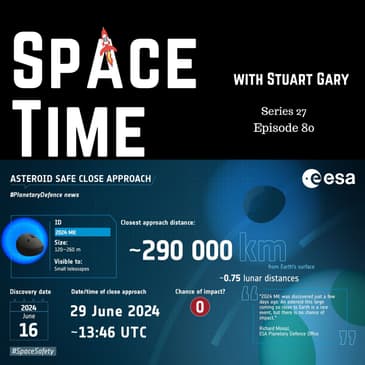
First, the European Space Agency reports a rare occurrence of two large asteroids swooping past Earth within 42 hours. One of these, 2024 MK, was only discovered two weeks before its close encounter, highlighting the need for improved detection of potentially hazardous near-Earth objects (NEOs). We delve into the details of these celestial visitors and their implications for planetary defense.
Next, we explore the challenges and solutions for sustaining human life on Mars. Scientists at Utah State University are working on a NASA-funded project to develop self-sustainability strategies for future Mars missions. Discover how researchers are optimizing food production and plant-based therapeutics to support long-term habitation on the Red Planet.
Finally, we look at how astronauts maintain fitness in microgravity and how similar workouts can be practiced on Earth. Researchers have found innovative ways to recreate Earth-like forces using centrifugal force, providing insights into maintaining physical health during space missions.
Follow our cosmic conversations on X @stuartgary, Instagram, YouTube, and Facebook. Join us as we unravel the mysteries of the universe, one episode at a time.
Sponsor Offer: This episode is proudly supported by NordPass. Secure your digital journey across the cosmos with a password manager you can trust. Find your stellar security solution at https://www.bitesz.com/nordpass.
Listen to SpaceTime on your favourite podcast app including Apple Podcasts, Spotify, YouTube Music, or wherever you get your podcasts.
Support SpaceTime: Become a supporter of SpaceTime: https://www.bitesz.com/show/spacetime/support/
www.bitesz.com
[00:00:00] This is SpaceTime Series 27 Episode 80 for broadcast on the 3rd of June 2024. Coming up on SpaceTime… Two asteroids swoop past the Earth. New research to work out how the first people on the Red Planet, Mars, will live. And how to practice a space workout when you're on planet Earth.
[00:00:20] All that and more coming up on SpaceTime. Welcome to SpaceTime with Stuart Gary. The European Space Agency has reported two large asteroids swooping past the Earth just 42 hours apart. The rare occurrence didn't pose a risk to the planet, but one of them, 2024MK, was only
[00:00:56] discovered two weeks before its close encounter with the Earth. That discovery clearly highlights the need to continue improving Earth's ability to detect potentially hazardous near-Earth objects, in our cosmic neighborhood. Asteroid 2024MK was somewhere between 120 and 260 metres wide. It zoomed past the Earth on
[00:01:18] June 29th, coming to within 290,000 kilometres of the planet's surface. That's a close call in astronomical terms. There was never any risk of the asteroid actually impacting the Earth, however an asteroid of that size would have caused considerable damage if it did hit.
[00:01:35] The second celestial visitor was the massive 2310 metre wide asteroid 415029 2011UL21, which is a giant, larger than 99% of all known near-Earth asteroids. Now luckily its Earth flyby was at a safe distance, some 17 times further away than
[00:01:55] the orbit of the Moon. This asteroid's orbit around the Sun is steeply inclined, which is unusual for such a large object. Normally most large objects in our solar system, including planets and asteroids, tend to orbit the Sun in or close to the equatorial
[00:02:11] plane or ecliptic. This monster's strange orbit could be the result of gravitational interactions with a large planet like Jupiter. See, Jupiter can often deflect previously safe asteroids inwards towards the Earth, so it's important for astronomers to better understand the process.
[00:02:27] In this case, we know the asteroid has an 11 to 34 resonance with the Earth. That means it completes 11 orbits around the Sun in exactly the same amount of time it takes the Earth to complete 34 orbits. Both these celestial visitors encountered with the Earth just happened
[00:02:43] to coincide with World Asteroid Day. The United Nations-endorsed World Asteroid Day commemorates the largest observed asteroid strike in recorded history. That's the 1908 airburst above Tunguska in Siberia. It was on the morning of June 30, 1908 that a massive explosion with the force of a 5
[00:03:04] megaton thermonuclear bomb, that's the equivalent of a thousand Hiroshima atomic bombs, smashed into northern Siberia. The blast was so powerful it lit up the night sky in London with an orange glow a third of the way around the planet, allowing Brits to read their evening newspapers without
[00:03:22] turning on the lights. Seismographs a thousand kilometres away also recorded the event, sparking intense scientific interest. Researchers were able to triangulate the blast to the remote Tunguska River region of northern Siberia. But the place is so isolated it took 19 years for a
[00:03:40] scientific expedition to reach it. What greeted the team when they arrived was a scene of utter devastation. The entire landscape had been flattened. The massive explosion shattered some 80 million trees over an area of more than 2,000 square kilometres. Mature trees were snapped off
[00:04:00] at their bases like mat sticks, covering the ground for hundreds of kilometres, and all were pointing away from the epicentre thought to be at the location of what these days is Lake Chico.
[00:04:11] The locals who witnessed the blast described a column of blue light that moved across the sky in the cool summer's morning air, and that was followed by a sudden tremendous explosion. Now both the explosion and the eyewitness accounts were all consistent with an asteroid impact, but mysteriously
[00:04:29] no crater was ever found. And that led scientists to speculate that this asteroid probably airburst before reaching the planet's surface. The idea of an airburst was also consistent with one very unusual characteristic of the impact site. All the flattened trees pointed away from the blast zone,
[00:04:47] all that is except those at ground zero. They remained upright. Computer simulations in the years since have supported the idea of an airburst explosion, probably caused by a meteor between 1 and 200 metres across. Now if it was a meteor, it probably came from the beta Taurids meteor shower,
[00:05:06] a debris trail left behind by the comet 2P Enki which the Earth passes through every June and October. Enki itself is thought to be a piece of a larger comet that probably broke apart between 20,000 and 30,000 years ago following numerous interactions with the powerful gravitational
[00:05:23] field of Jupiter. Now as their name suggests, the Taurids meteor shower radiant, that is the apparent point of origin, lies in the constellation of Taurus the Bull. Generally speaking, the Taurids meteors are made up of larger more massive material than most meteor showers. Think of
[00:05:39] pebbles instead of dust grains. That's because as well as the usual debris produced by comets as they de-gas and spluttering fragments into space from evaporating volatile materials, Enki is also encountering gravitational tidal forces from Earth and other planets causing larger chunks to break
[00:05:56] off. And all this makes the Taurid stream of material the largest in the inner solar system. Since the meteor stream is rather spread out in space, Earth takes several weeks to pass through it causing an extended period of meteor activity compared with a much smaller periods of activity
[00:06:13] in other meteor showers. Included in the Taurid stream is a denser flow of gravelly meteoroids called the Taurid swarm, thought to be a ribbon of rocks roughly 75 million by 150 million kilometers across and shepherded together by Jupiter's gravity. Occasionally Earth passes through the
[00:06:32] larger meteoroids in the denser Taurid swarm and it's thought that it was one of these larger chunks in the Taurid swarm that may have caused the infamous Tunguska event. That hypothesis has been supported by an examination of mineral debris trapped in peat from the blast area in Siberia.
[00:06:49] The debris was collected in the 1970s and 80s and scientists using high resolution imaging and spectroscopy identified polycrystalline aggregates of carbon minerals diamond, lonsdalite and graphite. And we know that nanometer-sized particles of lonsdalite formed together with diamond and
[00:07:07] graphite particles in carbon-rich material that's been suddenly hit by a shock wave such as that generated by a meteor impact. Scientists also found iron nickel alloys trolite and tainite together with tiny inclusions of iron sulfides all of which are often found in meteorites.
[00:07:24] So the meteor composition found in the Tunguska peat appears to be the microscopic vestiges of the largest meteor impact in recorded history and very similar to that found in the Canyon Diablo meteorite which produced the famous Barringer Impact crater in Arizona better known as Meteor
[00:07:42] Crater. However there's still a problem with all this. See at Tunguska there's still no major debris from an air burst and that's unusual because when a 20 meter wide meteor air burst in the Siberian skies above Chelyabinsk back in 2013, fragments from the space rock were found scattered across
[00:07:59] a wide area of the landscape and in a nearby lake. But other than the microscopic sized iron nickel grains no fragments of the Tunguska meteor have ever been found. One hypothesis which was reported in the monthly notices of the Royal Astronomical Society argues that there were no meteorite
[00:08:16] fragments because the asteroid didn't fragment after all. Instead it simply glanced off the Earth's atmosphere. And while that might sound fantastic, the simple fact is meteors have been known to skip across the atmosphere. One example being the giant daylight fireball caused by a
[00:08:33] space rock the size of a bus glancing off the upper atmosphere above Utah and Wyoming back in 1972. Scientists used computer modeling to explore several different scenarios looking at different sized meteors traveling at different angles and velocities. They found that an iron meteoroid about
[00:08:50] 200 meters across coming to within 10 kilometers of the Earth's surface at a shallow angle would have remained largely unscathed and continue orbiting the Sun. They say the rapid compression of the NE the asteroid would be enough to create the blast region observed. Overall Tunguska
[00:09:07] represents a lucky escape for Europe. It happened just a short rotation of the Earth away from affecting the continent's most heavily populated regions. Over the last two decades NASA and ESA have been performing detection and analysis of potentially hazardous NEOs. Current estimates
[00:09:26] suggest there could be more than 5 million NEOs out there larger than 20 meters in size. That's the threshold above which an impact could cause damage on the ground. Right now ESA's planetary defense office is carrying out a number of projects dedicated to improving astronomers
[00:09:41] ability to detect, track and mitigate potentially hazardous asteroids. For example, launching later this year will be ESA's HERA mission. That's part of the world's first test of asteroid deflection. As we mentioned in last week's show, HERA will perform a detailed post-impact survey of the
[00:09:58] asteroid Dimorphos. Dimorphos was impacted by NASA's DART mission back in September 2022. The impact of DART successfully changed Dimorphos' orbit around its host asteroid Didymos, shortening it by 32 minutes. HERA will study the impact site and surrounding areas, turning the experiment into a well-understood and repeatable planetary defense technique.
[00:10:22] ESA is also developing a network of insect-inspired fly-eye telescopes that'll use their uniquely wide field of view to automatically scan the entire skies every night looking for new potentially hazardous near-Earth asteroids. And ESA's future NEOMES satellite will be located
[00:10:39] between the Earth and the Sun. It'll use infrared sensors to spot asteroids approaching the planet from regions of the sky which can't normally be seen from the ground as they're obscured by the glare of the sun. Then there's ESA's Fireball camera in Spain, which captured a stunning meteor
[00:10:56] during the night of May the 18th and 19th this year. That was thought to have been a small piece of a comet which flew over Spain and Portugal, traveling at roughly 162,000 kilometers per hour
[00:11:07] before burning up over the Atlantic Ocean. And just a couple of weeks later, on June the 6th, the Catalina All-Sky Survey in Arizona also discovered a small asteroid about four meters in size which triggered an alert from ESA's Imminent Impact Monitoring System, MEARCAT.
[00:11:24] Likely that alert was not for an impact but for a very close call. And just a few hours later, the object flew over the Catalina Sky Survey telescopes at a distance of just 1,750 kilometers, making it only the second closest pass ever of a known non-impacting asteroid.
[00:11:44] This is Space Time. Still to come, how the first people living on Mars will survive, and practicing a space workout here on Earth. All that and more still to come on Space Time.
[00:11:58] When the first humans travel to Mars in the next decade or so, they're simply not going to be able to take all the food they'll need with them. See, a trip to the Red Planet will take at least six
[00:12:23] months each way. Then there's the problem of how long do you stay? Do you spend all that time traveling for just a week or two on the Red Planet's surface before heading back while the orbital
[00:12:34] alignment still allows a quick return trip? Or do you commit yourself to a much longer two-year habitation on Mars, waiting until the next Earth-Mars planetary alignment arrives? Either way, it's still going to take an awful lot of supplies, enough to sustain a crew for either
[00:12:51] 12 months or three years. While most will be selling supply missions in advance, self-sufficiency far away from Earth will still be a key part of any strategy. See, going to Mars isn't like a quick
[00:13:03] trip to the International Space Station which can be reached in just a few hours with fresh supplies. Even the manned journeys to the Moon can be resupplied in just three days. But the first humans to travel to the Red Planet will involve a totally different type of space
[00:13:19] flight. Right now, Utah State University scientists Bruce Bugbee and Lance Seafelt are working on a five-year NASA-funded multi-institutional project exploring self-sustainability on missions to Mars and beyond. Botanist Bugbee and biochemist Seafelt are among the principal investigators
[00:13:37] working on QUBES, the Center for Utilization of Biological Engineering in Space. QUBES is developing the supporting biotechnology needed for deep space exploration. It's looking to optimize food and plant-based therapeutics in space as well as to enable the production of biomaterials
[00:13:54] and energy. Seafelt says getting supplies from the Earth to Mars is too slow and too costly. Because of this, Mars explorers will need to generate their own food, their own pharmaceuticals and a lot of their own infrastructure. He says as part of that effort, Martian greenhouses will
[00:14:12] need to be constructed, most likely underground, to withstand the planet's harsh environment. So QUBES researchers are working on ways to supply growth chambers with sunlight and nutrients. Fellow researcher Bugbee says the team are also working to find out which kinds of plants,
[00:14:27] including rice, lettuce, potatoes and possibly soybeans, can be successfully grown on the Red Planet and will be capable of providing a nutritionally sustaining diet. This report from Utah State University. Three, two, one, boosters in ignition and liftoff of Artemis 1.
[00:14:47] We rise together back to the moon and beyond. Humanity is headed to Mars. NASA's Artemis missions, currently ongoing and in process, have the express goal of not just revisiting the moon
[00:15:00] but to learn how to live and work on another world as we prepare for human missions to the Red Planet. But back here on Earth, USU is working on a NASA grant to learn how to grow plants for these
[00:15:10] missions. Even with our greatest technology at this point, that transit to Mars is still going to be a year, a year plus. We can't necessarily take enough food and have it last for that long,
[00:15:21] for that trip to Mars, whatever we do on Mars and that transit path. So NASA tasked NOAA, along with Bruce Bugbee, Lance Seedfeld and other graduate and PhD students in figuring out how we could
[00:15:33] grow plants like lettuces with what's available on Mars. Mars has nitrogen in the atmosphere. Plenty of nitrogen to grow plants for hundreds of people for a hundred years. We just have to fix
[00:15:49] that nitrogen in a bioavailable form for the plants. To do this, Lance worked with his research team to identify a microbe that would do just that. Capture the atmospheric nitrogen and make it
[00:16:01] available for our spacefaring plants. If we take the bacteria and we feed them the atmosphere from Mars and we feed them light, they will then capture that gas, that atmosphere again too and turn it
[00:16:14] into what's called the fixed form of nitrogen. And that fixed form of nitrogen then is part of the biomass and so what it ends up looking like is like peanut butter. It's a dry sort of wet-ish dry paste
[00:16:24] that you could then use that mobilize that to feed the plants and hydroponics. That means that the astronauts would only need to bring a starter kit of sorts and then the whole system is designed to
[00:16:34] be recycled and recultivated time and time again. And this has applications here on Earth as well. So we also, plants need nitrogen on Earth of course as well and we end up wasting a lot of
[00:16:46] nitrogen from those fertilizers. We want to be able to use this research to help producers, to help growers maintain their nitrogen stores in that soil out in their fields to produce the most efficient plants that they can. And in that report we heard from Noah Langenfeld from the
[00:17:07] Crop Physiologist Laboratory, Bruce Bugbee, Director of the Crop Physiologist Laboratory and Chemistry and Biology Professor Lance Seafelt. All are with Utah State University. This is Space Time. Still to come, practicing a space workout on Earth and later in the science
[00:17:26] report, a new study has found that alcohol is responsible for some 2.6 million deaths annually. All that and more still to come on Space Time. One of the big problems of working in microgravity
[00:17:55] is the need to keep fit. Muscles tend to lose mass and bones tend to lose density in the weightless conditions of space. And so astronauts spend a great deal of their time working out just to keep in good shape. And while an out-of-this-world workout can keep
[00:18:11] astronauts fit on the space station, it seems you too can practice that here on Earth. That's as long as you've got access to a wall of death and some bungee cord. Walls of death are those
[00:18:22] semi-spherical bowls in which motorcycle riders like to travel around in their tests of bravery. Researchers ran horizontally around the motorcyclist's wall of death whilst being held in place by bungee cords in order to mimic the moon's gravity. Running this way allowed
[00:18:38] centrifugal force to simulate the higher levels of gravity. The new findings reported in the Journal of the Royal Society Open Science suggest that it would be possible to recreate Earth-like forces needed to maintain fitness in space. This is Space Time. And time now to take another brief
[00:19:12] look at some of the other stories making news in science this week with The Science Report. A new study by the World Health Organization claims that alcohol is responsible for some 2.6 million deaths each year. The report found that 7% of the world's population aged 15 years and over
[00:19:30] have an alcohol use disorder, and problematic alcohol and other drug use continues to have a major impact on health and development around the planet. The report outlines various strategies to reduce the use and misuse of drugs and alcohol in order to meet upcoming health targets, including
[00:19:47] strengthening healthcare systems, training health professionals, and increasing awareness of the risks of drug and alcohol consumption. Scientists tracing the family Tree of Solanum plant, that's a group in the nightshade family which includes red tomatoes, purple eggplants and
[00:20:03] potatoes, have found that while they're incredibly diverse in colours and sizes, their evolution actually follows some common guidelines. A report in the journal New Physiologist by researchers at Penn State University found that the size and colour of these fruits all evolved
[00:20:20] together, and that fruit-eating animals weren't the primary drivers of these fruits' evolution as had been previously thought. The findings may provide fresh insights into breeding these agriculturally important plants with new more desirable traits. There are some 1300 known species of the genus
[00:20:37] Solanum that makes it one of the most popular and diverse plant genera in the world. The authors collected samples from across the planet, including wild plants from Brazil, Peru and Puerto Rico, as well as many other specimens from botanical gardens in order to sequence their genes from RNA.
[00:20:54] They ultimately compared the sequences of some 1786 genes from a total of 247 species in order to reconstruct the family tree. The authors found that the colour and size of Solanum fruits was fairly conserved over evolutionary history, meaning that closely related species tend to have similar
[00:21:13] fruits. And the evolution of fruit colour and size also correlated with changes in one trait often corresponding to changes in the other. That led to fruits of certain colours ending up bigger than fruits of other colours. The results suggest that physiological and molecular mechanisms may play an
[00:21:31] important role in keeping the evolution of fruit colour and size tied together. New research presented to the Conference of the Federation of European Neuroscience Societies Forum claims that while people aren't very good at distinguishing between human voices and those
[00:21:48] generated by artificial intelligence, imaging people's brains showed that those little grey cells react quite differently when they hear a voice generated by AI compared to one generated by a real person. The authors played clips of both human and AI-generated voices expressing
[00:22:04] different emotions to 43 people. They found participants were only able to correctly identify human and AI voices around half the time. But by scanning their brains, scientists found that human voices more often showed up in areas of the brain associated with memory and empathy,
[00:22:22] and the AI voices elicited responses from the error detection and attention regulation areas of the brain. Samsung have announced the launch of their Unpacked showcase for July the 10th. The event, which will be Samsung's biggest in years, will feature loads of new AI-powered tech.
[00:22:41] With the details, we're joined by technology editor Alex Sahara-Vroid from TechAdvice.life. Yes, Samsung is launching its Galaxy Unpacked event in Paris July 10th 2024. They're going to have the new 6th generation Fold and Flip devices, known as the Z series, full of AI,
[00:22:58] and they should have new watches and I'm sure they'll have new tablets. So it'll be the ecosystem of devices infused by AI. They're saying get ready for a world of possibilities as we enter a new
[00:23:08] phase of mobile AI. So they clearly want to get Apple and Google as best as, you know, Microsoft as well as best they can. So we'll have more on that when it launches. Also Google have got another
[00:23:17] announcement. Yeah, well, on the same day as Samsung's announcement, Google said that they're launching their Made by Google event. They'll launch the Pixel 9 and 9 Pro and most likely their 3rd generation watch and probably a new tablet as well. And it'll have all of Android
[00:23:29] 15 plus the new AI enhancements that will be obviously even better than what they launched beforehand informed by what OpenAI and Apple have launched in their most recent events. And they're doing it on August the 13th in the US. So that's two months earlier than when they normally
[00:23:42] would normally it's a month after the new iPhone launches. So Google wants to capture the heart, minds and wallets of consumers as does Samsung and as does Apple. And SpaceX hasn't been left out
[00:23:53] either. Elon Musk has launched his new portable Starlink dish. Well, it's a Squish but yeah. Yes, it's called the Starlink Mini and it's being offered to existing Starlink users in the US and Canada for US $599. Now it weighs 1.13 kilograms, so it's 50% lighter than the standard
[00:24:10] dish and it's got little kickstands for the dish and it can fit into a backpack. It's got a Wi-Fi router as well. So you can set it up anywhere that you've got line of sight effectively. Now it's
[00:24:20] $150 per month with a 50 gigabyte speed cap dollar, I think dollar a gigabyte thereafter. The download rate is 100 and I think it's 25 megabits up but in any case, it's broadband on the go and not available in Australia yet but it is ubiquitous communications from just about anywhere.
[00:24:38] That's Alex Zaharov-Royd from TechAdvice.life. And that's the show for now. Space Time is available every Monday, Wednesday and Friday through Apple Podcasts iTunes, Stitcher, Google Podcasts, Pocket Casts, Spotify, Acast, Amazon Music, Bytes.com, YouTube, and from Spacetime with Stuart Garry.com.
[00:25:18] Space Time is also broadcast through the National Science Foundation on Science Zone Radio and on both iHeart Radio and TuneIn Radio. And you can help to support our show by visiting the Space Time store for a range of promotional merchandising goodies, or by becoming a Space
[00:25:34] Time Patron which gives you access to triple episode commercial free versions of the show, as well as lots of bonus audio content which doesn't go to air, access to our exclusive Facebook group and other rewards. Just go to Spacetimewithstuartgarry.com for full details.
[00:25:50] And if you want more Space Time, please check out our blog where you'll find all the stuff we couldn't fit in the show, as well as heaps of images, news stories, loads of videos and things
[00:26:00] on the web I find interesting or amusing. Just go to spacetimewithstuartgarry.tumblr.com. That's all one word and that's Tumblr without the E. You can also follow us through at Stuart Garry on Twitter, at Spacetime with Stuart Garry on Instagram, through our Space
[00:26:17] Time YouTube channel and on Facebook just go to facebook.com forward slash spacetimewithstuartgarry. You've been listening to Space Time with Stuart Garry. This has been another quality podcast production from Bytes.com.