
Next, a new study reveals that Mars is hit by meteors on a daily basis. Using seismic data from NASA's Mars InSight lander, scientists have determined that between 280 and 360 meteors strike the Red Planet each year, forming impact craters greater than eight meters across. This discovery offers new insights into Martian impact rates and the planet's geological history.
Finally, claims of alien technology discovered on the seafloor near Australia have been dismissed. Harvard astronomer Avi Loeb's controversial expedition retrieved tiny iron spheres, but further analysis showed no evidence of interstellar origin. The scientific community remains skeptical, emphasizing the need for extraordinary evidence to support extraordinary claims.
Follow our cosmic conversations on X @stuartgary, Instagram, YouTube, and Facebook. Join us as we unravel the mysteries of the universe, one episode at a time.
Sponsor Offer:This episode is proudly supported by NordVPN. Secure your digital journey across the cosmos with a VPN service you can trust. Find your stellar security solution at https://www.bitesz.com/nordvpn.Listen to SpaceTime on your favourite podcast app including Apple Podcasts, Spotify, YouTube Music, or wherever you get your podcasts.
www.spacetimewithstuartgary.com
www.bitesz.com
Become a supporter of this podcast: https://www.spreaker.com/podcast/spacetime-with-stuart-gary--2458531/support.
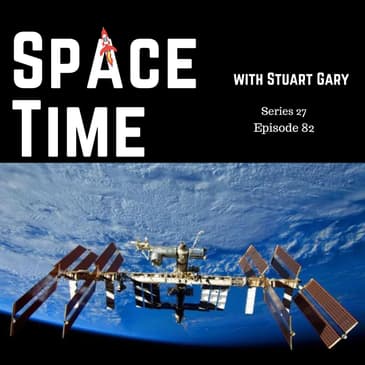
[00:00:00] This is SpaceTime Series 27 Episode 82 for broadcast on the 8th of July 2024. Coming up on SpaceTime, a space debris emergency aboard the International Space Station, a new study shows that Mars is hit by meteors on a daily basis,
[00:00:17] and claims of alien technology discovered on the sea floor have been dismissed. All that and more coming up on SpaceTime. Welcome to SpaceTime with Stuart Gary. The crew aboard the International Space Station were ordered to take shelter in their spacecraft
[00:00:50] and prepare for an emergency after ground-based radar detected a large cloud of debris moving towards the orbiting outpost. The debris cloud was caused by the breakup of a six-ton disused Russian satellite flying at 355 km above the planet.
[00:01:07] The danger was detected by the new Western Australian Space Radar Tracking Station operated by situational awareness firm LeoLabs. Located near Coley, the facility which was opened in January last year, is the company's second space surveillance station in the Southern Hemisphere,
[00:01:23] the other being on the New Zealand South Island. LeoLabs has four other sites located north of the equator. The Coley complex includes two S-band radar arrays designed to track and monitor medium to high inclination objects in low Earth orbit.
[00:01:38] NASA says the precautionary shelter measure on the space station lasted around an hour, with the crew remaining in their docked spacecraft ready to isolate the capsules from the space station by sealing the hatches and undertaking an emergency departure in the event of a damaging collision.
[00:01:54] The capsules act as lifeboats for the crew in case of an emergency such as a collision causing the loss of pressure or damage to the life support modules or other critical components.
[00:02:04] Once the danger was passed, the crew aboard the space station were allowed to resume their normal activities. NASA says LeoLabs will continue to monitor the debris cloud and provide more details in the near future.
[00:02:16] LeoLabs tracks more than 20,000 objects in low Earth orbit using AI software to process millions of measurements. And of course it's by no means the first space junk warning affecting the International Space Station.
[00:02:28] In fact, space junk has become such a problem, crew aboard the station have to take emergency or evasive actions at least once or twice a year. So bad now has the problem become. This is Space Time.
[00:02:40] Still to come, a new study shows that Mars is being hit by meteors on a daily basis and claims of alien technology discovered on the sea floor near Australia have now been dismissed. All that and more still to come on Space Time.
[00:02:57] Scientists have been surprised to find that the red planet Mars is being bombarded by meteors on a daily basis. The new global meteor impact count is based on seismic data from NASA's Mars Insight Lander.
[00:03:26] The findings indicate that between 280 and 360 meteors strike the red planet each year, forming impact craters greater than 8 metres across. One of the study's authors, Geraldine Zenhausen from ETH Zurich, says this rate of impact is about five times higher than the number estimated from orbital imagery alone.
[00:03:45] And it shows that seismology is an excellent tool for measuring Martian impact rates. The seismometer data from InSight had previously shown that six seismic events recorded near the Lander were eventually identified as meteor impacts,
[00:03:58] a process enabled by the recording of a specific acoustic atmospheric signal generated as the meteors entered the Martian atmosphere. Now, Zenhausen and colleagues have determined that these six seismic events belong to a much larger group of Mars quakes known as Very High Frequency or VF events.
[00:04:17] The key was the fact that the source process for these quakes occur much faster than for a tectonic Mars quake of similar size.
[00:04:24] Where a normal magnitude 3 quake on Mars takes several seconds, an impact-generated event of the same size only takes 0.2 seconds or even less due to the hypervelocity of the collision.
[00:04:36] So by analysing Mars quake spectra, the authors identified a further 80 Mars quakes which weren't Mars quakes at all but rather were caused by meteor strikes.
[00:04:46] Their research began back in December 2021. That was just a year before all the dust that accumulated on the solar panels of the InSight Lander brought the mission to an end.
[00:04:55] An important factor was a distant quake recorded by the seismometer which reverberated a broadband seismic signal throughout the planet. Remote sensing associated this particular quake with the appearance of a new 150-metre wide crater.
[00:05:10] To confirm their suspicions, the InSight team partnered with the Mars Reconnaissance Orbiter Group to search for other fresh craters which would match the timing and location of other seismic events that had been detected by InSight.
[00:05:22] And the detective work paid off, finding a second fresh crater over 100 metres in diameter. So at this point we knew there was a connection. However, smaller craters formed when something say the size of a basketball strikes the planet remained elusive though they should be far more common.
[00:05:39] Now, by looking through the data for these special high frequency quakes, numerous smaller impact events have been identified. Rocks falling from space strike planets and other celestial bodies all the time. Just look at the Moon.
[00:05:52] And even here on Earth it's estimated approximately 17,000 meteors fall to Earth each year. Most of them burn up in the atmosphere and unless they streak across the atmosphere at night they're rarely noticed.
[00:06:06] Now, while most meteors disintegrate as they enter Earth's atmosphere, on Mars the atmosphere is 100 times thinner and so that leaves the red planet's surface exposed to more frequent meteor impacts.
[00:06:17] Until now, trying to work out exactly how many impacts you're likely to get on a given celestial body has been difficult. The best place to look has always been the Moon. However, trying to extrapolate those estimates to Mars has proved challenging.
[00:06:32] See, scientists had to account for the stronger gravitational pull of Mars and its closer proximity to the main asteroid belt, both of which would mean more meteorites hit the red planet.
[00:06:42] On the other hand, regular sandstorms mean craters on Mars are less well preserved than those on the Moon. And therefore, art is easy to identify through orbital imagery.
[00:06:52] But when a meteoroid strikes a planet, the seismic waves generated by the impact travel through the crust and mantle and can be picked up by seismometers. That's where InSight came in. The authors then estimated crater diameters from the magnitude of all the VF Marsquakes and their distances
[00:07:09] and used that to calculate how many craters would have formed around the InSight lander over the course of a typical year. They then extrapolated that data to estimate the number of impacts that would happen annually across the entire Martian surface.
[00:07:22] While new craters can best be seen on flat and dusty terrain where they stand out, this type of terrain covers less than half the Martian surface. However, the sensitivity of the InSight seismometer could hear every single impact within the lander's range.
[00:07:37] Impact rate is important because it helps determine the age of a body's surface. It's a lot like the lines and wrinkles on your face. The size and density of impact craters on the surface of a celestial body provides clues about the age of different regions of that body.
[00:07:53] And that in turn can give you clues as to what that part of the surface is made from. Put simply, the less craters, the younger the surface region is. Venus, for example, has almost no visible craters. That's because its surface is constantly being reworked by volcanism.
[00:08:09] The Earth also has very few visible impact craters because of erosion and weathering. On the other hand, Mercury and the Moon, with their ancient surfaces that have remained largely unchanged, are all heavily cratered.
[00:08:20] Mars falls somewhere in between these samples, with some old and some very young regions that can be identified by the number of craters present. The new data is showing scientists that an impact crater about 8 metres across happens somewhere on the surface of Mars nearly every day.
[00:08:37] And larger 30 metre craters would occur at least once a month. Since hypervelocity impacts cause blast zones that are easily 100 times larger than the diameter of the crater, knowing the exact number of impacts is important for the safety of both spacecraft and future manned missions to the Red Planet.
[00:08:54] This is space time. Still to come, claims of alien technology discovered on the sea floor north of Australia have been dismissed, and later in the Science Report, a new study shows Australia's life expectancy has fallen for the first time since the mid-1990s.
[00:09:11] All that and more still to come on Space Time. Controversial claims that tiny spheres found on the sea floor near Australia could be evidence of ancient alien technology have been dismissed by scientists.
[00:09:39] Back in 2014, a meteor crashed into the Earth in the tropical waters of the South Pacific Ocean, north of Australia. Little was known about the impact event until Harvard astronomer R.V. Loeb took an interest. He would eventually launch an expedition to the site.
[00:09:56] Problem is, finding ground zero was going to be difficult. Not just because it was underwater, but also because despite several requests by scientists, the Australian government has repeatedly refused to fund an early warning near-Earth asteroid space watch program,
[00:10:12] one which would scan local skies, looking for potentially hazardous near-Earth asteroids which could be on a collision course with the planet. Similar programs are operated by the United States and Europe, searching the northern hemisphere skies for near-Earth objects.
[00:10:26] And NASA used to fund such a project at the Australian National University's Siding Spring Observatory through the University of Arizona. But when the Obama administration cut funding, the money ran out and the project was aborted, after requests for Canberra to continue the funding fell on deaf ears.
[00:10:44] So, on January 8th, 2014, when an asteroid slammed into the Earth somewhere north of Australia, little was really known about the event. We knew it happened because the United States Ballistic Missile Detection System
[00:10:57] identified an object slamming into the Earth's atmosphere in a region of the Pacific north of Australia and near Papua New Guinea. But as to details of the exact impact site, the velocity of the object or the trajectory, that couldn't be accurately measured.
[00:11:11] Now based on the limited data available, Arvi Loeb and colleagues determined that the impact, whatever it was, was definitely too fast to be a missile. In fact, it was too fast to be any solar system bound object, ruling out comets and asteroids.
[00:11:25] Loeb says it was moving faster than some 95% of all the stars in the vicinity of the Sun, and therefore it was more likely to be an interstellar visitor. He says based on his calculations, the meteor would have exploded into a fireball about 10km above sea level.
[00:11:41] A reasonable assumption based on the information we have. He also claimed the object must have been composed of material 10 times stronger than any other known space rock. That's why it was able to travel so deeply into the atmosphere before it finally airburst.
[00:11:55] Now based on that information, Loeb then claimed there were two possibilities to explain the observations. Either it originated from some very unusual source, something very different from what we find in our solar system, or alternatively, and this is where he makes a long reach, it was artificially made,
[00:12:12] produced by some alien civilization beyond the solar system which collided with the Earth simply by chance. Now these sort of claims aren't new for RV Loeb. He's been known to go out on a limb before. In fact in 2019, he suggested that the cigar-shaped interstellar asteroid Amauamua,
[00:12:30] which passed through the solar system in late 2017 and early 2018, might have actually been a probe sent by an alien civilization after it appeared to suddenly change course for no apparent reason. However, many of his colleagues in the scientific community have challenged that claim.
[00:12:47] Meanwhile, Loeb had already moved on to his next project. He identified a probable search area for the 2014 impactor and then undertook his own expedition last year to see what's there.
[00:12:58] He was able to determine that it exploded over the sea some 84 km north of Manus Island in Papua New Guinea. The exact impact point was along a narrow band 11 km long and a km across.
[00:13:12] He hoped to find some fragments of the air-bursted object, whatever it was, on the sea floor some 2 km below the surface. So he hired a trawler to act as a research vessel and over the course of two weeks,
[00:13:24] he undertook 26 sweeps of the area using a magnetic sled designed to retrieve iron particles by skimming across the seabed. They eventually retrieved mostly normal seabed material, things like iron-containing volcanic ash. But Loeb and colleagues also found some 722 tiny iron spheres, each just a millimetre across,
[00:13:45] some of which he believes would have come from the impactor because they were so decidedly unusual, being extremely rich in beryllium, lanthanum and uranium. The lanthanum and uranium counts were some 500 times more plentiful than what's usually found in terrestrial rocks.
[00:14:01] And Loeb says that indicates a source very unlike anything found in our solar system. And as for the beryllium levels, well they were also hundreds of times more plentiful than what you'd find on Earth.
[00:14:12] Loeb says that's even more important because beryllium, the second lightest metal on the periodic table, is produced by a process called spallation, where it's chipped out of the nuclei of heavier elements by the impact of high-energy cosmic rays.
[00:14:26] Loeb says that's a flag of interstellar travel because it can occur at such high levels in our solar system where the solar wind helps protect the Earth from the bulk of the radiation which causes it.
[00:14:35] He says even the iron in these spherules were unusual with isotope ratios unlike anything seen in the solar system. Consequently, he says, it must have clearly come from beyond. The problem is, Loeb's senses were limited in their precision and they were open to measurement error propagation.
[00:14:53] So the extrapolations reached and the conclusions drawn were all open to some considerable level of interpretation. Professor Phil Bland from Curtin University says while planet Earth does occasionally get hit by meteors containing material from beyond our solar system,
[00:15:08] an analysis of the spherules from this debris shows there's nothing interstellar about their chemical makeup or composition. There's a number of aspects to this that are really, really interesting and as a scientist you don't agree with everything someone else says so there's other stuff that I'll disagree with.
[00:15:29] We live at a really, really interesting point in history where there's a good chance that even in my lifetime, I'm kind of getting, you know, 10 years I'll be retired, but in the springtime,
[00:15:43] we will discover, we will have an inkling of whether we're alone in the universe or whether we're not. If we go to all those possible sites where life could have evolved in the solar system and we don't find anything,
[00:15:59] and if telescopes like James Webb are able to resolve the spectra of terrestrial-sized planets in habitable zones around other stars and we don't find any other biosphere, it'll start to feel a little bit lonely.
[00:16:17] But what is gorgeous is that we're actually at a time when that can happen. We could wake up one morning and the news could be that James Webb has found an atmosphere that basically requires a biosphere to generate it,
[00:16:32] which is crazy to live at a time when that can happen. Now, the stuff that Avi Loeb got interested in, the interstellar asteroid that moved through the solar system several years ago, Umauamaua, and there were a number of characteristics about that asteroid that are really odd,
[00:16:48] that require explanation. And it's got a really, like, it's very elongated, which is very peculiar for an asteroid. And we need explanations for these things. Now, I personally don't think that that was artificial, but it requires an explanation.
[00:17:06] And it's certainly the fact that the very first thing that we saw moving through the solar system from another planetary system is this very odd shape is fascinating.
[00:17:16] The big issue there was gases coming out of the thing that were causing it to change its direction of travel, contrary to the effects of gravity from the sun. And the influence of other large bodies nearby.
[00:17:29] That was, I think, put down to heat from its close encounter with the sun, causing these gases to escape and changing its direction. So I think it's, I mean, I think where I... It's not just the Yakovsky effect, but it's... It's not. No, absolutely.
[00:17:43] So I think where I would definitely agree with RV Loeb is that you should approach everything with an open mind.
[00:17:51] And if you are making observations that are, you're seeing things that are really odd, then follow that evidence, follow that data, and don't exclude options simply because it's kind of convenient to.
[00:18:04] I'm not going to say anyone did that, but I think that was his point initially, that you should include every possibility. If you're seeing an object that is very, you know, has a weird shape and is changing its direction of travel, that's strange.
[00:18:19] And so let's dive into that. Now, there are almost certainly explanations for that that don't require that to be an artificial object, but acknowledge the weirdness and then dive in and do your best to find those explanations. And I think that was initially, that was his point.
[00:18:38] Extraordinary claims need extraordinary evidence. They do, absolutely. But equally, if you have, you know, extraordinary evidence or an extraordinary observation, it requires you as a scientist to really stretch yourself to explain that.
[00:18:53] So I think there's certainly a number of aspects to that event, to the Umar-Umar event that are really fascinating.
[00:19:00] And closer to home, we've got the ongoing search for biological activity on Mars with the Curiosity and Perseverance rovers and soon a Mars sample return mission by the United States and the European Space Agency.
[00:19:13] The thing there that I find fascinating is if they do find evidence of past biological life on the red planet, that doesn't mean it formed there. That could be something that's come from Earth through panspermia on a meteorite, a bit of bacteria that survived the journey.
[00:19:28] Which would be fascinating, wouldn't it? Exactly.
[00:19:30] And if you could find like either extant life or if you could find life and basically, you know, some way of getting a sense that this was essentially kind of a separate, I don't want to say creation event because that's an unfortunate word to use, but that formed independently, then that would be really fascinating.
[00:19:49] But it's certainly a fact that the Earth and Mars have been swapping material for the, you know, for the entire history of our planet. We could be Martians or Martians could be us if they exist. Exactly.
[00:20:00] I think the more fascinating idea, concept is if we find life in the oceans of Enceladus or Europa because that's not likely to have come from Earth. That's not likely to be panspermia. That would indicate that life is ubiquitous. It can happen anywhere. Exactly. That would be astonishing.
[00:20:22] And, you know, like I say, it's fascinating. It's wonderful to kind of be at a time when there are missions planned to test some of these things, to go to some of these places where there are the conditions.
[00:20:34] What you can say is that there are the conditions now that if you put terrestrial bacteria there, they would probably thrive. And which also kind of puts a lot of requirements on us to send, like to sterilize any spacecraft that go there.
[00:20:49] That's why Cassini was made to burn up in Saturn's atmosphere and the Galileo probe did the same in Jupiter's atmosphere. Right. And that whole concept of kind of planetary protection has been a really big deal for NASA for decades.
[00:21:02] And it's, you know, they are always very, very careful about that. I think, yeah, absolutely, Stuart. I think, you know, the possibility of discovering life around in icy moons. Enceladus is a really interesting one because there's that plume of material coming out. Right.
[00:21:19] And so getting to an environment in Europa where you can actually test for biological signature is really hard. You've got to get through the ice crust. Enceladus, this material is being delivered into orbit.
[00:21:33] And so there's a potential to kind of have a flyby there and detectors there that could either analyze that material in situ or bring it back, which would be amazing.
[00:21:43] They're starting to detect what appear to be plumes, not as big as Enceladus, but nevertheless geysers in the atmosphere of Europa as well. Oh, seriously? That's incredible. That's wonderful. I didn't know about that. Thank you.
[00:21:57] They're not 100% sure, but we've done stories on a couple of papers that have suggested it. Wow. And Europa Clipper will certainly verify that. In fact, that's one of the instrument packages being put on Europa Clipper, just in case. That's fantastic. I didn't know about that. That's wonderful.
[00:22:13] That's launching in what, October? So that's only a couple of months. It's really, I was looking, I visited JPL and the High Bay where they're putting it together and I was able to see it. It was amazing.
[00:22:25] That's Professor Phil Bland from Curtin University and this is Space Time. And time now to take a brief look at some of the other stories making use in science this week with the Science Report.
[00:22:52] A new study warns that the popular diabetes and weight loss drug semaglutide, which is a key ingredient in products like Azempic and Wegovy, may be associated with an increased risk of an eye condition which causes vision loss.
[00:23:07] Non-arteric anterior ischemic optic neuropathy is a condition that typically causes sudden vision loss in one eye due to a loss of blood flow to the optic nerve, and people with diabetes are at a higher risk.
[00:23:19] The researchers used eye clinic patient data to identify 710 people treating type 2 diabetes and 979 people treating overweight or obesity either with semaglutide or an entirely different medication.
[00:23:34] Looking at non-arteric anterior ischemic optic neuropathy diagnoses, the authors found the risk of diabetes patients over the three years of the study was 8.9% for those on semaglutide and just 1.8% for those on another medication. And among the overweight and obese group, the risk was 6.7% compared to 0.8% respectively.
[00:23:56] Now these findings, which have been reported in the Journal of the American Medical Association, do not show that semaglutide causes this increased risk. But it does suggest that the link needs to be further researched.
[00:24:10] For the first time since the mid-1990s, Australia's average life expectancy rate has fallen. The findings by the Australian Institute of Health and Welfare's 2024 report suggest that a child born around 2020 to 2022 can now expect to live for an average of 81.2 years for men and 85.3 years for women.
[00:24:30] That's a reduction of 0.1 years in both cases. That means an Australian's average life expectancy at birth now is 83.73 years, placing the nation in 10th position, well behind Hong Kong on 85.83 years, Macau on 85.51, Japan on 84.95, Switzerland on 84.38, Singapore on 84.27, Italy on 84.2 years, South Korea 84.14, Spain 84.05 and Malta on 83.81.
[00:25:05] But Australia's not alone in suffering a drop in life expectancy. In fact, there have been greater declines in the United States from 78.9 to 76.4 years and in the United Kingdom from 81.3 to 80.4 years.
[00:25:21] The study also showed a growing majority of Australians, currently around 60%, are living with some sort of chronic illness, such as cardiovascular disease or cancer. And these contributed to some 90% of deaths between 2002 and 2022.
[00:25:37] In fact, chronic diseases were common causes of death among people aged over 45, while dementia was the most common cause of death for those aged over 85.
[00:25:46] COVID-19 was another major factor, being the third biggest cause of death in 2022 alone, the first time in over half a century that an infectious disease was in the top five leading causes of death in Australia.
[00:25:59] The World Health Organization says more than 7 million people have been killed by the COVID-19 coronavirus since it was first detected among workers at China's Wuhan Institute of Virology back in September 2019.
[00:26:12] However, the WHO estimates the true death toll is likely to be above 18 million, with some 775 million confirmed cases globally. Researchers may be on their way to solving one of the greatest problems in science. How to stop your beloved family pussycat from scratching up the furniture?
[00:26:32] The answer, they say, could be as simple as placing scratching posts in areas cats frequently pass or near their preferred resting spot. The findings, reported in the journal Frontiers of Veterinary Science, are based on surveys involving some 1,200 humans owned by cats. You know I'm right.
[00:26:49] Interestingly, the authors also found that having children as well as high levels of play and night-time activities all contribute to an excess in scratching. Cats described as aggressive or disruptive were also seen to appear to scratch more often.
[00:27:04] While scratching is a natural behaviour for cats and relieves stress, the authors say you can reduce unwanted scratching by using lots of scratching posts, as well as providing safe hiding places, high spots where cats can survey their kingdoms from,
[00:27:16] and short play sessions that mimic natural hunting scenarios, which would reduce stress and therefore the urge to scratch furniture. As you may have noticed in our Skeptics' Guide segments, we love to cover creepy listicles, especially those detailing the supernatural. The most haunted places and the deadliest locations.
[00:27:36] Now there's a new list that's just come out. This one claims to know the 30 scariest places on Earth. Tim Mendham from Australian Skeptics says it's not the first and it won't be the last list of its kind, and it does include lots of old favourites.
[00:27:51] There are a mass of videos out there, blogs, websites, whatever, which always talk about the scariest places on Earth. The top 10, the top 30. Yeah, we've covered the scariest places of water on Earth and the scariest houses and hotels and things like that.
[00:28:08] There's always scary hotels. And this particular one I was looking at recently has the top 30 scariest places on Earth, most of which aren't particularly scary.
[00:28:16] They might be a bit weird, but there's like the entrance to hell, which is basically a mine that went wrong with methane coming out and it's burning. This is the one in Turkmenistan. That's right. That's the one I think it is, yes.
[00:28:29] There's also one in New South Wales. There's a burning mountain up in New South Wales. Oh yeah, yeah. That's a coal mine up in the Hunter Valley that they never got to fire out. Yeah, there's coal mines and things that have been burned for hundreds of years.
[00:28:40] And so therefore, it's not particularly scary. It's a bit weird. This other thing is the 30 scariest places. There are certain ones that always crop up. There's the Stanley Hotel in America, which supposedly has a link with the book The Shining.
[00:28:52] It has no link with the film The Shining because that was filmed somewhere else. In Canada. Stephen King stayed there. The writer of The Shining stayed there for a while. He found it a bit spooky because they were the only guests there.
[00:29:02] So any hotel, large hotel, with me, or the only guests is a bit weird. But the hotel in The Shining is not the same hotel, so you get the film. But other things, there's a forest in Japan where a lot of people go to. Not a lot.
[00:29:13] Suicide forest? Suicide forest. And it's sort of like a place to go if you want to die. But when it goes, they die. Some do. It becomes famous for those that do. And that probably encourages others who have issues, obviously.
[00:29:27] But there's an island of dolls where people hang out dolls. There's a place in Lithuania which has a lot of crosses all over the place. Habits of people, traditions, if you like, might be a bit weird. Not necessarily scary.
[00:29:38] The one that comes in at number one on this list is Chernobyl. You can sort of understand that because if you see the sarcophagi that covers the number four nuclear reactor, that is scary to think what's under there and is slowly radiating death.
[00:29:53] Yeah, it's pretty scary. This is the actual town near it. It's quite a large town of baths and everything. Yeah, there's an amusement park and everything. That's right. People can go to as a tourist, by the way. There are still squatters living there. They won't leave.
[00:30:07] That's right. And there's animals living there and they don't have two heads, etc. But I mean, this is the number one scariest place. It's got a good reputation, obviously Chernobyl, for being sort of dangerous. Whether dangerous equals scary, I'm not quite sure.
[00:30:20] But we get these listener skeptics all the time. Whether it's the most haunted places, the scariest places. They're fun, aren't they? Are they fun? Yeah, they are fun. After a while you get, oh, the bloody Stanley Hotel again. Some of them become cliches, right?
[00:30:32] Some of them became, yes, the obvious candidate and they keep cropping up over and over again. It's nice when someone pulls up an unusual one that you haven't heard of before. A lot of them are just abandoned buildings.
[00:30:41] This used to be a hospital or this used to be a mental asylum and it's abandoned. Isn't that scary? Okay, Stanley Hotel, island of the dolls. People go and leave dolls there and they rot away, etc. There's an island with a lot of snakes.
[00:30:54] There's an island in Venice, which is sort of off limits. There used to be a leopard area. There is the suicide park in Japan. There's one weirdly with a statue of Jesus at the underwater in Italy. Nothing in Australia.
[00:31:07] I was going to say, did Australia make the list? No, Australia's not scary, mate. But a lot in America, a lot of old buildings, like old hospitals and things like that, that have sort of fallen apart.
[00:31:16] A lot of old castles in Europe and islands for some reason and in the UK. So naturally you have old castles, unused castles falling apart and they're supposedly scary. They probably categorise them mainly into weird islands, weird old buildings and weird habits of people.
[00:31:31] That's Tim Mendham from Australian Sceptics. And that's the show for now. Spacetime is available every Monday, Wednesday and Friday through Apple Podcasts iTunes, Stitcher, Google Podcasts, Pocket Casts, Spotify, Acast, Amazon Music, Bytes.com, SoundCloud, YouTube, your favourite podcast download provider and from spacetimewithstuartgarry.com.
[00:32:11] Spacetime's also broadcast through the National Science Foundation on Science Zone Radio and on both iHeart Radio and TuneIn Radio. And you can help to support our show by visiting the Spacetime store for a range of promotional merchandising goodies.
[00:32:25] Or by becoming a Spacetime patron, which gives you access to triple episode commercial free versions of the show, as well as lots of bonus audio content which doesn't go to air, access to our exclusive Facebook group and other rewards. Just go to spacetimewithstuartgarry.com for full details.
[00:32:43] And if you want more Spacetime, please check out our blog where you'll find all the stuff we couldn't fit in the show, as well as heaps of images, news stories, loads of videos and things on the web I find interesting or amusing. Just go to spacetimewithstuartgarry.tumblr.com.
[00:32:59] That's all one word and that's Tumblr without the E. You can also follow us through at Stuart Garry on Twitter, at Spacetime with Stuart Garry on Instagram, through our Spacetime YouTube channel and on Facebook just go to facebook.com forward slash spacetimewithstuartgarry.
[00:33:17] You've been listening to Spacetime with Stuart Garry. This has been another quality podcast production from bytes.com.