
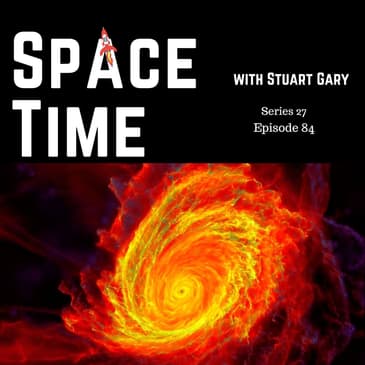
- First, new ultra-high-resolution cosmology simulations are shaking up long-held beliefs about how supermassive black holes grow and evolve. These simulations reveal that magnetic fields play a far more significant role than previously thought, propping up and shaping the accretion discs that feed these monstrous objects. Discover how these findings are bridging the gap between large-scale cosmic phenomena and the intricate details of star formation.-
- Next, we explore a proposed new NASA flagship mission to study Uranus, one of the solar system's most mysterious ice giants. This mission aims to uncover the secrets behind Uranus' unusual magnetic field, its many moons, and its rings, providing insights left unanswered since the Voyager 2 flybys nearly 50 years ago.
- Finally, a Chinese rocket launches unexpectedly during a static engine test, leading to a dramatic explosion. Learn about the mishap and its implications for the commercial space company Space Pioneer.
Follow our cosmic conversations on X @stuartgary, Instagram, YouTube, and Facebook. Join us as we unravel the mysteries of the universe, one episode at a time.Sponsor Offer
This episode is proudly supported by NordVPN. Secure your digital journey across the cosmos with a password manager you can trust. Find your stellar security solution at https://www.bitesz.com/nordvpn.
Listen to SpaceTime on your favourite podcast app including Apple Podcasts, Spotify, YouTube Music, or wherever you get your podcasts.
Support SpaceTimeBecome a supporter of SpaceTime: https://www.bitesz.com/show/spacetime/support/
www.bitesz.com
For an extra special deal from our sponsor, Malwarebytes - cyber security for everyone, visit www.bitesz.com/malwarebytes ....but be quick. For a very limited time you get 50% off. You really don't want to miss this. It's one we use and swear by. It just works!
[00:00:00] This is SpaceTime Series 27 Episode 84 for broadcast on the 12th of July 2024. Coming up on SpaceTime, new cosmology simulations revealing surprises about how black holes grow and evolve, a new mission to study the many mysteries of the planet Uranus, and a Chinese rocket launches accidentally during a planned test.
[00:00:22] All that and more coming up on SpaceTime. Welcome to SpaceTime with Stuart Gary. Astrophysicists have for the first time managed to simulate the journey of primordial gas dating from the early universe to the point where it swept up into a disk of material
[00:00:56] fueling a supermassive black hole. And these new ultra-high resolution computer simulations are upending ideas which astronomers have held for years about how supermassive black holes form and evolve. The first of these collaborations, which has been named Feedback in Relativistic Environments,
[00:01:14] or FIRE for short, is focused on the larger scale universe, studying questions such as how galaxies form and what happens when they collide. The second collaboration, known as StarForge, is designed to examine much smaller scales, including how stars are formed in individual clouds of gas.
[00:01:30] One of the study's authors, Phil Hopkins from Caltech, says there was a huge gap between the two, but thanks to these new high resolution simulations, the gap has now been bridged for the first time.
[00:01:41] To do that, the authors had to build a simulation with a resolution more than a thousand times greater than anything that had been previously done. A report in the Open Journal of Astrophysics claims that to their surprise, the new simulation revealed that magnetic fields played a much larger
[00:01:57] role than previously thought in forming and shaping the huge disks of material, the accretion disks that swirl around and feed supermassive black holes. Hopkins says the theories originally told us that the disks should be flat like crepes, but he says astronomers knew that wasn't right
[00:02:14] because the observations showed that they're actually fluffy, more like angel cake. And that's where these new high resolution simulations come in. They helped Hopkins and colleagues understand that magnetic fields are quite literally propping up the disk material, making it fluffier. In the
[00:02:30] new simulation, the authors perform what they call a super zoom in on a single supermassive black hole, a monstrous object that lies at the heart of most if not all galaxies, including our own Milky Way. These ravenous and mysterious bodies contain anywhere from thousands to billions of times
[00:02:46] the mass of our sun, and they exert a huge effect on anything that gets too close. Astronomers have known for decades that as gas and dust are pulled into the tremendous gravity wells of these black
[00:02:57] holes, they're not immediately sucked in. Instead, forming a disk of material rapidly whirling around the black hole itself, an object called an accretion disk. It's similar to water going down the drain
[00:03:09] in the sink. It doesn't all go down at once. Instead it swirls around a bit before it finally disappears. Once material reaches the accretion disk of a black hole, temperatures, pressures and gravity
[00:03:20] fields get so intense it's literally crushed, torn and ripped apart all at once, being stretched and squeezed, releasing vast amounts of energy before finally passing beyond the point of no return known as the event horizon and then disappearing forever into the black hole singularity, a place
[00:03:38] of infinite density and zero volume where the laws of physics as science understands them stop making sense. And the energy being released by material on the accretion disk shines with a brilliance unmatched by just about anything else in the universe. Depending on exactly how astronomers
[00:03:56] are seeing them, they're called quasars, blazars or active galactic nuclei and much is still unknown about the properties of these objects. The accretion disks around supermassive black holes have been imaged previously. The event horizon telescope imaged the disk circling around the black hole
[00:04:13] at the heart of our own galaxy in 2022 and in the galaxy Messier 87 three years earlier in 2019. But both these accretion disks are much closer and also more tame than the ones churning around quasars. And it's to visualize what's happening around these more active, more distant black
[00:04:31] holes that astrophysicists turn to supercomputing simulations. So how do you do this? Well you feed all the information of physics you have and how that works in the galactic setting into one of these supercomputer simulations. Everything from basic equations that govern gravity to how to
[00:04:47] treat dark matter and stars. The input includes many algorithms, that is series of instructions for the computers to follow in order to recreate extremely complicated phenomena. So for example these computers, and there are thousands of them all working in parallel, they know that once gas
[00:05:04] becomes dense enough a star will form. But the process isn't that straightforward. Hopkins reminds us that if you just say gravity pulls everything down and then eventually the gas forms into a star
[00:05:16] and the star just builds up, if you say that you'll get everything wrong. After all stars do lots of things that affect their surroundings. They shine radiation which can heat up and push away surrounding gas. They also blow stellar winds which can sweep up surrounding material. And they
[00:05:32] explode a supernovae sometimes launching material clear out of galaxies or changing the chemistry of their surroundings. So the computers need to include all this stellar feedback as they regulate how many stars a galaxy can actually build. But at these larger scales the set of physics that are
[00:05:48] most important to include and what approximations can be made differ widely from those at smaller scales. For example on the galactic scale the complicated details of how atoms and molecules behave are extremely important. They need to be built into any simulation. However scientists
[00:06:04] agree that when simulations focus on more immediate areas around say black holes, molecular chemistry can be ignored because the gas there is too hot to form atoms and molecules. Instead what exists there is simply a hot ionized plasma. So creating a simulation that could cover all the relevant
[00:06:20] scales right down to the level of a single accretion disk around a supermassive black hole was an extremely huge computational challenge. One that also required a code that could handle all the physics. Hopkins says there were some codes that had the physics needed to do the small part
[00:06:35] of the problem and other codes that had the physics needed to do the larger cosmological part of the problem but nothing that could do both. So the authors developed a code which they called Gizmo for both large and small scale simulation projects. Importantly they built the FIRE project
[00:06:51] so that all the physics they added there could also work with the Starforce project and vice versa. This allowed the scientists to simulate a black hole that was about 10 million times the mass of
[00:07:02] our sun beginning it in the early universe. The simulation then zooms in on that black hole at the moment when a giant strip of material is torn off a cloud of star-forming gas and begins to swirl around the supermassive black hole. The simulation then continues zooming in resolving
[00:07:19] a finer area at each step of the way and following the gas on its way towards the event horizon. Now in the simulation the authors saw the disk forming around the black hole though much of their
[00:07:31] surprise it didn't look anything like what they'd expected. In two seminal papers both from the 1970s which described the accretion disks fueling supermassive black holes scientists assumed that the thermal pressure, that is the change in pressure caused by the changing temperature of gas in the
[00:07:47] disks, played a dominant role in preventing such disks from collapsing under the tremendous gravity they experience as they get closer and closer to the black hole's event horizon. Now at the time they acknowledged that magnetic fields might play a minor role in helping to shore up these disks
[00:08:02] but that was all. In contrast what the new simulations are showing is that the pressure from the magnetic fields of such disks was actually 10,000 times greater than the pressure from the heat of the gas. So the disks are almost completely controlled by the magnetic fields.
[00:08:19] Hopkins says the magnetic fields clearly perform many functions one of which just happens to be propping up the disks and making the material puffy. Now this realization changes a host of predictions that scientists have made about such accretion disks. How dense and thick they should
[00:08:34] be, how fast the material should be able to move around them and into the black hole and even their overall geometry such as whether the disks could be lopsided. This amazing new high resolution
[00:08:45] simulation will open up new research such as what happens in detail when two galaxies merge, what types of stars form in the dense regions of galaxies where conditions are unlike those in our local galactic neighborhood and exactly what did the first generations of stars in the universe
[00:09:01] really look like. We've been trying to understand how the universe makes quasars, these most luminous sources in the universe when a supermassive black hole is swallowing huge amounts of gas and dust around it. What we found emerging was completely different from what the standard theory has
[00:09:27] predicted for about 50 years, particularly that these central regions have vastly stronger magnetic fields than we had thought or really that anyone had been predicting and the magnetic fields are really the thing that's controlling the evolution and the fueling of these black holes and the whole
[00:09:46] dynamics of this region around the black hole is regulated by these very, very strong magnetic fields. You're just trying to model a set of equations that are too complicated for us to solve pencil and paper. You've got gravity pulling things together, turbulence and fluid dynamics, there's
[00:10:03] magnetic fields but there's also radiation pushing on the matter around it and all of those are things that we think we understand the fundamental equations that they obey but how they all interact
[00:10:14] non-linearly in this chaotic messy system is the challenge and so we use a computer to solve that by basically breaking up those equations into little pieces over some domain and just solve the same equation a trillion times to ultimately predict how this whole system is evolving.
[00:10:32] As you zoom in and reach the scales around the black hole, the standard theory predicted that all the energy should be in the form of heat and that should be the dominant thing controlling the
[00:10:41] system. The magnetic fields are actually the thing that's dominating and controlling the dynamics on those scales. Magnetic fields being so strong makes qualitatively different predictions from the theories that we've had for decades. So, for example, the magnetic fields can actually hold up
[00:10:58] material and prevent it from collapsing under gravity so it's this thick ring of material around the black hole instead of being this flat disk. I like to believe that these simulations
[00:11:13] have an effect on how we understand the cosmos that we see even if just to give us a better idea of how it all got there, how did we get something like the Milky Way and where do these
[00:11:26] giant black holes come from. And in that report we heard from theoretical astrophysics professor Phil Hopkins from Caltech. This is Space Time. Still to come, a new mission to study the many mysteries of the planet Uranus and a Chinese rocket launches accidentally during what should
[00:11:48] have been a static test firing. All that and more still to come on Space Time. Scientists are urging NASA to focus its next major flagship mission on the solar system's giant ice planets Uranus and Neptune. When the Voyager 2 spacecraft visited Uranus almost 50 years ago, it discovered a magnetic
[00:12:23] mystery. Unlike most other planets, the ice giant's magnetic field is tilted by roughly 60 degrees away from its spin axis and that is creating an asymmetric magnetic field that varies in strength. Understanding the reason behind this anomaly will be one of the key goals of this proposed new NASA
[00:12:40] flagship mission. Much remains unknown about Uranus and Neptune. While the interterrestrial worlds Mercury, Venus, Earth and Mars and the two gas giants Jupiter and Saturn have all had spacecraft orbiting around them collecting lots and lots of data for scientists, the two ice giants
[00:12:58] Uranus and Neptune have only ever experienced brief flybys by the Voyager 2 spacecraft. They were back in 1986 and 89 respectively and both these tantalizing encounters left behind far more questions than answers. This lack of knowledge has led to cause for NASA's next large-scale
[00:13:17] flagship mission to focus on these distant worlds. Now the current proposal involves both an orbiter which will gather information about Uranus over time and a probe to drop down into Uranus's atmosphere in order to scan the planet from the inside. The mission will spend at least five
[00:13:33] years exploring how Uranus and the outer solar system formed, helping to solve some of the mysteries of this strange sideways tilted world, its many moons and rings and its strange tilted magnetic field. Now the planet's weird magnetic field is also likely behind another curious
[00:13:50] finding from the Voyager 2 mission. See a planet with a strong magnetic field can capture charged particles from space which then drift around the planet in what's known as a radiation belt. Earth is these, we call them the Van Allen belts. And the Voyager 2 spacecraft detected proton
[00:14:06] radiation belts around Uranus but they were far weaker than what was expected, about 100 times weaker than expected in fact. Now a new study reported in Geophysical Research Letters is using new modeling to try and work out why. Most planetary magnetic fields can be modeled with a
[00:14:22] dipole field but the study's authors added a more complex quadrupole field in their model in order to better mimic the planet's magnetic axial asymmetry. They used the Boris algorithm, often used to simulate the motions of particles in an electromagnetic field, to model the paths of
[00:14:38] charged particles surrounding Uranus. And they found that particles change speed at various points in their orbits as they move through stronger and weaker areas of an asymmetric magnetic field. Now importantly this effect only appears when the magnetic field is modeled with an additional
[00:14:53] quadrupole field. The authors say areas of increased speed are spreading out the particles, decreasing their density by up to 20% in some regions around the planet. And they think Voyager 2 could have passed through one of these low density areas and that would explain why the
[00:15:09] spacecraft found fewer particles in the radiation belts than expected. Now this doesn't fully account for the radiation belt weakness observed by Voyager 2 but the data could help explain the mechanisms behind the Voyager 2 findings and provide new theoretical data on the effects of
[00:15:24] the planet's magnetic field. So this proposed new flagship mission to Uranus could provide more data helping us understand the mechanisms behind the planet's unusual magnetic field. Of course such a journey would take decades to develop and execute but when it does happen we'll keep you informed.
[00:15:44] This is Space Time. Still to come a Chinese rocket launches unexpectedly during a planned test and later in the science report a new study shows that cigarette smokers, cigar smokers and non-smokers each have their own distinct personality types. All that and more still to come on Space Time.
[00:16:17] A Chinese rocket is unexpectedly launched into the sky from the Henan spaceport during what should have been a static engine test burn with the booster supposed to remain firmly bolted to the launch pad. But instead the Tianglong-3 rocket's first stage launched into the air
[00:16:33] climbing several hundred meters before falling back to the ground and exploding. The commercial Chinese company Space Pioneer who were behind the project have been forced to issue a grovelling apology to the public following the spectacular failure. The Tianglong-3 was a two-stage kerosene
[00:16:49] liquid oxygen fuelled rocket comparable with SpaceX's Falcon 9. The static engine burn was designed to test its nine first stage engines prior to a planned launch a few days later. However as the engines reached full thrust a structural failure caused the rocket to
[00:17:05] detach from the launch pad unexpectedly and blast off. The engines were then shut down by the onboard computer and the booster fell back to the ground in mountainous terrain about one and a half
[00:17:14] kilometres away where it exploded into flames. No one was injured in the failure but numerous houses were destroyed. This is space time. And time now to take another brief look at some of
[00:17:42] the other stories making news in science this week with the Science Report. A new study has concluded that cigarette smokers, cigar smokers and non-smokers each have their own very distinct personality types. The findings reported in the journal PLOS One show that people who smoke are
[00:18:00] less conscientious and agreeable and are far more extroverted than non-smokers. They also found that cigar smokers tend to have lower levels of neuroticism and higher openness than either cigarette smokers or non-smokers. The authors suggest that the low conscientiousness among
[00:18:16] smokers may reflect a lack of self-discipline and a disregard for their own long-term health characteristic of more impulsive behaviours. While their reduced agreeableness could explain why smokers persist in their habit despite societal disapproval. They also suggest that the higher
[00:18:33] extrovertism observed may suggest that these individuals enjoy the social nature of smoking. Paleontologists have discovered the fossil remains of an ancient giant Gondwandian salamander-like creature in what is now Namibia. The fossils reported in the journal Nature date back some
[00:18:51] 280 million years to the Permian Epoch, a time before the age of dinosaurs. The findings include numerous skull fragments and an incomplete vertebral column. The authors say the skull alone would have been around 60 centimetres long giving the creature a potential body length of around two
[00:19:08] and a half metres and that makes the animal named Gaiacea genae the largest tetrapod or four-legged animal of its day. They say the creature had huge fangs indicating it was a carnivore and probably
[00:19:20] hung out near the bottom of swamps and lakes hunting for prey. Well it looks like whether it's Pixie, Dixie and Jinx or Tom and Jerry it seems mice really can be sneaky and deceive the animals
[00:19:33] chasing them. The findings reported in the journal the Royal Society Open Science follows studies where researchers set up a test chamber in order to film evidence of wild mice intentionally deceiving other mice that were chasing them. They watched as the mice being chased hid around the
[00:19:48] corner at the entrance of the chamber until their rival followed them in and then they sneaked back out again when the pursuer's back was turned. The authors say this intentional tactical deception shows a complex level of thinking that's only rarely been documented in animals other than
[00:20:03] primates and corvids like crows. Those who believe in the paranormal are now claiming that recent astronomical events have triggered an increase in supernatural phenomena. It seems May's geomagnetic storms which triggered spectacular auroral events combined with April's total eclipse of the sun
[00:20:21] over North America have brought the true believers out in force. Tim Mindom from Australia Skeptic says while spectacular there's nothing supernatural about them it's just science. Obviously you might have noticed that there's been a few interesting sort of natural phenomena lately that have been
[00:20:37] sort of causing a bit of a ruckus one was the total solar eclipse went over the US, one was an earthquake in New Jersey and this latest of course is the aurora which all the records keep referring to
[00:20:47] the northern lights and no one refers to the southern lights very much. We did in our program. We did and we do here I know but all the stories you see about northern lights and one of them
[00:20:57] is that the aurora or at least the northern lights in this case have been increasing the paranormal activity especially the accuracy of predictions and that sort of stuff. Some slight problems with the course of that you know they're suggesting that the electromagnetism or the interference
[00:21:12] caused by the solar flares in the same way that might interfere with satellites and things like that is interfering with the paranormal and increasing paranormal activity. Well it's giving the ghosts headaches isn't it? It could give the ghost headaches, it could give the ghost hunters
[00:21:24] headaches because we might be interfering with their little machines that go nip and also of course there's a slight problem with some of these theories is that you go in the arctic circles and
[00:21:32] the Antarctic circles you get these a lot more often. Yeah. So you would think the paranormal activity in those parts of the world northern Norway, Iceland wherever and the Antarctica would have a huge amount of paranormal activity because they're getting bombarded all the time by these
[00:21:44] things and it's not around all the time. So but the people have been making the same suggestions about the total solar eclipse that was in America recently some people saying this is increased
[00:21:53] psychic accuracy you think well that must have been a short time because the eclipse only runs for how long three minutes? Yeah thereabouts. Yeah and then of course you start to look at the rest
[00:22:01] of the world so they have second rate psychics who are not very accurate because the eclipse didn't go past them. Same for the aurora, same for the someone suggesting that the earthquake and the eclipse that is an American congresswoman who's suggesting that the eclipse and the
[00:22:14] earthquake in New Jersey I think it was a sign from God that we better get our act together. People see significance in things which are natural they might not be that common like a
[00:22:21] fireball like a big like an aurora like an eclipse. Well that goes back to ancient times doesn't it before science? That's right. People would see something in the sky they don't understand or
[00:22:32] relate to and they'd have to come up with some explanation for it and so they make stuff up. Yes yeah that's right there has to be a reason for everything and people can't say I don't know.
[00:22:40] No because they all know it all to start with. And therefore you know that's the same thing people doing today they see something in the sky they don't know what it is so it's a flying
[00:22:48] saucer you can't say I don't know and let's find out you have to say I don't know therefore it must be this. That's Tim Mendham from Australian Skeptics and that's the show for now. Space Time is available
[00:23:15] every Monday, Wednesday and Friday through Apple Podcasts iTunes, Stitcher, Google Podcasts, Pocket Casts, Spotify, Acast, Amazon Music, Bytes.com, SoundCloud, YouTube, your favourite podcast download provider and from Spacetime with Stuart Garry.com. Space Time is also broadcast through
[00:23:35] the National Science Foundation on Science Zone Radio and on both iHeart Radio and TuneIn Radio and you can help to support our show by visiting the Space Time store for a range of promotional
[00:23:46] merchandising goodies or by becoming a Space Time patron which gives you access to triple episode commercial free versions of the show as well as lots of bonus audio content which doesn't go to air access to our exclusive Facebook group and other rewards. Just go to Spacetime with Stuart
[00:24:03] Garry.com for full details and if you want more Space Time please check out our blog where you'll find all the stuff we couldn't fit in the show as well as heaps of images, news stories, loads of
[00:24:14] videos and things on the web I find interesting or amusing. Just go to Spacetime with Stuart Garry.tumblr.com that's all one word and that's tumblr without the e. You can also follow us through at Stuart Garry
[00:24:27] on Twitter, at Spacetime with Stuart Garry on Instagram, through our Space Time YouTube channel and on Facebook just go to facebook.com forward slash Spacetime with Stuart Garry. You've been listening to Space Time with Stuart Garry this has been another quality podcast production from Bytes.com