
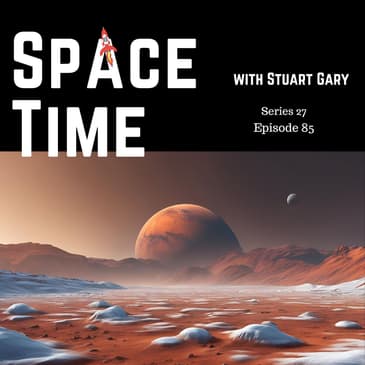
- First, a groundbreaking new study suggests that Mars may have always been a cold, icy world, incapable of supporting life as we know it. This research, published in Communications Earth and Environment, challenges the long-held belief that the Red Planet was once warm and wet, potentially hospitable to life. By analysing Martian soils in Gale Crater, scientists found similarities to the cold, subarctic soils of Newfoundland in Canada, raising questions about Mars' ability to support life.
- Next, Europe's new Ariane 6 rocket powers into space for the first time. After a decade of development and numerous delays, the Ariane 6 has finally launched, marking a new era for the European Space Agency's heavy-lift capabilities. This maiden flight from the Kourou Spaceport in French Guiana carried 18 satellites, demonstrating the rocket's versatility and potential for increased launch capacity.
- Finally, the crew of Boeing's Starliner spacecraft remains aboard the International Space Station, but NASA insists they are not marooned. Despite experiencing thruster malfunctions and helium leaks, the crew is confident in their return home. NASA and Boeing are working diligently to resolve the issues, with a potential return date set for late July.
- Follow our cosmic conversations on X @stuartgary, Instagram, YouTube, and Facebook.
Join us as we unravel the mysteries of the universe, one episode at a time.
- Sponsor Offer:This episode is proudly supported by NordVPN. Secure your digital journey across the cosmos with a VPN service you can trust. Find your stellar security solution at https://www.bitesz.com/nordvpn.
- Listen to SpaceTime on your favourite podcast app including Apple Podcasts, Spotify, YouTube Music, or wherever you get your podcasts.
Support SpaceTime:
www.bitesz.com
[00:00:00] This is SpaceTime Series 27 Episode 85 for broadcast on the 15th of July 2024. Coming up on SpaceTime… A new study claims the red planet Mars was always cold and icy, inconducive to life. Europe's new Ariane 6 rocket powers into space for the first time.
[00:00:20] And the crew of Boeing's Starliner still stuck aboard the International Space Station, but NASA insists they're not marooned. All that and more coming up on SpaceTime. Welcome to SpaceTime with Stuart Gary. A new study suggests Mars may always have been a cold icy world,
[00:00:56] incapable of supporting life as we know it. The findings reported in the journal Communications Earth and Environment contradict previous research which suggests the red planet was once a far warmer wetter world, one on which life could have existed and even thrived.
[00:01:13] The question of whether Mars ever supported life has captivated the imagination of scientists and the general public for more than 100 years. Now a new study looking at Martian soils in Gale Crater has shown they're very similar to that
[00:01:27] found in Canada's cold subarctic Newfoundland, and that raises questions as to whether life, if it ever developed on Mars, could have thrived. Scientists often use soil to depict environmental history. That's because the minerals present can tell the story of that landscape's evolution through time.
[00:01:46] So understanding more about how these minerals formed could help scientists answer long-standing questions about the historical conditions on the red planet. The soils and rocks of Gale Crater are providing a record of Mars' climate between 3 and 4 billion years ago.
[00:02:01] That's a time of relatively abundant water on the red planet, and the same period which saw the first life appear on Earth. The study's lead author, Anthony Feldman from the Desert Research Institute,
[00:02:12] says Gale Crater is a paleo lake bed with ample evidence that liquid water once existed in it. But Feldman says the environmental conditions when that water was present was very different from anything experienced on Earth. In fact, Mars is so alien compared to the Earth,
[00:02:28] he says scientists will never find a direct analogue between the Martian surface and here, because conditions are so different between the two worlds. But scientists can look for trends on Earth, and then use those to try and extrapolate what one might expect to see on Mars.
[00:02:43] NASA's Mars Curiosity rover has been investigating Gale Crater ever since its arrival on the red planet in 2011, and it's found a plethora of unusual soil materials known as X-ray amorphous material. These components in the soil lack the typical repeating atomic structures which define minerals,
[00:03:01] and therefore they can't be easily characterized using traditional techniques like X-ray diffraction. You see, when X-rays are shot into crystalline material like a diamond, for example, the X-rays will scatter in characteristic angles based on the mineral's internal structure.
[00:03:16] However, X-ray amorphous material doesn't produce any of these characteristic fingerprints. The X-ray diffraction method was used by Curiosity to demonstrate that X-ray amorphous material comprised between 15 and 73 percent of all the soil and rock samples tested in Gale Crater.
[00:03:33] Feldman says you can think of X-ray amorphous materials as being a bit like Jell-O, a soup of different elements and chemicals that just sort of slide past each other. The rover's chemical analysis of the rock and soil showed the amorphous material was rich in iron
[00:03:47] and silica and very deficient in aluminum. Beyond the limits of chemical information, scientists don't yet understand what amorphous material is, or for that matter, what its presence implies about the Martian historical environment. To understand more about amorphous materials, Feldman and colleagues visited three locations
[00:04:05] here on Earth looking for similar material. These included the tablelands of the Gros Morne National Park in Canada's Newfoundland, the mountains of Northern California, and the high deserts of western Nevada. These three sites all had serpentine soils expected to be very chemically
[00:04:22] similar to the X-ray amorphous materials seen in Gale Crater, that is rich in iron and silicon but lacking in aluminum. The three locations also provided a range of rainfall, snowfall, and temperatures which could help provide an insight into the type of environmental conditions
[00:04:37] that produce amorphous material and encourage its preservation. At each site, the authors examined the soils using X-ray diffraction analysis as well as transmission electron microscopy. This allowed them to see the soil's material at a more detailed level. They found the sub-arctic
[00:04:53] conditions of Newfoundland produced material which was chemically similar to that found in Gale Crater, minerals which also lacked a crystalline structure. But the soils produced in warmer climates, like California and Nevada, didn't have this feature. Feldman says the findings show that
[00:05:09] you do need water there in order to form these materials, but it needs to be very cold, with near freezing average temperature conditions, in order to preserve the amorphous material in the soils. See, amorphous material is often considered to be relatively unstable. That means that at an
[00:05:24] atomic level, the atoms haven't yet organized themselves into a final crystalline form. Feldman says there's clearly something going on in the kinetics, the rate of reaction, that's slowing it all down and that allows these materials to be preserved over geological time
[00:05:39] scales. It all suggests that very cold, close to freezing conditions is one of the peculiar kinetic limiting factors that allows these soils to form and be preserved. And all that suggests that the abundance of this material in Gale Crater is consistent with sub-arctic conditions being
[00:05:57] there over a very long, long period of time. Conditions which would not be conducive to the formation of life. This is Space Time. Still to come, Europe's new Ariane 6 rocket powers into space for the first time and the crew of Boeing Starliner spacecraft still stuck aboard the
[00:06:17] International Space Station, but they insist they're not marooned. All that and more still to come on Space Time. After more than a decade of development and years of delays, Europe's new Ariane 6 heavy lift rocket is finally blasted into orbit on its maiden flight. The Ariane 6
[00:06:51] replaces the previous Ariane 5 as the European Space Agency's expendable heavy lift launch system. Operated by Ariane Space on behalf of ESA, the two-stage rocket features an upgraded liquid hydrogen and liquid oxygen Vulcan engine known as the Vulcan 2 that originated with the old Ariane
[00:07:09] and it's combined with either two or four P-120 strap-on solid rocket boosters. The 63 meter tall Ariane 6-2 variant uses two of the solid rocket boosters and can launch up to 10,350 kilograms into low earth orbit and 4,500 kilos into geosynchronous transfer orbits.
[00:07:29] The more powerful Ariane 6-4 variant which will undertake its first launch next year will be using four of these strap-on boosters and it'll be capable of carrying payloads of up to 21,500 kilos into low earth orbit and 11,500 kilograms into geosynchronous orbit. The new Ariane 6 upper
[00:07:46] stage uses a single liquid hydrogen and liquid oxygen Vinci engine designed specifically for this vehicle and capable of multiple restarts. As for the P-120 solid rocket boosters, well they're shared with the core stage of Europe's other launch vehicle the Vega C and they're based on
[00:08:03] an improved version of the old P-80 solid rocket booster which was used as the first stage on the original Vega rocket. Originally selected in 2014 over an all solid fuel option, the Ariane 6 was targeted for a maiden flight in 2020. However the 4.5 billion euro program encountered numerous
[00:08:22] delays due both to a range of technical issues and also the COVID-19 pandemic and that resulted in the first launch not occurring until July the 9th and that's left quite a big gap since the
[00:08:34] Ariane 6's workhorse predecessor the Ariane 5 last flew a year ago. Ariane 6's modular design is meant to halve launch costs and increase capacity from 7 to 11 missions a year compared to the older Ariane 5 but the program has faced controversy over both its high costs and its lack of reusability
[00:08:54] compared to SpaceX's Falcon 9. The maiden flight from the European Space Agency's Kourou spaceport in French Guiana designated as VA-262 carried 18 satellites and fixed payloads. It also demonstrated the functioning of the new custom-built launch pad and ground facilities
[00:09:12] which are designed to allow for a faster turnaround of Ariane launches. Operations running smoothly here at the European spaceport in Amazonian French Guiana as we prepare to turn the next page in space history. Europe's newest rocket Ariane 6 is on its newly built pad preparing for
[00:09:29] its first journey into space. We have a stack of passengers on board from experiments and CubeSats they're up there in the fairing to re-entry capsules waiting to lift off right now the boards are all green that's a good sign. Organizations across Europe have come together
[00:09:44] to build Ariane 6 and guarantee Europe's continued access to space. We are one minute to launch. Our best wishes to all the Ariane 6 teams and everyone who's been working so hard for today. Good luck everyone. Go Ariane 6, bon voyage. Launch of the new rocket Ariane 6.
[00:10:28] Europe's new rocket Ariane 6 has left the pad and is blazing a trail across the equatorial skies. The range operations manager is telling us that everything is going according to plan. Spacecraft are rumbling now. And Jupiter too, we hear her. It's the most incredible feeling we have
[00:10:52] we're on the edge of tears here in the in the commentary box because this is a big day in a big moment. Actually the buildings are rumbling around us now. We have clear skies tonight this afternoon we had rain all day but the clouds parted the boosters.
[00:11:09] We see them falling off. We have booster separation so wow that's the first clapping here that we see what a beautiful lift-off. So these boosters they have transported us 60 kilometers high. The trajectory is normal
[00:11:25] everything going according to plan but now we have actually lost half our mass already because the boosters have burned almost 300 tons of fuel in two minutes. Everything nominal as the range operations manager says. Yes and we're getting close now to the next
[00:11:41] thing which will be the jettisoning of the fairing. The fairing being the nose cone of the launch vehicle which is where the passengers are sitting. We had confirmation there that the fairing has been jettisoned. Yes so the fairing that was protecting our spacecraft withstands all the
[00:12:04] pressure and the heat and once we stuck out the nose out of the atmosphere we didn't need her anymore and it has been jettisoned already in 140 kilometers. 2.4 kilometers per second and the main stage is operating. It's a 32 meter high cylinder weighs
[00:12:22] 23 tons when it's empty and it can carry 154 tons of cryogenic propellant supporting the upper stage and the boosters. For our technical audience we don't have any common bulkhead anymore so we have
[00:12:34] now two separate tanks and this makes the handling of the pressures a bit easier than on Ariane 5. And it's burning a very powerful engine. He's telling us that the trajectory is normal. Exactly yeah working engine is now simplified
[00:12:48] mainly for cost reduction reasons with regard to Ariane 5. The nozzle manufacturing is completely different and the gas generator is made of additive manufacturing. Telling us that there's two minutes left of propulsion on the Vulcan engine.
[00:13:03] So the Vulcan engine has a new challenge because the booster plumes impact at liftoff they're actually so high that the thermal protection around the nozzle actually had to be beefed up a
[00:13:12] bit and we have tiles now around the nozzle and the nozzle itself also has a new manufacturing method so it's a more simple and cost-effective design right now. We're getting closer now to the next
[00:13:22] phase which is switching off the engine and jettisoning the main stage because of course we want to lose each section of the rocket as we climb higher the lighter we are the faster we go
[00:13:33] so we're separating the next stage but that's actually quite a complex process isn't it? Indeed because you have to detect first that the rocket is actually ready for separation this is done by the guidance algorithm and afterwards the Vulcan engine is cut off and six seconds later
[00:13:49] only we will see separation of the stage initiated by pyro commands and we do that by actually extending a set of springs and the push that the lower stage does to get rid of the upper stage or
[00:14:02] the other way around to push itself away from the upper stage has the same push or the same thrust as we call it as the Vinci engine but it only does that during 0.2 seconds. Getting close now to what we call MECO main engine cutoff that's coming up.
[00:14:20] We have confirmation that Vulcan has switched off. Separation LLPM. And the lower stage has separated. Ignition of Vinci engine. And Vinci is ignited. Wow that's a very very very important moment of this mission. Congrats to Bremen and to Berlin. And we have applause here.
[00:14:37] Everyone's clapping here in Jupiter. An hour after launch the first set of satellites were released from the upper stage and placed into a 600 kilometre high orbit. These included numerous demonstrator and experimental satellites from various space agencies, private companies, research institutes and universities.
[00:14:54] Following the deployment of the initial group of satellites, Ariane 6's upper stage then relit its Vinci engine several times in order to deploy additional satellites into a range of other orbits. It then de-orbited itself back into the atmosphere at the end of its mission to ensure it doesn't
[00:15:10] become another piece of space junk. The success of this first flight marks the start of Ariane 6's operational career, once again giving Europe autonomous access to space. In fact, Ariane Space already has 30 flights booked for the Ariane 6 on its manifest. This report from ESA TV.
[00:15:30] Ariane 6 joins Europe's fleet of rockets for independent access to space. Building on the design and knowledge of five decades of Ariane launches, Ariane 6 will be versatile, modular, European. Ariane 6 comes in two versions that together can
[00:15:50] launch any type of satellite to mission into orbits around our home planet, to the Moon and beyond. Ariane 6 has four main sections. The boosters provide an enormous push early on to escape Earth's gravity. Depending on the power needed, Ariane can be fitted with two boosters or four.
[00:16:12] They burn for about two minutes and then are ejected. The main stage, powered by the mighty Vulcan 2.1 engine, provides part of Ariane 6's thrust. It ignites with the boosters but continues to fire for almost eight minutes until the rocket is out of Earth's atmosphere. The upper stage
[00:16:30] kicks in next. Powered by the restartable Vinci engine, it can fire at will to bring multiple satellites to different orbits as well as returning to Earth for safe disposal, minimizing space debris.
[00:16:42] The fairing sits at the top of the rocket like a hat to protect the satellite or passenger inside. Thirteen countries contribute to Ariane 6 and components for the rocket have been designed and constructed by companies all over Europe. Four organizations take care of the Ariane 6 program.
[00:17:00] ESA is the head of the program. It manages the budget and is in charge of the overall launch system. Ariane Group is the main contractor and has designed the Ariane 6 rocket. It orders and ensures the delivery of components from production facilities across Europe. Its modern and
[00:17:18] operational approach is based on its expertise from Ariane 5. France's space agency Canesse designed and built the Ariane 6 launch pad at Europe's spaceport in French Guiana, managing operations, ensuring range safety and tracking the launch. Ariane Spa sells the Ariane launches,
[00:17:36] negotiating with and accompanying companies and public organizations to launch their products into space. The trip to space starts in mainland Europe with companies delivering thousands of precision components needed to build a rocket. The Ariane 6 stages are shipped to Europe's spaceport
[00:17:59] by the unique canopy ship that can make a round trip every month to Europe's spaceport in Kourou, French Guiana and reduce transport costs by half. Sales on the ship will reduce emissions by up to
[00:18:11] 30 percent. Europe's spaceport is near the equator so rockets get a boost from Earth's rotation, the ideal place to launch to the stars. Integration of the Ariane stages starts on arrival at the spaceport where the rocket is built. Just hours before launch, the mobile gantry rolls away
[00:18:30] to give Ariane 6 a clear view of its destination, the stars. From design to liftoff, thousands of Europeans contribute to the Ariane adventure, launching space missions to explore and benefit from our universe. This is Space Time. Still to come, the crew of Boeing's Starliner still stuck
[00:18:54] aboard the International Space Station and NASA insists they're not marooned. And later in the science report, fresh warnings that the H5N1 strain of bird flu is showing clear signs of spreading between mammals. All that and more still to come on Space Time. The crew of Boeing's Starliner
[00:19:27] spacecraft who have been stuck aboard the International Space Station for a month now say they're confident that their trouble player capsule will soon bring them home. Butch Wiltmore and Sonny Williams launched way back on June the 5th on what should have been
[00:19:41] a trouble-free eight-day mission to the International Space Station to certify the vehicle to join SpaceX's Dragon capsule in transporting crew to and from the orbiting outpost. However, their Boeing CST-100 Starliner experienced thruster malfunctions and helium
[00:19:56] leaks during their ascent to orbit. Those problems persisted as they tried to dock to the space station's Harmony module. Five of the Starliner's thrusters, which are used to provide fine orbital maneuvering, failed to kick in during the spacecraft's approach to the space station,
[00:20:11] delaying the docking. Engineers still aren't sure exactly why the spacecraft's computer decided to deselect the thrusters. However, the crew were able to restart four of them and carry out a manual docking. Boeing's current working theory for the thruster malfunction involves overheating due
[00:20:28] to excessive firing. Now as for the helium leaks, mission managers knew of one helium leak before the launch. They weren't too worried about it. The trouble is more and more leaks began emerging during the flight. Helium is an inert non-combustible gas. It's used to pressurize the spacecraft's
[00:20:45] propulsion systems. Boeing thinks the leaks could have been caused by debris entering the propulsion system or by the use of undersized seals on the system. NASA and Boeing insist they're not too worried about this because Starliner carries 10 times more helium than it
[00:21:00] needs in order to return to Earth. But with Starliner in space, working out what's caused the problems is difficult. You see all the issues are located in Starliner's service module and that will be jettisoned before re-entry, meaning it'll burn up in the atmosphere, thereby not allowing
[00:21:16] engineers to study it. So if NASA and Boeing technicians want to find out what's gone wrong, they need to undertake as many probes as they can before any re-entries attempted. And because of
[00:21:27] that, no date's yet been set for the return to Earth. But NASA officials say right now they're eyeing off a return in late July. While on station, the Starliner crew have been performing tasks with
[00:21:38] the rest of the orbiting outpost team, changing out a pump on a machine that processes urine back into drinking water and carrying out science experiments such as gene sequencing in microgravity. One of the key tests they were meant to perform on Starliner while docked at the space station
[00:21:53] has also been carried out, that is using the vehicle as a safe haven in case of problems aboard the ISS and checking out how its life support systems would perform with four crew inside. Meanwhile, back on the ground, engineering teams are running simulations of similar thrusters
[00:22:08] and helium seals of the White Sands Missile Ranch in New Mexico to try and understand the technical issues Starliner's now experiencing. That could result in modifications in the way it flies during
[00:22:19] its return to Earth. Both NASA and Boeing insist Starliner could fly home in case of an emergency, so they're balking at the term stranded when describing the crew's current situation aboard the space station. They say the problems are only affecting the thrusters controlling orientation,
[00:22:35] not the more powerful ones used for deorbiting. However, there are concerns as to whether these malfunctioning orientation control thrusters have become degraded. That would make it necessary to rely on other thrusters during the descent. NASA says the batteries aboard Starliner were
[00:22:52] initially rated for 45 days but they're performing well and will be re-rated for another 45 days. Now that's not really a problem because once fully operational, Starliner will be meant to stay docked to the space station for missions lasting around six months. While both Boeing and NASA would prefer
[00:23:07] to bring the crew back home aboard Starliner, they're not ruling out a return to Earth aboard SpaceX's Dragon. Although that would be a huge humiliation for Boeing, its reputation has already hit the skids in recent years over safety concerns affecting its commercial airliners. What with two
[00:23:23] Boeing 737 MAX crashes, hatches blowing out on another airliner and wheels falling off two others. NASA awarded both SpaceX and Boeing commercial crew transport contracts back in 2014. The idea being to develop two separate operating systems, the ferry crews to and from the
[00:23:41] International Space Station following the early retirement of the space shuttle fleet in 2011. For SpaceX it was a no-brainer. They began transporting crews in 2020 using their Dragon capsule. They've now transported dozens of people to the space station as well as private missions
[00:23:56] into orbit. But Boeing have had multiple problems with their Starliner, only managing two unmanned flights prior to this current mission. The first of those failed to reach orbit was almost destroyed due to computer programming during its re-entry. The second mission in May 2022 seemed to go fairly
[00:24:14] smoothly with only some minor issues but more problems cropped up back on the ground, further delaying the first manned test flight for several years. Needless to say we'll keep you informed.
[00:24:26] This is Space Time and time now to take a brief look at some of the other stories making news in science this week with a science report. There are fresh warnings today that the H5N1 strain of the
[00:24:53] bird flu virus which spread to 69 cattle herds in the United States earlier this year is now showing signs of potentially spreading between mammals far more easily than previous strains. The findings reported in the journal Nature represent the first documented outbreak in cattle of an avian
[00:25:10] influenza known to be highly infectious. Studies of a sample of the virus taken from an infected cow's milk show that it can spread to the mammary glands of mammals and then be passed on to the next
[00:25:21] generation. They say this new virus strain can also bind to acids found in human upper airways in a way the older H5N1 viruses may not have been able to, which among other features they saw means this
[00:25:33] new version of the virus is better at infecting and transmitting in mammals. Scientists say they can't explain it but new research has found a link between high ceilings in exam halls and the performance of students. A report in the Journal of Environmental Psychology analyzed exam results
[00:25:50] from 15,400 students over eight years across three separate campuses. The authors found students tended to underperform in exam rooms with elevated ceilings compared to those taking exams in rooms with standard height ceilings. The new findings reinforce earlier research using brain mapping
[00:26:08] technology and virtual reality which showed a relationship between cognitive ability and the perceived size of a subject's surroundings. The authors say while the shape of a room can't compensate for intelligence or lack of study, environments do seem to have an effect on
[00:26:23] concentration and the ability to perform certain mental tasks. They say big open rooms with high ceilings could very simply be making it harder for students to focus. A new report in the journal Nature claims work on the world's largest nuclear fusion energy experiment, the International Thermonuclear
[00:26:42] Experimental Reactor or ITER, has been delayed by at least four years and may now not be operational until 2039. The delay means the 35 billion dollar tokamak in southern France likely won't be the first fusion reactor to achieve its goal of generating more energy than is needed to power it.
[00:27:02] Physicists say the project remains essential to building the foundations of a future fusion industry. ITER's thermonuclear fusion reactor will use over 300 megawatts of electrical power to cause the plasma in its tokamak to absorb 50 megawatts of thermal power, in the process
[00:27:18] generating 500 megawatts of heat from fusion for periods of between 400 and 600 seconds. That means a tenfold gain of plasma heating power as measured by heating input and thermal output. Unlike current nuclear power stations which use nuclear fission to generate heat,
[00:27:35] in the process producing excessive radioactivity, fusion reactions aim to replicate the processes which take place in the sun where the intense pressure and heat in the stellar core fuses nuclei together, producing large amounts of energy. It's a by-product. Harnessing fusion power on earth would
[00:27:53] provide virtually unlimited energy and do so in a sustainable manner that has relatively little impact on the environment. One gram of deuterium tritium fuel mixture in the process of nuclear fusion would produce 90 000 kilowatts of energy. That's the equivalent of 11 tons of coal.
[00:28:13] Last week marked the anniversary of the Roswell incident when reports surfaced on radio and in newspapers that a flying disc had crashed near the isolated New Mexican desert township of Roswell
[00:28:24] and the US Army Air Force had found the debris and taken it away for study. The story wasn't fantasy. It was based on an official government press release and as you'd expect it made international headlines. But within 24 hours authority had backtracked. They changed the story
[00:28:41] claiming instead it was just a crashed weather balloon. That story later changed again this time to technology which was part of a crash top secret operation called Project Mogul which was designed to detect soviet nuclear tests. As the story evolved claims of shape-shifting materials,
[00:28:59] structural beams lighter than balsa wood, strange hieroglyphic writing, alien bodies and autopsies and a massive government cover-up soon emerged. And the legend of Roswell has lived on ever since. Well it turns out Roswell wasn't an isolated incident. A new UFO film released at the
[00:29:19] recent Cannes Film Festival suggests that the Vatican has its own UFO secrets. The movie called God vs Aliens is claimed to be an expose of what the Vatican knows about UFOs and their links to
[00:29:32] the paranormal. Tim Mendham from Australian Skeptics says when it comes to keeping UFO secrets it looks like the US government isn't alone. The Vatican is a place of secrecy is the image that it has
[00:29:44] right of all these sort of information they're collecting and all the people sort of working away in secret basements with secret information. I've seen angels and demons I know what goes on. And the Vatican also has one of the world's best collection of meteorites which is an interesting
[00:29:58] situation but it sort of collects them because it started off with a big collection given by some French collector but it's built up itself. They do have an observatory yeah. They have an observatory
[00:30:08] and they do actual studies, they study astronomy and they do actually proper work. I don't know if they've seen any angels yet but they do proper work. So naturally because this is a secret and
[00:30:16] secretive organization they are hiding UFOs in the same way as the Americans are hiding craft and aliens in Area 51 whatever it is. And the Vatican is doing... Well that's actually a fallacy. The aliens and the craft were first taken
[00:30:31] from Roswell up to Ohio to the Wright-Patterson Air Force Base and from there bits and pieces were transferred or so the story goes. Yeah right okay yes the funny thing about these stories is
[00:30:42] it gets hard to pin down sometimes but in any case the Vatican supposedly has down somewhere hidden in the Sistine Chapel or wherever has a flying craft an alien craft or parts of it alien
[00:30:52] creatures or parts of them and supposedly they have shipped some of this to the Americans so that they could store it as well right. So naturally there's a lot of things going on between the
[00:31:00] Vatican and the USA in working these things out and hiding things away. The UK government might be involved as well so you know naturally there's a global conspiracy. A film came out fairly recently
[00:31:10] called God vs Aliens which was shown at the Cannes Film Festival. I don't know if that necessarily means it's a good film because there's a lot of stuff shown at Cannes which is sort of fringe
[00:31:20] but that's not necessarily the future blockbusters etc. This certainly doesn't look like a blockbuster film because it has one of the worst film trailers I've ever seen in my life. Anyway it makes claims
[00:31:30] about the Vatican. The Vatican knows the truth about UFOs and sort of makes the point that as the Vatican knows it's convinced as members of the US and UK governments knows that the UFOs are
[00:31:40] demonic in origin so that would be funny for the Vatican I assume. I'm not quite sure about the US and UK government supporting. Well it must be remembered that the guy behind this is a guy
[00:31:48] called Mark Christopher Lee. I mean he didn't just call himself Mark Lee it's Mark Christopher Lee. Yes well he's a vampire then isn't he? So yes Mark Christopher Lee is the producer of this film. He's
[00:31:59] an award-winning filmmaker and the awards he's got a pretty sort of fringe not very well known award because they looked him up. So this is promoting this conspiracy theory that there is aliens out
[00:32:08] there, the Vatican knows what they are, the Vatican has some and that they're keeping it secret. Others are saying that the aliens and craft are non-corporeal, non-physical, that they're actually things that we can't sort of assess. Well that lines up with passages in the Bible doesn't it?
[00:32:24] The wheels within wheels and the wheels rims have eyes in them and things like this. Yes people take the Bible and then apply it post-facto in a way that indicates in the same way as von Daniken
[00:32:33] would take a lot of evidence in quotes to prove aliens and ancient alien visitors. You can amass any evidence from anywhere to make an argument for anything if you try hard enough and this
[00:32:43] particular one is about which is pretty widespread it's the same old story of crash craft in the 12th of the 1950s and the original sightings 10 years earlier that have been around for 70 years
[00:32:54] and they keep saying next year it will be revealed and the next year keeps being put off and it's been put off and put off and put off for 70 years. That's Tim Mindom from Australian Skeptics
[00:33:04] and that's the show for now. Space Time is available every Monday, Wednesday and Friday through Apple Podcasts iTunes, Stitcher, Google Podcasts, Pocker Casts, Spotify, Acast, Amazon Music, Bytes.com, SoundCloud, YouTube, your favorite podcast download provider and from
[00:33:38] spacetimewithstuartgarry.com. Space Time is also broadcast through the National Science Foundation on Science Zone Radio and on both iHeart Radio and TuneIn Radio and you can help to support our show by visiting the Space Time store for a range of promotional merchandising goodies or by becoming
[00:33:56] a Space Time Patron which gives you access to triple episode commercial free versions of the show as well as lots of bonus audio content which doesn't go to air, access to our exclusive Facebook group and other rewards. Just go to spacetimewithstuartgarry.com for full details and if
[00:34:13] you want more Space Time please check out our blog where you'll find all the stuff we couldn't fit in the show as well as heaps of images, news stories, loads of videos and things on the web I find
[00:34:23] interesting or amusing. Just go to spacetimewithstuartgarry.tumblr.com. That's all one word and that's Tumblr without the e. You can also follow us through at Stuart Garry on Twitter, at Spacetime with Stuart Garry on Instagram, through our Space Time YouTube channel and on
[00:34:41] Facebook just go to facebook.com forward slash spacetimewithstuartgarry. You've been listening to Space Time with Stuart Garry. This has been another quality podcast production from bytes.com