
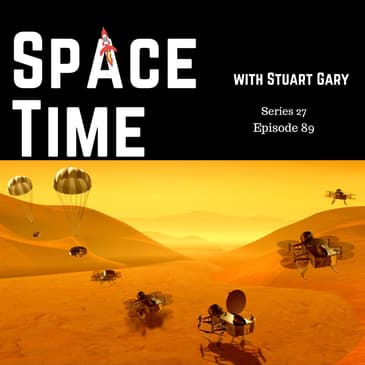
- Titan's Tiny Waves: Astronomers have determined that the seas of Saturn's largest moon, Titan, exhibit very tiny waves, only a few millimetres high. The findings, based on data from the Cassini spacecraft, reveal tidal currents and provide fresh insights into Titan's liquid hydrocarbon seas.
- Moon Caves as Future Lunar Dwellings: New research suggests that underground cave networks on the Moon could offer safe dwellings for future astronauts. Detected through NASA's Lunar Reconnaissance Orbiter, these caverns could provide shelter from radiation and extreme temperatures.
- Increased Fire Risk on Space Missions: A new study warns of an increased risk of fire on future long-distance interplanetary space missions. The unique conditions of microgravity and lower ambient air pressure could make fires spread more quickly and burn more intensely, posing significant dangers for space travellers.
- 00:00:00 - New research shows moon caves could provide future lunar dwellings for astronauts
- 00:00:47 - Scientists find evidence of tidal currents in seas of Saturn's largest moon Titan
- 00:07:57 - Astronomers find evidence of potentially accessible underground cave networks on the moon
- 00:10:31 - New research warns fires will provide increased risk for space travellers on future missions
- 00:15:31 - New study claims some bugs could be linked with autism spectrum disorder
- 00:18:06 - Apple's new vision pro augmented goggles have grabbed heaps of attention
Follow our cosmic conversations on X @stuartgary, Instagram, YouTube, and Facebook. Join us as we unravel the mysteries of the universe, one episode at a time.
Sponsor Offer: This episode is proudly supported by NordVPN. Secure your digital journey across the cosmos with a VPN service you can trust. Find your stellar security solution at https://www.bitesz.com/nordvpn.
Listen to SpaceTime on your favourite podcast app including Apple Podcasts, Spotify, YouTube Music, or wherever you get your podcasts.
Become a supporter of this podcast: https://www.spreaker.com/podcast/spacetime-with-stuart-gary--2458531/support.
[00:00:00] This is SpaceTime Series 27 Episode 89 for broadcast on the 24th of July 2024. Coming up on SpaceTime, a new study shows there's no surf on Titan. Your research shows that moon caves could provide future lunar dwellings for astronauts on the Moon.
[00:00:19] And we look at the increased risk of fire on future space missions. All that and more coming up on SpaceTime. Welcome to SpaceTime with Stuart Gary. We start off with a bit of bad news for any interplanetary surfers out there.
[00:00:51] Astronomers have determined that the seas of Saturn's largest moon, Titan, have very tiny waves only a few millimeters high. The findings reported in the journal Nature Communications also show that there may be rips to watch out for after astronomers found evidence of tidal currents.
[00:01:08] The authors analyzed data from the Cassini spacecraft's mission, which collected radar observations between 2014 and 2016. They found that the seas of Titan are mostly completely flat. But there's evidence of some small surface waves up to a few millimeters high with tidal currents caused by rivers flowing into the seas.
[00:01:28] Titan is the only world in our solar system other than the Earth to have liquid rain. The rain falls onto the ground, forming streams and rivers, which eventually flow into lakes and seas. But on Titan, the liquid isn't water like it is on Earth.
[00:01:44] Instead, it's ethane and methane. Titan's so-called water on this moon is frozen solid, forming bedrock. Titan's the largest of Saturn's 146 known moons, and is even larger than the Earth's moon. The new findings reported in the journal Nature Communications
[00:02:02] are based on a study of radar data from the Cassini-Huygens mission. It's providing fresh insights into the makeup and activity of the liquid hydrocarbon seas near Titan's north pole. The authors were able to determine the composition and roughness of Titan's sea surfaces,
[00:02:18] something previous analyses were unable to achieve. The study's lead author Valerio Poggioli from Cornell University undertook a bi-static radar experiment, that's one in which a radar beam from a spacecraft is aimed at a target, in this case Titan, and is then reflected towards a receiving antenna on Earth.
[00:02:38] The surface reflection is polarised, meaning that it provides information collected from two independent perspectives, as opposed to one provided by monostatic radar data, where the reflected radio signal simply returns to the spacecraft. So, the bi-static information provides a more complete dataset,
[00:02:56] and is sensitive to both the composition of the reflecting surface, as well as its roughness. This current study used four bi-static radar observations collected by Cassini during four of its flybys between 2014 and 2016. For each, surface reflections were observed
[00:03:12] as the spacecraft neared its closest approach to Titan, and again as it moved away. The authors analysed data from the observations of Titan's three largest polar seas. Their analyses found differences in the composition of the hydrocarbon sea's surface layers
[00:03:28] that was dependent both on latitude and location, such as near rivers and estuaries. Interestingly, the southernmost portion of one of these seas, known as Kraken Mare, showed the highest dielectric constant, that's a measure of the material's ability to reflect radio signals.
[00:03:44] Now for example, water here on Earth is very reflective, with a dielectric constant of around 80. But the ethane and methane seas of Titan only measured around 1.7. The authors also determined that all three of these seas on Titan
[00:03:59] were mostly calm at the time of the flybys, with surface waves no greater than 3.3 mm. A slightly higher level of roughness, up to a colossal 5.2 mm, was detected near coastal areas, estuaries, and interbasin straits, and that's thought to possibly indicate tidal currents.
[00:04:17] Pagliari and colleagues also had indications that the rivers feeding the lakes are pure methane, at least until they flowed into the open seas, which are mostly ethane-rich. And that's sort of analogous to Earth, where freshwater rivers flow into and then mix with salty water in the oceans.
[00:04:34] The new findings fit nicely with meteorological models for Titan, which predict that the rain that falls from the skies is likely to be mostly pure methane, but with trace amounts of ethane and other hydrocarbons. Pagliari says more work is already underway on the data generated by Cassini
[00:04:51] during its 13-year examination of Titan. And this work is vital for NASA's next mission to this world, the planned Dragonfly rotocopter. Dragonfly is slated for launch in July 2028, with the probe arriving on Titan in 2034. It'll make the first powered and fully controlled atmospheric flight on any moon,
[00:05:13] with the intention of studying pre-body chemistry and extraterrestrial habitability. It'll use its VTOL vertical takeoff and landing capabilities to move between various exploration sites on this distant world. This report from NASA TV. Saturn's largest moon, Titan, has a thick atmosphere and a frozen surface rich in organic molecules.
[00:05:36] A NASA mission called Dragonfly will arrive at Titan and study its chemical makeup. Dragonfly is a rotorcraft designed to visit multiple sites across the moon's varied terrain. At each new landing site on Titan's surface, Dragonfly uses a pulsed neutron generator and onboard gamma-ray sensor
[00:05:57] to detect key elements such as carbon and hydrogen in organic materials or oxygen in water ice. Dragonfly determines if there are well-defined layers of these materials just below the lander. For a closer inspection, Dragonfly uses its drill to generate tailings from Titan's hard, frozen surface.
[00:06:17] These surface samples can then be ingested through the pneumatic system, carried with Titan air into the chilled sample lines and to the sample collection carousel. One of the carousel sample cups is placed in a pneumatic port. The cup captures the surface material from the cold air stream
[00:06:35] and transfers it to the chemical laboratory for measurement. Pulses from a laser release large organic molecules from the surface sample for analysis in the mass spectrometer. The mass spectrometer sorts molecules by mass and measures diagnostic fragments
[00:06:50] that tell Dragonfly the kinds of chemical components that are present in the surface and whether there are molecules of prebiotic interest. For those potential prebiotic samples, a new cup is placed into an oven and heated to release molecules into a gas chromatograph
[00:07:06] where they are sorted for size and type before entering the mass spectrometer. This advanced separation of organic components includes isolating molecules with the same formula but different chiral arrangements or handedness. Having a preference for one-handedness over another is a key biosignature for life on Earth.
[00:07:25] When the chemical analysis is complete, Dragonfly may choose to take another surface sample or find a new location on Titan to investigate. This is Space Time. Still to come, a new study shows moon caves could provide safe dwellings for humans on the lunar
[00:07:50] surface and new research warns of an increased fire risk on future interplanetary missions. All that and more still to come on Space Time. Astronomers have found evidence of potentially accessible underground cave networks on the moon. A report in the journal Nature Astronomy says the caverns could provide potential
[00:08:25] shelter from radiation for future man bases and colonies on the lunar surface. They were detected through an analysis of data from NASA's Lunar Reconnaissance Orbiter, which was using radar to look at what lies beneath the Mare Tranquillitatis.
[00:08:40] The authors say that over 200 pits have been found on the surface, with many having been created by cave-ins from lava tubes which flowed across the lunar surface billions of years ago. One of these pits, known as the Mare Tranquillitatis pit,
[00:08:55] has a radius of around 100 meters, and scientists say their simulations, based on the radar images, suggest the potential for a tunnel located between 130 and 170 meters deep, between 30 and 80 meters long, with a width of around 45 meters. This study has clear
[00:09:12] implications for the development of manned missions to the moon where the environment is hostile to human life. Surface temperatures on the illuminated side of the moon can reach 127 degrees Celsius, while temperatures on the unilluminated side can drop to minus 173 degrees
[00:09:28] Celsius. And it doesn't end there. Cosmic and solar radiation can be up to 150 times more powerful on the lunar surface than what one would expect to experience on Earth. And there's also the constant threat of meteorite impact. All of these conditions
[00:09:44] drive the need to find safe sites for the construction of infrastructure which could support sustained exploration. And natural features like caves and caverns provide one solution to that problem. This is space time. Still to come, a new study finds an increased
[00:10:02] risk of fire on future long-distance interplanetary space missions. And later in the science report, new research into the link between depression and heart disease. All that and more still to come on Space Time. New research warns that fires will provide an increased risk for space travelers once they
[00:10:37] undertake longer distance interplanetary journeys. The research suggests the unique conditions of microgravity combined with lower ambient air pressure will make fires both spread more quickly and burn more intensely. The findings show that fires on planned missions to Mars could
[00:10:55] spread significantly faster than what they would on Earth or for that matter aboard the International Space Station. It all comes about because of plans to adjust to a lower ambient air pressure on the interplanetary journey to the Red Planet. The study's lead author, Florian Meyer from the
[00:11:10] University of Bremen, says a fire aboard any spacecraft is one of the most dangerous scenarios for any mission. That's because there are hardly any options for getting to a safe place or escaping from the spacecraft. He says it's therefore crucial to understand the behavior of fires
[00:11:25] under these special conditions. So Meyer and colleagues have been conducting experiments on the propagation of fires in reduced gravitational conditions since 2016. They've examined flame physics in environmental conditions similar to those on the International Space Station,
[00:11:41] which is oxygen levels and ambient pressures similar to that on Earth, as well as a forced air circulation system. These earlier experiments showed that flames behave completely differently in the weightless conditions of space compared to the 1G conditions seen on Earth. You see, in
[00:11:57] microgravity, a fire burns with a much smaller flame and it spreads more slowly. That simply means you can go unnoticed for a longer period of time. On the other hand, it also burns hotter and can
[00:12:10] ignite materials which are basically non-flammable on Earth. As well as all this, incomplete combustion of such materials could produce more toxic gases. And all these conditions will then be further amplified on interplanetary journeys which are planned to use modified atmospheric environments.
[00:12:28] The current idea is crew on a mission to Mars will experience lower cabin air pressure. This offers two crucial advantages. Firstly, they can prepare for a spacewalk more quickly. They don't need to spend time decompressing in order not to get the bends. It also means
[00:12:45] the spacecraft can be built lighter with less mass and that saves on fuel. But it means the crews need a higher proportion of oxygen in their air. And that, as we've found with the Apollo 1
[00:12:56] mission, can have dangerous consequences in the event of a fire. Now in the case of Apollo 1, the electrical short which sparked the fire that killed all three astronauts aboard the spacecraft occurred in a pure oxygen environment. But the lesson's still there. The more oxygen,
[00:13:11] the more intense the flame. And we know from various everyday situations that the speed of airflow also has a strong influence on the spread of fire. That's why strong winds and hot temperatures are always a bad formula for bushfires. And air on a spacecraft needs to be kept
[00:13:28] in constant motion otherwise microgravity conditions cause different gases to separate and pool. That can result in the buildup of pockets of deadly gases like carbon dioxide. Using a drop tower which replicates zero gravity conditions for brief periods, Meyer and colleagues observed
[00:13:45] the propagation of flames after lighting acrylic glass coils and investigating how the fire reacts when one of the three parameters, ambient pressure, oxygen content and flow velocity, were changed in different proportions. The results showed that although lower pressure has a dampening effect,
[00:14:01] the fire accelerating effects of the increased oxygen level in the air predominates. Increasing the oxygen level from 21% as aboard the International Space Station to the planned 35% for future interplanetary missions will cause the fire to spread three times faster. And that means
[00:14:18] an enormous increase in danger for any crew in case of a fire accident. Meyer says the findings highlight critical factors that need to be considered when developing fire safety protocols for manned space missions. He says understanding how flames spread under different atmospheric
[00:14:34] conditions will allow scientists to mitigate the risk of fire and improve safety for the crew. Everybody is familiar with the flame heats up in the air and the light air is transported upwards.
[00:14:45] From below there is the cold air coming supplying the flame with oxygen. But did you know that this is only the case on earth due to gravity? In space there is no up and down so the warm air cannot
[00:14:57] move away. This leads to the spherical shape of the flame with a limited supply of oxygen. This difference is actually a big challenge concerning fire safety in human spaceflight. In recent experiments we found out that on a spacecraft the flame burns weaker and will spread
[00:15:12] much slower, which is good. But on the other hand the flame can be locally hotter, produces more toxic smoke and is much harder to detect. This research helps to better understand fire under zero gravity and to make future exploration missions safer. That's Florian Meyer from the
[00:15:29] University of Bremen and this is Space Time. And time now to take another brief look at some of the other stories making use in science this week with a science report. A new study claims some
[00:15:56] types of bugs which kids have in their intestinal tract could be linked with autism spectrum disorder and may contribute to the development of the condition. A report in the journal Nature looked at the microbiome of 1,627 children aged between 1 and 13, some of whom were on the spectrum.
[00:16:15] They identified 14 archaea which are similar to bacteria, 51 bacteria, 7 fungi, 18 viruses, 27 microbial genes and 12 metabolic pathways that were altered in kids with autism. They then used artificial intelligence to see if the presence of 31 different bugs or functions
[00:16:33] could predict whether a child had the syndrome and they found that this had a higher diagnostic accuracy than just looking at one type of bug such as bacteria alone. The authors suggest that a special test could potentially be developed by looking at the composition of children's microbiomes.
[00:16:52] Scientists believe they may be finally able to explain the puzzling link between depression and heart disease saying it could all be down to genetics. A report in the journal Frontiers of Psychiatry claims the authors found a gene module which consists of 256 functionally related and
[00:17:08] co-expressed genes that are fundamental to the development of birth diseases. They believe these genes can now be used as biomarkers for both conditions and could lead to medicines that could target both in the future. A new study claims repeated outbreaks of the plague may have
[00:17:26] contributed to the decline of Neolithic populations in Scandinavia. A report in the journal Nature analyzed ancient DNA for more than 100 Neolithic people over six generations. The authors found evidence of the plague-carrying bacterium Yersinia pestis in 17% of the people studied and
[00:17:44] the analysis suggested the plague spread through the community in at least three distinct waves over a period of 120 years. They believe that these plague waves may well have contributed to the collapse of Neolithic populations in many parts of Europe between 5,300 and 4,900 years ago,
[00:18:02] a period known as the Neolithic Decline. Apple's new Vision Pro augmented goggles have grabbed heaps of attention since their release with some describing them as the future of augmented reality, personal communications, and portable computing. However others point to that $6,000
[00:18:21] price tag as being a significant barrier for most people. Our technology editor Alex Zaharov wrote from TechAdvice.life has taken the new gadget for a test drive. The Apple Vision Pro
[00:18:33] has finally arrived in other parts of the world besides the USA and I had a chance to try it. Apple invited me to a briefing and so I put it on and look it was very much like the Apple
[00:18:45] demonstrations both at the worldwide developer conference when they first announced it and then when they had that video that showed a sort of like a 10 minute video showing somebody using it
[00:18:57] for the very first time. You put it on you get to see the icons in front of you whichever icon you're looking at animates and comes to life a little bit so you know that you're looking at that icon
[00:19:05] you can then just simply pinch or tap your index finger to your thumb without having to lift it up into the air it can just be in your lap and that is how you click on something or select it then
[00:19:15] simply waving your hand in the air with your index finger and your thumb joined together so you swipe up swipe down left or right and then you can put two hands in front of you to
[00:19:24] zoom in and zoom out. It's very natural very quick to figure out how to use it and the apps are right there floating in front of you that can be easily repositioned in space around you. You can
[00:19:33] have iPad apps, iPhone apps, native Vision Pro apps. I mean the Vision Pro is a computer all by itself a spatial computer where all these screens can be left in different parts of your house even you
[00:19:44] know it's not just floating around you where you are but you can walk into a different part of the house and see a screen or some information you've left there and look for version one it is extremely
[00:19:53] impressive. I did notice that it was a little bit heavy after about half an hour on the front of my head and you do have to put a battery in your pocket but this is something that's new and
[00:20:03] exciting and clearly is going to get slimmer and cheaper and lighter and even more capable over the next few years. I mean you can imagine the Vision Pro headset in a decade's time is going to be
[00:20:14] almost as slim as the pair of glasses you may be wearing right now as you're listening to us speaking. So really it's a vision of the future augmented reality the way that I've imagined it
[00:20:26] would be and you can even turn the dial and the whole room in front of you becomes the top of a mountain of a volcano or another scene you can be completely ensconced and enmeshed in your own
[00:20:37] virtual world but you can dial the digital crown back and suddenly you're looking out and seeing the real world with the same fidelity as when you take the glasses off. So I'm loving it I wish it
[00:20:47] was $600 and not $6000 which it was half the weight but all these things will come and I'm very excited to have finally had a chance to see what spatial computing looks and feels like and it's
[00:20:58] definitely a lot better than the virtual reality headsets that I've been trying and using in different ways over the past 20 to 30 years this is a step above and very exciting. Is this the way
[00:21:09] the future is going will this replace our phones, our computers, laptops things like that? I believe it's something that will replace our phones and tablets and laptops but in a few years time when
[00:21:20] it is much cheaper and lighter and has much longer battery life at the moment it's $6000 but it's version one we all know that in 12 months perhaps 18 months there'll be another
[00:21:29] version that will be cheaper and lighter maybe it's not going to be as cheap and as light as we want but it certainly will be better than the first version. The first version will then become
[00:21:37] a collector's item that will sell for a million dollars in 20 years time if you bought one and never opened it up like has happened with iPhones. Do you think there'll still be a place for a cell
[00:21:46] phone and a laptop and a tablet in the future or will this sort of end up replacing them all? Look I mean I guess eventually it will end up replacing it and one of the things you can
[00:21:55] imagine is that there's going to be some sort of brain computer interface that doesn't require drilling a chip into your head but is somehow wireless and you can then think directly into
[00:22:04] a computing device. I mean the Apple Vision Pro doesn't let you think into a device you can speak you can tap on a virtual keyboard you can have a real keyboard in front of you but until this
[00:22:13] unit comes down in price there will still be a place for traditional rectangular mobile phones tablets and traditional computers but eventually when the price comes down and you can have all that computing power and 10 times more in a decade or longer just in glasses on your head
[00:22:28] you won't want those other devices. That's Alex Zahara-Vroid from Tech Advice Start Life and that's the show for now. Space Time is available every Monday, Wednesday and Friday through Apple Podcasts iTunes, Stitcher, Google Podcasts, Pocket Casts, Spotify,
[00:22:59] Acast, Amazon Music, Bytes.com, SoundCloud, YouTube, your favorite podcast download provider and from Spacetime with Stuart Garry.com. Space Time is also broadcast through the National Science Foundation on Science Zone Radio and on both iHeart Radio and TuneIn Radio.
[00:23:18] And you can help to support our show by visiting the Spacetime store for a range of promotional merchandising goodies or by becoming a Spacetime patron which gives you access to triple episode
[00:23:28] commercial free versions of the show as well as lots of bonus audio content which doesn't go to air, access to our exclusive Facebook group and other rewards. Just go to spacetimewithstuartgarry.com
[00:23:40] for full details. And if you want more Space Time please check out our blog where you'll find all the stuff we couldn't fit in the show as well as heaps of images, news stories, loads of videos and
[00:23:51] things on the web I find interesting or amusing. Just go to spacetimewithstuartgarry.tumblr.com that's all one word and that's tumblr without the e. You can also follow us through at Stuart Garry on Twitter, at Spacetime with Stuart Garry on Instagram, through our Spacetime YouTube channel
[00:24:09] and on Facebook just go to facebook.com forward slash spacetimewithstuartgarry. You've been listening to Spacetime with Stuart Garry. This has been another quality podcast production from bytes.com