
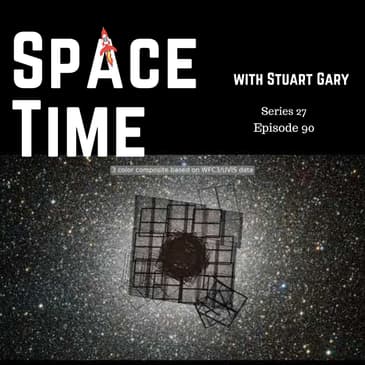
- **Discovery of an Intermediate Mass Black Hole**: Astronomers have detected what they believe is a rare intermediate mass black hole buried deep inside the Omega Centauri globular star cluster. This discovery, based on two decades of Hubble Space Telescope observations, provides compelling new evidence for this elusive type of black hole, which acts as a missing link in black hole evolution.
- - **Europe's JUICE Spacecraft Flyby**: The European Space Agency's Jupiter Icy Moons Explorer (JUICE) is about to undertake a gravity-assisted flyby of the Earth and Moon. This manoeuvre will alter the spacecraft's speed and direction, setting it on a course to Jupiter. The flyby is a double world first, being both the first lunar-Earth flyby and the first double gravity assist manoeuvre.
- - **Portable Urine Recycling System for Spacesuits**: Inspired by the still suits in the movie Dune, scientists have developed a new portable urine collection and recycling system for spacesuits. This system could solve the hygiene and water scarcity issues faced by astronauts during long spacewalks and deep space missions.
- Follow our cosmic conversations on X @stuartgary, Instagram, YouTube, and Facebook. Join us as we unravel the mysteries of the universe, one episode at a time.
- Sponsor Offer: This episode is proudly supported by NordVPN. Secure your digital journey across the cosmos with a VPN service you can trust. Find your stellar security solution at https://www.bitesz.com/nordvpn.Listen to SpaceTime on your favourite podcast app including Apple Podcasts, Spotify, YouTube Music, or wherever you get your podcasts.
- Support SpaceTime:- Become a supporter of SpaceTime: https://www.bitesz.com/show/spacetime/support/
- www.bitesz.com
- 00:00:00 - This is spacetime series 27, episode 90 for broadcast on 26 July 2024
- 00:00:48 - Astronomers have detected what they believe is a rare intermediate mass black hole
- 00:07:02 - Juice spacecraft to make first gravity assist flyby of Earth and moon
- 00:15:46 - Astronauts need to use adult diapers when undertaking a spacewalk
- 00:18:57 - New study finds diabetes drug could improve symptoms of heart failure
- 00:21:37 - There are fresh warnings about the dangers of the so called wellness industry
- 00:24:21 - Long standing underinvestment in women's health worries experts
- 00:27:16 - spacetime is available every Monday, Wednesday and Friday through various podcasting platforms
[00:00:00] This is SpaceTime Series 27 Episode 90 for broadcast on the 26th of July 2024. Coming up on SpaceTime, Discovery of an intermediate-mass black hole in Omega Centauri, Europe's Juice spacecraft about to undertake a flyby of the Earth-Moon system,
[00:00:17] and the development of a new portable urine recycling system for spacesuits based on the movie Dune. All that and more coming up on SpaceTime. Welcome to SpaceTime with Stuart Gary. Astronomers have detected what they believe is a rare intermediate-mass black hole buried deep
[00:00:53] inside the Omega Centauri globular star cluster. Only a few intermediate-black hole candidates have ever been identified. Most are stellar-mass black holes, which can be up to around 100 times the mass of our Sun. They're created by the collapse or merger of massive stars.
[00:01:10] Then there are supermassive black holes, which lie at the hearts of most if not all galaxies and are usually millions to billions of solar masses in size. But finding intermediate-sized black holes, which fit somewhere in between these two extremes, has been difficult.
[00:01:26] Intermediate-mass black holes are scarce, but are considered an important missing link in black hole evolution. Astronomers want to know how common intermediate-mass black holes are, how and where they're made, are they created by the merger of smaller stellar-mass black holes,
[00:01:41] and do they go on through further mergers to form interlarger supermassive black holes? Astronomers sifting through more than 500 Hubble Space Telescope images spanning two decades of observations may now have identified an intermediate-mass black hole by following
[00:01:58] the motions of seven fast-moving stars in the innermost region of the Omega Centauri globular star cluster. These stars provide compelling new evidence for the presence of a gravitational pull from an intermediate-mass black hole tugging on them.
[00:02:12] Globular clusters are tight balls of thousands of stars, thought to either be the intact galactic cores of satellite dwarf galaxies, cannibalised by larger galaxies, or former stellar nurseries containing stars which were all originally born together at the same time and have remained
[00:02:29] gravitationally bound. They're some of the oldest structures in the universe, often dating back some 10 to 12 billion years, and they're commonly found orbiting large galaxies. Our own Milky Way galaxy has more than 150 of them. Located just above the plane of the Milky Way, Omega Centauri is easily
[00:02:50] visible from Earth with the unaided eye from dark areas, and it's become a favoured celestial object for stargazers living in the southern hemisphere. Located just above the plane of the Milky Way, it was first listed in Ptolemy's catalogue nearly 2,000 years ago as a single star. Later Edmund
[00:03:08] Halley reported it as a nebula in 1677. In the 1830s, English astronomer John Herschel was the first to recognise it as a globular cluster. Omega Centauri consists of roughly 10 million stars that are all gravitationally bound. The cluster is about 10 times more massive than other big globular
[00:03:28] clusters. In fact, it's almost as massive as a small galaxy. Astronomers have now created an enormous catalogue of the motions of these stars, measuring the velocity of 1.4 million stars gleaned from Hubble images of the cluster. Now most of these observations were originally intended simply to
[00:03:45] calibrate Hubble's instruments rather than for any specific scientific purpose, but they've turned out to be an ideal database for the author's research efforts. The study's lead author Maximilian Haberle from the Max Planck Institute says his team discovered seven stars that shouldn't be there.
[00:04:03] They're moving so fast they should have been flung out of the cluster and never come back. Now the most likely explanation for their retention in the cluster is that some massive object is gravitationally pulling on these stars, keeping them close to the centre. And the only
[00:04:18] known object that could be massive enough to do that would be a black hole with a mass at least 8,200 times that of our Sun. Now several other studies have already suggested the presence of an intermediate-mass black hole in Omega Centauri. However, other studies have proposed the mass could
[00:04:35] be contributed by a central cluster of stellar-mass black holes and had suggested the lack of fast moving stars above the necessary escape velocity made an intermediate black hole less likely in comparison. Still, the potential discovery is really exciting because there are only a very few
[00:04:51] black holes known of similar mass. The black hole in Omega Centauri, if that's what it is, may well be the best-known example of an intermediate-mass black hole in our cosmic neighbourhood. If confirmed
[00:05:04] at a distance of 17,700 light years, this candidate black hole would be residing closer to Earth than Sagittarius A star, that's the 4.3 million solar-mass black hole at the centre of our Milky Way galaxy. It's located some 27,000 light years away. This report from NASA TV. Intermediate-mass
[00:05:25] black holes are a long sought missing link in black hole evolution. They are smaller than the supermassive black holes that lie at the cores of large galaxies but larger than stellar-mass black holes formed by the collapse of massive stars. Only a few candidates have been found to date.
[00:05:44] Now, a team of astronomers analyzed over 500 images from 20 years of NASA's Hubble Space Telescope observations to find evidence of an intermediate-mass black hole by tracking seven fast-moving stars in the Omega Centauri globular star cluster. Scientists think a
[00:06:03] massive object is gravitationally pulling on the stars within Omega Centauri, keeping them close to its center. From the motions of the stars, they estimate it has a mass of at least 8,200 times that
[00:06:16] of our Sun. The only object that can be so massive is a black hole. This discovery is the most direct evidence, so far, of an intermediate-mass black hole in Omega Centauri, which is exciting because
[00:06:29] only a few other known black holes have a similar mass. Thanks to Hubble's treasure trove of data, astronomers were able to make this incredible discovery as we continue to uncover more and more mysteries of the universe. This is Space Time. Still to come, European space agencies'
[00:06:48] Jupiter Icy Moons Explorer or JUICE spacecraft about to undertake a gravity-assisted flyby of the Earth and Moon. And scientists develop a new portable urine recycling system for spacesuits based on the movie Dune. All that and more still to come on Space Time.
[00:07:20] The European space agency's Jupiter Icy Moons Explorer or JUICE spacecraft is about to undertake a gravity-assisted flyby of the Earth and Moon. JUICE will swoop past the Moon and then the Earth itself on the 19th and 20th of August. This braking maneuver will take the JUICE spacecraft
[00:07:38] on a shortcut to Jupiter by way of Venus. And it's a double world first. Not only is it the first ever lunar Earth flyby, but it's also the first ever double gravity assist maneuver. It'll change JUICE's
[00:07:52] speed and direction, altering its course through space. But it's a daring feat. The slightest mistake could take JUICE off course, spelling the end of the mission. Following JUICE's launch back in April last year, the Earth-Lunar flyby was going to be the first step in that spacecraft's waltz through
[00:08:09] the solar system on its journey to Jupiter. During the flyby, Earth will bend JUICE's trajectory through space, firstly breaking it and then redirecting it on course for a Venus flyby in August 2025. From that moment on, the energy boost will begin, with JUICE being flung out by Venus
[00:08:27] and then twice more by the Earth. Jupiter, on average, is some 800 million kilometers away from Earth. So without an enormous rocket, sending JUICE straight to the solar system's largest planet would require any possible 60,000 kilograms of onboard propellant. And then JUICE would need
[00:08:45] to be carrying an enormous amount of additional propellant to slow itself down enough once it gets there in order to go into orbit around Jupiter rather than simply slipping by and continuing
[00:08:55] off into deep space. So instead, JUICE is taking the scenic route. It's using the gravity of other planets to carefully adjust its trajectory through space and ensure it arrives at Jupiter with the right speed and direction in order to be able to achieve orbit insertion. And somewhat
[00:09:12] counterintuitively, using the Lunar-Earth flyby to slow JUICE down next month is actually more efficient than using a flyby to speed it up. If we instead use this flyby to give JUICE a boost
[00:09:24] towards Mars, we'd have to wait for a long time for the next planetary flyby. So this first braking maneuver is really a way of taking a shortcut through the inner solar system. Mission managers
[00:09:35] have already adjusted JUICE's path to ensure it arrives first at the Moon and then a day later at Earth at precisely the right time with the right speed and traveling in the right direction. JUICE
[00:09:45] will come extremely close to both the Moon and Earth. From the 17th through to the 22nd of August, JUICE will remain in continuous contact with ground stations around the world. Every second of the way, operators will keep a careful watch on the data coming down from JUICE,
[00:10:01] making tiny adjustments as needed to keep the spacecraft on the right course. ESA will also be activating the spacecraft's 10 science instruments as it passes by the Moon and Earth for some bonus observations. The Lunar-Earth flyby provides a prime test environment for instrument teams to
[00:10:18] collect and analyze data from an actual surface in space for the first time. In fact, for some instruments, it'll be the only opportunity to make some measurements during JUICE's entire AE journey to Jupiter. It'll give scientists and engineers the chance to calibrate their instruments,
[00:10:34] smooth out any remaining issues, and they may even make some surprising bonus scientific discoveries along the way. The Lunar-Earth flyby is especially crucial for JUICE's radar instrument whose data can be disturbed by electronic noise within the spacecraft. The flyby of the Moon on
[00:10:51] August the 19th is one of the few chances before arrival at Jupiter for technicians to check how this noise is affecting the instrument's performance. During the closest approach to the Moon, the radar
[00:11:02] will have eight minutes to observe alone, with all the other instruments either switched off or set to quiet mode. Based on these observations, the radar team will then be able to work out algorithms
[00:11:13] in order to correct any noise problems. The development of this mission has been a long and involved project, as this report from ECTV explains. We have started our first test in the environmental test campaign, which is the thermal balance, thermal vacuum test,
[00:11:35] and the program is going as planned. That means we are now at 60 and we will start pumping down, okay? Right, okay. Guys, pumping down is starting now. Now? Now. The test is divided in
[00:11:51] three phases. We have a first phase which we call thermal balance, a second phase which we call thermal vacuum, and the last phase which we call Venus hot phase. This is a vertical integration
[00:12:04] stand. We are preparing this stand for the next transport of the spacecraft. We are clarifying the way to the chamber. We have to go through several green rooms to get there and it's quite interesting
[00:12:18] all the time and very dynamic and a lot of people you have to deal with. My name is Areth Schnorch and my function in the JUICE project is that I'm the manager of the assembly integration and testing
[00:12:32] of the spacecraft and also of the launcher interface. We will bring the spacecraft into this big chamber and then we will close it and nobody will see it anymore. We'll do a long test which
[00:12:45] is lasting months and the main objective is to verify that the thermal subsystem of the spacecraft is operating fine, like it will be in space. This is a quite sensitive operation because you have to
[00:13:00] come close to get access to the instruments. Okay, but yes finally we are successful so I guess it will be the next hour we finalize all the preparations and we can close the chamber. I was the quality representative for Airbus and we were yesterday closing both
[00:13:23] doors of the chamber. First the upper one then the five meters front door. So yeah, it was the last one to see JUICE before we see it again a few weeks after its first trip
[00:13:34] to space. So no, it was something very nice to do and also to see it finally in the configuration, no scaffolding, everything open, no retach items, everything looking as close as possible to how it's going to look when it's traveling to Jupiter. So really so nice experience.
[00:13:55] It's the pressure going down in the chamber from one bar so we will go to one 10 to the minus five millibar. In space is real vacuum it's even lower than that but normally one 10 to the minus five is
[00:14:12] good enough to start. Good luck with the test and here we are. Thank you. Okay, almost at the end of the test we will rotate the spacecraft and switch on the sun of the LSS
[00:14:30] which is also a very nice moment. We have seen it already in the dry run but of course with much less intensity and that will occur during the test itself. That we will go up to
[00:14:45] I don't know 3,400 watts per square meter which is really a lot of heat simulating the sun. And in that report from ESA TV we heard from JUICE project manager Giuseppe Sari from ESA, JUICE spacecraft assembly integration and testing floor manager Hussein Seglaoui from Airbus,
[00:15:11] JUICE spacecraft assembly integration and testing general manager Arid Schnork from ESA, JUICE mechanical spacecraft assembly integration and testing manager Klaus Brindle from Airbus, Eduardo Miron from Airbus Quality Assurance and JUICE test program manager Eduardo Berner
[00:15:27] from European Test Services. This is Space Time. Still to come a new portable urine recycling system for spacesuits which is based on the ones in the movie Dune and later in the science report
[00:15:42] scientists discover the longest running cyclone in recorded history. All that and more still to come on Space Time. Being an astronaut is actually a lot less glamorous than you may think. There are
[00:16:08] actually quite a lot of downsides to the job. One of them is the need to use adult diapers when you're undertaking a spacewalk. That's because there's no other known way so far of taking care of
[00:16:20] business when you need to take care of business. Another problem is the lack of water so instead astronauts are forced to drink recycled urine and sweat when they're aboard the space station.
[00:16:31] And these problems are about to grow as more deep space missions are undertaken in the near future. NASA and the European Space Agencies are undertaking manned missions to the moon aboard the Artemis 2 and 3 flights next year and in 2026. Artemis 2 will see humans orbit the moon
[00:16:48] while Artemis 3 will see their return to the lunar surface. These missions are expected to be followed by the first manned missions to Mars in the early 2030s. And while there are toilets aboard the
[00:17:00] International Space Station, the issue of what to do when you're on a spacewalk remains. I mean there's no flap at the back and there are no celestial outhouses orbiting in space. And so instead astronauts undertaking EVAs, that's extra vehicle activities, spacewalk in NASA speak, need to use
[00:17:18] adult diapers. However astronauts have long complained about the lack of comfort and hygiene associated with these maximum absorbency garments or mags as they're called in NASA speak. These waste management systems have been used in traditional NASA spacesuits ever since the 1960s.
[00:17:34] These days they're made of super absorbent polymers. However the mags have problems with leaking and that can cause health issues such as urinary tract infections, gastrointestinal distress. Additionally astronauts currently only have one litre of water available in their in-suit drink
[00:17:50] bags. And that's insufficient for planned longer lunar spacewalks which can last up to 10 hours and even 24 hours in an emergency. Now a report in the journal Frontiers of Space Technology has released details of a new portable urine collection and recycling system which could be carried on the
[00:18:08] next generation of spacesuits. And technicians have now built a prototype ready for testing after being inspired by the stillsuits worn by the characters of the fictional Dune books and movies which absorb sweat and urine and recycle them back into drinking water. The new design includes a
[00:18:25] silicon collection cup that fits around the genitalia and is lined with an absorbent material. A vacuum pump then collects the urine and pushes it through a filter that extracts the water after which electrolytes are added and it's transported back into the in-suit drink container.
[00:18:41] The system is designed to collect and purify 500 milliliters of urine in five minutes and could be useful on future space missions. Not much more to say really other than cheers. This is Space Time. And time now to take another brief look at some of the other
[00:19:17] stories making use in science this week with a science report. A new study has found that semaglutide, the diabetes drug that has now become best known for its weight loss properties, could
[00:19:28] improve symptoms of a common type of heart failure that up until now has had few treatment options. A study reported in the Journal of the American College of Cardiology included two trials comparing semaglutide with the placebo over a year in 1,145 patients. They found that of those on
[00:19:47] semaglutide, women lost an average of 9.6 percent of their body weight or men lost an average of 7.2 percent. Both sexes also saw notable improvements in heart symptoms, physical limitations and exercise abilities. These improvements were similar in both men and women and this indicates that the
[00:20:04] improvements may be at least in part independent of their weight loss. Meanwhile a separate study reported in the New England Journal of Medicine has found that the diabetes and weight loss drug trizepatide sold under the name of Monjaro could also help treat sleep apnea. A year of treatment
[00:20:22] with the drug which works in a similar way to ozempic was found to reduce sleep apnea symptoms, increase weight loss and improve sleep in people with moderate to severe obstructive sleep apnea compared to a placebo. The World Meteorological Organization says tropical cyclone Freddie has
[00:20:39] been named as the longest running cyclone in recorded history. The storm first surfaced northwest of Western Australia back in February 2023. It then headed across the Indian Ocean, doing major damage across southeastern Africa in March. The WMO says the cyclone remained at
[00:20:57] tropical storm status for 36 days, beating the previous record set by tropical cyclone John in 1994. A global study has found the key to mapping biodiversity may have been staring us in the face all the time, namely the air which surrounds us. A report in the journal Nature claims
[00:21:17] scientists use DNA sequencing to identify fungi from air samples collected from 47 sites around the world. The research has produced some groundbreaking knowledge about the climatic and evolutionary factors influencing the occurrence and seasonal variation of both
[00:21:32] previously known and unknown species of fungi. There are fresh warnings today about the dangers of the so-called wellness industry. The $4 trillion business has a well-deserved reputation for pushing pseudoscientific concoctions to often desperate people. They're the classic
[00:21:51] snake or salesman. Tim Mendham from Australian Skeptic says there are often key words that provide red flags that the products being pushed have no real scientific evidence supporting their claims. The issue here is that there's a lot of stuff in the wellness industry that is overtly
[00:22:07] wrong, misrepresenting health issues etc. The wellness industry which covers a whole range of areas that are sort of looking at things you can do to take control of your mental health, physical health, it even goes into social, spiritual, vocational health. So wellness is
[00:22:23] much about a state of mind as it is about a physical health issue and they often sort of try and link one to the other which you improve your physical health, will improve your mental health, will improve your social health, your financial health etc. It's not necessarily the
[00:22:37] straight things that we understand of medical doctor treatment, hospital treatment, that sort of thing. It does tend to be a user-managed process with the help of a lot of other organizations etc. And the things that those organizations are saying is often misleading. Now yet to
[00:22:52] watch out for this industry globally is worth about $4 trillion, a TR trillion which is bigger than most countries. So it's a very, very big industry. We're not talking pharmaceuticals, we're not talking health medicine etc., we're talking wellness. And there's an article that
[00:23:04] came out quite encouragingly in a section of the LA Times called High School Insider in which it encourages people in secondary school, high school students to post stories and report on issues that matter to them and their communities and these are actually often very intelligent pieces,
[00:23:19] not necessarily with a lot of academic background, fair enough, they're high school kids but with a lot of understanding and appreciation of some of the issues. And one of the ones they point out about the wellness industry and especially the supplements and multivitamins industry which is
[00:23:32] a major part of it where they talk about treatments etc. and they use words like boosts, aids, stimulates, optimizes. They never say cure which they probably are legally unable to but they have
[00:23:42] this indication that we will help. As everyone knows a lot of this stuff, they say plus you should eat well and you should exercise etc. but we're there as well. So in a way, they're carried in on
[00:23:51] the coattails with the proper exercise and good eating regimens. And there's a lot of things like that of words that are used in a way that sort of imply some benefit but actually is not guaranteed.
[00:24:02] A lot of these things come under the food administration areas which is not as rigorously applied as might be the case with medical products and appliances and that sort of thing. Medical appliances often have to go through rigorous tests or should do, certainly they have to go through
[00:24:14] things where they have to present evidence that they actually work. But if you're coming in under the food guidelines, it will be more open to make strange things. Now whether vitamins is food or medicine, it is obviously diet issues, maybe food other than medicine, there's financial, spiritual,
[00:24:29] social, mental issues and one area in particular that is a worry to people is long-standing underinvestment in women's health. A lot of the research that's done and this has actually been shown by studies that has been applied to men's health and they say well that should apply to
[00:24:40] women as well. So women who because they feel neglected in one particular aspect, they are disproportionately moving towards these influences especially the online influences etc and the products that they're pitching which is these wellness products in desperation for a promised
[00:24:53] solution. Everyone's after a solution. Boost, aid, stimulate, optimizes, we've got a solution. A lot of these wellness things, they use words that imply that they're helping out and a lot of people fall for it. So all those weasel words that people like Gwyneth Paltrow using,
[00:25:07] Goop and things like that, that's the sort of stuff we're talking about. Yes. Goop is a major sort of proponent of this. There's a gazillion number of influences on social media especially young women sort of promoting sort of their particular diet etc
[00:25:19] by people who look like they don't need it. This article by a high school student makes this a very good summary point. It says that you should look at a four-factor process before you
[00:25:28] accept any wellness thing which they call SIFT. It says when it's top and cause before making any changes to your lifestyle and diet, then investigate the source of the health claims might be totally made up. It will come from a dubious source. Find the F potential coverage
[00:25:41] from more trustworthy sources. We always say put in the claim and then put skeptic after it if you're doing a Google type search and you'll find the alternative explanations and perhaps some critical
[00:25:50] appraisal or some of these things. And finally, the T is trace the health claims back to a primary source such as a clinical study. If you can't get up and that is doing a lot of research and
[00:25:59] a lot of people, it's not as convenient as someone who says I will boost your immunity, I will aid in your wellness etc. Doing this sort of work. And even if it's a clinical study, you've really got to make sure it's from a reputable source.
[00:26:09] That's right. It's not easy doing it. That's why we recommend putting the claim for skeptic. In many cases, someone else does it for you but they have to be seen to be reliable as well.
[00:26:19] We can't be experts in everything. It's impossible. We do rely on other people to tell us things. I rely on car mechanics to tell me how to fix the car. I wouldn't be able to do it myself.
[00:26:29] So therefore in certain instances, you do have to rely on other people. Then you got to make sure that they're reliable. Chopping around for the best car mechanic can be an interesting experience. It takes time but it's worthwhile. Same with this advice on wellness and health
[00:26:39] and that sort of stuff. You really got to do some work before you leap in when someone says this will stimulate your self-healing processes etc. Which is the terms you find all the time. These are words that are basically meaningless. Weasel words is the term that's used.
[00:26:53] Weasel words are everywhere. Basically it's words that are sort of, in some cases, it's trying to avoid responsibility is a weasel word. In other cases, a weasel word is something that's making a claim which is not very specific or supported. That's where the boost, fade,
[00:27:06] stimulate, optimise etc comes in. They're weasel words in which they're making a claim but it's a vague claim and it's also allied with other things as well which very well might be the reason why you might feel better. That's Tim Indom from Australian Skeptics.
[00:28:30] Please check out our blog where you'll find all the stuff we couldn't fit in the show as well as heaps of images, news stories, loads of videos and things on the web I find interesting or amusing. Just go to spacetimewithstuartgarry.tumblr.com. That's all one word and that's
[00:28:46] tumblr without the e. You can also follow us through at Stuart Gary on Twitter, at spacetime with Stuart Gary on Instagram, through our Spacetime YouTube channel and on Facebook just go to facebook.com forward slash spacetimewithstuartgarry. You've been listening to
[00:29:03] Spacetime with Stuart Gary. This has been another quality podcast production from bytes.com