
Join us for these fascinating updates and more!
For more SpaceTime visit our website at www.spacetimewithstuartgary.com
www.bitesz.com
Become a supporter of this podcast: https://www.spreaker.com/podcast/spacetime-with-stuart-gary--2458531/support.
[00:00:00] This is SpaceTime Series 27 Episode 93 for broadcast on the 2nd of August 2024. Coming up on SpaceTime, NASA acts as its VIPER lunar rover project, discovery of another intermediate black hole, this one near the centre of our galaxy, and a special message for the Jovian ice moon Europa.
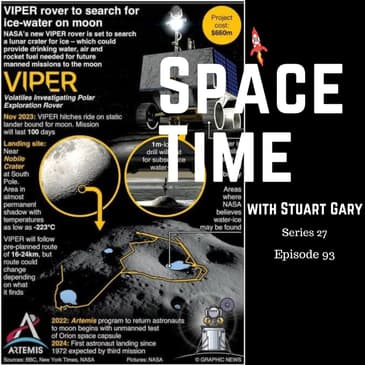
[00:00:21] All that and more coming up on SpaceTime. Welcome to SpaceTime with Stuart Gary. NASA has been forced to axe its $450 million lunar VIPER mission due to rising costs and delays in the launch schedule. Astrobotics Volatiles Investigating Polar Exploration Rover, or VIPER, was originally
[00:00:58] slated for launch last year but was delayed to allow more time for pre-flight testing of the lander. Subsequent schedule and supply chain delays pushed VIPER's readiness date to September 2025, with its Commercial Lunar Payload Services launch aboard Astrobotics' Gryphon lander delayed by a similar time frame.
[00:01:17] NASA says continuing VIPER would have increased costs and delayed other experiments on the flight. NASA, of course, is undertaking an array of missions to the moon over the next five years looking for ice and other resources.
[00:01:29] The agency will now dismantle and reuse VIPER's instruments and components for other moon missions. Meanwhile, Astrobotics will continue with its Gryphon mission 1 for NASA aiming for a launch later next year. The flight will demonstrate the Gryphon lander's capabilities including its engines.
[00:01:47] Another Commercial Lunar Payload Services launch, the Polar Resources Ice Mining Experiment Prime 1, is slated to land at the lunar South Pole before the end of this year. It will also search for water ice and undertake a resource utilization demonstration using
[00:02:01] a drill and mass spectrometer to measure the volatile content of subsurface materials. The mission will also transport instruments which will form part of NASA's Artemis Lunar Man missions, which are expected to start arriving on the lunar surface in 2026.
[00:02:15] These include a Lunar Terrain Vehicle designed to undertake mobile observations of volatiles across the South Pole region and provide astronauts with access to the moon's permanently shadowed regions for SAP or return missions. This report from NASA TV.
[00:02:30] NASA's Artemis missions will establish the first long-term human presence on the lunar surface. Living and working on the lunar surface will require using resources that are already present there like water ice which can be used for life support and fuel.
[00:02:45] The Polar Resources Ice Mining Experiment 1, or Prime 1, will be deployed to the lunar South Pole by our Commercial Lunar Lander Partner Intuitive Machines. Prime 1 is intended to drill for water on the lunar surface. Prime 1 is the combination of two instruments, a drill built by Honey Bee Robotics called
[00:03:03] Triton which stands for the Regolith Ice Drill for Exploring New Terrain and the Mass Spectrometer Observing Lunar Operations or MSOLO, which is a commercially available mass spectrometer from our industry partner Inficon that we have modified for operation in the harsh space environment.
[00:03:18] Triton will drill into the lunar surface taking one small bite deeper into the soil at a time and bringing that sample up and depositing it on the lunar surface. MSOLO will then evaluate those samples as they arrive on the surface to identify and
[00:03:30] measure the composition of water and other volatiles emanating from the samples. The objective of Prime 1 is to inform NASA's plans for mining resources on the lunar surface. So how will we extract water on the moon?
[00:03:42] The Prime 1 mission will set the foundation for future resource utilization on the moon, a key component for the success of upcoming Artemis missions as well as expanding human exploration of our solar system. And in that report from NASA TV, we heard from NASA Ice Mining Engineer Amy Eisenbaum.
[00:03:59] This is Space Time. Still to come, discovery of another intermediate black hole, this one near the center of the galaxy and a special message for the Jovian ice moon Europa. All that and more still to come on Space Time.
[00:04:30] Astronomers have discovered what they believe is another rare intermediate mass black hole, this one near the center of the Milky Way galaxy. The new find comes just a week after the announcement of another intermediate mass black hole candidate
[00:04:42] discovery, that one 17,700 light years away in the Omega Centauri globular star cluster. The new find was detected as researchers were studying a cluster of stars in the immediate vicinity of Sagittarius A star. Located 27,000 light years away at the heart of the Milky Way galaxy, Sagittarius A star
[00:05:02] is a supermassive black hole with some 4.3 million times the mass of our Sun. So far, only around 10 intermediate mass black hole candidates have been identified. They are considered rare events. See, most black holes are either stellar mass black holes which can be up to around 100
[00:05:21] times the mass of the Sun and are created by the collapse or merger of massive stars. At the other end of the scale there are supermassive black holes like Sagittarius A star. These lie at the hearts of most if not all galaxies and are usually millions to billions
[00:05:36] of times the mass of the Sun. Finding intermediate size black holes which fit somewhere between these two extremes has been difficult. But it's an important goal because intermediate mass black holes are considered the missing links in black hole evolution.
[00:05:51] Astronomers need to know how common they are, how and where they're made. Are they created by the merger of smaller stellar mass black holes and do they ultimately merge to form larger supermassive black holes?
[00:06:02] A report in the Astrophysical Journal claims this new discovery may date to the very early universe. It was discovered during an analysis of a star cluster known as IRS-13 located just 0.1 light years from the centre of the galaxy.
[00:06:17] Astronomers noticed that the stars in IRS-13 move in an unexpectedly orderly pattern. They had actually expected the stars to be far more randomly arranged. The study's lead author, Florian Fisker from the University of Cologne, says the compact regular pattern suggests that IRS-13 appears to be interacting with Sagittarius
[00:06:36] A star, resulting in the orderly motion of the stars. On the other hand, there must also be something inside the cluster to be able to maintain its observed orderly compact shape. Multi-wavelength observations using the European Southern Observatory's Very Large Telescope
[00:06:52] the VLT, as well as the Atacama Large Millimeter Submillimeter Array Radio Telescope ALMA and NASA's Chandra X-ray Telescope suggest that the reason for the compact shape of IRS-13 could be an intermediate mass black hole located at the centre of the cluster.
[00:07:09] And that's been supported by observations detecting characteristic X-rays in ionized gas rotating at a speed of several hundreds of kilometres per second in what could be an accretion disk around the suspected location of the intermediate mass black hole.
[00:07:24] Another indication of the presence of an intermediate mass black hole is the unusually high density of the star cluster, which is far higher than any other known density of a star cluster in the galaxy. Fisker believes IRS-13 is a building block for the growth of Sagittarius A star.
[00:07:41] He says this fascinating star cluster has continued to surprise the scientific community ever since it was discovered 20 years ago. At first it was thought to be an unusually heavy single star, but with higher resolution data astronomers can now confirm the building block composition of an intermediate black
[00:07:58] hole at its centre. Fisker says planned future observations with the James Webb Space Telescope and the Extremely Large Telescope, which is currently under construction, will provide further insights into the processes within this fascinating star cluster. ISS Space Time
[00:08:16] Still to come, a special message for the Jovian ice moon Europa, and later in the Science Report a new study shows that people who drink cranberry juice are less likely to develop urinary tract infections. All that and more still to come on Space Time.
[00:08:46] In the spirit of NASA's twin Voyager spacecraft, which are each carrying a golden record with greetings from Earth, NASA's new Europa Clipper mission, which is slated to launch in October, is also carrying a richly layered plaque commemorating the Jovian-bound mission.
[00:09:01] This plaque contains inspirational messages and more than 2.6 million names submitted by the public. Europa contains a deep subsurface ocean beneath its icy crust. This global ocean contains more than twice the amount of water of all the Earth's oceans combined.
[00:09:18] Europa is the smallest of the four Galilean moons orbiting Jupiter, the others being Io, Ganymede and Callisto. It's the sixth largest moon in the solar system, and it's only slightly smaller than the Earth's moon. It has a very thin atmosphere composed primarily of oxygen.
[00:09:35] It has a geologically young white-beige crust, which just happens to be the smoothest surface of any known solid object in the solar system. That's possibly due to water upwelling from the subsurface ocean and constantly resurfacing
[00:09:47] the exterior, which is dry-rated in light tan-coloured cracks and streaks with very few impact craters. It's thought Europa's oceans are kept liquid by tidal flexing generated friction due to constant squeezing and stretching by the gravitational influence of Europa's giant host planet Jupiter and the other nearby moons.
[00:10:07] And this constant flexing also drives ice movements similar to plate tectonics, absorbing chemicals from the surface into the ocean below and spraying sea salts from the ocean onto the surface. There's speculation that the minerals in these sea salts are caused by interaction between
[00:10:22] the ocean floor and the moon's mantle, providing nutrients for any life that might exist there. Scientists know that mid-ocean ridges on Earth provide unique habitats for exotic species of marine life and may even have been the cradle where life on Earth began.
[00:10:38] And if a similar process occurred in the oceans of Europa, it would mean life can form almost anywhere and is likely plentiful across the universe. That's why the Europa Clipper mission is so important. In 2030, after its six-year, 2.6 billion kilometre journey, Europa Clipper will begin orbiting
[00:10:57] Jupiter, making 49 close flybys of the ice moon Europa. To determine if there are conditions on that icy world that could support life, the spacecraft is equipped with a powerful suite of scientific instruments. They'll gather data about the moon's subsurface ocean, its icy crust, its thin atmosphere and
[00:11:14] its surrounding space environment. Its main science objectives will be to determine the thickness of the crust and its interactions with the ocean below, to investigate its composition and to characterise its geology. The mission's detailed exploration of Europa will help scientists better understand the
[00:11:32] astrobiological potential for habitable worlds beyond our planet. The electronics for those instruments are all housed in a massive metal vault designed to protect them from Jupiter's punishing radiation. And the commemorative plaque we talked about at the top of our story is mounted just above
[00:11:48] the opening to this vault. This report from NASA TV. 3, 2, 1, engine ignition. There's a legacy of NASA spacecraft carrying inspirational messages from Earth, going back to the Pioneer plaque and the Voyager Golden Record. Now, Europa Clipper, a new mission from one ocean world to another, will continue this tradition.
[00:12:15] Because water connects our planet and Jupiter's moon Europa, all life as we know it and all human cultures, a part of the spacecraft has been engraved with designs inspired by water and human connections. This metal plate is part of a structure that will protect the spacecraft's electronics
[00:12:35] from the threat of Jupiter's radiation. On one side of the plate is a design we call Water Words, recordings of the word for water in a diverse collection of human languages. The other side of the plate is a montage of elements that complete our message in a bottle.
[00:12:54] At the top is the Drake Equation, a tribute to the visionary idea that the probability of finding life in the cosmos is something we can estimate. Next, two lines represent radio frequencies emitted in space by molecules related to water,
[00:13:10] which have been considered an ideal place to search for interstellar communications, as suggested by some researchers. They represent our ability to use the language of science to search for signs of life. Next is a portrait of one of the founders of planetary science, Dr. Ron Greeley, whose
[00:13:28] early efforts to develop a Europa mission laid the foundation for Europa Clipper. At the heart of this message in a bottle is a poem in the handwriting of U.S. Poet Laureate Ada Limon. The poem connects the two water worlds, Earth yearning to reach out and understand what
[00:13:48] makes a world habitable, and Europa waiting with secrets yet to be explored. Finally, the bottle, orbited by the four largest moons of Jupiter, to which will be attached a microchip etched with more than 2.6 million names of those who signed on in the spirit
[00:14:08] of the poem as our message is sent on its voyage to Europa. As technically advanced as the spacecraft is, every part of it is made by people. And all of the markings on the plate are either handwritten, hand-drawn, or represent human voices and names.
[00:14:29] Because exploration is something we do together. Something that connects us all as we head out into the cosmic sea. This is Space Time. And time now to take another brief look at some of the other stories making use in science this week with the Science Report.
[00:15:19] Scientists have developed a revolutionary new blood test based on lipids, that's fats in the blood, that could save millions of lives by identifying people at early risk of heart attack or stroke. The discovery, reported in the Journal of the American College of Cardiology, improves
[00:15:33] risk prediction, identifying people who might require aggressive preventative treatment or alternatively a step-down approach such as lifestyle modification. This new tool can take over from traditional blood tests like the Framington Risk Score, which looks for classical risk factors like good and bad cholesterol levels and which have
[00:15:51] limitations especially in accurate assessment. This can be especially dangerous as there are often a lack of symptoms in the early stages of heart disease resulting in late diagnosis when the disease or heart damage is far more difficult to treat.
[00:16:05] So researchers at the Baker Heart and Diabetes Institute and La Trobe University developed a lipidomic risk score that refines intermediate risk assessment where traditional models like the Framington Risk Score fall short. The new test better predicts the risk for heart disease based on high-risk plaque build-up
[00:16:22] in the arteries and it can be integrated into routine blood tests. A new study shows that people who regularly drink cranberry juice are 54% less likely to develop urinary tract infections. The findings, reported in the journal European Urology Focus, confirms that cranberry juice
[00:16:41] appears to be a natural UTI remedy. It's long been suspected that cranberries contain compounds that prevent bacteria from adhering to the walls of the urinary tract, reducing the risk of infection. However, until now the effectiveness of cranberry juice had not been confirmed.
[00:16:58] That was until this network meta-analysis by scientists at Bond University who amalgamated the results of 20 separate studies involving some 3,091 participants worldwide. They showed that drinking cranberry juice made you less likely to develop UTIs. A new discovery in the dark depths of the Pacific Ocean is challenging the scientific
[00:17:21] consensus on how oxygen is produced and could also introduce new questions on how life began on Earth. While conducting experiments on the sea floor to measure oxygen concentrations in preparation for deep sea mining, scientists found oxygen was actually being produced in the darkness
[00:17:37] at 4,000 metres below the sea surface, a region where no light can penetrate. Traditionally oxygen in the seas thought to come from photosynthetic organisms like plants and algae which use sunlight to produce oxygen.
[00:17:51] But the authors of this study found nodules on the sea floor which effectively act as small batteries using electricity to split sea water into hydrogen and oxygen. A report in the journal Nature Geoscience says these dark oxygen findings call into question what researchers know about oxygen production.
[00:18:08] And the findings have led scientists to warn that mining could impact deep sea ecosystems if the nodules were to be harvested. In a world dominated by corrupt journalists pushing a cause who think the story's all
[00:18:22] about their opinion, there are very few news organisations these days that simply focus on giving you the facts with balance and honest reporting. But as Tim Mendham from Australian Skeptics reports, one of those rare bastions of truth-to-power
[00:18:36] news organisations has now decided to include the pseudoscience of astrology in, of all places, its flagship 6 o'clock news hour. It's slightly disappointing, you might say, us people in journalism with our background in journalism and reporters, i.e. reporting stuff.
[00:18:51] We've had astrology on TV programs before, obviously I think most countries have. It's normally in the morning program which is a bit of a magazine type tabloid program with bits and pieces and they throw in their resident astrologer to talk about what's coming up.
[00:19:04] For most of the astrologers, it gives them a bit of business. It's light-hearted. This is the evening news. This is the major news broadcast of this particular TV channel. Sticking in its text, it's not a talking head but it's predictions, astrological predictions
[00:19:18] of the most inane, vague, generalistic sort you've ever seen amongst astrological predictions which is a pretty high barrier to jump over but they have, in the middle of the news, actually towards the end of the news, in the funny section if you like, just listing these
[00:19:31] here are yours, star signs and here are your predictions of how the week's going to be. I always regarded them as the most respected news service in Australia because they don't put bias in their stories and they just give you the facts and I like that.
[00:19:43] That's what I think journalism should be about. Maybe that's just me but that's what I like about them. And now they've kicked me right in the guts. They're putting astrology in their news broadcast. What the hell is that about? I don't know.
[00:19:56] It's caused a ruckus amongst serious journalists, semi-serious journalists, whatever. That is obviously just a ploy for what you call in the industry, bums on seats, right? It's click bait to try and get an audience in for a light-hearted entertainment aspect
[00:20:10] of the news which is pretty distressing when you see that the news program is obviously having a lot of trouble. One trying to overcome some rather unfortunate decisions that's made editorially in the past, in the recent past, people have interviewed etc. and supported but also just declining
[00:20:25] viewing of TV news generally as opposed to online or newspapers having the same problems where they have had astrology columns for a long time. Online podcasts, everything like that has taken over from the traditional media.
[00:20:36] So, it's not going to try anything to get people in but gee whiz, it makes you wonder if this is the people you want to get into your news broadcast. It's depressing. It is depressing. It affects credibility. It really does affect the… Totally. It affects the whole program.
[00:20:50] I mean people don't differentiate that little bit from the rest of it. Anthony, what are you doing? If you can't do the job properly, get out of it. Let somebody else in there. Yeah, yeah, I know. It's sad.
[00:21:00] It's a play by a new broom in the department I think who just wants to sort of… It's like an episode of the comedy series Frontline. It's exactly like that. When they went from the blue newsy background to the bright orange exciting background type thing. Yes, yes.
[00:21:16] It is jumping the shark, right? As we say in the entertainment industry. It's really the lowest common denominator you're going for. If you can state it categorically, there is no truth to astrology. It does not work.
[00:21:27] It cannot work and it's a pseudoscience that's been around for a long, long, long, long time based on star signs which is a tenuous belief anyway because they don't exactly match up to what the astrology columns say they do.
[00:21:39] Astrology columns were often written by journalists in their spare time. They just may come up or they were reused over and over again and no one realized, no one paid any attention. They were just a fun thing in the news. It's a bit more serious.
[00:21:50] That's Tim Mendham from Australian Skeptics. And that's the show for now. Space Time is available every Monday, Wednesday and Friday through Apple Podcasts iTunes, Stitcher, Google Podcasts, Pocket Casts, Spotify, Acast, Amazon Music, Bytes.com, SoundCloud, YouTube, your favourite podcast download provider and from spacetimewithstuartgarry.com.
[00:22:30] Space Time is also broadcast through the National Science Foundation on Science Zone Radio and on both iHeart Radio and TuneIn Radio. And you can help to support our show by visiting the Space Time store for a range of promotional merchandising goodies.
[00:22:45] Or by becoming a Space Time Patron which gives you access to triple episode commercial free versions of the show as well as lots of bonus audio content which doesn't go to air, access to our exclusive Facebook group and other rewards. Just go to spacetimewithstuartgarry.com for full details.
[00:23:02] And if you want more Space Time, please check out our blog where you'll find all the stuff we couldn't fit in the show as well as heaps of images, news stories, loads of videos and things on the web I find interesting or amusing.
[00:23:14] Just go to spacetimewithstuartgarry.pumblr.com. It's all one word and that's Tumblr without the E. You can also follow us through at Stuart Garry on Twitter, at Spacetime with Stuart Garry on Instagram, through our Space Time YouTube channel and on Facebook just go to
[00:23:31] facebook.com forward slash spacetimewithstuartgarry. You've been listening to Space Time with Stuart Garry. This has been another quality podcast production from Bytes.com.