
Join us for these fascinating updates and more!
00:00:00 - This is spacetime series 27, episode 99 for broadcast on the 16 August 2024
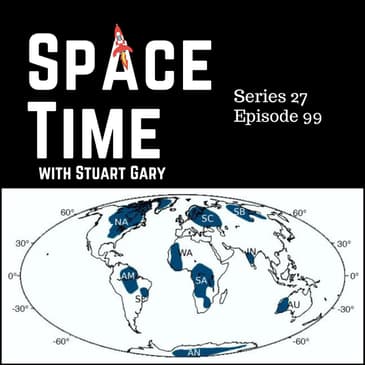
00:00:45 - New study pokes holes in leading theories of continental formation
00:03:49 - Neutrinos are fundamental to the standard model of particle physics
00:05:53 - Scientists have detected high energy neutrinos from the Large Hadron Collider
00:16:37 - The World Health Organisation has issued a warning about a new superbug
00:18:39 - Reports growing that UK is running out of ghosts
For more SpaceTime, visit our website at www.spacetimewithstuartgary.com
www.bitesz.com
Become a supporter of this podcast: https://www.spreaker.com/podcast/spacetime-with-stuart-gary--2458531/support
[00:00:00] [SPEAKER_00]: This is SpaceTime, Series 27, Episode 99, for broadcast on the 16th of August 2024.
[00:00:07] [SPEAKER_00]: Coming up on SpaceTime, current ideas on how Earth's continents form just got a whole lot muddier,
[00:00:13] [SPEAKER_00]: a major breakthrough in subatomic particle measurements,
[00:00:17] [SPEAKER_00]: and studying the cosmic dawn and the ultimate fate of our universe.
[00:00:22] [SPEAKER_00]: All that and more coming up on SpaceTime.
[00:00:26] [SPEAKER_02]: Welcome to SpaceTime with Stuart Gary.
[00:00:45] [SPEAKER_00]: The formation of Earth's continents billions of years ago
[00:00:48] [SPEAKER_00]: helped set the stage for the formation and eventual evolution of life on this planet.
[00:00:54] [SPEAKER_00]: But scientists have long disagreed on exactly how those land masses formed
[00:00:58] [SPEAKER_00]: and whether it's through the same sort of geological processes we see today.
[00:01:03] [SPEAKER_00]: Now, a new study by David Hernandez-Aribe from the University of Illinois
[00:01:07] [SPEAKER_00]: adds new information to the debate,
[00:01:10] [SPEAKER_00]: poking holes in the leading theories of continental formation.
[00:01:13] [SPEAKER_00]: Hernandez-Aribe used computer models to study the formation of magmas
[00:01:17] [SPEAKER_00]: thought to hold clues about the origins of the continents.
[00:01:21] [SPEAKER_00]: His work reported in the journal Nature Geoscience
[00:01:24] [SPEAKER_00]: looked for magmas that matched the compositional signature
[00:01:26] [SPEAKER_00]: of rare mineral deposits called zircons
[00:01:29] [SPEAKER_00]: that date back to the Archaian period between 2.5 and 4 billion years ago.
[00:01:33] [SPEAKER_00]: That's the time most scientists think the first continents formed.
[00:01:38] [SPEAKER_00]: Last year scientists from Australia and China published a paper
[00:01:41] [SPEAKER_00]: arguing that Archaian zircons could only be formed by subduction.
[00:01:45] [SPEAKER_00]: That's when two tectonic plates collide, one subducting under the other
[00:01:49] [SPEAKER_00]: and pushing the lighter material, the land mass, up to the surface.
[00:01:53] [SPEAKER_00]: Now that process still happens today, causing earthquakes and volcanic eruptions
[00:01:57] [SPEAKER_00]: and reshaping the coastlines of continents.
[00:01:59] [SPEAKER_00]: But Hernandez-Aribe claims subduction wasn't necessary
[00:02:03] [SPEAKER_00]: to create the Archaian zircons.
[00:02:06] [SPEAKER_00]: Instead, he found that the minerals could also form
[00:02:09] [SPEAKER_00]: through the high pressures and temperatures associated
[00:02:11] [SPEAKER_00]: with the melting of Earth's thick primordial crust.
[00:02:14] [SPEAKER_00]: He says that his calculations and models are producing
[00:02:17] [SPEAKER_00]: the same signatures for zircons and even provide a better match
[00:02:20] [SPEAKER_00]: through the partial melting of the bottom of the crust.
[00:02:23] [SPEAKER_00]: Now if correct, it means that based on these results
[00:02:26] [SPEAKER_00]: scientists still don't have enough evidence to say exactly
[00:02:29] [SPEAKER_00]: which process first began forming continents.
[00:02:33] [SPEAKER_00]: Now these results also raise uncertainty about when plate tectonics
[00:02:37] [SPEAKER_00]: would have started on Earth.
[00:02:38] [SPEAKER_00]: If Earth's first continents were formed by subduction,
[00:02:41] [SPEAKER_00]: that meant that the continents started moving between 3.6 and 4 billion years ago,
[00:02:46] [SPEAKER_00]: which is as little as 500 million years after the planet first formed.
[00:02:50] [SPEAKER_00]: But the alternative theory of melting crust forming the first continents
[00:02:54] [SPEAKER_00]: means that subduction and tectonics could have started much later.
[00:02:58] [SPEAKER_00]: The thing is, as far as we know, Earth's the only planet
[00:03:02] [SPEAKER_00]: in our solar system to have active plate tectonics.
[00:03:05] [SPEAKER_00]: And that's important because how the first continents moved
[00:03:08] [SPEAKER_00]: controlled the planet's weather.
[00:03:10] [SPEAKER_00]: It also controlled the chemistry of the oceans.
[00:03:13] [SPEAKER_00]: And all that was important for the formation and evolution
[00:03:16] [SPEAKER_00]: of life as we know it.
[00:03:18] [SPEAKER_00]: This is space time.
[00:03:20] [SPEAKER_00]: Still to come, a major breakthrough in subatomic particle measurements
[00:03:24] [SPEAKER_00]: and a new space telescope to study the cosmic dawn
[00:03:27] [SPEAKER_00]: and the ultimate fate of our universe.
[00:03:30] [SPEAKER_00]: All that and more coming up on Space Time.
[00:03:49] [SPEAKER_00]: Physicists at CERN have achieved the first ever direct observations
[00:03:53] [SPEAKER_00]: of high energy electron- and muon-neutrino interactions
[00:03:56] [SPEAKER_00]: in a particle accelerator.
[00:03:59] [SPEAKER_00]: Neutrinos are elementary subatomic particles.
[00:04:01] [SPEAKER_00]: They're fundamental to the standard model of particle physics,
[00:04:05] [SPEAKER_00]: the foundation stone of science's understanding of the universe.
[00:04:09] [SPEAKER_00]: Neutrinos are generated through radioactive decay in stars,
[00:04:13] [SPEAKER_00]: in supernovae, in nuclear explosions,
[00:04:15] [SPEAKER_00]: in particle accelerators and atomic reactors.
[00:04:19] [SPEAKER_00]: They're so named because they're electrically neutral
[00:04:22] [SPEAKER_00]: and because their rest mass is so small, it was long thought to be zero.
[00:04:26] [SPEAKER_00]: Neutrinos are the most common form of matter in our universe.
[00:04:30] [SPEAKER_00]: And because they have almost no mass,
[00:04:32] [SPEAKER_00]: they're capable of being accelerated to almost the speed of light.
[00:04:36] [SPEAKER_00]: Neutrinos come in three known types or flavours,
[00:04:40] [SPEAKER_00]: electron-neutrinos, muon-neutrinos and tau-neutrinos.
[00:04:44] [SPEAKER_00]: Each of these have their own specific properties.
[00:04:47] [SPEAKER_00]: Confusingly however, the three flavours of neutrinos
[00:04:50] [SPEAKER_00]: don't line up with their three rest masses.
[00:04:53] [SPEAKER_00]: It seems that each of the three flavours is made up
[00:04:56] [SPEAKER_00]: of a quantum mixture of the three mass species,
[00:04:59] [SPEAKER_00]: so a particular tau-neutrino for example,
[00:05:01] [SPEAKER_00]: has bits of both electron and muon-neutrinos in it.
[00:05:05] [SPEAKER_00]: And because of these different mass species,
[00:05:07] [SPEAKER_00]: it allows neutrinos to oscillate between the three flavours.
[00:05:10] [SPEAKER_00]: For example, an electron-neutrino produced in a beta decay reaction
[00:05:14] [SPEAKER_00]: could well end up interacting in a distant detector
[00:05:17] [SPEAKER_00]: as a muon or tau-neutrino.
[00:05:19] [SPEAKER_00]: The other amazing thing about neutrinos is that they interact with matter
[00:05:23] [SPEAKER_00]: only through gravity and the weak nuclear force.
[00:05:26] [SPEAKER_00]: In fact, they're so weakly interactive,
[00:05:28] [SPEAKER_00]: right now there are several trillion neutrinos passing through you
[00:05:31] [SPEAKER_00]: and you don't even notice them.
[00:05:33] [SPEAKER_00]: They're important for answering fundamental questions about the universe,
[00:05:38] [SPEAKER_00]: including why particles have mass
[00:05:39] [SPEAKER_00]: and why there's more matter than antimatter in our universe.
[00:05:43] [SPEAKER_00]: So understanding their rare interactions with matter
[00:05:45] [SPEAKER_00]: is crucial for obtaining a more complete picture of particle physics
[00:05:49] [SPEAKER_00]: and consequently a better understanding of the universe.
[00:05:53] [SPEAKER_00]: Now so far most neutrinos studied by researchers
[00:05:56] [SPEAKER_00]: have all been relatively low-energy ones.
[00:05:59] [SPEAKER_00]: To date, neutrino interaction cross sections,
[00:06:01] [SPEAKER_00]: which is the probability of a neutrino interacting with a target particle,
[00:06:05] [SPEAKER_00]: have not been measured at energies above 300 GV from an electron neutrino
[00:06:10] [SPEAKER_00]: and between 400 GV and 6 TV for a muon neutrino.
[00:06:16] [SPEAKER_00]: But all that has now changed.
[00:06:18] [SPEAKER_00]: In a groundbreaking study reported in the journal Physical Review Letters,
[00:06:22] [SPEAKER_00]: physicists led by Akitaka Uraga from Chiba University in Japan
[00:06:26] [SPEAKER_00]: have utilized the FASA forward search experiment
[00:06:29] [SPEAKER_00]: at CERN's Large Hadron Collider
[00:06:31] [SPEAKER_00]: to achieve the first ever direct observation
[00:06:34] [SPEAKER_00]: of high-energy electron and muon neutrino interactions
[00:06:37] [SPEAKER_00]: in a particle collider.
[00:06:39] [SPEAKER_00]: One of the primary objectives of FASA
[00:06:41] [SPEAKER_00]: is to study the high-energy neutrinos
[00:06:43] [SPEAKER_00]: produced by the Large Hadron Collider's proton-proton collisions
[00:06:46] [SPEAKER_00]: using the dedicated FASA-V detector.
[00:06:49] [SPEAKER_00]: Akitaka Uraga says charged particle tracks
[00:06:52] [SPEAKER_00]: produced by neutrino interactions in the detector
[00:06:54] [SPEAKER_00]: can be reconstructed with sub-micron precision,
[00:06:57] [SPEAKER_00]: allowing scientists to identify electron and muon
[00:07:00] [SPEAKER_00]: charged current neutrino interactions
[00:07:02] [SPEAKER_00]: and the measurement of neutrino interaction cross sections
[00:07:05] [SPEAKER_00]: in the currently unexplored terrate electron volt energy range.
[00:07:09] [SPEAKER_00]: The FASA-V emulsion detector is made up of 730 layers
[00:07:13] [SPEAKER_00]: of interleaved tungsten plates and emulsion films
[00:07:16] [SPEAKER_00]: with a total mass of just over a ton.
[00:07:18] [SPEAKER_00]: The team analyzed just a subset from the exposed detector volume
[00:07:22] [SPEAKER_00]: corresponding to a mass of just 128.6 kilograms,
[00:07:25] [SPEAKER_00]: looking for high-energy neutrinos
[00:07:27] [SPEAKER_00]: from the Large Hadron Collider collisions.
[00:07:30] [SPEAKER_00]: And after applying strict criteria,
[00:07:32] [SPEAKER_00]: selecting events with electrons and muons
[00:07:34] [SPEAKER_00]: with energies above 200 giga electron volts,
[00:07:37] [SPEAKER_00]: four electron neutrino interaction candidate events,
[00:07:40] [SPEAKER_00]: and eight muon neutrino interaction candidate events were observed.
[00:07:44] [SPEAKER_00]: These interactions had a high statistical significance
[00:07:47] [SPEAKER_00]: of 5.2 sigma for the electron neutrinos
[00:07:49] [SPEAKER_00]: and 5.7 sigma for muon neutrinos.
[00:07:53] [SPEAKER_00]: In physics, anything above 5 sigma is considered a real discovery.
[00:07:57] [SPEAKER_00]: In other words, it's extremely unlikely
[00:07:59] [SPEAKER_00]: to be just random background fluctuations
[00:08:01] [SPEAKER_00]: and therefore they represent actual neutrinos.
[00:08:05] [SPEAKER_00]: The neutrinos detected in this study
[00:08:06] [SPEAKER_00]: had energies in the terrate electron volt range,
[00:08:09] [SPEAKER_00]: the highest ever detected from an artificial source.
[00:08:12] [SPEAKER_00]: This marks the first ever measurement
[00:08:14] [SPEAKER_00]: of neutrino interaction cross sections
[00:08:16] [SPEAKER_00]: in the unexplored energy range of 560 to 1740 giga electron volts
[00:08:22] [SPEAKER_00]: for an electron neutrino,
[00:08:24] [SPEAKER_00]: and 520 to 1760 giga electron volts for a muon neutrino.
[00:08:30] [SPEAKER_00]: Importantly, the measured interaction cross sections
[00:08:33] [SPEAKER_00]: are consistent with predictions in the Standard Model.
[00:08:36] [SPEAKER_00]: So these results are marking the first ever physics results
[00:08:39] [SPEAKER_00]: on neutrinos from a particle collider.
[00:08:42] [SPEAKER_00]: That's a breakthrough in particle physics
[00:08:44] [SPEAKER_00]: that could revolutionize the strategy
[00:08:46] [SPEAKER_00]: of large-scale experimental research in this field.
[00:08:50] [SPEAKER_00]: This space time.
[00:08:52] [SPEAKER_00]: Still to come, studying the cosmic dawn
[00:08:54] [SPEAKER_00]: and the ultimate fate of our universe
[00:08:56] [SPEAKER_00]: using a new spacecraft,
[00:08:58] [SPEAKER_00]: and later in the science report,
[00:09:00] [SPEAKER_00]: the World Health Organization issues a new warning
[00:09:03] [SPEAKER_00]: about a new type of super bug threat.
[00:09:06] [SPEAKER_00]: All that and more still to come on Space Time.
[00:09:23] [SPEAKER_00]: As America's intelligence agencies
[00:09:25] [SPEAKER_00]: continue to improve their designs
[00:09:27] [SPEAKER_00]: for ever newer generations of spy satellites,
[00:09:30] [SPEAKER_00]: older reconnaissance and surveillance spacecraft designs
[00:09:32] [SPEAKER_00]: are becoming superseded.
[00:09:34] [SPEAKER_00]: And so it was in 2012
[00:09:37] [SPEAKER_00]: when the National Reconnaissance Office
[00:09:38] [SPEAKER_00]: gave NASA two spare spy satellites
[00:09:41] [SPEAKER_00]: for repurposing into space telescopes,
[00:09:43] [SPEAKER_00]: each potentially more powerful
[00:09:45] [SPEAKER_00]: than the agency's famous Hubble Space Telescope.
[00:09:48] [SPEAKER_00]: For years it had been an open secret
[00:09:50] [SPEAKER_00]: in the astronomy community
[00:09:52] [SPEAKER_00]: that the school bus-sized Hubble
[00:09:53] [SPEAKER_00]: was simply a modified Keyhole spy satellite
[00:09:56] [SPEAKER_00]: redesigned and fitted out to point upwards into space
[00:09:59] [SPEAKER_00]: rather than downwards onto the planet's surface.
[00:10:03] [SPEAKER_00]: Hubble even shares the same 2.4-meter primary mirror
[00:10:06] [SPEAKER_00]: and 30.5-centimeter wide secondary mirror dimensions
[00:10:09] [SPEAKER_00]: as used by Keyhole,
[00:10:11] [SPEAKER_00]: but with a longer focal length
[00:10:12] [SPEAKER_00]: and hence a narrower field of view.
[00:10:15] [SPEAKER_00]: In much of its communications,
[00:10:17] [SPEAKER_00]: navigation and maneuvering systems
[00:10:18] [SPEAKER_00]: are also exactly the same as that used by Keyhole.
[00:10:22] [SPEAKER_00]: The two gifted Keyhole spy satellites
[00:10:25] [SPEAKER_00]: gave NASA the opportunity
[00:10:26] [SPEAKER_00]: to develop a new Earth-orbiting wide field telescope
[00:10:29] [SPEAKER_00]: specifically designed to search for signs
[00:10:32] [SPEAKER_00]: of a mysterious force called dark energy
[00:10:34] [SPEAKER_00]: which is responsible for the accelerating expansion
[00:10:37] [SPEAKER_00]: of our universe.
[00:10:39] [SPEAKER_00]: Understanding dark energy
[00:10:40] [SPEAKER_00]: will allow scientists to determine nothing less
[00:10:43] [SPEAKER_00]: than the ultimate fate of the cosmos.
[00:10:46] [SPEAKER_00]: Will the expansion of the universe eventually slow down,
[00:10:49] [SPEAKER_00]: with gravity taking over
[00:10:50] [SPEAKER_00]: and causing everything to start to come together again,
[00:10:53] [SPEAKER_00]: sort of a big crunch?
[00:10:54] [SPEAKER_00]: Or will dark energy eventually peter out,
[00:10:57] [SPEAKER_00]: allowing the universe's expansion to stop
[00:10:59] [SPEAKER_00]: and turning the cosmos into a steady state?
[00:11:02] [SPEAKER_00]: Or will that accelerating expansion continue forever,
[00:11:06] [SPEAKER_00]: eventually resulting in stars and galaxies
[00:11:08] [SPEAKER_00]: being so far away from each other
[00:11:10] [SPEAKER_00]: the sky is just a cold, dark, empty place?
[00:11:14] [SPEAKER_00]: Work on the new probe,
[00:11:16] [SPEAKER_00]: which has been named the Nancy Grace Roman Space Telescope,
[00:11:19] [SPEAKER_00]: has now been underway for about a decade,
[00:11:21] [SPEAKER_00]: with scientists looking at a launch date of May 2027
[00:11:24] [SPEAKER_00]: aboard a SpaceX Falcon Heavy rocket.
[00:11:27] [SPEAKER_00]: Originally named the Wide Field Infrared Survey Telescope
[00:11:31] [SPEAKER_00]: or WFIRST,
[00:11:32] [SPEAKER_00]: it was renamed in honor of Nancy Grace Roman,
[00:11:34] [SPEAKER_00]: a Jewish-American astronomer
[00:11:36] [SPEAKER_00]: who made important contributions
[00:11:37] [SPEAKER_00]: to stellar classification and motions.
[00:11:40] [SPEAKER_00]: She was the first female executive at NASA,
[00:11:43] [SPEAKER_00]: serving as the agency's first chief of astronomy
[00:11:45] [SPEAKER_00]: throughout the 1960s and 1970s.
[00:11:49] [SPEAKER_00]: The telescope's development has been primarily handled
[00:11:52] [SPEAKER_00]: by NASA's Goddard Space Flight Center
[00:11:53] [SPEAKER_00]: in Greenbelt, Maryland,
[00:11:55] [SPEAKER_00]: with participation by the Jet Propulsion Laboratory
[00:11:57] [SPEAKER_00]: in Pasadena, California.
[00:12:00] [SPEAKER_00]: Like the Webb Space Telescope,
[00:12:02] [SPEAKER_00]: Roman will be looking at the universe using infrared eyes,
[00:12:05] [SPEAKER_00]: and again like Webb,
[00:12:06] [SPEAKER_00]: it'll be placed in orbit around the Lagrangian L2 point,
[00:12:09] [SPEAKER_00]: one and a half million kilometers away
[00:12:11] [SPEAKER_00]: on the nighttime side of the Earth.
[00:12:13] [SPEAKER_00]: However, while Webb's designed to operate
[00:12:16] [SPEAKER_00]: in a very narrow and detailed field of view,
[00:12:18] [SPEAKER_00]: the Nancy Grace Roman will cover
[00:12:20] [SPEAKER_00]: a very broad patch of the sky.
[00:12:23] [SPEAKER_00]: Roman's mirror gives the telescope
[00:12:24] [SPEAKER_00]: a 0.281 degree field of view.
[00:12:28] [SPEAKER_00]: The light from the telescope
[00:12:29] [SPEAKER_00]: will enter two main instruments,
[00:12:31] [SPEAKER_00]: the Wide Field Instrument
[00:12:32] [SPEAKER_00]: and the telescope's chronograph instrument.
[00:12:35] [SPEAKER_00]: Roman will measure the light from over a billion galaxies
[00:12:38] [SPEAKER_00]: over five and a half years,
[00:12:40] [SPEAKER_00]: giving astronomers an unprecedented number
[00:12:42] [SPEAKER_00]: of galaxies in his field of view,
[00:12:43] [SPEAKER_00]: as well as the distribution of those galaxies
[00:12:45] [SPEAKER_00]: across the universe.
[00:12:47] [SPEAKER_00]: These will include galaxies that current
[00:12:49] [SPEAKER_00]: ground-based telescopes are missing,
[00:12:51] [SPEAKER_00]: and that will allow astronomers to better understand
[00:12:54] [SPEAKER_00]: the effects of dark energy on large cosmological scales,
[00:12:58] [SPEAKER_00]: looking at the clustering and evolution of galaxies.
[00:13:01] [SPEAKER_00]: Now, because of these characteristics,
[00:13:03] [SPEAKER_00]: it'll also observe a large number
[00:13:04] [SPEAKER_00]: of Type 1a supernovae.
[00:13:07] [SPEAKER_00]: These mark the explosive depths
[00:13:08] [SPEAKER_00]: of a specific type of star
[00:13:10] [SPEAKER_00]: that led to the concept of dark energy
[00:13:12] [SPEAKER_00]: in the accelerated expansion of the universe
[00:13:14] [SPEAKER_00]: in the first place.
[00:13:16] [SPEAKER_00]: Type 1a supernovae are caused by the death
[00:13:18] [SPEAKER_00]: of stars in a specific mass range,
[00:13:21] [SPEAKER_00]: and because they're roughly all the same,
[00:13:23] [SPEAKER_00]: they explode with roughly
[00:13:24] [SPEAKER_00]: the same level of luminosity,
[00:13:26] [SPEAKER_00]: and that allows astronomers to determine
[00:13:28] [SPEAKER_00]: how far away they are
[00:13:30] [SPEAKER_00]: by judging their apparent brightness
[00:13:32] [SPEAKER_00]: using what's known as the inverse square law.
[00:13:35] [SPEAKER_00]: It's like looking down the road
[00:13:36] [SPEAKER_00]: at a row of streetlights.
[00:13:38] [SPEAKER_00]: The further away the streetlights are,
[00:13:40] [SPEAKER_00]: the dimmer they appear, even though you know
[00:13:42] [SPEAKER_00]: they all have exactly the same level of luminosity.
[00:13:45] [SPEAKER_00]: The telescope's unique design
[00:13:47] [SPEAKER_00]: will allow it to probe the chronology
[00:13:49] [SPEAKER_00]: of the universe and the growth of cosmic structure,
[00:13:52] [SPEAKER_00]: with the end goal of measuring the effects
[00:13:54] [SPEAKER_00]: of dark energy, the consistency
[00:13:56] [SPEAKER_00]: of general relativity, and the curvature
[00:13:58] [SPEAKER_00]: of the very fabric of space-time.
[00:14:01] [SPEAKER_00]: These characteristics mean
[00:14:02] [SPEAKER_00]: it'll also be able to search for
[00:14:04] [SPEAKER_00]: extrasolar planets using gravitational microlensing,
[00:14:07] [SPEAKER_00]: the bending of light by the effect
[00:14:09] [SPEAKER_00]: mass has on the curvature of space-time.
[00:14:12] [SPEAKER_00]: This report by NASA TV.
[00:14:15] [SPEAKER_01]: Is there life out there?
[00:14:16] [SPEAKER_01]: Are we alone?
[00:14:18] [SPEAKER_01]: One NASA instrument will get us closer
[00:14:20] [SPEAKER_01]: to finding answers to some of humanity's
[00:14:22] [SPEAKER_01]: biggest questions.
[00:14:24] [SPEAKER_01]: NASA's Nancy Grace Roman Space Telescope
[00:14:27] [SPEAKER_01]: will fly with an instrument on board
[00:14:28] [SPEAKER_01]: called a coronagraph
[00:14:30] [SPEAKER_01]: that will allow scientists to see exoplanets
[00:14:32] [SPEAKER_01]: or worlds beyond our solar system
[00:14:34] [SPEAKER_01]: like never before.
[00:14:35] [SPEAKER_03]: So a coronagraph is a camera
[00:14:38] [SPEAKER_03]: or an instrument that we use
[00:14:40] [SPEAKER_03]: to look at planets around other stars.
[00:14:43] [SPEAKER_03]: And the reason we need a special instrument
[00:14:44] [SPEAKER_03]: to do this is because stars
[00:14:46] [SPEAKER_03]: are so much brighter than planets.
[00:14:50] [SPEAKER_03]: And what we need to do is we need
[00:14:51] [SPEAKER_03]: to put something in front of the star
[00:14:54] [SPEAKER_03]: to block the light from the star
[00:14:56] [SPEAKER_03]: so that we can instead see the very faint light
[00:14:58] [SPEAKER_03]: coming from the planet.
[00:15:00] [SPEAKER_01]: The Roman coronagraph, built at NASA's Jet Propulsion Lab,
[00:15:03] [SPEAKER_01]: will take a giant leap forward in our ability
[00:15:05] [SPEAKER_01]: to see worlds beyond our solar system
[00:15:07] [SPEAKER_01]: and will observe larger exoplanets,
[00:15:10] [SPEAKER_01]: roughly the size of Jupiter.
[00:15:12] [SPEAKER_01]: Testing the technology to see these planets
[00:15:14] [SPEAKER_01]: is the stepping stone toward one day
[00:15:15] [SPEAKER_01]: capturing direct images of Earth-like planets
[00:15:18] [SPEAKER_01]: around Sun-like stars.
[00:15:19] [SPEAKER_01]: These technologies include different
[00:15:21] [SPEAKER_01]: specially designed masks
[00:15:23] [SPEAKER_01]: and self-flexing mirrors
[00:15:24] [SPEAKER_01]: that will work together to block starlight
[00:15:27] [SPEAKER_01]: making planets orbiting these stars observable.
[00:15:29] [SPEAKER_01]: Testing technologies that could enable
[00:15:31] [SPEAKER_01]: future missions like NASA's Habitable Worlds
[00:15:33] [SPEAKER_01]: Observatory Mission Concept.
[00:15:35] [SPEAKER_03]: One of the primary goals
[00:15:37] [SPEAKER_03]: for the Habitable Worlds Observatory
[00:15:39] [SPEAKER_03]: will be to use a coronagraph
[00:15:41] [SPEAKER_03]: using the technology that we demonstrate
[00:15:43] [SPEAKER_03]: in the Roman coronagraph
[00:15:45] [SPEAKER_03]: to look for signs of life
[00:15:48] [SPEAKER_03]: around Earth-like planets
[00:15:50] [SPEAKER_03]: orbiting Sun-like stars.
[00:15:52] [SPEAKER_03]: If we show that these technologies
[00:15:54] [SPEAKER_03]: work together well,
[00:15:56] [SPEAKER_03]: we will have demonstrated about
[00:15:57] [SPEAKER_03]: a thousand times better performance
[00:15:59] [SPEAKER_03]: of a coronagraph in blocking starlight
[00:16:02] [SPEAKER_03]: and allowing planet light to come through
[00:16:04] [SPEAKER_03]: than any coronagraph ever built.
[00:16:07] [SPEAKER_01]: As it embarks on its journey
[00:16:08] [SPEAKER_01]: to the stars aboard NASA's
[00:16:09] [SPEAKER_01]: Nancy Grace Roman Space Telescope,
[00:16:12] [SPEAKER_01]: the Roman coronagraph instrument will pave
[00:16:13] [SPEAKER_01]: the way for future searches for
[00:16:15] [SPEAKER_01]: habitable worlds and ultimately
[00:16:17] [SPEAKER_01]: the search for life beyond Earth.
[00:16:27] [SPEAKER_00]: And in that report from NASA TV
[00:16:29] [SPEAKER_00]: we heard from Roman coronagraph instrument
[00:16:31] [SPEAKER_00]: technologist Vanessa Bailey
[00:16:32] [SPEAKER_00]: and Roman coronagraph deputy project scientist
[00:16:35] [SPEAKER_00]: Jason Rhodes.
[00:16:37] [SPEAKER_00]: This is Space Time.
[00:16:55] [SPEAKER_00]: And time now to take another brief look
[00:16:57] [SPEAKER_00]: at some of the other stories making news
[00:16:58] [SPEAKER_00]: in science this week with the Science Report.
[00:17:01] [SPEAKER_00]: The World Health Organization
[00:17:02] [SPEAKER_00]: has issued a warning about a new
[00:17:04] [SPEAKER_00]: superbug called Hypervillorant-Clebe
[00:17:06] [SPEAKER_00]: Cillianumonia Sequence Type 23
[00:17:09] [SPEAKER_00]: which has been reported in all
[00:17:10] [SPEAKER_00]: six World Health Organization regions
[00:17:12] [SPEAKER_00]: including Australia.
[00:17:14] [SPEAKER_00]: The superbug is resistant to all
[00:17:16] [SPEAKER_00]: last line antibiotics and can
[00:17:18] [SPEAKER_00]: cause severe infections even in healthy people.
[00:17:22] [SPEAKER_00]: The WHO has assessed
[00:17:23] [SPEAKER_00]: the risk as moderate given the
[00:17:25] [SPEAKER_00]: challenges with surveillance, lack of
[00:17:27] [SPEAKER_00]: information on laboratory testing rates,
[00:17:29] [SPEAKER_00]: track and scale of community transmission,
[00:17:31] [SPEAKER_00]: the gap in the available data on
[00:17:33] [SPEAKER_00]: infections, hospitalisation
[00:17:34] [SPEAKER_00]: and the overall burden of the disease.
[00:17:38] [SPEAKER_00]: WHO is
[00:17:38] [SPEAKER_00]: recommending that all countries increase
[00:17:40] [SPEAKER_00]: the laboratory diagnostic capabilities
[00:17:42] [SPEAKER_00]: to allow for the early and reliable
[00:17:44] [SPEAKER_00]: identification of this new threat.
[00:17:47] [SPEAKER_00]: Well in case you haven't noticed it,
[00:17:49] [SPEAKER_00]: planet Earth is currently going through
[00:17:51] [SPEAKER_00]: its sixth mass extinction event
[00:17:53] [SPEAKER_00]: and this one is caused
[00:17:55] [SPEAKER_00]: by human activity.
[00:17:57] [SPEAKER_00]: A report in the Journal of the Frontiers of Science
[00:17:59] [SPEAKER_00]: says researchers have now identified
[00:18:01] [SPEAKER_00]: 16,825
[00:18:03] [SPEAKER_00]: sites around the world which should be
[00:18:05] [SPEAKER_00]: targeted to help prevent the worst
[00:18:07] [SPEAKER_00]: effects of the Anthropocene
[00:18:08] [SPEAKER_00]: mass extinction which is already wiping out
[00:18:11] [SPEAKER_00]: species at an ever accelerating
[00:18:13] [SPEAKER_00]: rate. Now look at the areas of the
[00:18:15] [SPEAKER_00]: world scientists should be targeting,
[00:18:17] [SPEAKER_00]: the authors met the entire world using
[00:18:18] [SPEAKER_00]: biodiversity data to find areas
[00:18:21] [SPEAKER_00]: currently unprotected by conservation
[00:18:23] [SPEAKER_00]: efforts that house large amounts of rare
[00:18:25] [SPEAKER_00]: and threatened species.
[00:18:27] [SPEAKER_00]: They say the sites they have identified
[00:18:28] [SPEAKER_00]: covered 1.22% of the world's
[00:18:31] [SPEAKER_00]: landmass and proper protection
[00:18:33] [SPEAKER_00]: of these sites would help preserve
[00:18:35] [SPEAKER_00]: some of the world's remaining rare and endangered
[00:18:37] [SPEAKER_00]: species.
[00:18:39] [SPEAKER_00]: A new study has concluded
[00:18:41] [SPEAKER_00]: that the so called screaming woman mummy
[00:18:43] [SPEAKER_00]: may well have died in agony.
[00:18:45] [SPEAKER_00]: A report in the Journal of Frontiers of
[00:18:47] [SPEAKER_00]: Medicine used state of the art techniques
[00:18:49] [SPEAKER_00]: to virtually dissect the
[00:18:51] [SPEAKER_00]: 3,500 year old New Kingdom female
[00:18:53] [SPEAKER_00]: corpse known as the screaming mummy
[00:18:55] [SPEAKER_00]: because of her remarkable open mouth
[00:18:57] [SPEAKER_00]: expression. That combined with
[00:18:59] [SPEAKER_00]: the presence of organs which are normally removed
[00:19:01] [SPEAKER_00]: during the mummification process
[00:19:02] [SPEAKER_00]: initially led researchers to believe that her mouth
[00:19:05] [SPEAKER_00]: was opened due to careless embalmers
[00:19:07] [SPEAKER_00]: neglecting to close it. However
[00:19:09] [SPEAKER_00]: the team found that she had been embalmed
[00:19:11] [SPEAKER_00]: correctly using costly imported frankincense
[00:19:13] [SPEAKER_00]: in juniper and her hair had been
[00:19:15] [SPEAKER_00]: dyed and a wig had been made
[00:19:17] [SPEAKER_00]: and placed on her head potentially
[00:19:19] [SPEAKER_00]: ruling out carelessness.
[00:19:21] [SPEAKER_00]: There was no obvious cause of death
[00:19:24] [SPEAKER_00]: but researchers say the mummy's
[00:19:26] [SPEAKER_00]: open mouthed expression may be
[00:19:27] [SPEAKER_00]: due to cadaveric spasm which is
[00:19:29] [SPEAKER_00]: typically associated with dying in
[00:19:31] [SPEAKER_00]: considerable pain and under strong
[00:19:33] [SPEAKER_00]: emotions.
[00:19:35] [SPEAKER_00]: In what could be the biggest crisis
[00:19:37] [SPEAKER_00]: facing the world of the paranormal today
[00:19:39] [SPEAKER_00]: there are now growing reports that
[00:19:42] [SPEAKER_00]: the United Kingdom is running
[00:19:44] [SPEAKER_00]: out of ghosts.
[00:19:46] [SPEAKER_00]: Authorities in such things fear spirits
[00:19:47] [SPEAKER_00]: have either become dormant or have moved
[00:19:49] [SPEAKER_00]: on to the other side.
[00:19:51] [SPEAKER_00]: Tim Mendham from Australian Skeptic says
[00:19:53] [SPEAKER_00]: at least one scientist believes he
[00:19:55] [SPEAKER_00]: has the answer.
[00:20:09] [SPEAKER_04]: There are various suggestions. They're either dying off
[00:20:11] [SPEAKER_04]: which I thought ghosts already were or
[00:20:13] [SPEAKER_04]: they're running out of energy and they need a boost.
[00:20:15] [SPEAKER_04]: They need to be plugged into a powerpoint
[00:20:17] [SPEAKER_04]: in the wall to get a boost to their
[00:20:19] [SPEAKER_04]: energy level so it's like the paranormal
[00:20:21] [SPEAKER_04]: version of an electric vehicle so
[00:20:23] [SPEAKER_04]: they need that energy boost.
[00:20:25] [SPEAKER_04]: Well they've just passed over to the other side, they've had enough
[00:20:27] [SPEAKER_04]: of hanging around sort of pubs and old buildings
[00:20:29] [SPEAKER_04]: and they've finally moved on and they've
[00:20:31] [SPEAKER_04]: settled down for a nice deck chair in
[00:20:33] [SPEAKER_04]: heaven. But there's a suggestion by a fellow
[00:20:35] [SPEAKER_04]: who has a PhD
[00:20:37] [SPEAKER_04]: in nuclear physics. What?
[00:20:40] [SPEAKER_00]: Well after the University of
[00:20:41] [SPEAKER_00]: Wollongong I don't think PhD
[00:20:43] [SPEAKER_00]: is going to be in the main territory.
[00:20:46] [SPEAKER_04]: It's a sad thing that
[00:20:47] [SPEAKER_04]: he's suggesting that ghosts are running out
[00:20:49] [SPEAKER_04]: and he's asked people about their
[00:20:51] [SPEAKER_04]: ghost hauntings etc.
[00:20:53] [SPEAKER_04]: And even some supposedly highly
[00:20:55] [SPEAKER_04]: haunted places haven't experienced
[00:20:57] [SPEAKER_04]: anything as much or anything at all
[00:20:59] [SPEAKER_04]: in the last few years. This crossed up a case
[00:21:01] [SPEAKER_04]: and this fellow's theory was that they need
[00:21:03] [SPEAKER_04]: an energy boost and
[00:21:05] [SPEAKER_04]: he's using nuclear physics, nothing
[00:21:06] [SPEAKER_04]: as plugging a ghost into a nuclear power plane is going to
[00:21:09] [SPEAKER_00]: help that much. Is he being serious or is he just
[00:21:11] [SPEAKER_04]: ahhhhhhhhh? How can you tell?
[00:21:13] [SPEAKER_04]: He goes on about it a bit actually so you tend
[00:21:15] [SPEAKER_04]: to think maybe there is something that he's sincere
[00:21:17] [SPEAKER_04]: about it. You can find a PhD
[00:21:19] [SPEAKER_04]: to be sincere about any sort of
[00:21:21] [SPEAKER_00]: nonsense. Who was that famous
[00:21:23] [SPEAKER_00]: UFO enthusiast who had
[00:21:25] [SPEAKER_00]: a PhD? Stanton Freeman.
[00:21:27] [SPEAKER_04]: Stanton Freeman, yeah.
[00:21:29] [SPEAKER_04]: It's also called
[00:21:30] [SPEAKER_04]: the Nobel syndrome or what we call the
[00:21:33] [SPEAKER_04]: Nobel rock. They've got a lot of Nobel prize winners
[00:21:35] [SPEAKER_04]: move off into other areas beyond
[00:21:37] [SPEAKER_04]: their actual award winning discipline
[00:21:39] [SPEAKER_04]: and they go sideways into something else that
[00:21:41] [SPEAKER_04]: they have no qualification for but because they've won
[00:21:43] [SPEAKER_04]: a Nobel prize everyone thinks well they must know
[00:21:45] [SPEAKER_04]: what they're talking about or they don't. It's a common
[00:21:47] [SPEAKER_04]: phenomenon of academics and things going
[00:21:49] [SPEAKER_04]: into other areas. It happens a lot
[00:21:50] [SPEAKER_04]: unfortunately. We've had physicists who talk about ghosts
[00:21:53] [SPEAKER_04]: actually that's probably closer than a nuclear physics
[00:21:55] [SPEAKER_04]: person talking about ghosts disappearing
[00:21:57] [SPEAKER_04]: but it's not that uncommon, it's
[00:21:59] [SPEAKER_04]: depressing. It's interesting that
[00:22:00] [SPEAKER_04]: a lot of the alternative belief
[00:22:02] [SPEAKER_04]: industry says well science doesn't know what
[00:22:04] [SPEAKER_04]: it's talking about so here's my scientist
[00:22:06] [SPEAKER_04]: explaining what it really is. You can't have it both
[00:22:09] [SPEAKER_04]: ways but that happens a lot too. So whether this
[00:22:11] [SPEAKER_04]: guy is serious or not, it's hard to say.
[00:22:12] [SPEAKER_04]: Whether spirits are really disappearing
[00:22:14] [SPEAKER_04]: I don't know. Maybe people are getting sick of them.
[00:22:17] [SPEAKER_04]: These things come in waves. It wasn't
[00:22:18] [SPEAKER_04]: that long ago that someone was saying
[00:22:20] [SPEAKER_04]: Loch Ness Monster was definitely finished because in
[00:22:22] [SPEAKER_04]: the last 12 months we hadn't had any recent sightings.
[00:22:25] [SPEAKER_04]: So they're back, you've got more sightings,
[00:22:26] [SPEAKER_04]: you've got more sightings of ghosts. Same things happen with UFOs
[00:22:29] [SPEAKER_04]: and those are the things you take with a grain of salt and throw the salt over your shoulder to make sure there's no ghosts behind you.
[00:23:14] [SPEAKER_00]: And from Space Time with Stuart Gary dot com.
[00:23:18] [SPEAKER_00]: Space Time's also broadcast through the National Science Foundation on Science Zone Radio and on both I Heart Radio and Tune In Radio.
[00:23:26] [SPEAKER_00]: And you can help to support our show by visiting the Space Time store for a range of promotional merchandising goodies.
[00:23:32] [SPEAKER_00]: Or by becoming a Space Time patron which gives you access to triple episode commercial free versions of the show as well as lots of Burniss audio content which doesn't go to air,
[00:23:42] [SPEAKER_00]: and you can also get access to our exclusive Facebook group and other rewards.
[00:23:46] [SPEAKER_00]: Just go to Space Time with Stuart Gary dot com for full details.
[00:23:50] [SPEAKER_00]: You've been listening to Space Time with Stuart Gary.
[00:23:53] [SPEAKER_02]: This has been another quality podcast production from Bytes dot com.