
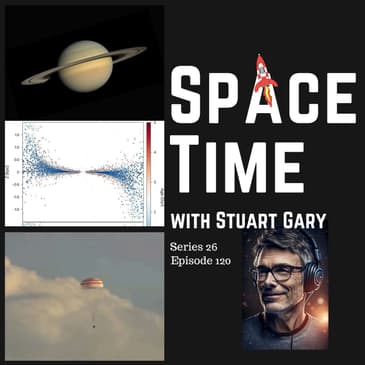
SpaceTime Series 26 Episode 120 Show Notes: 1. **Saturn's Rings and Icy Moons Origins Unveiled**: Recent supercomputer simulations have unveiled new insights into the origins of Saturn's rings and icy moons. These findings suggest a significant collision event in the recent history of our 4.6 billion-year-old Solar System. This massive collision theory provides a plausible explanation for the formation and current state of Saturn's iconic rings and its icy satellites. 2. **Demystifying the Milky Way's Warp**: The Milky Way, our home galaxy, isn't as flat as once thought. Recent discoveries have shown it to be warped, and the reasons behind this warp have been a subject of intrigue. New computer models have come to the rescue, helping astronomers understand this phenomenon better. These models offer insights into the forces and events that might have caused our galaxy to take on its current shape. 3. **A Record-Breaking Stay in Space**: Two Russian cosmonauts and an American astronaut have made headlines with their safe return to Earth. Their mission aboard the International Space Station lasted a year, setting a new record. This extended stay in orbit provides invaluable data on the effects of long-term space travel on the human body, crucial for future deep-space missions. 4. **October Skywatch - A Celestial Treat**: This month, the night sky offers a plethora of astronomical wonders. From our nearest star system, Alpha Centauri, to our closest neighboring galaxies, the large and small Magellanic clouds. Additionally, stargazers can look forward to three meteor showers. Each of these events presents a unique opportunity for both amateur and seasoned astronomers to observe and study the cosmos. 5. **More on SpaceTime**: For those eager to dive deeper into the mysteries of the universe, SpaceTime offers a wealth of content. By visiting [this link](https://linktr.ee/biteszHQ), listeners can access a range of episodes, articles, and related links that delve into various astronomical and astrophysical topics.
Listen to SpaceTime on your favorite podcast app with our universal listen link: https://spacetimewithstuartgary.com/listen and access show links via https://linktr.ee/biteszHQ Additionally, listeners can support the podcast and gain access to bonus content by becoming a SpaceTime crew member through www.bitesz.supercast.com or through premium versions on Spotify and Apple Podcasts. Details on our website at https://spacetimewithstuartgary.com For more SpaceTime and show links: https://linktr.ee/biteszHQ
Become a supporter of this podcast: https://www.spreaker.com/podcast/spacetime-with-stuart-gary--2458531/support.
00:00:00
STUART GARY: This is SpaceTime series 26 episode, 100 and 20
00:00:03
for broadcast on the sixth of October 2023. Coming up on Space
00:00:08
Time, new simulation shedding fresh light on the origin of
00:00:12
Saturn's Majestic rings. Why? A Milky Way galaxy is warped and a
00:00:18
record setting space station crew returned safely to Earth.
00:00:23
All that and more coming up on Space Time.
00:00:27
GENERIC: Welcome to Space Time with Stuart Garry.
00:00:47
STUART GARY: A new series of supercomputer simulations have
00:00:50
offered an answer to the mystery of the origins of Saturn's
00:00:53
spectacular ring system. This one involves a massive collision
00:00:57
in the recent history of the 4.6 billion year old Solar System.
00:01:02
Now, according to this new research which is reported in
00:01:04
the Astrophysical journal, Saturn's rings could have
00:01:07
evolved from the debris of two progenitor icy moons that
00:01:11
collided and shattered just a few 100 million years ago.
00:01:14
The two moons would have been similar in size to two of
00:01:17
Saturn's current moons, Dion and rear and the debris that didn't
00:01:21
end up in the rings could have contributed to the formation of
00:01:24
some of Saturn's present day moons. Most of our contemporary
00:01:28
high quality measurements of Saturn have come from nasa's
00:01:31
Cassini spacecraft.
00:01:33
Cassini spent 13 years studying the ring world and its system of
00:01:37
moons after achieving Saturnian orbit insertion in 2004. During
00:01:42
that time, the spacecraft captured precise data passing by
00:01:46
and even diving into the gap between the Saurian rings and
00:01:50
the planet itself.
00:01:51
Cassini found that Saturn's rings are almost pure ice and
00:01:55
they've accumulated very little dust pollution since their
00:01:58
formation and all that suggests that they must have formed very
00:02:02
recently in the history of the Solar System, motivated by the
00:02:06
remarkable youth of the rings.
00:02:08
The authors turn to the cosmo machine which is hosted by
00:02:11
Durham University as part of the Uk's di direct distributed
00:02:15
research utilization advanced computing facility. They modeled
00:02:19
what different collisions between precursor moons would
00:02:21
have looked like.
00:02:22
These hydro dynamical simulations were conducted using
00:02:26
the swift open source software at resolutions more than 100
00:02:29
times higher than previous studies giving scientists their
00:02:33
best insights yet into the Saturnian system's history.
00:02:36
One of the study's authors, Vincent Eck from Durham
00:02:39
University says an impact of icy moons is able to send enough
00:02:43
material near to satin to form the rings that we can see today.
00:02:47
The scenario naturally leads to ice rich rings because when the
00:02:51
progenitor moons crash into each other, a rock in the cause of
00:02:54
these colliding bodies is dispersed less widely than the
00:02:57
overlying ice.
00:02:59
Saturn's rings live close to the planet within what's known as
00:03:02
the Roche limit. That's the distance from a planet at which
00:03:05
point its gravitational tidal forces will stress and tear
00:03:08
apart a smaller celestial object which is held together purely by
00:03:12
gravity inside this Roche limit.
00:03:15
Any parts of the moon closer to Saturn are attracted more by the
00:03:19
strong pull of the planet's gravity than other parts of the
00:03:21
moon further away.
00:03:23
And that causes the moon to physically pull itself apart,
00:03:26
forming the rings and any material outside this Roche
00:03:30
limit would coalesce to form new moons by simulating some 200
00:03:35
different versions of the impact. The authors discovered a
00:03:38
wide range of collision scenarios that could scatter the
00:03:41
right amount of ice into Saturn's Roche limit there.
00:03:44
The ice would settle into rings just as we see them around satin
00:03:48
today. But since other elements in the system have a mixed ice
00:03:51
rock composition, alternative explanations haven't been able
00:03:54
to explain why there would be almost no rock in Saturn's
00:03:58
rings.
00:03:59
This is Space Time still to come. Why is our galaxy so
00:04:04
warped? And a record breaking space station crew returned
00:04:08
safely to Earth all that and more still to come on Space
00:04:12
Time?
00:06:25
GENERIC: This is Space Time with Stuart Gary.
00:06:28
STUART GARY: Now, while we're on the subject of computer
00:06:31
modeling, new computer simulations may have helped
00:06:33
astronomers resolve some of the mysteries surrounding the recent
00:06:37
discovery that the Milky Way Galaxies actually warped. Most
00:06:41
spiral Galaxies like the Milky Way have sweeping spiral arms
00:06:46
that stretch out from the galactic bulge.
00:06:48
And when viewed on appear almost flat. That recent observations
00:06:53
by the European Space Agency's Gaer Space Telescope showed that
00:06:56
the spiral arms of the Milky Way are slightly warped near the end
00:07:00
tips of the spiral arms with one side flaring upwards and the
00:07:03
opposite side flaring down.
00:07:06
Now, most hypotheses to try and explain this odd warping of the
00:07:10
Milky Way have revolved around the idea of a collision between
00:07:13
the Milky Way and another galaxy. Most likely the
00:07:16
Sagittarius dwarf, a small satellite galaxy which has
00:07:20
already passed through the Milky Way's disk on several occasions,
00:07:23
losing more stars than gass with each encounter.
00:07:27
Eventually Sagittarius dwarf will be completely consumed by
00:07:30
the Milky Way, becoming another example of galactic cannibalism.
00:07:35
But the idea of galactic collisions can't fully explain
00:07:38
the observations. Now, a report in the Journal Nature Astronomy
00:07:42
claims computer simulations based on new modeling could be
00:07:46
explained by a tilt of the dark halo.
00:07:49
The authors found that the Milky Way's galactic halo is slightly
00:07:53
off kilter compared to the disk that makes up the bulk of the
00:07:56
galaxy itself. Now, they believe the only thing that could have
00:07:59
caused the galactic halo to tilt in such a way would be an
00:08:03
imbalance in the dark matter permeating the galaxy.
00:08:07
The authors then developed a computer simulation of the once
00:08:10
infant still forming Milky Way galaxy. And after a lot of trial
00:08:14
and error found a 25 degree tilt in the galaxy's dark matter halo
00:08:18
slowly led to the spiral arms developing their current warp
00:08:21
over a period of about 5 billion years. They suggested the dark
00:08:26
matter halo itself was slightly tilted by the gravitational
00:08:29
interaction caused by a collision with another galaxy.
00:08:33
And once again, thanks to GAA, we know the Setters dwarf galaxy
00:08:37
probably collided with the Milky Way spiral arms about 5.7
00:08:42
billion years ago. There was a second collision about 1.9
00:08:46
billion years ago and a third one about a billion years ago.
00:08:50
This is Space Time still to come.
00:08:54
A space station crew returned to Earth after a record stay in
00:08:57
orbit and we check out our nearest neighboring star system
00:09:01
Alpha Centauri, two of our nearest neighboring Galaxies,
00:09:04
the large and small Magellanic clouds and three meteor showers.
00:09:08
All of which are among the highlights of the October night
00:09:10
skies on sky watch.
00:09:29
Two Russian cosmonauts and an American astronaut have landed
00:09:32
safely back on Earth after spending over a year aboard the
00:09:35
International Space Station there, Soyuz 23 spacecraft
00:09:39
floated down the Kazakhstan step in overcast skies near the city
00:09:44
of Jessa. Scan under a giant orange and white parachute.
00:09:48
TV COMMENTATOR: Now, right after the completion of the deorbit
00:09:49
burn the orbital module, the top section of the Soyuz spacecraft,
00:09:53
the three section Soyuz spacecraft, it was depressurized
00:09:57
about 10 seconds after the conclusion of the deorbit burn,
00:10:01
setting the stage for the module separation that's coming up.
00:10:05
The precise landing coordinates are being relayed to the crew on
00:10:09
board the Soyuz. The current projection by the ballistics
00:10:13
officers for the R and NIA team at the Russian mission control
00:10:19
center shows the landing site at 47.20 degrees North 69.39
00:10:25
degrees east. That is where the search and recovery forces will
00:10:30
be positioned to greet the Soyuz crew following touchdown.
00:10:34
And now reports having been received from the Russian
00:10:37
mission control center of a nominal separation of the three
00:10:41
sections of the Soyuz module separation is now complete that
00:10:45
all went by the book the next milestone about three minutes
00:10:48
from now.
00:10:49
And that will be the Soyuz hitting the top of the Earth's
00:10:52
atmosphere station on two for the Russian Mi eight
00:10:58
helicopters. Part of the Euro Rosa Yaa search and recovery
00:11:01
forces are nearing the landing site southeast of Jez Kazan to
00:11:06
move into a racetrack pattern, an oval shaped pattern around
00:11:10
the landing zone awaiting the arrival of the Soyuz spacecraft
00:11:14
with touchdowns scheduled about 23.5 minutes from now.
00:11:17
Flight controllers in Kroo outside Moscow receiving data on
00:11:21
the Soyuz spacecraft through their communication satellites,
00:11:25
the loch system, the Soyuz now has entered the Earth's
00:11:30
atmosphere. The three crew members feeling the first
00:11:33
effects of gravity on their bodies in 371 days just over
00:11:38
eight minutes until the scheduled deployment of the
00:11:40
parachutes.
00:11:41
The Soyuz currently descending through the Earth's atmospheres
00:11:44
as expected, we are not receiving voice communication
00:11:47
from the crew. This is typical at this point of the entry
00:11:51
sequence.
00:11:51
Once the spacecraft passes through the plasma regime, the
00:11:55
period of peak heating we should be hearing from the crew once
00:11:59
again with communications relayed through the Antonov 26
00:12:03
fixed wing aircraft in the vicinity of the landing site.
00:12:06
The Soyuz should be emerging from that plasma regime any
00:12:09
minute. This is the point where the crew is experiencing maximum
00:12:13
G loads on their bodies of about 4 to 5 GS.
00:12:19
And there is that familiar beacon signal from coming from
00:12:23
the Soyuz MS 23 we have maximum plus one along the Sergei Perko,
00:12:48
the Soyuz commander reporting that everything is in great
00:12:51
shape on board the Soyuz, the crew experiencing those maximum
00:12:55
G loads but they are through the plasma regime as we stand by
00:12:59
just over a minute from now for shoot deploy notable and we are
00:13:08
good communication now being received from the Soyuz MS 23.
00:13:12
And how are you feeling? We are feeling great. Thank you and.
00:13:18
Sergei Perko reporting that the crew is feeling well, great news
00:13:22
as the Soyuz MS 23 approaches its landing site in Kazakhstan.
00:13:27
We should be getting information momentarily on the opening of
00:13:30
the shoots.
00:13:31
The Russian Mi eight helicopters, part of the search
00:13:33
and recovery forces are approaching on station in the
00:13:37
landing zone around where the Soyuz will touch down. We now
00:13:41
have confirmation that the Soyuz parachute has been deployed.
00:13:45
Once again. The Soyuz MS 23 is now descending toward its
00:13:49
landing just about 11 minutes from now.
00:13:53
Its parachute has deployed. The crew is feeling well. According
00:13:57
to Sergeyev, the Soyuz commander, all of the entry
00:14:00
events have gone by the book to this point, the skies are quite
00:14:05
overcast at the landing site.
00:14:07
Temperatures around 69 degrees, the search and recovery forces
00:14:11
at the landing site now confirm that they have the Soyuz in
00:14:15
sight under its parachute. All of the events to this point have
00:14:18
been a winner. Everything has gone according to schedule and
00:14:22
the crew.
00:14:23
According to Sergei Prokop, the Soyuz commander is feeling well
00:14:27
the Soyuz MS 23 it is gently descending under its large
00:14:31
orange and white parachute surge and recovery forces are
00:14:34
reporting back that everything is looking good from their
00:14:36
perspective.
00:14:37
There were some rain showers in the area earlier today, the
00:14:41
Soyuz descending under a deck, several decks of broken clouds
00:14:44
toward it down point about 90 miles to the southeast of Jess
00:14:48
Gun.
00:14:49
The extended mission of Frank Rubio, Sergei Perko and Dmitry
00:14:53
Patin is now in the home stretch after more than a year in space
00:14:57
less than four minutes from touchdown on the desolate step
00:15:01
of Kazakhstan, the parachutes 1000 deployed as planned at 6:03
00:15:07
a. m. central time.
00:15:09
Three minutes later, the Soyuz heat shield was jettisoned 49.
00:15:14
Confirm the next event will be just a second or two before
00:15:18
touchdown. That will be the firing of the soft landing
00:15:20
engine, six engines fire to slow the Soyuz descent rate to just
00:15:25
1.5 m per 2nd.
00:15:28
100 m to ground 100 m to go. The crew being told to brace for
00:15:33
touchdown getting close to touchdown. Touchdown confirmed
00:15:38
at 6:17 a. m. Central time. Rubio's record ride comes to an
00:15:43
end as he and Pailin returned to Earth after a 371 day 157
00:15:51
million mile journey at the International Space Station. The
00:15:55
third longest flight ever in human space flight history is
00:15:58
over with a pinpoint landing on the step of Kazakhstan.
00:16:01
STUART GARY: The three had traveled to the International
00:16:03
Space Station last year on a mission that was meant to last
00:16:06
six months. But their original MS 22 capsule developed a
00:16:10
coolant leak while docked to the orbiting outpost. Engineers with
00:16:14
the Russian Federal Space Agency at Oz Cosmos determined a micro
00:16:18
meteoroid impact likely caused the leak.
00:16:22
But just two months later, the exact same coolant leak
00:16:25
developed on a Russian progress. MS 21 cargo ship which was also
00:16:29
docked to the space station and the idea of two micro meteoroids
00:16:34
hitting two separate spacecraft in exactly the same position
00:16:37
isn't very likely, but it does follow a pattern.
00:16:40
These incidents follow the formation of several air leaks
00:16:44
both in Russian spacecraft and in modules aboard the Russian
00:16:47
segment of the space station. And there have been other
00:16:50
problems with Russian equipment as well.
00:16:52
There was that abort during ascent of the SOZ MS 10 mission
00:16:56
to the space station just two minutes into the flight back in
00:16:59
2018, that was caused by a strap on booster crash into the course
00:17:03
stage of the Soyuz rocket. And then there was the sudden
00:17:06
unprogrammed ignition of a thruster aboard the new Russian
00:17:10
NAA science module on the space station, sending the orbiting
00:17:13
outpost tumbling out of control for 45 minutes.
00:17:17
Neither mission managers nor the crew on the space station could
00:17:20
turn the thruster off eventually having to resort to turning on
00:17:24
another thruster to try and balance the load. The thruster
00:17:27
on the NAA eventually turned off only when it ran out of fuel.
00:17:31
As for the Suez MS 22 incident without coolant. Mission
00:17:36
managers were concerned that temperatures inside the capsule
00:17:38
could reach over 40 degrees during re entry, making the trip
00:17:42
uncomfortable for the crew and of course, who knows what else
00:17:45
was going wrong. So the Soyuz MS 22 was returned to Earth empty
00:17:50
and a replacement the Soyuz MS 23 was instead sent up empty in
00:17:54
late February.
00:17:55
Its original crew being bumped to the soy's MS 24 flight which
00:17:59
only arrived at the space station last week. This gave the
00:18:03
Soyuz MS 22. Now MS 23 crew an extra six months on station.
00:18:09
The MS 23 landing established American astronaut Frank Rubio
00:18:13
as the new holder of the single longest mission flown by an
00:18:16
American astronaut 371 days. But of course, Russian Valery
00:18:21
Poliakov retains the all time record for the longest single
00:18:25
space flight after spending 437 days aboard the space station.
00:18:30
The International Space Station remains a rare venue of
00:18:32
cooperation between the West and Russia as tensions intensify
00:18:36
over Moscow's invasion of Ukraine. This is Space Time and
00:18:57
time now to turn our eyes to the skies and check out the
00:19:00
celestial sphere for October on Skywatch. October is the 10th
00:19:04
month of the year and that may seem confusing since Octo in
00:19:08
Latin means eight rather than 10.
00:19:10
The answer lies in the old Roman calendar which had just 10
00:19:14
months before the edition of January and February. And that
00:19:18
10 month year is still reflected today with the name September or
00:19:22
Septum being Latin for 7 October or Octo meaning 8 November and
00:19:27
Novem nine and December of Desi meaning 10.
00:19:31
Of course, the highlight of October for kids and those who
00:19:34
are young at heart has to be the last day of the month celebrated
00:19:38
as all Hallow's evening or Halloween. Halloween is based on
00:19:42
ancient Celtic pagan festivals such as Sao, when the Gaelic
00:19:46
Festival Of The Dead, Sao Wen was eventually Christianized by
00:19:50
the early church to become All Saints or Hallow's Eve or simply
00:19:54
Halloween.
00:19:55
It's a time when darkness overtakes the light of day, a
00:19:58
reference to the increasing hours of darkness as the
00:20:01
planet's northern hemisphere moves towards longer winter
00:20:04
nights.
00:20:05
And so it's a time when the harvest comes to an end, the
00:20:09
increased hours of darkness mean the boundary between the ward of
00:20:13
the living and the ward of the dead becomes especially thin,
00:20:16
allowing the dead and supernatural to rise in search
00:20:20
of the living.
00:20:21
And so the living wear disguises, so as not to be
00:20:24
recognized by the dead. And it's this, which has led to today's
00:20:28
tradition of the Halloween Fancy dress party in some parts of the
00:20:32
world. Cross dressing is popular on Halloween, a reflection of
00:20:35
the secret desires and fantasies of their peg and ancestors
00:20:39
sometimes not so many generations removed to ensure
00:20:43
that crops and livestock survive the cold winter months ahead.
00:20:46
Offerings of food and drink would be left outside for the
00:20:49
spirits and fairies of the other side. And it was this which
00:20:52
ultimately led to today's practice of t trick or treat.
00:20:56
Also, candles would be lit and prayers offered to the souls of
00:20:59
the dead. As Halloween was a time when the spirits of the
00:21:02
dead would return to their former homes. Special bonfires
00:21:07
were also lit on Halloween to light the darkness, thereby
00:21:09
preventing souls of the dead from returning and keeping the
00:21:13
evil away.
00:21:14
The flames, smoke and ashes were deemed to have protective and
00:21:17
cleansing powers and were used for divination as for the
00:21:21
tradition of carving pumpkins into jacka lanterns. Well, that
00:21:25
was originally meant either to represent spirits or
00:21:28
supernatural beings or alternatively to ward off evil
00:21:31
spirits in many parts of the world.
00:21:34
The Christian religious observances of all Hallow's Eve
00:21:37
include attending church services and lighting candles on
00:21:40
the graves of the dead. And Christians historically
00:21:43
abstained from eating meat on all Hallow's Eve.
00:21:46
A tradition reflected in the eating of certain vegetable
00:21:49
foods on the day, including apples, potato pancakes and soul
00:21:53
cakes. Apple bobbing originated because the Apple was a Celtic
00:21:57
symbol of love. And so grabbing the Apple with your teeth had
00:22:01
certain erotic overturns.
00:22:03
Halloween is a time of fortune telling and deviation games
00:22:07
playing pranks to scare people, visiting haunted attractions,
00:22:11
telling scary stories and of course, watching horror movies,
00:22:16
looking to the Southwest, you'll see the two bright pointer stars
00:22:20
which show the weight of the Southern Cross the brightest and
00:22:23
what also looks like the more distant of the two stars from
00:22:26
the Southern Cross is Arthur Centauri, which is actually the
00:22:29
nearest star system to our own Solar System.
00:22:32
Alpha Centauri is a triple star system comprising two stars
00:22:36
Alpha Centauri A and B which orbit each other in a binary and
00:22:40
a third star Proxima Centauri which orbit the pair like the
00:22:44
sun. A centauri is a spectra type G yellow dwarf star.
00:22:49
It's about 10 per cent more massive than our sun and about
00:22:52
1.5 times as luminous astronomers describe stars in
00:22:57
terms of spectral types. It's a classification system based on
00:23:01
temperature and characteristics. The hottest, most massive and
00:23:05
most luminous stars are known as spectral type O blue stars.
00:23:09
They're followed by spectra type B, blue white stars.
00:23:13
Then spectra type A white stars, spectral type f, whitish yellow
00:23:17
stars, spectral type G yellow stars. That's where our sun fits
00:23:21
in spectra type K, orange stars and the coolest and least
00:23:26
massive stars of all are the spectra type M red stars.
00:23:30
Each spectra classification is also subdivided using a numeric
00:23:34
digit to represent temperature with zero being the hottest and
00:23:37
nine, the coolest and A Roman numeral to represent luminosity.
00:23:41
Now you pull all that together and our sun becomes A G two V or
00:23:46
G 25 yellow dwarf star. Also included in the stellar
00:23:50
classification system are spectral types.
00:23:52
Lt and Y which are assigned to failed stars known as brown
00:23:56
dwarves, some of which were actually born as spectra type M
00:24:00
red stars but became brown dwarves after losing some of
00:24:03
their mass, brown dwarfs fit into a unique category between
00:24:07
the largest planets which can be up to 13 times the mass of
00:24:10
Jupiter and the smallest stars, those spectral type M red dwarf
00:24:15
stars we mentioned earlier, these can be 75 to 80 times the
00:24:19
mass of Jupiter or about 0.08 solar masses.
00:24:24
Alpha Centauri A's binary partner. Alpha Centauri B is a
00:24:28
spec type K orange dwarf star a little smaller and cooler than
00:24:33
its companion with about 90 per cent of the sun's mass and about
00:24:37
half its luminosity. This binary pair Alpha Centauri A and B
00:24:42
orbit each other at between 11.2 and 35.6 astronomical units.
00:24:47
An astronomical unit is the average distance between the
00:24:50
Earth and the sun which equates to about 100 and 50 million
00:24:53
kilometers or around 8.3 light minutes. So the pair's orbit
00:24:58
around each other varies by between the average distance
00:25:01
between the sun and Saturn and between the sun and Pluto.
00:25:05
It takes the two stars 79.91 Earth years to complete each
00:25:10
orbit. On average A Centauri A and B are located 4.37 light
00:25:15
years from the sun. Now, although a li ear sounds like a
00:25:19
measure of time. It's actually a measure of distance, a layer is
00:25:23
a distance of about 10 trillion kilometers.
00:25:26
That's the distance a photon can travel in a year at the speed of
00:25:29
light, which is around 300 kilometers per second in a
00:25:32
vacuum. And the ultimate speed limit of the universe. The third
00:25:36
star in the Alpha Centauri system is a spectra type M red
00:25:40
dwarf star named Proxima Centauri.
00:25:43
Right now, Proxima Centauri is just 4.25 light years away,
00:25:47
making it the nearest start to the Earth other than the sun, it
00:25:51
is only loosely gravitationally bound to Alpha Centauri A and B
00:25:55
orbiting the pair at an average distance of 13 astronomical
00:25:59
units or around 0.21 light years. That's about 430 times
00:26:04
the size of Neptune's 30 astronomical unit orbit around
00:26:08
the sun.
00:26:09
In 2016, astronomers confirmed the existence of an Earth sized
00:26:13
terrestrial planet orbiting within the habitable zone of
00:26:16
Proxima Centauri, making it the nearest known extra solar or
00:26:20
exoplanet to Earth.
00:26:22
The habitable zone, which is sometimes also referred to as
00:26:25
the gaudy lock zone is that area out from a star where it's not
00:26:28
too hot, not too cold, but just right for liquid water central,
00:26:33
for life as we know it to exist on the planet's surface. The
00:26:37
planet known as Proxima B takes just 11 Earth days to complete
00:26:41
one orbit around its host star that's far closer than mercury's
00:26:45
88 Earth day orbit around the sun a few years ago.
00:26:49
A second more distant planet Proxima C was also discovered
00:26:53
orbiting around the star but well outside its habitable zone.
00:26:58
The second and slightly fainter of the two pointer stars is
00:27:01
Peter Centauri.
00:27:03
And while Arthur Centauri is the third brightest star in the
00:27:05
night sky outshine only by Sirius And Canopus. Beter
00:27:09
Centauri is only about the 10th brightest looking to the
00:27:13
southeast and you'll see the bright blue white star Alpha Aid
00:27:17
or Aina, which represents the southern tip of Ero Daus, one of
00:27:21
the largest and longest constellations in the sky.
00:27:24
Aina is located about 100 and 39 light years away. It's actually
00:27:29
a binary star system comprising two stars, Alpha Aid A and
00:27:33
Alpha. Ridd B Alpha ride is a height young spectra type B blue
00:27:38
star. It's about 6.7 times the mass of the sun and a stunning
00:27:43
3150 times the sun's luminosity. By comparison, the companion
00:27:48
star Alpha Rodney B appears to be a spectra type, a white star
00:27:52
with about twice the sun's mass.
00:27:55
The two stars orbit each other every 14 to 15 Earth years at an
00:27:59
average distance of about 12.3 astronomical units because of
00:28:04
its high rotation rate of over 16 kilometers per second. Alpha
00:28:08
arid A is actually one of the least spherical stars in the
00:28:11
Milky Way spinning so rapidly. It's assumed the shape of an
00:28:15
oblique SRO with an equatorial diameter 56 per cent greater
00:28:19
than its polar diameter.
00:28:21
This distorted shape means the star displays a significant
00:28:24
latitudinal temperature with its polar temperature being about
00:28:27
20 Kelvin while its equatorial temperatures only
00:28:30
around 10 Kelvin. That's because it's much further away
00:28:34
from its stellar core. The high polar temperatures are
00:28:37
generating a fast polar wind that's ejecting matter from the
00:28:41
star and creating spectacular polar envelope of hot gas and
00:28:46
plasma.
00:28:47
Now, if you look up between the south celestial pole and Acana
00:28:50
from a really dark place, you'll see two faint fuzzy looking
00:28:54
clouds. Now, these aren't actually clouds, they're two
00:28:59
satellite dwarf Galaxies which orbit the Milky Way known as the
00:29:02
large and small Magellanic clouds.
00:29:05
They're named after Ferdinand Magellan who became the first
00:29:08
European to officially record them during his expedition to
00:29:11
circumnavigate the Earth between 15, 19 and 15, 22 the bigger and
00:29:17
nearer of the pair is the large Magellanic cloud, which is
00:29:20
located around 100 and 60 light years away. It's easier to spot
00:29:25
about halfway between Aina and the horizon.
00:29:28
It's about 14 million light years across twice that of the
00:29:31
small Magellanic cloud, which is located a more distant 200
00:29:35
light years from the Milky Way. Now, by comparison to these two
00:29:39
satellite Galaxies, the Milky Way is huge, 100 layers
00:29:43
across these two dwarf Galaxies are separated from each other by
00:29:47
roughly 75 light years.
00:29:50
The Magellanic clouds were considered the closest Galaxies
00:29:53
to the Milky Way until the 1994 discovery of the Sagittarius
00:29:57
dwarf elliptical galaxy. And the 2003 confirmation that the Canis
00:30:01
Major dwarf galaxy is actually our nearest galactic neighbor.
00:30:05
The total mass of the Magellanic clouds is uncertain.
00:30:08
Only a fraction of their gas seems to have coalesced into
00:30:11
stars. They also probably both have very large dark matter
00:30:14
halos. Still one recent estimate places the t total mass of the
00:30:18
large Magellanic cloud at about 1/10 that of the Milky Way, the
00:30:22
Magellanic clouds have both been greatly distorted by
00:30:25
gravitational tidal interactions as they're gradually torn apart
00:30:29
and absorbed by the Milky Way.
00:30:32
These huge tidal forces have turned both Magellanic clouds
00:30:36
into irregular disrupted bad spiral Galaxies. The large
00:30:40
Magellanic cloud still retains a very clear spiral structure, at
00:30:44
least in radio telescope images of neutral hydrogen.
00:30:48
But gravity isn't a one way street and the combined
00:30:51
gravitational force of both Magellanic clouds is also
00:30:54
affecting the Milky Way distorting the outer parts of
00:30:57
our galactic disk. And there are streams of neutral hydrogen gas
00:31:01
clouds and isolated stars connecting both dwarf Galaxies
00:31:05
to each other and to the Milky Way, a brilliant example of
00:31:09
galactic cannibalism at work.
00:31:12
Now, if you look just above the small Magellanic cloud using a
00:31:15
backyard telescope or a good pair of binoculars, you'll see a
00:31:18
small blurry dot That is the 47 Tianna globular cluster, a
00:31:24
tightly packed ball of stars some 16 layers away. They
00:31:28
were all originally formed at the same time through the
00:31:30
gravitational collapse of the same molecular gas and dust
00:31:34
cloud.
00:31:35
If you look to the West, you'll see the bright reddish orange
00:31:38
super giant star in Taris, the heart of the constellation
00:31:41
Scorpius, the Scorpion and above it, you'll see a bunch of stars
00:31:45
stretching out, shaped like a reverse question Mark. That's
00:31:49
the Tale of the Scorpion.
00:31:51
Now just above and to the North is the constellation
00:31:54
Sagittarius. The Archer Sagittarius shows the way to the
00:31:58
supermassive black hole at the center of the Milky Way galaxy
00:32:01
some 27 light years away. This monster black hole known as
00:32:06
Sagittarius, a star has about 4.3 million times the mass of
00:32:10
our sun.
00:32:12
Now looking to the North, North West. This time of the year,
00:32:15
you'll see the constellation lier of the Harb and its
00:32:18
brightest star Vega, the fifth brightest star in the night sky
00:32:21
and one of the closest are just 25 light years away. Vega is a
00:32:26
special Taipei white star more than twice the size and some 40
00:32:30
times the mass of our sun.
00:32:33
Now just to the right of Lyra and almost directly North, just
00:32:36
above the horizon is the constellation of Cygnus, the
00:32:39
Swan and its brightest star Den Ebb, one of the most luminous
00:32:43
stars in the sky. Den Eb is a massive spectra type, a white
00:32:47
super giant some 19 times the mass and over 100 times the
00:32:51
diameter of the sun.
00:32:53
The star is somewhere between 55 and 100 and 96 times
00:32:58
as luminous as the sun. The huge range in luminosity estimate is
00:33:02
caused by the difficult in determining Deneb's exact
00:33:05
distance from us. Science's best estimates place its somewhere
00:33:09
around 2600 light years away. Give or take 212 light years
00:33:14
high in the northern sky right now is the constellation a quill
00:33:18
of the eagle.
00:33:19
And its brightest star terre alter is another spectra type, a
00:33:23
white star but located a lot closer just 17 light years away.
00:33:28
It's about 10 times brighter than the sun with about 1.89
00:33:32
times the sun's mass despite its size, tere spins on its axis in
00:33:37
just 10 hours compared to our sun's 28 Earth day rotation.
00:33:42
Now, these three stars alter Dene bega form a stellar
00:33:46
grouping known as the summer triangle.
00:33:49
Now, also in October, there are three meteor showers, the
00:33:54
draids, the tours and the orionid, the draids take place
00:33:58
on October the eighth. They're so mean because the Meteors
00:34:02
appear to radiate out from the constellation Draco, the dragon
00:34:06
and so are best viewed from the northern hemisphere.
00:34:09
They're actually produced as the Earth's orbit, takes it through
00:34:12
the debris trail left behind by the comet 21 P Sheena which
00:34:17
takes about 6.6 Earth years to make a single revolution of the
00:34:21
sun.
00:34:22
The Torres meteor shower takes place on October 10th and as
00:34:26
their name suggests, they appear to radiate out from the
00:34:28
constellation tourists, the ball, their Meteors are composed
00:34:32
of larger than average pebbles and dust grains and are thought
00:34:35
to be generated by debris left behind by the comet two P Anki.
00:34:40
Although it's thought that both the tores and Anke could be the
00:34:43
remains of an earlier comet which disintegrated over the
00:34:46
past 20 to 30 years, breaking into several pieces and
00:34:50
releasing material both by normal cometary activity and
00:34:54
possibly also by gravitational tidal interactions with the
00:34:57
Earth and other planets.
00:34:59
The Torres debris stream is the largest in the inner Solar
00:35:02
System, taking the Earth several weeks to pass through and
00:35:05
resulting in an extended period of meteor activity compared to
00:35:09
other meteor showers which are usually over in just a matter of
00:35:12
days.
00:35:13
Now, due to the gravitational perturbations of the planets,
00:35:16
especially Jupiter, the Torres have been spread out over time
00:35:19
allowing separate segments labeled the northern Torres and
00:35:23
southern Torres to be observable at different times in different
00:35:26
hemispheres.
00:35:27
The southern Toros are active from around September the 10th
00:35:30
to November 20th while the northern Toros are active from
00:35:33
October the 20th to December the 10th, the third meteor shower
00:35:37
this month is the orionid which peak on October the 20th,
00:35:42
they're caused by debris from the comet hay which also causes
00:35:45
the eta Aris meteor shower in May.
00:35:47
Comet Haley takes 76 years to complete each orbit around the
00:35:51
sun. It'll next become visible near Earth in 2061. The orionid
00:35:57
are equally spectacular in both northern and southern hemisphere
00:35:59
skies with up to 20 Meteors an hour radiating out from the
00:36:03
constellation Orion.
00:36:05
The best time to see the orionid is just after midnight and right
00:36:09
before dusk and now with more on the October night skies, I'm
00:36:14
joined by leading Australian science writer, Jonathan Nalley.
00:36:17
Good day Stewart.
00:36:18
JONATHAN NALLY: Yeah. Well, during October evenings we're
00:36:20
really starting to see the summer constellations making
00:36:22
their first appearance. And I say summer constellations that's
00:36:25
down here in the southern hemisphere for our friends in
00:36:27
the northern half of the planet. Of course, they're the winter
00:36:29
constellations. Well, we call them summer constellations.
00:36:32
We've got the Milky Way. It's stretching from the North to the
00:36:34
south all the way from the North to south in the western half of
00:36:37
the sky. This is during the evening time. You've got the
00:36:40
constellations of Sagittarius and really impressive Scorpius,
00:36:43
which really does look like a Scorpion and they're easily
00:36:46
visible high overhead.
00:36:47
But as the Earth is turning by midnight, the Milky Way will
00:36:50
have set in the West below the horizon, then the sort of sky is
00:36:53
relatively empty, it seems. So you don't have any of the Milky
00:36:56
Way up there. And we're looking out of the plane of our galaxy,
00:36:59
that galaxy is like a discus, like a sports discus, right? And
00:37:02
we're out sort of about two thirds of the way out from the
00:37:04
middle.
00:37:05
So if we look through the thickness of the discus, then
00:37:08
we're looking through them into the Milky Way. But if looking
00:37:11
straight up above or down below, we're looking out of the plane
00:37:14
of the Milky Way and that's where there are fewer stars, of
00:37:16
course. So it does look a bit empty. So that's what it's like
00:37:18
during the latter part of the evening, during October.
00:37:21
But, you know, still for those of us in the southern
00:37:23
hemisphere, we're reaching the time of year when the Magellanic
00:37:25
cloud Galaxies are seen at their best. These are two nearby
00:37:29
fairly sizable Galaxies outside our Milky Way. They're named
00:37:32
after Explorer Magellan and they're called the Magellanic
00:37:34
clouds.
00:37:35
Because when you look up on the, if you didn't know that they
00:37:37
were Galaxies, you would think they were just little fluffy
00:37:39
clouds fairly dim and you do need to get away from street
00:37:43
lights and things and let your eyes dark, adapt to see them.
00:37:45
But if you're out in the countryside or something or just
00:37:47
away from a lot of light, then you will be able to see them and
00:37:50
you look up and you think, oh, what's that cloudy stuff?
00:37:51
Actually, an entire galaxy, two Galaxies, the large and the
00:37:54
small Magellanic clouds. So they're really, really good
00:37:56
things to find. We've got the famous Southern Cross
00:37:58
constellation everyone wants to see, but at the moment it's
00:38:01
upside down and it's either right on the southern horizon or
00:38:05
even below it from most populated southern latitudes,
00:38:07
depending on how far south you are.
00:38:09
If you're in Melbourne or Hobart, you will be able to see
00:38:12
it quite easily, but it will be down towards the southern
00:38:14
horizon. Now, after midnight, the sky changes. So the Earth
00:38:18
has turned quite a bit and what we get is the Milky Way, comes
00:38:20
up again, the Milky Way in the other direction.
00:38:22
So it's rising in the east after midnight and bringing with it
00:38:25
all these fabulous constellations you've got Orion
00:38:28
and Taurus and Gemini pupp, Karina Canis Major and lots of
00:38:32
other ones, all of them are just bursting with interesting stars
00:38:35
and deep sky objects. So for instance, Canis Major has the
00:38:38
brightest star in the sky.
00:38:39
Sirius Taurus has the plies star cluster, which I think is easily
00:38:43
the easiest to see and probably the prettiest star cluster in
00:38:47
the night sky. Just a pair of binoculars gives you a fantastic
00:38:50
view. And of course, Orion has the famous Orion nebula which
00:38:52
you can actually see. It's just a faint smudge of light with the
00:38:56
naked eye.
00:38:57
And if you get a telescope onto it, it looks a lot better. In
00:38:59
addition to that. Now, all those post midnight constellations
00:39:02
will rise increasingly earlier as the weeks go by between now
00:39:06
and the new year. So that by the end of the year, you won't have
00:39:09
to be staying up past midnight or getting up early in the
00:39:11
morning, they'll be rising before midnight.
00:39:13
So, Orion and all those other ones will be in the evening sky.
00:39:16
So we've got that to look forward to as we get towards the
00:39:18
end of the year. Now, let's look at the planets for October
00:39:20
mercury is a no go, I'm afraid it's around on the other side of
00:39:23
the sun for most of this month and therefore, is lost in the
00:39:26
solar glare.
00:39:27
The next planet out Venus is up and about, but you've got to be
00:39:30
up early to see it because it's rising above the eastern horizon
00:39:33
about two hours before sunrise. So if you're getting home from
00:39:37
night shift or you're getting up early to go to work or whatever,
00:39:39
you should be able to see Venus out there in the east and you
00:39:41
really can't miss it because it's really big and bright.
00:39:44
It looks like a huge, big, bright white star Mars. It's a
00:39:47
bit like mercury. It's disappeared from view this month
00:39:49
and it's lost in the sunset glow because it's going around the
00:39:52
other side of the sun and it won't be back until January when
00:39:55
we will see it again.
00:39:56
But this time and not in the West where the sun is setting,
00:39:59
but in the east before the sun rises, so it will be coming up
00:40:02
over the eastern horizon before dawn and the other planet that's
00:40:05
easy to see in the evening sky at the moment is Jupiter. Now
00:40:08
it's getting brighter as it heads towards what astronomers
00:40:11
call opposition in November, which will be when we get our
00:40:14
best views of the planet.
00:40:15
So, go out and have a look in the east after sunset and you'll
00:40:18
see this fairly big bright star looking thing. Well, that's the
00:40:20
planet Jupiter. It's brighter than anything else that's around
00:40:23
there at the moment. So you shouldn't have any trouble
00:40:25
finding. It. Finally Saturn too is easy to see this month. Look
00:40:29
for it pretty much due North after sunset.
00:40:32
So the sun's gone down, look to the North or to the south. If
00:40:35
you're in the northern hemisphere and it's pretty easy
00:40:37
to see. It's bright, it's got a slightly yellowish tint. But if
00:40:39
you're having trouble identifying Saturn, go out and
00:40:42
take a look on October the 24th. And the reason I mentioned that
00:40:45
date is because on that date, the moon will be very close by.
00:40:48
So all you've got to do is go out and find the moon and then
00:40:51
the brightest thing that's near to the moon will be Saturn.
00:40:54
Saturn will four moon widths away from the moon. So that's,
00:40:58
that's one easy way actually, of finding planets very often the
00:41:01
moon is close to them.
00:41:02
And so if you know when that's coming up, you can go out and
00:41:05
say, oh, well, Mars is meant to be near the moon this week. So,
00:41:08
oh, there's the moon, oh, that red thing, there must be Mars.
00:41:10
So you can do that with Saturn this month, October the 24th go
00:41:13
out and have a look and Saturn will be just four moon widths
00:41:16
away from that. And that Stewart is the sky for October that's.
00:41:18
STUART GARY: Leading Australian science writer, Jonathan Ally
00:41:21
and this is Space Time and that's the show for now.
00:41:40
SpaceTime is available every Monday, Wednesday and Friday
00:41:43
through Apple Podcasts, itunes, Stitcher, Google Podcast, pocket
00:41:47
casts, Spotify, acas Amazon music bites dot com, soundcloud,
00:41:53
YouTube, your favorite podcast download provider and from Space
00:41:57
Time with Stewart Gary dot com.
00:41:59
SpaceTime is also broadcast through the National Science
00:42:02
Foundation on Science Zone Radio and on both iheart Radio And
00:42:06
Tune in radio.
00:42:08
And you can help to support our show by visiting the SpaceTime
00:42:11
store for a range of promotional merchandizing goodies or by
00:42:15
becoming a SpaceTime patron, which gives you access to triple
00:42:18
episode commercial free versions of the show as well as lots of
00:42:21
bonus audio content which doesn't go to air access to our
00:42:24
exclusive Facebook group and other rewards. Just go to Space
00:42:28
Time with Stewart Gary dot com for full details.
00:42:32
And if you want more Space Time, please check out our blog where
00:42:35
you'll find all the stuff we couldn't fit in the show as well
00:42:37
as heaps of images, news stories, loads of videos and
00:42:41
things on the web. I find interesting or amusing. Just go
00:42:44
to Space Time with Stewart Gary dot tumblr dot com.
00:42:48
That's all one word and that's Tumbler without the e you can
00:42:51
also follow us through at Stuart Garry on Twitter at Space Time
00:42:55
with Stuart Garry on Instagram through our Space Time YouTube
00:42:59
channel and on Facebook, just go to Facebook dot com forward
00:43:02
slash Space Time with Stewart Gary and SpaceTime is brought to
00:43:06
you in collaboration with Australian Sky and Telescope
00:43:09
Magazine. Your Window on the Universe.
00:43:12
GENERIC: You've been listening to Space Time with Stuart Gary.
00:43:15
This has been another quality podcast production from bitesz
00:43:18
dot com.