
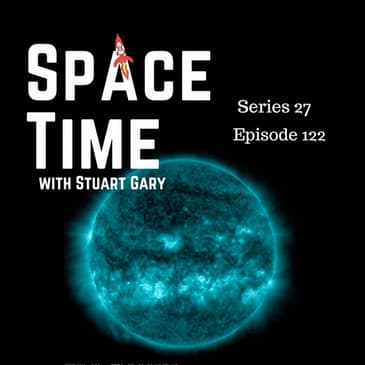
*The Sun's Most Powerful Solar Flare in Over a Decade
The Sun has unleashed its most powerful solar flare in more than a decade, with a spectacular X9.1 class event. This massive solar flare, part of a pair that erupted just two days apart, was detected by NASA’s Solar Dynamics Observatory. The event sparked strong G3 class geomagnetic storms, causing auroral activity to reach mid-latitudes and triggering deep shortwave radio blackouts. Solar flares, like this one, can have significant impacts on Earth's atmosphere, communications, and power grids.
*Ceres: A Former Ocean World?
New research suggests that the dwarf planet Ceres may have once been an ocean world. The study, published in Nature Astronomy, indicates that Ceres has a dirty icy crust, suggesting a past filled with muddy oceans. Computer simulations reveal that the crust may contain up to 90% ice, challenging previous assumptions of a drier Ceres. The findings are based on data from NASA’s Dawn mission, which observed surface features like volcanoes and glaciers.
*NASA's Europa Clipper Mission
NASA’s Europa Clipper mission is set for launch to explore Jupiter's ice-covered moon, Europa. The mission aims to investigate the moon's potential for life, with a suite of nine scientific instruments on board. These tools will study Europa's icy crust, subsurface ocean, and surface composition. The spacecraft will perform 49 flybys of Europa, gathering data to help scientists understand the moon’s habitability and its potential for hosting life.
00:00:00 - The sun unleashes its most powerful solar flare in more than a decade
00:00:27 - The sun has just emitted its most powerful solar flare in more than a decade
00:04:35 - New study claims dwarf planet Ceres may once have been an ocean world
00:14:34 - NASA's Europa Clipper mission is looking for life on icy moon Europa
00:19:58 - New figures show 47,000 people suffered heat related deaths across Europe last year
00:22:33 - Microsoft will release a new update for Windows 11 next month with AI features
00:25:46 - Outlook reminds you you haven't added your attachment yet
00:26:56 - Spacetime is available every Monday, Wednesday and Friday through various podcast providers
www.spacetimewithstuartgary.com
www.bitesz.com
🌏 Get Our Exclusive NordVPN deal here ➼ www.bitesz.com/nordvpn. The discount and bonuses are incredible! And it’s risk-free with Nord’s 30-day money-back guarantee! ✌
Check out our newest sponsor - Old Glory - Iconic Music and Sports Merch. Well worth a look....
Become a supporter of this podcast and access commercial-free episodes plus bonuses: https://www.spreaker.com/podcast/spacetime-with-stuart-gary--2458531/support.
[00:00:00] This is SpaceTime, Series 27, Episode 122, broadcast on the 9th of October 2024.
[00:00:07] Coming up on SpaceTime, the Sun unleashes its most powerful solar flare in more than a decade.
[00:00:14] A new study shows the dwarf planet Ceres may have once been an ocean world.
[00:00:19] And NASA's European Clipper mission slated for launch tomorrow.
[00:00:23] All that and more coming up on SpaceTime.
[00:00:27] Welcome to SpaceTime with Stuart Gary.
[00:00:46] The Sun has just emitted its most powerful solar flare in more than a decade.
[00:00:51] It was one of a pair of solar flares that erupted just two days apart, which were the most powerful in the current solar cycle.
[00:00:59] The biggest was a spectacular X9.1 class event which hit close to the top of the energy scale.
[00:01:05] And it hurled a coronal mass ejection directly towards the Earth.
[00:01:09] The powerful blast was generated by the same AR3842 Sunspot group, which had earlier launched an X7.1 class flare, the second strongest solar flare of the current solar cycle.
[00:01:22] Both were detected by NASA's Solar Dynamics Observatory spacecraft.
[00:01:26] The X7.1 class event hit the Earth on October the 4th as a mild halo coronal mass ejection.
[00:01:33] And the more powerful X9.1 blast hit on October the 6th.
[00:01:37] The dual impact sparked strong G3 class geomagnetic storms with auroral activity reaching mid-latitudes.
[00:01:45] Radiation from the flares ionized the top of Earth's atmosphere, causing deep shortwave radio blackouts.
[00:01:51] Solar flares are powerful bursts of energy flying out into space as magnetic field lines from deep inside the Sun erupt out above the Sun's surface along sunspots and then snap, releasing energy in the process.
[00:02:04] These events' classification as X-class flares indicate they're the most intense type of solar flare that's produced, while the numbers provide more information about their strength.
[00:02:15] Solar flares are classified on a logarithmic scale, similar to earthquakes and tornadoes.
[00:02:20] If the events are strong enough, and these two were, they can drag solar plasma and magnetic field into space with them.
[00:02:27] That's a coronal mass ejection.
[00:02:29] The space weather event, known as geomagnetic storms, can damage or even destroy spacecraft.
[00:02:35] Or at least they can shorten their lives by causing the Earth's atmosphere to expand.
[00:02:39] And that increases atmospheric drag on the spacecraft.
[00:02:42] That causes orbital decay, forcing the satellites to use up more of their reserve fuel in order to maintain an operational orbit.
[00:02:49] Geomagnetic storms can also disrupt communications and navigation systems.
[00:02:54] They black out power grids on the ground by overloading transformers.
[00:02:59] And they can increase radiation levels for astronauts and even people in high-altitude aircraft.
[00:03:04] Of course, on the plus side, they cause spectacular aurora light displays, usually at higher latitudes, as the charged particles they bring travel along the Earth's magnetic field lines and excite atoms and molecules in the atmosphere, triggering the aurora borealis and aurora australis, the northern and southern lights.
[00:03:22] Our sun's currently experiencing a massive increase in solar activity as it moves towards the climax of its 11-year solar cycle.
[00:03:30] The current solar cycle, number 25, began in 2019 and should reach solar maximum, that's the climax of the cycle, sometime in the next year or so.
[00:03:40] At which point, the sun's magnetic poles will quite literally flip polarity, with the north pole becoming south and the south pole north.
[00:03:48] That won't be the end of the solar storms, but gradually over time, they will start to decrease again, until they reach solar minimum sometime around 2030.
[00:03:58] Needless to say, we'll keep you informed.
[00:04:01] This is space-time.
[00:04:03] Still to come, a new study claims the dwarf planet Ceres may once have been an ocean world, although probably a somewhat muddy one.
[00:04:11] And NASA's Europa Clipper mission to the Jovian Ice Moon slated for launch tomorrow.
[00:04:16] All that and more still to come, on Space Time.
[00:04:35] A new study claims the dwarf planet Ceres may once have been an ocean world that slowly morphed into a giant, muddy, icy orb.
[00:04:44] Since its discovery in 1801, astronomers and planetary scientists have pondered the makeup of this distant frozen world,
[00:04:52] which is the largest body in the main asteroid built between Mars and Jupiter.
[00:04:56] The 950-kilometre-wide dwarf planet has surface features like volcanoes, landslides and glaciers,
[00:05:03] and a heavily battered and dimpled surface covered with impact craters.
[00:05:08] And that suggests the world hasn't been resurfaced in recent history.
[00:05:11] And therefore, it couldn't have been very icy in the past.
[00:05:15] However, a new study reported in the journal Nature Astronomy suggests that Ceres has a rather dirty, icy crust,
[00:05:23] meaning it may once have been an ocean world, if for somewhat muddy one.
[00:05:28] The findings are based on new computer simulations,
[00:05:31] which examined how craters on Ceres deformed over billions of years.
[00:05:35] One of the study's authors, Mike Surrey from Purdue University,
[00:05:39] says there appears to have been lots of water ice near Ceres' surface,
[00:05:43] and that it appears to get gradually less icy the deeper and deeper you go.
[00:05:47] Surrey says people used to think that if Ceres was very icy,
[00:05:51] the craters would deform quickly over time,
[00:05:54] like glaciers flowing on Earth, or like gooey flowing honey.
[00:05:57] However, these new simulations have shown that ice can be much stronger in conditions on Ceres
[00:06:03] than previously predicted if you mix in just a little bit of solid rock.
[00:06:07] The team's discovery is contradictory to the previous belief that Ceres was relatively dry.
[00:06:13] The common assumption was Ceres was less than 30% ice,
[00:06:16] but Surrey's team now believes the surface is actually more like 90% ice.
[00:06:21] Surrey says Ceres used to be an ocean world like Europa,
[00:06:25] the Jovian Ice Moon, which contains a global subsurface liquid water ocean beneath its frozen crust.
[00:06:31] However, Ceres had a dirty, muddy ocean.
[00:06:34] As that muddy ocean froze over time,
[00:06:37] it created an icy crust with a little bit of rocky material trapped in it.
[00:06:42] Now, even solids will flow over long timescales,
[00:06:45] and ice flows more readily than rock.
[00:06:48] Craters have deep bowls, which produce high stress levels
[00:06:51] and then relax to a lower stress state,
[00:06:53] resulting in a shallower bowl thanks to a solid state flow.
[00:06:57] So, the conclusion after NASA's Dawn mission
[00:06:59] was that due to the lack of relaxed shallow craters,
[00:07:02] the crust couldn't be very icy.
[00:07:04] However, the new computer simulations account for a new way the ice can flow
[00:07:09] with only a little bit of non-ice material mixed in.
[00:07:12] And that would allow a very ice-rich crust to barely flow even over billions of years.
[00:07:17] And in that way, you could end up with an ice-rich Ceres
[00:07:20] that still matches the observed lack of crater relaxation.
[00:07:25] To reach their conclusions,
[00:07:27] the authors tested different crustal structures in their simulations.
[00:07:30] They found that gravitational crust with a high ice content near the surface
[00:07:34] that grades down to lower ice with depth
[00:07:37] was the best way to limit relaxation of Ceres.
[00:07:41] Back in September 2007,
[00:07:44] NASA launched the Dawn mission to visit Ceres
[00:07:46] and another main-belt asteroid called Vesta.
[00:07:50] It was the first spacecraft to go into sustained orbits
[00:07:53] around two separate extraterrestrial destinations.
[00:07:57] Dawn arrived at Ceres in 2015
[00:07:59] and remained in orbit starting the dwarf planet until 2018.
[00:08:03] The authors used multiple observations made by Dawn
[00:08:06] to provide the data they needed for their simulations.
[00:08:09] Different surface features, such as pits, domes and landslides,
[00:08:13] all suggest that the near subsurface of Ceres contains lots of ice.
[00:08:18] And spectroscopic data also shows
[00:08:20] that there should be ice beneath the regolith on the dwarf planet
[00:08:23] and gravity data yields a density value near that of ice,
[00:08:27] specifically ice loaded with impurities.
[00:08:30] The authors also took a topographical profile
[00:08:33] of an actual complex crater on Ceres
[00:08:35] and used it to construct the geometry for some of their simulations.
[00:08:40] Sorry says it all points to the dwarf planet
[00:08:42] having once been a frozen ocean world,
[00:08:45] pretty close in many characteristics other than size
[00:08:48] to the planet Earth itself.
[00:08:51] This is space-time.
[00:08:53] Still to come, NASA's Europa Clipper mission,
[00:08:56] slated for launch to the Jovian ice moon tomorrow.
[00:08:59] And later in the science report,
[00:09:01] researchers have for the first time
[00:09:03] mapped the entire brain of Drosophilus,
[00:09:06] the fruit fly.
[00:09:07] All that and more still to come on Space Time.
[00:09:25] NASA's Europa Clipper mission is slated for launch
[00:09:28] to the Jovian ice moon
[00:09:29] during a 21-day launch window which opens tomorrow.
[00:09:32] The 3,241 kg spacecraft is the largest planetary mission
[00:09:38] ever undertaken by the space agency.
[00:09:40] It'll launch from the Kennedy Space Center in Florida
[00:09:43] aboard a SpaceX Falcon Heavy rocket
[00:09:45] comprising three Falcon 9 core stages mounted side by side.
[00:09:50] If all goes well,
[00:09:51] the spacecraft will reach the Jovian system in April 2030.
[00:09:55] On board will be nine science instruments
[00:09:58] designed to understand the nature of this 3,120 km wide frozen world
[00:10:03] and the global liquid ocean beneath its icy crust.
[00:10:07] The mission is designed to help scientists
[00:10:09] better understand the potential for life on other worlds.
[00:10:13] Its instruments include a mapping imaging infrared spectrometer
[00:10:17] that'll map ices, salts and organics
[00:10:19] as well as warm spots on Europa
[00:10:21] that could be suggesting habitability.
[00:10:23] It'll also reveal how material is exchanged
[00:10:26] between the surface ice and the ocean below.
[00:10:29] There's a tetracorder
[00:10:31] which will provide rapid analysis of Europa's composition.
[00:10:34] A thermal emissions imaging system
[00:10:36] will map the temperature and texture of Europa's surface
[00:10:39] looking for clues about activities such as icy geysers
[00:10:43] and regions where the moon's suspected ocean
[00:10:45] may be nearer the surface.
[00:10:47] There's an ultraviolet spectrograph
[00:10:49] which will study Europa's atmospheric and surface composition.
[00:10:52] It'll provide special focus on the plumes
[00:10:54] that may be erupting from the ocean beneath the ice.
[00:10:57] Its measurements are especially sensitive
[00:10:59] to detecting vapour plumes
[00:11:01] that could be difficult to spot using other techniques.
[00:11:04] The instrument will also study interactions
[00:11:06] between Europa's thin atmosphere
[00:11:08] and charged particles in space.
[00:11:11] These interactions can make Europa's atmosphere
[00:11:13] glow in ultraviolet
[00:11:14] very much like aurorae on Earth.
[00:11:17] Then there's the Europa imaging system.
[00:11:19] It'll use visible light cameras
[00:11:21] to generate high-resolution maps of Europa's surface
[00:11:24] covering about 90% of its surface at 100 metres per pixel.
[00:11:29] That equates to six times more of Europa's surface
[00:11:31] and five times better resolution
[00:11:33] than has ever been captured before.
[00:11:36] And when the spacecraft makes a close flyby of Europa,
[00:11:39] the instrument will produce images
[00:11:40] with a resolution 100 times better.
[00:11:42] Its three-dimensional views
[00:11:44] will also allow scientists to measure surface heights
[00:11:46] and its colour images will provide information
[00:11:49] about Europa's surface material.
[00:11:52] Another part of the spacecraft's scientific package
[00:11:54] is a dual-frequency ice-penetrating radar instrument.
[00:11:58] It'll characterise and sound Europa's icy crust
[00:12:00] from near the surface right down to the ocean,
[00:12:03] in the process revealing the hidden structure
[00:12:05] of Europa's ice shell
[00:12:06] and potential water pockets within it.
[00:12:08] It'll also probe the exosphere,
[00:12:10] the surface and near surface,
[00:12:12] and the full depth of the ice shell itself
[00:12:14] right down to the ice-ocean interface,
[00:12:17] which could be up to 30 kilometres deep.
[00:12:19] The Europa Clipper magnetometer
[00:12:21] will be used to characterise magnetic fields
[00:12:23] around Europa
[00:12:24] using three magnetic flux gates
[00:12:25] placed along an eight-metre boom,
[00:12:27] which will be stowed during the launch
[00:12:29] and then deployed once in flight.
[00:12:32] By studying the strength and orientation
[00:12:34] of Europa's magnetic field over multiple flybys,
[00:12:37] scientists hope to be able to confirm
[00:12:38] the existence of Europa's subsurface ocean,
[00:12:41] as well as characterise the thickness
[00:12:43] of its icy crust
[00:12:44] and measure the water's depth and salinity.
[00:12:47] There's a plasma magnetic siding instrument
[00:12:50] aboard as well.
[00:12:51] It'll measure plasma to characterise
[00:12:53] the magnetic fields generated by plasma currents.
[00:12:56] These plasma currents mask
[00:12:58] the magnetic induction response
[00:13:00] of Europa's subsurface ocean,
[00:13:02] and in conjunction with a magnetometer,
[00:13:04] it'll be key to determining
[00:13:05] Europa's ice shell thickness,
[00:13:07] ocean depth and salinity.
[00:13:09] It'll also probe the mechanisms
[00:13:11] responsible for weathering
[00:13:12] and releasing material from Europa's surface
[00:13:15] into the atmosphere and ionosphere,
[00:13:17] and understand how Europa influences
[00:13:19] its surrounding space environment
[00:13:20] and Jupiter's magnetosphere.
[00:13:23] There's a mass spectrometer
[00:13:24] that'll determine the composition
[00:13:26] of the surface and subsurface ocean
[00:13:28] by measuring Europa's extremely tenuous atmosphere
[00:13:31] and any surface material ejected into space.
[00:13:34] There's also a dust analyzer,
[00:13:36] another type of mass spectrometer,
[00:13:38] that'll measure the composition
[00:13:39] of small solid particles ejected from Europa.
[00:13:42] That'll provide an opportunity
[00:13:44] to directly sample the surface
[00:13:45] and potential plumes during low-altitude flybys.
[00:13:49] This instrument's also capable
[00:13:51] of identifying traces of organic
[00:13:52] and inorganic compounds in the ice ejector.
[00:13:55] Finally, Europa Clipper will use its radio antenna
[00:13:59] to perform additional experiments
[00:14:00] and learn more about Europa's gravitational field.
[00:14:04] You see, as the spacecraft performs
[00:14:06] each of its 45 flybys,
[00:14:08] its trajectory will be subtly altered
[00:14:10] by the Moon's gravity.
[00:14:12] Now, by sending radio signals
[00:14:13] between the Earth and the Moon
[00:14:15] and characterising the Doppler shift
[00:14:17] in the return signal,
[00:14:18] scientists should be able to create
[00:14:19] a detailed characterisation
[00:14:21] of the spacecraft's motion.
[00:14:23] And that data will help determine
[00:14:25] how Europa flexes
[00:14:26] in relation to its distance from Jupiter,
[00:14:28] which in turn will reveal information
[00:14:30] about the Moon's internal structure
[00:14:32] and its tidal motions.
[00:14:34] This report on Europa Clipper by NASA TV.
[00:14:37] Everywhere on Earth
[00:14:39] that there's water, there's life.
[00:14:42] We have several ocean worlds
[00:14:44] in our solar system.
[00:14:46] And by exploring Europa,
[00:14:48] we're getting a taste
[00:14:49] of what these ocean worlds are like.
[00:14:52] Europa is one of the moons of Jupiter.
[00:14:54] It's about the same size as our own moon,
[00:14:56] a little bit smaller.
[00:14:58] But it's so much different.
[00:15:01] It's an ice world.
[00:15:07] Europa probably has,
[00:15:09] beneath its icy surface,
[00:15:11] a global ocean of water.
[00:15:14] We think there are thermal vents
[00:15:17] in this vast subsurface ocean.
[00:15:19] There may be primitive organisms there,
[00:15:22] similar to the original primitive organisms
[00:15:25] on Earth from which we all evolved.
[00:15:27] When we first discovered hydrothermal vents
[00:15:30] on our seafloors on the Earth,
[00:15:32] we also discovered life.
[00:15:34] There was no sunlight
[00:15:35] that was penetrating down that deep,
[00:15:37] but yet there was life living there.
[00:15:38] On Europa,
[00:15:40] we're not looking for life itself.
[00:15:41] We're just looking for an environment
[00:15:42] in which life could thrive.
[00:15:44] I just love Europa's surface.
[00:15:47] I think it's one of the most complex surfaces
[00:15:49] in our solar system.
[00:15:50] Typically,
[00:15:50] when you look at another planetary surface,
[00:15:52] it's covered with craters,
[00:15:54] just like our moon.
[00:15:55] There are very few,
[00:15:57] shockingly few,
[00:15:58] impact craters.
[00:15:59] That means something is going on
[00:16:01] to erase the craters,
[00:16:03] just like happens here on Earth.
[00:16:04] And on Earth,
[00:16:05] we call that geology.
[00:16:06] One of the key questions right now
[00:16:08] that we have about Europa
[00:16:09] is whether or not
[00:16:10] there is plume activity.
[00:16:12] Plumes are one way
[00:16:13] that you can definitely get
[00:16:14] ocean material to the surface.
[00:16:16] We really need a spacecraft
[00:16:17] in the system
[00:16:18] that's watching Europa
[00:16:19] to see when those plumes are happening,
[00:16:21] if they're happening.
[00:16:22] The Europa Clipper mission
[00:16:24] will be the first in-depth exploration
[00:16:28] of an ocean world.
[00:16:31] Europa Clipper is orbiting Jupiter,
[00:16:33] and it's performing
[00:16:34] 49 flybys of Europa.
[00:16:36] And the main reason it's doing that
[00:16:38] is to stay mostly outside
[00:16:40] of Jupiter's really intense
[00:16:42] radiation belts.
[00:16:44] Each time we make a flyby,
[00:16:46] we turn on all of the instruments
[00:16:48] at once.
[00:16:49] Most of us know about cameras
[00:16:51] because that's what our eyes see,
[00:16:53] but there is a whole slew
[00:16:55] of other instruments
[00:16:56] on board Europa Clipper
[00:16:58] that expands our vision.
[00:17:00] We have four different instruments
[00:17:01] that we're really using
[00:17:02] to take images of Europa's surface.
[00:17:04] We have the visible wavelength,
[00:17:06] the near-infrared,
[00:17:07] the far-infrared,
[00:17:09] and the UV,
[00:17:09] the ultraviolet.
[00:17:10] We're hoping to see evidence of change,
[00:17:12] new cracks,
[00:17:13] new surface colors
[00:17:14] that indicate different materials,
[00:17:16] maybe have moved around
[00:17:18] or come up from the subsurface.
[00:17:20] We have an instrument
[00:17:22] that can sniff
[00:17:22] the very thin atmosphere,
[00:17:25] the gases,
[00:17:26] and determine the composition
[00:17:27] with extreme precision.
[00:17:30] We're looking for signs
[00:17:31] of organics at Europa.
[00:17:33] Are there materials
[00:17:34] that contain carbon
[00:17:36] and hydrogen
[00:17:36] and oxygen and nitrogen?
[00:17:38] And we have another instrument
[00:17:40] that can tell us
[00:17:41] the composition
[00:17:42] of dust particles.
[00:17:43] We're pretty sure there are salts
[00:17:45] on Europa's surface,
[00:17:47] and those salts may have come out
[00:17:48] of the ocean.
[00:17:49] We want to understand
[00:17:50] what are those salts.
[00:17:51] We have a magnetometer
[00:17:52] and a plasma instrument
[00:17:54] that are going to be studying
[00:17:55] that magnetosphere environment
[00:17:57] that Europa is sitting in
[00:17:58] and Jupiter's
[00:17:59] magnetosphere environment.
[00:18:01] The magnetic field of Europa,
[00:18:03] in turn,
[00:18:04] can tell us
[00:18:05] about the properties
[00:18:06] of the ocean.
[00:18:07] How thick is it
[00:18:08] and how salty is it?
[00:18:10] And then we have this
[00:18:11] novel ice-penetrating radar
[00:18:14] that will try to get
[00:18:15] below the ice shell.
[00:18:18] Last but not least,
[00:18:19] we have a gravity experiment
[00:18:21] using the communication system
[00:18:23] of the spacecraft.
[00:18:25] And from that,
[00:18:26] we can get essentially
[00:18:27] a map of the gravity field.
[00:18:30] We can get the shape,
[00:18:32] understand, you know,
[00:18:32] what's underneath,
[00:18:33] maybe even get some information
[00:18:35] on the depth of the ocean.
[00:18:36] It's really a sophisticated payload.
[00:18:38] So there really has not been
[00:18:40] a mission like Europa Clipper.
[00:18:42] The pictures that we are
[00:18:43] going to get back
[00:18:43] are going to be just fantastic.
[00:18:45] The legacy of Europa Clipper
[00:18:46] will be just a treasure trove
[00:18:48] of knowledge about this world.
[00:18:51] Just to find an environment
[00:18:52] that is similar to the one
[00:18:55] from which life arose on Earth
[00:18:56] would really be groundbreaking.
[00:18:57] It would be awesome.
[00:18:59] I have no idea
[00:19:00] what we are going to detect
[00:19:02] beneath Europa's icy surface,
[00:19:04] but all I know
[00:19:04] is it's going to be wonderful.
[00:19:06] We do this work of exploration
[00:19:08] for the next generation.
[00:19:10] We don't know if Earth
[00:19:12] is the only place
[00:19:13] that life got started
[00:19:14] or if it's really common.
[00:19:17] And a really important way
[00:19:19] to get at that
[00:19:19] is to understand,
[00:19:20] is there life elsewhere
[00:19:22] in our solar system?
[00:19:35] And in that report
[00:19:36] from NASA TV,
[00:19:37] we heard from
[00:19:38] Europa Clipper project scientist
[00:19:39] Robert Papalato from JPL,
[00:19:42] Europa Clipper deputy project scientist
[00:19:44] Bonnie Buratti,
[00:19:45] Europa Clipper staff scientist
[00:19:46] Katie Kraft
[00:19:47] from the Johns Hopkins
[00:19:48] Applied Physics Laboratory,
[00:19:50] Europa Clipper staff scientist
[00:19:51] Aaron Leonard,
[00:19:52] also from JPL,
[00:19:54] and Europa Clipper
[00:19:55] investigation scientist
[00:19:56] Sean Brooks.
[00:19:58] This is Space Time.
[00:19:59] And time now
[00:20:16] to take another brief look
[00:20:17] at some of the other stories
[00:20:18] making news in science
[00:20:19] this week
[00:20:20] with a science report.
[00:20:22] New figures show
[00:20:23] that more than 47,000 people
[00:20:25] suffered heat-related deaths
[00:20:27] across Europe last year.
[00:20:29] The findings reported
[00:20:30] in the journal Nature
[00:20:31] are based on a modelling study
[00:20:33] by international researchers.
[00:20:35] And they claim
[00:20:36] the figures would be much higher
[00:20:38] if people didn't have
[00:20:39] modern-day healthcare
[00:20:40] and comforts like air conditioning.
[00:20:42] The authors reached their conclusions
[00:20:43] based on death data
[00:20:45] from the European Statistical Office.
[00:20:47] That allowed them
[00:20:48] to estimate heat-related deaths
[00:20:50] in 2023
[00:20:50] across 35 European countries.
[00:20:53] The figures suggest
[00:20:55] that 47,312 heat-related deaths
[00:20:58] may have happened
[00:20:59] between May 29th
[00:21:01] and October 1st, 2023,
[00:21:03] with the highest number
[00:21:04] of heat-related deaths
[00:21:05] occurring in Southern Europe.
[00:21:07] The authors then estimated
[00:21:08] what the death rate
[00:21:09] would have been
[00:21:10] without modern-day advantages.
[00:21:12] That suggests
[00:21:13] that the heat-related
[00:21:14] death rates across Europe
[00:21:15] could have been 80% higher
[00:21:17] in the general population
[00:21:18] and 100% higher
[00:21:20] in the elderly.
[00:21:22] A new study claims
[00:21:24] a mysterious type
[00:21:25] of iron-rich magma
[00:21:26] interned within extinct volcanoes
[00:21:28] is likely to be abundant
[00:21:29] in rare earth elements.
[00:21:31] The findings,
[00:21:32] reported in the journal
[00:21:33] Geochemical Perspectives letters,
[00:21:35] could offer a new way
[00:21:36] to source these metals.
[00:21:38] Rare earth elements
[00:21:39] are important
[00:21:40] to modern society.
[00:21:41] They're found in everything
[00:21:43] from smartphones
[00:21:44] and flat-screen TVs
[00:21:45] through to magnets,
[00:21:46] trains and missiles.
[00:21:48] They're also vital
[00:21:49] for the development
[00:21:50] of electric vehicles
[00:21:51] and renewable energy technologies
[00:21:53] such as bird-killing wind turbines.
[00:21:56] Scientists have for the first time
[00:21:58] mapped the entire brain
[00:22:00] of Drosophila,
[00:22:01] the fruit fly.
[00:22:02] A report in the journal Nature
[00:22:03] claims this new map
[00:22:05] can teach researchers
[00:22:06] about brain function.
[00:22:07] The authors say
[00:22:08] the fruit fly brain
[00:22:09] has around 140,000 neurons
[00:22:11] and more than 50 million connections.
[00:22:14] That's around a million times
[00:22:15] fewer neurons
[00:22:16] than most human brains.
[00:22:18] They say despite its size,
[00:22:20] the fruit fly brain
[00:22:21] is still used
[00:22:22] for a range of complex behaviours
[00:22:23] by the insect
[00:22:24] and that makes it
[00:22:25] an ideal starting point
[00:22:26] to help them
[00:22:27] towards their eventual goal
[00:22:28] of mapping other species,
[00:22:30] including the human brain.
[00:22:33] There'll be a new update
[00:22:34] for Windows 11
[00:22:35] coming out next month.
[00:22:36] With the details,
[00:22:37] we're joined by technology editor
[00:22:39] Alex Saharov-Royd
[00:22:40] from TechAdvice.live.
[00:22:42] So this is called
[00:22:42] the Windows 11 24H2,
[00:22:46] so the second half of 2024.
[00:22:47] And normally,
[00:22:48] these things are not always
[00:22:49] bringing new features.
[00:22:51] I mean, sometimes they are.
[00:22:52] Obviously, there's bug fixes.
[00:22:53] But this time,
[00:22:53] if you have a Windows Plus
[00:22:55] co-pilot PC,
[00:22:57] which is one of the new ones
[00:22:58] with the chip inside
[00:22:59] that does the artificial intelligence
[00:23:01] with the neural processing unit,
[00:23:03] you'll get the new recall feature.
[00:23:05] In Preview,
[00:23:06] which takes screenshots
[00:23:07] of everything that you're doing
[00:23:08] and allows you to search
[00:23:10] through those screenshots
[00:23:11] and actually interact with them.
[00:23:12] You don't have to bring up
[00:23:12] the actual Word or PDF document,
[00:23:14] for example.
[00:23:15] You can copy and paste text
[00:23:16] and copy images from it.
[00:23:17] But you'll now have to
[00:23:18] have Windows Hello
[00:23:19] or your fingerprint
[00:23:20] or a password
[00:23:20] to enable access to that.
[00:23:22] Nothing is meant to be
[00:23:23] going back to Microsoft.
[00:23:24] And there's additional features inside
[00:23:27] that basically take advantage
[00:23:28] of the fact that
[00:23:29] your AI chip can sit there
[00:23:31] and help you to remember things
[00:23:33] and find things
[00:23:34] that a normal search cannot.
[00:23:35] And you can also pause
[00:23:37] the recall feature
[00:23:39] if you're going to sites
[00:23:40] where you don't want it
[00:23:40] to remember anything,
[00:23:41] maybe your banking site,
[00:23:42] for example,
[00:23:43] or other sites that you're on.
[00:23:44] And it's supposed to give
[00:23:45] your PC a photographic memory.
[00:23:47] And it's actually
[00:23:48] quite a smart idea,
[00:23:49] but the way that Microsoft
[00:23:49] rolled it out at first
[00:23:50] and basically promised security
[00:23:52] when nobody believes
[00:23:53] Microsoft can deliver
[00:23:54] a secure version of Windows,
[00:23:56] naturally people were
[00:23:57] a bit concerned about it
[00:23:58] and it got paused.
[00:23:59] And so this is meant
[00:24:00] to be coming in November,
[00:24:02] one of the biggest features.
[00:24:04] There's also a thing
[00:24:04] called the click-to-do feature.
[00:24:07] So this is where
[00:24:08] you can take a snapshot
[00:24:09] like with the old-fashioned
[00:24:10] snipping tool,
[00:24:11] but now you can blur
[00:24:12] the background
[00:24:13] or erase objects
[00:24:14] from a photo.
[00:24:14] So emulating some of those
[00:24:16] photo magic eraser features
[00:24:17] that we see on the Samsung
[00:24:19] and the Google phones
[00:24:20] and even now with iOS 18,
[00:24:22] on Apple iPhones.
[00:24:24] The Windows search tool itself
[00:24:25] in the past
[00:24:26] took whatever you said
[00:24:27] and if it couldn't find it,
[00:24:28] it didn't show you any results.
[00:24:29] But everybody knows
[00:24:30] if you go to Google
[00:24:31] and you misspell a word,
[00:24:32] it still finds
[00:24:33] what it is you're looking for.
[00:24:34] And so the internal
[00:24:35] Windows search facility
[00:24:37] will finally get
[00:24:38] this sort of fuzzy intelligence
[00:24:39] that we're used to
[00:24:40] with using search engines.
[00:24:42] Photos and paint,
[00:24:43] we're going to get
[00:24:44] more AI features,
[00:24:45] AI enhancements,
[00:24:46] and we can reimagine
[00:24:48] and enhance
[00:24:49] old resolution,
[00:24:50] low resolution photos
[00:24:51] like in those CSI type shows
[00:24:53] on TV
[00:24:53] where they're improving
[00:24:54] the resolution
[00:24:55] of someone's number plate
[00:24:56] way off in the distance.
[00:24:57] Well, you'll get
[00:24:58] similar sorts of capabilities.
[00:24:59] You can reportedly
[00:25:00] increase the resolution
[00:25:01] by up to eight times
[00:25:03] with a little slider
[00:25:04] and the neural processing unit
[00:25:05] will do that task for you.
[00:25:06] So they're really trying
[00:25:08] to make you feel like
[00:25:09] your PC without
[00:25:10] AI features
[00:25:11] is going to be old.
[00:25:12] They want you to upgrade
[00:25:13] and no surprise there.
[00:25:14] Everyone's doing
[00:25:15] the same thing.
[00:25:16] My Apple,
[00:25:16] the Mac OS Sequoia
[00:25:17] now has a bunch
[00:25:18] of AI features built in.
[00:25:20] The Google phones
[00:25:21] are all coming with Gemini,
[00:25:22] which is their version of AI.
[00:25:23] And the use cases
[00:25:24] are coming out
[00:25:25] thick and fast.
[00:25:26] But still,
[00:25:26] for most people
[00:25:27] who haven't used it yet,
[00:25:29] they're still sort of
[00:25:29] yet to try it
[00:25:30] and see the wow
[00:25:31] for themselves.
[00:25:32] But pretty soon
[00:25:33] every device
[00:25:33] will just come with AI
[00:25:34] standard and still have
[00:25:35] the pre-AI era
[00:25:37] and the post-AI era.
[00:25:38] And we're firmly
[00:25:39] into that now
[00:25:40] and all the companies
[00:25:41] want your job great.
[00:25:41] But of course,
[00:25:42] if you wait until next year,
[00:25:43] you get even better
[00:25:43] PCs, smart phones
[00:25:44] and tablets
[00:25:45] and even better AI features.
[00:25:46] I had an interesting experience
[00:25:47] the day before yesterday.
[00:25:48] I was organizing
[00:25:50] an interview
[00:25:50] via email
[00:25:51] and in the email,
[00:25:53] one line I said was
[00:25:54] I'll give you all the details
[00:25:54] in the attachment.
[00:25:55] That was all I said
[00:25:56] and I was just about
[00:25:57] to send it off
[00:25:58] and then Outlook reminded me
[00:26:00] you haven't added
[00:26:01] your attachment yet.
[00:26:04] Look, yes and no.
[00:26:05] I mean, I've seen Google
[00:26:07] do that as well
[00:26:08] and the trigger
[00:26:09] is the word attachment.
[00:26:10] I have an attachment
[00:26:11] and then if
[00:26:12] the email program sees
[00:26:13] well hang on,
[00:26:13] there's no attachment
[00:26:14] attached to this email.
[00:26:16] I mean, it says
[00:26:16] well hey, hang on,
[00:26:17] you mentioned an attachment
[00:26:18] in your email
[00:26:19] but you haven't sent one.
[00:26:19] I don't think it's actually
[00:26:20] going through your email
[00:26:22] and you're seeing anything.
[00:26:22] Look, I didn't mind
[00:26:23] because I had forgotten
[00:26:24] to add the attachment
[00:26:26] but it was still
[00:26:27] disconcerting for me.
[00:26:28] I guess it's got to become
[00:26:28] a lot more disconcerting
[00:26:29] in the future
[00:26:30] when your computer
[00:26:30] actually is reading
[00:26:32] and understanding
[00:26:32] what it is you're saying
[00:26:33] at the moment.
[00:26:33] It's just a trigger
[00:26:34] for the word attachment
[00:26:35] and it's like
[00:26:36] it's like a new
[00:26:36] send statement.
[00:26:37] You know,
[00:26:37] if the user
[00:26:38] sent attachment
[00:26:39] and there's no actual
[00:26:39] attachment file
[00:26:41] attached to this email
[00:26:42] then send a little
[00:26:43] pop-up to the user
[00:26:44] and I've seen that
[00:26:45] for the last few years
[00:26:46] on Gmail
[00:26:46] and I haven't been
[00:26:47] using Outlook
[00:26:48] for a long time
[00:26:48] because I just
[00:26:49] defected to Gmail
[00:26:50] and I've been very
[00:26:50] happy ever since
[00:26:51] but it's nice to hear
[00:26:52] that Outlook
[00:26:53] has finally caught up
[00:26:54] and it's offering
[00:26:54] this as a useful service.
[00:26:56] That's Alex Sahar of Roy
[00:26:57] from TechAdvice.
[00:26:59] Live.
[00:27:15] And that's the show
[00:27:16] for now.
[00:27:16] Space Time is available
[00:27:18] every Monday,
[00:27:19] Wednesday and Friday
[00:27:20] through Apple Podcasts,
[00:27:21] iTunes,
[00:27:22] Stitcher,
[00:27:23] Google Podcasts,
[00:27:24] Pocket Casts,
[00:27:25] Spotify,
[00:27:26] Acast,
[00:27:27] Amazon Music,
[00:27:28] Bytes.com,
[00:27:29] SoundCloud,
[00:27:30] YouTube,
[00:27:31] your favourite podcast
[00:27:32] download provider
[00:27:33] and from Spacetime,
[00:27:34] with Stuart,
[00:27:35] Gary.com.
[00:27:36] Spacetime's also broadcast
[00:27:38] through the National Science Foundation
[00:27:39] on Science Zone Radio
[00:27:41] and on both iHeart Radio
[00:27:42] and TuneIn Radio.
[00:27:44] And you can help to support our show
[00:27:46] by visiting the Spacetime store
[00:27:48] for a range of promotional
[00:27:49] merchandising goodies
[00:27:50] or by becoming a Spacetime patron
[00:27:53] which gives you access
[00:27:54] to triple episode commercial
[00:27:55] free versions of the show
[00:27:57] as well as lots of bonus audio content
[00:27:59] which doesn't go to air,
[00:28:00] access to our exclusive Facebook group
[00:28:02] and other rewards.
[00:28:04] Just go to
[00:28:05] spacetimewithstuartgary.com
[00:28:07] for full details.
[00:28:08] And if you want more Spacetime
[00:28:10] please check out our blog
[00:28:11] where you'll find all the stuff
[00:28:12] we couldn't fit in the show
[00:28:13] as well as heaps of images,
[00:28:15] news stories,
[00:28:16] loads of videos
[00:28:17] and things on the web
[00:28:18] I find interesting or amusing.
[00:28:20] Just go to
[00:28:22] spacetimewithstuartgary.tumblr.com
[00:28:24] That's all one word
[00:28:25] and that's Tumblr without the E.
[00:28:28] You can also follow us
[00:28:29] through atstuartgary on Twitter,
[00:28:31] at spacetimewithstuartgary on Instagram,
[00:28:34] through our Spacetime YouTube channel
[00:28:36] and on Facebook
[00:28:37] just go to
[00:28:38] facebook.com
[00:28:39] forward slash
[00:28:40] spacetimewithstuartgary.
[00:28:41] You've been listening
[00:28:43] to Spacetime with Stuart Gary.
[00:28:45] This has been another
[00:28:46] quality podcast production
[00:28:47] from bytes.com
[00:28:49] Spacetime with StuG
[00:28:50] You've been listening to Spacetime
[00:28:51] Spacetime with StuG