
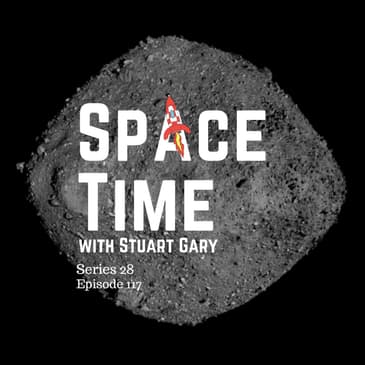
(00:00:47) Scientists have discovered minerals older than our solar system embedded in asteroid Bennu
(00:10:22) Scientists using NASA's Webb telescope have uncovered mysterious features in Saturn's atmosphere
(00:14:58) NASA's Parker Solar Probe completes 25th close approach to the sun
(00:17:27) The Science Report
In this episode of Space Time, we uncover groundbreaking discoveries that challenge our understanding of the cosmos. Join Stuart Gary as he discusses the astonishing findings from the asteroid Bennu, revealing minerals older than our solar system itself. Delve into the unexpected features observed in Saturn's atmosphere and learn about the Parker Solar Probe's close flyby of the Sun. This episode is packed with insights that could reshape our knowledge of planetary formation and cosmic history.
Chapters:
(00:00) This is space time series 28 episode 117 for broadcast on 29 September 2025
(00:47) Scientists have discovered minerals older than our solar system embedded in asteroid Bennu
(10:13) Scientists using NASA's Webb telescope have uncovered mysterious features in Saturn's atmosphere
(14:59) NASA's Parker Solar Probe completes 25th close approach to the sun
(17:41) A widely reported study on apple cider vinegar and weight loss has been retracted
Become a supporter of this podcast: https://www.spreaker.com/podcast/spacetime-with-stuart-gary--2458531/support.
00:00:00
This is Space Time, Series 28, Episode 117, for broadcast on
00:00:04
the 29th of September, 2025. Coming up on Space Time,
00:00:09
Stardust, older than the solar system, found in the asteroid
00:00:13
Bennu. Strange and mysterious features discovered in Saturn's
00:00:17
atmosphere. And the Parkas solar probe undertakes a close flyby
00:00:22
of the Sun. All that and more coming up on Space Time.
00:00:28
Welcome to Space Time with Stuart Gary.
00:00:47
Scientists have discovered minerals older than our solar
00:00:50
system, embedded in the asteroid Bennu. The findings, reported in
00:00:54
the journal's Nature Astronomy and Nature Geoscience, could
00:00:57
help explain how planets like the Earth first formed.
00:01:01
The new research provides the most comprehensive analysis yet
00:01:04
of samples from NASA's OSIRIS-REx mission, which
00:01:07
returned more than 120 grams of pristine asteroid material from
00:01:12
Bennu to Earth in 2023. One of the study's authors, Nick Timms
00:01:16
from Curtin University, says the findings show the asteroid Bennu
00:01:20
is composed of ancient cosmic material, including stardust,
00:01:24
which is older than the solar system itself.
00:01:27
The analysis indicates that the 490-metre-wide asteroid's parent
00:01:32
body was built from a rich, varied mix of organic compounds,
00:01:36
icy materials, silicates and grains from ancient stars,
00:01:40
preserved in near-perfect conditions for more than four
00:01:43
and a half billion years.
00:01:45
Tim says some of these materials formed in other stars long
00:01:49
before the solar system existed. Others formed in the outer solar
00:01:53
system, and still others were condensed close to the Sun
00:01:57
before being carried outwards.
00:01:59
This means that asteroid Bennu's parent body must have been
00:02:02
formed from dust from distinct regions of the solar system, or
00:02:06
at least the protoplanetary disk which eventually would form our
00:02:09
solar system, and then likely travelled from an orbit beyond
00:02:12
Jupiter towards the inner solar system and the main asteroid
00:02:15
belt.
00:02:16
Some time later, the parent body was destroyed and some parts
00:02:20
were reassembled into Bennu, a rubble pile asteroid which
00:02:24
eventually drifted into its current near-Earth orbit. Tim
00:02:28
says Bennu helps astronomers understand how planets form and
00:02:31
how key ingredients, such as water and organic matter, may
00:02:35
have reached the Earth.
00:02:36
Some of the work involved looking at the small components
00:02:40
that make up asteroid Bennu and it's basically quite a buffet
00:02:44
of... Of all sorts of different particles from early in the
00:02:47
solar system and even some tiny particles that formed before our
00:02:50
solar system formed as well, which tells us about whereabouts
00:02:54
in the solar system the parent body for asteroid Bennu was
00:02:58
formed.
00:02:59
And also we've been finding out a lot about the conditions on
00:03:02
the parent body for the asteroid as well and how water was very
00:03:07
instrumental in changing some of the components of the asteroid
00:03:10
and altering things at conditions. Roughly around room
00:03:14
temperature on the parent body for asteroid Bennu very, very
00:03:17
early on in the solar system, long before it was smashed up
00:03:21
and reassembled into a big rubble pile asteroid Bennu is
00:03:25
today.
00:03:25
So what can you tell us about the environment Bennu was formed
00:03:29
in?
00:03:30
Well, the asteroid was, or the parent to the asteroid at least,
00:03:33
was kind of amalgamated or accreted from dust particles and
00:03:38
ice particles from different parts in the solar system very
00:03:41
soon after the Sun formed.
00:03:43
And before really the planets got to form into the planets
00:03:46
that we know today, we think there were lots more
00:03:49
proto-planets or baby planets which started to creep from the
00:03:53
dust in the solar disk in the early solar system. And some of
00:03:57
those survived and accumulated today to what we know as the
00:04:01
planets, and some of them didn't. And the parent body for
00:04:03
asteroid Bennu was one of the early ones that didn't survive.
00:04:07
But we found out some of the components were formed. In the
00:04:10
inner solar system, and some of the parts of Bennu, the Bennu
00:04:14
parent body, were accreted in the outer solar system. So there
00:04:17
was lots of movement and mixing and migration of material in the
00:04:22
early solar system to make up what we now see as asteroid
00:04:25
Bennu.
00:04:26
So how did you determine that? Was it simply that you looked at
00:04:29
the composition of the water itself to see how much deuterium
00:04:33
there was in it, or how is that done?
00:04:35
So what we can do is look at, well, there are two things.
00:04:38
Really two main ways of studying the asteroid material. One is to
00:04:43
make measurements of larger pieces of it and look at the
00:04:46
bulk geochemistry of those fragments. So it sort of
00:04:50
amalgamates everything together to get a sort of a bulk view of
00:04:53
what the average of everything is in all of the bits inside the
00:04:56
asteroid material.
00:04:58
And the other approach really is to look at the individual grains
00:05:01
and individual crystals and fragments and particles within
00:05:04
the asteroid material and try to fingerprint where they're from
00:05:07
using a combination of geochemistry and isotope
00:05:11
geochemistry. And it's the combination of those things that
00:05:15
have helped sort of identify all of these different weak
00:05:18
components.
00:05:19
For example, the asteroid contains just a few percent of
00:05:23
types of minerals which have escaped hydrothermal alteration
00:05:27
of some of the original bit if you like, some of the original
00:05:30
fragments, and the hydrosilicates, a group of
00:05:33
minerals which include things like olivine, which you might
00:05:37
know as peridote, which people put on jewelry, and a group of
00:05:40
minerals called pyroxenes.
00:05:42
Now, we could analyze those crystals individually and
00:05:45
measure their oxygen isotope values, so the proportions of
00:05:49
different isotopes of oxygen, so oxygen-16 and oxygen-17,
00:05:53
oxygen-18, and that allows us to interpret. What their sources
00:05:58
were. And some of them was really, really primitive
00:06:01
material, primordial material formed right after the formation
00:06:04
of the Sun, some of the earliest solids to form in the solar
00:06:07
system.
00:06:08
And some of those minerals have actually been processed, they've
00:06:11
been remelted again, and are fragments of what we call
00:06:14
chondrules, which are subject to sort of flash heating events in
00:06:18
the early solar system as well. So that's just an example of how
00:06:22
we can fingerprint some of the origins of some of the minerals
00:06:25
in asteroid Bennu.
00:06:27
Some of your colleagues were also able to find material in
00:06:30
there that was from beyond our solar system, grains from
00:06:33
stardust from interstellar origins.
00:06:35
Yeah, that's exactly right. So a small team, a couple of groups
00:06:39
around the world are able to look at the composition of
00:06:42
really, really small particles that are very rare. They only
00:06:45
exist, you know, a few tens of parts per million in the
00:06:49
asteroid, which is very low abundance.
00:06:51
But they're very conspicuous because they have extremely
00:06:55
different. Isotope ratios in several different types of
00:06:59
isotopes, including nitrogen and oxygen and so on and so forth,
00:07:03
that really indicate that they can't have formed from the
00:07:07
environment of our Sun and they have to have formed in different
00:07:11
star systems.
00:07:12
So they were into solar system or galactic dust that was around
00:07:16
at the time of the formation of the solar system and then they
00:07:19
got accreted or basically absorbed into these
00:07:23
proto-planetary bodies. They got mopped up. As well.
00:07:25
And some of them have survived the alteration, so we can
00:07:28
analyze those and see back to what kind of star systems that
00:07:32
they were formed in. It just gives us some indication of what
00:07:34
sort of cosmic dust was around right at the beginning of our
00:07:37
solar system in the environment that our Sun formed in.
00:07:40
And one of the other surprising finds was that Bennu was a
00:07:43
sibling to Ryugu, the other recent asteroid visited by a
00:07:47
spacecraft for sample return.
00:07:49
Yeah, that's right. So the Japanese space agency JAXA also
00:07:53
returned samples from... An asteroid before. We had samples
00:07:58
from the asteroid Bennu. The asteroid they returned samples
00:08:01
from was called Ryugu. And both of the two asteroids are very,
00:08:05
very similar in all of the types of particles that make them up
00:08:09
and their isotopic and geochemical compositions.
00:08:13
And so, in a sense, they're almost like sibling asteroids
00:08:16
that have happened to have come in from the asteroid belt to
00:08:21
near-Earth orbits and have had very, very similar histories.
00:08:24
And probably formed in very, very similar regions of the
00:08:27
solar system originally.
00:08:28
And both asteroids were chosen by the different space agencies
00:08:32
because they were very carbon-rich, and we wanted to
00:08:35
sample some carbon-rich asteroids to look at the
00:08:37
organics in both of those. And it turns out that they are very
00:08:40
similar, which is quite phenomenal, really.
00:08:42
I remember when the OSIRIS-REx mission landed on Bennu to gain
00:08:46
samples, they discovered just how fluffy and little density it
00:08:50
had.
00:08:51
Yeah, so when Osiris Rex... Touchdown on asteroid Bennu
00:08:54
after it was sort of hung around in orbit with it for the best
00:08:58
part of two years. And they were taking incredibly detailed
00:09:02
images of the asteroid so they can map it in detail, figure out
00:09:05
a really good place to touch down, grab a sample and jet back
00:09:08
off again.
00:09:09
But nobody, I don't think anybody was expecting how soft
00:09:13
the asteroid was. I've heard my colleagues describe that
00:09:16
touchdown. It was almost like a probe sinking into a bowl of
00:09:20
popcorn. It was, you know that's soft and they had to initiate
00:09:24
thrusters actually to get the probe back out again before the
00:09:29
spacecraft jetted back to Earth.
00:09:32
So it was a really kind of exciting, intense moment and all
00:09:35
of it captured with amazing video footage as well from the
00:09:38
spacecraft that was relayed back to Earth and it's really quite,
00:09:41
it's quite incredible. It was really good to see when we were
00:09:45
part of the mission and that happened live as well. It was a
00:09:48
really, really exciting time.
00:09:50
That's Associate Professor Nick Timms from Curtin University.
00:09:54
And this is Space Time. Still to come, strange and mysterious
00:09:59
features discovered in Saturn's atmosphere. And NASA's Parker
00:10:03
Solar Probe undertakes a close flyby of the Sun. All that and
00:10:07
more still to come on Space Time.
00:10:25
New observations from the Webb Space Telescope have uncovered
00:10:29
mysterious, never-before-seen features in Saturn's atmosphere.
00:10:33
The strange, complex structures of beads in a star-like pattern
00:10:37
are unlike anything ever seen before on another planet. The
00:10:41
findings were presented at the Europlanet Science Congress
00:10:44
Division Of Planetary Sciences Conference in Helsinki, Finland.
00:10:48
One of the study's authors, Tom Stellard from Northumbria
00:10:51
University, says the findings came as a complete surprise.
00:10:55
Stollard says astronomers expected to see emissions in
00:10:58
broad bands at various atmospheric levels.
00:11:01
But instead, the observations showed these fine-scale patterns
00:11:04
of beads and a star that, despite being separated by huge
00:11:08
distances in altitude, may somehow be interconnected and
00:11:11
may even be linked to Saturn's famous North Pole hexagon. He
00:11:15
says these features were completely unexpected and, at
00:11:18
present, are impossible to explain.
00:11:21
The patterns were discovered during a continuous 10-hour
00:11:24
observation period using Webb back in November last year. The
00:11:28
authors were focused on detecting emissions by a
00:11:31
positively charged molecular form of hydrogen, which plays a
00:11:34
key role in reactions in Saturn 's atmosphere, and so can
00:11:38
provide valuable insights into the chemical and physical
00:11:41
processes at work.
00:11:42
Webb's near-infrared spectrograph allowed the authors
00:11:45
to simultaneously observe hydrogen ions in the ionosphere.
00:11:49
1 kilometers above Saturn's cloud tops, and methane
00:11:52
molecules in the underlying stratosphere at an altitude of
00:11:55
around 600 kilometers.
00:11:58
In the electrically charged plasma of the ionosphere, the
00:12:01
authors observed a series of dark bead-like features embedded
00:12:05
in bright auroral halos. These structures remained stable for
00:12:09
hours, but they appeared to drift slowly over longer
00:12:12
periods. And around 500 kilometers lower, down in Saturn
00:12:15
's stratosphere, the authors observed a strange asymmetric
00:12:19
star-shaped feature.
00:12:21
This unusual structure extended out from Saturn's North Pole
00:12:25
towards the equator. But only four of the star's six arms were
00:12:28
visible, with two mysteriously missing, in the process creating
00:12:32
what appears to be a lopsided pattern. Saturn's upper
00:12:35
atmosphere has proven to be incredibly difficult to study
00:12:38
with missions and telescopes to date due to the extremely weak
00:12:42
emissions from this region.
00:12:44
But web sensitivity has revolutionized science's ability
00:12:47
to observe these atmospheric layers, in the process revealing
00:12:51
structures completely unlike anything ever seen before.
00:12:54
The authors mapped the exact locations of these features,
00:12:57
finding that they overlaid the same region of Saturn at
00:13:00
different levels, with the star 's arms appearing to emanate
00:13:04
from positions directly above the points of the storm cloud
00:13:07
level polar hexagon. This all suggests that the processes that
00:13:11
are driving the patterns may influence a column stretching
00:13:14
right through Saturn's atmosphere.
00:13:17
Stallard thinks that the dark beads may result from complex
00:13:20
interactions between Saturn's magnetosphere and its rotating
00:13:23
atmosphere, potentially providing new insights into the
00:13:27
energy exchange which drives Saturn's aurora. The asymmetric
00:13:30
star pattern suggests previously unknown atmospheric processes
00:13:34
operating in Saturn's stratosphere, possibly linked to
00:13:37
the hexagonal storm pattern observed deeper in the
00:13:40
atmosphere.
00:13:41
Tantalizingly, the darkest beads in the ionosphere appear to line
00:13:45
up with the strongest star arm in the stratosphere, but it's
00:13:48
not clear at this point whether they are actually linked or
00:13:51
whether it's just a coincidence.
00:13:53
While both features could have significant implications for
00:13:56
understanding atmospheric dynamics on gas giants, more
00:13:59
work is needed to provide explanations for the underlying
00:14:02
causes. So the authors are now looking for additional time on
00:14:07
Webb for follow-up observations. In order to further explore
00:14:10
these mysterious features.
00:14:12
And with Saturn currently at its equinox, which only occurs once
00:14:15
every 15 Earth years, the structures may well change
00:14:18
dramatically as Saturn's orientation to the Sun shifts
00:14:22
and the northern hemisphere moves into autumn. This is Space
00:14:26
Time. Still to come, NASA's Parker Solar Probe undertakes a
00:14:31
close flyby of the Sun, and later in the Science Report, a
00:14:34
new study is confirmed.
00:14:36
That people who remain virgins into adulthood tend to be less
00:14:39
happy. All that and more still to come. On Space Time, NASA's
00:14:59
Parker Solar Probe has just completed its 25th close
00:15:03
approach to the Sun.
00:15:04
This latest encounter matched the spacecraft's previous record
00:15:08
distance of 6.2 million kilometres above the solar
00:15:11
surface. The probe checked in with mission managers at Johns
00:15:14
Hopkins Applied Physics Laboratory in L'Oreal, Maryland,
00:15:17
two days after the close approach, using a series of
00:15:20
coded beacon turns, indicating that its systems were all
00:15:23
operating nominally.
00:15:25
Parker was out of contact with the Earth and operating
00:15:27
autonomously during the close flyby. A more detailed download
00:15:31
of data will take place when the spacecraft moves further away
00:15:35
from the Sun, out to an area where the star's intense ionized
00:15:38
plasma radiation atmosphere will have less of an effect on
00:15:41
communications.
00:15:43
During the flyby, Parker also equaled its record-setting speed
00:15:46
of 687 kmph, a Mark that, like the distance record, was
00:15:52
set and subsequently matched during close approaches on
00:15:55
December 24th last year and on March 22nd and June 19th this
00:16:00
year. Parker will now remain in this orbit around the Sun and
00:16:03
continue making observations.
00:16:07
During these solar encounters, Parker's four scientific
00:16:09
instrument packages are gathering unique observations
00:16:12
from inside the Sun's atmosphere, the corona. The
00:16:16
flyby allows the spacecraft to conduct unrivaled measurements
00:16:19
of solar activity as the Sun goes through Solar Max, the peak
00:16:24
of its 11-year solar cycle.
00:16:27
The data being gathered includes observations of the solar wind,
00:16:31
solar flares and coronal mass ejections, which are all
00:16:35
critical. To help astronomers better understand geomagnetic
00:16:37
storms. These drive high-energy space weather events, which can
00:16:42
increase radiation exposure for crew in orbit on deep space
00:16:45
missions and even people in high-altitude aircraft.
00:16:48
The events can also damage or destroy spacecraft, or at least
00:16:52
shorten the lifespans of satellites by causing Earth's
00:16:55
atmosphere to expand, thereby increasing atmospheric drag,
00:16:58
resulting in orbital decay, and forcing spacecraft to use more
00:17:02
fuel in order to maintain their correct operational orbits.
00:17:06
Solar storms also interrupt navigation and communication
00:17:09
networks here on Earth, and they can trigger power grid
00:17:12
overloads, which can cause terrestrial electricity
00:17:15
blackouts affecting wide areas on the ground. This is Space
00:17:19
Time.
00:17:36
Time now to take a brief look at some of the other stories making
00:17:38
news in science this week with the Science Report. Well, in
00:17:42
case you haven't worked it out yet, a new study has confirmed
00:17:45
that people who remain virgins in adulthood are on average more
00:17:49
nervous, more lonely and more unhappy. But the good news is
00:17:54
they're also likely to be more educated and less likely to use
00:17:57
alcohol or drugs.
00:17:59
The findings reported in the journal PNAS analysed the traits
00:18:03
of some 400 British virgins between the ages of 39 and 73,
00:18:08
as well as some 13 Australian virgins aged 18 to
00:18:12
89, in order to look for similarities among those who go
00:18:16
well into adulthood without ever having had sex.
00:18:19
The authors found common genetic variants explained about 17% of
00:18:23
variation in sexlessness in men and 14% in women, although they
00:18:27
stress there is no virgin gene. Links between genetics and
00:18:31
behavior. Are too complex for that. But they did find that
00:18:35
physical traits appeared to be far more strongly linked to
00:18:38
virginity in men. Men were also more likely to be virgins if
00:18:41
they lived in areas with fewer women.
00:18:45
A widely reported study on apple cider vinegar and weight loss
00:18:49
has now been retracted. The retracted research, reported in
00:18:53
the British Medical Journal, suggested that a small amount of
00:18:56
apple cider vinegar every day may help overweight or obese
00:18:59
people lose weight and reduce their body mass index.
00:19:03
The small clinical trial received widespread
00:19:05
international attention when it was first published, and it
00:19:08
continues to be referenced by the media today. The retraction
00:19:11
comes after concerns were raised by critics of the study, which
00:19:14
was then referred to statistical experts to evaluate its
00:19:17
reliability.
00:19:19
Not only were the statisticians unable to replicate the results,
00:19:22
but multiple analytical errors were also found. The British
00:19:26
Medical Journal also notes that there were irregularities in the
00:19:29
data set and the report. The authors say the errors were
00:19:32
honest mistakes, and they've agreed with the decision to
00:19:35
retract the study.
00:19:38
Scientists have confirmed a new species of theropod dinosaur.
00:19:42
They're the ones that look like T-Rex. Harquin rapticus sally
00:19:46
was 7 meters long and weighed over 1 kilograms. The fossil
00:19:51
was found at a dig site in South America with a crocodile leg
00:19:54
bone in its jaws, suggesting it may well have been a top
00:19:58
predator when it was roaming the lands, and in this case the
00:20:00
shoreline, some 70 million years ago.
00:20:04
A report in the journal Nature Communications claims the new
00:20:06
species is part of a family of dinosaurs with powerful arms and
00:20:10
large claws which once lived across South America, Asia and
00:20:14
Australia.
00:20:16
An investigative reporter with the New York Post has destroyed
00:20:20
the credibility of several paranormal true believers inside
00:20:23
the US government. Tim Mendham from Australian Skeptics says
00:20:27
the cutting takedown exposed several rogue military officials
00:20:31
and a few Washington politicians, some of whom even
00:20:34
believed they were being haunted by UFOs, ghosts and monsters
00:20:37
from Skinwalker Ranch.
00:20:39
There was quite a good video that came out recently, actually
00:20:41
on New York Post. There's a fellow there who does a lot of
00:20:43
investigations of the paranormal, and he's very good.
00:20:46
He does investigate properly. He looks at the evidence and goes
00:20:49
to places to see what happens.
00:20:51
Anyway, he was someone who was investigating in this recent
00:20:53
video UFOs and certain claims by UFOs that have had a high
00:20:58
profile lately, and also UFOs which often appear at a place
00:21:02
called Skinwalker Ranch in the US.
00:21:04
Now, the UFO claims, first of all, A number of people
00:21:07
appearing before Congress, putting their hand up and
00:21:09
swearing this is true, that they were told by someone, the
00:21:11
brother-in-law of someone else, that the America and the
00:21:14
governments are covering up UFOs and that they're holding craft.
00:21:17
And listen, if the news is going to come out there any day now,
00:21:20
which is something they've been saying for 70 years, literally
00:21:23
70 years, that any day now the evidence, the convincing
00:21:26
evidence is going to come out. It hasn't.
00:21:28
There is nothing substantial in what they've said at all. No
00:21:31
evidence. Nothing. Then you move into the Skinwalker Ranch, which
00:21:34
is this place in America which was supposedly a center for UFO
00:21:38
activity, not to mention ghosts and all kinds of monsters and
00:21:41
various things.
00:21:42
Skinwalkers have a place in Native American folklore, don't
00:21:45
they?
00:21:45
Yes, it's nice of them to appropriate that term and apply
00:21:49
it to a place which therefore gives it the imprimatur that it
00:21:51
's sort of an ancient heritage, strange things going on.
00:21:54
Skinwalkers were supposed to be someone who could take on the
00:21:56
form of an animal and therefore move unnoticed.
00:21:59
So they named this ranch Skinwalker Ranch. But it is this
00:22:01
place supposedly full of all sorts of paranormal encounters.
00:22:04
It's got TV shows they run. It's got a lot of publicity. The guys
00:22:08
running it obviously make a few bucks out of it. And this fellow
00:22:11
who did this...
00:22:11
It's a bit like finding Bigfoot, isn't it? They keep searching
00:22:13
for these mythical creatures and they never quite get there in
00:22:17
time.
00:22:18
They just missed it. It was here yesterday. Yes. But, I mean, the
00:22:21
thing about This Skinwalker Ranch is it has a lot of
00:22:24
followers, high-profile followers and people who you
00:22:26
would hope would know better, including a lot of American
00:22:29
politicians.
00:22:29
Some of them went to Skinwalker Ranch and then claimed that they
00:22:32
were attacked by a ghost or something, which then followed
00:22:34
them back to where they came from. Skinwalkers in the Midwest
00:22:38
somewhere. These ghosts followed them back to the East Coast and
00:22:41
are still haunting them and annoying them. And you think
00:22:43
these are people making policy decisions about the most
00:22:45
important things in America.
00:22:47
I'll let you in on a little secret. Politicians really
00:22:49
aren't that bright. Believe me, I know. I know. I've met a lot
00:22:52
of them.
00:22:52
They're as easily fooled as anybody else. And there's still
00:22:56
no evidence of these things being there, of attacking
00:22:58
people. It's all gossip, rumour, publicity, you name it. None of
00:23:02
these things have ever shown any good evidence for them, but that
00:23:05
's never stopped them being popular.
00:23:06
That's Tim Mendham from Australian Skeptics.
00:23:24
And that's the show for now. Space Time is available every
00:23:28
Monday, Wednesday and Friday through Apple Podcasts, ITunes,
00:23:31
Stitcher, Google Podcasts, Pocket Casts, Spotify, Acast,
00:23:36
Amazon Music, Bytes.Com, SoundCloud, YouTube, your
00:23:40
favorite podcast download provider and from
00:23:43
spacetimewithstuartgary.com.
00:23:46
Space Time is also broadcast through the National Science
00:23:48
Foundation on Science Zone Radio and on both IHeart Radio and
00:23:52
TuneIn Radio. And you can help to support our show. By visiting
00:23:56
the Spacetime store for a range of promotional merchandising
00:23:59
goodies.
00:24:00
Or by becoming a Spacetime patron, which gives you access
00:24:03
to triple-episode commercial-free versions of the
00:24:06
show, as well as lots of bonus audio content which doesn't go
00:24:09
to air, access to our exclusive Facebook group and other
00:24:12
rewards. Just go to spacetimewithstuartgary.com for
00:24:16
full details.
00:24:18
You've been listening to Spacetime with Stuart Gary. This
00:24:21
has been another quality podcast production from Bytes.Com.