
Become a supporter of this podcast: https://www.spreaker.com/podcast/spacetime-with-stuart-gary--2458531/support.
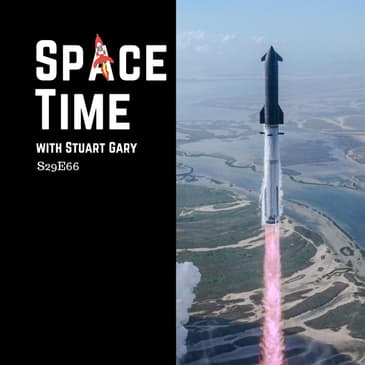
This is Spacetime Series twenty nine, episode sixty six, for broadcast on the third of June twenty twenty six. Coming up on space Time, Starship undertakes its twurth test flight, but with mixed results. Blue Origins, New Glenn suffers a massive explosion at Cape Canaveral, and how planet Earth recycles the continents. All that and more Coming up on space Time. Welcome to space Time with Stuart Gary. The largest and most powerful rocket ever built. SpaceX's super heavy Starship has undertaken its truth test flight with mixed results. The launch from SpaceX's book a Chicka Star based on the Texas Gulf Coast, suffered a number of problems during the flight, resulting in the FAA grounding future flights until the course of these problems has been determined and a potential fix adopted. But problems were expected on this mission as it was the first launch of the new version three variant of the one hundred and twenty four point four meter tall Mega rocket, which in many ways has undergone a complete design overhaul. It was also the first flight from Starbase's new second launch pad. The upgraded rocket design is two meters taller than the last variant, it carries an extra five hundred tons of propellants. Also, Version three is powered by a more powerful, upgraded Raptor engine known as the Raptor V three. The booster stage, known as the Super Heavy, features extra shielding around the thirty three rocket engines in order to compensate for the higher pressures coming from the V three raptors at the other end of the booster. Hot staging ring has now been integrated into the vehicle instead of being a separate structure. Hot staging involves the upper Starship stage beginning to fire its engines before separating from the Superheavy booster stage, and instead of the previous four grid fins for aerodynamic control, the new Version three booster uses just three grid fins, but they're each much larger and the changes don't end there. The upper Starship stage has also been modified with the addition of four inflight propellant transfer ports, which will allow for refueling while in orbit that'll be necessary for missions to the Moon, Mars and beyond. Because it's so different, the Version three rocket also uses new ground equipment, hence the need for a second launch pad at Starbase, but that's where the first of the issues on test flight twelve, developed mission managers say the hydraulic pin locking part of the launch tower mechanism wasn't retracting correctly, resulting in a series of delays at T minus forty seconds, ultimately leading to the launch being scrubbed for a day. But when it did finally blast off, we got to see the booster's new engine startup sequence. Instead of the slow sequential engine startup used on previous boosters, the new version tree can ignite much quicker, consequently launch quicker. The more powerful Rapti V three engines also allow the rocket to reach max Q sooner. As it lifted off into the cleve blue ticks and skies, things appeared to be going smoothly. Ten nine eight, seven, six five four three ignition, We up the top, put you down ranch. Boster optching for pressure nominal. All right, we are a T plus thirty seconds into flight CEE at thirty three out of thirty three Raptor three engines, the Booster V three ascending over the Gulf. Now coming up on maximum aerodynamic pressure. Booster and ship, if you're on expower telemetronomenal. Systems, looking good. We're just passing through the period of maximum dynamic pressure a little over a minute into flight. Now Starship Flight twelve arc out over the Gulf. The next major thing coming up is going to be hot staging. Finder we do what's our version of MIKO. Most engines cut off, So we're going to shut down all but five of the Raptor engines on the booster, and then after that happens, we're going to ignite the six engines on ship while it is still attached. We have clamps that hold the two together. Those are going to retract inside of that hot stage ring kind of protect them. Yeah. Well, but shortly before stage separation, one of the Superhavor boosters thirty three engines suddenly failed. Now that in itself shouldn't have been a problem, as the on board systems eye designed to compensate for such an eventuality. However, then after the boost to separated during hot staging and commenced its flipback maneuver to return to Worth, there was another REPTIVEV three engine issue which cut out modible engines which we needed for the boost back burn and controlled descent. We had one of the engines go out still flying on thirty two of the Raptor engines. But again, once we get the hots aging, those six engines on the ship are going to ignite. We're going to do it in a little bit different of a sequence. On version three. Essentially, those three RVAC engines will ignite first. Almost immediately after, just one of those central engines is going to ignite, and that's going to give the Booster a bit of a kick, sending it in a known direction, followed shortly after by the. Other two age separation. There you go, successful hot staging separation. We are not seeing as many Booster engines ignite as we expected for boost back, but we are seeing six good engines lit on ship. It looks like we just had an early boost back shut down. Again a reminder, the Booster was planned to essentially head into the Gulf for a splashdown, but it has shut its engines down early on into boost back. Now it's possible the other failed engines would damaged by the initial engine failure, possibly inch to the higher engine pressures, and then you wrapped the three murders. But making matters worse, one of the Boost's gridfins caught part of the engine exhaust from the starship up the stage that caused the flipmannerve to be accelerated and out of balance. Mission managers were planning to undertake a soft water splash down in the Gulf of America during this mission, rather than a return to the launch bed, as had already been done on several previous occasions, but the booster engine failures meant the descent was much too rapid, resulting in the booster undergoing an unscheduled disassembly. In other words, that blew up as a question of the sea rather than the soft water landing originally. Planned as power We're enomical planning on bringing the booster back for this flight, as this was the very first time again continuing to watch so booster did not complete its boost back burn. We did not see all of the engines ignight that we expected. Booster continues to make its way back down towards the water, all right, so a little over five and a half minutes in flight, looks like boosters starting to come in. Hot, Booster coming back down, making its way into the gulf. Once again. We were not going to bring the super heavy booster back to the tower. We were planning on having it land in. The Gulf and it looks like the Booster and its mission there in the Gulf. We did see at least a couple engines fire up on Booster for the landing burn before we lost contact with it. I mean, well, the starship up a stage continued, it's a scent towards orbit. But then suddenly one of the rep of the three vacuum engines on the starship also failed and we. Just see one of the r vacs. So we're now running on five engines on ship. We do have engine out capability, so it's going to continue into its ascent. Remaining two vacuum and three sea level engines were able to compensate and continue to climb to sub orbit. The ship planned to burn its engines for about eight minutes and change. About eight minutes and eleven seconds was our planned timeline for today. That could shift slightly as we do have one engine out running on one fewer urvas ship continuing to fire five of the six standing by for call outs, making sure ships on its planned trajectory. Again, we are planning a suborbital trajectory for the ship today. Hope the chamber pressures on five out of six ship Wreptor. Engines still flying. Great to see that still have five out of six engines there on S thirty nine. Yes, we also heard good chamber pressures as well on those engines that are lit. We do have engine out capability. We do see that we have one of the RVAC, one of the Raptor vacuum engines that is currently out, but that's okay. Ship is continuing on. We should have just a little over twenty seconds to go. We'll see if the burn extends a little bit for the engine out. Essentially, you can run your engines a little bit longer, throttle up a little bit more to account for the one engine not being lit. So right now we are standing by for ce go and again we are continuing to go a little bit longer. Five engines still burning on ship coming up on t plus nine minutes and starting to see shut down. Our vacs have shut down, Sea levels are shut down. Chip orbit insertion. Again, we did run longer as we were engine out. We were flying with five of those six Raptors pretty much the whole time. Chip FTS is saved. All right, Well, we definitely got a ship in space right now. If we are awaiting the call out of nominal insertion, so we're going to stand by for that. The flaps moving here actuating The objectives for ship today not only included the separation that we saw, but we're also planning to deploy twenty Starlink simulator satellites as well as two Dodger Dog satellites. That's what our internal teams refer to as our newer satellites. With the lack of standard actial flight profile because of the foul vacuum engine, the admission manages to abort the planned engine restat in orbit test originally scheduled. We actually saw the three gibbling engines kind of gimble over a little bit to compensate for that offset and thrus So that was really cool. That's something I know the team's been We've analyzed that since flight one all the way back, so it's something that we've thought about quite a bit and it was kind of cool to see it in action in real life today. One non rafter thing I noticed also the aft flaps. It's at a little weird We have tiles on the leeward side, so not on the side where we're going to see heating and you might be asking why are were putting tiles there. I talked to some of our heat shield engineers the other day and the fact that we're seeing all these tiles still on the flap right now is really good because that actually was one of our experiments where we wanted to test different connection methods on the way uphill on ship, so actually a cent so it looks like most, if not all, the tiles are still hanging on there, so that's actually a really good data point. We are looking good. It does look like we are within bounds of what we analyzed if we were down one of our RVAC engines, so I wouldn't call it a nonominal orbital insertion, but we're in an on a trajectory that we had analyze and it's within bounds. So teams continuing to work through it with that end out, they're working through some steps on the engines. We probably will end up skipping the raptor relighte for today, but it sounds like we should still be on for payload deploy. Mission managers did carry out the planned obital payload release with twenty two satellites deployed twenty dummy versions of the company's Styling broadband satellites, as well as two actual styling satellites equipped with imaging senses. Pez door is open. Just a reminder, we've got twenty two deployables in the payload bay today. Twenty of those Starlink mass simulators, and then two are our Dodger Dogs, so we like to call them internally sitting out there modified V two Starlink satellites. Those are going to be testing a bunch of components that we're planning to fly on Starlink V three, and we've also got them outfitted with a number of cameras for another tech demo that we're trying out on this flight. We definitely are looking for a way that we can look at starship's heat shield while it's still in space. You can kind of only see so much from the cameras in the flap. You can't see everything kind of on the underbelly, and one of the only ways you can do that is if you got something else flying near it. So our final two satellites going out the door have a suite of cameras on them that are going to be looking back at the ship. We're going to be in night time. They've got some powerful flashlights on them to try and illuminate the ship's heat shield while we fly away from it. One of the things that we upgraded in version three kind of gave a little soup up to the pez dispenser. So those satellites going to move out a little bit quicker than they did on previous Starship flight tests. First two out the door, Two more on their way outright, four down, eighteen to go. This very much a tech demo. We're going to deploy those The satellite's going to kind of try and turn everything on look back at Starship, and the primary reason we're trying to do this is to get some views of the heat shield. Two more out the door. We're more out the door, and I think that counts. That comes up to eight total. This Starship version three is built to deploy up to sixty of starlinks more advanced V three satellites. Everything's V three designed to offer sixty terabits per second of downlink capacity per satellite. Now that is twenty times more than each Falcon nine does today. Incredible, all right. I think that's number ten going out the door. Yeah, there it goes. Just a couple of updates while we continued payload, deploy data, get confirmation we're going to be skipping that relight of the Raptor engine just due to everything that we saw on the way uphill those sea level engines were going to use them for a landing burn, though they are still capable to be used for that. Reentry was smooth with descent over the Indian Ocean off the Western Australian coast, getting about fifty minutes after launch, and then when the major issues as starship became enveloped and a spectacular superheated plasma bubble just as expected. As it entered the upper atmosphere. You'll start to see a light show building up. Plasma starting to build up on the xterior of the vehicle. Now, we do not plan to recover the spacecraft today. Re Entry is a critical phase of flight and we need information on how the ship systems perform. The data gathering is really the main reason why we're doing these flight tests. If ship manages to make it all the way through re entry, we'll collect valuable data on the spacecraft flying through the Earth's atmosphere at these hypersonic speeds, which is basically more than five times the speed of sound. Now we do anticipate that it might be a little bit of a spicy re entry, so we'll see how far we get. It's re entering at or around orbital velocity roughly eight kilometers per second for those of us that think in other units, roughly five miles per second. At those speeds, the spacecraft is moving through the atmosphere and it creates that plasma field forming around the vehicle. Now, we should hear some callouts as the ship makes its way back to Earth. When we hear entry max heating and entry max Q, that means the ship has made it through the maximum heating and aerodynamic loads that it will experience it's as it returns. So if we make it through those, we're doing pretty well. Yeah, we're at twenty three and a half thousand kilometers per hour speed. That's just a crazy number to think about. But as we keep progressing the mission, we are going to hear a call out when the ship is transonic and then subsonic. So transonic refers to the period of flight where the velocities of air flows surrounding and flowing past the vehicle are concurrently below at and above the speed of sound, kind of in that mock zero point eight to one point two range, and for reference, commercial jets have a range of cruising speeds but mostly fly around mock points seven four to mock point eighty five. And after we hear the call out that Starship is transonic, we should hear the call out when Starship is subsonic. This refers to speeds that are much less than the speed of sound, so at this point in the flight, ship's velocity will be slowing down. During this phase of the mission, spacecraft's control services actuate as in hate shields all performed as well as expected. We are going to attempt a landing burned. We'll see how they perform when we get there. We are going to be stressing the ship on the way in. We're going to intentionally do a maneuver where we're going to kind of pitch the nose up and deploy those aft those bottom flaps to really put a lot of pressure on them. So we'll see how it does through that maneuver, and then we'll be doing kind of a final banking turn before we get to a landing burn. Of course, thinking long term here, Starship is designed to land on Mars where there are no runways or other humans to help out. That's where we're going with the propulsive landing instead of a more traditional means like parachutes. Starship underwent a series of test maneuvers designed to stress whereas parts of the vehicle in order to test their structural limits during the final descent. The vehicle also executed a novel banking minerva for its landing burn that was meant to mimic the trajectory and orientation needed for a launch now catch. On our return to starbase, we kind of kick the nose up to fully deploy those apt flaps to really get a good test of the structural strength of that part of the ship. We did that on one previous flight test on version two. We're going to try and do that today since we did skip the in space burn. We're carrying a little bit of extra propellant in our header tanks up in the nose, and so that's going to put a little bit of extra stress on those forward flaps as we come in, so we will see if they're able to hold through through that. Re entry engine chill has started. So essentially what that means is we are prepping the landing engines by getting them down to temperature ahead of that landing burn. And as we're going down through the atmosphere here we are at about mock sixteen point one, so still extremely fast, although we have scrubbed dot substantial amount of our speed already. Altitude at a little less than sixty kilometers. All right, we're about eight minutes away from our targeted landing and splash out time. Again. This is when the ship's going to start really. Ship US approaching the round all the peak heating region. The highest temperature ship the starship is going to see during its re entry. The forward flap on starship helping to steer the ship down for its precise landing in the Indian Ocean. We've still got a couple maneuvers lined up where we're going to be really stressing the flaps on the ship, so ship. US pause through the peak heating region. External temperatures are coming down. Wow, that is incredible news. As Dan mentioned, we were expecting this re entry to be super spicy, but excellent news that were now past that period of peak heating, and that now the external temperatures are starting to decrease. Those heat shield tiles on the belly of the ship really doing a ton of work to burn off all of that inertia that the vehicle had prior to re entering the atmosphere. We're starting to pick up a couple more g's here, so we're definitely entering the thicker part of the atmosphere where we're scrubbing off all that energy. Ship is out peak dynamic pressure and we're now at peak pressure. Ship flop load test. It looks like gets holden again. The intent of that was to put just a lot of extra stress on those apt flaps. We are expecting the forward ones too to see a little bit of extra stress as we've got more propellant in our header tank. So the area right at the very nose of Sharket is completely and we're through that test. There we go, and we just did that test at Mock seven just for reference there, so we are still going incredibly fast. We've got ship starting the RTLS banking maneuver. Essentially, what that is is when we come back to star base, or when we plan to come back to starbas The trajectory is designed so we'll essentially swing out over the gulf and do a swoop maneuver to then come back to the towers for catch and so we are doing that exact same maneuver as we head towards our targeted splash down in the Indian Ocean. Yeah, and that call out there that we heard RTLS stands for return to launch site, So definitely a pretty cool thing we're demoing here on the ship. You know, as in the future we are going to be trying to bring the ship back to the log site, which, yeah, gonna be absolutely insane. Pressure is coming down, all right, we heard their dynamic pressure coming down, and I'd say we're in a pretty good bank right now. Yeah, executing the power slide. We're about ninety seconds away from our anticipated landing burn. Starship is subsmic and is on target. We are on target for this precise in the Indian Ocean. This will once again be a soft splashdown. So we're sub fifteen kilometers executing what we call the belly flip maneuver, the aft flap, making minor correction. Starship is turning for a final approach to landing site. There we go minor corrections and a full turn. Then reignited two of its engines for a final landing burn. Coming up real soon. Again going for a landing burn, trying to light two of these raptors sea level engines. Landing burnt, landing burn, startup two rand in flip successful, flip, who we can't start. Test Flight thirteen. Hardware is now being prepared for possible launch, maybe as soon as July, depending on FAA approval. NASA is relying on a version of Starship called the HLAs or Human Landing System as one of two manned lunar landers to duck with the Otomis Orion capsule in lunar orbit and transport humans down to the Luna's surface. The agency is also contracted Blue Origins Blue Moon lunar land of spacecraft undertake the same mission, and it's indicated a willingness to fly with whichever land is ready when it's time for the Atomis four mission to fly in late twenty twenty eight. Atamis four will return humans to the lunar surface, landing near the Moon's south pole. But before that adventure, both Starship and Blue Moon will need to undertake low Earth orbit missions in mid to late next year in conjunction with the Atomis three mission to test the two lunar lander's abilities to maneuver, rendezvous and dark with the Irion spacecraft in orbit. Atemis three will follow on from April's Atomis two mission, which saw four astronauts a border on Iran spacecraft complete a successful ten day mission around the Moon and back. Bad. As we're about to tell you, things for the Atomis program aren't quite on track. This is space time still to calm a massive rocket explosion at Cape Canaveral and how the planet Earth recycles its continents. All that and more still to come on spacetime. Blue Origin's latest New Glen rocket has exploded in the spectacular ball of flame and fire during a static hot fire test at the Cape Canavil Space Force space in Florida. The dramatic blast at Launch Complex thirty six occurred during the standard pre flight test program head of the NNG four mission, which was sledded for June fourth. The test is designed to check out the launch vehicle's main engines with a booster still anchored to the launch pad, but instead of a successful test and shutdown, the ninety eight meter tall New Glen rocket suddenly exploded in a series of blasts, quickly erupting a massive billowing, bright orange fireball, sending towering plumes of flame and smoke lighting up the night sky. This was easily the biggest explosion ever seen at Cape Canaveral. The blast destroyed the launch pad and much of the surrounding infrastructure, which could take up to a year to rebuild. The event ignited one thousand tons of liquid methane and liquid oxygen propellant. It was so massive it showed up on weather radars and was heard fifty kilometers away in Orlando. Estimates suggest it was the equivalent of a one kiloton nuclear bomb. Blue Origin boss Jeff Bezos says no one was injured in the blast and all personnel have now been accounted for. YU Glen had only recently been returned to flight status by the Federal Aviation Administration following a failure during its last launch in April, when mission managers were forced to implement corrective measures after one of the upper stage b E three U engines didn't achieve full FRST due to a propellant leak and hydraulic vowel failure that resulted in the mission payload that Bluebirds seven communications satellite being placed into the wrong orbit, and this latest launch would have been bigger. The heaviest payload ever carried by New Glenn with some forty eight satellites Amazon's Low Earth Orbit Internet service Broadband Now. NASA has been watching these Lettus developments closely, and they're worried. See as we mentioned earlier, Blue Origin is one of the companies contracted by the Agency the transport vehicles and equipment to the Moon as part of the Artemis program. It was to launch the first of three payloads this year, kicking off work on America's twenty billion dollar moon base. How quickly the cause of this explosion can be determined and how quickly any necessary design changes are made, not to mention the time it's going to take to rebuild the launch pad ll be heavy on NASA's mind. New Glenn that its maiden flight in twenty twenty five. It's named after John Glenn, the first American to orb the Earth, and is much bigger, more powerful than Blue Origins. New Shepherd rockets, which are used for space tourism flights out of Texas. New Shepherds named after Alan Shepherd. It was the first American to reach space. This is space time still to come. How planet Earth recycles the continents, and later in the Science report, a new study shows that dentists have been drilling into people's teeth for almost sixty thousand years. All that and more still to calm on space time, a new study claims Earth's crust and mantle have been mixing together for billions of years, continuously reworking the planet's continents deep beneath the surface. The findings, reported in the journal Nature, show that Earth's continental crust can be dragged deep underground during continental collisions and later rise again through relamination. The new study focuses on what happens when two continental plates collide for major mountain ranges such as the Himalayas and Alps. While geologists have long known that continental collisions build mountains and deform the crust, new research shows that portions of continental crust can also be dragged deep down inside the Earth during subduction, before rising again and mixing with mantle rocks. The studies lead author, Daniel Gomez Frutas from the University of Portsmouth, says the results show that continental collisions is far more than just left mountains. They also create deep hybrid zones where crust and mantle materials blend together, reducing magmas that fundamentally build the continents. This process, known as relamination, creates a hybrid crust mantle source that can later generate post collisional magmas teutonic rocks that appear millions of years after continental collisions took place. Plutonic rocks are a type of igneous rock that forms when magmas cool and solidify deep beneath the Earth's surface. The authors used the combination of computer simulations and laboratory melting experiments to show that magmas produced by this hybrid source closely match the chemical composition of post collisional igneous rocks found across the planet. The findings may also help solve a long standing geological puzzle why many post collisional plutonic rocks resemble ancient rocks known as san yucatoids, which formed during the Akaan Eon three billion years ago. The origin of modern day plate tectonics is an ongoing matter of controversy for many in the scientific community. According to the authors, this similarity suggests that crust metal hybridization has been a fundamental process for billions of years, potentially pinpointing the earlier stages of plate tectonics. On Earth. It implies that complex plate tectonic interactions involving continental subduction and crust mantal mixing may have been active much earlier in Earth's history than previously understood. This is space time and time. That'll take another brief look at some of the other stories making news and science this week with the Science Report. A new study shows that dentists had been drilling teeth to treat cavities for almost sixty thousand years. The findings, reported in the journal Plus One, followed the discovery of a tooth in a Russian cave, suggesting that Neanderthals had the know how to identify tooth infection and the murder skills to drill out the damage. The single molar tooth they discovered had a deep hole in the center with the same shape and pattern that researchers were able to recreate by drilling into a modern tooth with a stone till that was similar to the tools found in the cave. Needless to say, the procedure would have hurt. The authors say it's the first time such behavior has been demonstrated outside Homo sapiens, and it pushes back the date for the earliest use of this type of behavior by more than forty thousand years. A new study has warned that even moderate increases in average temperatures heightens the likelyhoo of koala deaths. The findings are reported in the journal Biology Letters, based on an analysis of some twelve thousand koala rescues in New South Wales between the year two thy and twenty twenty two. The authors found koala death increased once average temperatures exceeded twenty seven degrees celsius. At Exposure above thirty degrees celsius increased the odds of death by up to three and a half times compared with individuals exposed to just twenty five degrees celsius. And you study warns that one in six kids who have access to the Internet are now experiencing some form of online sexual exploitation or abuse. The findings, reported in the journal Nature, looked at a survey of nearly twelve thousand children aged between twelve and seventeen in twelve countries across Asia and Africa, and say that over the area surveyed, these numbers are equivalent to more than ten million kids worldwide experiencing this abuse. Now, this included receiving unwanted sexual images, being pressured into sexual conversations, having private images shared without the consent, or being blackmailed online. The authors found that children did disclose more than half of the incidents, and when they did, they tended to only tell their friends rather than their parents, the cops or kids Health lines. Ro Kid have now released their new smart glasses in Australia with the details were joined by Technology But to Alex Hart from tech Advice Start Life, they've got three models. One is a model that has no screen, it's just audio. The second one you actually have a like a green screen, like the old fashioned nineteen late nineteen seventies or nineteen eighties green screens where you can look through the glasses and you can see this information appearing in front of your eye, so you can use it as a teleprompter. You can chat with Chad Jibytil Gemini. You can look at text that's in a different language and have it translated to English. You can actually have someone speaking to you in a different language and it's then translated into English or into French or some of the language. For I had somebody at the launch that I was at speaking to me in Chinese and I saw it translated to French. And you can also have as a pair of Bluetooth headphones, so the sound comes out of the arms that go over your ears. You're supposed to also be able to use it as a turn by turn map and you can slide your finger on the right arm to go through the different menus. You can say hey, rocket, and it will then listen to you and you can ask the questions which goes through to the AI. And it's only forty nine grams, so it looks like a normal pair of glasses, but it has a camera that can take photographs and you have to look really close to you actually see it has a little camera there. So this is the sort of glasses that are going to become a lot more commonplace. They also had a third model, which is spatial glasses, where you put it on and you can actually see an Android interface where you can have different apps. And I brought up the browser and you know, I could see it y that I write for what I could see the website there and I had a little puck in my hand. This is the third spatial glasses, separate from the ones that had the green screen and this is awful color. And the little puck that's connected via a cable looks like an original two thousand and seven iPhone. It's quite uncaddy how it looks like that. And you can swivele your thumb around to control the pointer and you can use two fingers on the puck to then scroll up and down on webpages. So it had three different pairs of glasses, but the one that they're really promoting is the one that is the AI slash Ar glasses. Now there are thousand and ninety nine dollars to purchase, so you know it's not cheap, but it's not super expensive either. Do need to pair it with your iPhone and your Android, and it's got about eight hours of battery life. Obviously is less if you're using it for English transcription where you get subtitles. It's the beginning of this change when instead of us having to hold the device in our hands and look at that, we actually have it as a heads up display. I mean, there's real utility to these glasses. Obviously over time they're going to get more advanced and better. And we do have glasses from Google and also the ones from Meta which is Facebook that have a color display. But we're seeing basically the beginnings of these devices becoming useful, and they're only going to get cheaper in the future, more features and have more battery life. That's alex Ohrovrouyd from Take Advice, Start Life, and this is Spacetime, and that's the show for now. Spacetime is available every Monday, Wednesday and Friday through at bytes dot com, SoundCloud, YouTube, your favorite podcast download provider, and from space Time with Stuart Gary dot com. Space Time's also broadcast through the National Science Foundation, on Science Own Radio and on both iHeartRadio and tune In Radio. And you can help to support our show by visiting the Spacetime store for a range of promotional merchandising goodies, or by becoming a Spacetime Patron, which gives you access to triple episode commercial free versions of the show, as well as lots of bonnus audio content which doesn't go away, access to our exclusive Facebook group, and other rewards. Just go to space Time with Stewart Gary dot com for full details. You've been listening to space Time with Steward Gary. This has been another quality podcast production from bytes dot com