
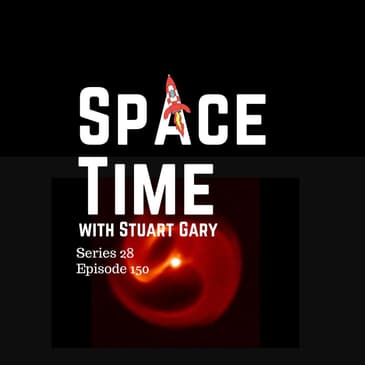
In this episode of SpaceTime, we delve into intriguing discoveries and ongoing challenges in the realm of astrophysics and planetary science.
Cosmic Dance of Dying Stars
Astronomers have made fascinating observations of a unique star system named Apep, located over 8,000 light years away in the constellation Norma. This rare system consists of three massive stars locked in a 190-year orbit, creating stunning spirals of cosmic dust. Using the advanced capabilities of NASA's Webb Space Telescope and the Very Large Telescope in Chile, researchers captured extraordinary images revealing four distinct dust shells spiraling outward from the stars. Lead author Ryan White from Macquarie University discusses how these findings enhance our understanding of stellar interactions and the evolution of massive stars over time.
Titan's Liquid Ocean: A New Perspective
A recent study challenges the long-held belief that Saturn's largest moon, Titan, harbors a vast underground ocean. Instead, researchers suggest that Titan may have a more complex internal structure characterized by slushy tunnels and pockets of meltwater rather than a global liquid water ocean. This revelation, based on a reanalysis of data from NASA's Cassini mission, could have significant implications for the search for potential life on Titan, indicating that any existing life forms might inhabit a more confined environment with concentrated nutrients.
NASA's MAVEN: Communication Challenges
Mission managers at NASA are working diligently to restore contact with the Mars Atmosphere and Volatile Evolution (MAVEN) spacecraft, which went silent during a routine pass behind Mars on December 6. Engineers are analyzing data from before the loss of signal to identify the cause and determine if the spacecraft can be salvaged. MAVEN has been crucial for studying Mars' atmosphere and has served as a vital communications relay for surface missions.
www.spacetimewithstuartgary.com
✍️ Episode References
Astrophysical Journal
Nature
NASA TV
Become a supporter of this podcast: https://www.spreaker.com/podcast/spacetime-your-guide-to-space-astronomy--2458531/support.
(00:00:00) This is space time series 28 episode 150 for broadcast on 22nd December 2025
(00:00:47) NASA's Webb Space Telescope reveals four spectacular dust shells from distant star system
(00:10:58) New study says Titan probably doesn't have a vast underground liquid water ocean
(00:15:57) NASA mission managers continue efforts to restore contact with missing maven spacecraft
(00:18:36) New study finds shared genetic patterns across 14 common psychiatric disorders
(00:20:56) A new study claims acupuncture treatment for lower back pain reduces pain
00:00:00 --> 00:00:03 Stuart Gary: This is space time series 28 episode
00:00:03 --> 00:00:05 150 for broadcast on 22nd
00:00:05 --> 00:00:08 December 2025. Coming up on
00:00:08 --> 00:00:11 spacetime. The deadly embrace of
00:00:11 --> 00:00:13 three dying stars claim
00:00:13 --> 00:00:16 Saturn's biggest moon, Titan, might not have
00:00:16 --> 00:00:19 an underground ocean after all. And
00:00:19 --> 00:00:22 NASA's missing MAVEN spacecraft still
00:00:22 --> 00:00:25 silent. All that and more coming up
00:00:25 --> 00:00:26 on, on Space Time.
00:00:27 --> 00:00:30 Voice Over Guy: Welcome to Space Time with Stuart Gary
00:00:46 --> 00:00:48 Stuart Gary: Astronomers are unraveling the mysteries of a
00:00:48 --> 00:00:51 distant star system where three massive stars
00:00:51 --> 00:00:54 are locked in a 190 Earth year orbit and
00:00:54 --> 00:00:57 in the process creating spectacular spirals
00:00:57 --> 00:01:00 of cosmic dust. The findings reported
00:01:00 --> 00:01:02 in the Astrophysical Journal show four
00:01:02 --> 00:01:05 spectacular dust shells spiraling outwards
00:01:05 --> 00:01:08 from three massive stars locked in a cosmic
00:01:08 --> 00:01:10 dance. The rare stellar system called
00:01:10 --> 00:01:13 Apep is located more than 8 light years
00:01:13 --> 00:01:16 away in the constellation Norma. Named after
00:01:16 --> 00:01:18 a serpent deity from Egyptian mythology,
00:01:19 --> 00:01:22 Apep consists of a Wolf Rayet binary star
00:01:22 --> 00:01:24 system and a hot blue supergiant.
00:01:25 --> 00:01:28 Wolf rays are a very rare class of massive
00:01:28 --> 00:01:30 stars in which some of the earliest carbon in
00:01:30 --> 00:01:33 the universe is forged. Only 1000
00:01:33 --> 00:01:36 Wolf Ray stars are estimated to exist in our
00:01:36 --> 00:01:39 Milky Way galaxy, a galaxy that contains
00:01:39 --> 00:01:42 literally hundreds of billions of stars. Of
00:01:42 --> 00:01:44 the few hundred wolf ray binaries that have
00:01:44 --> 00:01:47 been observed, Apep is the only example that
00:01:47 --> 00:01:49 contains two Wolf Rayer stars in our galaxy.
00:01:50 --> 00:01:53 Using NASA's Webb Space Telescope, together
00:01:53 --> 00:01:55 with data from the Very Large Telescope, the
00:01:55 --> 00:01:58 VLT in Chile, the study's authors obtained
00:01:58 --> 00:02:00 extraordinary images of this rare system,
00:02:00 --> 00:02:02 displaying four distinct shells of dust.
00:02:03 --> 00:02:05 One of the study's authors, Ryan White from
00:02:05 --> 00:02:07 Macquarie University, says the discovery
00:02:07 --> 00:02:10 helps astronomers better understand how stars
00:02:10 --> 00:02:12 like this interact and how they evolve over
00:02:12 --> 00:02:15 centuries. White and colleagues combine
00:02:15 --> 00:02:17 precise measurements of the ring location
00:02:17 --> 00:02:19 from Webb images, together with the speed of
00:02:19 --> 00:02:22 the shell's expansion from taken by the
00:02:22 --> 00:02:25 VLT over eight years. This
00:02:25 --> 00:02:28 is a one of a kind star system with an
00:02:28 --> 00:02:31 extremely long orbital period. In fact, the
00:02:31 --> 00:02:33 next longest orbit for a dusty Wolf Rayer
00:02:33 --> 00:02:36 binary is around 30 Earth years and most have
00:02:36 --> 00:02:38 orbits between 2 and 10 Earth years.
00:02:38 --> 00:02:41 Observations of this system taken prior to
00:02:41 --> 00:02:44 Webb only detected one shell. While
00:02:44 --> 00:02:45 the existence of the outer shells was
00:02:45 --> 00:02:48 hypothesized, ground based telescopes were
00:02:48 --> 00:02:50 simply unable to, uncover any. And that's
00:02:50 --> 00:02:53 where Webb comes in. The Webb image, combined
00:02:53 --> 00:02:55 with several years of data from the European
00:02:55 --> 00:02:57 Southern Observatory's Very Large Telescope
00:02:57 --> 00:03:00 was able to narrow down how often the pair
00:03:00 --> 00:03:03 swung around each other. Roughly every 190
00:03:03 --> 00:03:05 Earth years. And over each incredibly long
00:03:05 --> 00:03:08 orbit, the stars passed closely together for
00:03:08 --> 00:03:11 just 25 Earth years. And it's during
00:03:11 --> 00:03:13 these Relatively short periods of time that
00:03:13 --> 00:03:15 they were able to create their clouds of
00:03:15 --> 00:03:18 dust. Webb also confirmed that as
00:03:18 --> 00:03:20 well as the binary Wolf Ray A pair, there's a
00:03:20 --> 00:03:23 third star in the system, A massive spectral
00:03:23 --> 00:03:26 type O class blue supergiant. And the
00:03:26 --> 00:03:28 dust ejected by the two Wolf Ray A stars is
00:03:28 --> 00:03:31 slashed by the third star, carving a hole
00:03:31 --> 00:03:33 into each expanding cloud of dust from its
00:03:33 --> 00:03:36 wider orbit. The authors were able to refine
00:03:36 --> 00:03:38 the orbits of the Wolf Ray binaries by
00:03:38 --> 00:03:40 combining precise measurements of the ring
00:03:40 --> 00:03:42 location from the Webb images with the speed
00:03:42 --> 00:03:44 of the shell's expansion. Based on the
00:03:44 --> 00:03:46 observations taken by the vlt,
00:03:49 --> 00:03:51 the dust producing Wolf Ray stars in APEP
00:03:51 --> 00:03:54 aren't exactly on a tranquil cruise.
00:03:54 --> 00:03:56 They're whipping through space and sending
00:03:56 --> 00:03:59 out dust at around 2 to 3
00:03:59 --> 00:04:02 kilometers per second. When the two Wolf
00:04:02 --> 00:04:04 Rayer stars approach each other, their strong
00:04:04 --> 00:04:07 stellar winds collide and mix, forming and
00:04:07 --> 00:04:10 casting out heaps of carbon rich dust for a
00:04:10 --> 00:04:13 quarter of a century at a time. And that dust
00:04:13 --> 00:04:15 is also very dense. The specific
00:04:15 --> 00:04:18 makeup of the dust is another reason why Webb
00:04:18 --> 00:04:21 was able to observe so much more. That's
00:04:21 --> 00:04:23 because it, largely consists of amorphous
00:04:23 --> 00:04:26 carbon. Carbon dust grains retain
00:04:26 --> 00:04:28 higher temperatures even when they're
00:04:28 --> 00:04:30 spreading far away from the progenitor star.
00:04:31 --> 00:04:33 Now, while these exceptionally tiny dust
00:04:33 --> 00:04:35 grains are considered warm in terms of space,
00:04:35 --> 00:04:38 the light they emit is still extremely faint,
00:04:38 --> 00:04:40 which is why it could only be detected from
00:04:40 --> 00:04:43 space using Webb's mid infrared instrument.
00:04:43 --> 00:04:46 The authors believe the two Wolf Rayet stars
00:04:46 --> 00:04:48 were initially far more massive than their
00:04:48 --> 00:04:50 supergiant companion. But over the years,
00:04:50 --> 00:04:53 they've shed most of their mass. It's
00:04:53 --> 00:04:56 now likely that both Wolf Ray stars are,
00:04:56 --> 00:04:58 between 10 and 20 times the mass of the Sun,
00:04:58 --> 00:05:01 While their companion supergiant is 40, 50
00:05:01 --> 00:05:04 times the sun's mass. As for the future,
00:05:04 --> 00:05:07 Ryan White says eventually the two Wolf Rayet
00:05:07 --> 00:05:09 stars will explode a supernovae quickly
00:05:09 --> 00:05:12 throwing their contents into space. And
00:05:12 --> 00:05:14 he admits that either one or both of these
00:05:14 --> 00:05:17 Wolf rays may also eventually produce a gamma
00:05:17 --> 00:05:19 ray burst, one of the most powerful events in
00:05:19 --> 00:05:22 the universe, before ultimately collapsing
00:05:22 --> 00:05:24 down to become stellar mass black holes.
00:05:24 --> 00:05:27 Nick Timms : So a Wolf Ray star is the kind
00:05:27 --> 00:05:30 of the very end of life stages of the most
00:05:30 --> 00:05:33 massive stars. So stars that are born
00:05:33 --> 00:05:35 with masses more than about 25
00:05:35 --> 00:05:38 or 30 times the mass of our own sun, they go
00:05:38 --> 00:05:40 through their lives combining hydrogen into
00:05:40 --> 00:05:42 helium in their core, and then once they've
00:05:42 --> 00:05:44 run out of hydrogen, they combine helium into
00:05:44 --> 00:05:47 carbon, nitrogen, oxygen, etc. And
00:05:47 --> 00:05:49 eventually, when these stars kind of start
00:05:49 --> 00:05:52 Burning through all of their fuel, they get
00:05:52 --> 00:05:54 rid of their outer layers and they're
00:05:54 --> 00:05:56 essentially a purely helium
00:05:56 --> 00:05:59 carbon nitrogen star. So
00:05:59 --> 00:06:01 they get rid of most of their mass. They're
00:06:01 --> 00:06:04 incredibly bright, they have extremely strong
00:06:04 --> 00:06:07 stellar winds and they live for just a
00:06:07 --> 00:06:10 blisteringly short amount of time. So
00:06:10 --> 00:06:12 for reference, our sun will live for about 10
00:06:12 --> 00:06:14 billion years. And these wolf ray stars, they
00:06:14 --> 00:06:17 spend about 100 years in this wolf
00:06:17 --> 00:06:19 ray stage. And the total star's life is about
00:06:19 --> 00:06:21 a million to a few million years.
00:06:21 --> 00:06:23 Stuart Gary: The James Deans of this stellar world.
00:06:24 --> 00:06:25 Nick Timms : Yes, exactly.
00:06:25 --> 00:06:28 Stuart Gary: So these are big O and B type
00:06:28 --> 00:06:29 stars that have reached the end of their
00:06:29 --> 00:06:32 lives. They're pumping huge amounts of
00:06:32 --> 00:06:35 carbon into space. And
00:06:35 --> 00:06:37 in this case there are two of them.
00:06:37 --> 00:06:39 Nick Timms : Exactly, yeah. So it's the only system we
00:06:39 --> 00:06:42 know of the R the system that has not one,
00:06:42 --> 00:06:45 but two of these classical wolf ray stars at
00:06:45 --> 00:06:47 the same time. It's the only system we've
00:06:47 --> 00:06:50 found in the universe that's like this. And
00:06:50 --> 00:06:52 we don't really know why it's like that, but
00:06:52 --> 00:06:53 it's a very interesting system.
00:06:53 --> 00:06:55 Stuart Gary: And they have a northern companion as well.
00:06:55 --> 00:06:56 Another large star.
00:06:56 --> 00:06:59 Nick Timms : Exactly, yeah. So I was very lucky to lead
00:06:59 --> 00:07:02 one of our team's papers on this system, with
00:07:02 --> 00:07:04 our new very beautiful James Webb Space
00:07:04 --> 00:07:06 Telescope image. And one of the main things
00:07:06 --> 00:07:09 I found was that there is this third, O type
00:07:09 --> 00:07:12 supergiant star as a part of the R the system
00:07:12 --> 00:07:15 as well. So it's reasonably far away from the
00:07:15 --> 00:07:16 two wolf ray stars. You can kind of think of
00:07:16 --> 00:07:18 it like the two wolf rays stars are happily
00:07:18 --> 00:07:20 orbiting around each other. And there's this
00:07:20 --> 00:07:22 third supergiant star a stone's throw away.
00:07:22 --> 00:07:25 But yeah, we found that like we exclusively
00:07:25 --> 00:07:27 linked this third, supergiant star as part of
00:07:27 --> 00:07:29 the system through its effects on this
00:07:29 --> 00:07:31 beautiful nebula that the two wolf rain stars
00:07:31 --> 00:07:34 make. So it's the first time that we've seen
00:07:34 --> 00:07:36 this kind of nebula interaction in nature
00:07:36 --> 00:07:39 before from a tertiary third companion. And
00:07:39 --> 00:07:41 it really complicates our view of the system
00:07:41 --> 00:07:43 even more. So it's not just that there's two
00:07:43 --> 00:07:45 wolf raised stars in the system now, it's
00:07:45 --> 00:07:47 that it's actually a triple system as well,
00:07:47 --> 00:07:49 which just makes it really complicated.
00:07:49 --> 00:07:51 Stuart Gary: I'm very scared that you're going to start
00:07:51 --> 00:07:53 talking about three body problems there. That
00:07:53 --> 00:07:53 wasn't my.
00:07:54 --> 00:07:56 Nick Timms : Yeah, yeah, there's a lot of complicated
00:07:56 --> 00:07:58 three body stuff happening here.
00:07:58 --> 00:08:00 Stuart Gary: Now these two stars, the two primary stars,
00:08:00 --> 00:08:03 they orbit each other roughly once every 190
00:08:03 --> 00:08:05 years. But the key area is
00:08:05 --> 00:08:08 roughly a 25 year period
00:08:08 --> 00:08:10 when there's a lot of interaction going on in
00:08:10 --> 00:08:13 the form of the dust that's being expelled
00:08:13 --> 00:08:14 from both these bodies.
00:08:14 --> 00:08:17 Nick Timms : Exactly right, yeah. So the two Wolf Ray
00:08:17 --> 00:08:19 stars on this 190 orbit, I can't
00:08:19 --> 00:08:22 say this enough. It really is an extreme and
00:08:22 --> 00:08:24 very complicated system. It's by far the
00:08:24 --> 00:08:27 longest orbital period for this type of
00:08:27 --> 00:08:29 system. And these beautiful dust shells that
00:08:29 --> 00:08:32 we see are only made in about 25 years of
00:08:32 --> 00:08:35 that 190 year orbital period. So each of
00:08:35 --> 00:08:37 these Wolf Ra stars has their own extremely
00:08:37 --> 00:08:40 strong stellar wind and they're on a quite an
00:08:40 --> 00:08:43 elliptical orbit. So they spend most of their
00:08:43 --> 00:08:45 time quite far away from each other. But
00:08:45 --> 00:08:47 every 25 years they kind of whip past each
00:08:47 --> 00:08:49 other in their orbit. And the conditions
00:08:50 --> 00:08:52 where their stellar winds collide are just
00:08:52 --> 00:08:55 right to form dust for that, for those
00:08:55 --> 00:08:57 25 years in particular. So you can kind of
00:08:57 --> 00:09:00 think about it as every 25 years the system
00:09:00 --> 00:09:02 is throwing out a puff of smoke essentially,
00:09:03 --> 00:09:05 which is quite unique for these systems as
00:09:05 --> 00:09:07 well. There are a couple of other of these
00:09:07 --> 00:09:09 Wolf, ray binaries that do episodically
00:09:09 --> 00:09:12 produce dust we say, but most of them are
00:09:12 --> 00:09:14 kind of more constant producers of dust. So
00:09:14 --> 00:09:16 it really is an interesting system.
00:09:16 --> 00:09:18 Stuart Gary: The dust is being pumped through the system
00:09:18 --> 00:09:20 at what, 3 kilometers per second, some
00:09:20 --> 00:09:22 amazing speed like that.
00:09:22 --> 00:09:22 Nick Timms : Yeah.
00:09:22 --> 00:09:25 Stuart Gary: So it must be giving you a great history
00:09:25 --> 00:09:27 lesson into the evolution of these systems.
00:09:27 --> 00:09:29 Nick Timms : Exactly, yeah. And that's one of the main
00:09:29 --> 00:09:32 reasons why we wanted James Webb imagery of
00:09:32 --> 00:09:34 the system is because we previously had an
00:09:34 --> 00:09:37 image of the Rupep Nebula with the Very Large
00:09:37 --> 00:09:39 Telescope, a ground based 8 meter telescope
00:09:39 --> 00:09:42 in Chile. But it was only sensitive enough to
00:09:42 --> 00:09:45 see one shell of dust in the RPEP Nebula.
00:09:45 --> 00:09:47 But with James Webb we were able to see four
00:09:47 --> 00:09:49 shells. And so effectively that means that
00:09:49 --> 00:09:52 each time we're looking at a further out
00:09:52 --> 00:09:54 shell, we're effectively looking 200 years
00:09:54 --> 00:09:57 back in time. And so with this new James Webb
00:09:57 --> 00:10:00 image we have essentially about 800 years
00:10:00 --> 00:10:02 of information about how these stars are
00:10:02 --> 00:10:05 moving, which has just been absolutely
00:10:05 --> 00:10:08 essential to like nail down the orbit of the
00:10:08 --> 00:10:10 system and what it's been like over time. And
00:10:10 --> 00:10:12 yeah it was, it was really quite crucial to
00:10:12 --> 00:10:14 link that third star into the system as well.
00:10:14 --> 00:10:16 Stuart Gary: That's Ryan White from Macquarie University.
00:10:17 --> 00:10:20 And this is space time still to
00:10:20 --> 00:10:22 come. A new study suggests that Saturn's
00:10:22 --> 00:10:24 largest moon, Titan, may not have a
00:10:24 --> 00:10:27 subsurface liquid water ocean after all.
00:10:28 --> 00:10:30 And mission managers at NASA are Continuing
00:10:30 --> 00:10:32 efforts to try and restore communications
00:10:32 --> 00:10:35 with their missing maven spacecraft. All that
00:10:35 --> 00:10:38 and more still to come on space time.
00:10:54 --> 00:10:56 A new study claims that the Saturnian moon
00:10:56 --> 00:10:59 Titan probably doesn't have a vast
00:10:59 --> 00:11:01 underground liquid water ocean after all.
00:11:01 --> 00:11:04 The findings reported in the journal Nature
00:11:04 --> 00:11:06 contradict earlier studies which suggested
00:11:06 --> 00:11:09 that a liquid water ocean existed below the
00:11:09 --> 00:11:10 methane covered world's surface.
00:11:11 --> 00:11:13 Titan is shrouded by a hazy
00:11:13 --> 00:11:15 atmosphere, and it's the only world in our
00:11:15 --> 00:11:18 solar system other than Earth where it rains.
00:11:19 --> 00:11:22 That rain forms streams and rivers and they
00:11:22 --> 00:11:25 flow into lakes and seas. However,
00:11:25 --> 00:11:27 on Titan, the liquid isn't water, but
00:11:27 --> 00:11:30 methane and ethane. In fact, Titan's so
00:11:30 --> 00:11:33 cold water there is frozen solid forming
00:11:33 --> 00:11:36 bedrock. Now, a, careful reanalysis of
00:11:36 --> 00:11:39 data from more than a decade ago indicates
00:11:39 --> 00:11:41 that a, journey below Titan's frozen surface
00:11:41 --> 00:11:44 likely involves more ice, giving way to
00:11:44 --> 00:11:47 slushy tunnels and pockets of meltwater near
00:11:47 --> 00:11:49 the rocky core. Data from NASA's
00:11:49 --> 00:11:52 Cassini mission to Saturn and its Huygens
00:11:52 --> 00:11:54 lander, which landed on the Titanian surface,
00:11:54 --> 00:11:57 initially led scientists to suspect a large
00:11:57 --> 00:12:00 ocean composed of liquid water lay deep
00:12:00 --> 00:12:03 beneath the ice. The problem is, when they
00:12:03 --> 00:12:05 modelled the moon with an ocean, the results
00:12:05 --> 00:12:06 didn't match the physical properties
00:12:06 --> 00:12:09 described by the data. That's where this new
00:12:09 --> 00:12:12 study comes in. This fresh look has
00:12:12 --> 00:12:15 yielded new slushier results, and they're
00:12:15 --> 00:12:18 important because these findings could spark
00:12:18 --> 00:12:20 similar inquiries into other worlds in the
00:12:20 --> 00:12:22 solar system. And they could also help narrow
00:12:22 --> 00:12:24 down the search for life on Titan, if it ever
00:12:24 --> 00:12:27 had or does exist there. One of the study's
00:12:27 --> 00:12:29 authors, Batiste Yeunot from the University
00:12:29 --> 00:12:32 of Washington, says instead of an open ocean
00:12:32 --> 00:12:34 like the Earth, astronomers would probably
00:12:34 --> 00:12:37 find something more akin to Arctic sea ice
00:12:37 --> 00:12:39 and aquifers. And that would have
00:12:39 --> 00:12:42 implications for the types of life, if any,
00:12:42 --> 00:12:45 that might exist there. And it also poses
00:12:45 --> 00:12:46 questions about the availability of
00:12:46 --> 00:12:49 nutrients, energy, and so on. NASA's
00:12:49 --> 00:12:52 Cassini mission began in 1997
00:12:52 --> 00:12:55 and lasted nearly 20 years, in the process
00:12:55 --> 00:12:58 producing volumes of data about Saturn and
00:12:58 --> 00:13:00 its 274 known moons.
00:13:01 --> 00:13:03 As Titan circled Saturn in its elliptical
00:13:03 --> 00:13:06 orbit, the authors observed the moon
00:13:06 --> 00:13:08 undergoing gravitational stretching and
00:13:08 --> 00:13:10 squeezing, depending on where it was in its
00:13:10 --> 00:13:12 orbit in relation to Saturn. Back in
00:13:12 --> 00:13:15 2008, scientists proposed that Titan must
00:13:15 --> 00:13:18 possess a huge ocean beneath its surface in
00:13:18 --> 00:13:19 order to allow for such significant
00:13:19 --> 00:13:22 deformation. Chenault says the degree
00:13:22 --> 00:13:25 of deformation depends on Titan's internal
00:13:25 --> 00:13:28 structure. A deep ocean would permit the
00:13:28 --> 00:13:30 crust to flex more under Saturn's
00:13:30 --> 00:13:32 gravitational pull. But if Titan were
00:13:32 --> 00:13:34 entirely frozen, it wouldn't be able to
00:13:34 --> 00:13:37 deform very much at all. Now, the deformation
00:13:37 --> 00:13:39 detected during the initial analysis of
00:13:39 --> 00:13:41 Cassini mission data could have been
00:13:41 --> 00:13:44 compatible with the global ocean, but it now
00:13:44 --> 00:13:46 seems that isn't the full story. You see,
00:13:46 --> 00:13:49 the new study shows that Titan's shape
00:13:49 --> 00:13:52 shifting lags about 15 hours behind the
00:13:52 --> 00:13:55 peak of Saturn's gravitational pull. It's a
00:13:55 --> 00:13:57 bit like a spoon stirring honey. It takes
00:13:57 --> 00:13:59 more energy to move a thick, viscous
00:13:59 --> 00:14:02 subsurface Than it does liquid water.
00:14:02 --> 00:14:04 And measuring that delay told the authors of
00:14:04 --> 00:14:07 this study how much energy it takes to change
00:14:07 --> 00:14:09 Titan's shape. And that allowed them to make
00:14:09 --> 00:14:11 inferences about the viscosity of the
00:14:11 --> 00:14:14 titanium interior. The amount of energy
00:14:14 --> 00:14:16 dissipated was much greater Than what would
00:14:16 --> 00:14:19 be expected In a global liquid water ocean
00:14:19 --> 00:14:21 scenario. So the model our authors are
00:14:21 --> 00:14:24 proposing instead features more slush and
00:14:24 --> 00:14:27 quite a bit less liquid water. Slush
00:14:27 --> 00:14:29 is thick enough to explain the lag, but it
00:14:29 --> 00:14:32 still contains water, Enabling Titan to morph
00:14:32 --> 00:14:35 when tugged. Of course, the watery layer on
00:14:35 --> 00:14:37 Titan is so thick and the pressure so immense
00:14:37 --> 00:14:39 that the physics of water changes.
00:14:39 --> 00:14:42 Jeannette says. On Titan, water and ice
00:14:42 --> 00:14:44 behave in a very different way to that of
00:14:44 --> 00:14:47 seawater here on Earth. Although
00:14:47 --> 00:14:49 the notion of an ocean on Titan Invigorated
00:14:49 --> 00:14:51 the search for life there, the authors
00:14:51 --> 00:14:53 believe the new findings Might actually
00:14:53 --> 00:14:56 improve the odds of finding it. Analysis
00:14:56 --> 00:14:58 indicates that the pockets of fresh water on
00:14:58 --> 00:15:01 Titan could reach 20 degrees Celsius, and
00:15:01 --> 00:15:03 any available nutrients Would be more
00:15:03 --> 00:15:06 concentrated In a smaller volume of water
00:15:06 --> 00:15:09 Compared to a huge open ocean. And that could
00:15:09 --> 00:15:11 facilitate the growth of any simple organisms
00:15:11 --> 00:15:14 which existed there. While it's unlikely
00:15:14 --> 00:15:16 scientists will discover fish wriggling
00:15:16 --> 00:15:18 through the slushy channels, if life is found
00:15:18 --> 00:15:20 on Titan, it may well resemble polar
00:15:20 --> 00:15:23 ecosystems right here on Earth.
00:15:23 --> 00:15:26 This is space time still to come.
00:15:27 --> 00:15:30 NASA's MAVEN mission remains silent. And
00:15:30 --> 00:15:32 later in the science report, paleontologists
00:15:32 --> 00:15:35 have discovered that some mosasaurs May well
00:15:35 --> 00:15:37 have hunted in rivers as well as seas.
00:15:38 --> 00:15:41 All that and more still to come on space
00:15:41 --> 00:15:41 time.
00:15:52 --> 00:15:53 Nick Timms : Foreign.
00:15:57 --> 00:15:59 Stuart Gary: NASA mission managers are, continuing their
00:15:59 --> 00:16:01 efforts to try and restore contact with their
00:16:01 --> 00:16:04 missing maven spacecraft. The Mars
00:16:04 --> 00:16:06 Atmosphere and Volatile Evolution spacecraft
00:16:06 --> 00:16:09 Fell silent During a routine pass behind the
00:16:09 --> 00:16:12 Red planet back on December 6.
00:16:12 --> 00:16:14 Engineers at NASA's Jet Propulsion Laboratory
00:16:14 --> 00:16:17 in Pasadena, California, have been reviewing
00:16:17 --> 00:16:20 the last data packages received before Mars
00:16:20 --> 00:16:22 occultation In order to try and determine
00:16:22 --> 00:16:25 what could have gone wrong. Only then will
00:16:25 --> 00:16:27 they be able to work out whether or not they
00:16:27 --> 00:16:30 can save the vehicle. Before the loss of
00:16:30 --> 00:16:32 signal telemetry indicated that maven
00:16:32 --> 00:16:34 subsystems were all operating nominally as it
00:16:34 --> 00:16:37 approached occultation. As Maven moved
00:16:37 --> 00:16:40 behind Mars, communications with NASA's Deep
00:16:40 --> 00:16:42 Space Network was always expected to cut off.
00:16:43 --> 00:16:45 But then mission managers failed to reacquire
00:16:45 --> 00:16:48 a downlink signal when the orbiter reappeared
00:16:48 --> 00:16:51 from behind the planet. Now one possibility
00:16:51 --> 00:16:53 is that Maven may have defaulted into a safe
00:16:53 --> 00:16:56 mode in the process changing its attitude or
00:16:56 --> 00:16:59 antenna positioning. That could have resulted
00:16:59 --> 00:17:01 in the probe's high gain antenna becoming
00:17:01 --> 00:17:03 misaligned with the Earth, preventing normal
00:17:03 --> 00:17:06 communications to try and resolve the issue.
00:17:06 --> 00:17:08 If that's the case, mission managers are now
00:17:08 --> 00:17:10 broadcasting continuous instructions to the
00:17:10 --> 00:17:12 spacecraft in the hope that it may pick up
00:17:12 --> 00:17:14 part of the signal and re establish contact.
00:17:15 --> 00:17:18 Now the communications being sent includes a
00:17:18 --> 00:17:20 sequence of contingency commands that target
00:17:20 --> 00:17:23 known safe mode and attitude control recovery
00:17:23 --> 00:17:26 paths. Maven has been orbiting
00:17:26 --> 00:17:29 Mars for over a decade. It is studying how
00:17:29 --> 00:17:31 radiation in the solar wind strips atmosphere
00:17:31 --> 00:17:34 away from the Red planet, a process which
00:17:34 --> 00:17:36 over billions of years has turned Mars from a
00:17:36 --> 00:17:39 warm wet world with a thick atmosphere
00:17:39 --> 00:17:41 capable of supporting liquid water and
00:17:41 --> 00:17:44 therefore possibly life into the freeze dried
00:17:44 --> 00:17:45 desert it's become today.
00:17:46 --> 00:17:49 Mavens also served as a key communications
00:17:49 --> 00:17:51 relay satellite linking Mars surface missions
00:17:51 --> 00:17:54 like the Curiosity and Perseverance rovers
00:17:54 --> 00:17:57 with Earth. Other Mars orbiters including the
00:17:57 --> 00:17:59 Mars Reconnaissance Orbiter, Odyssey and the
00:17:59 --> 00:18:01 Mars Trace Gas Orbiter, are taking up the
00:18:01 --> 00:18:03 slack to keep science going down on the Red
00:18:03 --> 00:18:06 planet's surface. But they're all a lot older
00:18:06 --> 00:18:08 than Maven, so it'd be nice to have it back.
00:18:09 --> 00:18:11 Needless to say, whatever happens will keep
00:18:11 --> 00:18:14 you informed. This is space,
00:18:14 --> 00:18:14 time.
00:18:30 --> 00:18:31 And time.
00:18:31 --> 00:18:32 Now to take a brief look at some of the other
00:18:32 --> 00:18:34 stories making use in science. The this week
00:18:34 --> 00:18:37 with the Science report, a new Study
00:18:37 --> 00:18:40 of the 2022 Hunga Tonga eruption
00:18:40 --> 00:18:43 suggests that a gaseous seal created pressure
00:18:43 --> 00:18:46 in the volcano acting like a cork, which
00:18:46 --> 00:18:48 eventually led to the massive explosion whose
00:18:48 --> 00:18:51 impact were felt worldwide. The
00:18:51 --> 00:18:52 findings, reported in the Journal of
00:18:52 --> 00:18:55 Volcanology and Geothermal Research, claim
00:18:55 --> 00:18:57 that the energy required to bring such a huge
00:18:57 --> 00:18:59 ash cloud from beneath the waves and into the
00:18:59 --> 00:19:02 atmosphere must have been comparable with the
00:19:02 --> 00:19:04 1883 Krakatoa explosion in
00:19:04 --> 00:19:07 Indonesia. If the authors are correct,
00:19:07 --> 00:19:10 this gas seal buildup trigger might be found
00:19:10 --> 00:19:12 in all plinian or explosive volcanic
00:19:12 --> 00:19:15 eruptions. And if that's true, it means
00:19:15 --> 00:19:17 early warning systems could be trained to
00:19:17 --> 00:19:20 detect a lack of leaking gases, suggesting
00:19:20 --> 00:19:22 that a buildup is underway and an explosion
00:19:22 --> 00:19:25 could take place. A
00:19:25 --> 00:19:28 new study has found shared genetic patterns
00:19:28 --> 00:19:30 across a range of common psychiatric
00:19:30 --> 00:19:33 disorders. The findings reported in the
00:19:33 --> 00:19:35 journal Nature found Broad genetic patterns
00:19:35 --> 00:19:37 across 14 different psychiatric conditions,
00:19:38 --> 00:19:40 including schizophrenia, depression and
00:19:40 --> 00:19:43 substance use disorders. The authors looked
00:19:43 --> 00:19:45 at the DNA from more than a million people,
00:19:45 --> 00:19:48 finding five key genetic factors that explain
00:19:48 --> 00:19:50 the majority of genetic variances in these
00:19:50 --> 00:19:52 disorders and that could connect different
00:19:52 --> 00:19:55 sets of conditions. The authors say the new
00:19:55 --> 00:19:58 findings could help improve diagnosis and
00:19:58 --> 00:19:59 lead to new treatments.
00:20:01 --> 00:20:03 Paleontologists have uncovered a 66 million
00:20:03 --> 00:20:06 year old mosasaur tooth in North Dakota.
00:20:06 --> 00:20:09 The findings suggest that at least some
00:20:09 --> 00:20:11 mosasaurs may have hunted in rivers as well
00:20:11 --> 00:20:14 as the open sea. The discovery, reported in
00:20:14 --> 00:20:17 the journal BMC Zoology, may represent the
00:20:17 --> 00:20:19 first evidence of a mosasaur hunting
00:20:19 --> 00:20:22 freshwater prey in the Hell Creek formation.
00:20:22 --> 00:20:25 Mosasaurs were giant aquatic lizard like
00:20:25 --> 00:20:28 reptiles that grew to 12 meters or longer and
00:20:28 --> 00:20:30 lived during the age of dinosaurs. The
00:20:30 --> 00:20:33 authors propose that members of this mesosaur
00:20:33 --> 00:20:35 group may have been opportunistic predators
00:20:35 --> 00:20:38 occupying a similar niche back then to modern
00:20:38 --> 00:20:40 day saltwater crocodiles that may have
00:20:40 --> 00:20:42 adapted to a freshwater environment in
00:20:42 --> 00:20:44 response to falling salt levels in the
00:20:44 --> 00:20:47 western Interior Seaway, gradually entering
00:20:47 --> 00:20:49 the river channels of Hell Creek as the
00:20:49 --> 00:20:50 seaway receded.
00:20:51 --> 00:20:53 A new study reported in the Journal of the
00:20:53 --> 00:20:55 American Medical association claims that
00:20:55 --> 00:20:58 acupuncture treatment for lower back pain has
00:20:58 --> 00:21:00 resulted in greater improvement in physical
00:21:00 --> 00:21:03 function and reduced pain compared to
00:21:03 --> 00:21:05 patients who received conventional medical
00:21:05 --> 00:21:07 care alone. But as the skeptics Tim
00:21:07 --> 00:21:10 Mendham points out, the studies left out some
00:21:10 --> 00:21:12 critical details and those details prevent us
00:21:12 --> 00:21:14 from getting an accurate picture of the
00:21:14 --> 00:21:16 research or the amount of true scientific
00:21:16 --> 00:21:17 rigour involved.
00:21:18 --> 00:21:20 Tim Mendham: This is a study done that, was funded by the
00:21:20 --> 00:21:23 National Institute of health in the US in
00:21:23 --> 00:21:26 which they enrolled 800 people and looked at
00:21:26 --> 00:21:28 giving some acupuncture and some ordinary
00:21:28 --> 00:21:30 treatment, established treatments and seen
00:21:30 --> 00:21:31 the difference. And they were saying that
00:21:31 --> 00:21:34 those who had acupuncture at 3 months, 6
00:21:34 --> 00:21:36 months, 12 months, feeling better about their
00:21:36 --> 00:21:38 lower back pain than those who are having
00:21:38 --> 00:21:40 ordinary treatments. Now. Interesting
00:21:40 --> 00:21:42 starting point. And they're looking at older
00:21:42 --> 00:21:44 people, which they reckon is a cohort that
00:21:44 --> 00:21:46 doesn't get studied a lot. And then they
00:21:46 --> 00:21:48 throw in a bit about, acupuncture being a
00:21:48 --> 00:21:50 thing that's been around for a long, long
00:21:50 --> 00:21:51 time in the East. Point out a few issues.
00:21:51 --> 00:21:53 People with chronic back pain are desperate
00:21:53 --> 00:21:55 to get rid of it. Absolutely. And anything
00:21:55 --> 00:21:58 they think will get rid of it if they firmly
00:21:58 --> 00:22:00 believe will make them feel better. Because
00:22:00 --> 00:22:02 pain is as much an emotional and mental thing
00:22:02 --> 00:22:04 as it is a physical thing. And how you react,
00:22:04 --> 00:22:05 you know, your threshold to pain and that
00:22:05 --> 00:22:07 sort of stuff. So therefore, you know People
00:22:07 --> 00:22:09 who are looking desperately for a treatment.
00:22:09 --> 00:22:10 They've probably been having medical
00:22:10 --> 00:22:11 treatment for years and they don't feel any
00:22:11 --> 00:22:14 better. So, they enrolled 800 people. Now,
00:22:14 --> 00:22:16 this story, and this is where they have
00:22:16 --> 00:22:17 problems with it. They don't say how they
00:22:17 --> 00:22:19 enroll those people. Obviously they've
00:22:19 --> 00:22:21 enrolled people with chronic back pain, lower
00:22:21 --> 00:22:24 back pain. Were they disenchanted people with
00:22:24 --> 00:22:26 medical treatment? Were they just people with
00:22:26 --> 00:22:28 back pain? Were they pro. Alternative people?
00:22:28 --> 00:22:30 The story doesn't say. It doesn't say where
00:22:30 --> 00:22:32 they got the 800 participants. They say they
00:22:32 --> 00:22:34 enrolled them. But were these people
00:22:34 --> 00:22:36 volunteering themselves? And that impacts on
00:22:36 --> 00:22:38 the veracity of the results you get. If
00:22:38 --> 00:22:39 people are volunteering themselves, they tend
00:22:39 --> 00:22:41 to want a certain result. Then they say they
00:22:41 --> 00:22:43 treated some with acupuncture and some, not.
00:22:43 --> 00:22:45 Normally, if you're doing an acupuncture
00:22:46 --> 00:22:48 test, you would have false acupuncture and
00:22:48 --> 00:22:49 real acupuncture. In other words, you have a
00:22:49 --> 00:22:49 needle.
00:22:49 --> 00:22:51 Stuart Gary: There are certain spots where the needle is
00:22:51 --> 00:22:54 supposed to go. So the placebo would be to
00:22:54 --> 00:22:55 not use those spots.
00:22:55 --> 00:22:57 Tim Mendham: And also. Yeah, that's true. This is the
00:22:57 --> 00:22:59 meridian idea of the human body has all these
00:22:59 --> 00:23:01 sort of nerve lines through it, and you have.
00:23:01 --> 00:23:03 There's so many meridian points that you have
00:23:03 --> 00:23:05 to stick a needle into it. And the other ones
00:23:05 --> 00:23:06 you don't stick a needle into because it
00:23:06 --> 00:23:08 doesn't have the same effect. That's a bad
00:23:08 --> 00:23:09 start. There's no proof of this meridian
00:23:09 --> 00:23:11 system at all. The other thing is that there
00:23:11 --> 00:23:13 should be a placebo acupuncture, which is a
00:23:13 --> 00:23:14 thing where the needle actually goes into,
00:23:15 --> 00:23:17 like a false knife we use in the movies.
00:23:17 --> 00:23:18 Stick something with a knife and the blade
00:23:18 --> 00:23:21 actually withdraws into the handle. So people
00:23:21 --> 00:23:22 think they're being jabbed with an
00:23:22 --> 00:23:24 acupuncture needle, but all they're feeling
00:23:24 --> 00:23:25 is the pressure and the needle itself is not
00:23:25 --> 00:23:28 penetrating. Okay, so this story about this
00:23:28 --> 00:23:30 test doesn't talk about using placebo
00:23:30 --> 00:23:32 acupuncture as opposed to real acupuncture,
00:23:32 --> 00:23:35 as opposed to non acupuncture treatments. So
00:23:35 --> 00:23:37 what you're suggesting is that these people
00:23:37 --> 00:23:39 are getting real acupuncture, are they? And
00:23:39 --> 00:23:41 that people who are, coming to a test might
00:23:41 --> 00:23:43 be more inclined to want acupuncture and who
00:23:43 --> 00:23:45 are disenchanted with other treatments. And
00:23:45 --> 00:23:48 therefore they might be suggesting that their
00:23:48 --> 00:23:50 back pain is going because they want the
00:23:50 --> 00:23:52 treatment to work. And that's a major issue
00:23:52 --> 00:23:54 when you're doing a test of any sort of
00:23:54 --> 00:23:55 treatment like this, especially one which is
00:23:55 --> 00:23:58 sort of so emotionally based. And so if
00:23:58 --> 00:24:00 someone has other conditions that you can
00:24:00 --> 00:24:01 probably test them, probably pretty
00:24:01 --> 00:24:03 definitively. Testing pain is a hard one to
00:24:03 --> 00:24:05 do. And it's a matter of sort of getting big
00:24:05 --> 00:24:07 numbers, etc. And getting some sort of
00:24:07 --> 00:24:10 results over a large cohort of people, 800
00:24:10 --> 00:24:11 people in this case. You don't know where
00:24:11 --> 00:24:12 they came from, you don't know how they got
00:24:12 --> 00:24:13 them. You don't know what their background
00:24:13 --> 00:24:15 is, at least as far as this particular
00:24:15 --> 00:24:17 summary goes. You know, if they had false
00:24:17 --> 00:24:19 acupuncture treatment or real acupuncture
00:24:19 --> 00:24:20 treatment, those who did, they should have
00:24:20 --> 00:24:22 had both. To differentiate between real
00:24:22 --> 00:24:24 acupuncture and false acupuncture and
00:24:24 --> 00:24:26 placebo, and or alternative treatments.
00:24:26 --> 00:24:28 Overall, the evidence for acupuncture is not
00:24:28 --> 00:24:31 good and the background to it is not good. It
00:24:31 --> 00:24:33 might have been a traditional treatment in
00:24:33 --> 00:24:35 China and places like that over hundreds, and
00:24:35 --> 00:24:37 hundreds of years. It was certainly promoted
00:24:37 --> 00:24:40 by Mao Zedong way back in the 60s and
00:24:40 --> 00:24:43 70s as an alternative to Western treatment.
00:24:43 --> 00:24:45 I'm not suggesting that this is good Chinese
00:24:45 --> 00:24:46 stuff and therefore we have to. It's got
00:24:46 --> 00:24:48 thousands of years behind it. The idea was
00:24:48 --> 00:24:50 that because in China they couldn't get
00:24:50 --> 00:24:51 proper clinics to treat.
00:24:51 --> 00:24:53 Stuart Gary: Yeah, but he used Western medicine, didn't
00:24:53 --> 00:24:55 he? He never relied on he personally because.
00:24:55 --> 00:24:56 Tim Mendham: Because they couldn't get Western treatments
00:24:56 --> 00:24:58 and clinics and that sort of stuff. The story
00:24:58 --> 00:24:59 goes he was promoting these alternative
00:24:59 --> 00:25:02 traditional medicine techniques because they
00:25:02 --> 00:25:03 were just easier to do, not because they
00:25:03 --> 00:25:04 worked.
00:25:04 --> 00:25:06 Stuart Gary: That's the skeptics. Tim Mendham. And this is
00:25:06 --> 00:25:07 Space Time.
00:25:23 --> 00:25:26 And that's the show for now. Space Time is
00:25:26 --> 00:25:28 available every Monday, Wednesday and Friday
00:25:28 --> 00:25:30 through bytes.com soundcloud,
00:25:30 --> 00:25:33 YouTube Music, your favorite podcast download
00:25:33 --> 00:25:34 provider, and from
00:25:34 --> 00:25:36 spacetimewithstuartgary.com
00:25:37 --> 00:25:39 spacetime's also broadcast through the
00:25:39 --> 00:25:41 National Science foundation on Science Zone
00:25:41 --> 00:25:43 Radio and on both iHeartradio and
00:25:43 --> 00:25:46 TuneIn radio. And you can help to support our
00:25:46 --> 00:25:49 show by visiting the Space Time Store for a
00:25:49 --> 00:25:51 range of promotional merchandising goodies,
00:25:51 --> 00:25:54 or by becoming a Space Time patron, which
00:25:54 --> 00:25:56 gives you access to triple episode commercial
00:25:56 --> 00:25:58 free versions of the show as well as lots of
00:25:58 --> 00:26:00 bonus audio content which doesn't go to air,
00:26:01 --> 00:26:03 access to our exclusive Facebook group and
00:26:03 --> 00:26:05 other rewards. Just go to
00:26:05 --> 00:26:08 spacetimewithstuartgary.com for full
00:26:08 --> 00:26:08 details.
00:26:09 --> 00:26:11 Voice Over Guy: You've been listening to Space Time with
00:26:11 --> 00:26:13 Stuart Gary This has been another quality
00:26:13 --> 00:26:15 podcast production from Bitesz.com